
Our readers keep the lights on and the weekend projects moving. As an Amazon Associate, I earn from qualifying purchases.
A 75-inch TV for movies is the centerpiece of a home cinema, but the wrong pick can ruin a dark scene with blooming, wash out colors in a bright room, or deliver audio that sounds thin and hollow. The difference between a great movie night and a frustrating one comes down to a few specific specs—local dimming zones, peak brightness, and panel technology—that most shoppers overlook.
I’m Rikta — the co-founder and writer behind FitlyFast. I’ve spent hundreds of hours analyzing the latest Mini-LED and OLED panels, contrasting real-world review data from thousands of buyers, and breaking down the technical specs that separate a true cinematic TV from a living room compromise.
This guide will walk you through the essential features to prioritize and the traps to avoid. Take your movie-watching experience to the next level with the 75 inch tv for movies that delivers the best contrast, color, and motion for your budget and room conditions.
How To Choose The Best 75 Inch TV For Movies
Choosing a large-screen TV for movies means shifting your focus away from gaming-centric specs like VRR and input lag and toward contrast, black-level uniformity, motion handling of 24p content, and HDR brightness. Here are the four factors that matter most for a cinematic experience.
Panel Technology: OLED vs. Mini-LED
OLED panels deliver perfect blacks and infinite contrast because each pixel emits its own light and can turn off completely. This makes them ideal for dark-room movie viewing. Mini-LED panels use thousands of tiny LEDs behind an LCD layer to approximate OLED blacks, and they can achieve much higher peak brightness—often over 2,000 nits—which helps in bright rooms and makes HDR highlights pop. For mixed-use rooms, Mini-LED is often the better choice; for a dedicated home theater, OLED is king.
Local Dimming Zones and Contrast
Local dimming is what separates a good Mini-LED from a mediocre one. The number of zones determines how precisely the TV can light up bright objects while keeping dark areas black. A TV with 512 zones will show noticeable blooming around subtitles in letterbox bars, while a model with 2,000+ zones will keep those bars nearly black. For movies with dark scenes, look for at least 500 zones; for premium performance, 1,500 or more is ideal.
Peak Brightness and Anti-Reflection
HDR movies demand high peak brightness—ideally 1,000 nits or more—to render specular highlights like sunlight, explosions, and reflections convincingly. Equally important is an effective anti-reflective coating. A glossy screen in a bright living room will wash out dark scenes and force you to close curtains. TVs with wide-angle or anti-glare layers (like LG’s G4/G5 series or TCL’s WHVA panels) maintain contrast even with ambient light.
Motion Handling and 24p Playback
Movies are shot at 24 frames per second, and a TV that introduces judder or the “soap opera effect” can ruin the cinematic feel. Look for a TV that supports native 120Hz or 144Hz refresh rates with proper 5:5 pulldown (each frame displayed five times) for smooth motion without interpolation artifacts. Many premium TVs have a “Filmmaker Mode” or “True Cinema” setting that disables motion smoothing for accurate 24p playback.
Quick Comparison
On smaller screens, swipe sideways to see the full table.
| Model | Category | Best For | Key Spec | Amazon |
|---|---|---|---|---|
| LG G5 (OLED77G5WUA) | OLED | Ultimate movie blacks | Alpha 11 Gen2 AI, 120Hz | Amazon |
| Sony A95L (XR77A95L) | QD-OLED | Best color volume | Cognitive XR, 4K/120Hz | Amazon |
| LG G4 (OLED77G4WUA) | OLED | Flush wall mount | a11 AI, 120Hz | Amazon |
| Sony Bravia 8 (K-77XR80) | OLED | PS5 integration | XR Contrast 15, 120Hz | Amazon |
| Samsung S90F (77S90F) | QD-OLED | Brightness & color | NQ4 Gen3, 144Hz | Amazon |
| TCL QM8K (75QM8K) | Mini-LED | Bright room movies | 288 VRR, 144Hz | Amazon |
| Samsung QN90D (QN75QN90D) | Mini-LED | Object Tracking Sound | Motion Xcelerator 144Hz | Amazon |
| TCL QM8L (75QM8L) | Mini-LED | Highest peak nits | 6000 nits, 144Hz | Amazon |
| Panasonic Z8 (77Z8BAP) | OLED | All HDR support | HCX Pro AI MKII, 144Hz | Amazon |
| Roku Pro Series (75-Inch) | Mini-LED | Easiest interface | 120Hz, QLED | Amazon |
| Hisense U7 (75U7SG) | Mini-LED | Gaming & movies | Native 165Hz, 3000 dimming | Amazon |
| Amazon Ember QLED (75-Inch) | QLED | Smart home integration | 4K QLED, 60Hz | Amazon |
| Amazon Ember Mini-LED (75-Inch) | Mini-LED | Value Mini-LED | 512 zones, 144Hz | Amazon |
In‑Depth Reviews
1. LG G5 (OLED77G5WUA)

LG’s G5 is the pinnacle of OLED engineering for 2025, delivering the signature perfect blacks and infinite contrast that define premium movie viewing. The Brightness Booster Max pushes HDR highlights to over 2,000 nits, making it viable even in living rooms with moderate ambient light—a traditional OLED weakness. The Alpha 11 AI Gen2 processor provides superb upscaling of HD and standard-def content, so older films look crisp on the large 77-inch panel.
Filmmaker Mode is pre-calibrated to preserve the director’s intent, and the 120Hz panel handles 24p content without judder when set correctly. Dolby Vision and Dolby Atmos support are both included. The One Wall Design lets the TV sit flush against the wall, and the included mounting bracket ensures a clean installation, though you’ll need to buy a stand separately if you plan to use the included legs.
Built-in speakers are adequate for casual viewing, but the G5 really shines when paired with a dedicated sound system—its WOW Orchestra feature can sync with LG soundbars for a wider soundstage. The webOS interface is snappy and supports up to five years of software updates, keeping the smart features current. The lack of backlit buttons on the Magic Remote is a minor annoyance in dark rooms, but the overall cinematice package is unmatched at this size.
Why it’s great
- Perfect blacks with 2,000+ nit peak brightness for HDR
- Flush wall-mount design with included bracket
- AI upscaling improves older movie content significantly
- Dolby Vision, Atmos, and Filmmaker Mode pre-calibrated
Good to know
- Requires separate purchase for a stand
- Magic Remote lacks backlit buttons for dark rooms
- Built-in speakers are average; a soundbar is recommended
2. Sony A95L (XR77A95L)

Sony’s A95L uses a QD-OLED panel that combines the perfect blacks of OLED with the color volume and brightness of quantum dots. The result is the widest color gamut available in a consumer TV—over 90% of the Rec.2020 color space—which translates to richer, more lifelike skin tones and more vibrant landscapes in movies like Dune or Avatar. The Cognitive Processor XR analyzes and optimizes each scene by mimicking how the human eye perceives detail, so focal points appear sharper and more three-dimensional.
For movie purists, the A95L offers Filmmaker Mode, Netflix Adaptive Calibrated Mode, and IMAX Enhanced support, all of which preserve the original creative intent. The built-in Acoustic Surface Audio+ uses actuators behind the screen to produce sound that feels like it’s coming directly from the on-screen action, which is particularly effective for dialogue in quiet scenes. The TV is also optimized for PlayStation 5 with Auto HDR Tone Mapping and Auto Genre Picture Mode.
Brightness peaks at around 1,500 nits, which is slightly below the best Mini-LED panels but still impressive for an OLED. The A95L excels in a dark or controlled-light room—direct sunlight can wash out the image due to the glossy screen coating. The Google TV interface is intuitive but some users report occasional slowness. The included aluminum remote is backlit and feels premium. Overall, this is the best TV for color accuracy and cinematic immersion, at a premium cost.
Why it’s great
- Best-in-class color volume and accuracy with QD-OLED
- Acoustic Surface Audio+ for immersive built-in sound
- Netflix and Prime Video calibrated modes for accurate picture
- Exclusive PS5 features for gaming
Good to know
- Glossy screen reflects light; best in a dark room
- Google TV can feel sluggish at times
- Some users report coating durability concerns
3. LG G4 (OLED77G4WUA)

The LG G4 is the predecessor to the G5 but remains a formidable movie-watching TV at a lower entry point. It features the same self-lit OLED technology with perfect blacks and 100% color volume. The Brightness Booster Max technology (slightly less aggressive than the G5) still delivers a bright HDR experience that outshines earlier OLED generations. The a11 AI Processor handles upscaling and motion processing with precision.
Flush wall mounting is a key selling point—the G4 comes with a slim bracket that leaves virtually no gap between the TV and the wall. This makes it a standout choice for a dedicated home theater where aesthetics matter. It supports Dolby Vision, Dolby Atmos, and Filmmaker Mode, and has four HDMI 2.1 inputs for connecting a soundbar and multiple sources. The webOS interface is fast and easy to navigate.
Built-in audio is noticeably weak for a premium TV—most owners pair it with a soundbar or home theater system. The remote lacks backlit buttons. Some users report that very dark scenes in movies can appear nearly invisible in a completely dark room, though this is a characteristic of all WOLED panels. If you can find the G4 at a discount, it’s an exceptional value for a reference-level movie TV.
Why it’s great
- Flush wall-mount design for a clean installation
- Perfect blacks with solid HDR brightness
- Four HDMI 2.1 inputs for full system connectivity
- Fast and intuitive webOS platform
Good to know
- Built-in speakers are weak; external audio is necessary
- Remote lacks backlighting for dark rooms
- Does not include a stand; wall mount required
4. Sony Bravia 8 (K-77XR80)

The Sony Bravia 8 is the company’s more accessible OLED for 2025, sitting below the flagship A95L but still delivering exceptional cinematic performance. The XR Processor runs the show, intelligently enhancing color, contrast, and clarity in real-time. XR Contrast Booster 15 pushes the brightness higher than previous Sony OLEDs, making HGR highlights—like sunlight through a window or a campfire in a dark forest—really pop.
This TV is purpose-built for movie lovers who also own a PlayStation 5. Exclusive features like Auto HDR Tone Mapping and Auto Genre Picture Mode optimize the image for gaming and streaming without manual adjustments. The XR OLED Motion feature provides smooth, blur-free motion in fast-paced action scenes. The Bravia 8 also supports Dolby Vision, Dolby Atmos, IMAX Enhanced, and DTS:X, covering virtually every audio and video format a movie collector could want.
The Acoustic Surface Audio+ system vibrates the OLED panel to produce sound, which creates a wide, immersive soundstage. It’s better than most built-in TV speakers but still lacks low bass. The Google TV interface is clean but some users report intermittent sound dropouts, though firmware updates have mitigated this. The remote is nicely weighted and backlit. For a dark-room cinema setup with PS5 integration, the Bravia 8 is a fantastic choice.
Why it’s great
- Excellent contrast and brightness for OLED
- Exclusive PS5 features for seamless gaming
- Acoustic Surface Audio+ produces wide sound
- Supports all major HDR and audio formats
Good to know
- Best performance in a dark or controlled-light room
- Some reports of audio dropouts (firmware dependent)
- Heavy unit at ~100 lbs; requires help for mounting
5. Samsung S90F (77S90F)

For movie enthusiasts who watch in brighter rooms, the Samsung S90F offers a great compromise between OLED perfection and high brightness. This QD-OLED panel delivers extremely vibrant colors and deep blacks while maintaining much higher peak brightness than traditional WOLED panels—up to around 1,500 nits. The NQ4 AI Gen3 processor uses 128 neural networks to upscale content to impressive 4K quality and transform SDR content to HDR-like brightness and color.
The anti-reflective coating is excellent, reducing glare from windows and lights significantly better than Sony’s A95L. This makes it one of the best OLEDs for rooms with ambient light. Motion Xcelerator 144Hz ensures smooth motion in action movies and sports. The Tizen OS is packed with free Samsung TV Plus channels, though the interface includes ad prompts that some users find distracting. The Q-Symphony feature syncs with compatible Samsung soundbars.
The built-in speakers are decent for a flat panel but lack bass; the Q-Symphony feature helps when paired with a Samsung soundbar. Some users note that the remote is tiny, lacks dedicated buttons, and the solar charging cell is on the bottom, which makes it less practical. The S90F also lacks Dolby Vision support, relying on HDR10+ instead—a meaningful omission if you watch a lot of Dolby Vision content on streaming services.
Why it’s great
- QD-OLED with high brightness and vibrant colors
- Excellent anti-glare coating for bright rooms
- AI upscaling with 128 neural networks is superb
- Q-Symphony syncs with Samsung soundbars
Good to know
- No Dolby Vision support; uses HDR10+ instead
- Remote is small and lacks backlighting
- Anti-reflective coating can be scratched easily
6. TCL QM8K (75QM8K)
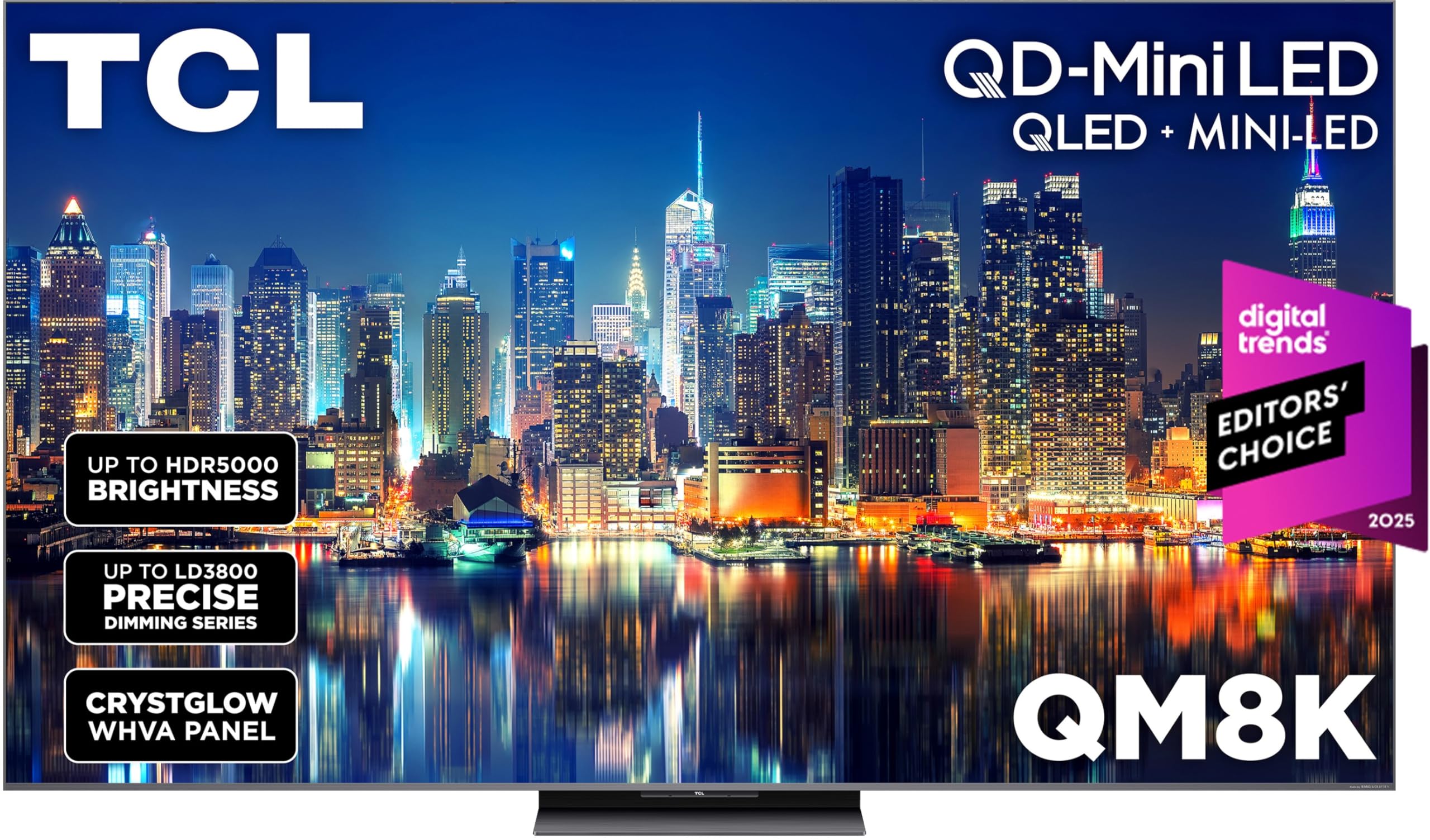
The TCL QM8K is a powerhouse for bright room movie watching. Its QD-Mini LED panel, combined with the TCL Halo Control System, delivers extraordinary brightness—around 2,300 nits peak—and precise local dimming that keeps blooming to a minimum. The CrystGlow WHVA panel offers a wide viewing angle and an effective anti-reflective layer that maintains contrast even with direct overhead lights or windows in the field of view.
For movie lovers, the 144Hz native refresh rate ensures smooth motion handling of 24p content when set correctly, and the TV supports Dolby Vision IQ and HDR10+ Adaptive, automatically adjusting brightness and tone mapping based on room lighting. The Google TV interface is responsive and provides easy access to all major streaming apps. The audio, tuned by Bang & Olufsen, is better than most built-in systems, with clear dialogue and decent bass for a TV.
Some users report occasional sync issues with the Hulu app, but other streaming services perform well. The built-in sound lacks deep sub-bass, so a soundbar is recommended for action movies. The backlit remote is a nice touch. Overall, the QM8K offers a premium movie experience at a mid-range price, particularly for living rooms where controlling ambient light isn’t an option.
Why it’s great
- Very high peak brightness for HDR in bright rooms
- Excellent anti-reflective and wide-angle panel
- Dolby Vision IQ and HDR10+ Adaptive support
- Bang & Olufsen audio is clear and punchy
Good to know
- Hulu app reported sync issues by some users
- Built-in bass is limited; add a soundbar for best audio
- Minor blooming in extreme contrast scenes
7. Samsung QN90D (QN75QN90D)

The Samsung QN90D is a Mini-LED TV that excels at both picture and sound quality. The Neo Quantum HDR+ delivers sensational contrast and brightness, with peak highlights reaching around 1,800 nits. The Quantum Matrix with Mini LEDs provides precise local dimming that keeps blacks deep and blooming low. The Real Depth Enhancer Pro analyzes each frame and adjusts the contrast of the focal point, creating a more three-dimensional image that’s especially noticeable in movie scenes with layered foreground and background elements.
Where the QN90D truly stands out is its audio. Object Tracking Sound+ uses built-in speakers that move sound across the screen to match the action, creating a 3D audio effect that rivals some soundbars. Combined with Dolby Atmos support, the soundstage is wide and immersive. The Motion Xcelerator 144Hz ensures smooth motion without blur in fast-paced films. Tizen OS provides easy access to streaming apps, though it requires a Samsung account for initial setup.
AI upscaling of older 4:3 content can introduce artifacts, and the glossy screen reflects more light than the spec sheet suggests. Some users note that the power cable placement interferes with VESA mounting. The television is heavy at around 75 pounds. Still, for a room where you want both great picture and great built-in sound without an external audio system, the QN90D is a top choice.
Why it’s great
- Object Tracking Sound+ creates immersive 3D audio
- High brightness with excellent Mini-LED contrast
- Real Depth Enhancer Pro for more dimensional image
- Dolby Atmos support with wide soundstage
Good to know
- AI upscaling can show artifacts in 4:3 content
- Glossy screen reflects more light than ideal
- Power cable placement can interfere with mounting
8. TCL QM8L (75QM8L)
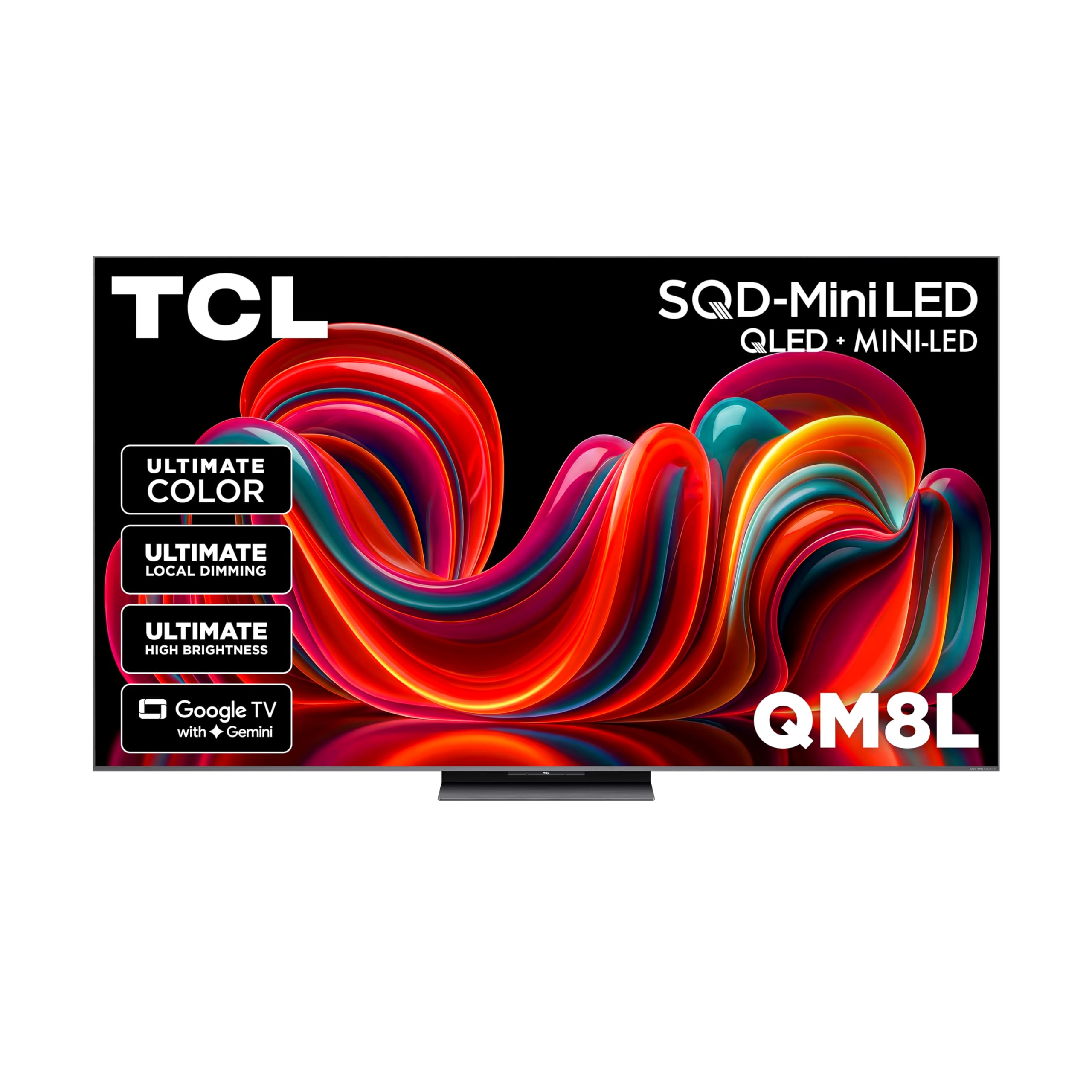
The TCL QM8L is an absolute beast of brightness, peaking at an eye-watering 6,000 nits. This makes it the ideal choice for a very bright living room, or for HDR movies that demand extreme highlights—think the sun in Melancholia or the fires in Mad Max: Fury Road. The SQD-Mini LED panel is paired with TCL’s Halo Control System and Ultra Color Filter, which uses much finer nanoparticles than typical filters for more precise color accuracy.
With over 4,000 local dimming zones, blooming is virtually nonexistent despite the extreme brightness. The WHVA 2.0 Ultra Panel provides excellent off-axis viewing angles, so movie night works for the whole couch rather than just the center seat. The TV is powered by Google Gemini Interactive AI, which provides personalized content recommendations. Audio is handled by Bang & Olufsen, with a punchy built-in sound system that can fill a large room.
The TV’s massive brightness means it can be fatiguing to watch in a completely dark room—you’ll want to adjust the backlight down. Some users report needing to calibrate colors and brightness out of the box to get the most natural movie picture. The backlit remote feels premium. Overall, the QM8L is the ultimate choice for those who need killer brightness and can’t control ambient light in their space.
Why it’s great
- Extreme 6,000-nit peak brightness for HDR
- 4,000+ local dimming zones for minimal blooming
- WHVA 2.0 panel for wide viewing angles
- Bang & Olufsen audio is powerful and clear
Good to know
- Can be too bright for dark rooms without adjustment
- Needs calibration out of the box for accurate picture
- Some minor OS glitches reported
9. Panasonic Z8 (77Z8BAP)
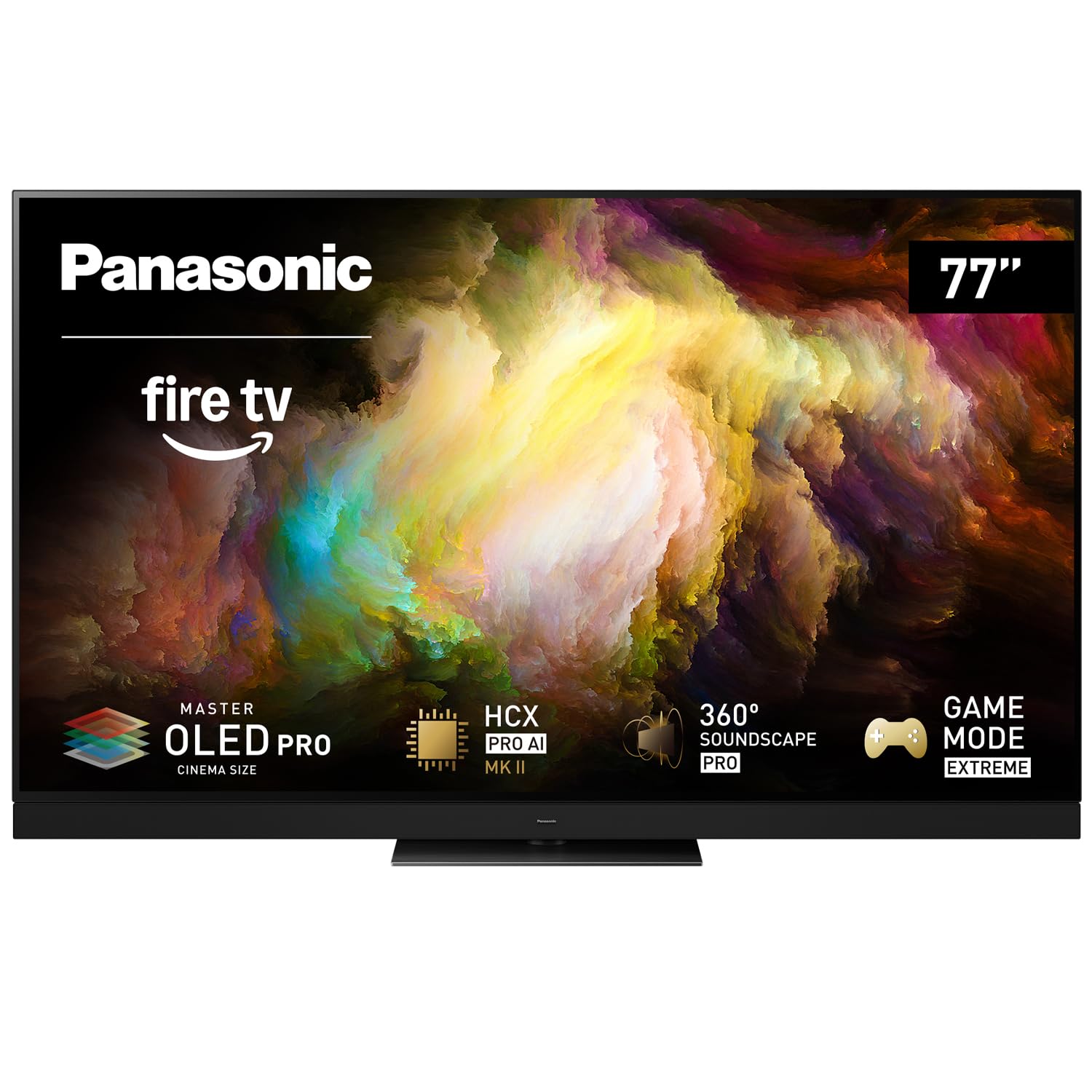
The Panasonic Z8 offers a unique value proposition: a premium OLED that supports every major HDR format, including Dolby Vision, HDR10+, and HLG, all with intelligent sensing that adjusts the picture based on ambient light. The Master OLED PRO panel with micro-lens-array technology delivers enhanced brightness compared to previous Panasonic OLEDs, making it suitable for rooms with some daylight. The HCX Pro AI Processor MKII provides excellent image processing and upscaling.
The 360 Soundscape Pro audio system, tuned by Technics, uses front-array, upward, and side-firing speakers to create a wide, immersive soundstage with Dolby Atmos support. For a built-in system, it’s one of the best available, rivaling entry-level soundbars. The TV handles motion beautifully with a 144Hz refresh rate, and supports VRR, AMD FreeSync Premium, and NVIDIA G-SYNC for gamers.
Panasonic has been absent from the U.S. market for a while, so the Fire TV built-in interface might be less familiar to some users. The TV is heavy (about 100 pounds) and requires help for mounting. Some reviewers note that the included media app has format limitations. The OLED panel is not as bright as Samsung’s QD-OLED or the best Mini-LEDs, so it’s best in a controlled light room. Overall, the Z8 is an excellent choice for globetrotting movie collectors who want full HDR coverage.
Why it’s great
- Supports all major HDR formats with ambient light sensing
- 360 Soundscape Pro audio is best-in-class for built-in
- HCX Pro AI Processor provides excellent image processing
- 144Hz and VRR support for smooth motion
Good to know
- Not as bright as QD-OLED or top Mini-LEDs
- Very heavy at ~100 lbs; needs help for installation
- Fire TV interface may not suit all users
10. Roku Pro Series (75-Inch)
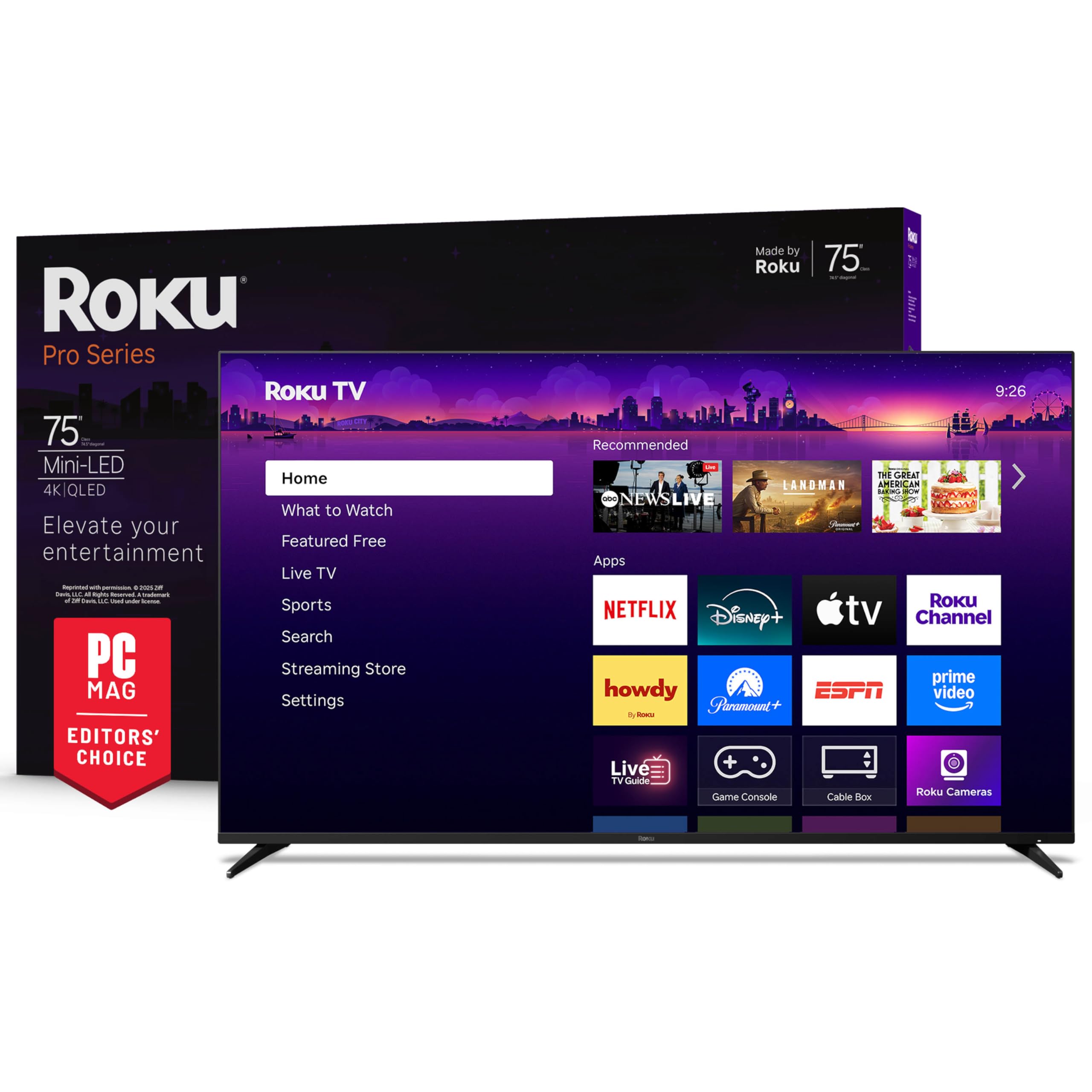
Roku’s Pro Series TV is designed for people who value simplicity and a rock-solid smart platform. The Mini-LED QLED panel delivers vibrant colors and deep blacks, with good contrast and brightness that handles most living room lighting conditions. Dolby Vision IQ adjusts the picture based on ambient light, preserving shadow detail in bright rooms. The Roku Smart Picture Max uses AI to clean up incoming TV signals and automatically refine color and sharpness for each scene.
The 120Hz refresh rate ensures smooth motion for fast-paced movies and sports, and the automatic game mode with FreeSync Premium Pro is a bonus. The custom mount lets you sit the TV flush against the wall, and tool-less stands offer two height adjustments. The backlit voice remote is rechargeable and has a remote finder button—a genuinely useful feature. The Roku interface is the gold standard for ease of use, with no ad clutter compared to other smart platforms.
Roku Soundstage Audio provides room-filling sound with side-firing speakers and Dolby Atmos support, though it still can’t match a dedicated soundbar for deep bass. The TV lacks some advanced features like full-array local dimming (it uses edge-lit Mini-LED), so blooming is more noticeable in dark scenes than on higher-end rivals. This is an excellent choice for families or anyone who wants a great picture with a simple, fast interface.
Why it’s great
- Best-in-class user interface (Roku) is intuitive and fast
- Rechargeable backlit remote with finder button
- Good picture quality with Dolby Vision IQ
- Tool-less stands and flush wall mount option
Good to know
- Edge-lit Mini-LED shows more blooming than full-array
- Built-in sound lacks deep bass; soundbar recommended
- Lacks advanced gaming features beyond 120Hz
11. Hisense U7 (75U7SG)
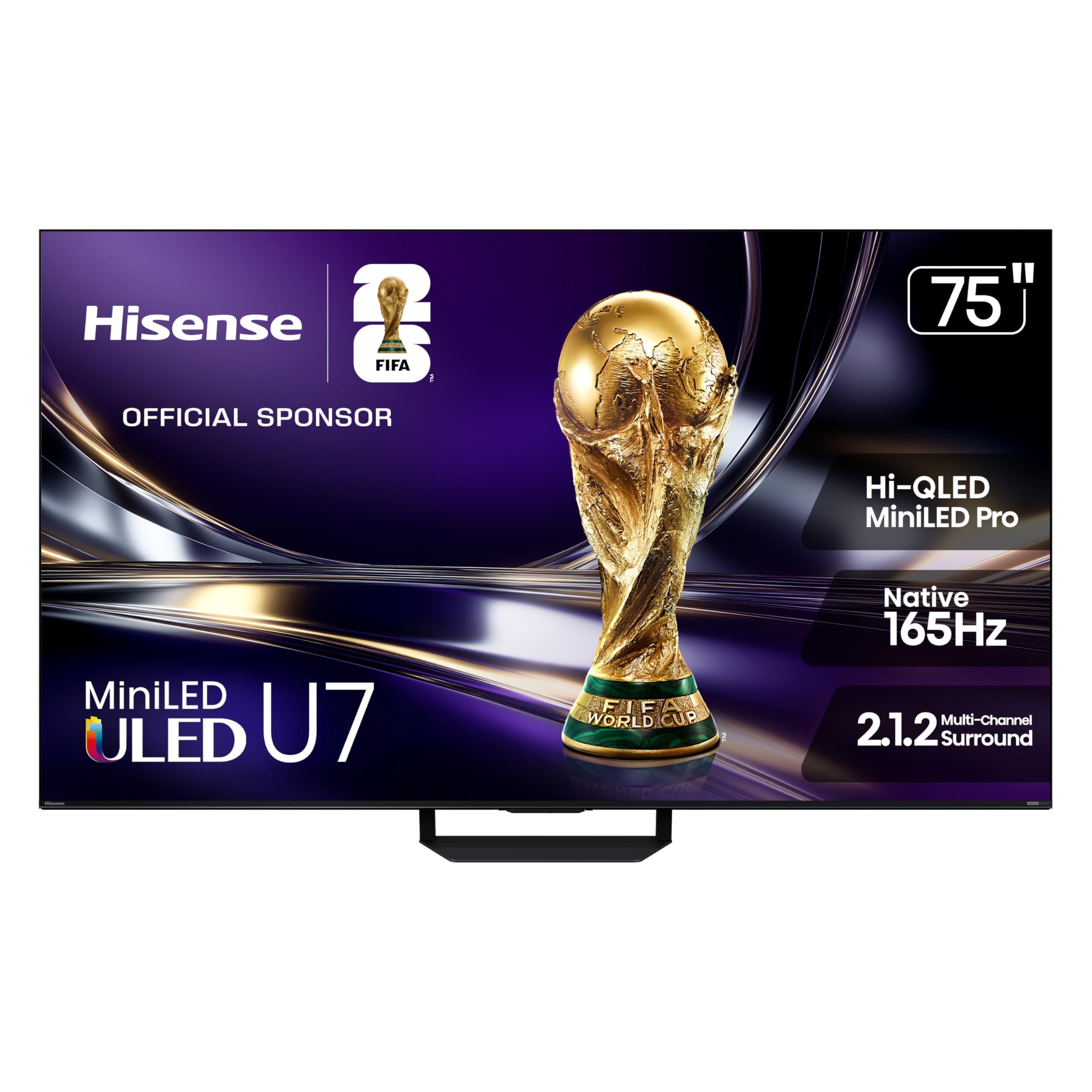
The Hisense U7 is a Mini-LED TV that punches well above its price point. With up to 3,000 local dimming zones and 3,000 nits peak brightness, it offers a contrast ratio and HDR impact that rivals TVs costing significantly more. The Hi-QLED MiniLED Pro panel delivers exceptional color accuracy and intensity, validated by Pantone. The anti-reflective layer does a great job reducing glare, making it an excellent choice for bright rooms.
A standout feature for movie lovers is the support for both Dolby Vision IQ and HDR10+ Adaptive, which automatically adjust the picture based on ambient lighting. The native 165Hz refresh rate provides incredibly smooth motion handling for action films and sports. The Google TV interface is intuitive and offers access to all major streaming apps. The built-in 2.1.2-channel audio system is decent, though you’ll want a soundbar for a truly immersive experience.
Some users find the Google TV interface can feel laggy at times, and the remote is basic. The U7 lacks a few premium features like a premium remote or a flush wall-mount design. The brightness can be overwhelming in a completely dark room, requiring manual adjustment. Overall, the Hisense U7 is a budget-friendly giant that delivers a truly cinematic experience for the price.
Why it’s great
- 3,000 nits brightness and 3,000 dimming zones
- Supports Dolby Vision IQ and HDR10+ Adaptive
- Native 165Hz for ultra-smooth motion
- Excellent anti-glare for bright room viewing
Good to know
- Google TV interface can feel laggy at times
- Remote is basic and lacks backlighting
- Very bright for dark rooms; may need adjustment
12. Amazon Ember QLED (75-Inch)
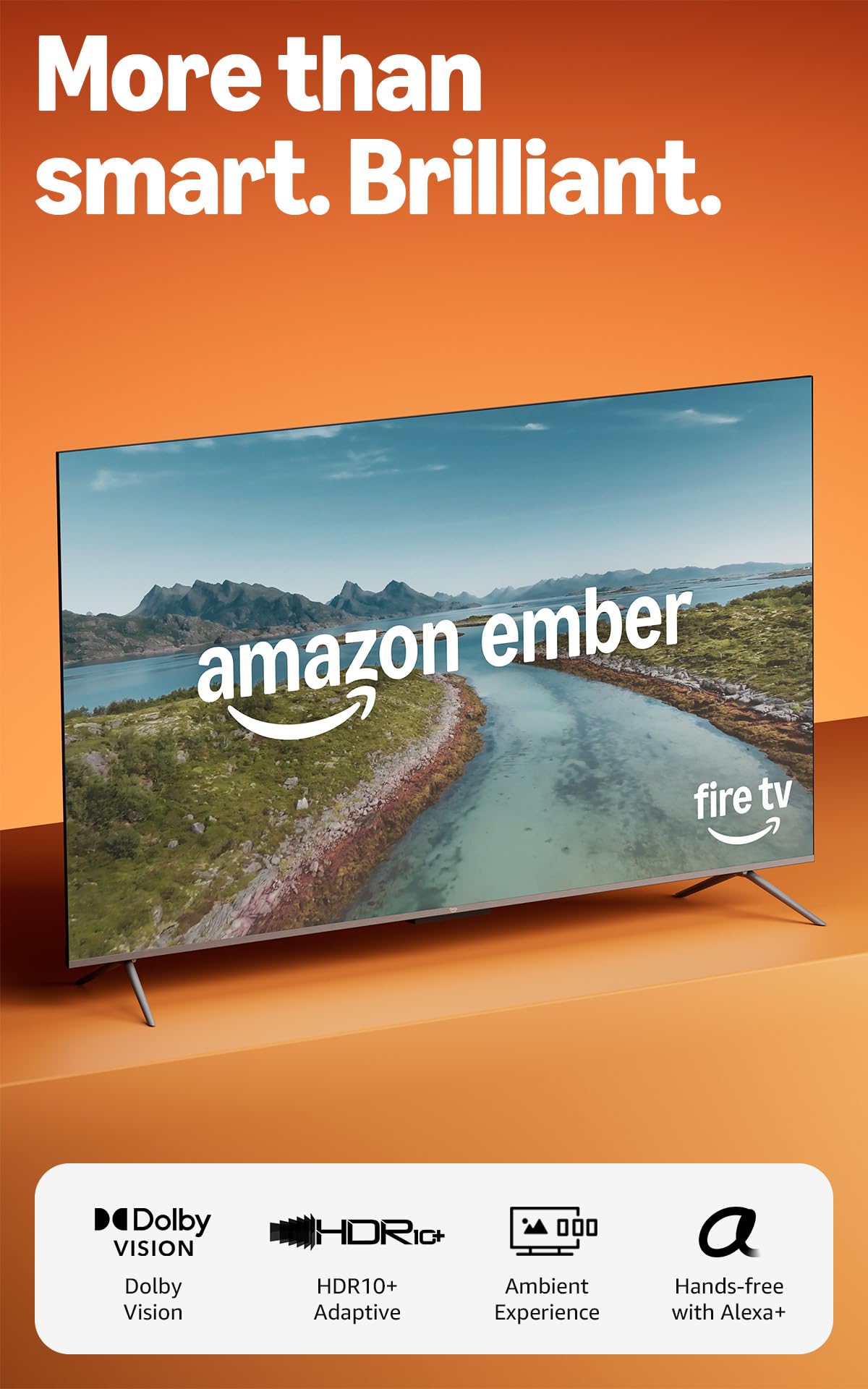
The Amazon Ember 75-inch QLED is the entry-level choice in this roundup, but it still offers a solid movie-watching experience. The 4K QLED display delivers vibrant colors and good contrast for the price, with support for Dolby Vision and HDR10+ Adaptive. Full-array local dimming helps keep blacks deeper than budget VA panels, though blooming is present in high-contrast scenes. The quad-core processor and Wi-Fi 6 ensure responsive streaming.
The Fire TV platform is deeply integrated, with hands-free Alexa that can find shows, manage smart home devices, and even display artwork when the screen is off thanks to Omnisense technology. The TV has four HDMI inputs for connecting external devices. The built-in Dolby Audio provides decent sound for casual viewing. For basic movie watching in a moderately lit room, the Ember QLED delivers a watchable image without breaking the bank.
The biggest drawbacks are the Fire TV interface, which some users find laggy and cluttered with ads, and quality control issues—some users report buggy software or a short usable lifespan. The built-in audio lacks bass and clarity, so a soundbar is highly recommended. The television is a good starting point for a large screen but doesn’t offer the picture quality or reliability of higher-end models. For a secondary room or a budget-first purchase, it works.
Why it’s great
- Affordable entry into 75-inch 4K QLED
- Deep Fire TV/Alexa integration for smart home users
- Dolby Vision and HDR10+ Adaptive support
- Wi-Fi 6 for faster streaming connectivity
Good to know
- Fire TV interface can be slow and ad-heavy
- Quality control and reliability are inconsistent
- Built-in audio is weak; soundbar is necessary
13. Amazon Ember Mini-LED (75-Inch)
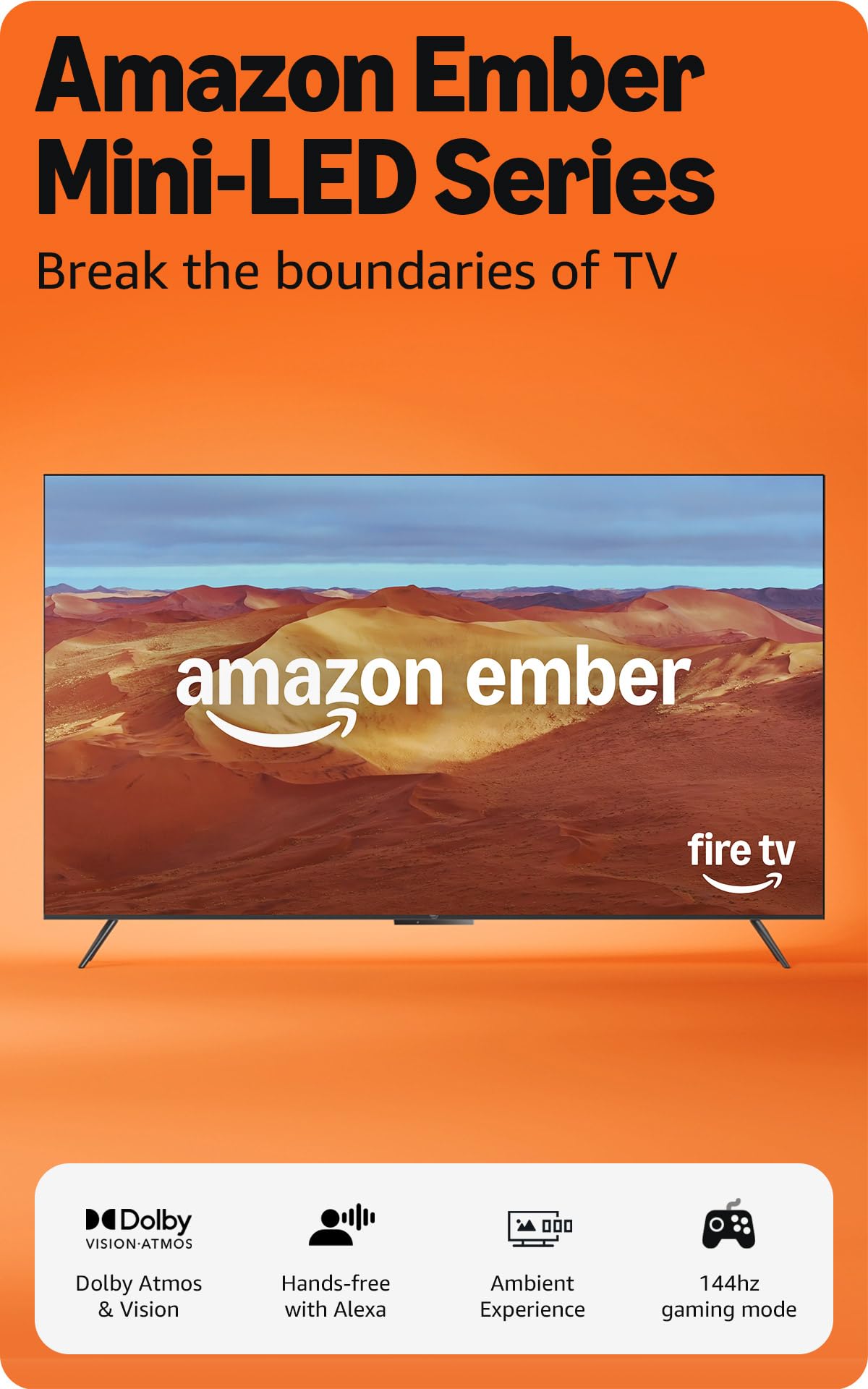
The Amazon Ember Mini-LED takes the QLED foundation and adds Mini-LED backlighting with 512 local dimming zones, significantly improving contrast and reducing blooming compared to the standard QLED model. It reaches up to 1,400 nits peak brightness, making HDR movies look much more impactful. The panel is a 4K QLED Mini-LED with Dolby Vision IQ and HDR10+ Adaptive, and the Fire TV Intelligent Picture processor fine-tunes the scene based on room lighting.
This model is also Amazon’s best TV for gaming, with a 144Hz refresh rate and AMD FreeSync Premium Pro certification, which is a bonus for movie fans with the occasional gaming session. The built-in 2.1 Dolby Atmos audio delivers clear dialogue and decent bass, better than most budget TVs. The Omnisense technology wakes the screen when you enter the room, making it feel like a premium smart display.
Software issues are the main complaint—some users report menu lag after updates and occasional random reboots. The Fire TV interface is ad-heavy, and some find it intrusive. For the price, the contrast and brightness are very good, but reliability concerns should not be ignored. This is a strong value pick if you want Mini-LED contrast without paying premium prices, provided you’re comfortable with the smart platform.
Why it’s great
- 512-zone Mini-LED for good contrast at this price
- 1,400-nit peak brightness for solid HDR impact
- 144Hz with FreeSync Premium Pro for smooth gaming
- Dolby Vision IQ and HDR10+ Adaptive support
Good to know
- Software updates can cause lag and stability issues
- Fire TV interface is cluttered with ads
- Random reboots reported by some users
FAQ
Why is a native 120Hz panel important for watching movies on a 75-inch TV?
Is OLED or Mini-LED better for watching movies in a living room with windows?
How many local dimming zones do I need for a good movie experience?
What is the difference between Dolby Vision and HDR10+ for movie watching?
Will a 75-inch TV fit in my room for a proper movie viewing distance?
Final Thoughts: The Verdict
For most users, the 75 inch tv for movies winner is the LG G5 because it delivers the perfect blacks of OLED with high enough brightness to handle mixed room lighting, along with Dolby Vision and Filmmaker Mode for accurate cinematic reproduction. If you want the ultimate color volume and are building a dark room theater, grab the Sony A95L. And for a bright living room where you can’t control the light, nothing beats the extreme brightness of the TCL QM8L.