
Our readers keep the lights on and the weekend projects moving. As an Amazon Associate, I earn from qualifying purchases.
Finding a telescope that delivers crisp lunar craters and bright planetary detail without draining your wallet can feel impossible. Many entry-level scopes are little more than plastic toys, but a handful of serious 80mm and 90mm refractors prove that you can actually see Saturn’s rings and Jupiter’s moons for less than you’d think. The key is knowing which specs matter and which accessories are worth having.
I’m Rikta — the co-founder and writer behind FitlyFast. I’ve spent weeks analyzing optical coatings, aperture sizes, tripod stability, and customer feedback across seven of the most popular entry-level refractors to separate the true keepers from the disposable novelties.
Whether you are buying for a curious child or starting your own stargazing journey, this guide cuts through the marketing hype to deliver clear, actionable advice on the best cheap telescope options available right now.
How To Choose The Best Cheap Telescope
When you are shopping on a tighter budget, every dollar needs to earn its place. Instead of chasing the highest magnification figure on the box, focus on optical quality, mount stability, and the accessories that actually get you using the scope under real night skies.
Aperture Is Everything
The aperture — the diameter of the main lens — determines how much light your telescope collects. More light means you can see fainter objects and more detail on planets and the Moon. For an entry-level refractor, 80mm is the minimum threshold for satisfying views, while 90mm offers noticeably brighter images without a huge jump in price or portability.
Coatings Make the Image
Fully multi-coated optics apply anti-reflective layers to every air-to-glass surface. This reduces light loss, improves contrast, and cuts down on internal glare. A scope with fully coated glass will always outperform an uncoated model of the same aperture — even under suburban skies with light pollution.
Mount Stability Over Flashy Features
A shaky tripod turns even the best optics into a frustrating experience. Look for stainless steel legs and a solid altazimuth mount with slow-motion controls. Aluminum alloy tripods are lighter and cheaper, but steel provides the rigidity needed for high-magnification views without vibrations every time you touch the focus knob.
Quick Comparison
On smaller screens, swipe sideways to see the full table.
| Model | Category | Best For | Key Spec | Amazon |
|---|---|---|---|---|
| Celestron StarSense Explorer LT 80AZ | App-Enabled | Tech-assisted beginners | 80mm aperture, 400mm focal length, StarSense app | Amazon |
| MEEZAA 90mm | 90mm Refractor | Bright, high-contrast views | 90mm aperture, 800mm focal length, fully coated | Amazon |
| Dianfan 90mm (Purple) | 90mm Refractor | Colorful starter with bag | 90mm aperture, 800mm focal length, stainless tripod | Amazon |
| YENGUAN 90mm | 90mm Refractor | Lunar and planetary detail | 90mm aperture, 800mm focal length, multi-layer optics | Amazon |
| SOLOMARK 80mm | 80mm Refractor | Terrestrial and lunar combo | 80mm aperture, 900mm focal length, full-size tripod | Amazon |
| Dianfan 80mm (Purple) | 80mm Refractor | Creative kids and families | 80mm aperture, 500mm focal length, includes backpack | Amazon |
| Hawkko 80mm | 80mm Refractor | Ultra-portable backyard use | 80mm aperture, 500mm focal length, lightweight tripod | Amazon |
In‑Depth Reviews
1. Celestron StarSense Explorer LT 80AZ

This 80mm refractor with a 400mm focal length is a standout because it solves the hardest problem for beginners: actually finding objects in the night sky. The patented StarSense Explorer app uses sky recognition technology to analyze star patterns overhead and generate an on-screen bullseye guide. You dock your smartphone, follow the arrows, and when the bullseye turns green, the target is in your eyepiece. No reading star charts or guessing coordinates.
The included 25mm and 10mm eyepieces plus a 2x Barlow lens provide versatile magnification. The manual altazimuth mount includes a sliding rod for altitude slow motion adjustment, making it smoother for tracking planets as they drift across the field of view. The fully coated glass optics deliver sharp, high-contrast views of the Moon’s craters, Jupiter’s cloud bands and moons, and Saturn’s rings — which is impressive given the relatively short tube.
Assembly is straightforward, and the pre-assembled mount and tripod mean you can be observing within minutes. The StarPointer red dot finderscope complements the app, though some users report occasional issues with the finder’s alignment out of the box — Celestron’s US-based support team handles replacements quickly. For anyone who wants a guided, tech-friendly introduction to astronomy without a steep learning curve, this is the most rewarding pick in this price tier.
Why it’s great
- StarSense phone-dock enables app-guided object location — incredibly beginner-friendly
- Sharp fully coated glass optics produce clean planetary and lunar views
- Lightweight and quick to assemble, ideal for travel and spontaneous sessions
Good to know
- The red dot finder may arrive misaligned — check and adjust before first use
- Short 400mm focal length limits high-magnification deep-sky potential
2. MEEZAA 90mm Aperture 800mm Refractor

The MEEZAA 90mm refractor is the strongest pure performer in the list if you prioritize light gathering and image brightness. The 90mm aperture paired with an 800mm focal length (f/8.88) provides excellent contrast and minimal chromatic aberration for a scope at this level. Fully multi-coated optics across all glass surfaces ensure high transmission, so you see fainter deep-sky objects like the Orion Nebula or Andromeda Galaxy with far more detail than an 80mm can deliver.
The included 25mm and 10mm eyepieces plus a 3x Barlow lens give you magnification options ranging from 32x to 240x. The stainless steel tripod — adjustable from 28 to 46 inches — offers significantly better rigidity than aluminum alloy alternatives, which reduces vibration when focusing. The accessory tray adds further stability by bracing the legs. The phone adapter is simple to attach, and the whole kit fits into a padded carry bag for safe transport.
Setup takes around 10 minutes for most users, and the included paper manual is clear enough for a complete beginner. The altazimuth mount lacks slow-motion controls, so tracking fast-moving objects at high magnification requires gentle nudging, which is typical for this price bracket. If you are willing to accept that small friction, this scope delivers views that rival units costing considerably more.
Why it’s great
- 90mm fully multi-coated aperture provides noticeably brighter, sharper images than 80mm alternatives
- Stainless steel tripod eliminates wobble and provides a stable platform for high-mag viewing
- Generous accessory kit with bag, Barlow lens, and phone adapter ready to go out of the box
Good to know
- Mount lacks slow-motion controls, so tracking at 240x requires careful manual nudging
- Optical tube and tripod together weigh enough that you will want the bag for carrying
3. Dianfan 90mm Aperture 800mm Refractor (Purple)

The Dianfan 90mm telescope matches the MEEZAA’s core optical specs — same 90mm aperture, same 800mm focal length, and the same fully multi-coated objective lens — but stands apart with a vibrant purple finish and a slightly different accessory set. It includes a 45-degree erect image diagonal, which makes this scope capable for daytime terrestrial viewing too, keeping images correctly oriented for spotting wildlife or distant landscapes.
Magnification ranges from 32x to 240x using the 25mm and 10mm eyepieces plus the 3x Barlow lens. The stainless steel tripod is identical in build quality to the MEEZAA’s — stable, adjustable, and robust enough to resist wind vibration. The included phone adapter works for casual snapshot astrophotography, and the custom-fit carry bag is water-resistant, protecting the tube during outdoor trips.
Assembly is rated at about 15 minutes for first-timers. The straight-through finderscope can be a challenge to align for absolute beginners, but once calibrated, it works reliably for coarse object location. The purple aesthetic and included astronomy-themed stickers make this a particularly appealing option if you are buying for a child or a teenager. The overall build feels durable, and the views of Jupiter’s moons and Saturn’s rings are genuinely impressive for the money.
Why it’s great
- 90mm fully coated objective delivers bright, clear planetary and lunar views
- 45-degree erect image diagonal enables comfortable daytime terrestrial viewing
- Water-resistant carry bag and colorful design appeal to younger stargazers
Good to know
- Straight-through finderscope requires careful alignment before first serious session
- Stickers are removable but may leave residue if repositioned frequently
4. YENGUAN 90mm Aperture 800mm Refractor
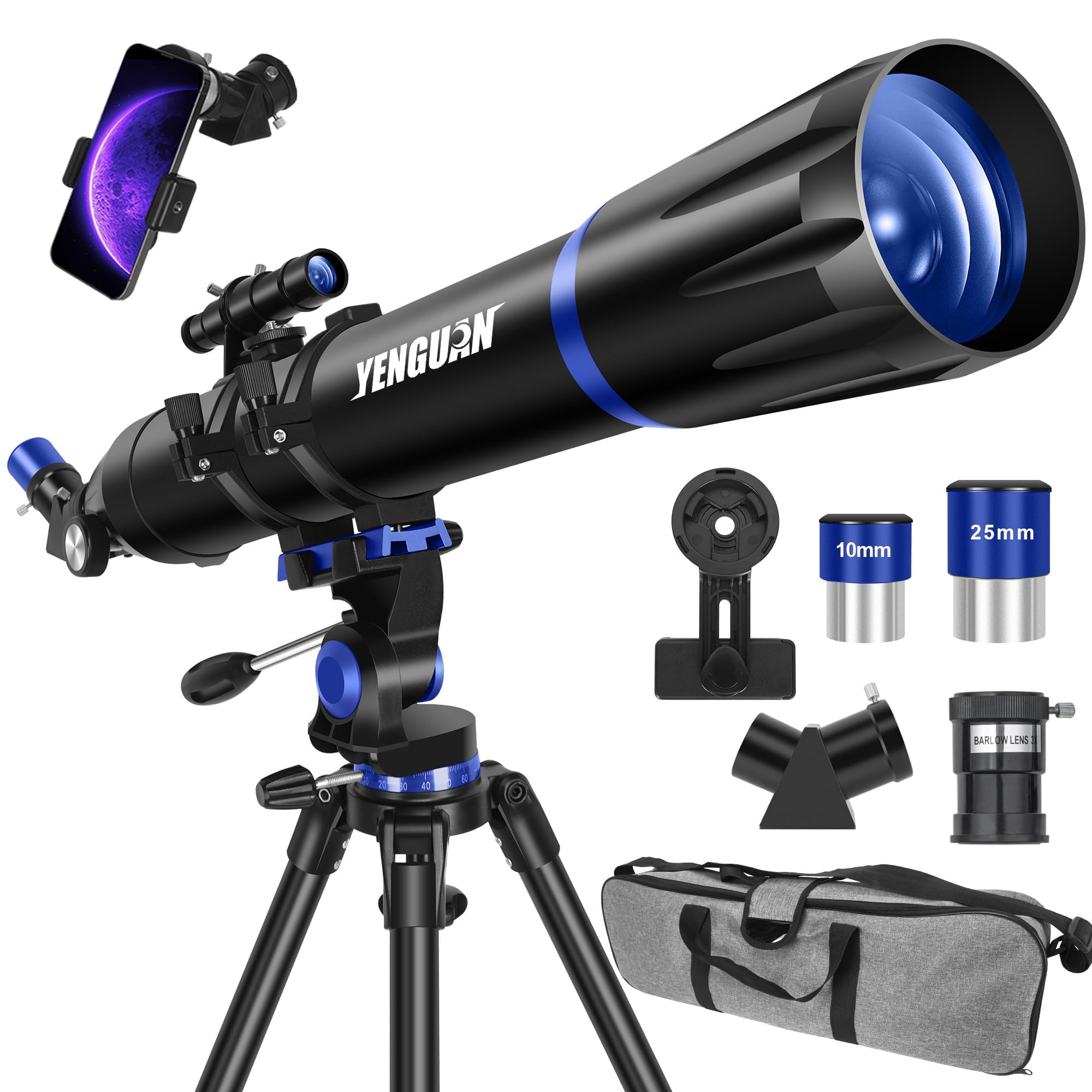
The 90mm aperture paired with 800mm focal length and fully multi-layer coated optics provides the same light-gathering advantage, revealing intricate lunar crater textures and distinct bands on Jupiter.
Included eyepieces are 25mm and 10mm, complemented by a Barlow lens for extended magnification range. The finderscope is a straight-through type, and the phone adapter is functional for basic astrophotography. The tripod is sturdy enough for steady viewing, and the entire kit packs into a carry bag for portability. Multiple customer reviews specifically highlight impressive views of Jupiter and three moons even with the 10mm eyepiece.
One recurring note from experienced users is to double-check that the objective lens cap is completely removed before searching for targets — a surprisingly easy mistake that can waste 20 minutes of frustration. The instruction manual is reasonably clear, but some beginners found the assembly sequence unintuitive. For the price, though, the optical quality-to-cost ratio is exceptional, and the 90mm aperture ensures you see more than you would with any 70mm or 80mm starter scope.
Why it’s great
- 90mm aperture with multi-layer coatings delivers premium light gathering at a budget-friendly price
- Sturdy tripod and carry bag make this suitable for backyard and park sessions
- Customers consistently report good planetary detail — Jupiter’s bands and moons are visible
Good to know
- Assembly instructions could be clearer for absolute first-time telescope users
- The lens cap is easy to forget on the objective, blocking all light — check before observing
5. SOLOMARK 80mm Aperture 900mm Refractor

Where most budget refractors use a 500mm or 800mm focal length, the SOLOMARK 80900 pushes to 900mm. This longer tube reduces chromatic aberration and increases the effective magnification of each eyepiece — the 10mm eyepiece gives 90x magnification, and the 20mm gives 45x. For terrestrial viewing over long distances (200m to 40 miles), multiple users report zero color fringing and crisp focus, which is unusual at this price level.
The 80mm fully coated green optics lens captures enough light for satisfying lunar and bright planetary views. The full-size aluminum alloy tripod includes an azimuth gimbal with clear scale markings, making it easier to return to specific celestial coordinates. The phone adapter is well-designed and easier to mount than many competing units, which is a common pain point for beginners trying to capture their first images.
The package includes a 5×24 finderscope, an erect image diagonal, and a carrying bag. One experienced reviewer noted that the included star pointer was awkward to use and swapped it for a red dot finder, but that is an optional upgrade rather than a deal-breaker. The scope is heavier than the 500mm models — about 10 pounds — but the sturdy tripod handles the weight well. If you want a scope that performs as well during the day as it does at night, this is the strongest hybrid option here.
Why it’s great
- 900mm focal length minimizes chromatic aberration and boosts native magnification per eyepiece
- Excellent terrestrial performance — clear, color-free images from 200 meters to 40 miles
- Azimuth gimbal with altitude-azimuth scales enables repeatable positioning
Good to know
- The star pointer finder is basic and some users replace it with a red dot alternative
- Heavier than typical 80mm entry-level scopes at around 10 pounds
6. Dianfan 80mm Aperture 500mm Refractor (Purple)
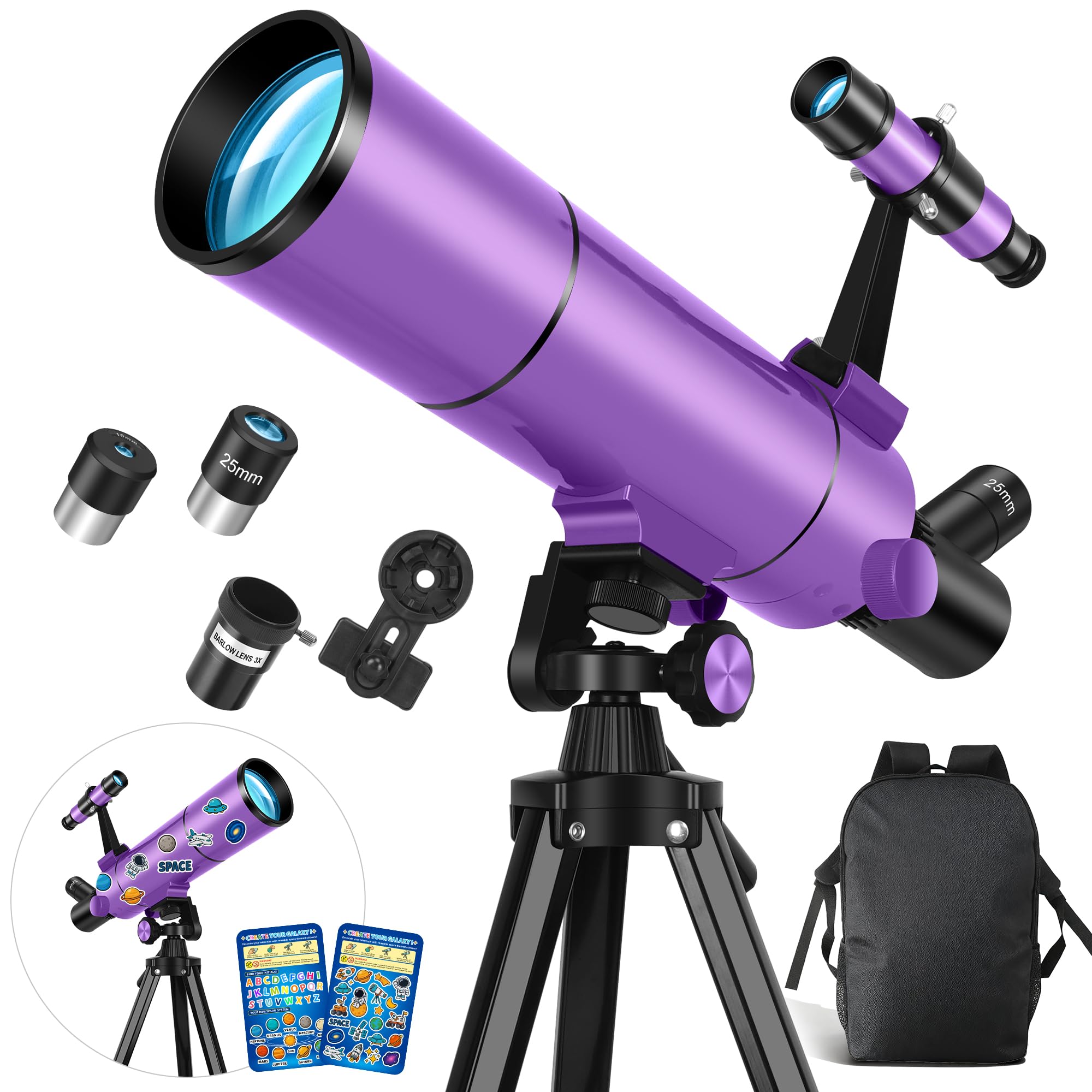
The Dianfan 80mm telescope is tailored specifically for families with young children. The purple finish and included reusable astronomy-themed stickers encourage kids to personalize their scope, making the discovery process feel more engaging. At 80mm aperture with a 500mm focal length, it provides 20x to 150x magnification — enough to reveal lunar craters, Jupiter’s moons, and the brighter deep-sky objects.
Fully multi-coated optics ensure decent light transmission for the price, and the included 25mm and 10mm Kellner eyepieces produce acceptable image quality. The 3x Barlow lens extends the magnification range, though image brightness falls off at the highest settings as expected with an 80mm objective. The backpack is a genuine plus — it holds the tube, tripod, and all accessories securely, making this an excellent grab-and-go option for camping trips.
Setup is rated at about 15 minutes, and the instruction manual is clear enough for a parent helping a child. The phone adapter works for sharing quick moon shots, though you will need a steady hand or a remote shutter for the best results. The altazimuth mount is simple to operate. The primary trade-off is the shorter focal length, which limits the maximum useful magnification compared to a 900mm scope, but for a young beginner, the portability and creative customization options outweigh that limitation.
Why it’s great
- Customizable purple finish with reusable stickers makes astronomy fun and personal for kids
- Included backpack makes this genuinely portable for family trips and outdoor excursions
- Fully coated 80mm optics deliver solid lunar and planetary views for the price
Good to know
- 500mm focal length limits high-magnification performance compared to longer-tube models
- The mount lacks slow-motion controls, so tracking at higher magnifications is challenging
7. Hawkko 80mm Aperture 500mm Refractor
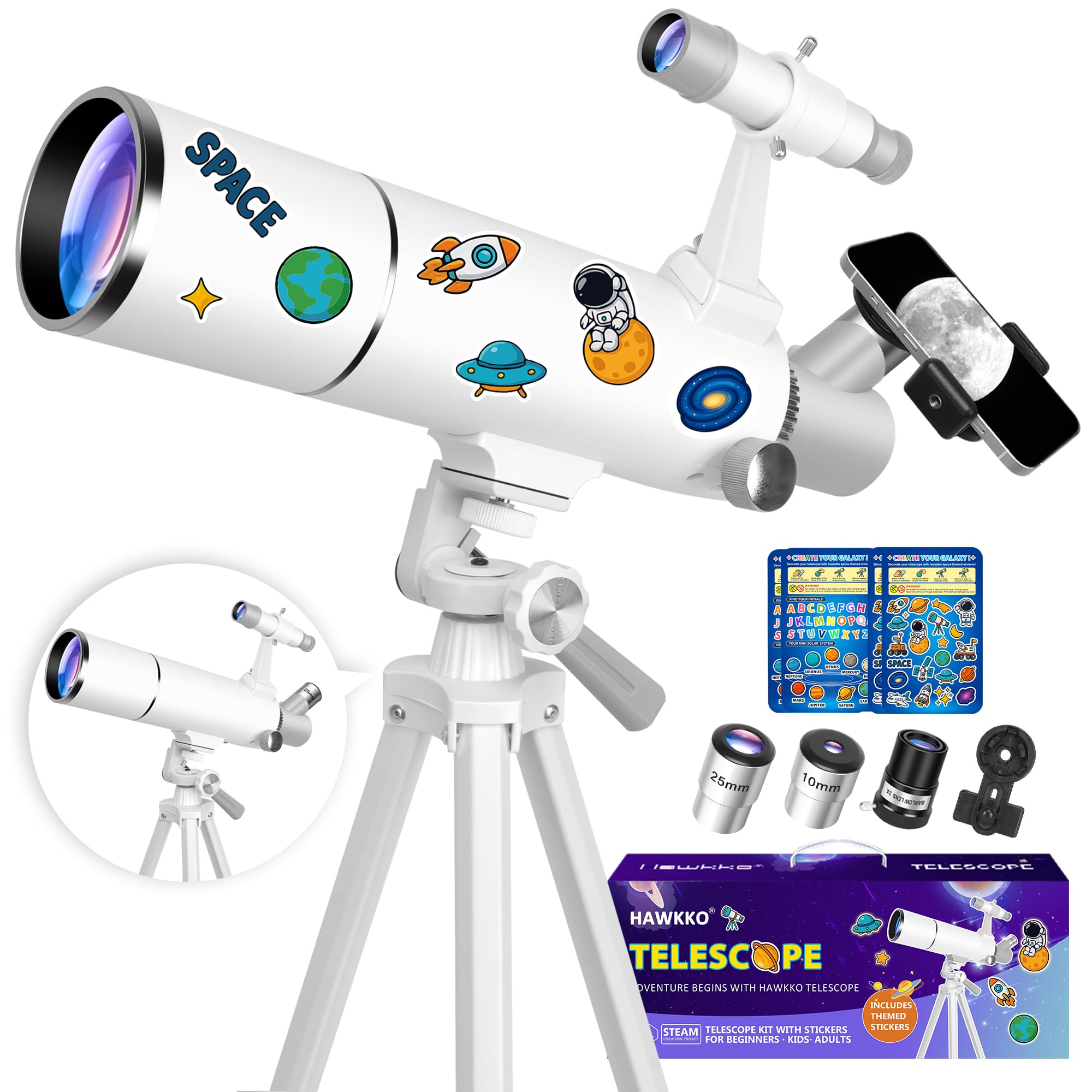
The Hawkko 80500 refractor is the lightest and most portable option in this selection, making it ideal for spontaneous backyard sessions or tossing into a car for a weekend camping trip. The 80mm aperture gathers 60 percent more light than 70mm models, and the fully multi-coated objective lens produces bright, crisp views of the Moon’s craters and Jupiter’s Galilean moons. The 500mm focal length keeps the overall tube length manageable.
Magnification ranges from 20x to 150x using the 25mm and 10mm eyepieces plus the 3x Barlow lens. The aluminum alloy tripod is lightweight but stable enough for low-to-medium power viewing. The kit includes a straight-through finderscope, a phone adapter for basic photography, and a set of space-themed stickers that kids enjoy applying. The setup is tool-free, and most users report being able to assemble it within minutes of opening the box.
Where the Hawkko economizes is in the tripod and mount — at higher magnifications, the lightweight construction transmits vibrations more readily than the stainless steel tripods on the 90mm models. The finderscope is functional but basic, and the overall build feels less substantial than the SOLOMARK or MEEZAA options. For a pure entry-level price, however, it delivers more light gathering than a 70mm scope and includes enough accessories to get a beginner started without frustration.
Why it’s great
- Tool-free assembly and ultra-lightweight design mean you can be observing in minutes
- 80mm fully multi-coated objective provides 60% more light than 70mm alternatives
- Space-themed stickers and smartphone adapter appeal to young beginners
Good to know
- Lightweight tripod transmits vibrations at higher magnifications — best kept below 100x
- Mount lacks fine adjustment controls, making precise tracking a manual effort
FAQ
Can I see Saturn’s rings with an 80mm telescope?
Is a longer focal length always better for a cheap telescope?
Why do my telescope images look blurry at high magnification?
Final Thoughts: The Verdict
For most users, the best cheap telescope winner is the Celestron StarSense Explorer LT 80AZ because the smartphone-dock guidance system completely eliminates the frustration of finding celestial objects, making every session productive. If you want the purest optical performance with a larger 90mm aperture, grab the MEEZAA 90mm for its bright, high-contrast views and sturdy stainless steel tripod. And for a creative family gift that encourages kids to engage with astronomy, nothing beats the portable, customizable Dianfan 80mm (Purple) with its backpack and stickers.