
Our readers keep the lights on and the weekend projects moving. As an Amazon Associate, I earn from qualifying purchases.
Cutting the cord on grid dependence means facing a real hardware challenge: powering a well pump, an electric dryer, or even a central AC unit demands a split-phase 240V output that most portable power stations simply don’t deliver. The 5000-watt solar generator category is the current battleground where raw inverter capacity meets scalable battery storage — it’s the minimum rated power that unlocks true whole-home potential without requiring a permanent installation crew.
I’m Rikta — the co-founder and writer behind FitlyFast. My deep market research involves analyzing hundreds of hours of real user benchmarks, cross-referencing inverter waveform data, MPPT controller specs, and LFP cycle-life ratings to separate marketing claims from practical daily performance.
Whether you are facing hurricane season, building an off-grid workshop, or preparing for a mobile life in an RV, this guide focused on the 5000 watt solar generator options available today cuts straight to the split-phase capability, recharging speed, and expandability that define a serious investment.
How To Choose The Best 5000 Watt Solar Generator
A 5000-watt tier generator isn’t a casual buy. You are selecting the electrical backbone for your home or off-grid setup. Focus on four pillars: split-phase 240V output, usable capacity in kilowatt-hours, solar recharge speed, and physical portability against expansion potential. Ignoring any one of these can turn a premium unit into a frustrating paperweight during an outage.
Split-Phase 240V — The Dealbreaker
A single 120V unit with 5000 watts can’t power a well pump, an electric oven, a central AC condenser, or a Level 1 EV charger. You need 240V split-phase output, usually via an L14-30R or NEMA 14-50R receptacle. If a station advertises 5000W but only provides 120V outlets, it is not a whole-home solution. Verify the spec sheet explicitly lists 120V/240V dual-voltage AC output.
Usable vs. Advertised Capacity
A 3600Wh station with a 3600W inverter will deplete faster than raw math suggests — high-drain appliances trigger BMS cutoff typically around 15–25% remaining charge. Look for a capacity buffer in the 4kWh to 5kWh range for real-world daily use. Expandable units that accept extra battery packs extend runtime without requiring a second inverter.
Solar Input — MPPT Voltage and Amperage
High solar input wattage on paper (2000W+, 4000W+) only matters if the MPPT voltage range matches your panel string. Many stations cap at 150V or 145V input, forcing you into series-parallel configurations that complicate portable setups. A wide MPPT range (12V–175V or higher) gives you more freedom to use common 200W or 400W panels without clipping your recharging speed.
Physical Form and Expansion Path
Units weighing 100–135 pounds need good wheels and a robust handle to be truly “portable” around the house or campsite. Some models use a rack-style battery module that slides into a separate expansion housing, while others stack on top. Confirm that expansion batteries communicate via the same CAN/RS485 bus so the system manages charge/discharge as a single bank.
Quick Comparison
On smaller screens, swipe sideways to see the full table.
| Model | Category | Best For | Key Spec | Amazon |
|---|---|---|---|---|
| Jackery 5000 Plus | Premium LFP | Whole-home backup with smart transfer switch | 7200W / 5040Wh, 4000W solar input | Amazon |
| Anker SOLIX F3800 | Mid-Range 120/240V | EV charging and RV direct plug-in | 6000W / 3840Wh, NEMA 14-50R | Amazon |
| OUPES Guardian 6000 | Mid-Range 120/240V | Cost-effective whole-house via transfer switch | 6000W / 4608Wh, 3600W solar in | Amazon |
| EcoFlow DELTA Pro 3 | Premium LFP | Silent whole-home with fast switchover | 4000W / 4096Wh, 10ms EPS | Amazon |
| GROWATT HELIOS 3600 | Mid-Range Split-Phase | Split-use: home + independent pack | 3600W / 7372Wh, dual-module | Amazon |
| ECO-WORTHY 10.2kWh System | Rack-Mount DIY | Fixed-site permanent backup | 5000W / 10240Wh, rack battery | Amazon |
| OSCAL PowerMax 6000 | Mid-Range with Panels | All-in-one kit with 3x400W panels | 6000W / 3600Wh, 1.44h AC charge | Amazon |
| EcoFlow DELTA Pro + 400W | Mid-Range with Panel | Portable backup with included solar | 3600W / 3600Wh, 15 outlet ports | Amazon |
| Jackery HomePower 3600 Plus | Lightweight LFP | Lightweight rolling backup | 3600W / 3584Wh, 2h hybrid charge | Amazon |
| Westinghouse WGen14500TFc | Tri-Fuel Engine | High-wattage fuel-based backup | 14500W running / 713cc V-Twin | Amazon |
| Honda EB5000 | Industrial Gas | Jobsite and contractor use | 5000W running / 439cc OHV | Amazon |
In‑Depth Reviews
1. Jackery Solar Generator 5000 Plus
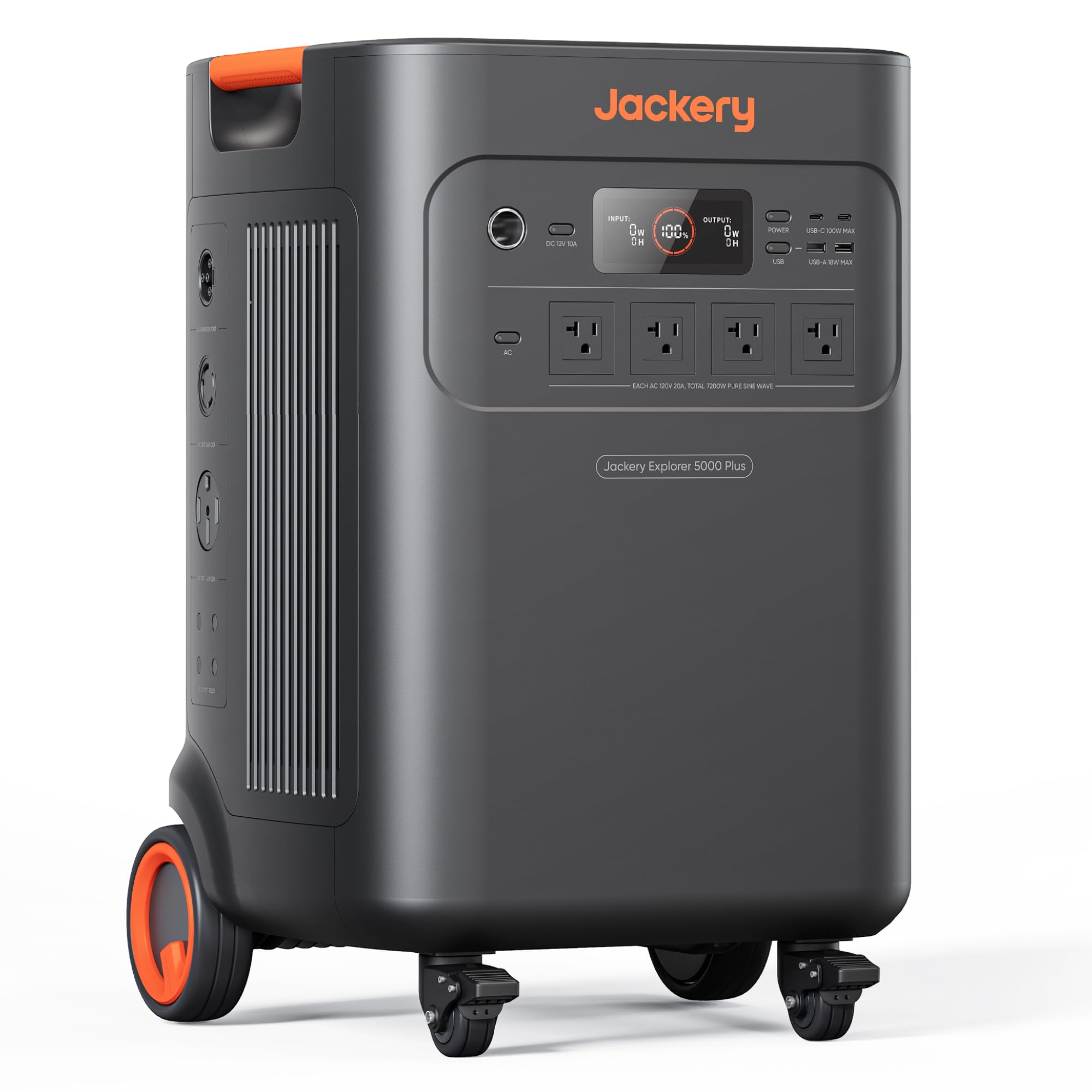
The Jackery 5000 Plus delivers a genuine 7200W continuous output on both 120V and 240V legs from a 5040Wh LFP pack, making it one of the few units that can handle a 5-ton AC startup surge without flinching. Its 4000W solar input capacity via high- and low-voltage panel compatibility means you can refill the entire battery in roughly two hours of direct sun, which is exceptional for this power class. The optional 60A Smart Transfer Switch integrates up to 12 circuits, turning the system into a seamless automatic home backup that doesn’t require manual cable swapping during an outage.
At 134.5 pounds, the unit is heavy, but it sits on a sturdy wheeled base with a telescopic handle that mimics professional luggage — moving it from the garage to the transfer switch panel is manageable for one person. Real users report that the Bluetooth and WiFi module draws standby power when left connected, so it is worth shutting those down if the station sits idle for extended periods. The ChargeShield 2.0 technology and 6000-cycle LFP cells give a projected 11-year daily-use lifespan.
Some early adopters encountered firmware bugs with UPS mode losing 30% charge per day and Code 6 overload errors under light loads, but support has been responsive with over-the-air updates. The app interface is still basic compared to EcoFlow’s offering, lacking granular per-outlet monitoring. Overall, the Jackery 5000 Plus is the most balanced high-capacity station for homeowners who want a single-box solution that genuinely replaces a gas generator for 90% of scenarios.
Why it’s great
- True 7200W split-phase output handles heavy loads like 5-ton AC and water heaters
- Expandable to 60kWh with extra battery packs for multi-day outages
- Smart Transfer Switch enables automatic whole-home backup without manual intervention
Good to know
- Heavy unit at 134.5 lbs; wheels are essential but well-designed
- Standby drain from WiFi/BT module can reduce idle battery life
- Requires firmware updates to resolve initial overload and scheduling quirks
2. Anker SOLIX F3800

The Anker SOLIX F3800 stands out for its direct NEMA 14-50R port that lets you plug an EV charging cable straight in without any grounding adapters or complicated bonding plugs — a feature few competitors offer at this price tier. Its 3840Wh base capacity can be scaled to 26.9kWh with up to six expansion batteries, and pairing two units pushes the system to 12,000W AC output for extreme loads. The 6000W continuous inverter runs everything from a 240V well pump to an RV’s full 50A electrical system without breaking a sweat.
Real-world testing reveals that the MPPT is optimized for Anker’s own solar panels, and the maximum solar input of 2400W is harder to achieve with third-party panels due to voltage matching constraints. The BMS limits charging current below 50°F (10°C), dropping from 1500W to about 710W DC, which is a significant winter limitation for off-grid users. Users praise the 5-year warranty and 10-year lifespan projection, backed by EV-class LFP cells and impact-resistant construction.
The companion app lacks a Time-of-Use scheduling feature and detailed voltage/current logging, which power users will miss. Some customers reported that firmware updates require stable WiFi and that AI customer service can be slow for hardware issues. Despite these quirks, the F3800 is the most straightforward path to Level 1 EV charging and 50A RV direct connection in a single portable station.
Why it’s great
- Direct NEMA 14-50R port for hassle-free EV charging up to 6000W
- Scalable from 3.84kWh to 26.9kWh with add-on battery packs
- Dual-unit pairing enables 12,000W output for extreme whole-home loads
Good to know
- Solar MPPT optimized for Anker panels; third-party panels may underperform
- Charging speed drops significantly below 50°F ambient temperature
- App lacks TOU scheduling and detailed power tracking for advanced users
3. OUPES Guardian 6000
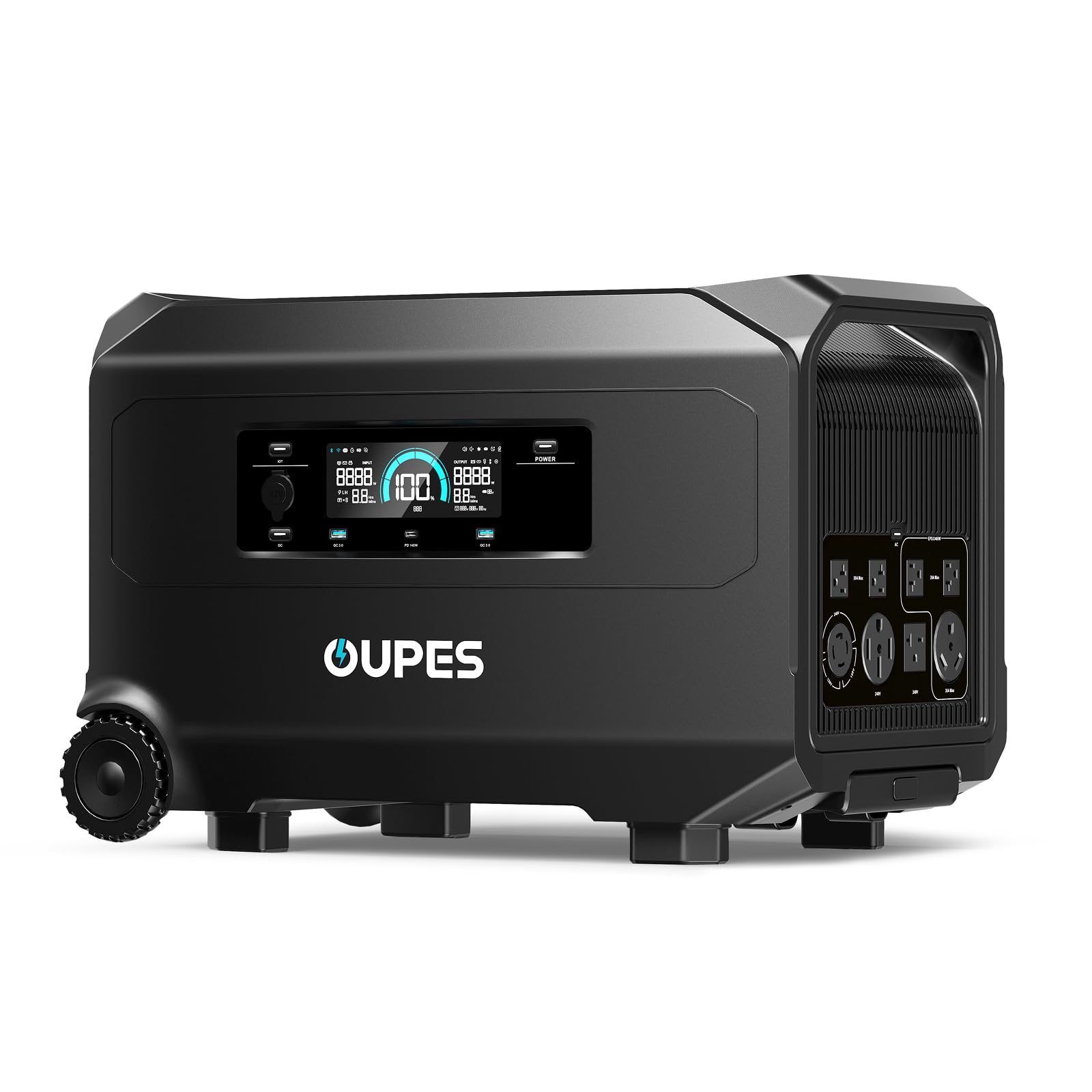
The OUPES Guardian 6000 delivers a compelling combination of 4608Wh capacity and 6000W split-phase output at a price point that undercuts most competitors with similar specs. It can be fully recharged from empty in 64 minutes when combining 240V AC and 3600W solar input, which is nearly five times faster than typical 1800W-limited stations. The 11 output ports include a NEMA 14-50R, TT-30R, L14-30R, and a 6-20R, giving it the most versatile outlet array in its class.
Early adopters report successful integration with manual transfer switches for whole-home backup, with one user running their entire 2000 sq ft house including a well pump during multiple New England outages. The expandable ecosystem scales to 41kWh with G5 Extra Battery packs, though those packs are not yet widely available at retail. The 111-pound unit has built-in wheels and a handle layout that balances well for rolling over grass and gravel.
The main drawbacks are Bluetooth-only display connectivity (no local LCD readout of detailed stats) and an MPPT solar spec that is technically difficult to hit with common panel configurations — you’d need around 24× 200W panels to approach the 3600W limit. Users also report the 50A RV plug sits at the bottom of the unit, making it incompatible with right-angle RV power cords without an adapter. Despite that, the Guardian 6000 offers the best raw power-per-dollar ratio for split-phase users.
Why it’s great
- Exceptional 64-minute full recharge via combined AC + solar input
- Wide outlet selection includes NEMA 14-50R, TT-30R, and L14-30R
- Lowest price point for true 240V split-phase output at this capacity
Good to know
- Solar input spec (3600W) requires impractical number of panels in real use
- Bluetooth-only display lacks local LCD readout of real-time power data
- 50A RV plug at bottom is incompatible with right-angle RV cords
4. EF ECOFLOW DELTA Pro 3
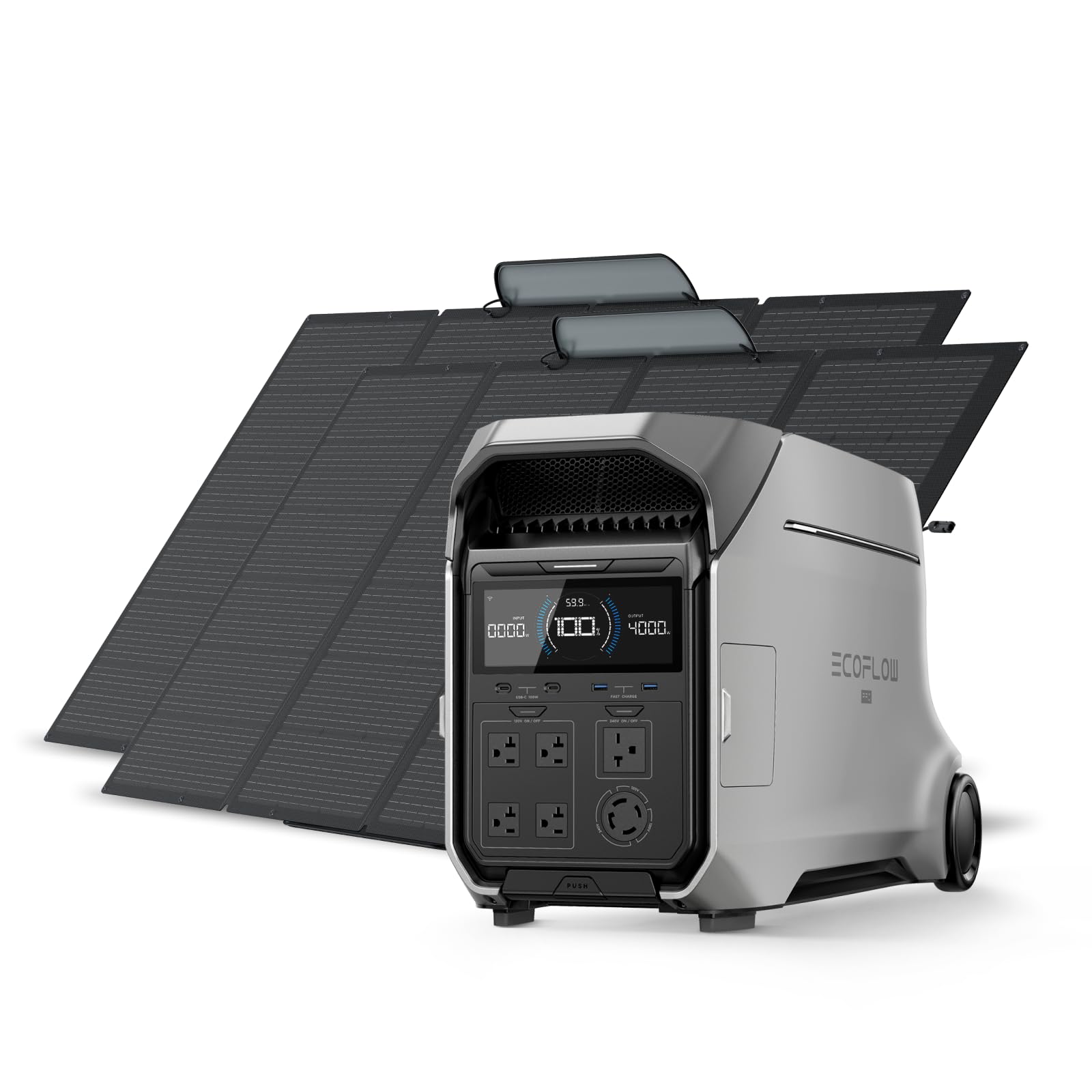
The EcoFlow DELTA Pro 3 raises the bar for operational silence — its X-Quiet technology drops the fan noise to just 30 dB, which is quieter than a library whisper and makes it viable for indoor use next to a bed or server rack. The 4096Wh base capacity uses IP65-rated CTC battery pack technology, meaning the cells are sealed against dust and water ingress, a significant durability upgrade for garages or basements. The 10ms EPS switchover is fast enough to keep sensitive electronics like NAS drives and network switches uninterrupted during a grid drop.
Despite its 4000W continuous output, the X-Boost function pushes this to 6000W for motor startup surges, enough for a 3-ton central AC or a 1 HP well pump. The unit can scale to 48kWh with extra batteries, and it supports 18 different charging methods including EV charging piles and the EcoFlow Smart Home Panel 2. The 115-pound body rolls on a wheel-and-handle system that feels more refined than most competitors, with metal-reinforced handle attachment points.
Some users have reported Error Code 135 issues after the return window, and customer service response times have been inconsistent for warranty claims. The 400W solar panels included in the bundle are heavy but foldable, though their kickstand design is flimsy in moderate wind. The app is the most feature-rich in the category, offering granular per-port control, scheduling, and energy history. For users who prioritize near-silent operation and fast transfer switching, the DELTA Pro 3 is the clear leader.
Why it’s great
- Near-silent 30 dB operation suitable for indoor and bedroom use
- 10ms EPS switchover protects sensitive electronics during grid outages
- IP65-rated battery cells resist dust and moisture for long-term reliability
Good to know
- Some units experience Error Code 135 failures after initial return window
- Included solar panels have poor kickstand stability in outdoor conditions
- Customer service response times vary for complex warranty issues
5. GROWATT HELIOS 3600
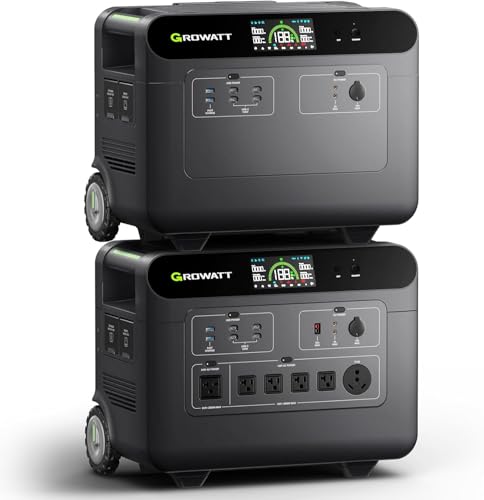
The Growatt HELIOS 3600 set takes a unique approach by bundling the main 3600W power station with a detachable 3600Wh expansion battery that can operate independently, giving you two separate power sources from one purchase. This split-use design means you can leave the main unit connected to your home transfer switch while taking the expansion pack to a campsite or workshop. Combined, the system delivers 7372Wh total capacity, and you can stack up to four expansion batteries for an 18kWh total, or run two units in parallel for 240V split-phase output.
The core station uses EV-grade LFP cells with a 4000-cycle lifespan and advanced BMS that includes cold start technology. Users report running an 8,000 BTU AC for about 5 hours on the combined pack, and recharging a PHEV from the main unit takes roughly 3.5 hours. The Anderson input and outlet are specifically designed for overlanding and RV setups, a niche that other brands often overlook.
Several customers noted Bluetooth and WiFi connectivity issues that made the app unusable out of the box, though Growatt’s US-based support has been responsive with replacement units when hardware defects arise. The 240V combiner cable disables EPS pass-through, so you lose the automatic backup switchover when running in split-phase mode. The manual also lacks detailed charging specifications, which can frustrate DIY users. For the price, you get a modular ecosystem with genuine split-use flexibility that no other station matches.
Why it’s great
- Detachable expansion battery operates as a standalone power source
- Anderson input/output ports cater to overlanding and RV applications
- 4000-cycle LFP cells with cold start tech for sub-freezing use
Good to know
- Bluetooth/WiFi connectivity can be unreliable, limiting app functionality
- 240V parallel operation disables EPS pass-through for automatic backup
- Manual lacks detailed charging specs and troubleshooting guidance
6. ECO-WORTHY 10.2kWh Home Power Station
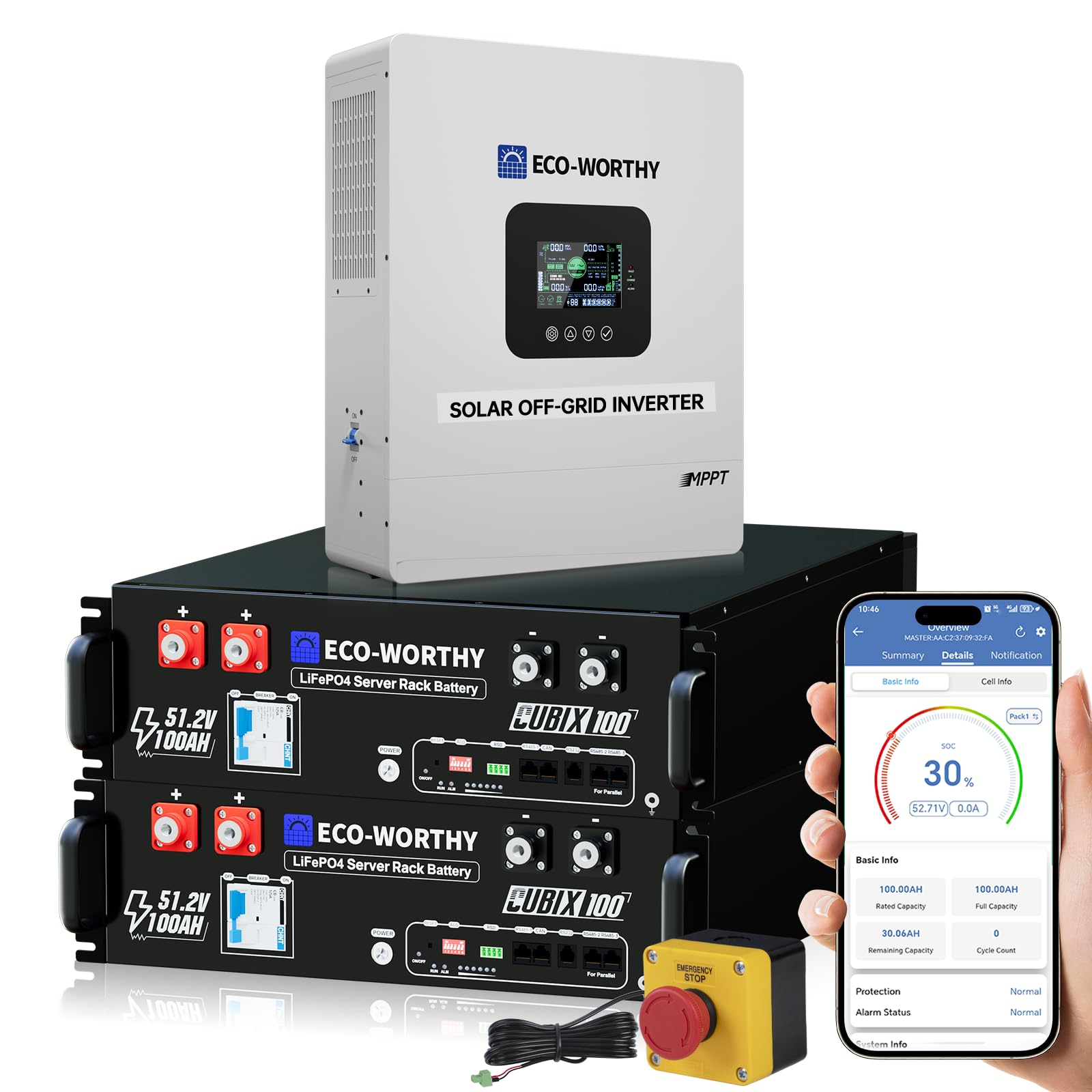
The ECO-WORTHY system is a different beast — this is not a portable power station with a handle and wheels but a rack-mount battery setup paired with a separate 5000W MPPT hybrid inverter. The kit includes two 51.2V 100Ah server-rack batteries and a 3-in-1 inverter that combines a pure sine wave inverter, 100A MPPT charge controller, and 100A battery charger. The total 10240Wh capacity and 5000W continuous output (10,000W peak) make this a legitimate whole-home backup solution for users who have a dedicated space for installation.
The batteries have passed UL1973 and UL1741 testing, meeting California Energy Commission standards for safety compliance. Closed-loop CAN/RS485 communication allows the batteries to talk to the inverter for intelligent charge management, and built-in Bluetooth/WiFi lets you monitor each battery pack individually through the ECO-WORTHY app. The inverter supports up to six units in parallel for 30kW output, and up to 32 batteries can be combined for 163kWh total storage — commercial-scale expansion.
Setup takes a couple of hours and requires rack-mounting and understanding basic electrical parameters — you must change the max grid AC current from factory settings (around 40A) down to 15A for a standard US 110V circuit to avoid tripping breakers. The weight is substantial at 223.8 pounds for the combined kit, and the batteries ship separately, adding logistical complexity. This is not a grab-and-go solution, but for a fixed garage or basement installation, the cost per kilowatt-hour is dramatically lower than any all-in-one portable station.
Why it’s great
- Exceptional 10.2kWh capacity with rack-mount form factor for permanent installs
- UL1973/UL1741 certified batteries meet stringent safety standards
- Parallel up to 6 inverters and 32 batteries for massive scalability
Good to know
- Not portable; requires rack-mounting and a dedicated installation space
- Setup requires adjusting inverter parameters to avoid breaker trips
- Heavy at 223.8 lbs; batteries and inverter ship in separate packages
7. OSCAL PowerMax 6000
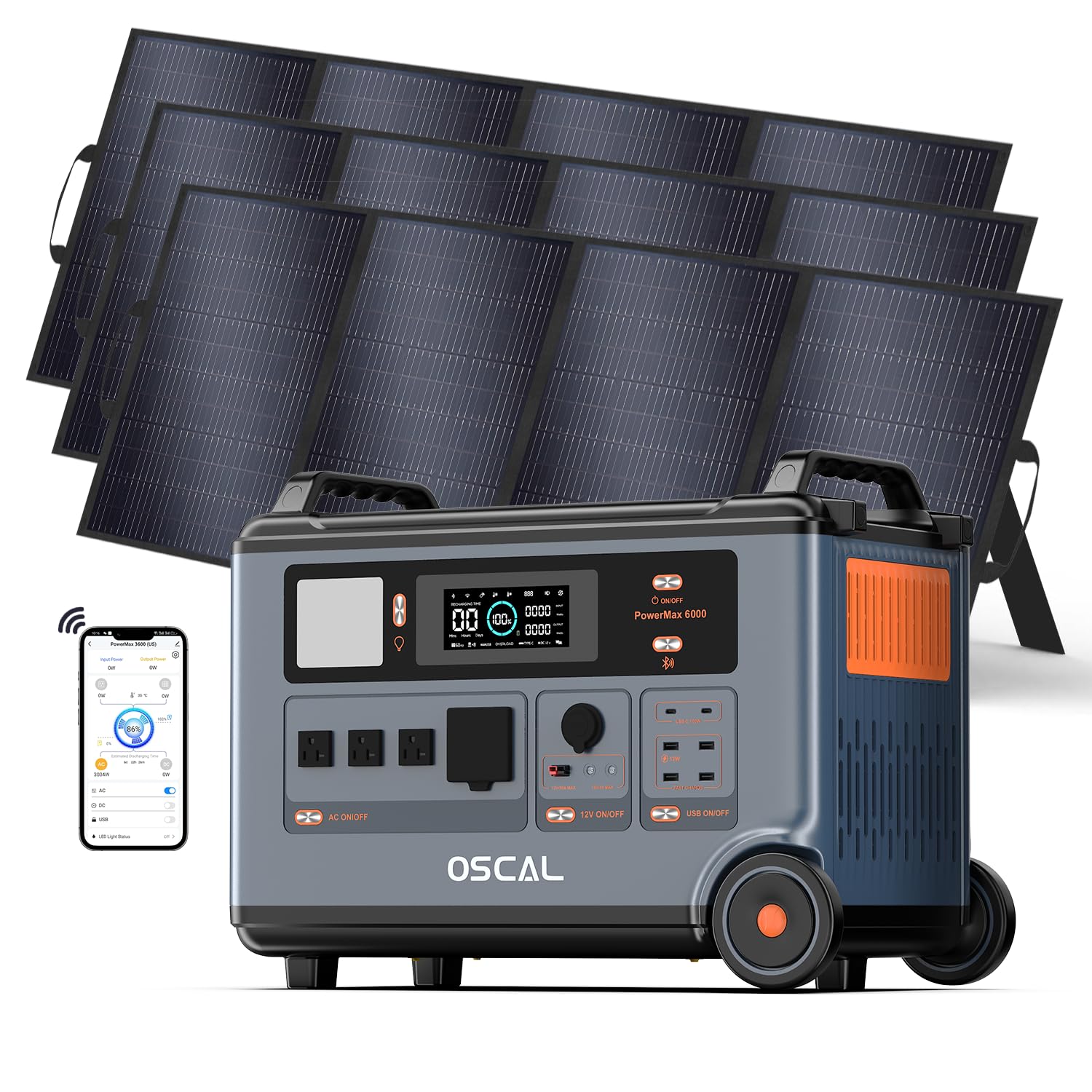
The OSCAL PowerMax 6000 arrives as a complete kit with three 400W solar panels, making it the most “out of the box” ready option for buyers who want to generate solar power without sourcing panels separately. The station itself offers 6000W surge (9000W peak) with 120V/240V split-phase output from a 3600Wh LFP battery that claims 3500 cycles and a 25-year service life through its eight-layer BMS. The 2200W bi-directional inverter can recharge from empty in under two hours via AC input.
The 5–8ms EPS switchover is fast enough to keep network equipment running during a flicker, and the OSCAL app provides remote monitoring and control. The unit has 14 outlet sources including four AC outlets, USB-C PD, and 12V ports. Users report that the fans are quiet and the built beep is audible when charging completes, which is helpful but may annoy some. The 100-pound unit includes wheels and a handle for moving around the house.
A critical caveat from verified buyers: the 6000W output claim appears to be a peak/surge rating rather than continuous — one user found that a single LED bulb drained 15% of the battery in two hours, suggesting the usable capacity or inverter efficiency is lower than advertised. The included solar panels need an MC4 4-way branch connector (not included) to work as a four-panel series string, and the charge cord is notably short. For the convenience of a full panel kit at a mid-range price, the PowerMax 6000 works, but don’t expect it to sustain its peak rating indefinitely.
Why it’s great
- Complete kit includes three 400W solar panels for immediate solar generation
- 2200W bi-directional inverter recharges from AC in under 2 hours
- Fast 5-8ms EPS switchover protects sensitive electronics
Good to know
- 6000W output is surge/peak, not continuous; continuous rating is lower
- Solar panels require separate MC4 branch connector for full string
- Battery efficiency may be lower than advertised based on user drain tests
8. EF ECOFLOW DELTA Pro + 400W Panel

The original EcoFlow DELTA Pro paired with a 400W foldable solar panel remains a strong entry point for buyers who want a proven ecosystem with a relatively compact solar generator bundle. The 3600Wh station delivers 3600W continuous output (7200W surge) via 15 outlets and ports, including five AC outlets. The included 400W panel features a 22.4% conversion efficiency and folds into an adjustable carry case, making it practical for portable use despite its 35.3-pound weight.
Users consistently praise the DELTA Pro’s robust pass-through feature, which allows the station to serve as a UPS that automatically switches to battery power during a grid outage without interrupting connected devices. The EcoFlow app is one of the most mature in the category, offering charge/discharge scheduling, battery temperature monitoring, and per-port control. One reviewer noted that on a half-charge, the unit ran a standard refrigerator for about 20 hours continuously.
A notable caveat: the 3.6kWh capacity is effectively only 2.7kWh usable because the BMS shuts off at 25% to protect the LFP cells. The included solar panel has a fixed angle that cannot be adjusted for optimal sun tracking, and the carabiners used for the case are fragile. The DELTA Pro ecosystem is excellent, but this bundle’s 3600W output is well below the 5000W threshold for serious whole-home use — it is better suited as a high-capacity portable backup for refrigerators and essential circuits rather than running a 240V well pump.
Why it’s great
- Proven EcoFlow ecosystem with mature app support and scheduling
- Automatic pass-through UPS function for seamless outage switchover
- High-efficiency 400W foldable panel included for portable solar charging
Good to know
- Usable capacity is only about 2.7kWh due to 25% BMS shutdown floor
- 3600W single-phase output cannot power 240V appliances
- Solar panel angle is fixed and carry case carabiners are not durable
9. Jackery HomePower 3600 Plus
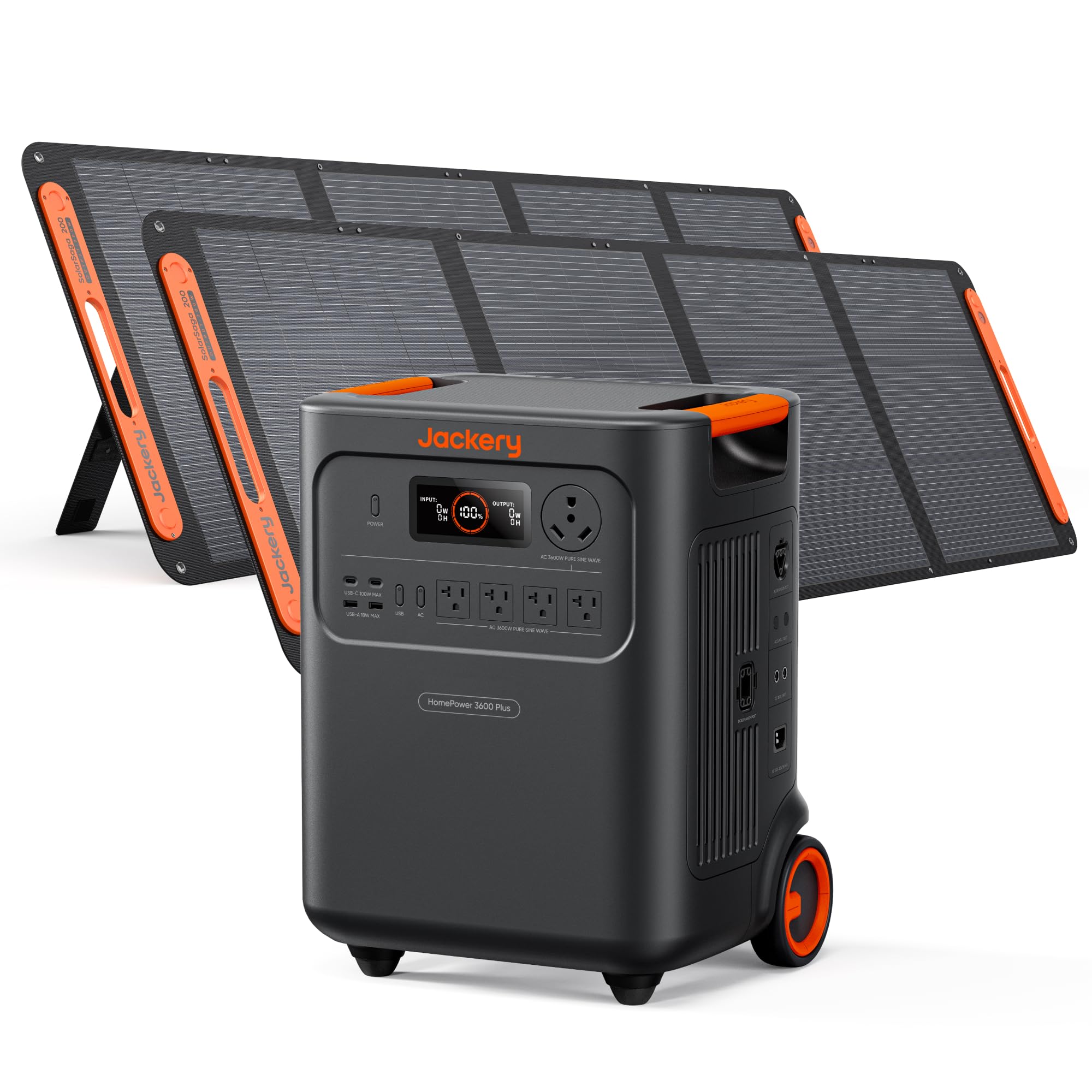
The Jackery HomePower 3600 Plus is the lightest 3.6kWh LFP station on the market at just 77.2 pounds — nearly 30% lighter than comparable models — thanks to automotive-grade CTB (Cell-to-Body) technology. This weight reduction makes a meaningful difference for users who need to roll the unit between the garage, kitchen, and RV without straining. Despite the lighter frame, the ceramic membrane battery cells are tested to withstand 302°F and perform down to -4°F, offering a 6000-cycle lifespan with a projected 10-year service life.
The station supports four charging methods: hybrid AC+DC charging reaches full in 2 hours, AC-only in 2.5 hours, solar-only in 4 hours, or gas generator in 2.5 hours. The luggage-style telescopic handle and wheels make it genuinely easy to move, unlike heavier units that require significant effort. The capacity can be expanded to 21kWh per unit with extra battery packs, and dual voltage (120V/240V) is achieved when pairing two units in parallel.
The main limitation is that a single unit outputs only 3600W at 120V — it cannot provide 240V split-phase by itself, which means it cannot power well pumps, dryers, or EV chargers without a second unit. The app loses connection to the station when you move out of Bluetooth range and can be difficult to reconnect without restarting. For users who prioritize easy mobility and long cycle life over raw split-phase power, this is an excellent mid-range option that feels significantly more approachable than its 100+ pound competitors.
Why it’s great
- Lightest 3.6kWh LFP station at 77.2 lbs with effective rolling luggage design
- 6000-cycle LFP cells with ceramic membrane for thermal stability down to -4°F
- Four charging methods including 2-hour hybrid fast charge
Good to know
- Single unit provides only 120V output; 240V requires pairing two units
- App loses Bluetooth connection easily and requires restart to reconnect
- 3600W output is below the 5000W threshold for heavy whole-home loads
10. Westinghouse WGen14500TFc
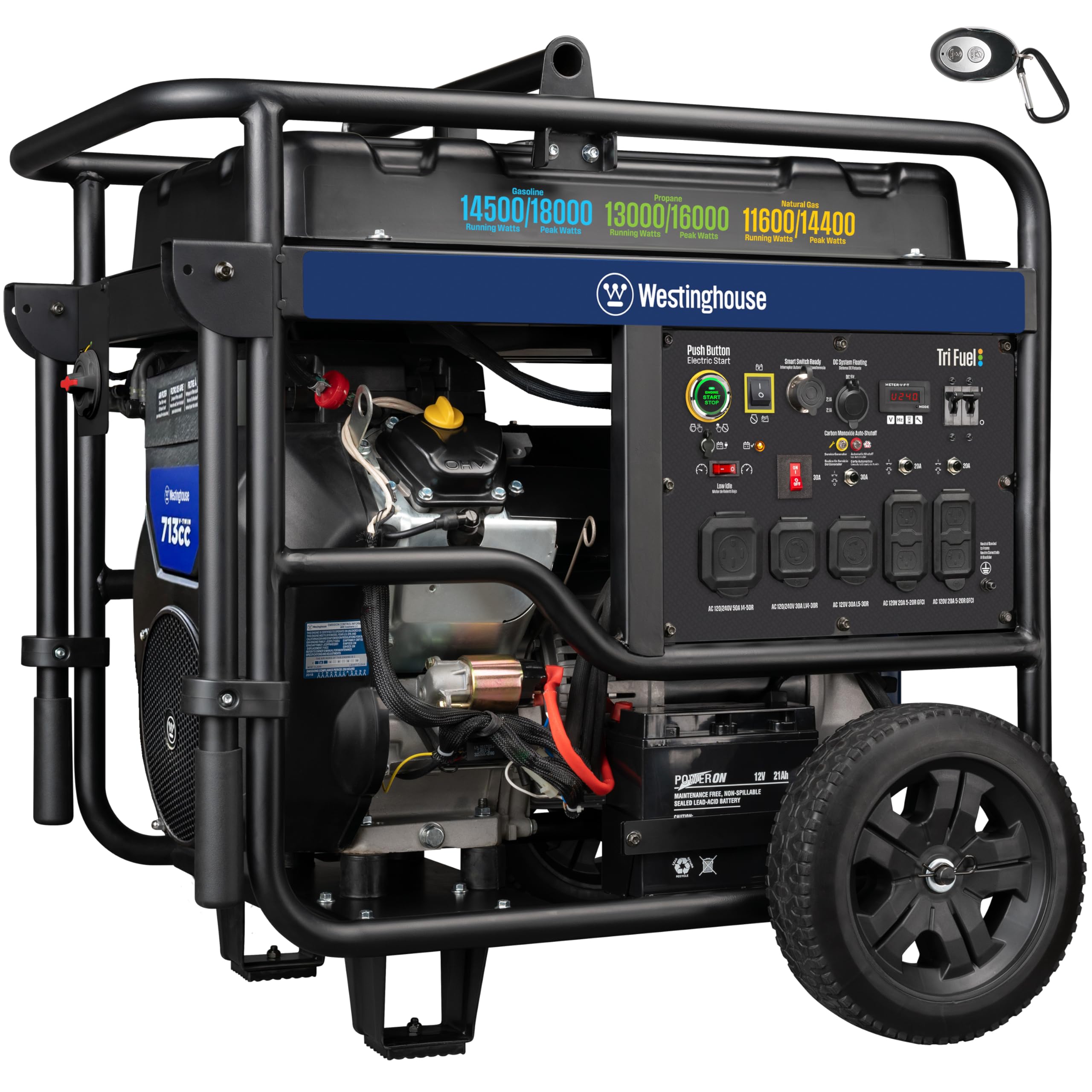
The Westinghouse WGen14500TFc represents the traditional gas generator category, offering 18,000 peak watts (14,500 running) on gasoline, with lower outputs on propane and natural gas. This is not a solar generator, but it is included here as a comparison point for readers who need raw wattage at a lower upfront cost than battery systems. The 713cc V-Twin OHV engine runs up to 16 hours at 25% load on a 10.5-gallon gas tank, and tri-fuel capability means you can switch to propane or natural gas for indefinite runtime during extended grid failures.
The generator features push-button and remote start, a CO-MINDER automatic shutdown sensor for safety, and less than 5% THD for clean power that won’t damage sensitive electronics. It is transfer switch and interlock kit ready with a 14-50R 50A outlet and an L14-30R 30A outlet. The 74 dBA noise level is louder than any solar station, but reasonable for an open-frame generator of this power class.
At 348.3 pounds, this is a stationary machine — you need a dolly or two people to move it. It requires regular maintenance: oil changes, spark plug replacements, and fuel stabilization. Users on natural gas report stable 60Hz output at full load (around 11kW) with THD around 5.5-5.8%, which is slightly above the 5% threshold for the most sensitive electronics. For buyers who need the absolute highest wattage for running a full house including AC and well pump simultaneously, and who have access to natural gas, this is the most cost-effective option — but it trades fuel savings for noise, emissions, and ongoing maintenance.
Why it’s great
- Tri-fuel flexibility allows switching between gas, propane, and natural gas
- Massive 18,000 peak watts powers entire home including heavy appliances
- CO-MINDER auto-shutdown and <5% THD protect electronics
Good to know
- Weighs 348 lbs and requires dolly or two people for movement
- Regular engine maintenance required (oil, plugs, fuel stabilization)
- Noise output of 74 dBA is significantly louder than battery generators
11. Honda EB5000
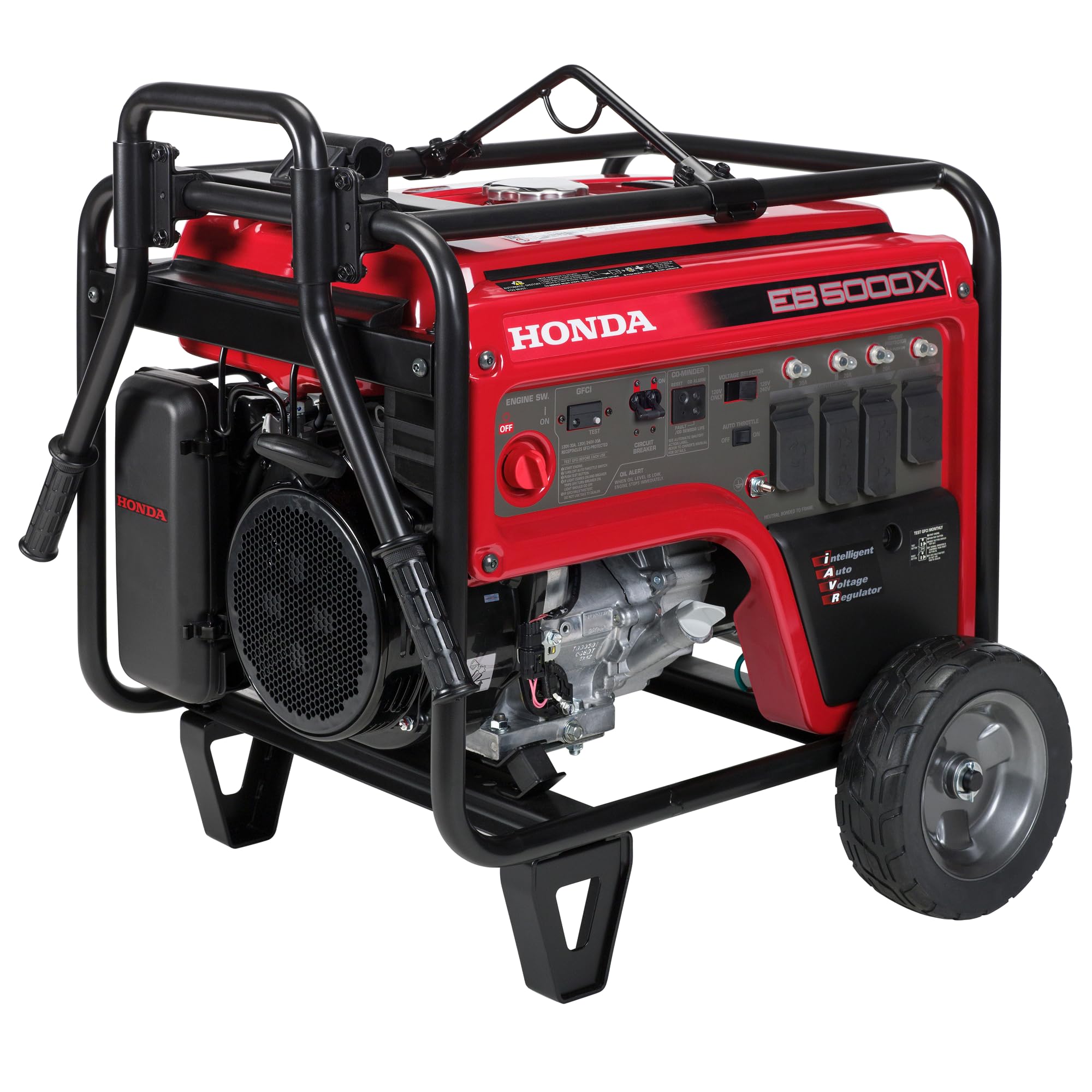
The Honda EB5000 is the gold standard for industrial-grade gas generators, delivering a true 5000W continuous output (7000W surge for 10 seconds) at a whisper-quiet 63-65 dBA — significantly quieter than most open-frame competitors. The 439cc OHV engine with iAVR (Intelligent Automatic Voltage Regulation) provides stable power for sensitive electronics and tools, and OSHA-compliant GFCI protection makes it legal for construction job sites. The 6.2-gallon fuel tank delivers 7.1 to 10.5 hours of runtime at rated load.
The CO-MINDER system continuously monitors carbon monoxide levels and automatically shuts down the generator before dangerous concentrations build up — a critical safety feature for use near occupied structures. The wheel kit makes it transportable across flat ground, though the 219-pound weight still requires effort. Users consistently report that Honda generators start on the first pull even after months of storage, and the build quality is exceptional with cast iron sleeves and heavy-duty components.
This generator is not available for sale in California due to emissions regulations, and it lacks the tri-fuel flexibility of the Westinghouse — it runs on gasoline only. The EB5000 is also a pure sine wave generator through iAVR, not a true inverter generator, so total harmonic distortion is low but not inverter-grade. For contractors who need a reliable, quiet, and OSHA-compliant jobsite generator that will start every time for decades, the Honda EB5000 is the proven workhorse — but it is a fuel-based machine, not a solar generator, and won’t suit anyone looking for silent, emissions-free backup.
Why it’s great
- Industry-leading reliability with Honda OHV engine and decades-proven track record
- Exceptionally quiet at 63-65 dBA for an industrial gas generator
- OSHA-compliant GFCI protection for construction job site use
Good to know
- Gasoline only — no tri-fuel or solar capability
- Not available for purchase in California due to emissions standards
- 219-pound weight requires wheel kit and substantial effort to move
FAQ
Can a 5000W solar generator run a central AC unit?
How many solar panels do I need to fully charge a 5000W generator battery in one day?
What does “6000 cycles” mean for a LiFePO4 battery lifespan?
Can I use a 5000W solar generator with my existing home transfer switch?
How do I calculate how long a 5000W generator will power my home?
Final Thoughts: The Verdict
For most users, the 5000 watt solar generator winner is the Jackery Solar Generator 5000 Plus because its 7200W split-phase output, 5040Wh base capacity, and 4000W solar input combine into a single-box solution that genuinely replaces a gas generator for both emergency backup and daily off-grid use. If you want the fastest recharge times and the widest outlet variety at a lower price, grab the OUPES Guardian 6000. And for fixed-site installation with the lowest cost per kilowatt-hour and massive 10.2kWh capacity, nothing beats the ECO-WORTHY 10.2kWh Home Power Station.