
Our readers keep the lights on and the weekend projects moving. As an Amazon Associate, I earn from qualifying purchases.
The moment you notice your smartphone can’t separate your dog from the background or capture a moving subject without blur, it’s time to step into a real interchangeable-lens camera. A beginner camera for photography and video frees you from the computational shortcuts of a phone, giving you actual control over focus, depth of field, and low-light performance.
I’m Rikta — the co-founder and writer behind FitlyFast. I’ve spent countless hours analyzing optical performance, autofocus capabilities, build quality, and ecosystem value across dozens of models to pinpoint the cameras that genuinely serve someone learning both stills and motion.
Whether you want crisp 4K video, reliable autofocus, a lightweight body for daily carry, or the ability to grow into manual controls over time, the right tool exists. This guide breaks down the key specs and tradeoffs to help you choose the absolute best beginner camera for photography and video that fits your goals and budget.
How To Choose The Best Beginner Camera For Photography And Video
A camera that excels at both photography and video does not compromise equally on both. Some prioritize stills with high-resolution sensors and deep buffer depths; others favor video with unlimited record times and 10-bit internal color. As a beginner, knowing where to compromise matters more than chasing the highest spec sheet.
Sensor size sets your ceiling
APS-C sensors dominate the entry and mid-range tiers because they balance price, low-light performance, and depth of field control. Full-frame sensors offer cleaner high-ISO images and shallower depth of field but cost significantly more — and the lenses to match them cost even more. For a first camera, a modern APS-C sensor delivers professional-looking results for years before you feel cramped.
Autofocus determines your sanity
Phase-detection autofocus with human and animal eye tracking transforms the learning curve. Cameras like the Sony ZV-E10 and Canon EOS R10 use on-sensor phase detection to lock onto moving subjects reliably, while older DSLR designs with 9-point phase detection demand precise focus-and-recompose technique. For video, continuous autofocus that doesn’t hunt is non-negotiable — you’ll see contrast-detect pulsing in your footage immediately.
Stabilization saves the shot
In-body image stabilization (IBIS) lets you shoot handheld at slower shutter speeds and smooth out handheld video without a gimbal. The Panasonic Lumix G85 is a standout here, offering 5-axis IBIS at a price point where competitors only provide lens-based stabilization. Without IBIS, you’ll rely on lens stabilization or a tripod for anything below 1/60th of a second.
Quick Comparison
On smaller screens, swipe sideways to see the full table.
| Model | Category | Best For | Key Spec | Amazon |
|---|---|---|---|---|
| Panasonic Lumix G85 | Mirrorless | Stabilized 4K video | 5-axis IBIS + OIS | Amazon |
| Sony Alpha ZV-E10 | Mirrorless | Vlogging & fast AF | 425 phase-detection points | Amazon |
| Canon EOS R10 | Mirrorless | Action & tracking | 15 fps mechanical shutter | Amazon |
| Nikon Z 30 | Mirrorless | Streaming & vlogging | Unlimited 4K record time | Amazon |
| Canon EOS R100 | Mirrorless | Compact daily carry | 143 zone Dual Pixel AF | Amazon |
| Panasonic Lumix G100 | Mirrorless | Built-in audio tracking | 360° mic with tracking | Amazon |
| Nikon D7500 | DSLR | Sports & wildlife | 51-point AF, 8 fps | Amazon |
| Canon EOS RP | Mirrorless | Full-frame entry | 26.2 MP full-frame CMOS | Amazon |
| Sony a7 III | Mirrorless | Full-frame all-rounder | 693 phase-detection points | Amazon |
| Canon EOS 2000D / Rebel T7 Bundle (Product 1) | DSLR | Budget all-in-one kit | 9-point AF, 24.1 MP | Amazon |
| Canon EOS 2000D / Rebel T7 Bundle (Product 3) | DSLR | Budget intro kit | DIGIC 4+, 3 fps | Amazon |
In‑Depth Reviews
1. Panasonic Lumix G85

The Panasonic Lumix G85 remains a top-tier mid-range mirrorless choice for beginners who want serious video capability alongside stills. Its 16-megapixel Micro Four Thirds sensor delivers fine detail — the lack of an optical low-pass filter boosts resolving power by roughly 10% over earlier Lumix sensors. But the real headline is the 5-axis in-body image stabilization, which pairs with the kit lens’s Power O.I.S. to produce stable handheld video without a gimbal.
For video shooters, the G85 records 4K at 30 fps with full pixel readout and offers a microphone jack for external audio — a rare find at this price. The magnesium-alloy front panel and weather-sealed build give it a tank-like durability that entry-level DSLRs lack. The eye-level OLED viewfinder (2.36 million dots) is bright and responsive, and the articulating touchscreen makes vlogging possible from any angle.
Autofocus uses contrast detection with depth-from-defocus, which works well in good light but can hunt slightly in dim environments. The 49-point DFD system locks onto stationary subjects quickly, though continuous AF for fast action isn’t as sticky as phase-detect systems. Overall, this is the most complete hybrid package in its price tier — you’ll outgrow the sensor resolution before you outgrow the stabilization and build quality.
Why it’s great
- Outstanding 5-axis IBIS smooths handheld video
- Weather-sealed magnesium alloy body
- Microphone jack and 4K unlimited recording
Good to know
- Contrast-detect AF hunts in low light
- Lower resolution sensor limits cropping
- No headphone jack for audio monitoring
2. Sony Alpha ZV-E10
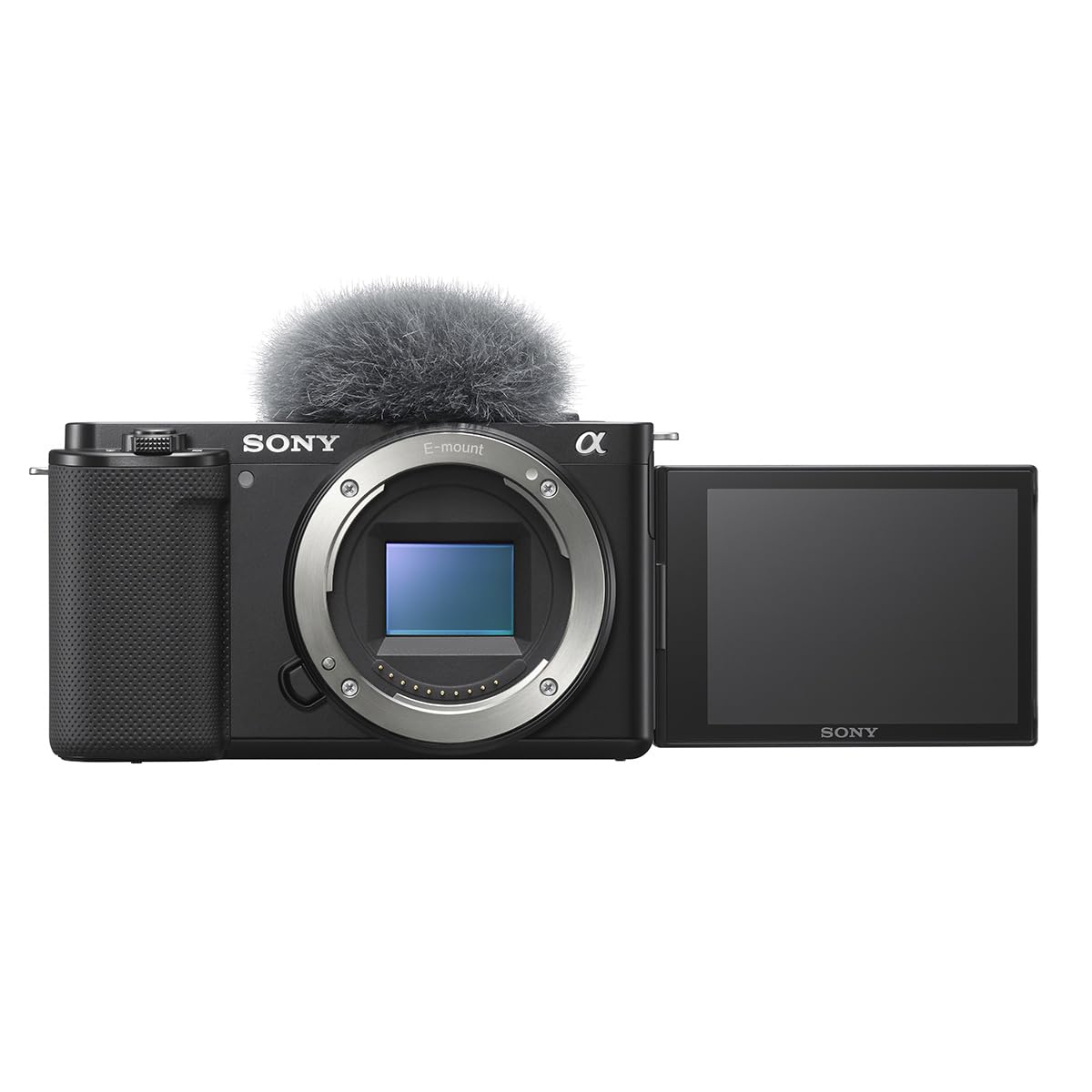
The Sony ZV-E10 is purpose-built for creators who shoot themselves as much as they shoot the world around them. It packs the same 24.2-megapixel APS-C sensor found in the popular a6400, but wraps it in a lighter body with a fully articulating touchscreen, a dedicated background defocus button, and a product-showcase mode that transitions focus from your face to an object instantly. The 4K video is oversampled from 6K with full pixel readout, producing noticeably sharper footage than many rivals at this price.
Autofocus is the ZV-E10’s strongest asset — 425 phase-detection points cover the frame, and Sony’s Real-time Eye Tracking for humans and animals keeps subjects pinned even when they move unpredictably. The 14-bit RAW files and S-Log profile give you latitude for color grading in post. The kit lens (16-50mm) folds down to a pancake size for portability, though its variable aperture limits low-light performance before you upgrade glass.
There is no in-body stabilization, so handheld video will show shake unless you pair it with a stabilized lens or a gimbal. Battery life sits around 25 minutes of continuous 4K recording — a spare battery is mandatory for a full day out. Rolling shutter in 4K 30p is noticeable during fast pans. Despite these tradeoffs, the image quality and autofocus speed make it the best pure video-focused hybrid for the price.
Why it’s great
- Best-in-class eye-tracking autofocus
- Oversampled 4K from 6K for sharp video
- Lightweight and vlogging-friendly flip screen
Good to know
- No IBIS — needs stabilized lens or gimbal
- Heavy rolling shutter in 4K
- Short battery life for video work
3. Canon EOS R10

The Canon EOS R10 bridges the gap between entry-level and enthusiast with a 24.2-megapixel APS-C sensor paired with the DIGIC X processor — the same engine found in Canon’s high-end R3. Burst shooting hits 15 fps with the mechanical shutter, and Canon’s Dual Pixel CMOS AF II covers the frame with 651 zones, making it incredibly sticky for erratically moving subjects. Subject detection extends to humans, animals, and vehicles, which is rare at this tier.
Video captures 4K at 60 fps oversampled from 6K, delivering crisp footage with natural colors straight out of camera. The RF-S 18-45mm kit lens is compact and lightweight, though its f/4.5-6.3 aperture forces higher ISO indoors. The electronic viewfinder uses a 2.36-million-dot OLED panel that is sharp and lag-free, and the vari-angle touchscreen protects itself when reversed against the body.
The main frustrations are the LP-E17 battery, which needs frequent charging during heavy use, and Canon’s decision to omit in-body stabilization — you’ll need an RF-S lens with IS for stable handheld video. The kit lens quality is decent for a starter but not exceptional; serious users will eventually want a faster prime. For beginners who plan to shoot action, sports, or pets, the R10’s autofocus speed is the strongest in its bracket.
Why it’s great
- Blazing 15 fps with mechanical shutter
- Subject-detection AF — humans, animals, vehicles
- Sharp 4K 60p from 6K oversampling
Good to know
- No IBIS — relies on lens stabilization
- Kit lens is slow for low-light work
- Battery life is average; carry spares
4. Nikon Z 30

Nikon designed the Z 30 specifically for creators who prioritize video and want a camera that doubles as a high-quality webcam. It records 4K at 30 fps with no record time limit — a huge advantage over the 30-minute cap found on many entry-level cameras. The 20.9-megapixel APS-C sensor uses a hybrid autofocus system that combines contrast, phase, and depth detection across 209 points for reliable tracking of faces and dogs.
The flip-out touchscreen faces forward for self-recording and shows exposure accurately even in bright conditions. The built-in stereo microphone has adjustable sensitivity and picks up clean audio for casual vlogs. USB-C charging lets you power the camera during streaming or long recording sessions. The 16-50mm zoom lens is compact and stabilized, delivering VR that smooths out handheld walkaround footage surprisingly well.
The tradeoff is the absence of a viewfinder — you must compose everything on the rear screen, which can wash out in direct sunlight. The Z 30 also lacks IBIS, relying on the lens’s VR for stabilization. Still, for a pure entry-level hybrid that handles streaming, casual vlogging, and family photo duty without overheating or capping recordings, the Z 30 is an easy recommendation.
Why it’s great
- Unlimited 4K recording — no time limit
- USB-C power for streaming and extended shoots
- Light and compact with good kit lens VR
Good to know
- No viewfinder — screen-only composition
- No IBIS; relies on lens stabilization
- Limited native Z DX lens selection
5. Canon EOS R100

The Canon EOS R100 is the lightest and smallest body in the EOS R series, making it the ultimate grab-and-go camera for daily carry. Its 24.1-megapixel APS-C sensor uses Canon’s Dual Pixel CMOS AF across 143 zones, delivering smooth, accurate autofocus for both photos and video. The DIGIC 8 processor enables 4K video capture at 24 fps and Full HD at 60 fps, with in-camera Wi-Fi and Bluetooth for instant transfers to your phone.
For a beginner who wants mirrorless benefits without the bulk, the R100 hits a sweet spot. The RF-S 18-45mm kit lens collapses down to an almost pocketable footprint. The graphical user interface includes guided modes and creative preset filters that help you learn aperture and shutter priority without reading a manual. The eye detection AF works for both stills and video, and switching between photo and video modes is straightforward.
The drawbacks are minor but real for the price: the LCD is fixed and non-touch, which limits shooting angles and menu navigation speed. 4K video is capped at 24 fps, making it less fluid for fast scenes. The single SD card slot supports UHS-I speeds, so buffer clearing is slower than UHS-II competitors. For the beginner who values portability above all and shoots mostly stills with occasional video, the R100 is a capable entry point into Canon’s RF ecosystem.
Why it’s great
- Smallest and lightest EOS R body — truly portable
- Dual Pixel AF with human eye detection
- Wi-Fi and Bluetooth for easy phone pairing
Good to know
- 4K capped at 24 fps
- Non-touch, non-articulating LCD
- Single UHS-I SD card slot
6. Panasonic Lumix G100

The Lumix G100 targets a specific niche: creators who want great audio without a separate microphone rig. Its built-in microphone uses 360-degree tracking with auto-adjusting sensitivity that follows the subject’s face and reduces wind noise — the system is genuinely impressive for casual recording. The 16-megapixel Micro Four Thirds sensor and 12-32mm kit lens produce pleasing colors and decent detail, and the 5-axis Hybrid I.S. keeps handheld footage steady.
This camera also doubles as a high-quality webcam over USB, making it useful for live streaming, interviews, and remote work. The frame marker feature lets you compose for different social aspect ratios, and the V-Log L recording gives you color grading room if you want to learn post-production. The body is lightweight enough for one-handed operation, and the OLED viewfinder is accurate for outdoor composition.
The biggest caveat: 4K video recording is capped at a maximum time — not truly unlimited — which can be a dealbreaker if you record long events. The Micro Four Thirds sensor is smaller than APS-C, so low-light performance is noticeably grainier, and the kit lens aperture is slow. The autofocus uses contrast detection, which hunts more than phase-detect systems. For audio-first creators who vlog or interview in controlled light, the G100’s built-in mic is a genuine differentiator.
Why it’s great
- Innovative 360-degree tracking microphone
- Lightweight and comfortable for one-handed use
- V-Log L and frame markers for social content
Good to know
- 4K recording has a time limit
- Contrast-detect AF hunts in low light
- Small sensor impacts low-light noise
7. Nikon D7500

The Nikon D7500 is a DSLR that borrows the metering and image processing engine from the D500, Nikon’s flagship APS-C camera. Its 20.9-megapixel sensor provides class-leading dynamic range and ISO performance, and the 51-point AF system with 15 cross-type sensors delivers reliable tracking for fast-moving subjects. Shooting bursts at 8 fps with deep buffer depth makes it a strong candidate for sports and wildlife beginners.
The 18-140mm kit lens is an excellent walkaround zoom — wide enough for landscapes, long enough for portrait compression. The 3.2-inch tilting touchscreen is responsive, and the optical viewfinder offers zero-lag composition with accurate color representation. 4K UHD video records at 30 fps with stereo sound, power aperture control, and auto ISO for smooth exposure transitions during recording.
The tradeoff for DSLR design is size and weight — it is larger than the mirrorless alternatives on this list, and live-view autofocus during video is slower than phase-detect mirrorless systems. The D7500 also lacks a headphone jack for audio monitoring during video. The lens mount is the classic Nikon F, which has decades of affordable glass available. For a beginner who wants a durable, optical-viewfinder experience with outstanding stills quality, the D7500 is a proven workhorse.
Why it’s great
- Fast 8 fps burst with deep buffer
- Excellent in-body dynamic range and high-ISO
- Versatile 18-140mm kit lens for all-around use
Good to know
- Bulky compared to mirrorless options
- Live-view AF is slow for video
- No headphone jack for audio monitoring
8. Canon EOS RP

The Canon EOS RP is the most affordable full-frame mirrorless camera on the market, making it an attractive leap for beginners who want the shallow depth of field and low-light benefits of a larger sensor. Its 26.2-megapixel full-frame CMOS sensor delivers outstanding image quality with rich colors and natural bokeh. The RF 24-105mm kit lens includes optical image stabilization rated for up to 5 stops, allowing sharp handheld shots at slower shutter speeds.
The RP uses Dual Pixel CMOS AF with 4779 selectable points, providing reliable face and eye tracking for both photos and video. The body is compact for a full-frame camera — close in size to some APS-C mirrorless models — and the vari-angle touchscreen makes creative framing easy. It also works as a webcam via Canon’s EOS Utility software or clean HDMI output, making it a dual-purpose tool for content creators.
The biggest compromise is video: 4K is heavily cropped (1.6x) and limited to 24 fps, and the camera uses contrast-detect AF for 4K — slower and more prone to pulsing than in Full HD. The LP-E17 battery provides mediocre battery life, especially for prolonged video shoots. On the plus side, the RP is compatible with Canon’s entire RF and EF/EF-S lens mount (via adapter), giving you a huge upgrade path. For pure stills photography with occasional 1080p video, the RP offers a low-cost gateway to full-frame quality.
Why it’s great
- Lowest-cost full-frame mirrorless entry
- Compact body with vari-angle touchscreen
- Excellent stills image quality and color science
Good to know
- 4K has heavy 1.6x crop and contrast-detect AF
- LP-E17 battery life is only average
- Single UHS-II card slot
9. Sony a7 III

The Sony a7 III is the baseline for full-frame mirrorless — a camera that excels in nearly every metric and remains competitive years after its release. Its 24.2-megapixel back-illuminated Exmor R sensor delivers 15 stops of dynamic range with clean ISO up to 204,800. The 693-point phase-detection AF covers 93% of the frame, with Real-time Eye Tracking that locks onto human and animal eyes with minimal hunting.
The a7 III shoots 4K video with full pixel readout from the sensor’s 6K resolution, producing oversampled footage that remains sharp and detailed. The 10 fps continuous shooting with mechanical shutter paired with the large buffer makes it capable for action. Battery life is exceptional — the NP-FZ100 pack can last a full day of mixed shooting, eliminating the need for multiple spares.
The 28-70mm kit lens is adequate for learning but its f/3.5-5.6 aperture won’t exploit the full-frame sensor’s low-light advantage. The menu system is historically complex, though customizable buttons help once configured. The touchscreen only enables touch focus, not tap-to-shoot or menu navigation. Despite being a 2018 model, the a7 III still outperforms most new entry-level cameras and gives a beginner room to grow into professional-grade glass.
Why it’s great
- Exceptional 693-point phase-detect AF with eye tracking
- 15-stop dynamic range with outstanding low-light
- Best-in-class battery life for mirrorless
Good to know
- Kit lens is slow; upgrade recommended
- Complex menu navigation — steep learning curve
- Touchscreen limited to touch focus only
10. Canon EOS 2000D / Rebel T7 Bundle (Product 1)

The Canon EOS 2000D (Rebel T7) bundle provides a complete starter package for someone who wants to learn photography and video on a strict budget. The 24.1-megapixel APS-C sensor paired with the DIGIC 4+ processor produces solid image quality for the price, and the 18-55mm kit lens covers the standard zoom range for everyday shooting. The inclusion of a tripod, memory card, case, and extra wide-angle and telephoto lens attachments in this bundle removes the guesswork from assembling starter gear.
The optical viewfinder offers a classic DSLR shooting experience with zero display lag. Built-in Wi-Fi and NFC allow wireless image transfer to a smartphone for quick social media sharing — a feature that was premium-tier just a few years ago. For a complete newcomer, the Scene Intelligent Auto mode dials in appropriate settings automatically while you learn the exposure triangle.
The limitations are significant for video: recording maxes out at Full HD 1080/30p with no 4K capability. The 9-point autofocus system is basic and demands careful composition. The lack of an external microphone jack means audio quality is permanently tied to the built-in mic. The bundle’s tripod and extra lenses are basic quality — they get you started but will likely need upgrading. For a pure photography beginner on a tight budget who wants a full kit out of one box, this bundle delivers.
Why it’s great
- Complete kit with tripod, memory card, case
- 24.1 MP APS-C sensor for solid stills
- Built-in Wi-Fi for easy phone sharing
Good to know
- Full HD only — no 4K video
- No external microphone jack
- 9-point AF is very basic
11. Canon EOS 2000D / Rebel T7 Bundle (Product 3)

This second Canon EOS 2000D bundle offers the same 24.1-megapixel sensor and EF-S 18-55mm lens combination but adds a case, 32GB memory card, and accessory kit from TopKnotch. It is an international version, meaning the included charger may require an adapter depending on your region. For the price, it provides a functional entry into interchangeable-lens photography with easy menu navigation and solid image quality.
The DIGIC 4+ processor is older but proven, delivering sufficient speed for casual shooting. Full HD 1080p at 30 fps is adequate for sharing to social media, and the Scene Intelligent Auto mode ensures usable results without manual intervention. The 9-point AF system with center cross-type sensor is basic but accurate for stationary subjects. The optical viewfinder gives you a direct, unprocessed view of the scene — something mirrorless viewfinders still struggle to replicate perfectly.
The downsides mirror the other T7 bundle: no 4K, no microphone jack, slow 3 fps burst rate, and a small 3-inch fixed LCD display. The accessories in the bundle are generally low quality — expect to eventually replace the tripod and perhaps buy a faster memory card. Some users report that finding compatible accessories for the international version can be tricky. It is a true entry-level DSLR kit that teaches the fundamentals but will feel limiting within months for anyone serious about video.
Why it’s great
- Very affordable entry with complete starter gear
- Optical viewfinder with zero-lag composition
- Proven Canon EOS ecosystem and lens compatibility
Good to know
- No 4K video or external mic jack
- Slow 3 fps burst and basic 9-point AF
- International version may require plug adapter
FAQ
Should I get a DSLR or mirrorless as my first camera for photography and video?
How many megapixels do I really need as a beginner?
Is it worth buying a full-frame camera as a beginner?
What is the most important spec for video on a beginner camera?
Why do some cameras have record time limits on video?
Final Thoughts: The Verdict
For most users, the best beginner camera for photography and video winner is the Panasonic Lumix G85 because it pairs professional-grade in-body stabilization, weather-sealed build, and a microphone jack with 4K video at a mid-range price. If you want blazing-fast autofocus for vlogging and content creation, grab the Sony ZV-E10. And for a compact daily carry that teaches you the Canon RF system, nothing beats the Canon EOS R100.