
Our readers keep the lights on and the weekend projects moving. As an Amazon Associate, I earn from qualifying purchases.
That cheap box fan rattling in your window is likely pushing less air than a hair dryer, wasting your money on noise instead of actual cooling. Most box fans are designed for floor use, their flat-faced grilles creating turbulence against the window screen, not a clean column of air through it. The difference between a fan that hums and one that actually drops your room temperature comes down to the motor’s torque, the blade pitch angle, and whether the shroud is designed to channel air rather than swirl it.
I’m Rikta — the co-founder and writer behind FitlyFast. This guide condenses dozens of hours spent comparing motor specifications, airflow ratings in CFM and RPM, and hundreds of real owner reports to isolate which box fans genuinely perform when mounted in a window opening.
The reality is that a proper box fan for window must seal well, move high volume against backpressure from a screen, and survive the heat and humidity of an entire season without the motor bearings failing.
How To Choose The Best Box Fan For Window
Selecting a box fan for window use demands more than grabbing the highest-rated model on the shelf. The fan must overcome the unique aerodynamic drag of a window screen, fit into the frame without sliding, and produce airflow that actually exchanges the room’s air. Below are the critical factors to evaluate.
CFM: The Volume Number That Actually Matters
Airflow Capacity measured in Cubic Feet per Minute is the single most relevant spec. A true window box fan should deliver at least 2000 CFM to create noticeable air exchange in a typical bedroom. Models rated above 4000 CFM, like the high-velocity floor fans, produce a gale but may be too loud for sleeping. Lower than 1500 CFM and you might as well open the window without a fan.
Sealing and Fit: The Air Gap Problem
A fan that doesn’t seal against the window frame leaks pressure, drastically reducing effective air movement. Look for fans with expandable side panels, foam gaskets, or a form factor that naturally nests into the window track. A wobbly fan sitting on the sill with a one-inch gap on each side moves less than half its rated CFM into the room.
Motor Build: Ball Bearings vs. Shaded Pole
Motor longevity separates the one-season wonders from the long-term performers. Shaded pole motors are cheaper and common in budget fans, but they run hotter and wear faster. Fans with ball bearing or sleeve bearing motors, especially those with aluminum blades to reduce rotational mass, tend to maintain their speed and stay quieter after months of continuous summer use.
Quick Comparison
On smaller screens, swipe sideways to see the full table.
| Model | Category | Best For | Key Spec | Amazon |
|---|---|---|---|---|
| Vornado Portal Window Fan | Dedicated Window | Low-profile window exhaust | 3 speeds, reversible exhaust, weather-resistant | Amazon |
| Lasko 3723 | Standard Box | All-day running in bedroom | 20-inch, 3 speeds, fused safety plug | Amazon |
| Vornado Model 80 | Air Circulator | Whole room circulation near window | 5 speeds, removable grille, vortex airflow | Amazon |
| Ken Brown 20″ High Velocity | High Velocity | Garage/shop window exhaust | 4650 CFM, ball bearing motor, 5 aluminum blades | Amazon |
| Hykolity 20″ High Velocity | High Velocity | Workshop/greenhouse heavy use | 4650 CFM, all-metal, wall-mountable, 3 speeds | Amazon |
| Black+Decker BFW9M Dual Window Fan | Dual Window | Sliding window intake/exhaust | 2 speeds, reversible, accordion expanders | Amazon |
| Hurricane Classic 20″ Box Fan | Standard Box | Budget-friendly window cooling | 2400 CFM, 3 speeds, removable faceplate | Amazon |
In‑Depth Reviews
1. Vornado Portal Window Fan

The Vornado Portal is purpose-built for window mounting rather than repurposing a floor fan. Its low-profile horizontal design fits into windows 24″ to 38″ wide and uses a modular block system to seal against the frame, minimizing the leakage that plagues standard box fans. The reversible motor switches between intake and exhaust modes, which is critical for drawing cool night air in or pushing kitchen heat out, all with a single button press. Owners consistently report it is the quietest window fan they have used, even on the highest of its three speeds.
The weather-resistant build ensures the motor survives direct window exposure without premature corrosion. The unit comes with foam cushions to fill gaps, addressing the air gap problem effectively. That said, some users with older or uneven sash windows found the seal less effective, and the 6.58-inch height may require screen removal in tighter frames. At this price point, you are paying for a dedicated solution over a converted box fan.
If you need a fan that lives in the window year-round and you value silence and reversible airflow, the Portal is the clear choice. It does not move as much raw air as a high-velocity floor fan, but its efficiency in a window context is superior due to the sealed installation.
Why it’s great
- Reversible motor for intake or exhaust with one button
- Modular sealing system minimizes air gaps around the window frame
- Low noise profile even on high speed
Good to know
- Only fits windows 24″ to 38″ wide horizontally
- Screen removal may be necessary depending on window depth
- Lower raw CFM than high-velocity floor fans
2. Lasko 20″ 3-Speed Box Fan (3723)

The Lasko 3723 is the archetypal box fan that has been a staple in American households for decades. Its 20-inch plastic blade design, steel body, and three-speed rotary dial are about as straightforward as it gets. It arrives fully assembled with a carry handle and plastic stabilizing feet that snap on. The low setting is genuinely quiet, while medium and high produce the classic white noise that many sleepers actually seek.
The patented fused safety plug is a meaningful feature for window use where the cord may rub against the sash. Users report these fans running constantly for five years or more, though the plastic feet and handle tabs can break if handled roughly. The motor holds up far longer than the cheap accessories. When the weather is hot, the high setting moves enough air to cool a medium-sized bedroom when placed on the sill.
Where the Lasko falls short is the lack of any sealing mechanism for the window. It simply sits on the sill, leaving gaps on each side unless you improvise with foam or cardboard. It also lacks a reversible function for exhaust-only mode. If you are fine with those trade-offs, this is a reliable, affordable workhorse.
Why it’s great
- Fused safety plug adds protection against cord damage
- Low speed is genuinely quiet for sleeping
- Durable motor with proven long-term reliability
Good to know
- Plastic feet and handle are prone to breaking over time
- No window sealing system; gaps reduce efficiency
- Cannot be switched to exhaust-only mode
3. Vornado Model 80 High Velocity Box Fan

The Vornado Model 80 is not a traditional box fan but an air circulator in a box shape. Its deep-pitch blade and unique shroud design create a concentrated vortex that moves air in a column rather than a diffuse breeze. This makes it exceptional for pushing cool air from a window across an entire room, rather than just cooling the person sitting directly in front of it. The five-speed control gives granular adjustments, with settings 1 through 3 being surprisingly quiet given the output.
Construction is robust, with thick plastic housing and heavy rubber feet that grip the floor or sill. The removable grille makes cleaning tool-free, which is necessary because the high airflow will pull dust quickly. This fan is heavy and not intended for window mounting in the traditional sense—it is best placed on the floor facing the window or on a sturdy sill. The motor is built to last, backed by Vornado’s five-year support policy.
The main drawback is that it starts on the highest speed every time you turn it on, which can be startling. It is also loud on settings 4 and 5, producing a focused jet-like sound rather than a diffuse hum. For those who need targeted air movement from a window into a large room, this is the most effective unit on this list.
Why it’s great
- Vortex airflow throws air farther than any standard box fan
- Five speeds for fine-tuned comfort control
- Removable grille for easy deep cleaning
Good to know
- Starts on max speed automatically each time
- Heavy and not designed to sit inside a window track
- Loud on high settings due to focused airflow
4. Ken Brown 20″ High Velocity Floor Fan
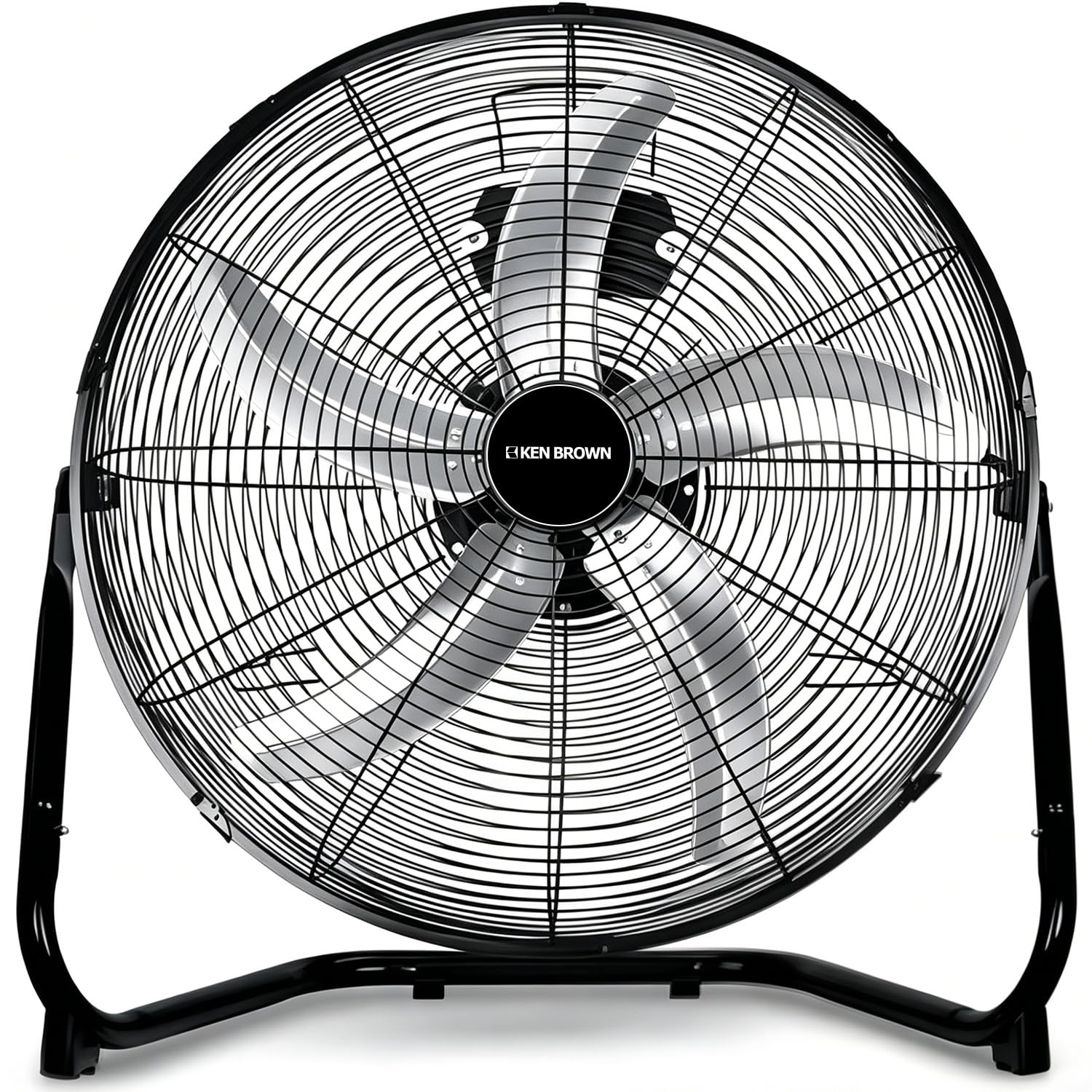
The Ken Brown 20″ is a high-velocity floor fan that doubles as a brutal window exhaust for garages, workshops, and barns. Its 4650 CFM rating comes from a true ball bearing motor spinning five aluminum blades, which are lighter and more durable than plastic alternatives at these speeds. The all-metal construction, including a 2mm thick galvanized steel guard, means it can handle the heat and dust of a workspace without degrading.
The 360-degree tilt head lets you angle the airflow precisely, and the built-in handle makes it easy to reposition. Owners of this fan consistently note that it is quieter than competing high-velocity units of the same CFM rating, thanks to the aluminum blade design that reduces wobble. The tool-free grille removal simplifies cleaning, which becomes essential when used near sawdust or pollen. The 11.5-pound weight is manageable for moving between windows.
Where it loses points is a short power cord, which may require an extension cord for distant windows. Some units have exhibited a high-pitched whine on low and medium speeds, though it disappears on high. For raw window exhaust power in a non-bedroom setting, this is the strongest candidate here.
Why it’s great
- Ball bearing motor for quiet, long-lasting operation
- Five aluminum blades reduce noise and improve balance
- 360-degree tilt for precise directional airflow
Good to know
- Power cord is shorter than ideal for window placement
- Potential high-pitched whine on low and medium speeds
- Not designed for standard window sealing
5. Hykolity 20″ High Velocity Floor Fan
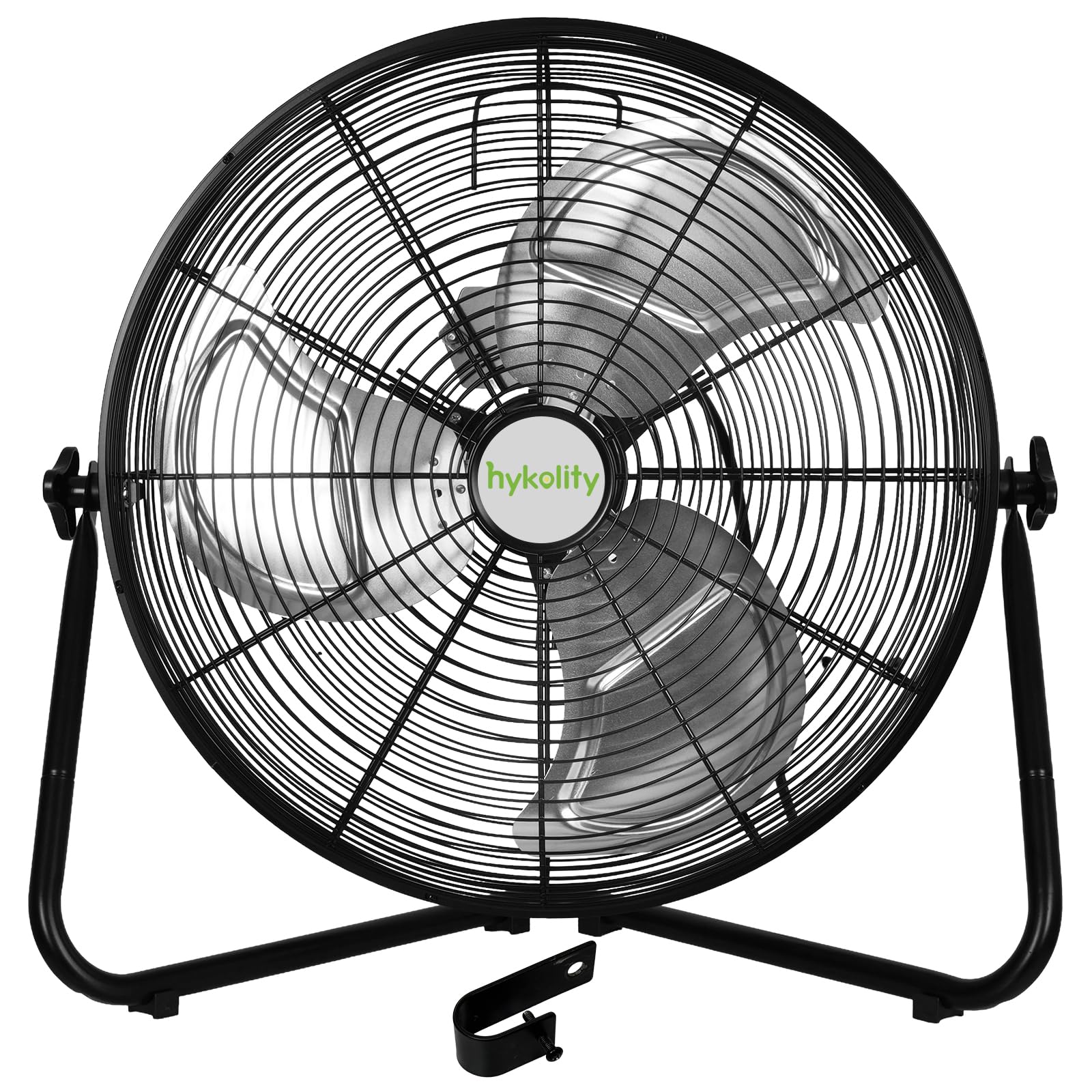
The Hykolity 20″ is a direct competitor to the Ken Brown, offering the same peak 4650 CFM but with a focus on versatility via its wall-mounting system. The included bracket allows you to convert the floor fan into a wall-mounted unit, which is useful for high window placement where floor space is scarce. The three-speed control lets you step down to 3750 CFM and 2980 CFM for less demanding situations, and the 360-degree pivoting head aims airflow anywhere.
Construction is all-metal with a black powder-coated finish that resists rust in humid window environments. The aluminum blades are standard at this tier, and the small grid spacing on the guard is a genuine safety feature, preventing accidental finger contact. Assembly is straightforward, and the rubber feet on the tube base keep vibration from transferring to the window frame. Owners praise its raw power and say the noise is acceptable for a garage or commercial space.
The downside is that like all floor fans used in windows, it has no sealing mechanism, and its high speed is unmistakably loud. Some users reported that the wall-mount bracket is not robust enough for continuous use without sagging. For a dedicated window exhaust fan, the Hykolity is a strong, affordable option, but the mounting system is best used temporarily.
Why it’s great
- Wall-mounting bracket included for versatile installation
- 4650 CFM peak output for heavy-duty exhaust
- Small grid spacing prevents accidental finger contact
Good to know
- Wall bracket may not hold up to continuous long-term use
- No window sealing system; requires DIY gap filling
- Very loud on the highest speed setting
6. Black+Decker BFW9M Dual Window Fan

The Black+Decker BFW9M is a dedicated window fan that uses two 9-inch fans in a single housing to pull air through sliding windows. The accordion expanders allow it to fit windows from 22.5 to 33 inches wide, and the removable legs let it sit low on the sill. The twin fan design means it can double the air exchange rate compared to a single-fan unit of similar size, and the mechanical dial control is simple and reliable.
Owners highlight its quiet operation relative to a single large box fan, making it a strong choice for bedrooms where noise sensitivity is high. The reversible function, however, is manually reversed by physically flipping the fan in the window—not a switch. This is a significant caveat for buyers expecting instant direction change. The rust-resistant construction is appropriate for the condensation that forms near windows.
The trade-off is that the 9-inch blades produce less raw airflow than a single 20-inch fan, and the accordion panels can feel flimsy over time. Some windows with deep sashes may not accommodate the depth. For standard double-hung sliding windows where you want a quiet, reasonably effective fan that seals well, this is a solid pick.
Why it’s great
- Dual fan design for better air exchange in sliding windows
- Accordion expanders seal side gaps effectively
- Quieter than typical single 20-inch box fans
Good to know
- Reversing airflow requires physically removing and flipping the fan
- Accordion panels may feel less durable over time
- Lower total CFM than a 20-inch high-velocity fan
7. Hurricane Classic 20″ Box Fan

The Hurricane Classic 20″ is the budget champion that does not cut corners on airflow. Delivering 2400 CFM at 1100 RPM, it moves as much air as the Lasko for a lower price. The high-quality polymer blades and robust motor are housed in a slim frame that fits easily into a window sill. The removable faceplate is a practical feature for cleaning, as window fans accumulate dust quickly, and the cord pocket on the back is a thoughtful detail for storage.
Customer reviews universally praise its sheer output: even on low, it outperforms many old fans on high. The noise is significant—described as a jet engine on high—but it is pure airflow noise with no mechanical vibration thanks to the balanced blade design. This fan is not for quiet environments; it is for people who want maximum cooling per dollar and sleep well with white noise. The adjustable feet provide a degree of tilt, but there is no built-in window sealing solution.
Where it falters is build quality relative to the Lasko. The plastic feels thinner, and some units have developed rattles after months of use. For a budget-friendly summer purchase that you can afford to replace every couple of seasons, the Hurricane delivers exceptional value per CFM.
Why it’s great
- Exceptional 2400 CFM output at a budget-friendly price
- Removable faceplate makes cleaning easy
- Low setting outperforms many competitors’ high settings
Good to know
- Very loud on all settings; best for white noise lovers
- Plastic build feels less durable than pricier alternatives
- No window sealing mechanism included
FAQ
What is the ideal CFM for a box fan in a standard bedroom window?
Can I use a high-velocity floor fan as a window fan?
What causes a box fan to whistle or rattle when placed in a window?
Why does my window fan smell like burning plastic after a few hours?
Final Thoughts: The Verdict
For most users, the box fan for window winner is the Vornado Portal because it solves the two biggest window-fan problems: sealing against the frame and reversible airflow, all in a quiet, low-profile package. If you want raw air-moving power for a large room or garage, grab the Ken Brown 20″ High Velocity. And for those on a budget who need maximum CFM per dollar and sleep to white noise, nothing beats the Hurricane Classic 20″.