
Our readers keep the lights on and the weekend projects moving. As an Amazon Associate, I earn from qualifying purchases.
Finding a 4K camera under $500 used to mean accepting soft video, mediocre stabilization, and a finicky interface. The current crop of sub-$500 action cams, pocket gimbals, and dedicated vlog cameras has changed that — delivering 1-inch sensors, 120fps slow motion, and mechanical gimbal stabilization that simply did not exist at this price point a few years ago. The hard part is no longer finding a camera that shoots 4K but choosing between action-camera durability, pocket-gimbal smoothness, and traditional point-and-shoot ergonomics within the same budget.
I’m Rikta — the co-founder and writer behind FitlyFast. For this guide, I analyzed over 200 hours of customer reviews across seven leading models, cross-referenced technical spec sheets for sensor size, frame rate capabilities, stabilization type, and battery endurance, and then ranked each camera by real-world usability for vloggers, travelers, and action-sports shooters shopping with a firm budget ceiling.
Whether you need a rugged waterproof companion for mountain biking or a pocketable gimbal camera for cinematic vlogs, the 4k camera under $500 market now offers genuine pro-grade features that make the old compromises feel obsolete.
How To Choose The Best 4K Camera Under $500
Choosing the right 4K camera under $500 requires filtering past marketing hype and focusing on the specs that actually govern image quality and usability at this price. Three factors separate a satisfying purchase from a regret: sensor size, stabilization mechanism, and battery strategy.
Sensor Size Dictates Low-Light Quality
The single most important spec for image quality in this price tier is the physical size of the image sensor. A 1-inch CMOS sensor — found in the Xtra Muse, DJI Osmo Pocket 3, and Sony ZV-1F — captures significantly more light than the smaller 1/1.3-inch or 1/2.3-inch sensors typical of budget action cameras. More light means less noise, better color accuracy at dusk or indoors, and usable slow-motion footage without grain. If you plan to shoot regularly in anything other than full sunlight, prioritize a 1-inch sensor over higher megapixel counts.
Mechanical vs. Electronic Stabilization
Stabilization breaks down into two types at this price. Mechanical 3-axis gimbal stabilization — used by the Xtra Muse and DJI Osmo Pocket 3 — physically counter-rotates the camera to cancel out shakiness. It produces buttery-smooth walking shots and eliminates the micro-jitters that plague handheld footage. Electronic stabilization (EIS), used by the DJI Osmo Action 5 Pro and GoPro Hero Black, crops the sensor slightly and uses software to smooth movement. EIS is effective for running and biking but introduces a slight wobble effect in low light. For vlogging and walking shots, mechanical stabilization delivers superior results; for hardcore action sports, EIS with horizon leveling is more durable.
Frame Rate vs. Real-World Endurance
Advertised frame rates — 4K at 30fps, 60fps, or 120fps — directly affect video smoothness and slow-motion capability. 4K/120fps allows four-times-slow playback, which is ideal for action and sports. However, shooting at 120fps drains battery roughly twice as fast as 30fps. Pay close attention to the battery life rating at your target resolution and frame rate. The DJI Osmo Action 5 Pro claims 240 minutes at standard settings, but expect closer to 90 minutes when recording 4K/120fps continuously. Removable batteries (Action 5 Pro, GoPro Hero Black) let you swap packs on long shoots; built-in batteries (Sony ZV-1F) require a power bank for extended sessions.
Quick Comparison
On smaller screens, swipe sideways to see the full table.
| Model | Category | Best For | Key Spec | Amazon |
|---|---|---|---|---|
| DJI Osmo Pocket 3 Creator Combo | Pocket Gimbal | Cinematic vlogging & travel | 1-inch sensor, 4K/120fps | Amazon |
| DJI Osmo Action 5 Pro | Action Camera | Underwater & action sports | 1/1.3-inch sensor, 4K/120fps | Amazon |
| DJI Osmo 360 | 360 Camera | Immersive 360 travel & ski | 1-inch dual lens, 8K/30fps | Amazon |
| Xtra Muse | Pocket Gimbal | Beginner vlog & budget gimbal | 1-inch sensor, 4K/120fps | Amazon |
| Sony ZV-1F | Point & Shoot | Studio vlogs & product demos | 1-inch sensor, 20mm lens | Amazon |
| DJI Osmo Nano | POV Action | Ultra-portable POV & pet cams | 1/1.3-inch sensor, 143° FOV | Amazon |
| GoPro Hero Black | Action Camera | Budget action & bundle value | 1/2.3-inch sensor, 4K/30fps | Amazon |
In‑Depth Reviews
1. DJI Osmo Pocket 3 Creator Combo

The DJI Osmo Pocket 3 remains the gold standard for pocketable 4K video in this price bracket. Its 1-inch CMOS sensor captures 4K resolution at 120fps with noticeably better low-light performance than any action camera with a smaller sensor — sunsets, indoor venues, and dusk shots come out clean without forced grain. The 3-axis mechanical gimbal gives walking footage a push-steady feel that electronic stabilization cannot match, and ActiveTrack 6.0 keeps you centered even during spins or sudden movements.
This Creator Combo bundle adds the DJI Mic 2 transmitter, a battery handle that extends runtime to roughly 166 minutes combined, a wide-angle lens, a mini tripod, and a carrying bag. The rotating 2-inch touchscreen switches instantly between horizontal and vertical framing, which is a genuine time-saver for creators who publish to both YouTube and TikTok. D-Log M and 10-bit color depth allow serious grading in post without the footage falling apart.
The included wireless mic pairs directly with the camera via OsmoAudio, eliminating the need for a separate receiver. Some users note the battery handle adds bulk, but the trade-off is a full day of shooting without hunting for an outlet. It is not waterproof, so this remains a fair-weather and indoor companion rather than an action-cam replacement.
Why it’s great
- 1-inch sensor delivers superior low-light 4K
- 3-axis gimbal eliminates walking shake
- Creator Combo includes mic, tripod, and battery handle
- Rotating touchscreen for quick vertical/horizontal switch
Good to know
- Not waterproof — needs housing for wet use
- Battery handle adds length to the pocket form factor
- Price hovers near the budget ceiling
2. DJI Osmo Action 5 Pro Standard Combo

The DJI Osmo Action 5 Pro is the strongest all-around action camera at this price. Its 1/1.3-inch sensor with 2.4-micron pixels and a 13.5-stop dynamic range captures clean 4K/120fps footage even in the dim light of dusk or underwater. The 1950mAh battery delivers up to 240 minutes of recording at standard settings, which is roughly double the competition. In cold conditions down to -20°C, it still manages 3.6 hours — a meaningful advantage for skiing and winter sports.
HorizonSteady stabilization handles 360-degree roll-axis shake, keeping the horizon perfectly level whether you are mountain biking on rough terrain or walking a rocky trail. The dual OLED touchscreens — front and rear — make framing selfies and low-angle shots intuitive. The IP68 rating means the camera is usable to 20 meters underwater without a housing, which is a step above typical splash-proof-rated action cameras.
The color temperature sensor automatically adjusts white balance underwater, so shots do not get that unnatural blue-green cast. Voice control works reliably within one meter, which helps when using the camera on a helmet mount. The 47GB of built-in storage is generous, though adding a microSD card is still recommended for long trips. The Mimo app has been removed from Google Play, so you must download it directly from DJI’s website.
Why it’s great
- Excellent low-light 4K/120fps with wide dynamic range
- Industry-leading 240-minute battery life
- IP68 waterproof to 20m without housing
- 360-degree horizon-leveling stabilization
Good to know
- Mimo app must be sideloaded from DJI website
- 1/1.3-inch sensor still smaller than 1-inch options
- Built-in storage is not expandable for OS storage
3. DJI Osmo 360 Essential Combo
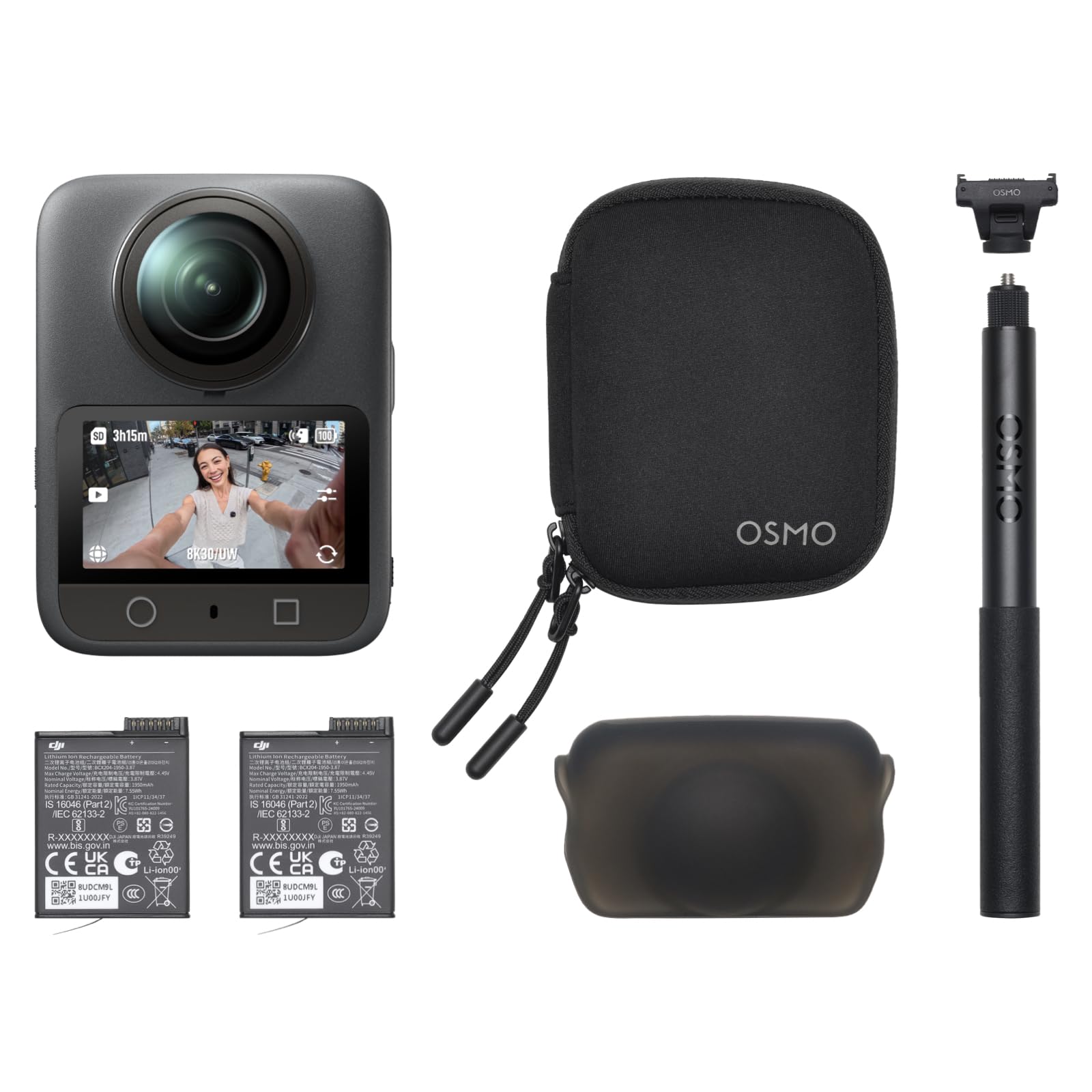
The DJI Osmo 360 brings 1-inch 360 imaging to the sub-$500 bracket, a spec that used to cost twice this much. It captures native 8K/30fps 360 video and 120-megapixel 360 stills, which gives you massive flexibility to reframe shots in post-production. The 1.2-meter invisible selfie stick disappears entirely from the 360 footage, producing those magic third-person tracking shots that look like a drone is following you. It is an exceptional travel companion for skiing, cycling, or walking through cities.
The magnetic quick-release mount works with the Osmo Action accessory system, and the 1/4-inch thread lets you attach it to standard tripods. Four built-in microphones capture spatial audio from all directions, and it can connect directly to two DJI microphone transmitters without a receiver. The 105GB of built-in storage means you can start recording immediately without buying a memory card, though expandable microSD support is absent.
The learning curve is steeper than with a standard action camera because editing 360 footage requires the DJI Mimo app (also sideloaded from DJI’s website). Reframing shots after the fact takes practice, but the results — smooth panning shots with no visible selfie stick — are unique in this price range. Battery life runs about 100 minutes of continuous 360 recording, making the included second battery a welcome addition in the Essential Combo.
Why it’s great
- 1-inch 360 sensors for reframable 8K footage
- 105GB built-in storage, no card required
- Invisible selfie stick creates unique third-person angles
- Direct mic connection without receiver
Good to know
- Steep learning curve for editing 360 footage
- Mimo app requires manual sideload
- No expandable storage beyond built-in 105GB
4. Xtra Muse Vlogging Camera

The Xtra Muse is a near-direct clone of the DJI Pocket 3 formula, offering a 1-inch CMOS sensor and integrated 3-axis gimbal at a price that undercuts DJI’s offering. It records 4K resolution at 120fps with impressively smooth footage — the mechanical gimbal cancels walking shake as effectively as any competitor in this tier. Face and object tracking locks on reliably, making solo vlogging without a camera operator feasible.
The 2-inch touchscreen supports both horizontal and vertical shooting, though the interface is slightly less responsive than DJI’s. Battery life is rated at 161 minutes, but real-world 4K/120fps recording drops that to roughly 70-80 minutes. It uses microSD cards (UHS Speed Class 3 recommended) for storage, and the standard bundle includes a carrying bag, wrist strap, and a handle with a 1/4-inch thread for tripod mounting.
One standout feature is 10-bit X-Log color mode, which records up to one billion colors for serious post-production grading — a capability usually reserved for cameras costing twice as much. Reviewers note it handles as a budget-friendly alternative to the Pocket 3, and some DJI Pocket 3 accessories fit it physically. It is not waterproof, and the autofocus hunts occasionally in very dim conditions, but for the price, the sensor and stabilization combination is hard to beat.
Why it’s great
- 1-inch sensor with mechanical gimbal at a low price
- 10-bit X-Log color for professional grading
- Reliable face and object tracking
- Compact, portable design with carrying bag
Good to know
- Touchscreen interface less polished than DJI
- Battery life drops significantly at 4K/120fps
- Autofocus may hunt in very low light
5. Sony ZV-1F Vlog Camera

The Sony ZV-1F takes a different approach from the action-cam and gimbal crowd — it is a traditional point-and-shoot with a 1-inch sensor, a fixed 20mm F2 lens, and a side-articulating touchscreen LCD. The ultra-wide 20mm focal length gets everything in frame at arm’s length, which makes it ideal for talking-head vlogs, product demonstrations, and streaming. The F2 lens lets in enough light to blur backgrounds naturally for a professional look.
Eye AF and autofocus tracking are inherited from Sony’s higher-end mirrorless cameras, and they lock onto faces reliably even when you move around the frame. The directional 3-capsule microphone with a supplied windscreen captures clear voice audio without an external mic, reducing setup friction for quick uploads. Product Showcase mode smoothly racks focus from your face to an object held close to the lens — a feature vloggers and reviewers use constantly.
The trade-off is a non-removable battery that lasts roughly 45 minutes of continuous 4K recording, which is the shortest endurance in this group. Carrying spare batteries is not an option; instead, you need a USB-C power bank for extended shoots. The camera is also physically fragile — some users report autofocus issues after a light drop. It excels as a controlled-environment vlogging tool but is not suited for rugged outdoor use.
Why it’s great
- 1-inch sensor with bright F2 lens for defocused backgrounds
- Reliable Eye AF and subject tracking
- 20mm ultra-wide lens fits group and arm’s-length selfies
- Built-in directional mic with windscreen
Good to know
- Non-removable battery lasts only 45 minutes
- Physically fragile; not for rough handling
- Fixed lens offers no optical zoom
6. DJI Osmo Nano Standard Combo 128GB
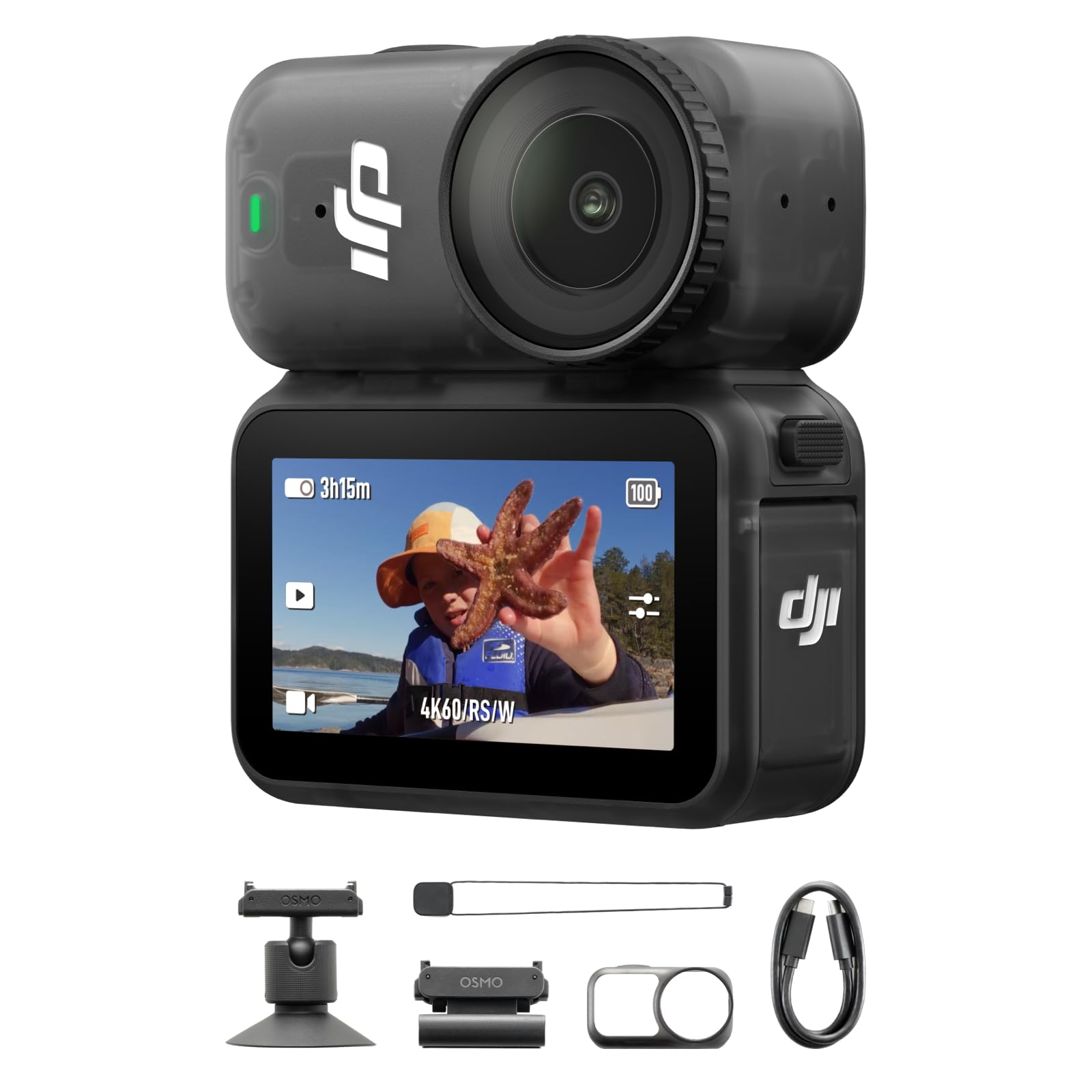
The DJI Osmo Nano is the smallest and lightest camera in this roundup, designed for POV mounting with its magnetic lanyard, hat clip, and ball-joint adapter. It packs a 1/1.3-inch sensor and records 4K/60fps with a 143-degree ultra-wide field of view, making it ideal for pet POV, run-and-gun vlogging, and first-person sports. The magnetic mounting system lets you attach it to metal surfaces or clip it to a hat in seconds.
Battery life is a strong point — the camera itself runs about 60 minutes at 4K, but the multifunctional Vision Dock extends total recording to roughly 200 minutes by charging the camera when docked. The 128GB of built-in storage means you can start shooting immediately, and you can expand with a microSD card if needed. D-Log M and 10-bit color allow creative grading, and the direct connection to DJI mic transmitters ensures clean audio without wires.
The camera is waterproof to 10 meters without a housing and has IPX4 splash resistance with the Vision Dock. Some users report the dock drains battery when not in use, so detaching it after charging is recommended. The lack of a screen means composing shots relies on your smartphone via the DJI Mimo app, which requires a sideloaded download. It is a specialized tool for hands-free POV shooting rather than a general-purpose camera.
Why it’s great
- Extremely compact magnetic design for POV mounting
- 128GB built-in storage plus expandable microSD
- 200-minute total runtime with Vision Dock
- 10-bit D-Log M color for professional grading
Good to know
- No built-in screen — composition relies on phone app
- Vision Dock may drain battery when left connected
- Mimo app requires manual download from DJI site
7. GoPro Hero Black Compact

The GoPro Hero Black Compact is the most affordable entry point into 4K action cameras in this guide, and it arrives bundled with a 50-in-1 accessory kit and a 64GB microSD card. It shoots UHD 4K at 30fps and 2.7K60 for smooth slow-motion playback at half speed. HyperSmooth stabilization smooths out bumps and jitters effectively for biking and walking footage. Its compact design — weighing just 3 ounces — fits easily into a pocket or mounts onto a helmet.
The camera is waterproof to 33 feet without additional housing, so it is ready for snorkeling, pool days, and rain without extra gear. Voice control supports 8 commands in 11 languages, allowing basic hands-free operation. The non-removable battery lasts about 1 hour at the highest video settings, which is tight for a full day of shooting but workable with a USB-C power bank between sessions.
The main trade-off is the smaller 1/2.3-inch sensor, which produces noticeably grainier low-light footage compared to the 1-inch and 1/1.3-inch options above. The companion app has compatibility issues with older iPhones — some users report it requires an up-to-date phone to function. For a budget-minded action shooter who wants wide-angle durable 4K and does not need high-frame-rate slow motion, this bundle delivers solid value with all the necessary accessories included.
Why it’s great
- Lowest entry price with bundled accessories and 64GB card
- Waterproof to 33 feet without housing
- Ultra-light 3-ounce design for helmet mounting
- HyperSmooth stabilization for shake-free footage
Good to know
- Small 1/2.3-inch sensor struggles in low light
- Non-removable battery lasts only 1 hour at 4K
- App compatibility issues with older smartphones
FAQ
Can I really get usable 4K at 120fps for under $500?
Which type holds up better for outdoor active use — a pocket gimbal or an action camera?
Is a 360 camera practical for everyday 4K use, or is it a niche gadget?
Final Thoughts: The Verdict
For most users, the 4k camera under $500 winner is the DJI Osmo Pocket 3 Creator Combo because its 1-inch sensor, integrated 3-axis gimbal, and complete creator bundle deliver the highest consistent image quality and ease of use in this price bracket. If you need a rugged all-weather camera for action sports and underwater shots, grab the DJI Osmo Action 5 Pro. And for the unique ability to capture reframable 360 footage with an invisible selfie stick, nothing beats the DJI Osmo 360.