
Our readers keep the lights on and the weekend projects moving. As an Amazon Associate, I earn from qualifying purchases.
You plug a laptop charger into your car’s 12V socket and the charger buzzes, refuses to light up, or worse, pops the fuse. That weak 100W cigarette-lighter adapter was never designed to run a CPAP machine, a power tool, or a mini fridge. An auto inverter solves that by stepping your vehicle’s DC battery voltage up to standard household AC power, but not all inverters deliver the clean, stable waveform that sensitive electronics demand—and many leave you stranded with a dead battery because they lack a proper low-voltage cutoff.
I’m Rikta — the co-founder and writer behind FitlyFast. I’ve spent dozens of hours cross-referencing real customer test data, tearing down spec sheets for continuous wattage versus peak surge claims, and comparing waveform purity, cooling efficiency, and safety certification across the most popular inverter tiers on the market.
Whether you need a compact unit for charging a MacBook on a road trip or a heavy-duty unit to run a refrigerator off-grid, this guide cuts through the marketing to find the best auto inverter for your exact use case.
How To Choose The Best Auto Inverter
Buying an auto inverter isn’t just about grabbing the model with the highest wattage number. You need to match the inverter’s waveform, continuous power rating, and safety features to the specific devices you plan to run. Make a mistake here, and you could damage your electronics, drain your car battery, or start a fire.
Continuous vs. Peak Wattage — Don’t Get Tricked
Every inverter advertises two numbers: continuous wattage (the steady power it can supply) and peak wattage (a brief surge needed to start motors in refrigerators, pumps, or power tools). A 3000W inverter that can only sustain 1500W before tripping is a 1500W inverter in the real world. Always compare the continuous rating against the running wattage of your largest appliance. If you plan to run a 700W microwave plus a 60W laptop charger, you need at least 800W continuous, not 1600W peak.
Pure Sine Wave vs. Modified Sine Wave — Which Waveform Do You Need?
A pure sine wave inverter produces clean AC power virtually identical to your home wall outlet. Sensitive devices—laptop power bricks, CPAP machines, variable-speed power tools, gaming consoles, and refrigerators with digital compressor controls—require pure sine wave to operate quietly, efficiently, and without overheating. Modified sine wave is cheaper and adequate for resistive loads like incandescent lights, basic fans, and simple heating pads, but it can cause motors to hum, chargers to buzz, and electronics to run hotter. If you’re powering anything with a microprocessor or a motor, invest in pure sine wave.
USB-C Power Delivery — The Speed Difference
Older inverters include only standard 5V USB-A ports that charge phones at a trickle. Modern inverters integrate USB-C Power Delivery (PD) at 30W, 65W, or even higher, capable of fast-charging a MacBook Pro or iPad Pro directly from the inverter without needing a separate AC adapter. If you frequently charge modern laptops or tablets in the car, a unit with 65W PD USB-C can replace your bulky laptop power brick. Budget inverters without PD will force you to use the AC outlet with your original charger, taking up a slot and adding cable clutter.
Installation Method and Cable Quality
Inverters under 400W typically plug into the cigarette lighter socket with a built-in 25–30-inch cable. This is convenient, but the 10–15A fuse in most vehicle sockets limits actual draw to around 120–180W—far lower than the sticker on the inverter. For any unit rated above 300W continuous, you must hardwire directly to the battery using the included ring terminals and the thick AWG cables provided. A 3000W inverter connected through a cigarette lighter plug will melt the socket or blow the fuse instantly. Check the supplied cable gauge: 16AWG is fine for 150W; you want 8AWG or thicker for anything over 500W.
Safety Certifications and Protections
Look for ETL, UL, or FCC certification, which means the unit has passed independent safety testing. The inverter should include automatic shutoff protections for overload, overheating, over-voltage, under-voltage (critical to prevent draining your starter battery below cranking voltage), and short circuit. A visual alarm (red LED or LCD warning) lets you diagnose problems without guesswork. Units with a replaceable fuse are preferable to those with a built-in non-replaceable fuse—you can keep spares on hand rather than trashing the whole unit.
Quick Comparison
On smaller screens, swipe sideways to see the full table.
| Model | Category | Best For | Key Spec | Amazon |
|---|---|---|---|---|
| Giandel 300W Pure Sine | Pure Sine | Sensitive electronics | 300W continuous pure sine wave | Amazon |
| VOLTWORKS 3000W Pure Sine | Pure Sine | Heavy-duty off-grid use | 3000W continuous, 30ft remote | Amazon |
| TOPBULL 3000W Modified Sine | Modified Sine | High-wattage resistive loads | 3000W cont / 6000W peak | Amazon |
| BELTTT 1000W Pure Sine | Pure Sine | RV and solar setups | 1000W continuous with LCD | Amazon |
| Vansoet 400W Modified Sine | Modified Sine | Everyday road trips | 400W cont, 30W PD USB-C | Amazon |
| BESTEK 300W Modified Sine | Modified Sine | Mobile office charging | 65W PD USB-C, ETL certified | Amazon |
| Pro Chaser 400W Modified Sine | Modified Sine | Budget-friendly backup | 400W cont, 65W PD USB-C | Amazon |
In‑Depth Reviews
1. Giandel 300W Pure Sine Wave Inverter

This is the inverter you want if you power sensitive electronics like a CPAP, gaming console, or variable-speed power tools in your vehicle. The pure sine wave output matches the clean waveform from your home wall outlet, meaning your laptop charger won’t buzz, your audio equipment won’t hum, and motors won’t overheat. At 300W continuous with a slim aluminum housing, it’s remarkably compact and lightweight for a pure sine unit, fitting neatly into a glove box or under a seat.
Two smart USB ports automatically detect your device and deliver up to 2.4A each, which is enough for most phones and tablets but noticeably slower than modern USB-C PD charging. The external 30A fuse is replaceable—keep a spare in your glove compartment. An isolation protection design and full suite of safety cutoffs (over-temperature, under/over-voltage, short circuit) give you piece of mind.
The major real-world catch: the included cigarette lighter plug is rated for roughly 120W continuous (the 10A vehicle socket limit). To actually draw the full 300W, you must hardwire directly to the battery using heavier gauge wire. Reviewers confirm the unit itself is well-built and the fan stays quiet at normal loads, but the stock cable runs hot above 150W. If you need truly clean power on a budget and you’re willing to do a simple battery connection, this is the best pure sine entry point.
Why it’s great
- Genuine pure sine wave output for sensitive electronics
- Replaceable external 30A fuse instead of built-in
- Super low idle current (0.35A max) saves battery
Good to know
- Cigarette plug limits real output to ~120W without hardwiring
- No USB-C Power Delivery (2.4A USB-A only)
- Reviewers note the metal case can get warm under sustained load
2. VOLTWORKS 3000W Pure Sine Wave Inverter

When you need to run a refrigerator, microwave, or full set of power tools from a truck, RV, or off-grid solar system, this VOLTWORKS 3000W pure sine wave inverter moves you into a different class of capability. It delivers a true 3000W continuous/6000W peak, with two standard AC outlets plus a hardwire terminal for permanent installation (compatible with 30A breakers). The pure sine output runs induction motors without the buzzing or overheating that plagues modified sine wave units.
The included 30ft remote controller with battery monitoring is a standout feature—you can switch the inverter on/off and check battery voltage from the driver’s seat or living area without crawling to the battery compartment. The intelligent cooling fan stays silent until the unit reaches 104°F or the load exceeds 1400W, which means no noise during light home-office or TV use. The aluminum housing is rugged and the included 4 AWG battery cables are adequate for the full 3000W draw.
Reviewers note that the remote’s battery gauge is calibrated for standard lead-acid batteries and may read inaccurately with LiFePO4 batteries. The unit is large and heavy (12.6 lbs), requiring a dedicated mounting space. The under-voltage alarm is set conservatively for lead-acid, so lithium battery users need to watch their battery management system cutoff independently. Overall, it’s a well-engineered pure sine inverter with a thoughtful remote setup that justifies its position as a top-tier option for serious off-grid power.
Why it’s great
- True 3000W continuous pure sine wave with 6000W surge
- 30ft remote controller with battery voltage monitoring
- Fan stays off at light loads (under 1400W) for silent operation
Good to know
- Remote battery gauge not accurate for LiFePO4 batteries
- Very heavy (12.6 lbs) and large footprint
- Some units reported shutting off at 1500-1600W (possibly defective)
3. TOPBULL 3000W Modified Sine Wave Inverter

If your power needs are limited to resistive loads like floodlights, space heaters, incandescent tools, and basic coffee makers, this TOPBULL 3000W modified sine wave inverter offers the highest continuous wattage per dollar on this list. The oversized LED color screen shows input voltage, output wattage, and fault codes at a glance—far more informative than a simple green/red LED. The dual smart fans are genuinely quiet until you push past 1000W, and the aviation-grade aluminum housing is built to survive the rough environment of a truck bed or boat compartment.
The built-in Intelligent Power Management and Voltage Regulation systems improve conversion efficiency and help maintain stable AC output. The included 100% pure copper battery cables are flexible and reduce power loss. Safety protections cover over/under-voltage, overload, over-temperature, short circuit, and reverse polarity. This unit is designed for permanent battery connection—do not attempt to plug it into a cigarette lighter socket, as the 3000W continuous draw would instantly melt the vehicle’s wiring.
The critical limitation: modified sine wave output means you cannot safely run many sensitive electronics. Laptop chargers may hum and run hot, CPAPs with heated humidifiers may malfunction, and variable-speed power tools may run erratically. Several reviewers noted that customer service was responsive and replaced units that failed within the warranty period. This inverter is an excellent choice for running high-wattage resistive appliances on a budget, but only if you don’t need clean power for electronics.
Why it’s great
- Highest continuous wattage (3000W) at the best budget price point
- Large color LED display shows real-time voltage and wattage
- Dual smart fans with aluminum housing for durability
Good to know
- Modified sine wave—not suitable for laptops, CPAPs, or sensitive electronics
- Requires direct battery hardwire; no cigarette lighter option
- Reported failures after months of use, though customer service responsive
4. BELTTT 1000W Pure Sine Wave Inverter
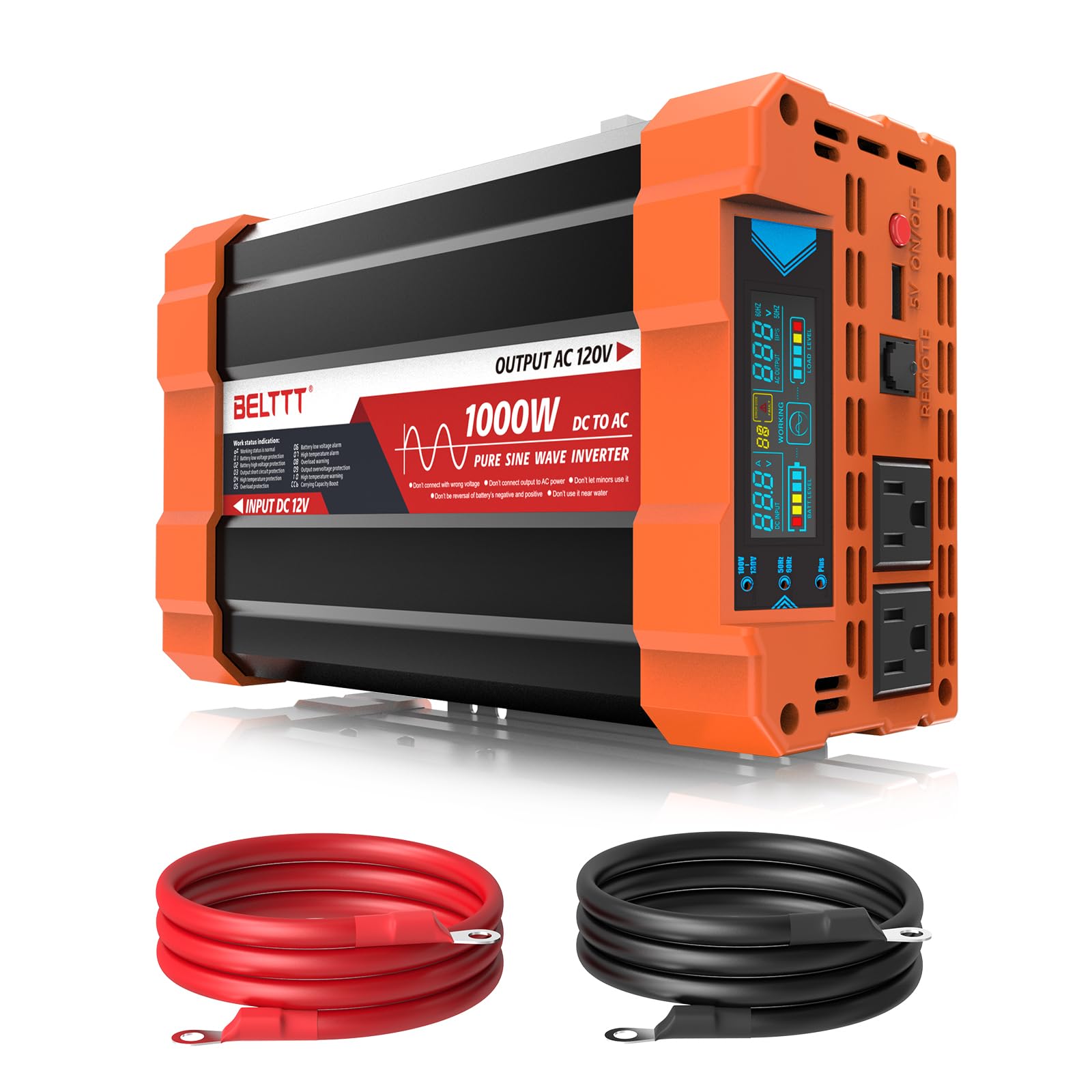
This BELTTT 1000W pure sine wave inverter hits a sweet spot for RV owners, truck campers, and off-grid solar users who need clean power for sensitive devices but don’t require the full 3000W. The high-brightness LCD smart screen simultaneously displays input voltage, output voltage, battery level, and load status—allowing you to spot a low battery or overload condition without guesswork. The unit uses two 5AWG battery cables (included) for a solid direct connection, and the aluminum-and-plastic hybrid housing is both rugged and lightweight at 4.37 lbs.
With a conversion efficiency above 90% and low no-load losses, this inverter is efficient enough to leave connected to a battery bank without draining it overnight. The fan operates on demand, staying off at low loads and only spinning up when the internal temperature rises. The pure sine output is stable and clean, eliminating flicker and hum from LED lights and audio equipment. Reviewers report running televisions, laptops, air purifiers, and small power tools without any interference or overheating.
The biggest caveat: the included battery cables are adequate for loads up to about 800W continuous but may run warm at sustained 1000W draw. Serious users should upgrade to 4AWG or thicker cables for full-rated performance. The USB port is limited to 5V 2.1A (10W), so you’ll need to use the AC outlets for modern fast-charging. The remote display option (not included) would be a welcome addition, but at this price for a pure sine unit, it’s hard to complain.
Why it’s great
- Affordable 1000W pure sine wave with intelligent LCD display
- High conversion efficiency (>90%) with low idle current
- Fan only runs when needed; quiet during normal operation
Good to know
- Included cables are borderline for full 1000W continuous load
- USB port is only 5V 2.1A (no fast charging)
- No remote display included (separate purchase)
5. Vansoet 400W Modified Sine Wave Inverter
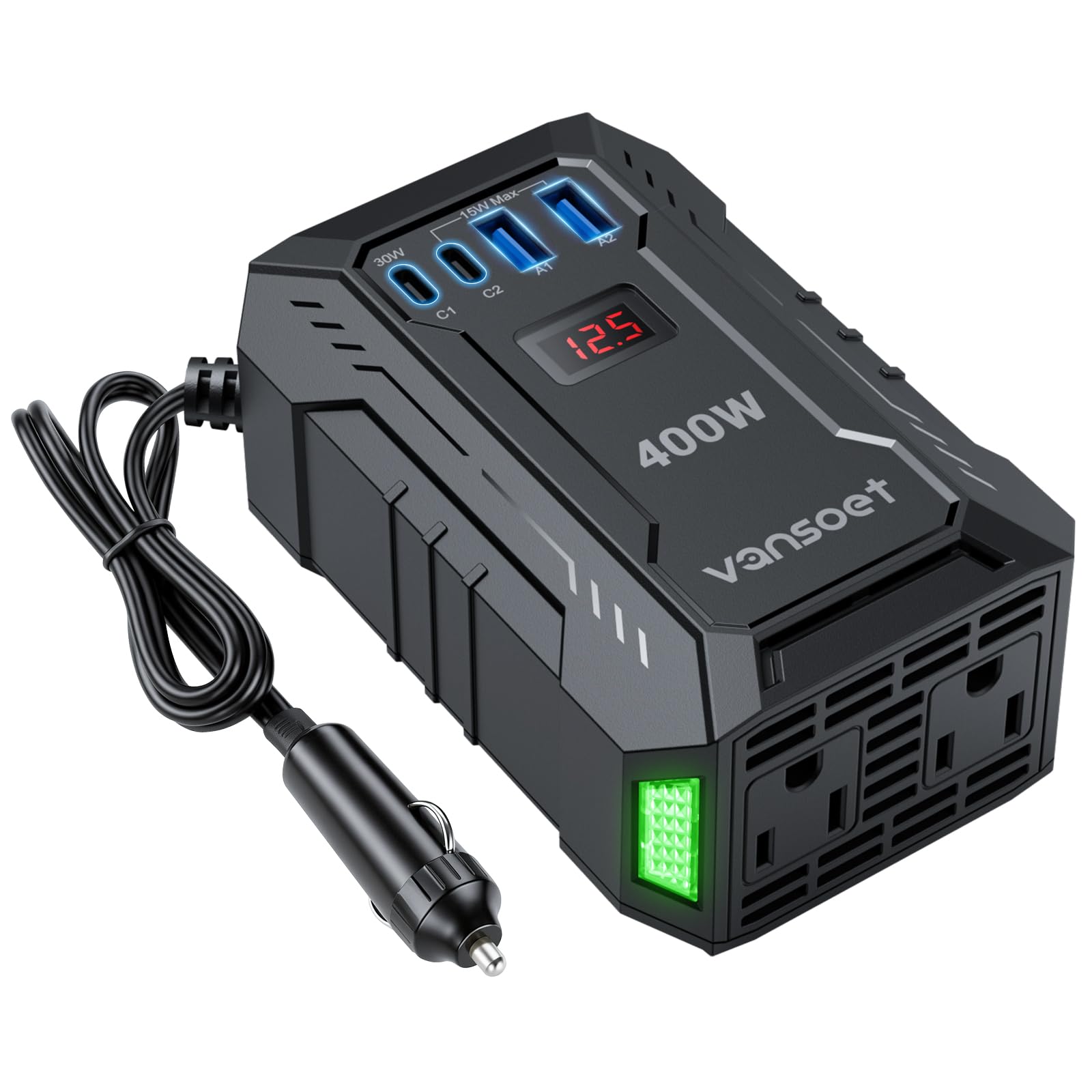
For most drivers who need a reliable, compact inverter for daily road trips, commuting, and camping, this Vansoet 400W unit hits the sweet spot. It packs two standard AC outlets, a 30W PD USB-C port, an additional 15W USB-C port, and two 15W USB-A ports into a package that fits in a cup holder. The real-time voltage display on the front panel shows your car battery voltage at a glance, so you can monitor charge level and avoid draining the battery below cranking voltage—a feature usually reserved for more expensive units.
The intelligent temperature-controlled cooling fan only activates when needed, keeping the unit silent during light device charging. The dedicated AC on/off switch lets you disable the AC outlets independently while still using the USB ports, saving energy and reducing unnecessary load on your alternator. The 400W continuous/800W peak rating is enough to run a laptop, charge a camera battery pack, and keep a mini cooler going simultaneously. Modified sine wave is fine for these devices; just avoid running motor-driven appliances or sensitive medical equipment.
The single consistent complaint across reviews is that the included cigarette lighter cable is on the shorter side (roughly 24 inches), which can limit placement options in larger vehicles. A few users also wished for a 65W PD port instead of 30W to charge larger laptops at full speed. That said, for the combination of compact size, multiple USB formats, real-time voltage monitoring, and reliable performance, this is the best all-around choice for everyday auto power needs.
Why it’s great
- Real-time battery voltage display prevents accidental drain
- Multiple USB ports including 30W PD USB-C and extra 15W USB-C
- Dedicated AC on/off switch with independent USB operation
Good to know
- Cigarette lighter cable is shorter than ideal (about 24 inches)
- PD port is 30W, not 65W (won’t fast-charge large laptops at full speed)
- Modified sine wave—not safe for CPAPs or sensitive medical gear
6. BESTEK 300W Modified Sine Wave Inverter

If your primary reason for buying an inverter is to charge a MacBook Pro and an iPhone simultaneously while working from your car, this BESTEK 300W unit is the most purpose-built option available. The 65W PD USB-C port delivers full-speed charging for a 13-inch MacBook Pro, iPad Pro, and any modern USB-C laptop, eliminating the need for the bulky AC adapter. The QC 18W USB-A port handles older devices at maximum speed. Smart power distribution automatically adjusts charging rates when both USB ports are used together.
BESTEK holds a US design patent (D785,565 S) for this form factor, and the red aluminum housing is compact enough to fit in a cup holder or slip into a laptop bag. The wide 11V-17V input voltage range makes it compatible with Tesla and other electric vehicles, which is rare at this price point. The intelligent cooling fan is genuinely silent during normal use—reviewers consistently highlight how quiet it is compared to budget units. ETL certification provides independent safety verification.
The trade-off is the 300W continuous/700W peak limit. You can charge two laptops and a phone simultaneously, but you cannot run a mini fridge, a power tool, or even a high-wattage camera battery charger at the same time as the laptop. A few users noted the 24-inch cable can be awkward in larger vehicles. For a dedicated mobile office setup where clean USB-C PD charging is the priority, this is the most elegant solution on the list.
Why it’s great
- 65W PD USB-C fast-charges MacBooks without AC adapter
- ETL certified with 5-year warranty and 180-day guarantee
- Ultra-compact; fits in cup holder or laptop bag
Good to know
- 300W continuous limits simultaneous device usage
- Short 24-inch cable can be restrictive in large vehicles
- Modified sine wave (fine for laptop chargers, but not for motors)
7. Pro Chaser 400W Modified Sine Wave Inverter
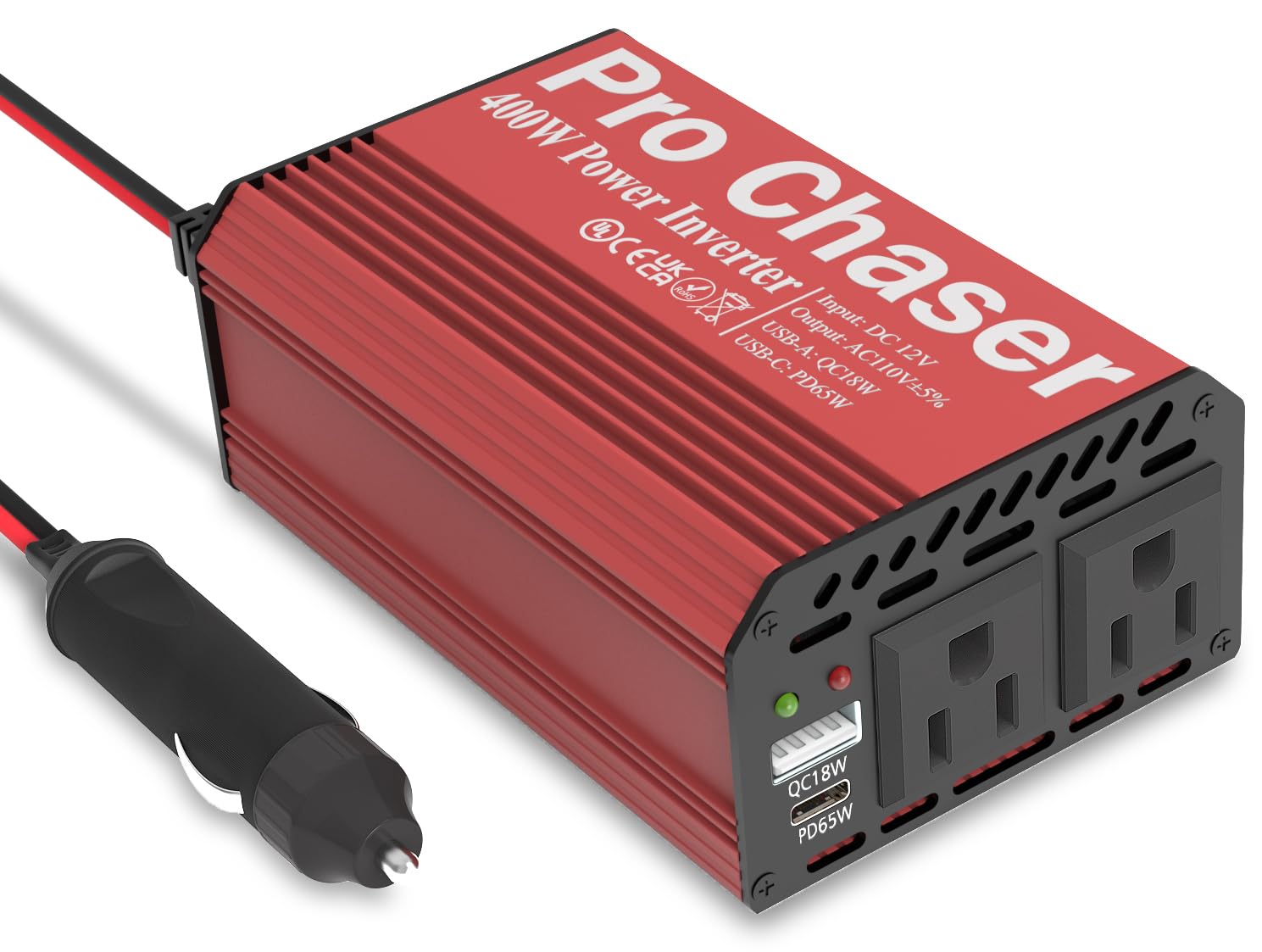
This Pro Chaser 400W inverter delivers the same 65W PD USB-C fast charging found in the pricier BESTEK unit, but with a higher 400W continuous rating and an extended 30-inch cord that reaches farther into the back seat. The cellphone-sized design with a red housing is compact enough to stash in the glove box when not in use. The fan remains quiet during normal operation and only activates when the internal temperature exceeds 113°F—which means it stays silent during phone and laptop charging.
The dual AC outlets are independent and each can handle roughly 200W respectively, so you can run a laptop and a small camera battery charger simultaneously. The built-in safety protections cover short circuit, overload, low voltage, over-voltage, and overheating. Pro Chaser includes a clear FAQ warning: using the PD65W port together with a high-wattage AC device may exceed the vehicle socket’s limit, so you should only connect one high-power device at a time if using the cigarette lighter plug.
Reviewers consistently note that the unit works well for powering heating pads, boomboxes, and laptop chargers, and they appreciate the quiet operation. The main downsides are the limited number of USB ports (one 65W PD USB-C and one 18W QC USB-A) compared to the Vansoet unit, and the fact that the AC outlets lack a dedicated on/off switch—you must unplug the inverter to disconnect power. For a budget-friendly option that still offers modern fast charging, this is a solid value pick.
Why it’s great
- 65W PD USB-C fast charging at a budget-friendly price
- Extended 30-inch cable reaches rear seats easily
- Very quiet operation; fan only triggers at 113°F
Good to know
- No dedicated AC on/off switch; must unplug to power down
- Only 2 USB ports total (less variety than Vansoet unit)
- May trip vehicle socket if PD65W and AC high-wattage device used together
FAQ
Can I run a refrigerator or freezer from a car inverter?
Will an inverter drain my car battery completely?
Why does my laptop charger hum when connected to a car inverter?
What is the difference between hardwiring and using the cigarette lighter plug?
Can I use an auto inverter with a lithium (LiFePO4) battery?
Final Thoughts: The Verdict
For most users, the auto inverter winner is the Vansoet 400W because it combines real-time battery voltage monitoring, multiple USB port formats including 30W PD USB-C, and a compact form factor at a reasonable price point—covering the widest range of daily driving and road trip needs. If you need clean pure sine power for sensitive electronics and are willing to hardwire, the Giandel 300W Pure Sine is the best value for CPAP users, gamers, and audio enthusiasts. And for heavy-duty off-grid power where you need to run a refrigerator, power tools, or full-size appliances, the VOLTWORKS 3000W Pure Sine with its 30ft remote controller delivers the most capable, clean power solution on this list.