
Our readers keep the lights on and the weekend projects moving. As an Amazon Associate, I earn from qualifying purchases.
Basement wall seepage — that persistent damp spot, the white powdery efflorescence, or the musty odor after heavy rain — is a signal that moisture is migrating through the concrete or masonry. A quality basement wall sealer does not just paint over the problem; it penetrates the pores and forms a chemical bond that repels liquid water while still allowing the wall to breathe and release trapped vapor. Without the right sealer, you risk mold growth, foundation degradation, and finished space damage.
I’m Rikta — the co-founder and writer behind FitlyFast. I have spent countless hours analyzing the chemical formulations, application methods, and real-world performance data of waterproofing sealers to help you pick the one that actually stops the leak without trapping moisture inside your walls.
Whether you are dealing with a damp block wall or a leaking poured concrete foundation, choosing the right basement wall sealer determines whether your repair lasts a season or a decade.
How To Choose The Best Basement Wall Sealer
Selecting a basement wall sealer requires matching the product chemistry to your wall material and moisture level. A silane-siloxane penetrating sealer works best for concrete and brick that needs breathability, while a liquid rubber membrane is better for below-grade block walls with active hydrostatic pressure. Key factors include whether the sealer is water-based or solvent-based, its vapor permeability rating, and the surface preparation required for proper adhesion.
Penetrating vs. Film-Forming Sealers
A penetrating sealer, typically silane-siloxane, soaks into the substrate and reacts with the minerals to create a hydrophobic barrier inside the pores. This type does not change the surface appearance and allows water vapor to escape. A film-forming sealer, such as acrylic or liquid rubber, creates a continuous coating on the surface. While effective against direct liquid water, it can peel or blister if trapped moisture pushes from behind — a common failure point on basement walls.
Vapor Permeability and Breathability
Below-grade walls are constantly exposed to ground moisture and vapor drive. A sealer that is not breathable can trap moisture inside the wall, leading to spalling or coating delamination. Look for products that explicitly list vapor transmission rates or are marketed as breathable. Silane-siloxane sealers naturally excel here because they do not form a surface film.
Coverage and Application Method
Coverage rates vary widely — from 50 square feet per gallon for thick liquid rubber to 225 square feet per gallon for penetrating formulas. Consider the total wall area you need to treat. Application by low-pressure pump sprayer is faster for penetrating sealers, while liquid rubber products generally require a brush or roller for even thickness. Always account for two coats when calculating project volume.
Quick Comparison
On smaller screens, swipe sideways to see the full table.
| Model | Category | Best For | Key Spec | Amazon |
|---|---|---|---|---|
| Armor SX5000 WB | Penetrating | Long-term waterproofing | 175-225 sq ft/gal | Amazon |
| Ames Block & Wall | Elastomeric | Below-grade foundations | Thick liquid rubber | Amazon |
| MasonryDefender Deep Penetrating | Silane-Siloxane | Invisible protection | 90-150 sq ft/gal | Amazon |
| MasonryDefender All Purpose | Multi-Surface | Brick & stone walls | 90-150 sq ft/gal | Amazon |
| AMES Blue Max White | Liquid Rubber | Crack bridging | 900% elongation | Amazon |
| Armor AR350 Low Gloss | Wet Look | Finished appearances | 175-225 sq ft/gal | Amazon |
| Wadities Clear Sealant | Bulk Repair | Large area coverage | 280 sq ft/5 gal | Amazon |
In‑Depth Reviews
1. Armor SX5000 WB Silane-Siloxane Sealer

The Armor SX5000 WB is a professional-grade water-based silane-siloxane sealer that chemically bonds below the surface to reduce water absorption by up to 95 percent. It delivers between 175 and 225 square feet of coverage per gallon and creates a vapor-permeable barrier that will not trap moisture, making it ideal for concrete basement walls that need to breathe. Users report effective water beading that lasts through several seasons, with no change to the surface color or texture.
Formulated with US-manufactured resins, this zero-VOC formula has no odor and cleans up easily with soap and water. The sealer is ready-to-use and applies evenly with a standard pump sprayer, and its deep penetration means there is no surface film to peel or wear away. Customers note that the Armor SX5000 WB performed well even on previously spalled concrete, slowing further deterioration and keeping treated areas clean longer than before.
Its long-lasting protection is rated for 7-10 years, which translates to fewer reapplication cycles compared to budget acrylic options. While it carries a premium price per gallon, the higher coverage rate and extended lifespan make it a cost-effective choice for homeowners who want a set-and-forget solution for their basement walls. This is the sealer to choose when you want maximum performance without altering the natural look of your foundation.
Why it’s great
- Reduces water absorption up to 95% without a surface film
- Zero VOCs and no odor for indoor basement application
- Coverage up to 225 sq ft per gallon for efficient use
Good to know
- Requires clean, dry, and absorbent concrete for proper bonding
- Premium-priced compared to film-forming sealers
2. Ames Block & Wall Liquid Rubber Waterproofer

The Ames Block & Wall Liquid Rubber Waterproofer is a thick elastomeric membrane specifically designed for below-grade foundations, retaining walls, and concrete block. In contrast to penetrating sealers, this product sits on the surface to provide a continuous rubber barrier that bridges small cracks and resists hydrostatic pressure. Its white, paint-like finish brightens dark basement walls while sealing out ground moisture.
Users consistently describe the consistency as very thick — akin to cake frosting — which allows it to fill minor voids and surface irregularities without running off vertical walls. The formula requires a brush or roller for application, and most customers recommend two coats for full protection. Once cured, the coating has a slight glossy sheen and feels tough and durable, holding up well against direct water contact.
Ames manufactures this product in the USA, and it remains popular among homeowners who have relied on it for ten years or more on the same basement walls. The key trade-off is that it is a film-forming sealer, so it should not be applied to walls with active moisture wicking from the back. For dry or properly drained walls, however, it provides reliable, long-term waterproofing that is easy to touch up and maintain.
Why it’s great
- Thick liquid rubber fills cracks and voids in block walls
- Bright white finish improves basement appearance
- Long-term durability with easy soap-and-water cleanup
Good to know
- Film-forming sealer may trap vapor if walls are damp from behind
- Requires a brush or roller, slower application than spray
3. MasonryDefender Deep Penetrating Concrete Sealer
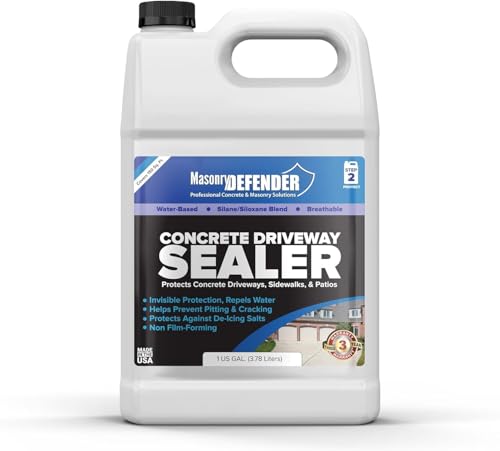
MasonryDefender Deep Penetrating Concrete Sealer uses a silane-siloxane formula that soaks into the substrate to provide invisible water-repellent protection. Unlike film-forming coatings, this sealer does not alter the color, sheen, or texture of the wall, which is ideal for exposed basement walls where appearance matters. The formula bonds chemically with concrete and masonry to create a hydrophobic layer that causes water to bead and roll away.
Each gallon covers between 90 and 150 square feet, which is typical for a penetrating sealer. The product is easy to apply with a low-pressure garden sprayer, and it dries clear without residue. Customers note that treated concrete stays cleaner and resists mold growth better than untreated surfaces, with one reviewer reporting excellent results after three years on a driveway that was left exposed to Pacific Northwest rains.
For basement walls, this sealer works best when applied to clean, dry masonry that does not have active leaks. It is a budget-conscious entry into the silane-siloxane category, delivering many of the same benefits as premium brands at a lower per-gallon cost. While its coverage is tighter and longevity may not match top-tier options, it remains a solid choice for routine preventive sealing on concrete basement walls.
Why it’s great
- Invisible protection that preserves natural wall appearance
- Easy spray application with no odor or harsh fumes
- Budget-friendly price for silane-siloxane technology
Good to know
- Coverage is 90-150 sq ft/gal, lower than premium penetrators
- Requires clean, dry surface for proper bonding
4. MasonryDefender All Purpose Brick Stone & Concrete Sealer

The MasonryDefender All Purpose Sealer is formulated to work on a broader range of surfaces beyond standard concrete — including brick, stone, limestone, granite, and cultured sandstone. This makes it a flexible option for basement walls that incorporate multiple materials, such as a stone foundation with concrete parging. The silane-siloxane chemistry provides deep penetration and a clear, waterproof barrier that does not alter the substrate color.
Customers report successful use on everything from brick porch walls to stone pillars, with one reviewer specifically solving basement water seepage around a stone post where previous repairs had failed. The sealer applies easily with a garden sprayer and dries quickly, producing visible water beading on the treated surface. Users recommend shaking the container thoroughly before use to prevent clumping that can clog the spray nozzle.
At a slightly higher price point than the standard MasonryDefender, this all-purpose version delivers the same 90 to 150 square feet of coverage per gallon but with expanded material compatibility. For homeowners whose basement walls include mixed masonry, this sealer eliminates the need to buy separate products for different surfaces. The trade-off is that specialized formulas from dedicated concrete or brick sealers may offer marginally better performance on a single substrate.
Why it’s great
- Works on concrete, brick, stone, and cultured masonry
- Clear penetrating formula does not change surface look
- Quick drying with visible water beading after application
Good to know
- Must shake well to avoid nozzle clogs from settled solids
- Coverage on porous stone may require additional product
5. AMES Blue Max White Liquid Rubber Waterproofer

AMES Blue Max White is a high-strength elastomeric liquid rubber that delivers 900 percent elongation, meaning it can stretch and contract with the substrate without cracking or peeling. This flexibility makes it an excellent choice for basement walls that experience settlement cracks or temperature-driven movement. The coating forms a thick white membrane that adheres strongly to concrete, wood, and metal.
The product is non-toxic, eco-friendly, and VOC compliant in all 50 states, making it suitable for indoor basement use. Application requires a brush, roller, or sprayer, with a 24-hour drying period between coats. Customers have used it for a wide range of waterproofing tasks beyond walls, including sealing subfloors and shower components, often praising its ease of use and strong adhesion.
Because Blue Max is a film-forming membrane, it works best on surfaces that are not under constant hydrostatic pressure. Users who applied it outdoors noted that it requires a top coat if exposed to direct sunlight. Inside a basement, it provides a durable, flexible seal that can bridge minor cracks and expand with the wall. For homeowners concerned about ongoing foundation movement, this rubber membrane offers a level of forgiveness that rigid coatings cannot match.
Why it’s great
- 900% elongation resists cracking from wall movement
- Non-toxic and low-VOC formula for indoor use
- Strong adhesion to concrete, wood, and metal surfaces
Good to know
- Requires a top coat if used in direct sunlight
- Film-forming membrane may trap vapor on damp walls
6. Armor AR350 Low Gloss Wet Look Concrete Sealer

The Armor AR350 is a solvent-based acrylic sealer that delivers a low-gloss wet look finish, dramatically darkening and enhancing the natural color of concrete and pavers. Unlike penetrating sealers, the AR350 creates a visible surface coating that adds depth and richness to basement walls made of stamped or finished concrete. It is self-priming and covers 175-225 square feet per gallon.
Application is straightforward with a roller or sprayer, and the sealer dries to a durable, non-yellowing finish that resists UV damage, road salts, and foot traffic. Customers have reported the coating lasting five years or more on garage floors and even transforming the appearance of stamped concrete patios. However, the solvent-based formula carries a strong chemical odor that requires a respirator for safe indoor use, making it less suitable for enclosed or poorly ventilated basement spaces.
This sealer is best reserved for finished basement walls where appearance is a priority and proper ventilation can be achieved. It provides a tough, glossy barrier that protects against moisture and abrasion. For homeowners who want the visual impact of a wet-look finish combined with long-term waterproofing, the AR350 delivers premium results — but only where the strong solvent smell can be managed during cure time.
Why it’s great
- Enhances color with a rich, low-gloss wet look finish
- Self-priming and durable for multi-year protection
- High coverage rate of up to 225 sq ft per gallon
Good to know
- Strong VOC odor requires respirator and good ventilation
- Film-forming sealer not ideal for actively damp walls
7. Wadities Liquid Waterproof Sealant Clear
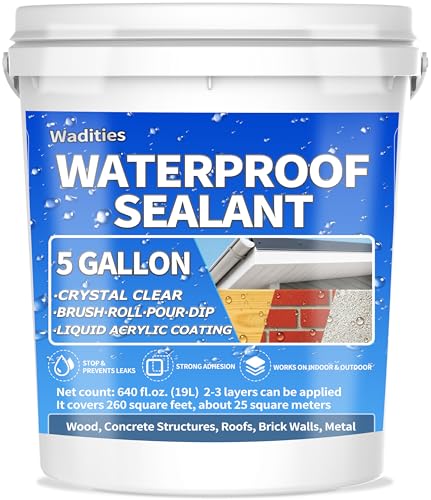
The Wadities Liquid Waterproof Sealant is a clear, water-based rubber coating that comes in a 5-gallon pail, providing approximately 280 square feet of coverage when applied in 2-3 coats. This bulk format makes it an economical option for sealing large basement wall areas or tackling multiple repair projects at once. The clear formula dries to a shiny flexible film that adheres to concrete, metal, wood, and PVC.
This sealant is UV-stabilized and designed to resist cracking in cold weather, which expands its usability to both interior and exterior applications. Users report success sealing gutters, window sills, and even humidifier containers, noting that it forms a thick, forgiving layer that cures over 48-72 hours. The product is designed to penetrate cracks and seal leaking joints immediately.
For basement walls, the Wadities sealant works best as a patch-and-repair solution for cracks and pipe penetrations rather than as a whole-wall waterproofing treatment. Because it is a film-forming coating, it should not be applied to walls with active moisture wicking. The 5-gallon volume is excellent value for those who need to cover extensive square footage, though the clear finish may not be the aesthetic choice for finished basement spaces.
Why it’s great
- 5-gallon bulk pail provides extensive coverage for large projects
- Clear flexible formula seals cracks and pipe penetrations
- UV resistant and cold-weather stable for indoor and outdoor use
Good to know
- Film-forming sealer may delaminate on actively damp walls
- Clear shiny finish not suitable for all aesthetic preferences
FAQ
Can I apply a basement wall sealer over existing paint or Drylok?
How long should I wait before painting over a sealed basement wall?
Final Thoughts: The Verdict
For most users, the basement wall sealer winner is the Armor SX5000 WB because its penetrating silane-siloxane formula provides breathable, long-lasting waterproofing without altering wall appearance or risking trapped vapor. If you need a thick membrane to bridge cracks and fill voids in block walls, grab the Ames Block & Wall Liquid Rubber Waterproofer. And for a budget-friendly penetrating option that still delivers strong water repellency, nothing beats the MasonryDefender Deep Penetrating Concrete Sealer.