
Our readers keep the lights on and the weekend projects moving. As an Amazon Associate, I earn from qualifying purchases.
Every podcaster knows the moment: you upload your episode, press play, and hear a constant background hiss or a hollow, distant quality to your voice. That noise floor isn’t a production quirk — it’s the sound of a mixer with subpar preamps or gain staging fighting your microphone. The right interface turns that struggle into broadcast-ready clarity with a single button push.
I’m Rikta — the co-founder and writer behind FitlyFast. I’ve spent hundreds of hours analyzing audio interface specifications, customer real-world feedback, and the subtle differences in preamp design that separate beginner frustration from professional results.
Whether you’re a solo host or running a multi-guest interview show, finding the right audio mixer for podcasting means balancing channel count, preamp gain, connectivity for remote guests, and workflow features like sound pads and auto-leveling.
How To Choose The Best Audio Mixer For Podcasting
The market is flooded with audio interfaces and mixers, but podcasting demands a specific set of features that live sound or DJ gear often skips. You need pristine preamps for voice, mix-minus for phone calls, and enough I/O for your co-hosts without paying for channels you’ll never use.
Preamp Gain & Noise Floor
Your microphone is only as good as the preamp feeding it. Dynamic mics like the Shure SM7B need over 60dB of clean gain to reach proper levels without introducing hiss. Look for specs listing EIN (Equivalent Input Noise) below -127dBu — any higher, and you’ll hear the noise floor rise as you crank the gain.
Channel Count & Connectivity
One host and one guest need at least two XLR inputs with independent headphone outputs. Add a third mic for a producer, and you’re already shopping for 4+ channels. Also confirm the mixer handles mix-minus on a dedicated Bluetooth or TRRS phone input — routing calls without echo is a non-negotiable for interview shows.
Onboard Effects & Workflow Tools
Sound pads, auto-gain buttons, and built-in compressor/EQ reduce post-production time significantly. A mixer with customizable pads lets you trigger intros, transitions, and sound effects live, while auto-leveling saves beginners from clipping disasters. If you value a lean editing timeline, these features matter more than raw channel count.
Quick Comparison
On smaller screens, swipe sideways to see the full table.
| Model | Category | Best For | Key Spec | Amazon |
|---|---|---|---|---|
| RØDE RØDECaster Duo | Premium All-in-One | Professional production with APHEX processing | 76dB gain, -131.5dBV EIN | Amazon |
| Mackie ProFX10v3+ | Premium Analog | Analog warmth with digital recording | 24-bit/192kHz USB-C | Amazon |
| TASCAM Mixcast 4 | Premium Workstation | Standalone SD recording with sound pads | 4 XLR inputs, 14-track SD | Amazon |
| Zoom LiveTrak L-8 | Premium Portable | Battery-powered multitrack recording | 12-track SD, 4 headphone outs | Amazon |
| Behringer FLOW 8 | Mid-Range Digital | App-controlled digital flexibility | 8 inputs, 60mm faders | Amazon |
| Numark M6 USB | Mid-Range DJ | DJ-heavy podcast setups with vinyl | 4 channels, replaceable crossfader | Amazon |
| Pyle PMXU46BT | Mid-Range Analog | Simple multi-mic with Bluetooth streaming | 4 channels, +48V phantom | Amazon |
| MAONO MaonoCaster AME2 | Entry-Level Production | Budget studio with 11 sound pads | 10 channels, 60dB gain | Amazon |
| Focusrite Vocaster Two | Entry-Level Interface | Simple two-host USB interface | 70dB gain, Auto Gain | Amazon |
In‑Depth Reviews
1. RØDE RØDECaster Duo
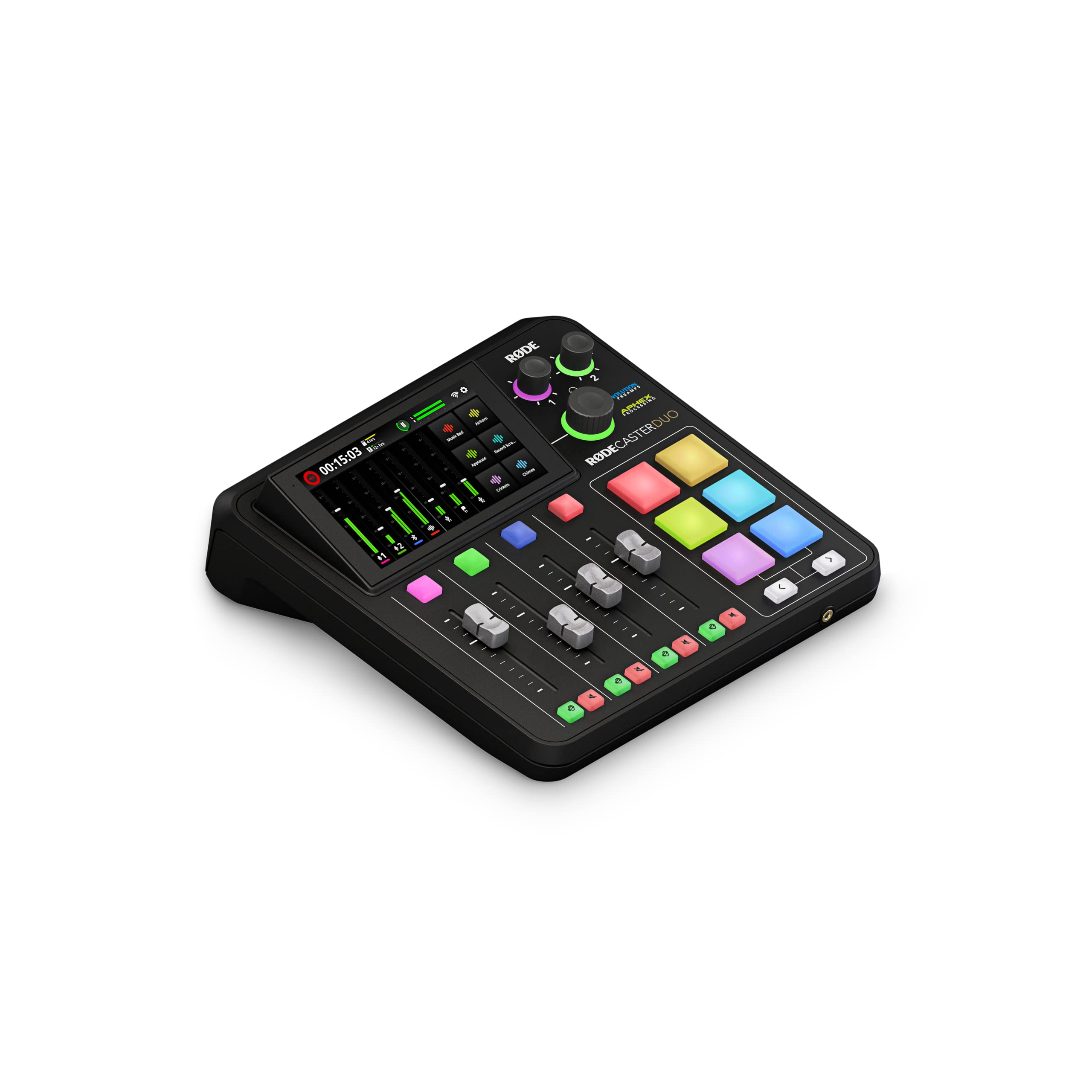
The RØDECaster Duo delivers enterprise-level audio processing in a compact desktop footprint. Its Revolution Preamps boast 76dB of gain with an EIN of -131.5dBV, meaning even a notoriously gain-hungry dynamic mic like the SM7B will produce a clean, full-bodied signal without an external booster. The four broadcast-quality faders and high-resolution touchscreen with haptic feedback let you control every aspect of the mix without digging through software menus — ideal for live streaming and recording.
Studio-grade APHEX processing is built directly into the unit, including the legendary Aural Exciter and Big Bottom effects. These aren’t gimmicks; they add presence and warmth to vocal tracks that would normally require post-production plugins. The six SMART pads with bank switching can trigger intros, ad reads, and sound effects on the fly, making your workflow faster than a typical audio interface and laptop setup.
The dual Neutrik combo jacks support both XLR microphones and 1/4-inch instrument inputs, and the 3.5mm TRRS input accommodates a broadcast headset like the NTH-100M for monitoring or recording. It also serves as a 2×2 USB audio interface for your DAW. Some users report a steep learning curve for routing, and the software has had occasional stability issues, but the sheer sonic ceiling here is unmatched in this list.
Why it’s great
- Ultra-clean 76dB preamps handle any mic without booster
- APHEX processing adds professional polish in real time
- SMART pads and touchscreen streamline live production
Good to know
- Setup can be complex for absolute beginners
- Firmware stability has been inconsistent across early batches
2. Mackie ProFX10v3+

The Mackie ProFX10v3+ is a 10-channel analog mixer that doubles as a 2×4 USB-C audio interface with a top-tier 24-bit/192kHz sample rate. The Onyx mic preamps deliver a warm, slightly colored tone that voiceover artists and musicians alike appreciate — it’s the same circuitry found in Mackie’s pro studio consoles. With switchable USB recording modes including Loopback for streaming, this mixer seamlessly merges analog character with modern digital workflow.
The upgraded GigFX+ effects engine is fully editable and savable via the color LCD screen, letting you dial in reverb, delay, chorus, and compression without external gear. The dedicated Bluetooth channel supports bidirectional audio with Mix Minus, which means you can bring in a phone call and route it to your co-host’s headphones without echo. The one-knob compression per channel is a lifesaver for taming plosives and inconsistent mic technique.
Build quality is classic Mackie: metal chassis, smooth faders, and secure XLR jacks. The unit includes 100Hz low-cut filters and Hi-Z switches on channels 1-2 for direct instrument input. The only drawback for podcasters is the lack of a second dedicated output bus, which could complicate complex monitoring setups for larger groups.
Why it’s great
- Warm Onyx preamps with one-knob compression on each channel
- 24-bit/192kHz USB-C interface with Loopback mode
- Bluetooth with Mix Minus for clean phone call integration
Good to know
- Only one aux send limits multi-monitor setups
- Some users report power supply failures after extended use
3. TASCAM Mixcast 4

The TASCAM Mixcast 4 is engineered specifically for podcast and streaming workflows, offering four XLR/TRS combo inputs and four independent headphone outputs — enough for a host, two co-hosts, and a producer. The standout feature is the 14-track onboard SD card recording: you can record every mic and line input as separate tracks, then transfer the files to your computer for editing without ever turning on a DAW during the session.
The unit’s eight banks of customizable sound pads, each with full-color illumination, let you trigger jingles, intros, and sound effects in real time. Assigning new sounds is straightforward via the Tascam Podcast Editor software, which also handles post-production trimming and track arming. The touch panel interface is responsive, and the per-channel compressor and EQ give you fine control over each voice in the mix.
Bluetooth audio input and a dedicated TRRS phone input (with mix-minus) make remote interviews simple. The onboard effects are solid, though not as deep as the APHEX processing on the RØDECaster. Some users note the firmware updates are less frequent than competitors, and the USB playback channel can clip if processing is enabled, but for pure podcast-centric hardware at this level, it’s tough to beat.
Why it’s great
- 14-track standalone recording to SD card
- Four independent headphone outputs with individual mixes
- Customizable sound pads with easy app-based assignment
Good to know
- Firmware updates are less frequent than RØDE or Mackie
- USB playback may require processing bypass to avoid clipping
4. Zoom LiveTrak L-8

The Zoom LiveTrak L-8 is a hybrid mixer/recorder built for portable multitrack capture. It features six combo XLR/TRS inputs plus two stereo line inputs, all feeding a 12-track 24-bit/96kHz recorder that writes directly to a standard SD card. The standout spec is the ability to run on AA batteries or USB power — you can record an entire interview in a park, coffee shop, or field location without hunting for an AC outlet.
The preamps offer up to 54dB of gain with a -121dBu noise floor, which is clean enough for most dynamic mics. Each channel has a 3-band EQ and onboard effects, plus you can create three independent monitor mixes across the four headphone outputs. This is crucial for live podcast audiences where the host, guest, producer, and engineer all need different cue blends.
The L-8 also functions as a USB audio interface, recording to SD and computer simultaneously. It lacks the automated features of the RØDECaster — no auto-gain or sound pads — and uses micro USB, which feels dated. But for podcasters who need location flexibility or a mobile recording station, the battery-powered SD recording is a unique capability no other mixer in this lineup matches.
Why it’s great
- Battery-powered standalone recording to SD card
- Three independent monitor mixes for up to four headphones
- 12-track simultaneous recording at 24-bit/96kHz
Good to know
- Micro USB interface feels outdated for the price
- No auto-gain or sound pad features for workflow automation
5. Behringer FLOW 8

The Behringer FLOW 8 packs digital mixer capabilities into a compact chassis just over an inch tall, making it the most portable option with physical faders. It has two Midas-designed microphone preamps with 48V phantom power and programmable gain, plus the EZ-Gain function that automatically sets optimal input levels — a fantastic time-saver for solo podcasters who don’t want to fuss with gain staging mid-recording.
The Bluetooth FLOW App gives you wireless remote control from an iOS/Android device, allowing you to adjust EQ, effects, and levels from across the room. The 60mm channel faders feel smooth and precise, and the rotary master control features a colored LED collar for quick visual feedback. With eight digital input channels (including stereo line and Bluetooth), you have room for multiple sources without the bulk of a traditional analog board.
Some users report the initial setup is unintuitive — default gain is set to zero, and pairing requires navigating the menu system. The headphone amplifier is on the weaker side, struggling with closed-back studio headphones like the Audio-Technica M50x. Channels 3-4 have been noted to introduce a slight noise floor. Still, for the size and digital flexibility, the FLOW 8 is a unique mid-range option.
Why it’s great
- EZ-Gain automation sets levels instantly
- Compact digital footprint with full 60mm analog faders
- App-based remote control for wireless mixing
Good to know
- Headphone amp is weak for high-impedance headphones
- Setup menu is not beginner-friendly initially
6. Numark M6 USB

The Numark M6 USB is a classic 4-channel DJ mixer that doubles as a USB audio interface. It’s built around a replaceable crossfader with slope control, making it ideal for podcasters who also mix music beds or do live DJ sets during their show. The three-band EQ per channel (treble, mid, bass) offers precise tonal control, and the dedicated cue system lets you preview tracks before bringing them into the main mix.
Input connectivity is robust: multiple phono and line inputs, a dedicated microphone input with its own EQ, plus master, record, and booth outputs via RCA. The USB plug-and-play connection works with Mac and PC, allowing you to record your mix directly to any DAW. The all-metal chassis is sturdy enough for weekly transport between venues or studio setups.
The faders are known to feel stiff initially and may develop crackle after months of heavy use. It lacks built-in effects and requires an external audio interface for timecode-based DJ software like Serato or Traktor. For pure podcast dialog, the DJ-oriented layout might feel redundant, but for music-heavy content creators, it’s a flexible workhorse.
Why it’s great
- Replaceable crossfader with slope control for DJ usage
- Metal construction is road-ready and durable
- Dedicated cue controls and three-band EQ per channel
Good to know
- Faders can become scratchy over extended use
- No built-in sound pads or vocal effects presets
7. Pyle PMXU46BT

The Pyle PMXU46BT is a straightforward 4-channel analog mixer with built-in Bluetooth and USB playback. It offers two XLR/TRS combo inputs, two stereo line inputs, and a dedicated stereo output with 12-segment level metering. The +48V phantom power lets you use condenser microphones, and the three-band EQ per channel is sufficient for basic vocal shaping.
Bluetooth connectivity allows you to stream background music or bring in a remote caller via your smartphone. The USB soundcard interface lets you record directly to a PC or Mac. The 15-foot wireless range is adequate for small studios. The LED indicator lights and rotary knobs are clearly marked, making this one of the most beginner-friendly mixers in the lineup.
The preamps are not the quietest at this level — users with sensitive dynamic mics may notice a faint noise floor at higher gain settings. The USB interface outputs a single stereo mix only, not individual tracks. Some units have arrived with slightly bent potentiometers. For a budget-conscious podcaster with simple needs, it’s a reliable analog starter.
Why it’s great
- Bluetooth input for wireless music and phone calls
- Clear labeling and LED meters simplify operation
- USB interface enables direct PC recording
Good to know
- Preamps introduce noise at higher gain levels
- Only records a single stereo mix, not multitrack
8. MAONO MaonoCaster AME2

The MAONO MaonoCaster AME2 packs an enormous feature list for its price point: 10-channel mixing, 11 customizable sound pads, 48V phantom power, Bluetooth input, and even a built-in 6.35mm instrument jack for guitar or bass. The preamps deliver up to 60dB of gain with a denoise function, and the 32-bit chipset provides clean enough audio for spoken word and streaming. Six reverb modes and 12-step auto-tune add creative flexibility for music-focused podcasters.
Three of the sound pads support up to 60 seconds of audio with one-key looping, while the remaining eight hold 20-second clips. You can upload your own audio via USB, smartphone, or Bluetooth. The mixer also includes independent volume control for each pad, plus switches for sidechain compression, music-only mode, and loopback recording for live-streams.
Long-term reliability is a concern — multiple user reports indicate units failing after roughly one year of use, with USB-C ports and LED indicators malfunctioning. The headphone monitor output may not perfectly match the final recording level. For the price, the feature depth is impressive, but expect the timeline of a budget electronic device rather than a pro console.
Why it’s great
- 11 customizable sound pads with looping capability
- Built-in 60dB preamps with denoise and 48V phantom
- Instrument input and Bluetooth for versatile source mixing
Good to know
- Reliability concerns — some units fail within a year
- Headphone monitor may not match final stream audio
9. Focusrite Vocaster Two

The Focusrite Vocaster Two is the most streamlined entry-level interface for a two-person podcast. It offers two XLR inputs with over 70dB of gain — enough to drive a Shure SM58 or Rode PodMic without an external booster. The Auto Gain function is a standout: press a button, start talking, and the interface sets your optimal level in seconds, eliminating the guesswork that trips up new podcasters. The built-in Enhance button cycles through four podcast-specific EQ presets that subtly open up the midrange and tighten the lows.
Each host gets their own independent headphone output with a Show Mix control, allowing them to balance their own voice against the guest and any Bluetooth or TRRS phone audio. The Bluetooth connection streams phone calls or music directly into the mix without additional cables. A hardware mute button cuts coughs and interruptions instantly. The lightweight plastic body (1.8 pounds) makes it easy to pack for remote recordings, and it can be powered via a laptop or iPad USB-C port.
The unit requires the Vocaster software for the Enhance presets, which some find restrictive compared to manual EQ. The USB cable included is short and some users report DOA units. The plastic build feels less premium than metal interfaces, and the front-mounted headphone jacks stick out awkwardly. For a simple, zero-fuss two-host setup, the Vocaster Two delivers surprisingly clean audio for its compact size and price.
Why it’s great
- 70dB+ gain drives dynamic mics without booster
- Auto Gain and Enhance presets simplify setup
- Bluetooth and TRRS phone input with independent monitoring
Good to know
- Plastic chassis feels less durable than metal alternatives
- Software locking for Enhance may frustrate advanced users
FAQ
Do I need 70dB of gain for a dynamic podcast microphone?
What is the difference between a USB audio interface and a podcast mixer?
Final Thoughts: The Verdict
For most users, the audio mixer for podcasting winner is the RØDE RØDECaster Duo because it combines ultra-clean 76dB preamps, professional APHEX processing, and intuitive workflow tools in a compact desktop unit. If you want standalone recording without a computer, grab the TASCAM Mixcast 4 with its 14-track SD recording and customizable sound pads. And for a budget-friendly two-person setup that removes all complexity, nothing beats the Focusrite Vocaster Two with its Auto Gain and Enhance features.