
Our readers keep the lights on and the weekend projects moving. As an Amazon Associate, I earn from qualifying purchases.
Bluestone is prized for its rich, natural color variations and clefted texture, but its porous nature makes it a magnet for moisture, stains, and freeze-thaw spalling. The wrong sealer can leave the stone looking plastic, slippery when wet, or, worse, trap moisture that leads to cracking. Choosing a formula that locks out water without locking in vapor is the central challenge of protecting this investment.
I’m Rikta — the co-founder and writer behind FitlyFast. After analyzing hundreds of reviews and technical datasheets for silane-siloxane blends, acrylic topcoats, and DOT-approved impregnators, I have built this guide to cut through the marketing.
Whether you are sealing a new patio, refreshing a century-old walkway, or protecting a high-traffic driveway from deicing salts, this breakdown of the best bluestone sealer will save you from costly mistakes and wasted labor.
How To Choose The Best Bluestone Sealer
Bluestone is a dense, feldspathic sandstone, and its porosity varies wildly depending on the quarry and the cut (full-color, thermal, or natural cleft). A sealer that works beautifully on smooth, thermal-finished flagstone can fail catastrophically on a clefted or tumbled surface. Understanding the interplay between porosity, exposure, and finish type is the first step.
Penetrating vs. Film-Forming Formulas
The single most important decision is whether to use an impregnating water repellent (silane/siloxane or siliconate) or a topical coating (acrylic or polyurethane). Penetrating sealers bond inside the stone’s pores, blocking liquid water while allowing water vapor to escape — this is the only safe choice for exterior bluestone in climates that experience freezing temperatures. Film-forming sealers create a plastic layer on the surface; they enhance color beautifully but can trap moisture, causing the stone to spall or the coating to peel. If you want a glossy shine and the stone is indoors (or in a mild climate), a high-quality acrylic like the Armor AR350 is viable. For all other exterior applications, a penetrating silane-siloxane is the correct tool.
Active Ingredient Concentration (Not Dilution)
Many water-based repellents are 5-10% active silane/siloxane in a water carrier. The Siloxa-Tek 8500 is an ultra-concentrate that is mixed with water at a 1:4 ratio to produce a ready-to-use solution with a much higher active content than most off-the-shelf products. Higher active content generally means deeper penetration and longer protection — measured in years rather than months. For dense bluestone, a high-concentration product ensures the chemical reaches deep enough to resist salt and chloride intrusion without wasting product on runoff. Always check the technical data sheet for weight percent actives, not just the marketing claims.
Finish: Natural, Low Gloss, or Super Wet Look
Bluestone has a natural muted beauty. A penetrating sealer (like Siloxa-Tek or Black Diamond) will create a subtle water-beading effect without changing the stone’s color or texture. A low-gloss acrylic (Armor AR350 or MasonryDefender acrylic) will darken the stone and give it a rich, damp appearance. A super wet-look formula (Shabebe) will create a high-shine, almost glassy surface. The right choice depends entirely on aesthetic preference and the stone’s location — high-gloss on a driveway can look greasy, while low-gloss on a patio can be stunning. Test an inconspicuous area first, because the effect is permanent until the sealer wears off.
Slip Resistance and Safety
Bluestone is naturally slip-resistant because of its cleft texture. A thick film-forming sealer can fill in the microscopic texture and create a slick surface, especially when wet. For patios, pool decks, and walkways, a penetrating repellent that preserves the stone’s natural friction is the safest choice. If you must use a topical sealer for aesthetics, look for a low-gloss or matte acrylic that includes a slip-resistant additive (anti-skid aggregate can be mixed in). Many users report that the Armor AR350, despite being a gloss enhancer, remains safe on textured concrete because it forms a thin, even film — but always test on bluestone specifically before committing to a full application.
Quick Comparison
On smaller screens, swipe sideways to see the full table.
| Model | Category | Best For | Key Spec | Amazon |
|---|---|---|---|---|
| Siloxa-Tek 8500 Ultra Concentrate | Penetrating | Long-term protection, weather resistance | 6x active silane/siloxane (concentrate) | Amazon |
| Armor AR350 Wet Look Acrylic | Topical | Color enhancement, low-gloss finish | Solvent-based, 700 VOC | Amazon |
| Black Diamond Stoneworks | Penetrating | General-use water repellent | Silicone-based, clear spray | Amazon |
| STONETECH Bulletproof | Penetrating | Porous natural stone, stain protection | Water-based, breathable, 16 oz | Amazon |
| Shabebe Super Wet Look | Topical | High-gloss shine, interior slate | Ultra-concentrated, high gloss | Amazon |
| MasonryDefender Patio Paver | Topical | Low-gloss finish, joint sand lock | Water-based acrylic, 1 gallon | Amazon |
| MasonryDefender Silane Siloxane | Penetrating | Bare concrete, water beading | Silane siloxane, 1 gallon | Amazon |
In‑Depth Reviews
1. Siloxa-Tek 8500 Ultra Concentrate

This is the top-performing penetrating sealer for bluestone applications that demand invisible, permanent protection. The active ingredient concentration is six times higher than standard water-based sealers, which means it penetrates deep into the stone’s pore structure — not just sitting on the surface. This deep impregnation creates a water-repellent and chloride-resistant barrier that does not alter the stone’s appearance, texture, or breathability. The gallon concentrate makes five gallons of ready-to-use solution, giving you exceptional coverage without the overhead of multiple containers.
DOT approval (Department of Transportation) means it meets strict standards for resisting deicing salts, which is critical for bluestone driveways and walkways in freeze-thaw regions. The formula is UV-stable and will not break down in direct sunlight. Users report water beading “like glass” even after multiple seasons on saltwater pool decks. The application is straightforward with a garden sprayer, and because it is non-film-forming, there is zero risk of peeling or flaking. Siloxa-Tek 8500 is the standard any serious bluestone treatment should be measured against.
One consideration: the ultra-concentrate must be mixed with water — follow the 1:4 ratio exactly (1 gallon concentrate to 4 gallons water). A small test area is necessary to confirm the coverage rate on your specific bluestone density. For vertical applications by a certified applicator, longevity can reach up to ten years, making this a set-it-and-forget-it solution. If your priority is preserving bluestone’s natural beauty while maximizing weather durability, this is the benchmark product.
Why it’s great
- Deep penetration with ultra-high active silane/siloxane content
- DOT-approved for chloride and deicing salt resistance
- Invisible, breathable protection with water-beading effect
- One gallon makes five gallons of ready-to-use solution
Good to know
- Requires mixing with water before application
- Premium cost per gallon compared to standard repellents
2. Armor AR350 Low Gloss Wet Look Acrylic

The Armor AR350 is the professional-grade choice when you want the deep, rich color saturation that comes from a wet-look film. It is a solvent-based acrylic sealer (available in 700, 350, and 50 VOC formulations) that darkens bluestone to mimic its appearance when wet — bringing out the charcoal, rust, and blue-gray tones. The finish is a low-gloss sheen, not a high-shine plastic look, so it respects the natural texture of the stone. It self-primes, meaning you can recoat without stripping previous layers.
Users report dramatic color enhancement on stamped concrete and slate, with water sheeting off the sealed surface. The durability is excellent for a topical sealer — one gallon covers 175-225 square feet, and the coating can last several years on patios and driveways with moderate foot and vehicle traffic. It provides a sacrificial layer that protects against abrasion, UV rays, and freeze-thaw cycles, but because it is a film, it is only appropriate for climates where moisture vapor can escape through the edges of the stone rather than through its face. Many users apply a second coat for added depth of color.
The trade-off is the strong solvent odor. Application requires a respirator and good ventilation, and cleanup requires a solvent, not soap and water. For those committed to a color-enhanced finish on exterior bluestone, the AR350 is the gold standard. If your stone has visible surface salts or efflorescence, treat it first with a cleaner, as the acrylic film can trap existing deposits underneath. This is not the choice for historical, clefted, or highly porous bluestone where breathability is a non-negotiable requirement.
Why it’s great
- Rich, dramatic color enhancement with low-gloss sheen
- Self-priming — easy to recoat without stripping
- Durable protection against abrasion, UV, and weather
Good to know
- Strong solvent odor — requires respirator
- Film-forming sealer; can trap moisture if improperly applied
3. Black Diamond Stoneworks Concrete Sealer
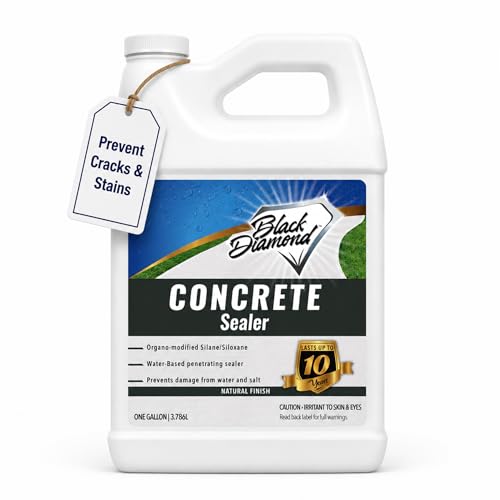
Black Diamond Stoneworks offers an excellent mid-range penetrating sealer that balances cost and performance for homeowners who need reliable water repellency without the complexity of an ultra-concentrate. The silicone-based formula is clear, low-odor, and safe around pets and plants once dry. It is designed to be applied with a sprayer or roller, and cleanup requires nothing more than soap and water. This makes it especially convenient for large areas like bluestone walkways or patio slabs where ease of application directly impacts project time.
The product manufacturer claims protection for up to ten years, with a recommended reapplication window of five to seven years for optimal performance. Real-world user reviews confirm good water beading and easy coverage, with many citing its use on grout and natural stone as well as poured concrete. The low-odor profile means no respirator is needed — a significant advantage over solvent-based options. It is particularly suited for homeowners sealing bluestone for the first time who want a straightforward, foolproof process.
A key limitation is that this product works best on surfaces with moderate porosity. Dense bluestone, especially thermal-finished or tumbled stone, may not absorb enough of the thin, watery formula to achieve deep penetration. Users in very cold climates have noted that the sealer performs well, but storage is critical — the formula is damaged by freezing and must be kept in a temperature-controlled environment. For general-purpose sealing where maximum longevity is not the priority, this is an excellent value proposition.
Why it’s great
- Low-odor and non-toxic — safe around landscaping
- Easy application with sprayer or roller
- Good water beading performance at a fair price
Good to know
- Silicone formula may not penetrate as deeply as silane/siloxane
- Will be damaged if exposed to freezing temperatures
4. STONETECH Bulletproof Sealer

STONETECH Bulletproof Sealer is specifically formulated for the most porous natural stones, tile, and masonry. The water-based, penetrating formula is breathable — meaning it will not trap moisture inside bluestone — and it offers maximum stain protection against both oil and water-based stains. This makes it an ideal choice for bluestone surfaces in dining areas, kitchens, or fireplaces where spills are common. It is professional grade, manufactured by LATICRETE, and is low-odor and non-flammable, suitable for both interior and exterior use.
User reviews highlight the ease of application: it can be applied with a paint edging pad or foam roller, and three coats are typically recommended for maximum protection. One reviewer on marble achieved a fantastic shine with preservation of natural veining. On bluestone, the sealer will maintain the stone’s natural matte appearance while creating a barrier that repels liquids. The 16-ounce size is small, making this product best suited for smaller projects like a bluestone hearth, vanity top, or wall cladding rather than full patios or driveways. The low odor is appreciated for indoor use, and the formula dries clear without altering the stone’s color.
Because it is a penetrating sealer, it will not leave a glossy film or create a slick surface. This is a strong advantage for interior floors or countertops where slip resistance matters. The main drawback is the smaller unit size — you will need multiple bottles for larger areas, and the per-ounce cost is higher than gallon-sized alternatives. For targeted stain protection on discrete bluestone elements, this is the most effective product in this guide.
Why it’s great
- Excellent stain protection for oil and water-based spills
- Breathable, penetrating formula preserves natural look
- Low-odor and safe for indoor use
Good to know
- 16-ounce bottle — not economical for large patios or driveways
- Requires multiple coats for maximum protection
5. Shabebe Super Wet Look Sealer

The Shabebe Super Wet Look Sealer delivers the highest gloss finish in this lineup. The commercial-grade formula creates a glossy, wet appearance that dramatically enhances the color and depth of bluestone, sandstone, slate, and concrete. It is UV-resistant, does not yellow, and is breathable, meaning it allows some vapor movement while maintaining a high-shine film. The manufacturer recommends it for paving machines, stone slabs, driveways, garage floors, patios, and bricks — the “super wet” effect is best appreciated on dark-colored natural slate or smooth thermal bluestone.
User reviews confirm that the product creates a stunning, mirror-like finish on landscape rock and slate tiles. One user diluted it with 30% water to achieve an even, sprayed-on coat. The formula goes on milky white and dries clear — careful application is needed to avoid puddling, which can leave white spots. The coverage is generous: a single gallon covers 150-300 square feet depending on porosity. The product holds up well outdoors, with a durability window of one to three years before reapplication is needed. It is excellent for decorative stone features, accent walls, and fire tables where visual impact is the primary goal.
The significant trade-off is the high-gloss finish itself. On large horizontal surfaces like a bluestone patio, the gloss can look unnatural and can become slippery when wet. The film can also highlight imperfections like saw marks, chips, or uneven surfaces. This sealer is also not recommended for polished stone or tile. For homeowners who want a bold, “always wet” look on specific bluestone elements, this delivers on the promise, but it requires careful surface preparation and precise application to achieve professional results.
Why it’s great
- Exceptional high-gloss, wet-look finish
- UV-resistant and non-yellowing
- Good coverage — 150-300 sq ft per gallon
Good to know
- Film-forming sealer; can be slippery when wet
- High gloss may look unnatural on rough or irregular bluestone
- Not suitable for polished stone or tile
6. MasonryDefender Patio Paver Sealer

This MasonryDefender offering is a water-based acrylic sealer designed for patios, pavers, and stone surfaces. It dries clear with a low-gloss finish — a subtle sheen that enhances color without creating a plastic look. A standout feature is its ability to harden and lock joint sand in place, preventing weed growth and ant colonization between bluestone pavers. If your patio has sand-filled joints that erode every season, this sealer serves a dual purpose: it protects the bluestone face and anchors the sand in the gaps.
User reviews consistently note that the product is easy to apply with a pump-up sprayer and a back brush. Coverage is rated at 75-150 square feet per gallon, which is slightly below average, meaning a larger patio will require at least two gallons. The low-odor formulation is ideal for occupied homes, and cleanup with soap and water is straightforward. Several users apply it every other year to maintain a beautiful matte finish on slate sidewalks, and the joint stabilization is praised as a major benefit that competing sealers do not offer.
The main limitation is the price per square foot — this is not the cheapest option in the long run, especially if you need to recoat annually. The UV resistance is good but not elite; in direct, harsh sunlight, the acrylic may degrade faster than a silane/siloxane penetrating sealer. For a bluestone patio set in sand, this is a functional, low-odor choice that solves the joint erosion problem while providing a clean, low-gloss finish. If you prefer an invisible, breathable protection, skip this and use a penetrating repellent instead.
Why it’s great
- Hardens and locks joint sand — blocks weeds and ants
- Low-gloss finish with subtle color enhancement
- Low-odor and easy water cleanup
Good to know
- Lower coverage rate (75-150 sq ft/gal) than many alternatives
- Acrylic film may need annual reapplication in high-traffic areas
7. MasonryDefender Concrete Sealer (Silane Siloxane)
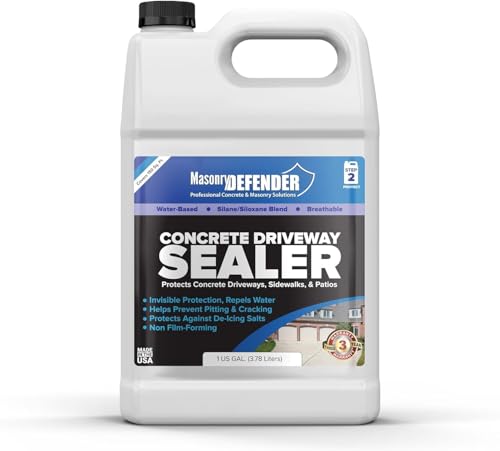
MasonryDefender’s silane-siloxane concrete sealer is a budget-friendly penetrating repellent that offers solid water beading for bare concrete and stone surfaces. The advanced silane-siloxane chemistry bonds with the substrate to repel water while allowing the material to breathe — no surface film, no color change, no gloss. It is specifically formulated for driveways, sidewalks, and patios, making it a direct competitor to other mid-range penetrating sealers. The ready-to-use one-gallon size eliminates mixing, and application with a garden sprayer is fast.
User reviews from the Pacific Northwest, a region with heavy rain, confirm the water-beading effect is excellent. One reviewer noted their treated concrete squares stayed whiter and cleaner than untreated areas over three years, though yearly reapplication is recommended for the most economical protection. The product has no odor, dries quickly, and cleans up with water — attributes that make it appealing for first-time users. The coverage is modest (90-150 square feet per gallon), but the low cost per gallon makes it easy to purchase enough for the full area.
The primary limitation is the concentration. This is a ready-to-use product, so the active ingredient percentage is lower than a true concentrate like Siloxa-Tek 8500. For dense bluestone, this means the protection depth is shallower, and the longevity will be shorter — expect to recoat annually in harsh exposures. It is a fine product for new homeowners sealing a bluestone driveway for the first time, but those seeking maximum durability should pay for a higher-concentration formula. The water beading is visible and satisfying, but do not expect multi-year performance.
Why it’s great
- Effective water beading with penetrating silane-siloxane
- Low-cost entry point for large projects
- No odor, no color change, breathes naturally
Good to know
- Ready-to-use — lower active ingredient than concentrates
- Annual reapplication recommended for best results
FAQ
Can I use a concrete sealer on bluestone without changing its color?
How long does bluestone sealer last before I need to reapply?
Will a wet-look sealer make my bluestone patio slippery?
What happens if I apply sealer to damp or cold bluestone?
My bluestone has white efflorescence — will a sealer fix it?
Final Thoughts: The Verdict
For most users, the best bluestone sealer winner is the Siloxa-Tek 8500 Ultra Concentrate because it provides the deepest penetration, longest protection, and zero aesthetic change — the ideal combination for preserving natural bluestone. If you want dramatic color enhancement on a patio or pool deck, the Armor AR350 delivers a professional-grade, low-gloss wet look. And for a simple, budget-friendly application on a new driveway or walkway, the Black Diamond Stoneworks Concrete Sealer offers reliable water repellency with low-odor convenience.