
Our readers keep the lights on and the weekend projects moving. As an Amazon Associate, I earn from qualifying purchases.
If your vintage amplifier or bookshelf speakers still deliver the warmth and presence you love, the only thing missing is a modern wireless connection. A dedicated Bluetooth receiver bridges that gap without asking you to replace a perfectly good system — you get CD-quality streaming from your phone, tablet, or laptop without sacrificing the sound signature you already dialed in.
I’m Rikta — the co-founder and writer behind FitlyFast. For this guide, I spent weeks breaking down DAC chipsets, Bluetooth codecs, output configurations, and real-world range tests to separate the units that simply connect from the units that actually perform.
A well-chosen bluetooth stereo receiver adds high-resolution audio support, multiple output types, and stable connectivity to any existing hi-fi setup without the fuss of replacing your entire system.
How To Choose The Best Bluetooth Stereo Receiver
The market is flooded with cheap adapters that promise wireless freedom but deliver noise, latency, and dropped connections. To land on the right unit, you need to weigh a few non-negotiable factors that directly impact how your system will sound and behave.
DAC Quality and Bluetooth Codec Support
The digital-to-analog converter (DAC) is the brain of any receiver. A quality chip like the Texas Instruments PCM5102A or the ESS ES9018K2M turns digital Bluetooth signals into clean, detailed analog audio. Pair that with a high-bitrate codec — LDAC, aptX HD, or AAC — and you get resolution that rivals wired playback. Skip these and you risk flat, compressed sound that betrays your speakers.
Output Flexibility for Your Specific Gear
Not all receivers speak the same language as your amplifier. RCA analog outputs work with most integrated amps, but if you have a powered subwoofer, a mixer, or a vintage receiver with digital inputs, you need optical, coaxial, or even XLR outputs. The best units keep all outputs active simultaneously so you can run a subwoofer and main speakers without replugging.
Connection Stability and Range
A receiver that drops signal when you walk to the other side of the room defeats the purpose. Look for units with an external antenna or a dedicated Bluetooth chipset like the Qualcomm QCC5125, which delivers stable range beyond 30 feet even through walls. Internal antennas in budget adapters often struggle with interference and range limitations.
Quick Comparison
On smaller screens, swipe sideways to see the full table.
| Model | Category | Best For | Key Spec | Amazon |
|---|---|---|---|---|
| Yamaha R-S202 | Stereo Receiver | Full system replacement | 100W per channel at 8 ohms | Amazon |
| Sony STRDH190 Bundle | Stereo Receiver | Vinyl + digital setups | Phono input + Bluetooth standby | Amazon |
| blafili B3 | Receiver Only | Pro audio & mixer setups | XLR + ESS ES9018K2M DAC | Amazon |
| 1Mii B06HD+ | Receiver Only | Hi-res wireless streaming | LDAC + ES9018K2M DAC + OLED | Amazon |
| Donner 1000W | Amplifier | Karaoke & home theater | 4-channel amp + dual mic inputs | Amazon |
| Pyle PDA77BU | Amplifier | Budget multi-room audio | 800W peak + SD card slot | Amazon |
| BluDento BLT-2 | Receiver Only | Value audiophile upgrade | TI PCM5102A DAC + aptX HD | Amazon |
In‑Depth Reviews
1. Yamaha R-S202 Stereo Receiver (Renewed)

Yamaha’s R-S202 is a proper full-sized stereo receiver with Bluetooth built right into the chassis — no separate dongle, no external power brick scenario. At 100 watts per channel into 8 ohms, it drives floor-standing and bookshelf speakers with authority, and the pure two-channel design means no artificial surround processing mucking up the signal path. The front-panel headphone output and dual speaker selector (A/B) add real utility for multi-room setups.
Connectivity covers four RCA analog inputs and one output, plus an AM/FM tuner with 40 presets. The Bluetooth implementation is straightforward: pair once, and the receiver remembers your device. Reviewers note the volume knob requires more turns than expected, but the remote compensates well. Treble and bass pots on the front panel allow quick tonal adjustments without digging into menus.
This renewed unit arrives looking and performing like new, making it a safe mid-range investment. The built-in Bluetooth handles SBC and AAC, so if you need LDAC or aptX HD, pair it with an external receiver. For most users who want a complete receiver with wireless and wired inputs in one box, this is the most practical choice.
Why it’s great
- 100W per channel with clean, uncolored sound
- Dual speaker outputs for zone switching
- Built-in Bluetooth with reliable pairing
Good to know
- No aptX HD or LDAC support
- Volume knob has a long rotation range
2. 1Mii B06HD+ Bluetooth Receiver
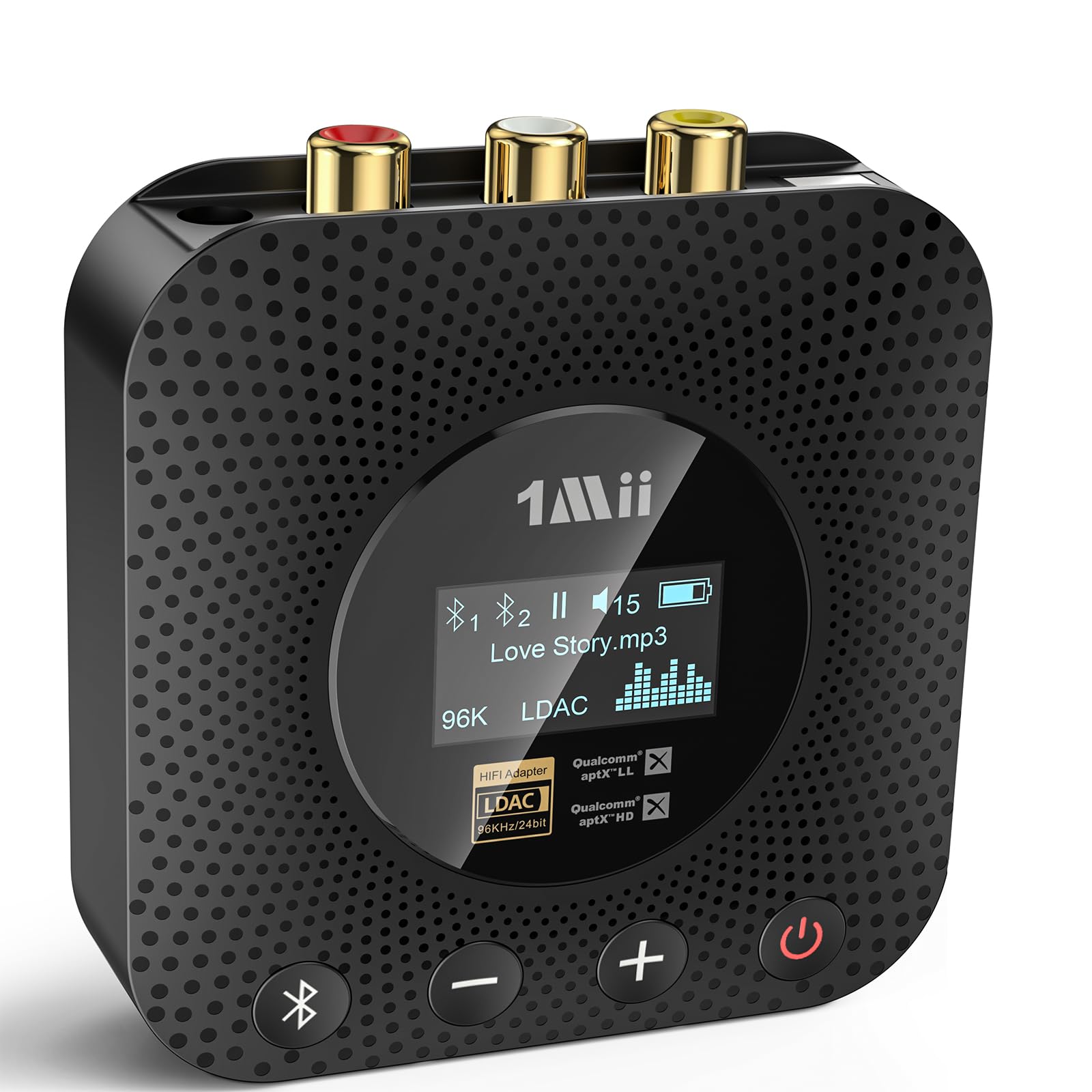
The 1Mii B06HD+ is a dedicated receiver that packs serious hardware: the Qualcomm Bluetooth 5.3 chipset and the ESS ES9018K2M DAC — the same DAC found in many mid-range external DACs. It decodes LDAC at 990 kbps, aptX HD, aptX Low Latency, AAC, and SBC, making it one of the most codec-complete adapters in this class. The OLED display shows song name, sampling rate, codec in use, and battery level, which is rare at this level.
Outputs include RCA analog, optical TOSLINK, and coaxial digital — all active simultaneously. The built-in rechargeable battery provides roughly 13 hours of playback, and the range extends to 50-80 feet indoors. The auto-shutdown after 10 minutes of inactivity can be either a helpful power-saver or a minor annoyance depending on your usage pattern.
For anyone with a vintage integrated amp or powered speakers who wants to stream Tidal Master or Qobuz in high resolution, this receiver delivers without forcing an amp upgrade. The external antenna keeps the connection stable even when the source device is in another room. If you prioritize wireless hi-res audio, this is the sweet spot.
Why it’s great
- LDAC and aptX HD support for hi-res streaming
- ESS ES9018K2M DAC for clean audio reproduction
- OLED display shows codec and song info
Good to know
- Auto-shutdown after 10 minutes idle
- Requires manual power-on after idle shutdown
3. blafili B3 Bluetooth Receiver

The blafili B3 stands apart because it includes balanced XLR outputs alongside the usual RCA, optical, and coaxial jacks — a feature normally reserved for pro audio gear that costs twice as much. Powered by the Qualcomm QCC5125 chipset and the ESS ES9018K2M DAC, it supports LDAC, aptX HD, aptX Low Latency, AAC, and SBC. All outputs remain active simultaneously, so you can feed balanced monitors and an RCA subwoofer without splitting signals.
A removable RP-SMA antenna extends range up to 100 feet, and the 1.3-inch display shows Bluetooth audio status without nagging beeps or voice prompts — the unit pairs silently. You can customize the Bluetooth broadcast name and set a 4-digit passcode via a software request, which is useful for shared or commercial environments. It also functions as a USB DAC for your computer, though resolution is capped at 16-bit/48 kHz.
For DJs, live sound engineers, or anyone feeding a PA system from a phone or tablet, the XLR connectivity is a deal-maker. The build quality feels substantial, and the company offers a lifetime guarantee on the unit. If your setup requires balanced connections, this is the receiver to buy.
Why it’s great
- Balanced XLR output for pro audio gear
- ESS ES9018K2M DAC with full codec support
- Customizable Bluetooth name and passcode
Good to know
- No RCA cable included in the box
- USB DAC limited to 16-bit/48 kHz
4. BluDento BLT-2 Receiver

The BluDento BLT-2 proves you don’t need to spend heavily to get genuine audiophile-grade sound from a Bluetooth receiver. Its secret weapon is the Texas Instruments PCM5102A DAC, which delivers warm, natural analog reproduction through RCA outputs. The unit supports aptX HD, aptX Low Latency, AAC, and SBC, and reviewers consistently note that sound quality rivals pricier adapters — with proper bass articulation, clean treble, and natural spatial ambience.
Output options include RCA analog, optical TOSLINK, and coaxial digital, all active simultaneously. The external antenna provides robust range across rooms and even outdoor spaces. Pairing is automatic: power it on, and it connects to the last paired device without any app or driver. The included accessories — optical cable, RCA cable, 3.5mm adapter, and micro USB cable — cover most setup scenarios.
One trade-off: there is no power button, so the unit stays in standby with a blinking LED when idle. Output volume is slightly lower than some competitors, likely due to the 0.6A USB power requirement. For anyone seeking high-quality wireless audio without spending for features they don’t need, this is the most cost-effective path.
Why it’s great
- TI PCM5102A DAC delivers warm, detailed analog sound
- aptX HD and aptX LL for quality plus low latency
- External antenna for stable long-range signal
Good to know
- No power button — blinking LED when idle
- Lower output volume than some competitors
5. Donner 1000W Stereo Receiver

Donner’s receiver is a full-function amplifier with Bluetooth 5.0, not just a receiver — it delivers 25 watts RMS per channel across four channels (1000W peak rating). The four independent channels support up to eight speakers with 4-8 ohm impedance, and each channel has its own volume knob. Beyond Bluetooth, it offers USB playback (up to 64 GB), two pairs of RCA inputs, AUX, optical, coaxial, FM radio, and dual 1/4-inch microphone jacks with echo and talkover functions.
The remote controls treble, midrange, bass, echo, and talkover settings in any input mode. The optical and coaxial inputs make it easy to connect a smart TV for improved dialogue clarity. The talkover function automatically lowers background music when the mic is active, which is useful for presentations, parties, or hosting events.
Some users report that the bass EQ does not produce deep low-end with demanding tower speakers, and the four-channel labeling can be confusing at first (four pairs of binding posts labeled L/R effectively give you independent control per pair). For a compact, multi-purpose amp that powers a karaoke room, garage system, or small home theater, this is a versatile pick. Just keep expectations realistic for bass-heavy music at high volumes.
Why it’s great
- Four independent channels with separate volume controls
- Dual mic inputs with echo and talkover functions
- Optical/coaxial inputs for TV connectivity
Good to know
- Bass EQ lacks depth for demanding speakers
- Speaker terminal labeling can confuse initial setup
6. Pyle PDA77BU Stereo Receiver

Pyle’s PDA77BU is a full stereo receiver with Bluetooth 5.0, rated at 800 watts peak power. It accepts audio from USB drives, SD cards (up to 32 GB), FM radio, AUX, RCA, and a 3.5mm jack — making it one of the most format-flexible entry-level amplifiers available. The dual 1/4-inch microphone inputs with independent volume, reverb, and delay controls make it a natural fit for karaoke, announcements, or live hosting.
The front-panel control center includes a digital LED display and push-button source selection. The remote replicates most functions, including source switching and EQ adjustments. Users report easy Bluetooth pairing and surprisingly loud output for the size, especially when driving four smaller speakers in a home office or garage setup.
Some users mention Bluetooth reconnection quirks with smart TVs, occasionally requiring a manual unpair/repair cycle. The amplifier section is better suited to efficient bookshelf or indoor/outdoor speakers rather than power-hungry floor-standing towers. For a budget-conscious buyer who needs multiple input options and karaoke support in a single box, this receiver delivers strong value.
Why it’s great
- Extensive input options: USB, SD, FM, RCA, Bluetooth
- Dual mic inputs with reverb and delay controls
- Compact footprint with full remote control
Good to know
- Bluetooth reconnection may require manual repair
- Not ideal for demanding floor-standing speakers
7. Sony STRDH190 Stereo Receiver Bundle

This bundle pairs the Sony STRDH190 2-channel stereo receiver with 50 feet of 14 AWG speaker wire and five pairs of gold-plated banana plugs — everything needed for a complete setup out of the box. The receiver itself delivers 100 watts per channel into 8 ohms, includes a dedicated phono input for turntables, and supports Bluetooth with standby mode so you can turn the receiver on directly from your smartphone.
Four analog audio inputs and one output provide ample room for CD players, cassette decks, or media streamers. High-Resolution Audio support ensures playback quality beyond standard CD resolution. The large-capacity power transformer is designed for clean, stable power delivery — important for preserving subtle dynamic shifts in acoustic and vocal recordings.
Users consistently praise the STRDH190 for its straightforward setup, reliable Bluetooth pairing, and natural sound with quality speakers. The FM tuner uses a proprietary antenna connector rather than a standard coax, which may complicate roof antenna hookups. For a vinyl enthusiast who wants to stream digital music alongside records without sacrificing audio quality, this bundle simplifies the process significantly.
Why it’s great
- Dedicated phono input for turntable integration
- Bluetooth standby powers on from phone
- Includes speaker wire and banana plugs
Good to know
- FM antenna uses proprietary connector
- No optical or coaxial digital inputs
FAQ
Can I use a Bluetooth stereo receiver with a turntable?
What causes audio lag when watching TV through a Bluetooth receiver?
Do I need an amplifier if I buy a Bluetooth receiver?
What does the external antenna do for a Bluetooth receiver?
Final Thoughts: The Verdict
For most users, the bluetooth stereo receiver winner is the Yamaha R-S202 because it combines a proper 100W amplifier, built-in Bluetooth, and dual-zone speaker switching in a single proven chassis. If you want pinpoint hi-res wireless streaming, grab the 1Mii B06HD+. For professional audio setups needing balanced XLR connections, nothing beats the blafili B3.