
Our readers keep the lights on and the weekend projects moving. As an Amazon Associate, I earn from qualifying purchases.
The difference between a snapshot and a keeper is often measured in millimeters. A bird at a distance is just a speck; with the right lens, that speck becomes a portrait with detail in every feather. A poor choice means soft images, a heavy bag, and missed opportunities. The right choice is a system that gets you closer, sharper, and faster.
I’m Rikta — the co-founder and writer behind FitlyFast. After hundreds of hours analyzing lens MTF charts, customer field reports, and real-world autofocus performance in various light conditions, this guide targets the exact trade-offs that matter for avian photography.
Whether you are chasing warblers in deep woods or documenting raptors in wide-open skies, finding the right tool requires balancing reach, aperture, and portability. This is your comprehensive guide to finding the best birding lens for your specific camera system and shooting style.
How To Choose The Best Birding Lens
Selecting a dedicated telephoto zoom for birds is a different process than picking a standard lens. You are optimizing for a specific set of demands: distance, speed, and physical endurance. The market offers three broad tiers, and understanding where your priorities lie is the first step.
Reach: The Optics of Getting Closer
The most critical spec for a birding lens is its maximum focal length. On a full-frame camera, 400mm is a starting point for larger birds and close-range encounters. Small songbirds and distant raptors demand 500mm, 600mm, or more. Do not underestimate the crop factor — pairing a 400mm lens with an APS-C body delivers a 600mm-equivalent field of view, which can save you significant weight and money while still filling the frame.
Aperture: The Light-Gathering Trade-off
Maximum aperture (usually F5.6 to F8 at the long end) directly determines your usable shutter speed in low light. A faster aperture (F5.6) gives you an extra full stop over an F8 lens. This means you can double your shutter speed or drop your ISO by half in overcast forests. Lenses like the Canon RF 100-500mm L and the Nikon 180-600mm live in the “fast enough” zone. Slower variable-aperture lenses require excellent stabilization or a monopod to keep images sharp at dawn and dusk.
Image Stabilization: Your Handheld Safety Net
Optical image stabilization (IS) is non-negotiable for most birders. A lens with 5.5 stops of VR allows you to shoot sharp handheld images at 1/30th of a second at 600mm — something impossible without it. Lenses with weaker stabilization (around 3 stops) demand steadier technique or a tripod. If you plan to hike long distances, prioritize lenses with strong in-lens stabilization that pairs with your camera body’s in-body stabilization (IBIS) for synchronous correction.
Quick Comparison
On smaller screens, swipe sideways to see the full table.
| Model | Category | Best For | Key Spec | Amazon |
|---|---|---|---|---|
| Sony FE 200-600mm G | Premium | Full-frame Sony shooters demanding reach & speed | 200-600mm, f/5.6-6.3, Internal Zoom | Amazon |
| Nikon Z 180-600mm VR | Premium | Nikon Z users who want max reach without primes | 180-600mm, f/5.6-6.3, 5.5-stop VR | Amazon |
| Canon RF 100-500mm L | Premium | Canon L-series enthusiasts needing L-quality | 100-500mm, f/4.5-7.1, Dual Nano USM | Amazon |
| Fujifilm XF 150-600mm | Premium | Fuji X-mount wildlife and bird shooters | 150-600mm, f/5.6-8, 914mm equiv. | Amazon |
| OM System Olympus 100-400mm | Mid-range | M4/3 users needing 800mm equiv. reach | 100-400mm, f/5.0-6.3, 800mm equiv. | Amazon |
| Tamron 150-500mm VC VXD | Mid-range | Sony shooters wanting 500mm at a value | 150-500mm, f/5-6.7, VC Stabilization | Amazon |
| Fujifilm XF 70-300mm OIS WR | Mid-range | Lightweight Fuji kit for hiking adventures | 70-300mm, f/4-5.6, 5.5-stop OIS | Amazon |
| Canon RF 100-400mm IS | Mid-range | Entry-level Canon R birding on a budget | 100-400mm, f/5.6-8, 5.5-stop IS | Amazon |
| Sony E 70-350mm G OSS | Mid-range | APS-C Sony users wanting a compact tele | 70-350mm, f/4.5-6.3, 525mm equiv. | Amazon |
| Nikon Z 28-400mm VR | Mid-range | Travelers wanting ultra-wide to tele reach | 28-400mm, f/4-8, 5.0-stop VR | Amazon |
| Tamron 70-300mm RXD | Budget | Entry-level Sony users on a tight budget | 70-300mm, f/4.5-6.3, 19 oz | Amazon |
In‑Depth Reviews
1. Sony FE 200-600mm f/5.6-6.3 G OSS

The Sony 200-600mm G is a benchmark lens for serious birders on Sony E-mount full-frame. The internal zoom mechanism keeps the lens barrel length constant during operation, which is a huge ergonomic win for handheld tracking. At 600mm with f/6.3, it captures enough light for daytime and early-morning shooting, especially when paired with a modern high-ISO body like the a7R V or a1.
The Direct Drive SSM (DDSSM) autofocus is exceptionally fast and silent, and it locks onto bird eyes reliably with Sony’s real-time tracking. The three-position image stabilization modes (standard, panning, and during exposure only) are practical for different bird behaviors, like shooting a perched kingfisher versus a swooping swallow. The weight, at 4.7 pounds, is manageable for dedicated sessions but will fatigue you on all-day treks without a monopod.
The build quality is excellent with dust and moisture sealing, and the white finish reflects heat in direct sun. The most common complaint is the tripod foot, which lacks an Arca-Swiss dovetail, requiring an aftermarket replacement for quick plate compatibility. For pure reach, AF speed, and internal zoom balance, this lens defines the full-frame birding standard.
Why it’s great
- Internal zoom keeps balance constant while panning.
- Excellent eye AF speed and precision for birds in flight.
- Three customizable focus hold buttons and functional stabilization modes.
Good to know
- Heavy enough to require a monopod for long hikes.
- Stock tripod foot lacks Arca-Swiss compatibility.
- Bokeh can appear busy at certain distances and backgrounds.
2. Nikon NIKKOR Z 180-600mm f/5.6-6.3 VR

Nikon’s Z 180-600mm VR is the closest thing to a one-lens solution for Z-series birders. The 180-600mm range is ideal: you start at a moderately wide telephoto for locating subjects and zoom to 600mm for tight framing. The internal zoom design means the center of gravity stays put, and the 5.5-stop VR makes handheld shooting at 600mm a real possibility even at lower shutter speeds.
The optics are sharp corner-to-corner across the range, with minimal chromatic aberration. Autofocus is driven by a stepping motor that is silent and accurate in good light, and it pairs beautifully with the Z8 and Z9’s subject-detection AI for bird eye tracking. The minimum focus distance of 4.27 feet at 180mm provides unexpected macro-like opportunities for nesting or feeding birds.
At 4.7 pounds, it matches the Sony 200-600mm in heft, but the weight is well-distributed. The included tripod foot is Arca-Swiss compatible out of the box, a clear win over its Sony competitor. The “case” included is a soft pouch, not a hard case, and the lens is known to be large for carrying in standard camera bags. For Nikon users, this is the baseline for serious birding on a budget.
Why it’s great
- Internal zoom and 5.5-stop VR enable stable handheld shooting at 600mm.
- Included tripod foot is Arca-Swiss compatible.
- Crisp, sharp images with excellent color contrast.
Good to know
- Heavy for extended hiking; a monopod is recommended for all-day use.
- Soft pouch included is not a protective case.
- Autofocus can hunt in very low light at the telephoto end.
3. Canon RF 100-500mm f/4.5-7.1 L IS USM

The Canon RF 100-500mm L represents the top of the line for Canon EOS R shooters. The L-Series build provides exceptional weather sealing and a robust physical construction that can handle wet and dusty conditions in the field. The Dual Nano USM autofocus is blazingly fast and whisper-quiet, working in lockstep with Canon’s advanced subject-detection AF to lock onto bird eyes instantly.
At 500mm, the f/7.1 maximum aperture requires higher ISO in dim conditions, but the 5-stop optical Image Stabilizer compensates during static shots. Users report that with the RF 1.4x extender, the effective 700mm F10 combo still produces sharp images, though autofocus slows down.
The minimum focus distance of 3.0 feet offers a 0.33x max magnification, turning it into a powerful semi-macro tool. For Canon shooters who value L-series build, speed, and image quality over absolute focal length, this lens is the pinnacle.
Why it’s great
- Superbly built with L-series weather sealing and durability.
- Fast and silent Dual Nano USM autofocus; excellent eye tracking.
- More portable than 600mm lenses at 3.0 pounds.
Good to know
- Aperture narrows to f/7.1 at 500mm, requiring higher ISO in low light.
- Variable aperture limits depth of field and light gathering at long end.
- High price point places it above many mid-range alternatives.
4. Fujifilm Fujinon XF 150-600mm f/5.6-8 R LM OIS WR

Fuji X-mount users who need serious birding reach will find their match in the XF 150-600mm. Thanks to the APS-C sensor, this lens offers a 35mm equivalent focal length of 229-914mm — that’s serious long-reach capability without the bulk of a full-frame 600mm prime. The internal zoom design is a standout feature: no lens creep, consistent balance, and better dust sealing during operation.
Autofocus performance is significantly upgraded from older Fuji telephoto zooms. The linear motor locks onto bird eyes with confidence on cameras like the X-T5, even tracking them in flight. The maximum aperture of f/8 at 600mm is slow, which means you will be shooting at ISO 1600-6400 regularly in forest shade. Pairing this lens with DxO PureRAW or Topaz DeNoise software helps recover clean detail from high-ISO files.
The 3.53-pound weight is extremely light for a lens offering this kind of equivalent reach, and the included Arca-Swiss compatible foot is a nice touch. Teleconverters (1.4x and 2x) are fully supported, pushing the effective reach to a staggering 1824mm at f/16. At that setting, autofocus slows dramatically, but for static perching birds in bright sun, it works.
Why it’s great
- Massive 914mm equivalent reach makes distant birds fill the frame.
- Internal zoom mechanism prevents dust ingress and weight shift.
- Very light for the focal length at 3.53 pounds.
Good to know
- f/8 at the long end is slow; expect high ISO noise in low light.
- Autofocus can struggle when using teleconverters at maximum reach.
- Aggressive cropping requires noise reduction software for publishable results.
5. OM SYSTEM Olympus M.Zuiko Digital 100-400mm F5.0-6.3 IS

Micro Four Thirds users get an extraordinary reach-to-weight ratio with the Olympus 100-400mm. The 2x crop factor gives you a 200-800mm equivalent field of view, putting small birds within reach without needing a massive lens. At just under 2.9 pounds, it is lighter than most 150-600mm full-frame lenses, making it a viable choice for multi-day backpacking trips where every ounce counts.
The in-lens image stabilization provides 3 EV steps at the long end, and it works in concert with the Olympus IBIS system to create a very stable viewfinder image. Image quality is sharp in the center at 400mm, and it holds up well with the MC-14 1.4x teleconverter for a 560mm (1120mm equivalent) reach. The autofocus is adequate for static birds and slow flyers, but some users report it is not fast enough for erratic birds in flight on older bodies like the G9.
Build quality is robust with dust and splashproof construction, ready for inclement weather. The variable aperture (f/5.0-6.3) means you lose about a half-stop compared to the Panasonic 100-400mm II, but the Olympus often resolves more detail. For the price, it offers one of the most affordable paths to serious super-telephoto birding in a lightweight package.
Why it’s great
- Excellent 800mm equivalent reach in a light, compact body.
- Fully weather-sealed for use in rain and dust.
- Compatible with teleconverters for up to 1120mm equivalent reach.
Good to know
- Autofocus can be slow for fast-moving birds in flight on certain bodies.
- Variable aperture (f/5.0-6.3) is slow for low-light conditions.
- Requires high ISO (6400+) in shaded environments; noise management is important.
6. Tamron 150-500mm f/5-6.7 Di III VC VXD (Sony E)

The Tamron 150-500mm VC VXD is an aggressive value play for Sony E-mount users who want 500mm reach without paying for a G Master or G lens. The 150-500mm range is slightly shorter than the competition but starts wider, making it easier to locate a bird in the frame before zooming in. The VXD linear motor autofocus is fast and quiet, providing very good tracking performance for birds in flight on A6xxx and A7 series bodies.
VC (Vibration Compensation) stabilization is effective at 500mm, allowing decently sharp handheld shots at moderate shutter speeds. At 4.14 pounds, it is lighter than the Sony 200-600mm by about a half-pound, but the external zoom design means the barrel extends significantly, and it can collect dust more easily. The 82mm filter thread is standard, and the build quality feels solid with a moisture-resistant construction, though it is not fully weather-sealed like premium lenses.
Image quality is surprisingly sharp across the frame for a lens in this price bracket, though it may not match the absolute top-tier resolution of the Sony 200-600mm G. The f/6.7 maximum aperture at 500mm is a full stop slower than some alternatives, making low-light performance its biggest weakness. For birders on a budget who need 500mm reach and fast AF, this is a compelling doorstep to the telephoto world.
Why it’s great
- Provides 500mm reach at a lower cost and weight than native Sony options.
- Fast and quiet VXD linear motor for reliable autofocus.
- Effective VC stabilization aids handheld shooting at the long end.
Good to know
- External zoom barrel extends, collecting dust over time.
- Slower aperture (f/6.7) at 500mm reduces low-light performance.
- Heavier than lightweight travel options, requiring good technique at full extension.
7. Fujifilm Fujinon XF70-300mmF4-5.6 R LM OIS WR
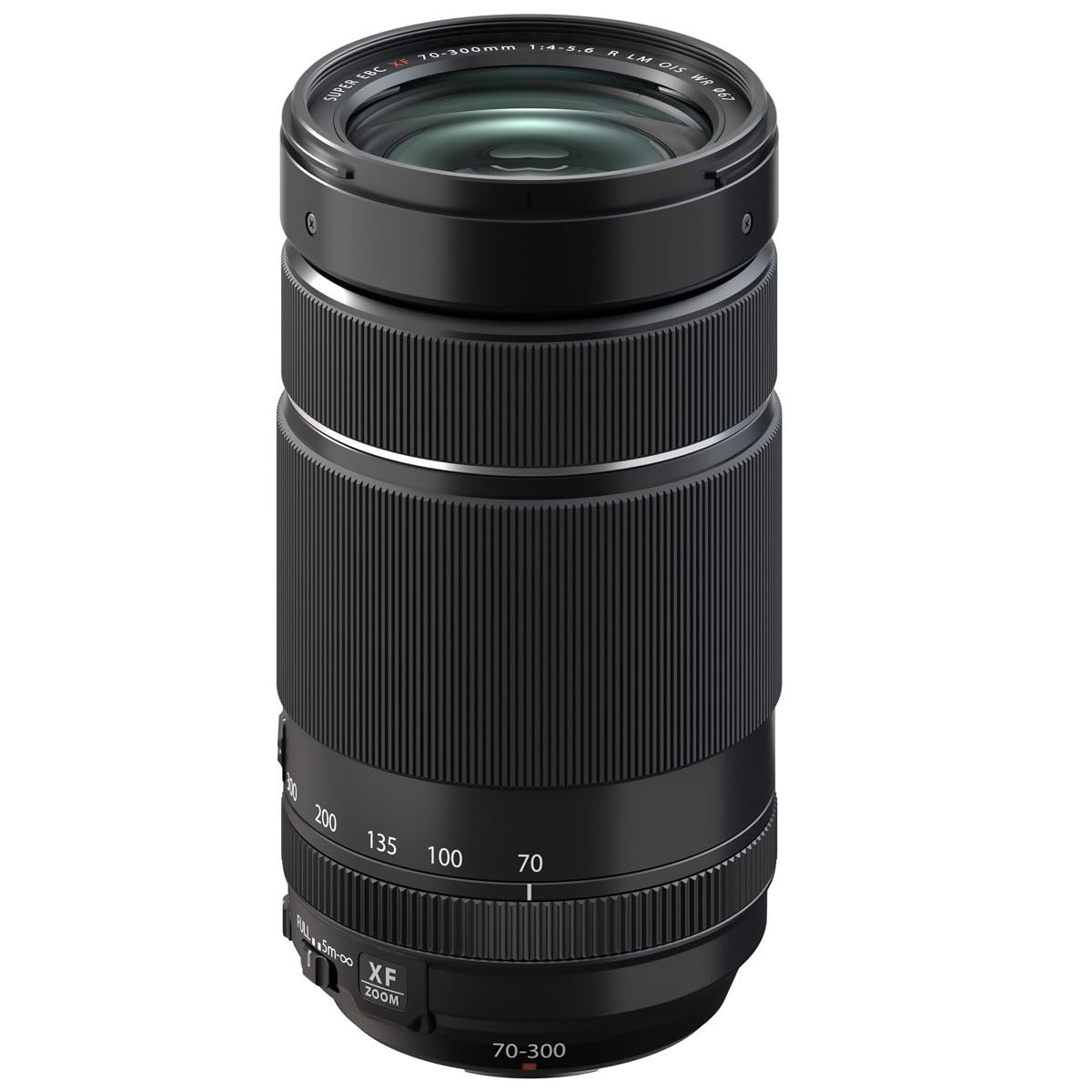
Fuji X-mount birders who prioritize portability will appreciate the XF 70-300mm. Weighing just 1.3 pounds, this lens is a featherweight compared to super-telephoto zooms, yet it still offers a 107-457mm equivalent focal range on APS-C. The 5.5-stop optical image stabilization is class-leading for its size, allowing sharp handheld shots even at the 300mm (457mm equivalent) end in moderate light.
The linear motor autofocus is near-silent and accurate, handling birds in flight adequately when paired with a modern Fuji body. The lens is dust and moisture resistant, and it can operate down to 14°F, making it a reliable companion for winter birding. The close focusing distance of 0.83 meters provides a 0.33x maximum magnification, enabling half-macro shots of insects or flowers alongside birds.
The compact size (5.2 inches long) means it fits easily into a standard daypack or chest carrier, a huge advantage for cyclists or hikers who also want wildlife capability. The trade-off is focal length: 300mm (457mm equivalent) is on the short side for small perching birds, especially if you can’t get within 30-40 feet. It is better suited for larger birds, waterfowl, or subjects in open habitats. For the weight-conscious birder, this lens is a gem.
Why it’s great
- Extremely lightweight (1.3 lbs) for all-day carry on long hikes.
- Excellent 5.5-stop OIS enables sharp handheld images at full zoom.
- Weather-sealed and cold-resistant for challenging environments.
Good to know
- Maximum equivalent reach of 457mm is short for small or distant birds.
- Variable aperture narrows to f/5.6, limiting use in low light.
- Autofocus, while good, is not as fast as higher-end Fuji telephoto lenses.
8. Canon RF 100-400mm F5.6-8 IS USM

Canon RF-mount users looking for an affordable entry into birding should start with the RF 100-400mm IS USM. This lens delivers 100-400mm of reach in a compact package that weighs under 1.5 pounds, making it one of the lightest telephoto options available. The 5.5-stop optical Image Stabilizer (6 stops when paired with IBIS on bodies like the R5 and R6) provides remarkable stability for handheld shooting at 400mm.
The Nano USM autofocus is fast and quiet, providing a smooth experience for both stills and video. At the minimum focusing distance of 2.89 feet at 200mm, the 0.41x max magnification is genuinely useful for close-up shots of insects and small creatures. Image quality is surprisingly sharp for an entry-level lens, though the f/8 maximum aperture at 400mm significantly limits its low-light capabilities.
Build quality is good for the price point, but there is no weather sealing, and the barrel extends as you zoom. It is best suited for bright, sunny days at parks, reserves, or your backyard feeder. The RF 100-400mm is the quintessential walk-around birding lens for Canon users who want to test the waters before committing to the heavier L-series glass.
Why it’s great
- Extremely lightweight (under 1.5 lbs) for comfortable all-day use.
- Powerful optical stabilization with up to 6 stops on selected bodies.
- Versatile 400mm focal length provides a great entry point for bird photography.
Good to know
- f/8 maximum aperture at 400mm is very slow; poor low-light performance.
- No weather sealing, limiting use in rain or heavy dust.
- Zoom physically extends, which can unbalance the lens over time.
9. Sony E 70-350mm f/4.5-6.3 G OSS

Sony APS-C shooters have a dedicated telephoto zoom in the E 70-350mm G OSS, which delivers a 105-525mm full-frame equivalent reach. The “G” designation signals Sony’s commitment to higher optical quality, and this lens delivers sharp corner-to-corner resolution across the zoom range. It weighs just 22.1 ounces, making it one of the most compact super-telephoto options for any mirrorless system.
The Optical SteadyShot (OSS) stabilization is effective at the 350mm (525mm equivalent) end, allowing clean handheld shots at moderate shutter speeds. The XD linear motor provides fast, precise, and quiet autofocus that handles birds in flight reasonably well on A6xxx series cameras. Image contrast and color are excellent straight out of the camera, a hallmark of Sony’s G-series optics.
This lens is a daylight specialist: the f/6.3 aperture at 350mm means it struggles in heavy shade or at twilight. The lack of weather sealing is also a concern for rainy-day birding. For a lightweight, travel-friendly kit that covers everything from landscape to wildlife, this lens is a top-tier choice for Sony APS-C users. It is an ideal “always on the camera” lens.
Why it’s great
- Compact and lightweight (22 oz) for effortless portability.
- Excellent G-series image quality with sharpness across the frame.
- Fast and quiet XD linear motor AF for responsive tracking.
Good to know
- f/6.3 at 350mm limits use in low light; best for daytime birding.
- No weather sealing limits use in rain or muddy environments.
- Focal length is short for very small or distant species.
10. Nikon NIKKOR Z 28-400mm f/4-8 VR

Nikon Z users who want the ultimate all-in-one travel lens will find the Z 28-400mm VR unmatched in range. The 14.2x zoom covers everything from wide-angle landscapes to super-telephoto birding, all in a single 1.6-pound package. The 5.0-stop VR performance is very effective at the 400mm end, and when paired with a Z body featuring Synchro VR, you get up to 5.5 stops of stabilization.
Autofocus is driven by a linear motor that provides smooth focus for both stills and video. On a DX body like the Z50, the effective reach becomes 42mm to 600mm, deepening its birding capabilities. The 0.35x maximum reproduction ratio at 28mm is very high for a zoom, offering detailed close-up shots of insects, flowers, or subjects near the lens.
The trade-off for such extreme zoom range is a slow variable aperture: f/4-8. At 400mm (or 600mm equivalent on DX), the f/8 aperture is very slow, requiring high ISO in anything but full sunlight. The lens is also not internal zoom, so the barrel extends. It is not a dedicated birding lens but rather a super versatile travel companion that can handle birds in the middle of the day. For a one-lens airline bag, it is a remarkable tool.
Why it’s great
- Unmatched 14.2x zoom range from 28mm wide to 400mm telephoto.
- Very light at 1.6 pounds, ideal as a single lens for travel.
- Effective VR and Synchro VR stabilization for steady handheld shots.
Good to know
- Slow f/8 aperture at 400mm makes it a daylight-only lens for birding.
- Not internal zoom; barrel extends and collects dust.
- Not compatible with Nikon Z teleconverters.
11. Tamron 70-300mm F/4.5-6.3 Di III RXD (Sony E)
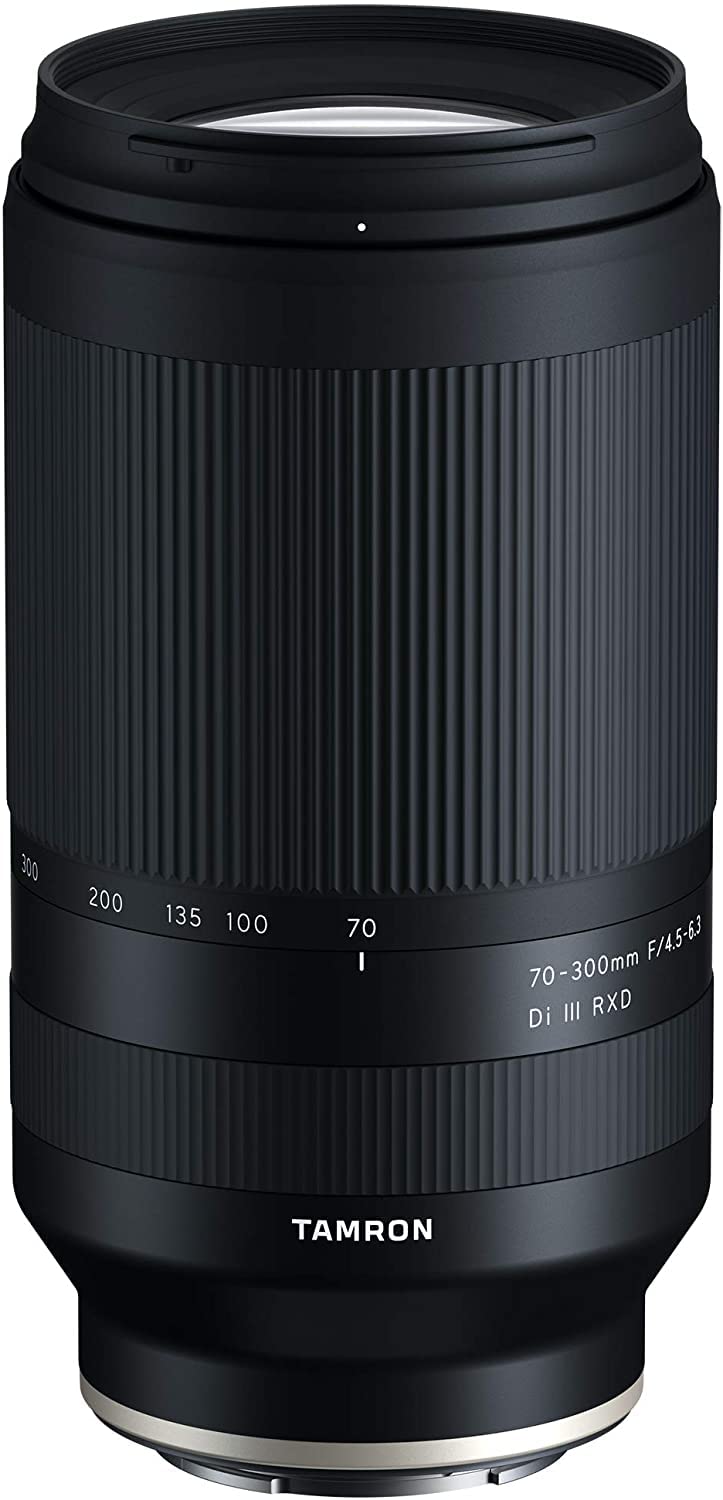
The Tamron 70-300mm RXD is the most affordable path to telephoto reach for Sony E-mount users. Weighing only 19 ounces, it is incredibly portable and turns a standard Sony body into a capable wildlife kit. The optical design, with 15 elements in 10 groups, delivers surprisingly sharp images at 300mm, especially when stopped down slightly. It is a lens that punches well above its price class in good light.
The RXD stepping motor autofocus is fast and quiet, making it a solid choice for capturing birds on feeders or larger species at moderate distances. The 1:5.1 maximum magnification at 300mm (59.1 inches minimum focus) allows for decent close-up shots of larger subjects. The moisture-resistant construction provides a basic level of protection against light spray, though it lacks full weather sealing.
The biggest omission is the lack of any image stabilization. On a body without IBIS (like the a6000 or a7 III), you will need to keep shutter speeds high or use a tripod for sharp results at 300mm. The plastic lens mount and basic build quality reflect the budget positioning. This lens is for the absolute beginner on a strict budget, or as a lightweight secondary lens for casual daytime birding where you can get relatively close to the action.
Why it’s great
- Extremely affordable and lightweight entry point to telephoto birding.
- Sharp image quality for the price at 300mm in good light.
- Fast and quiet RXD autofocus suitable for moderate birding scenarios.
Good to know
- No optical image stabilization demands high shutter speeds or a tripod.
- 300mm reach is short for small, distant birds.
- Basic build quality with a plastic mount and no weather sealing.
FAQ
What is the minimum focal length I need for bird photography?
Is it better to buy a shorter lens with a teleconverter or a longer native lens?
Can I use a full-frame telephoto lens on an APS-C camera?
Final Thoughts: The Verdict
For most users, the best birding lens overall is the Sony FE 200-600mm f/5.6-6.3 G OSS because it balances excellent reach, fast auto-focus, and effective stabilization in a well-built package that works for both birds in flight and static perchers. If you want maximum portability without sacrificing image quality on a Fuji system, grab the Fujifilm XF 70-300mm OIS WR. And for Nikon Z shooters who want the best value for dedicated birding, nothing beats the Nikon NIKKOR Z 180-600mm VR.