
Our readers keep the lights on and the weekend projects moving. As an Amazon Associate, I earn from qualifying purchases.
Radon is a colorless, odorless radioactive gas and the second leading cause of lung cancer. A single charcoal test kit left in the basement for a few days gives you one snapshot, but radon levels shift with weather, seasons, and ventilation patterns — that snapshot can easily mislead you. The real answer is continuous monitoring that captures the full daily cycle, and modern digital detectors now deliver lab-grade accuracy without waiting weeks for mail-in results.
I’m Rikta — the co-founder and writer behind FitlyFast. I’ve spent countless hours analyzing semiconductor sensor performance, ionization chamber precision, and data-logging capabilities across dozens of radon detectors to identify which units actually protect your family versus which ones just look like they do.
This guide compares seven digital monitors ranging from entry-level portable units to professional-grade plug-in detectors, all engineered to help you locate and track dangerous radon accumulation in your living spaces. We put each one through a rigorous spec-level comparison to help you find the best at home radon test kit for your home and budget.
How To Choose The Best At Home Radon Test Kit
Choosing between a digital radon monitor and a passive test kit is the first fork in the road. Digital monitors give you continuous real-time data, show daily fluctuations, and store long-term averages — essential for making informed mitigation decisions. Passive charcoal kits only capture a single 48- to 96-hour window and require you to mail them to a lab. For most homeowners, a digital continuous monitor is the smarter investment.
Sensor Technology
Digital radon detectors use one of two sensor types: ionization chambers or semiconductor particle detectors. Ionization chambers are proven, accurate, and typically respond faster to changes — the Ecosense EcoBlu uses this technology and delivers its first reading in just 10 minutes. Semiconductor sensors are smaller, more energy-efficient, and well-suited for portable battery-powered units. Both technologies can be accurate when properly calibrated, but semiconductor sensors usually require a longer stabilization period of 6 to 12 hours before reporting a reliable first number.
Data Visibility & Logging Depth
A monitor that only shows the current value isn’t enough — radon levels spike with barometric pressure drops, rain, and closed-window seasons. Look for a unit that stores hourly or 6-hour readings for at least 90 days, and ideally up to 504 days as some mid-range and premium models do. Being able to scroll back through weeks of data lets you distinguish a dangerous long-term average from a temporary weather-related blip.
Alarm Configuration
Every digital radon detector includes an alarm, but the flexibility varies. Basic units trigger a single beep when levels exceed 4.0 pCi/L (the EPA action threshold). Better monitors offer adjustable thresholds, mute-able alarms for nighttime, color-coded visual bars, and separate short-term versus long-term alert settings. If you have young children or sleep near the basement, a unit with a silent visual alarm is a practical safety feature that won’t disrupt sleep.
Quick Comparison
On smaller screens, swipe sideways to see the full table.
| Model | Category | Best For | Key Spec | Amazon |
|---|---|---|---|---|
| AEGTEST HOUND-1011 | Portable Digital | Lab-grade assurance at home | First reading in 6 hours, 504-day log | Amazon |
| Ecosense EB100 EcoBlu | Plug-In Digital | Fastest first reading (10 min) | Ionization chamber, corded electric | Amazon |
| LifeBasis RM-62 | Rechargeable Digital | First reading in 6 hours, TFT display | 0.09–1000 pCi/L, 504-day storage | Amazon |
| AEGTEST HOUND-1085 | Compact Digital | Palm-sized, 30-day logs | 6-hour first read, 504-day history | Amazon |
| AEGTEST HOUND-1011S | Entry Digital | Budget continuous monitoring | 12-hour first read, 45-day battery | Amazon |
| CRADTEC PRM-03H | Budget Digital | 24-hour first read, battery powered | Photoelectric sensor, AAA batteries | Amazon |
| Safety Siren Pro4 | USA Plug-In | Professional-grade, made in USA | Self-test daily, backlit display | Amazon |
In‑Depth Reviews
1. AEGTEST HOUND-1011
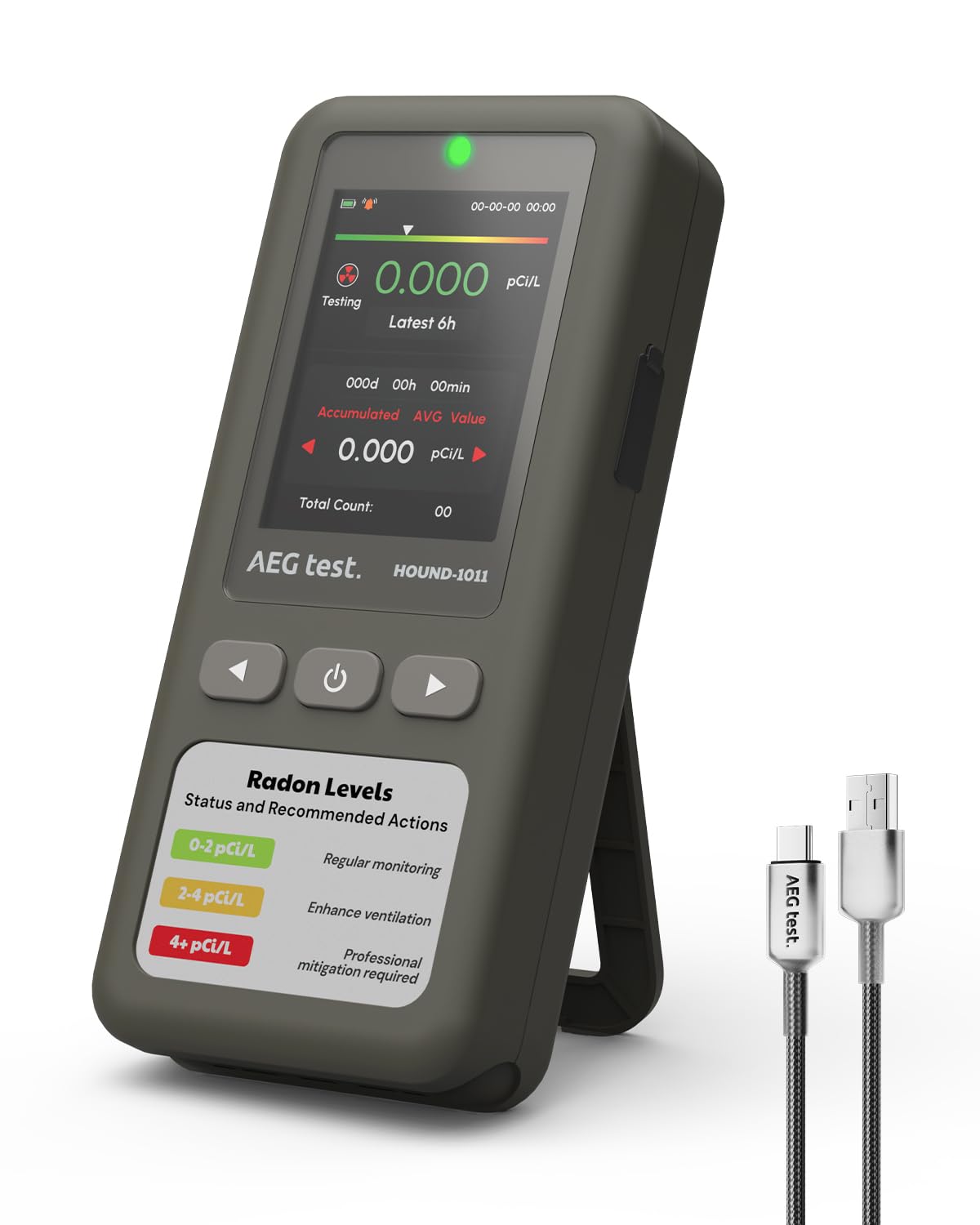
The HOUND-1011 uses a high-precision semiconductor sensor to measure radon from 0.09 to 1000 pCi/L with first results appearing in just 6 hours and hourly updates thereafter. An independent comparison with a Sun Nuclear 1030 professional unit showed the HOUND-1011 reading 32.8 pCi/L versus 33.6 pCi/L over a 4-day test — a difference of less than 3 percent. That kind of accuracy makes this unit a genuine alternative to professional lab tests for pre- and post-mitigation verification.
The 504-day data storage covers every common use-case: tracking seasonal shifts, evaluating mitigation system performance, and building a long-term average that overrides short-term weather fluctuations. The USB-C rechargeable battery lasts up to 45 days in sleep mode, and the alarm can be muted through the ECO menu so it doesn’t wake you up during nighttime monitoring in a bedroom.
Real-world users reported catching level spikes of 13 pCi/L in a mother’s home and 5.8 pCi/L at a friend’s house, then verifying post-mitigation drops to safe levels with the same device. The pocket-sized form factor and lanyard make it practical to carry room-to-room during an initial home survey, though some users noted the menu navigation takes a minute to learn.
Why it’s great
- Matches professional Sun Nuclear monitor within 3% accuracy
- 504-day data log captures seasonal radon variation
- USB-C rechargeable with 45-day battery in sleep mode
Good to know
- Menu system requires brief learning period
- First reading requires 6-hour stabilization window
2. Ecosense EB100 EcoBlu

The EcoBlu uses a patented ion chamber sensor that delivers its first radon reading in 10 minutes — significantly faster than any semiconductor-based portable unit in this guide. That speed matters when you’re touring a potential home or trying to quickly determine whether a newly discovered basement crack is leaking radon. Readings update every 10 minutes, and the full-color digital display shows real-time, daily, weekly, monthly, and long-term averages without needing to scroll through menus.
Users report accuracy within 2 percent of expensive lab tests and professional monitors. The plug-in design means you never worry about battery life, but it also means the unit stays tethered to an outlet — limiting portability. Ecosense recommends using the included AC adapter rather than a portable battery pack, as power fluctuations can affect the ion chamber’s accuracy. The audible alarm is adjustable, and a visible red line appears when levels are elevated, which is helpful for hearing-impaired household members.
A compact cube shape (2.36 x 2.76 x 2.76 inches) makes it unobtrusive on a nightstand or basement shelf. The corded electric requirement is the main limitation for multi-room surveys, but for a dedicated, always-on monitor in a single location, the 10-minute response time and proven ion chamber accuracy put the EcoBlu in a class of its own.
Why it’s great
- 10-minute first reading, unmatched speed in this category
- Accurate within 2% of professional lab tests
- Clear digital display shows multiple time-averages at once
Good to know
- Requires wall outlet; not portable for room-to-room surveys
- Battery pack use may reduce measurement accuracy
3. LifeBasis RM-62

The LifeBasis RM-62 stands out with its 2.0-inch color TFT display and graphical user interface — a noticeable upgrade from the monochrome LCD screens on many competitors. First results appear in 6 hours, and the unit logs one data point every 6 hours for up to 504 days, storing up to 10 separate detection records. This is especially useful if you want to compare radon levels across different rooms or seasons without manually resetting the device between tests.
Detection range spans 0.09 to 1000 pCi/L with a high-precision semiconductor sensor. The dual-signal system combines color-coded bars — green for safe, orange for caution, red for danger — with an adjustable audible buzzer that can be configured to your local safety threshold. The particle sound feature emits a short “beep” each time alpha decay is detected, which some users find reassuring and others find annoying (it can be turned off independently from the main alarm).
Battery runtime is rated at up to 45 days with the screen off, and a full charge via USB-C takes 3.5 hours. The compact dimensions (4.69 x 2.17 x 0.99 inches) and 3.84-ounce weight make it easy to carry between rooms. A few users reported occasional spike readings between 300 and 900 pCi/L that required a reset, but the consensus is that the RM-62 provides reliable long-term data for mitigation decisions at a mid-range price point.
Why it’s great
- Color TFT display with graphical UI for easy reading
- 504-day log with up to 10 separate detection records
- Adjustable alarm threshold to match local safety standards
Good to know
- Occasional high spike readings reported by some users
- No smartphone connectivity for data export
4. AEGTEST HOUND-1085
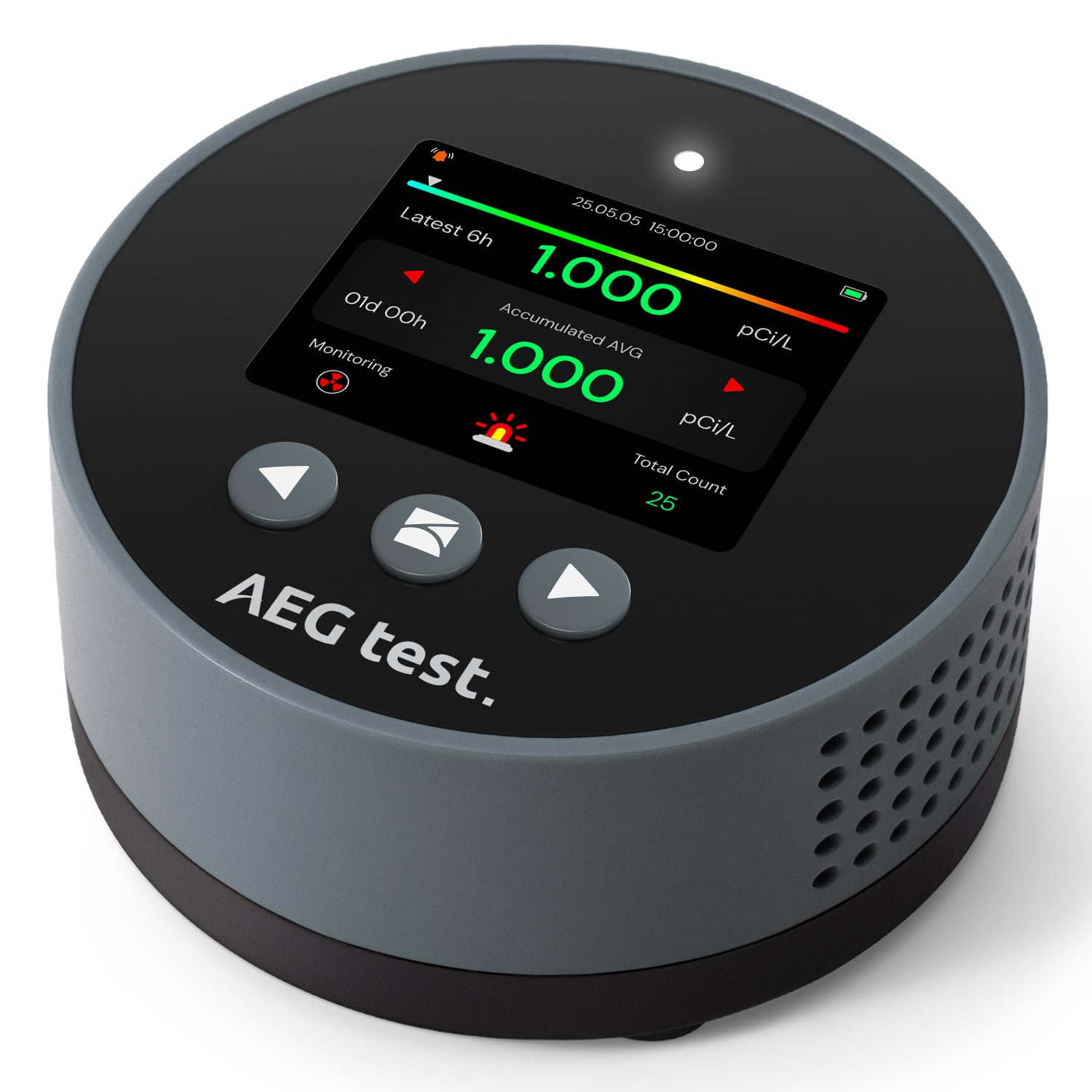
The HOUND-1085 shares the same semiconductor sensor architecture as the HOUND-1011 but in a smaller, palm-sized chassis (3.15 x 3.15 x 1.57 inches) weighing just 123 grams. The triple-vent design is engineered to accelerate radon diffusion into the sensor chamber, contributing to the 6-hour first-read time and hourly updates. Users consistently report that the device stabilizes quickly and matches readings from professional mitigation company tests.
Data storage covers short-term views (6, 24, 48, and 96 hours) alongside a 504-day long-term history log with auto-logging every 6 hours. The rechargeable lithium battery lasts over a month on a single charge, and a full recharge takes 3.5 hours. Color-coded visual bars paired with a customizable sound alarm give you two layers of warning: a quick glance tells you green (safe), orange (caution), or red (danger) without needing to read a numeric value.
One user documented a reduction from 6.2 pCi/L to 0.6 pCi/L after installing a mitigation fan, verifying the drop with the same HOUND-1085. The only common critique is that the included instruction manual could include more detail on interpreting results — a fair point since radon data interpretation is not always intuitive. For the size and price, the HOUND-1085 delivers exceptional monitoring depth in a carry-everywhere package.
Why it’s great
- Palm-sized with strong portability for multi-room surveys
- Triple-vent design accelerates sensor response time
- Color-coded visual bars plus customizable audio alarm
Good to know
- Instruction manual lacks detailed result interpretation guidance
- No app or wireless data export
5. Safety Siren Pro4
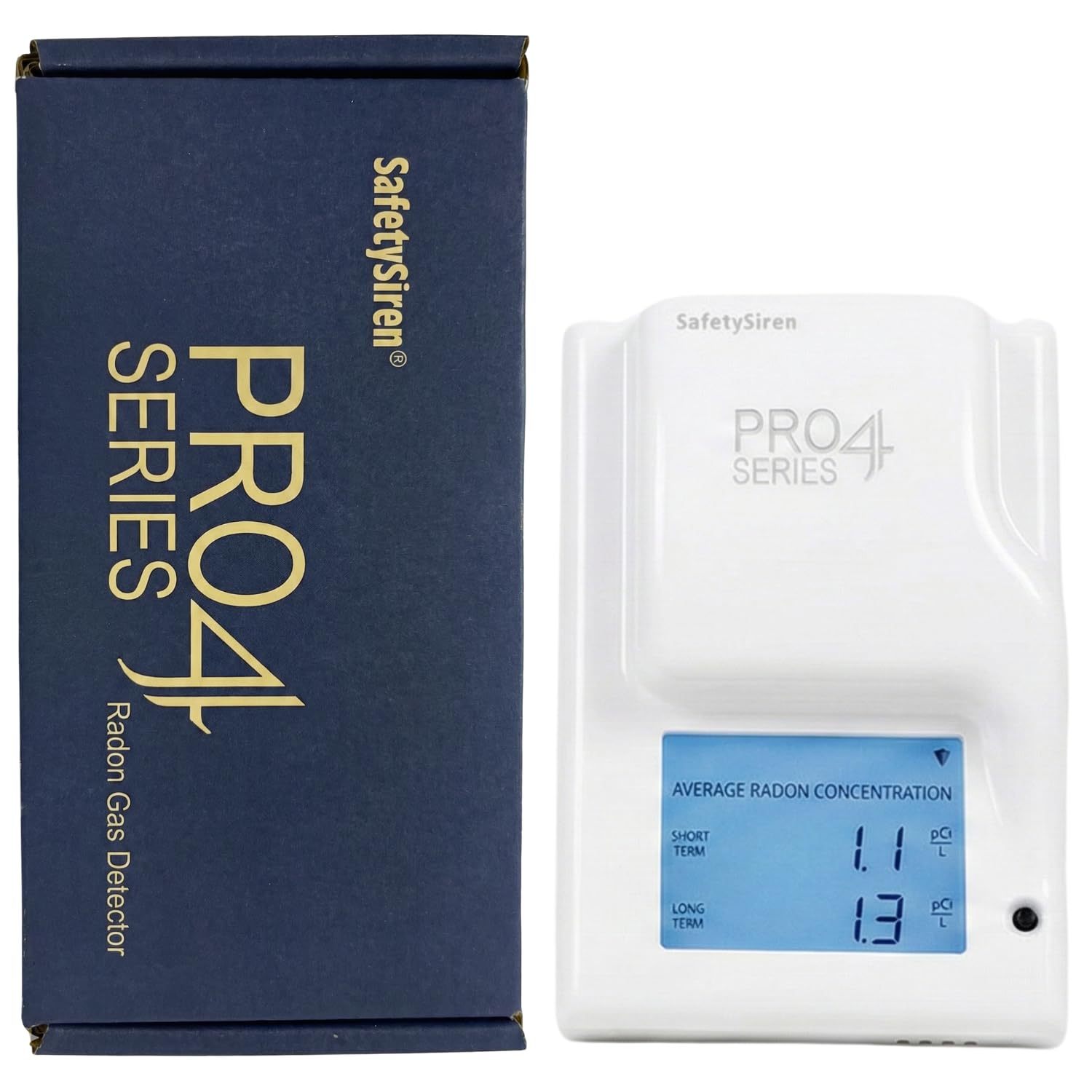
The Safety Siren Pro4 is the 4th generation of a continuous radon monitor that has been designed and manufactured in the USA since 1993. This is a plug-in unit — no batteries, no charging — that provides real-time digital readings alongside short-term and long-term averages. A 24-hour automatic self-test runs daily to verify the sensor is functioning correctly, which is a feature unique among the products in this guide and critical for long-term, unattended operation.
Users commonly report accuracy within 0.1 to 0.3 pCi/L compared to professional 72-hour tests, both before and after mitigation system installation. The backlit display is easy to read in dark basements, and the three selectable audible alarm modes plus a visual alert for the hearing impaired make this unit suitable for households with diverse needs. One user traced recurring headaches in elderly parents to a basement reading of 4.7 pCi/L, which prompted mitigation that resolved the symptoms.
The main trade-off is that the Pro4 is strictly a plug-in device with no battery backup — a power outage resets the averaging windows. It also lacks the multi-year data logging depth of the portable semiconductor units, focusing instead on reliable, straightforward continuous monitoring. For homeowners who want a set-it-and-forget-it solution made in the USA with professional-grade accuracy, the Pro4 is the benchmark.
Why it’s great
- Matches professional testing within 0.1 – 0.3 pCi/L
- Automatic daily self-test ensures consistent operation
- Visual alarm mode for hearing-impaired users
Good to know
- No battery backup; power loss resets averages
- Limited long-term data storage compared to portable units
6. AEGTEST HOUND-1011S
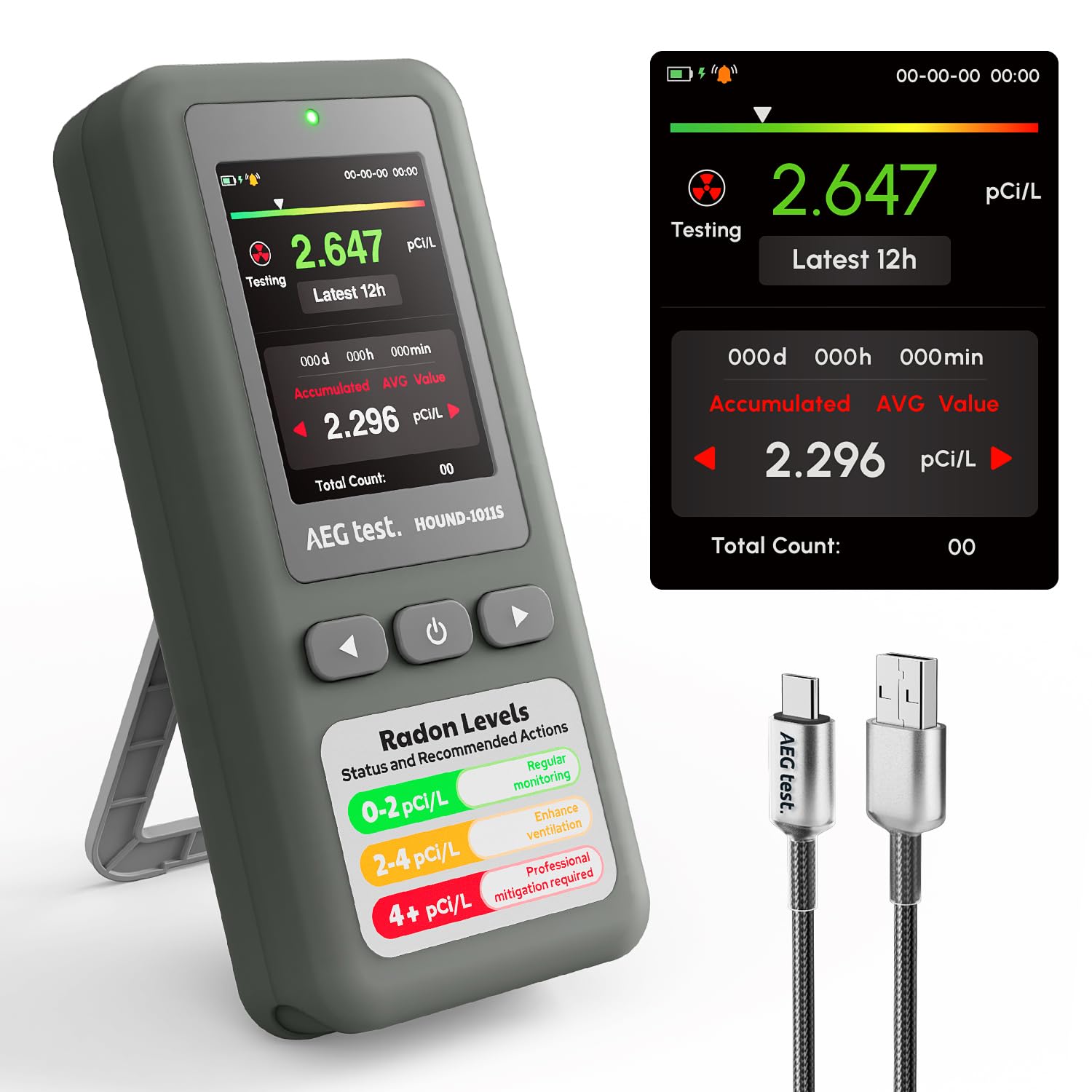
The HOUND-1011S is the entry-level sibling in the HOUND series, and the primary difference from the HOUND-1011 is the first-read time: 12 hours instead of 6 hours. For most homeowners, that delay is acceptable — you’re not making life-or-death decisions in the first half-day — and the trade-off brings the price down to one of the most accessible points in the continuous monitor category. The measurement range is identical (0.09 to 1000 pCi/L) with the same semiconductor sensor architecture.
Battery life mirrors the HOUND-1011 at up to 45 days in sleep mode with USB-C backup charging. One user documented readings around 3 pCi/L that closely aligned with a previous lab test of 2 pCi/L, confirming the unit’s general accuracy for threat identification. The color screen, graph display, and adjustable alarm are all present, though the 12-hour initial stabilization is the main spec that separates this model from its faster siblings.
Reviewers highlight the value proposition: continuous monitoring at a price near single-use test kits, but with the benefit of real-time hourly updates after stabilization. The main downside is the slower first reading — if you’re touring a home you’re about to buy and need an answer within hours, the 6-hour or 10-minute models are better choices. For ongoing monitoring in a single location, the 12-hour wait is a non-issue.
Why it’s great
- Continuous monitoring at near passive-test-kit pricing
- USB-C rechargeable with 45-day battery life
- Readings consistent with professional lab tests
Good to know
- 12-hour first reading slower than sibling models
- Not ideal for quick home-tour assessments
7. CRADTEC PRM-03H

The CRADTEC PRM-03H is the most budget-conscious entry in this guide, and it makes a specific design trade-off: it uses a photoelectric sensor rather than a semiconductor or ion chamber, and it reports its first reading after 24 hours. One user who already owned an AIRTHING monitor placed the PRM-03H next to it and recorded readings of 0.80 pCi/L versus 0.83 pCi/L — a difference small enough to be within normal sensor variance.
The 300 DPI tempered glass display is surprisingly crisp for the price point, with high light transmission that makes the screen readable from across the room. The device runs on three AAA batteries, which means no charging cables and easy replacement, though long-term battery costs can add up. The blinking alarm provides a visual warning alongside the audible beep when radon levels surge, and the included selectable holder allows either freestanding or wall-mount placement.
Reviews consistently note the straightforward setup and clear display. One user tested their home at 1.5 pCi/L and was satisfied with the peace of mind. The 24-hour first reading is the slowest in this guide, which makes the PRM-03H better suited for budget-conscious homeowners who can wait a full day for initial results. It lacks the data logging depth and hourly updates of the more expensive semiconductor units, but for basic long-term average monitoring at the lowest entry price, it delivers reliable service.
Why it’s great
- Lowest entry price for continuous digital monitoring
- Crisp 300 DPI tempered glass display
- Readings closely match more expensive monitors
Good to know
- 24-hour first reading is the slowest in this guide
- AAA batteries require periodic replacement
FAQ
How long should I run a continuous radon monitor before trusting the reading?
Can a digital radon monitor replace a professional lab test for real estate transactions?
What is the difference between semiconductor and ionization chamber sensors for radon detection?
Where is the best location to place a continuous radon monitor in my home?
Final Thoughts: The Verdict
For most users, the winner for the at home radon test kit is the AEGTEST HOUND-1011 because it combines lab-comparable accuracy, 6-hour first reading, and 504-day data logging in a portable USB-C rechargeable package that works for both pre-purchase home tours and long-term mitigation verification. If you want the fastest possible response time in seconds, grab the Ecosense EB100 EcoBlu for its 10-minute stabilization and proven ion chamber precision. And for a set-it-and-forget-it solution made in the USA with automatic daily self-tests, nothing beats the Safety Siren Pro4.