
Our readers keep the lights on and the weekend projects moving. As an Amazon Associate, I earn from qualifying purchases.
A dead phone at the trailhead or a drained camera halfway up the ridge isn’t just an inconvenience—it’s a safety risk. The right Backpack Solar Charger turns unlimited daylight into a reliable power source, letting you run GPS, capture shots, and stay connected without hunting for an outlet. But not all panels or solar backpacks deliver on their promise; many struggle with weak output, flimsy builds, or impossible charging angles.
I’m Rikta — the co-founder and writer behind FitlyFast. I’ve spent hundreds of hours parsing technical data sheets, cross-referencing customer field reports, and analyzing real-world wattage output and durability specs to separate the gear that actually works from the gear that just looks the part.
Whether you need a dedicated foldable panel for fast multi-device charging or an integrated solar backpack for all-day trekking, this guide cuts through the noise to help you choose the best backpack solar charger for your specific outdoor setup.
How To Choose The Best Backpack Solar Charger
Selecting a solar charger for your backpack requires matching the panel’s electrical output to your device needs and balancing weight against durability. Two main form factors exist: a standalone foldable panel you pack separately, or an integrated solar backpack with a panel sewn or clipped onto the bag. Your decision hinges on wattage, cell type, portability, and whether you require a battery bank for energy storage.
Wattage and Charging Speed
Panel wattage directly determines how fast your devices charge and what you can power. A 6W–7W panel handles a single smartphone but struggles with tablets or larger power banks. A 10W–14W panel charges a phone in about 3–4 hours of direct sun and can maintain a small power bank. For truly fast multi-device charging—two phones plus a bank simultaneously—look for panels in the 28W–30W range. Higher wattage panels are typically larger and heavier, so trade portability for charging speed.
Solar Cell Type: Monocrystalline vs. Polycrystalline
Monocrystalline solar cells are the industry standard for portable solar chargers. They offer higher efficiency (18-24%) and better performance in low-light, cloudy, or partial-shade conditions compared to polycrystalline panels. Products like the Anker Solix and Goal Zero Nomad use monocrystalline silicon, ensuring you still get usable power on overcast days or when the panel isn’t perfectly angled. Avoid older polycrystalline panels for backpacking—they require more direct sunlight and are heavier per watt.
Form Factor: Separate Panel vs. Solar Backpack
Separate foldable panels (e.g., Anker Solix, Goal Zero Nomad) are more versatile—you can lay them flat on the ground or a rock to achieve the optimal sun angle, and they pack inside any backpack. Integrated solar backpacks (e.g., Voltaic OffGrid, Outdoor Tech Mountaineer) offer all-in-one convenience but force the panel to hang vertically from your pack, which reduces efficiency because perpendicular sun exposure is rare during a hike. If your primary need is hiking with constant sun exposure and minimal stops, a detachable panel you can prop up during breaks is usually more practical.
Battery Bank Integration
A solar charger without a battery bank charges devices only when sunlight is strong. For cloudy days, morning/evening hikes, or overnight camping, a system with an integrated battery bank (like the Voltaic OffGrid) stores energy during sunny periods and delivers steady power later. If you choose a panel-only setup, you must pair it with a separate power bank and ensure the panel’s USB output matches the bank’s input requirements (most banks accept 5V/2A). The convenience of all-in-one integration justifies the higher cost for multi-day trips.
Durability and Weather Resistance
Your solar charger will face dust, light rain, and the inside of a pack jammed with gear. Look for an IP65 or IP66 rating (dust-tight and water-resistant) for panel-only units. For integrated solar backpacks, examine zipper quality (YKK is a good indicator), fabric tear strength (ripstop nylon or polyester), and whether the solar panel is detachable for protection when not in use. Avoid cheap units with thin, non-weather-sealed USB ports—moisture ingress is a common failure point.
Quick Comparison
On smaller screens, swipe sideways to see the full table.
| Model | Category | Best For | Key Spec | Amazon |
|---|---|---|---|---|
| Anker Solix PS30 | Foldable Panel | Fast multi-device charging | 30W, IP65, Dual USB (USB-C + USB-A) | Amazon |
| ELECOM NESTOUT | Foldable Panel | Premium compact design | 28W, SunPower cells, LED current checker | Amazon |
| Voltaic OffGrid V50 | Solar Backpack | All-in-one with battery bank | 10W panel, 20,000mAh V50 battery | Amazon |
| Goal Zero Nomad 10 | Foldable Panel | Backpacking lightweight panel | 10W, 1.2 lbs, adjustable kickstand | Amazon |
| Outdoor Tech Mountaineer | Solar Backpack | Day hiking with camera storage | 6.5W detachable panel, 40L, ripstop nylon | Amazon |
| ECEEN Solar Backpack (30L) | Integrated Backpack | Budget-friendly day use | 6.5W panel, 30L, 1.19 lbs | Amazon |
| ECEEN Solar Backpack (50L) | Integrated Backpack | Large capacity for travel | 7W removable panel, 50L, 17″ laptop slot | Amazon |
In‑Depth Reviews
1. Anker Solix PS30 Solar Panel

The Anker Solix PS30 delivers a commanding 30W of power from monocrystalline cells, making it the fastest charging option in this roundup. In clear sunlight, users report charging a phone from 15% to full in about 1.5 hours, and a 5,000mAh power bank fills in roughly half a day. The panel includes both USB-A and USB-C ports, allowing simultaneous charging of two devices, and the IP65 rating means light rain or dust won’t stop the session.
The foldable design packs down to 10.7 x 8.8 x 1.7 inches at 2.2 pounds, so it won’t dominate your pack weight. Built with aluminum framing and tempered glass over the monocrystalline cells, the durability feels substantial—though that weight is noticeable compared to smaller 10W panels. The included carabiners make hanging from a tent or tree branch straightforward, but the panel’s rigid hinges require careful handling to avoid pinching the charging cable.
While the Solix PS30 is not truly lightweight for ultralight backpacking, its charging speed is unmatched in this list. If you carry a power bank, a tablet, and a phone, this panel keeps everything topped off during a base camp or long break. It is the clear choice for anyone prioritizing raw charging speed over minimal weight.
Why it’s great
- 30W output charges multiple devices quickly
- IP65 weather-resistant for all conditions
- Durable aluminum and tempered glass build
Good to know
- Heavier than smaller panels at 2.2 lbs
- Hinges can pinch cables if not careful
- Requires direct sun for full 30W output
2. ELECOM NESTOUT Portable Solar Panel

The ELECOM NESTOOUT won the iF Design Gold Award for good reason—its thoughtful design integrates SunPower MAXEON cells that achieve up to 24% higher efficiency than standard monocrystalline panels. The output is 28W total (14W per panel), and the dual USB-A ports handle 4.8A combined, so you can charge two devices simultaneously. The built-in LED current checker displays real-time power generation, letting you confirm the panel is actually producing before you walk away.
Folded size is remarkably compact at roughly 11 x 2.4 x 6.1 inches, and the unit weighs just 1.18 pounds. The ripstop nylon exterior with water-resistant zippers holds up well against trail dust and light drizzle. The bag includes mesh storage pouches for cables and a small power bank, plus three external loops for hanging. The adjustable stands help you angle the panels, though they work best when the panel is placed on a flat surface rather than hung from a pack.
One notable limitation is the lack of a USB-C port—only USB-A is available, so you’ll need a cable adapter for modern phones and power banks that rely on USB-C input. Some users feel the price is high for a 14W panel, but the build quality, SunPower cells, and integrated storage bag make it a premium option for those who value compact design and reliable performance in a small package.
Why it’s great
- SunPower cells yield high efficiency in low light
- Integrated storage bag with mesh pockets
- LED indicator shows real-time charging output
Good to know
- No USB-C output port included
- Premium price for 14W panel
- Best results when laid flat, not hung
3. Voltaic Systems OffGrid Solar Backpack V50

The Voltaic OffGrid is the only integrated solar backpack in this list that includes a dedicated battery bank: the 20,000mAh V50 power bank stores solar energy throughout the day and delivers steady power even after sunset. The 10W monocrystalline panel charges most smartphones from dead to full in about 3.5 hours of direct sun, but the real advantage is the battery buffer—when clouds roll in or you’re hiking through dense forest, the power bank keeps your devices alive.
The backpack itself is built from recycled PET fabric, holds a 15-inch laptop and a 10-inch tablet in padded sleeves, and includes a large main compartment plus an expandable water bottle pocket. Weighing 4.2 pounds, this is the heaviest option here, but it replaces the need for a separate battery pack and a packable panel. Regular users report that the bag holds up well as a daily commuter pack and transitions seamlessly to weekender hiking duty.
Some users have reported intermittent functionality issues with the solar panel connection to the battery, though the 2-year warranty on the panel and 1-year on the battery provide peace of mind. The charging port configuration uses USB-A, so again, a USB-C adapter may be needed. If you want a true all-in-one solution for multi-day trips without managing separate components, this is the most complete package.
Why it’s great
- Integrated 20,000mAh battery stores power for later
- Rugged recycled PET fabric with laptop padding
- 2-year warranty on the solar panel
Good to know
- Heaviest option at 4.2 lbs
- Solar panel connection can be finicky for some users
- USB-A output; adapter needed for USB-C devices
4. Goal Zero Nomad 10

The Goal Zero Nomad 10 is a favorite among long-distance backpackers who need the lightest functional panel. At 1.2 pounds, it folds to roughly 9.5 x 7.2 x 1.2 inches and fits easily into a side pocket of any pack. The 10W monocrystalline panel produces about 8W in direct sun according to user measurements, enough to charge a typical 5,000mAh power bank fully in a single sunny afternoon or top off a phone in under 2 hours. The adjustable kickstand is a smart addition—flip it open and prop the panel at the right angle without needing a rock or tree branch.
The USB port is not weather-sealed, so the Nomad 10 should be kept dry during rain. Build quality is solid, with a plastic housing that feels durable but not bombproof. Customer reports note that the panel performs well even on cloudy days, producing about 5W through a glass door, so it’s genuinely usable in less-than-perfect conditions. The 180-degree kickstand allows flexible positioning, but the panel needs to be left flat or angled correctly—hanging from a backpack dramatically reduces output.
If your priority is ultralight backpacking and you need a reliable 10W panel for one smartphone or a small power bank, the Nomad 10 remains a standard-setter. It lacks a USB-C port and the output is limited to 5V/2A, but for the weight-conscious hiker, this is a proven, durable choice that will last for many seasons.
Why it’s great
- Ultralight at 1.2 lbs, easy to pack
- Adjustable kickstand for optimal sun angle
- Strong low-light performance reported by users
Good to know
- USB port is not weather-sealed
- Only 10W output, slower for multi-device charging
- No USB-C port
5. Outdoor Tech Mountaineer Solar Backpack

The Outdoor Tech Mountaineer is a 40L daypack built with 100% ripstop nylon, featuring a detachable 6.5W flexible solar panel. The detachable design is a genuine advantage—you can remove the panel and lay it flat in direct sunlight while the bag sits in the shade, optimizing charging efficiency. The bag itself is thoughtfully organized with three compartments, deep mesh side pockets for water bottles, and a bottom pocket designed for camera gear or a small first aid kit.
At 3 pounds, it’s lighter than the Voltaic but heavier than a pure foldable panel setup. The solar panel charges a phone slowly—about 10% in 35 minutes of direct sun according to user tests—so it’s best suited for emergency top-offs rather than fully charging a dead battery. The panel can also be used to trickle-charge a small power bank during the day. The bag’s padded and ventilated back panel helps with comfort on all-day hikes, though the shoulder straps lack heavy padding for loads over 15 pounds.
Some users report non-waterproof zippers and a lack of bottom padding in the camera compartment, so this isn’t a rugged expedition pack. However, as a lightweight daypack for fair-weather hikes, park visits, or as a car trunk emergency bag, the mountaineer works well. The detachable solar panel adds genuine utility without making the heavy commitment of a permanently sewn-in unit.
Why it’s great
- Detachable solar panel for flexible positioning
- 40L capacity with camera gear storage pocket
- Lightweight ripstop nylon construction
Good to know
- Slow charging speed (6.5W)
- Zippers not fully waterproof
- Limited padding for heavy loads
6. ECEEN Solar Backpack 30L
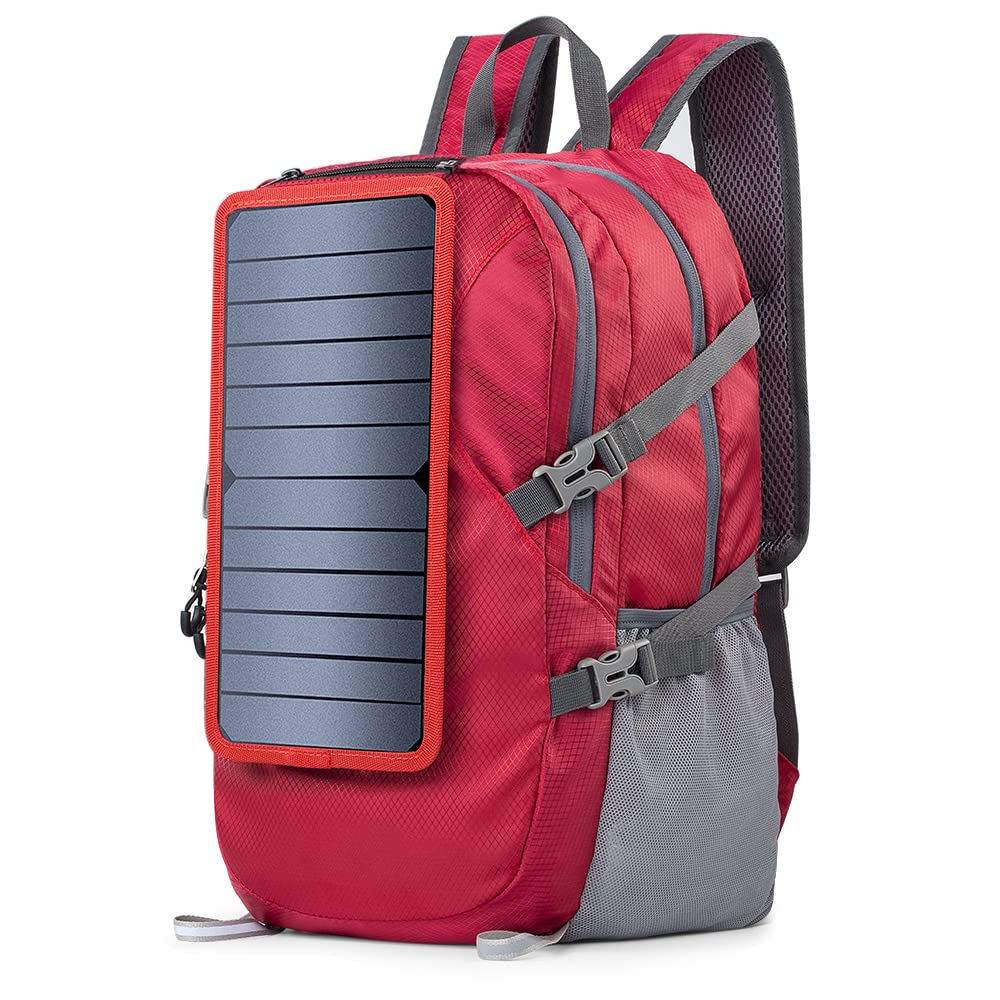
The ECEEN 30L Solar Backpack is one of the lightest integrated solar backpacks available at just 1.19 pounds. The 6.5W panel is permanently attached to the front face, and the USB output delivers 5V/1A. This wattage is enough to trickle-charge a smartphone over several hours of direct sunlight but will not charge a tablet or power bank quickly. Users confirm the charging is slow and heavily dependent on the sun being directly overhead—when the bag hangs vertically on your back, the angle is almost never optimal.
The backpack itself is made from water and tear-resistant nylon with metal zippers, and when not in use, the entire bag folds into a compact pouch roughly the size of a sandwich. The 30L storage is adequate for a day hike: water bottle, snacks, light jacket, and a small camera. The bag lacks any frame or padding, so it’s not comfortable for carrying more than about 8-10 pounds, and the shoulder straps are thin. It’s best for short, sunny walks where you want an occasional trickle charge to maintain your phone battery.
For the price, this is the most affordable entry point into solar backpacks, but the charging utility is minimal. Think of this as a very lightweight daypack that happens to include a small solar panel—it’s not a powerhouse. If your primary need is a spare pack for travel and you like the idea of free top-off power in sunny conditions, this fills that niche well. For serious hikers needing reliable charging, a separate panel like the Anker Solix or Goal Zero Nomad is a better investment.
Why it’s great
- Extremely lightweight at 1.19 lbs
- Packs into its own pouch for travel
- Budget-friendly entry into solar backpacks
Good to know
- Slow charging at 5V/1A
- No structural support for heavy gear
- Solar angle is poor when worn on the back
7. ECEEN Solar Backpack 50L

The 50L version of the ECEEN Solar Backpack increases capacity significantly while maintaining a low weight of 1.83 pounds. The 7W solar panel is detachable, which is a welcome improvement over the 30L model—you can remove the panel and lay it flat for better charging angle. Output is still USB 5V/1A, so the charging speed remains slow (users report it struggles to charge a modern iPhone or GoPro in a reasonable time without direct overhead sun). However, the detachable design does help you position the panel optimally.
The backpack itself includes a padded 17-inch laptop sleeve, making it suitable for commuting or as carry-on luggage. The honeycomb nylon ripstop fabric feels more durable than the 30L version, and the zippers appear sturdy. The extra 20L of storage means you can pack for a weekend trip, including a change of clothes, toiletries, a laptop, and a small DSLR. The bag’s padding is adequate for loads up to 15 pounds, and the removable solar panel adds minimal bulk when packed separately.
If you need a larger-capacity bag for travel and appreciate the detachable solar panel for emergency charging, this 50L model is a solid choice. However, as with the 30L version, don’t expect the solar panel to replace a dedicated higher-wattage panel. It’s a backup charging solution integrated into a practical, spacious backpack. Pair it with a small power bank for more reliable off-grid power.
Why it’s great
- Large 50L capacity with 17″ laptop sleeve
- Detachable solar panel for flexible positioning
- Lightweight for its size at 1.83 lbs
Good to know
- Solar output is slow at 5V/1A
- Not strong enough for modern power-hungry devices
- Limited padding for heavy loads over 15 lbs
FAQ
Can I charge my laptop with a backpack solar charger?
How does cloud cover affect solar charging speed?
How do I optimise my solar panel’s charging angle?
Is it safe to leave my solar panel in the rain?
Final Thoughts: The Verdict
For most users, the best backpack solar charger winner is the Anker Solix PS30 because it delivers the highest wattage (30W) in a foldable package, charging multiple devices quickly while offering IP65 weather protection and durable construction. If you want an ultralight panel for backpacking where every gram counts, grab the Goal Zero Nomad 10. And for a complete all-in-one solution with a built-in battery bank for multi-day trips without compromise, nothing beats the Voltaic Systems OffGrid V50 backpack.