
Our readers keep the lights on and the weekend projects moving. As an Amazon Associate, I earn from qualifying purchases.
Choosing between powered bookshelf speakers and studio monitors means deciding whether you want colored, enjoyable listening or a flat, unaltered mix that reveals every flaw in your track. The wrong pick leaves you with bloated low end that hides mix errors or a sound so analytical it drains the life from your favorite records.
I’m Rikta — the co-founder and writer behind FitlyFast. I’ve spent countless hours dissecting the amplifier topologies, driver materials, and frequency response curves that separate genuine studio tools from consumer-grade speakers dressed up for the desktop.
The goal of this guide is to help you match your ear, your room, and your budget to the right gear by walking through seven carefully researched options for the best audio gear you can add to your home setup.
How To Choose The Best Audio Gear
Whether you are producing music, podcasting, or simply want a more accurate listening experience on your desktop, the specs that define a quality monitor or speaker go far beyond wattage and driver size. Here are the critical factors to weigh before you commit.
Frequency Response and Flatness
A monitor with a flat frequency response (often cited as ±X dB from 50Hz to 20kHz) is the gold standard for critical listening. An exaggerated low end or a scooped midrange may sound impressive at first, but it will fool your ears during mixing, leading to a final product that translates poorly to headphones, car stereos, or club systems. Look for a spec that states a tight tolerance, such as ±2 dB, which indicates minimal coloration from the source signal.
Amplifier Topology: Class A/B vs. Class D
Modern monitors have largely adopted efficient Class D amplification, which runs cooler and conserves power without sacrificing headroom. However, some purists still prefer the Class A/B topology found in older designs for its smooth, natural distortion profile. The choice should be guided by your thermal environment and whether you prioritize energy efficiency over a very specific sonic character that only a traditional analog circuit can deliver.
Driver Material and Cabinet Construction
The woofer material (such as Kevlar, polypropylene, or treated paper) directly impacts transient response and cone breakup behavior. Kevlar drivers, common in the KRK ROKIT series, offer high stiffness with low mass, providing punchy, defined bass. The enclosure should be made from dense MDF to minimize resonances, and a front-firing bass port allows you to place the speaker closer to a wall without creating boomy low frequencies.
Quick Comparison
On smaller screens, swipe sideways to see the full table.
| Model | Category | Best For | Key Spec | Amazon |
|---|---|---|---|---|
| Yamaha HS5 (Pair) | Studio Monitor | Uncolored mixing | 54Hz–30kHz frequency response | Amazon |
| JBL 305P MkII (Pair) | Studio Monitor | Wide sweet spot imaging | 82 watts (dual 41W Class-D) | Amazon |
| KRK RP5G5 (Pair) | Studio Monitor | DSP-driven room tuning | 5″ Kevlar woofer | Amazon |
| Edifier MR3 (Pair) | Powered Monitor | Desktop versatility | 52Hz–40kHz Hi-Res Audio | Amazon |
| Edifier R1280T (Pair) | Bookshelf Speaker | Casual home listening | 42W RMS total output | Amazon |
| ALTO TX408 | PA Speaker | Live sound monitoring | 350W bi-amplified | Amazon |
| Fluance PA10 | Phono Preamp | Turntable signal chain | RIAA equalization | Amazon |
In‑Depth Reviews
1. Yamaha HS5 Powered Studio Monitor, Pair

The Yamaha HS5 has earned its reputation as the reference standard for near-field monitoring, and this pair delivers exactly the uncolored sound that serious mixing demands. Its 45W LF plus 25W HF bi-amp system provides 70 watts of total power, driving a 5-inch cone woofer and a 1-inch dome tweeter across a stated 54Hz to 30kHz frequency range. The key selling point is sonic purity — Yamaha designed the HS series to reject any alteration of the original signal, which is why it pairs well with a Focusrite interface for transparent audio editing.
In practice, the HS5 excels at revealing mix errors that would be masked by a speaker with a boosted low end. Users note that it works especially well for guitarists running modelers like a Vox Tonelab, as it lacks false bass coloration. The XLR and TRS phone jack inputs accept balanced or unbalanced signals, and the cabinet is dense enough to remain inert even at moderate listening levels. The second-generation HS5 is a huge upgrade from entry-level monitors like the PreSonus Eris 4.5, offering a wider stereo field and more detailed midrange.
A quality audio interface is strongly recommended to drive these monitors properly. Without one, you may lose some of the clarity that justifies the investment. The HS5 also does not include Bluetooth or digital inputs — it is a pure analog studio tool built for accuracy, not convenience.
Why it’s great
- Industry-standard flat frequency response
- Bi-amplified 70W power section provides clean headroom
- Rugged MDF cabinet reduces unwanted resonance
Good to know
- Requires an audio interface for optimal performance
- No Bluetooth or wireless connectivity
- Limited low-end extension compared to an 8-inch woofer
2. JBL 305P MkII 5″ Powered Studio Reference Monitors, Pair

The JBL 305P MkII is a formidable contender in the entry-level pro-audio space, offering a patented Image Control Waveguide that creates a wider sweet spot compared to the Yamaha HS5. Each monitor is powered by dual 41-watt Class-D amplifiers — one for the 5-inch woofer and one for the 1-inch tweeter — delivering a total of 82 watts per pair. The Slip Stream bass port is tuned to produce deep, clean low frequencies without audible chuffing, making these speakers suitable for sound design work as well as general music production.
The Boundary EQ and HF Trim switches are a practical addition that allows you to adjust the monitor’s output to compensate for room placement. If you are forced to put the speakers near a wall or corner, you can cut the low end to prevent a boomy bass response. Reviews consistently praise the 305P MkII for its clarity, with users noting an immediate improvement over budget options like the PreSonus E3.5, particularly in stereo width and low-mid fullness. The enclosures are built from medium-density fiberboard and tested for 100-hour reliability.
The 305P MkII uses XLR and 1/4-inch TRS balanced inputs exclusively — there is no RCA or Bluetooth connection. You will need a balanced audio interface or a dedicated DAC to get the best signal-to-noise ratio. The ribbon-like detail in the high frequencies is excellent for its price bracket, but some users find the overall sound brighter than the Yamaha HS5.
Why it’s great
- Wide, forgiving sweet spot from Image Control Waveguide
- Boundary EQ for room compensation
- Excellent detail and clarity across the frequency range
Good to know
- Requires balanced XLR/TRS inputs from an interface
- No Bluetooth or wireless streaming
- Bass response is limited compared to a paired subwoofer
3. KRK RP5G5 ROKIT 5 Generation Five 5″ Powered Studio Monitor, Pair

The KRK ROKIT 5 G5 is the latest iteration of a legendary studio monitor line, now featuring DSP-driven room tuning that sets it apart from passive EQ solutions. The 5-inch woofer is made from woven Kevlar, which offers high stiffness-to-weight ratio for fast, punchy transients. A new 1-inch silk dome tweeter improves high-mid and high-frequency phase coherence, and the Low Diffraction Baffle Design reduces cabinet-edge reflections for a cleaner stereo image. The bi-amplified Class D modules are custom-designed for improved thermal management.
The DSP section provides visual EQ curves displayed on the rear panel, allowing you to adjust the monitor’s output to match your room’s acoustic profile. The pair also includes acoustic foam wedge isolation pads to decouple the speakers from your desk. The XLR/1/4-inch TRS combo input is compatible with nearly any audio source. Reviews note that the G5 is cleaner than the previous generation, with marginally better clarity and a more refined sound signature, though some users point to reliability concerns with the Gen 4 power supplies.
This is a prosumer-grade monitor best paired with the KRK S10.4 subwoofer for critical listening. Without a sub, the 5-inch woofer delivers a balanced low end that works well for casual mixing, but it lacks the deep extension needed for bass-heavy genres. The Kevlar driver is durable, but its specific tonal character may require some adjustment time if you are moving from a paper-cone monitor.
Why it’s great
- DSP-driven room tuning for acoustic optimization
- Kevlar woofer provides fast, detailed bass
- Includes isolation pads for better desk placement
Good to know
- Bass extension is limited without a matching subwoofer
- Previous generation had PSU issues
- Kevlar cone character may not suit all tastes
4. Edifier MR3 Powered Studio Monitor Speakers, Pair

The Edifier MR3 is a compact powered monitor that bridges the gap between studio accuracy and everyday desktop convenience. It is Hi-Res Audio Certified, with a frequency response that extends from 52Hz to 40kHz — exceeding the range of most adult hearing but ensuring ultrasonic headroom for high-resolution audio files. The 18W*2 RMS output (36W total) drives 3.5-inch mid-low drivers and 1-inch tweeters, delivering a peak SPL of 92.5dB, which is sufficient for near-field listening in a small room.
Connectivity is the MR3’s strongest advantage: it includes balanced TRS inputs alongside RCA and AUX, plus Bluetooth 5.4 with multi-point connection. The front-panel headphone output is useful for late-night mixing sessions. The EDIFIER ConneX app allows you to switch between Music, Monitor, and Custom EQ modes, giving you granular control over the sound profile. Users report clean, neutral sound with tight bass and no hissing at idle, and the MDF cabinet reduces cabinet coloration better than plastic alternatives.
The Bluetooth volume is not fully controllable from the connected device — you must adjust it via the physical knob or the app. The 3.5-inch woofer limits the MR3’s ability to produce deep sub-bass, so it is best suited for podcasts, vocal mixing, and general desktop audio rather than heavy bass music production. The white and black finish options look elegant on a desk, but the plastic housing feels less premium than the all-MDF Yamaha HS5.
Why it’s great
- Hi-Res Audio Certification with extended 40kHz response
- Versatile connectivity — TRS, RCA, AUX, and Bluetooth 5.4
- App-based EQ for custom sound profiles
Good to know
- Limited sub-bass extension from 3.5-inch drivers
- Bluetooth volume control is partial — requires manual adjustment
- Enclosure material is predominantly plastic
5. Edifier R1280T Powered Bookshelf Speakers, Pair

The Edifier R1280T is the classic entry into powered bookshelf speakers, offering 42 watts RMS from a 13mm silk dome tweeter and a 4-inch full-range driver. This is not a studio monitor, but rather a consumer-grade near-field speaker designed for home listening. The MDF wood cabinet with a wood-effect vinyl finish is visually appealing and helps dampen cabinet resonance. Setup is straightforward — the included remote controls volume, and the side panel provides bass and treble knobs for quick EQ adjustments.
The dual AUX inputs allow you to connect two devices simultaneously, which is handy for switching between a turntable and a computer without repatching cables. The sound is natural and unoffensive, with clean mids and smooth treble, though the low end lacks punch compared to the Edifier MR3. Users recommend pairing these with a subwoofer for a balanced sound. The remote adds convenience, and the classic wood finish fits well in a living room or bookshelf setup.
These speakers are not designed for critical mixing or monitoring. They are best for casual listening to vinyl, streaming music from a smartphone, or as desktop speakers for general computer audio. The lack of Bluetooth means a physical cable is always required, and the sound signature is noticeably colored compared to a reference monitor.
Why it’s great
- Affordable entry into powered bookshelf sound
- Dual AUX inputs for multi-device connectivity
- Remote control and side-panel EQ adjustability
Good to know
- No Bluetooth — wired connection only
- Bass requires a separate subwoofer for fullness
- Designed for casual listening, not mixing accuracy
6. ALTO TX408 350W 8″ Powered PA Speaker
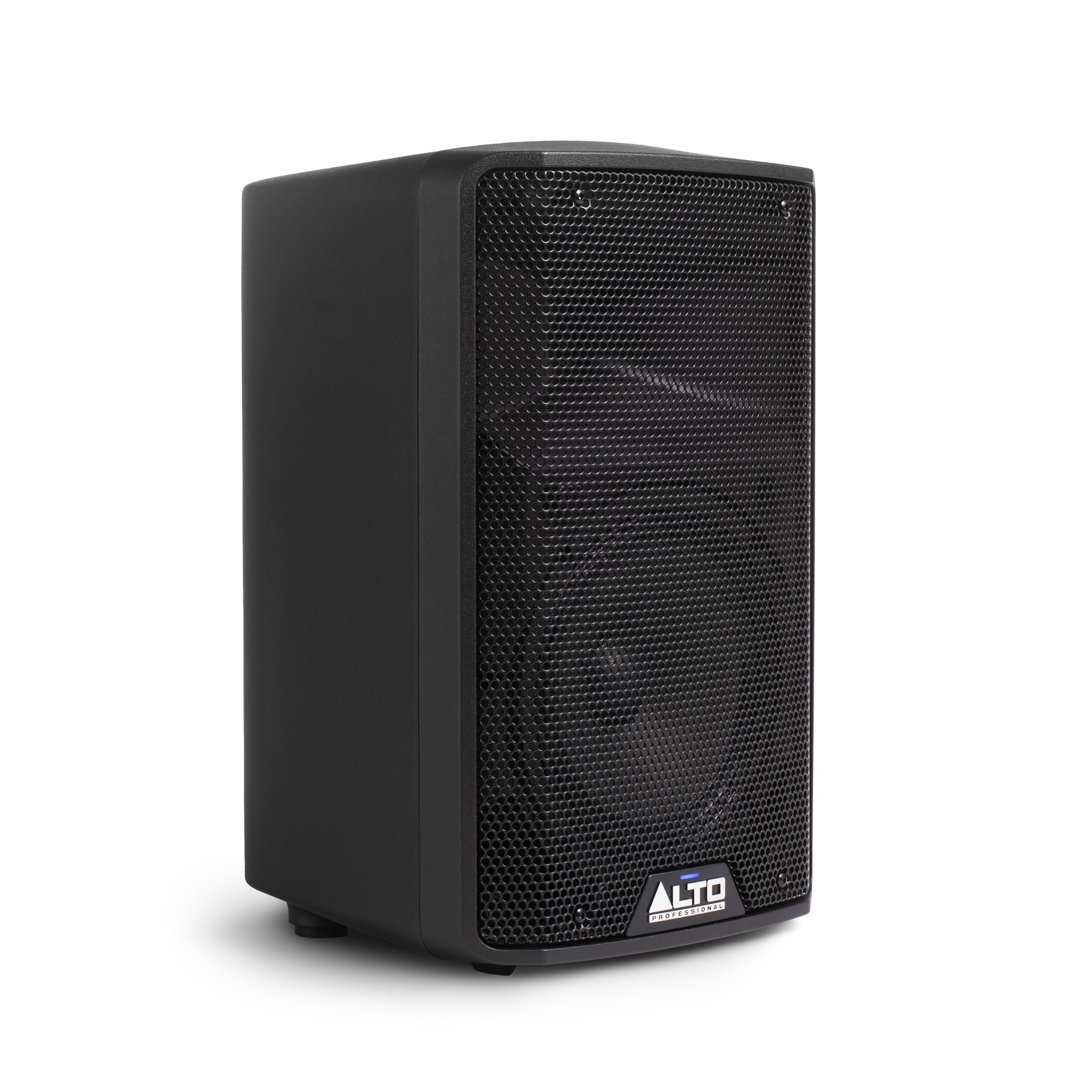
The ALTO TX408 is a compact powered PA speaker built for live sound reinforcement, not near-field studio monitoring. It delivers 350 watts from a bi-amplified Class-D amplifier (250W LF + 100W HF) to an 8-inch low-frequency driver and a 1-inch titanium diaphragm compression driver. The 90° x 60° wide-dispersion horn provides even coverage for small venues, and the built-in 2-channel mixer supports microphone, line-level, and Bluetooth inputs simultaneously. The integrated 36mm pole socket allows for standard PA mounting.
Bluetooth 5.0 with True Wireless Stereo (TWS) lets you pair two TX408 units for cable-free stereo streaming. The metal grille and rugged enclosure protect the driver array during transport. Reviews indicate that the TX408 punches above its weight for indoor events, filling spaces up to small gymnasiums with clean vocals and moderate bass. Users running exercise classes or mobile DJing at cocktail hours report excellent clarity at low volume settings. The contour EQ switch helps optimize playback for music versus speech.
The 36mm pole socket is slightly smaller than the industry-standard 35mm, requiring a minor fix if you are using standard speaker stands. The included power cable is shorter than some users prefer, and the plastic enclosure, while durable, feels less premium than a wooden cabinet. This is a purpose-built PA tool, not a replacement for studio monitors or bookshelf speakers.
Why it’s great
- 350W bi-amplified power for live venue coverage
- Bluetooth TWS for cable-free stereo pairing
- Built-in 2-channel mixer with mic input
Good to know
- Non-standard 36mm pole mount requires stand adaptation
- Plastic cabinet feels less robust than wood
- Short power cable included
7. Fluance PA10 High Fidelity Phono Preamp
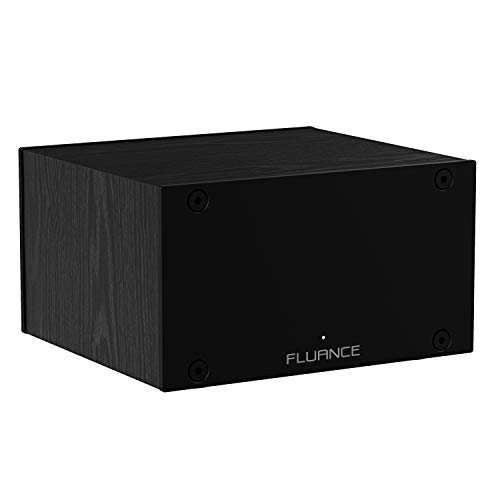
The Fluance PA10 is a dedicated MM phono preamplifier that serves the same signal-chain role that a balanced audio interface plays for studio monitors — it converts the tiny electrical signal from your turntable cartridge into a line-level signal that can drive powered speakers or a stereo amplifier. The circuit uses individual left and right channel OP amps for optimal channel separation, and an internal metal shielding enclosure blocks electromagnetic interference that could otherwise manifest as hum or buzz in the audio path.
An optional subsonic filter rolls off frequencies below 20Hz with a slow, gentle slope, which helps mitigate rumble from warped records or floor vibrations without affecting the audible bass. Reviews highlight the PA10’s ability to eliminate persistent hum from turntable setups, especially when paired with other Fluance components like the RT85 turntable. The sound is described as clean, neutral, and significantly more detailed than the preamp stage built into most entry-level turntables. Users report punchier bass and cleaner lows after adding this external unit.
This is a single-function component with no Bluetooth, no app control, and no adjustable gain settings. It is designed for users who already own a powered speaker setup or a stereo amplifier and need a clean RIAA stage. The wooden enclosure is aesthetic rather than structural, and the compact size fits easily into any audio stack.
Why it’s great
- Eliminates hum and noise from turntable setups
- Selectable subsonic filter reduces record rumble
- Clean, neutral sound with excellent channel separation
Good to know
- No adjustable gain or EQ controls
- Designed for MM cartridges only
- Requires powered speakers or a separate amplifier to function
FAQ
Do I need an audio interface for studio monitors?
What is the difference between a studio monitor and a bookshelf speaker?
Can I use a PA speaker for studio mixing?
Final Thoughts: The Verdict
For most users, the audio gear winner is the Yamaha HS5 Studio Monitor Pair because its flat frequency response and transparent sound make it the undisputed choice for accurate mixing and mastering. If you want a wider sweet spot and Boundary EQ flexibility for room compensation, grab the JBL 305P MkII Pair. And for a versatile desktop setup that includes Bluetooth and Hi-Res Audio certification, nothing beats the Edifier MR3 Pair.