
Our readers keep the lights on and the weekend projects moving. As an Amazon Associate, I earn from qualifying purchases.
The flash of an arc hitting a cheap lens is an instant reminder that your eyes are the most expensive tool in the shop. An auto-darkening helmet that lags, flickers, or distorts the weld pool turns every bead into a guessing game, and that guesswork costs time and material. The right filter drops the shade before your pupils can react, cutting glare while preserving the orange glow of the puddle so you can actually see what the wire is doing.
I’m Rikta — the co-founder and writer behind FitlyFast. I’ve spent countless hours cross-referencing shade ranges, sensor counts, optical classifications, and real-world user reports across budget-friendly cartridges, mid-range workhorses, and premium pro-grade shells to find which variables actually define a great weld.
Whether you are running low-amp TIG on stainless or laying down thick stick beads on structural steel, the auto darkening welding helmet you choose determines how accurately you can read the puddle and how fast your neck fatigues, which is why this guide focuses on the specs that matter for real weld processes.
How To Choose The Best Auto Darkening Welding Helmet
Not every helmet that darkens automatically is built to handle the full spectrum of welding processes. The deciding factors are almost never about the brand logo on the shell but rather the optical hardware hidden inside the cartridge. Buyers who skip the shade range and sensor count often end up with a unit that blinks during low-amp TIG or cannot switch fast enough for high-frequency starts.
Optical Clarity and True Color
The optical class rating (usually listed as 1/1/1/1 or 1/1/1/2) tells you how much light scatter, distortion, and color shift the lens introduces. A 1/1/1/1 rating delivers the sharpest image with minimal color aberration, letting you see the weld puddle and the surrounding base metal in near-natural tones. “True Color” lenses filter out the harsh yellow-green tint common in older cartridges, which reduces eye fatigue during long weld passes and helps you track the filler wire more accurately.
Shade Range and Variable Control
Fixed-shade lenses (typically shade 10) work fine for high-amp stick welding, but a wide variable range — DIN 5 to DIN 13 — is essential if you switch between processes. Low-amp TIG often requires shade 8 or 9 on thin material, while heavy flux-core or carbon-arc gouging pushes into shade 12 or 13. The ability to adjust in half-shade increments (0.5 steps) lets you dial in the exact darkness for the material thickness and amperage you are running.
Number of Arc Sensors and Switching Speed
Arc sensors detect the light from the arc and trigger the liquid-crystal filter to darken. A single-sensor helmet will fail to darken if your hand, your body, or a workpiece edge blocks the sensor from seeing the arc. Two sensors are the minimum for reliable detection; four sensors offer complete coverage even in awkward positions like overhead or inside corners. Switching speed — measured in milliseconds — should be below 1/15,000 of a second (roughly 0.07 ms) to prevent the initial flash from reaching your eyes.
Quick Comparison
On smaller screens, swipe sideways to see the full table.
| Model | Category | Best For | Key Spec | Amazon |
|---|---|---|---|---|
| Tefuawe 2×4 Lens | Upgrade Lens | Pipeliner / Pancake Hood | Lowest TIG rating 5A | Amazon |
| MIGVAN H-21 | Complete Helmet | Multi-process versatility | 4 Arc sensors, solar+rechargeable | Amazon |
| Fibre-Metal 110PWE | Passive Shell | Harsh environments | Fiberglass shell, moisture-proof | Amazon |
| Antra AH7-860 | Complete Helmet | Large view, low-amp TIG | 13.5 sq in window, TIG 2A | Amazon |
| Hobart 770869 | Complete Helmet | Entry-level multi-process | Three arc sensors, 7.1 sq in view | Amazon |
| Miller Classic 287803 | Complete Helmet | Professional TIG/MIG | ClearLight lens, 2 sensors | Amazon |
| ESAB Sentinel A60 | Complete Helmet | Serious professionals | 4 sensors, 0.5 shade steps | Amazon |
In‑Depth Reviews
1. Miller Classic 287803

The Miller Classic brings the ClearLight lens technology into a price range that competes with mid-tier imports while delivering an optical clarity that is noticeably cleaner than generic cartridges. With a 6-square-inch viewing area and a switching speed of 1/23,000 of a second, it eliminates the initial flash that can cause headaches over a long shift. The two arc sensors are positioned well for most positions, though tight overhead corners may require you to angle slightly.
The variable shade range covers weld shades 8 through 13, plus cut shades 5 through 8 and a grind mode at shade 3. This makes it genuinely multi-process out of the box — you can switch from gouging to TIG without changing lenses. The ratchet headgear locks in securely once adjusted, and the overall weight is well balanced, so it does not pull the helmet forward during extended vertical-up welds.
Three-year warranty from Miller backs the build, and the unit meets ANSI Z87.1+, CSA, and CE standards. The plastic shell feels sturdy enough for shop use, though it is not designed for the extreme impacts a fiberglass pipeliner shell can take. If you run mostly TIG or MIG in a controlled environment and demand consistent optical clarity, this helmet nails the balance between professional-grade optics and reasonable outlay.
Why it’s great
- High-definition ClearLight lens with natural color reproduction
- Fast 1/23,000 s switching speed
- Adjustable shade, delay, and sensitivity digital controls
Good to know
- Two arc sensors only; may miss in obstructed positions
- Viewing area smaller than some large-window options
2. ESAB Sentinel A60

The ESAB Sentinel A60 is built for the welder who moves between processes throughout the day and needs a helmet that remembers how he likes each one set. The on-board memory stores up to nine custom configurations — shade level, sensitivity, delay — so you can dial in your TIG parameters once and recall them instantly when you switch back from stick. The 0.08 millisecond switching time is among the fastest on this list, and the four arc sensors ensure no dead zones regardless of your welding angle.
The OpTCS True Color Lens Technology delivers a crisp, nearly colorless view of the puddle that reduces the eye fatigue that sets in during long-duration welds. The shade range covers DIN 3/5 through 13 in adjustable 0.5-step increments, giving you fine control that fixed-step helmets cannot match. The low-profile black nylon shell cuts down on snagging in tight spaces and weighs only a pound, though the headgear has been reported as less robust than the shell itself by some users.
Replaceable CR2450 batteries power the unit, with a low-battery LED that prevents surprise failures mid-bead. The grind mode and shade lock LEDs are helpful in noisy environments where you cannot hear the switch click. At the premium end of the market, the Sentinel A60 justifies its standing through customization and sensor coverage rather than just brand prestige.
Why it’s great
- Nine-setting on-board memory for multiple processes
- Four arc sensors with fast 0.08 ms switching
- 0.5-step shade increments from DIN 3/5 to 13
Good to know
- Headgear feel is less premium than the shell
- Outer lenses scratch relatively easily
3. Antra AH7-860

The Antra Grey Ghost earns its spot by offering one of the largest viewing windows available at its price point — 13.5 square inches — which is a meaningful advantage for welders who wear bifocals or want to monitor the full joint without craning their neck. The true color optics produce a clear image with minimal distortion across the shade range of DIN 4/5 to 13. TIG welders will appreciate the low-amp rating down to 2 amps, which prevents the flickering and flutter that plague many general-purpose cartridges on thin stainless or aluminum.
The headgear is adjustable with a ratchet mechanism that fits most head sizes, though some users have noted the pivot mechanism may not hold the helmet in the flipped-up position as firmly as they would like. Replacement batteries are user-accessible, and the solar-assist panel extends runtime, though the unit can still fail dark if the batteries are drained and you start welding before they charge. The shell is lightweight nylon, which keeps the overall weight down to about 16 ounces, but feels less rigid compared to fiberglass shells.
Safety certifications include ANSI Z87.1, CSA Z87.1, and EN 379, making it compliant for professional use. The grind mode switch is conveniently positioned but easy to bump accidentally, so double-check before striking an arc. For the combination of enormous viewing area and reliable low-amp TIG performance, the Antra delivers value that is hard to beat.
Why it’s great
- Massive 13.5 sq in viewing window for situational awareness
- Reliable auto-darkening down to 2-amp TIG
- True color optics with low distortion
Good to know
- Shell plastic feels flimsy compared to premium options
- Headgear pivot may not hold the hood up reliably
4. MIGVAN H-21
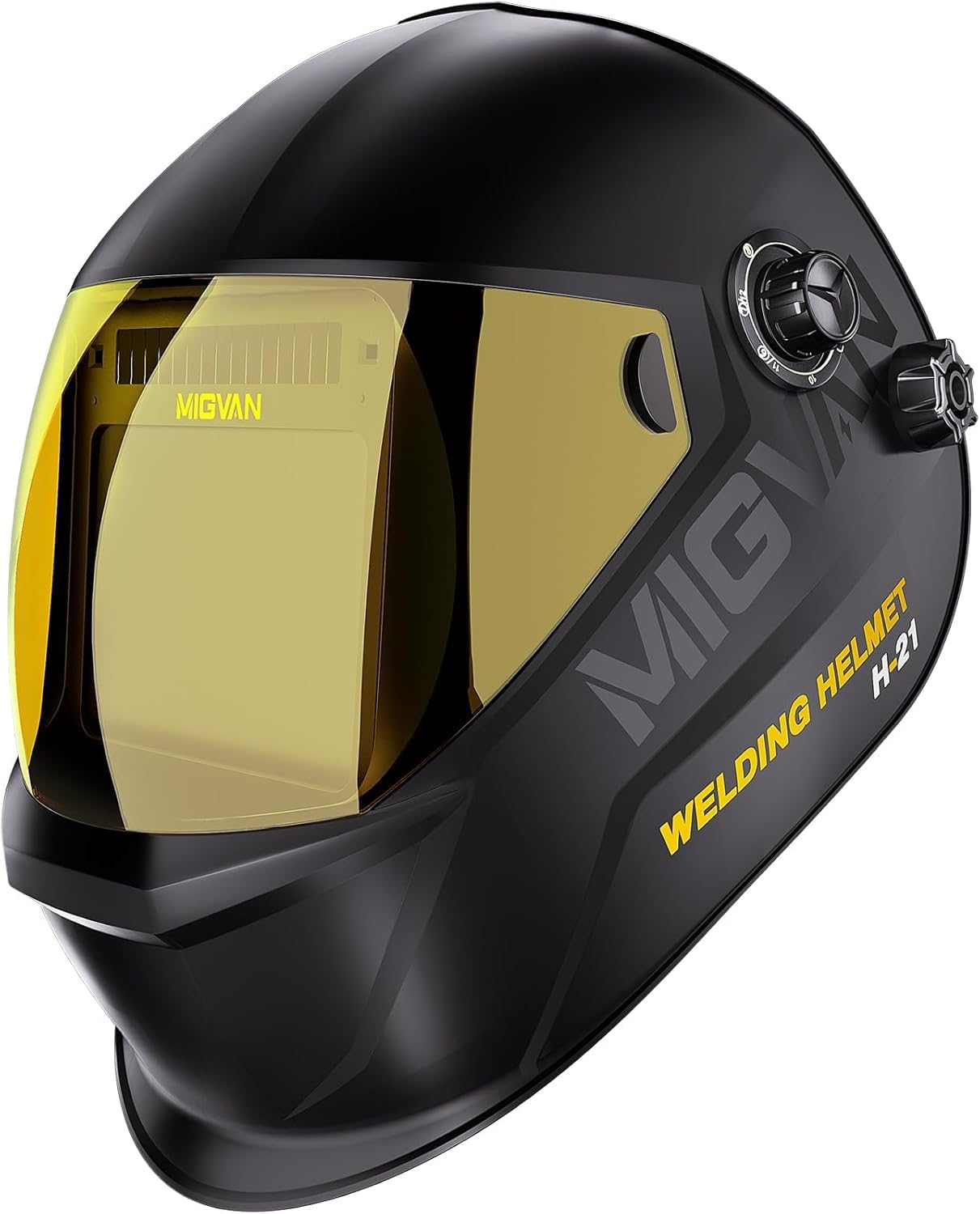
The MIGVAN H-21 delivers four arc sensors at a price point where most competitors offer only two, which translates directly into fewer misfires in awkward positions. The large viewing area paired with a true color golden lens produces an image that rivals helmets costing twice as much, with natural color reproduction that helps you differentiate between the puddle, slag, and base metal. The auto-darkening filter switches from DIN 4 (light state) to a variable DIN 5-13 in 1/10,000 of a second, which is fast enough to catch arc starts from high-frequency TIG machines without a blink.
Power comes from both a solar panel and a replaceable lithium battery, so the helmet remains functional even after long periods in low ambient light. The pivoting headgear is adjustable and the padding breathes reasonably well, though some users with larger heads noted the shell feels slightly compact and allows light to leak in at the sides and bottom. The included heavy-duty storage bag and extra inner and outer lenses add value, especially for welders who burn through protective covers quickly.
Safety compliance with ANSI and CE standards is confirmed, and the matte black finish resists scratches better than gloss shells. For a welder on a budget who wants multi-sensor reliability and clear optics, the MIGVAN H-21 is a surprisingly capable package that punches above its weight class in sensor count and clarity.
Why it’s great
- Four arc sensors for reliable detection in all positions
- True color golden lens with excellent clarity
- Dual solar and rechargeable battery power
Good to know
- Shell feels small; light can leak around edges
- Headgear uses a slick cloth that can shift
5. Hobart 770869

The Hobart Creator Series Camo helmet sits in the mid-range sweet spot where the features are practical and the price stays accessible. Three independent arc sensors provide better coverage than two-sensor units without stepping into the four-sensor premium tier, making it reliable for most shop and field positions. The 7.1-square-inch wide-screen viewing area is large enough to see the joint clearly without forcing you to turn your head, and the grind mode switch prevents the lens from darkening when you are using a grinder or cutoff wheel.
The polyamide nylon shell is lightweight at about 1.15 pounds, which reduces neck fatigue during all-day welding sessions. The headgear offers the typical ratchet adjustment found in this tier, and the controls for shade and sensitivity are simple enough that you do not have to study a manual to change settings between processes. Some long-term users report the internal components hold up well after years of intermittent use, with no welding flash events that would indicate a sensor failure.
Retired professional welders who have tested this unit note that it compares favorably to helmets costing several times more, particularly in terms of auto-darkening response and comfort. The camouflage finish is a cosmetic bonus for those who want something that stands out from the typical matte black crowd. If you need a dependable multi-process helmet that does not require a large investment, the Hobart is a proven choice with a reputation for durability.
Why it’s great
- Three arc sensors for reliable coverage
- Lightweight polyamide nylon shell reduces neck fatigue
- Proven durability over years of use
Good to know
- No low-amp TIG rating specified for thin material
- Viewing window smaller than large-window alternatives
6. Tefuawe 2×4 Lens

This Tefuawe cartridge is not a full helmet — it is a 2 x 4.25-inch drop-in lens designed specifically for classic pipeliner and pancake welding hoods. At just 0.19 inches thick, it fits snugly into honeywell Fibre-Metal 110PWE and similar passive shells, transforming a traditional fixed-shade hood into a modern auto-darkening system. The true color optics with a light-state shade of 2.5 let you see the workpiece clearly before you strike the arc, reducing the need to flip the hood up between tack welds.
The low-amp TIG rating of 5 amps makes it usable for thin-gauge stainless and small-diameter tube welding, though a small number of users found that the fixed sensitivity setting may not keep up with the lowest micro-arcs around 10 amps. The solar panel and arc sensors are designed for industrial use with high-temperature-resistant housing that prevents heat deformation inside a pipeliner shell, which is a common failure point for generic cartridges. Weight is negligible at 32 grams, so it will not change the balance of your existing hood.
Battery life is extended by the solar assist, and the 1-year warranty with 24/7 customer support provides peace of mind for a product that will likely outlast the shell it sits inside. If you prefer the compact profile and durability of a fiberglass pipeliner but want the convenience of auto-darkening, this lens upgrade is a cost-effective way to modernize your classic hood without buying a whole new helmet system.
Why it’s great
- Crystal-clear true color view with light-state 2.5
- Ultra-thin profile fits standard 2×4 pipeliner hoods
- Good low-amp TIG performance down to 5A
Good to know
- Fixed sensitivity; may not work below 10A for fine TIG work
- Lens-only purchase; requires compatible shell
7. Fibre-Metal 110PWE

The Fibre-Metal Pipeliner 110PWE is the definitive passive welding hood shell that professionals have trusted for decades. It is not an auto-darkening helmet by itself — you purchase it as a fiberglass shell and then add a drop-in 2 x 4.25-inch auto-darkening lens of your choice, such as the Tefuawe unit reviewed above. The fiberglass construction is impervious to moisture, resistant to impact, and self-extinguishing, which means it handles the abuse of field welding better than any plastic shell on this list.
The compact design allows access into tight spaces where a standard large-shell helmet simply will not fit, such as inside pipe racks, between structural beams, or under machinery. The included rubber headband is functional but many users immediately upgrade to a ratchet headgear like the Jackson 370 for a more secure and comfortable fit. The smooth white surface accepts paint well if you want to customize it, though the factory white paint is known to chip easily.
It accepts auto-darkening cartridges, passive fixed-shade lenses, filter plates, and magnifiers up to 2×4 inches. For the welder who needs a rugged, low-profile shell that will outlast multiple electronic cartridges, the Fibre-Metal Pipeliner is the gold standard of passive hoods.
Why it’s great
- Virtually indestructible fiberglass construction
- Compact profile fits into confined spaces
- Accepts any standard 2×4 auto or passive lens
Good to know
- Passive shell only — requires separate lens purchase
- Stock rubber headband is basic; upgrade recommended
FAQ
How long does an auto-darkening filter last before it needs replacement?
Can I use an auto-darkening helmet for overhead TIG welding without flickering?
What is the difference between a true color lens and a standard auto-darkening filter?
How do I know if a welding helmet fits safely over my respirator or prescription glasses?
Final Thoughts: The Verdict
For most users, the auto darkening welding helmet winner is the Miller Classic 287803 because it delivers professional-grade ClearLight optical clarity and a proven three-year warranty at a mid-range price that does not require a second mortgage. If you need the largest possible viewing window for situational awareness and low-amp TIG performance, grab the Antra AH7-860. And for serious professionals who want on-board memory for nine settings and four-sensor reliability in any position, nothing beats the ESAB Sentinel A60.