
Our readers keep the lights on and the weekend projects moving. As an Amazon Associate, I earn from qualifying purchases.
Nothing kills a game-day atmosphere like a blur on a fast break, a ghosted trail behind a hockey puck, or a washed-out field under harsh living-room lights. A big screen that can’t handle rapid panning and variable lighting literally removes you from the action — you end up watching the TV’s flaws instead of the sport itself.
I’m Rikta — the co-founder and writer behind FitlyFast. I’ve spent hundreds of hours analyzing panel technology, motion handling specs, and real-world viewing reports to separate the TVs that serve the game from the ones that serve the glossy box.
Whether you’re building a dedicated man-cave or upgrading the family room, finding the right big screen tv for sports means prioritizing native refresh rates, local dimming zones, and anti-reflective coatings over flashy features you’ll never use.
How To Choose The Best Big Screen TV For Sports
A sports TV lives or dies on a small set of critical specs, not the number of apps it runs. The three most important factors are native refresh rate, local dimming implementation, and screen finish. Ignore the marketing push for higher contrast ratios — the real-world numbers that matter are how many individual zones control the backlight and whether the panel can sustain fast motion without smearing.
Native Refresh Rate: The Real Number
A 120Hz native panel can display 120 distinct frames per second, crucial for smooth motion on fast-breaking plays, racing sports, and hockey. Many budget TVs list “effective” or “clear motion” rates that double or triple the number through backlight flashing — this doesn’t add real frame information. Always check the actual panel spec. For sports, a native 120Hz panel is the baseline.
Local Dimming and Brightness
Full-array local dimming allows the TV to darken zones behind letterbox bars and brighten zones around the scorebug without washing out the entire image. The number of zones — from dozens on mid-range sets to thousands on premium mini-LED models — directly determines how much control you have over blooming and black-level fidelity. For bright living rooms, peak brightness above 1,000 nits keeps the image legible on sunny afternoons.
Anti-Glare and Viewing Angles
Glossy screens reflect ceiling lights, windows, and the dreaded daylight. For a sports setup, an anti-glare treatment or matte finish preserves contrast and detail during daytime games. Wide viewing angles are also critical if you’re hosting a crowd — VA panels can lose color and contrast off-center, while IPS or specialized wide-angle layers keep the picture consistent for everyone on the couch.
Quick Comparison
On smaller screens, swipe sideways to see the full table.
| Model | Category | Best For | Key Spec | Amazon |
|---|---|---|---|---|
| LG C1 OLED 77″ | OLED | Cinematic black levels & sports | 120Hz native / self-lit pixels | Amazon |
| Hisense U8 Series 85″ | Mini-LED | Ultra-bright rooms & gaming | 165Hz native / 5000 nits | Amazon |
| Samsung S90F 77″ | QD-OLED | Color accuracy & vibrant sports | 144Hz native / 128 neural networks | Amazon |
| Sony BRAVIA 5 85″ | Mini-LED | Upscaling & PS5 pairing | 120Hz / XR Backlight Master Drive | Amazon |
| LG QNED80 75″ | Mini-LED | Mid-range with solid dimming | 120Hz native / Dimming Pro | Amazon |
| Samsung QN90C 75″ | Neo QLED | Bright spaces & anti-glare | 120Hz / Quantum Matrix Mini LEDs | Amazon |
| TCL QM7K Series 85″ | Mini LED QLED | High dimming zones for price | 120-144Hz / LD2500 dimming | Amazon |
| Sony BRAVIA 9 75″ | Mini LED QLED | Brightest Sony & wide angle | 120Hz / X-Anti Reflection | Amazon |
| Toshiba Z670 100″ | Mini-LED | Massive screen immersion | 144Hz native / 100-inch panel | Amazon |
| Amazon Ember 75″ | Mini-LED QLED | Fire TV integration & gaming | 144Hz / 512 dimming zones | Amazon |
| TCL 75S425 | 4K LED | Budget big screen entry | 120Hz CMI / Roku TV | Amazon |
In‑Depth Reviews
1. LG OLED C1 Series 77″

For the purist who wants every blade of grass and each sweat droplet visible during a night game, the LG C1’s self-lit OLED panel delivers infinite contrast and zero blooming around bright scoreboards or player numbers. The A9 Gen 4 processor handles motion processing cleanly, keeping fast breaks and slap shots crisp without the soap-opera effect that plagues lesser TVs. Its 120Hz native refresh rate matches the broadcast cadence of most sports content, and the near-instantaneous pixel response eliminates ghosting entirely on quick pans.
The C1 is a 2021 model, but it remains a benchmark because OLED burn-in concerns have been largely mitigated through pixel refresher cycles and screen-shift algorithms. The built-in speakers are adequate for voice clarity but won’t rattle the room — a soundbar is recommended for game-day roar. The screen is also highly reflective, so you’ll need to control ambient light or watch evening matches to get the full effect of those perfect blacks.
For a dedicated home theater or a dimly lit sports den, the C1 still outclasses many newer LED sets on motion clarity and contrast. Its WebOS interface has a learning curve with the magic remote, but once dialed in, the picture quality for live sports is as good as it gets without jumping to a + model.
Why it’s great
- True blacks and no blooming around bright elements like stats bars or player uniforms
- 120Hz native panel with near-instant pixel response eliminates motion blur
Good to know
- Glossy screen is highly reflective in bright rooms
- Built-in speakers lack bass for an immersive game-day experience
2. Hisense 85″ U8 Series
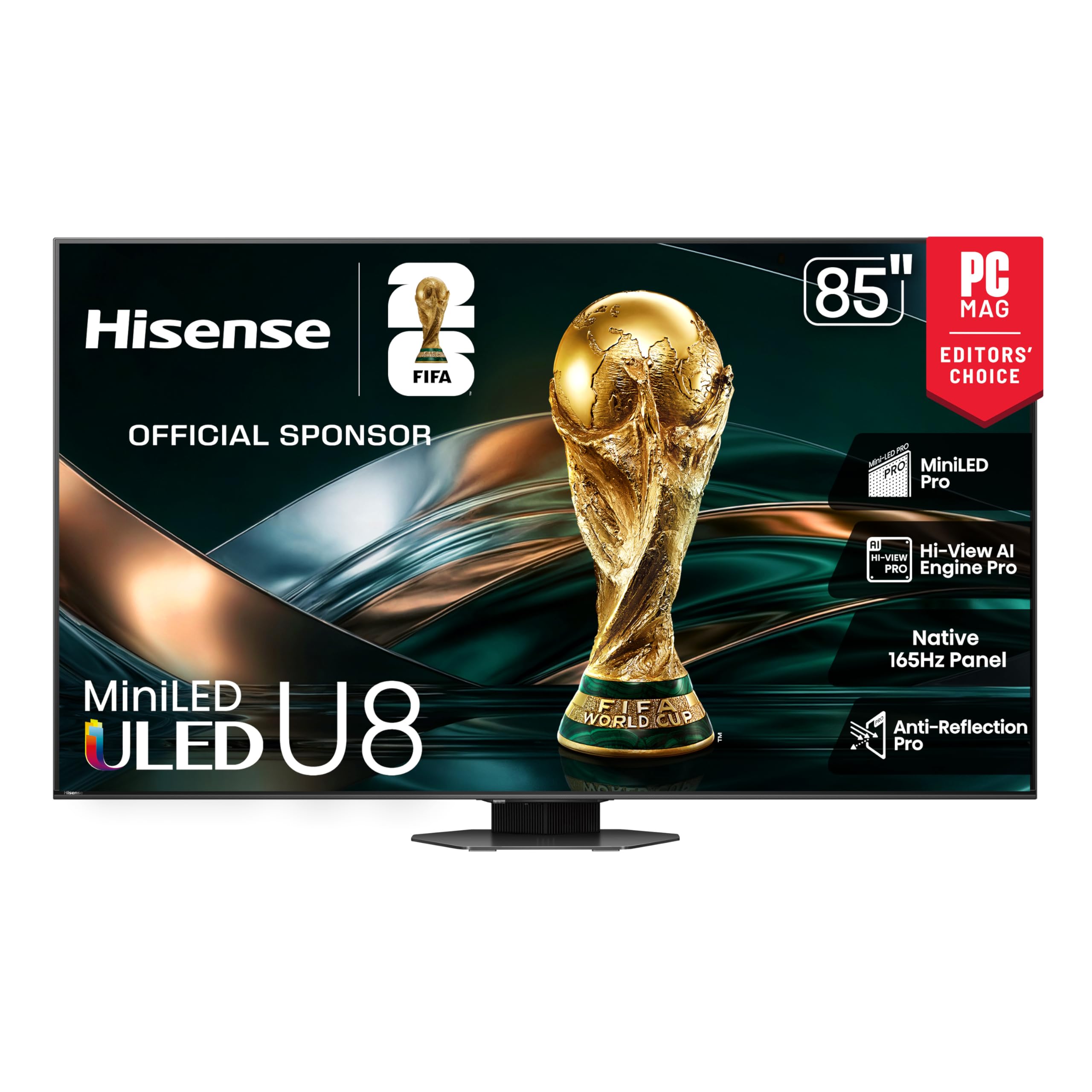
If your sports viewing happens in a living room with south-facing windows, the Hisense U8 Series is the antidote to washed-out images. With a peak brightness of 5,000 nits and a staggering 5,600 local dimming zones, this Mini-LED monster punches through glare while maintaining deep blacks in the shadows of a night game. The native 165Hz panel is overkill for broadcast sports but ensures that any 24p or 60fps content is handled without a single judder.
In real-world use, the Hi-View AI Engine Pro does a commendable job adjusting settings on the fly — grass stays green under bright ceiling lights, and the white of a hockey rink doesn’t bloom into the dark boards. The 4.1.2 channel Dolby Atmos system includes up-firing speakers, delivering a genuinely immersive soundstage that tracks the action. On the downside, the built-in sound, while impressive for a TV, still benefits from an external subwoofer for bass-heavy moments.
The Google TV interface is fast and uncluttered, though some users have reported intermittent software glitches that require a power cycle. Considering the price-to-performance ratio — especially the 85-inch size with this dimming zone count — the U8 Series earns its place as a top contender for bright-room sports fans who refuse to compromise on contrast.
Why it’s great
- Extreme brightness cuts through daytime glare without losing black levels
- Massive dimming zone count virtually eliminates halos around bright objects
Good to know
- Occasional software bugs may require a hard reboot
- Built-in audio lacks subwoofer depth for the most dramatic game moments
3. Samsung S90F 77″

The S90F leverages Samsung’s QD-OLED panel — a hybrid that combines the deep blacks of OLED with the color volume and brightness of quantum dots. For sports, this means team colors are more saturated and accurate than even the best conventional OLEDs. The 128 neural networks in the NQ4 AI Gen3 processor upscale standard 1080i broadcasts to near-4K clarity, pulling details out of compressed cable feeds that other TVs would simply blur.
Motion Xcelerator 144Hz ensures that fast-moving objects like soccer balls and race cars stay crisp, and the anti-reflective coating handles moderate room light without washing out the image. The built-in speakers are decent, but the real draw is the panel’s ability to maintain color and contrast from wide viewing angles — crucial when you’ve got friends on both sides of the sectional. The slim design also makes wall-mounting straightforward.
Potential buyers should note that QD-OLED panels are more susceptible to permanent image retention than traditional OLEDs if static elements like scorebugs are left on for hours. Samsung’s Pixel Shift feature helps, but this TV is best for viewers who switch content regularly. The solar-powered remote is a nice touch, though the button layout is cramped.
Why it’s great
- Superior color volume and saturation compared to standard OLED for vibrant fields and courts
- Wide viewing angle keeps image consistent for every seat in the room
Good to know
- QD-OLED more vulnerable to burn-in from static sports overlays than traditional OLED
- Remote control is difficult to navigate in the dark
4. Sony BRAVIA 5 85″

Sony’s XR Cognitive Processor is the standout feature here: it intelligently upscales lower-resolution sports broadcasts, detecting faces, text, and motion to enhance them in real-time. The Mini LED backlight, driven by the XR Backlight Master Drive, produces deep blacks with minimal blooming — a common weakness for LED sets during high-contrast scenes like a night football game under stadium lights.
For PlayStation 5 owners, the exclusive Auto HDR Tone Mapping and Auto Genre Picture Mode are seamless integrations that optimize both gaming and streaming sports. The built-in speakers deliver clear dialogue for commentary, and the XR Motion Clarity system keeps fast pans smooth without introducing the flickering artifacts that some motion interpolation systems produce. Anti-glare performance is solid, though not class-leading.
The main trade-off is that only two of the four HDMI ports support the full 2.1 bandwidth, which may matter if you plan to connect multiple next-gen consoles or a soundbar. The Google TV interface is responsive and free of bloatware, and the included Sony Pictures CORE app adds value for movie fans. For broadcast sports watchers who want the best picture from their cable feed, the BRAVIA 5 is a clear winner.
Why it’s great
- XR processor upscales 1080i cable sports to near-4K clarity with few artifacts
- Deep Mini LED blacks with minimal blooming around bright areas
Good to know
- Only two of four HDMI ports are 2.1 capable
- Remote lacks backlighting for dark room use
5. LG QNED80 Series 75″

The QNED80 combines LG’s NanoCell and Quantum Dot layers to produce a wide color gamut that keeps team uniforms looking accurate rather than oversaturated. The Dimming Pro algorithm dynamically adjusts the local dimming to maintain deep blacks, though the zone count is modest compared to premium Mini-LED sets — you may notice slight blooming around bright text on dark backgrounds during night scenes.
The a7 AI Processor Gen6 automatically detects sports content and adjusts both picture and sound to emphasize motion clarity and crowd noise. The virtual 5.1 surround sound is surprisingly effective for a flat panel, creating a sense of space that pulls you into the stadium. The Magic Remote supports simple point-and-click navigation, which simplifies browsing multiple streaming apps during commercial breaks.
Where this set falls short is in very bright rooms — the screen is glossy and reflects overhead lights, making daytime viewing a compromise. For a dedicated media room or evening sports sessions, the QNED80 delivers excellent value. The 120Hz native panel handles most sports cleanly, though hardcore gamers may notice the lack of full HDMI 2.1 support on all ports.
Why it’s great
- Accurate color reproduction keeps team kits looking authentic
- Virtual surround sound adds immersive crowd atmosphere without external speakers
Good to know
- Glossy screen reflects ambient light, reducing contrast in daytime rooms
- Local dimming zones are limited, causing some blooming on high-contrast content
6. Samsung Neo QLED QN90C 75″

The QN90C’s Ultra Viewing Angle technology combined with its anti-glare layer makes it one of the best big screens for living rooms where the sun moves across the room during a game. The Quantum Matrix Mini LEDs deliver a high contrast ratio even in bright conditions, and the Neural Quantum Processor’s 4K upscaling is among the best in the industry for cleaning up noisy cable feeds.
Motion Xcelerator Turbo+ keeps fast-paced soccer and hockey action smooth at 120Hz, and the Object Tracking Sound+ feature follows on-screen action with virtual surround placement that feels directional — a hockey puck sliding from left to right is audibly tracked. The Q-Symphony 3.0 feature pairs seamlessly with Samsung soundbars to create a cohesive soundstage without the usual lip-sync issues.
The downsides are typical of Samsung’s Tizen OS: the home screen is cluttered with ads and recommendations that can’t be fully removed. The solar-powered remote, while eco-friendly, lacks a number pad and requires navigating on-screen menus for channel input. For pure picture performance in a challenging lighting environment, the QN90C is a top-tier choice.
Why it’s great
- Excellent anti-glare performance maintains picture quality in bright, sunlit rooms
- Object Tracking Sound+ creates a believable directional audio experience
Good to know
- Tizen OS interface is ad-heavy and requires some navigation tolerance
- Remote lacks dedicated number buttons for direct channel entry
7. TCL QM7K Series 85″
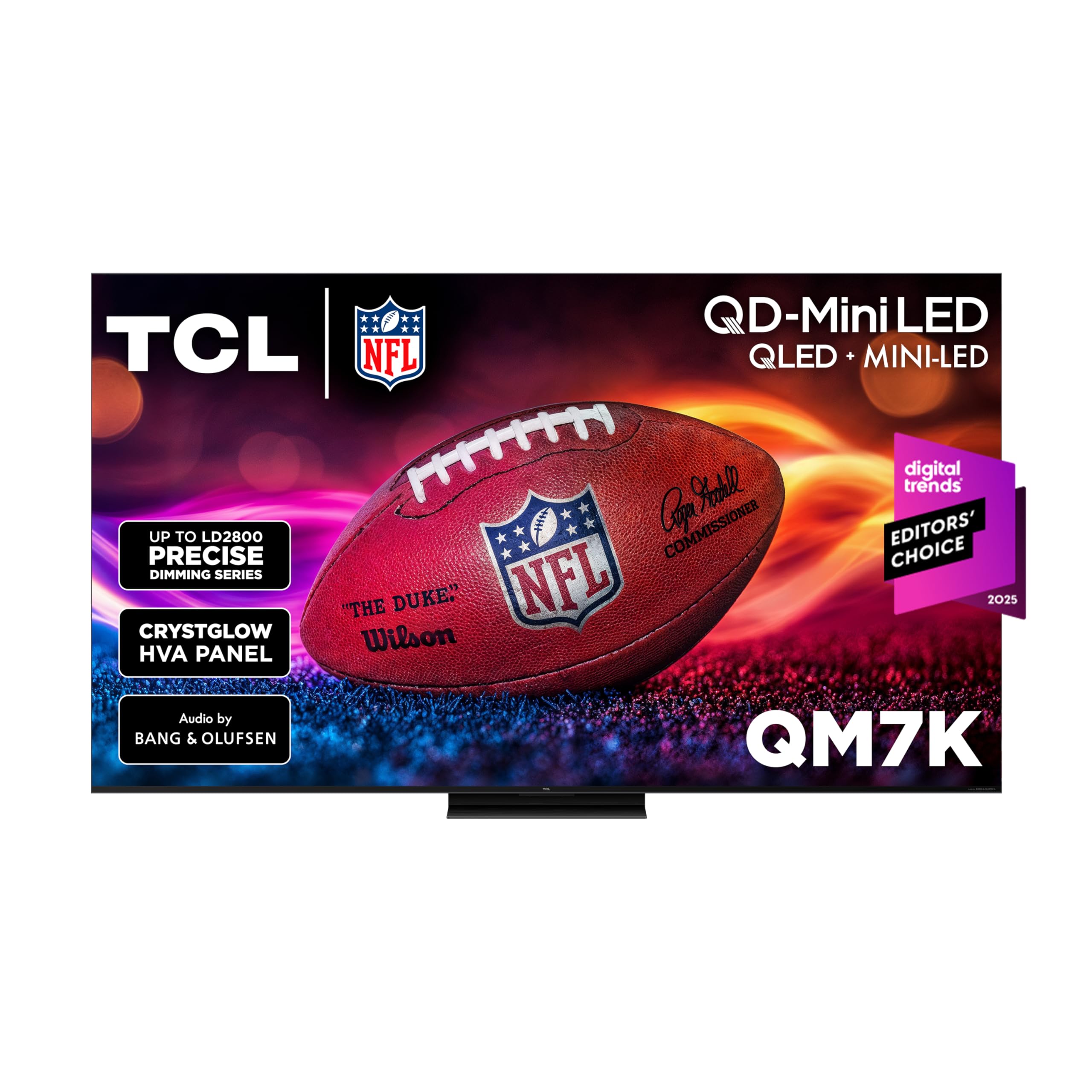
TCL’s QM7K series punches far above its price point with a mini-LED backlight and up to 2,500 local dimming zones — a number that competes with sets costing nearly twice as much. The CrystGlow HVA panel blocks reflections while maintaining high contrast, and the native 120Hz refresh rate with support for up to 144Hz VRR makes it a serious option for both sports and gaming.
The Onkyo-tuned speakers deliver a surprisingly robust soundstage with dedicated subwoofers, reducing the immediate need for a soundbar. Google TV provides a clean interface with fast app loading. The 85-inch size fills a wall effectively, making this an ideal centerpiece for a home theater that splits time between live sports and 4K streaming.
Where it cuts corners is in build quality — the remote feels cheap and the stand is a simple two-leg design that may wobble on uneven surfaces. The anti-reflective coating is effective but not as durable as Samsung’s, and some users report slight blooming in extremely dark scenes with bright sub-titles.
Why it’s great
- Over 2,000 local dimming zones for near-OLED black levels at a fraction of the price
- Onkyo audio system delivers bass-heavy sound without an external subwoofer
Good to know
- Remote feels low quality compared to the TV’s performance
- Slight blooming can appear around bright text on black backgrounds
8. Sony BRAVIA 9 75″

The BRAVIA 9 is Sony’s brightest consumer Mini LED TV, and for sports fans with a bright living room, it’s a near-perfect solution. The XR Backlight Master Drive controls thousands of Mini LEDs individually, producing contrast that rivals OLED without the risk of burn-in from static sports graphics. The combination of X-Wide Angle and X-Anti Reflection means the picture stays vibrant and accurate from any seat, even with sunlight streaming in.
The XR Processor handles motion flawlessly, and the XR Clear Image upscaling converts even grainy 720p broadcasts into something watchable. For PlayStation 5 owners, the exclusive features are seamless, and the Google TV interface is snappy and ad-light. The built-in speakers are surprisingly good for a set this slim, producing clear dialogue and enough bass for crowd roars.
The major drawback is the price—this is a premium investment. The included remote could use a redesign, as it’s small and the buttons are hard to distinguish in the dark. Some users have reported reliability issues, though these appear to be isolated cases. For the buyer who demands the best possible picture quality for sports in a variable-lighting environment, the BRAVIA 9 delivers.
Why it’s great
- Exceptionally bright Mini LED panel handles bright rooms without losing contrast
- Wide viewing angle keeps color accurate for everyone in the room
Good to know
- Premium price point limits accessibility for budget-conscious buyers
- Remote is small and lacks backlighting for dark room use
9. Toshiba 100″ Z670 Series

For the ultimate at-home stadium experience, the Toshiba Z670 at 100 inches offers an immersive size that makes 75-inch sets feel ordinary. The Mini-LED backlight with full-array local dimming delivers deep blacks and bright highlights, and the REGZA Engine ZRi Gen3 — tuned by Toshiba’s Japanese engineers — does a solid job of optimizing image quality in real-time. The native 144Hz panel ensures that any motion is silky smooth.
The REGZA Power Audio Pro system includes a dedicated bass woofer and up-firing speakers, creating a genuinely cinematic audio presence that fills a large room. The Fire TV interface makes content discovery straightforward, and Alexa integration adds hands-free control for pausing and searching during the game. Dolby Vision IQ adapts the picture to ambient light, keeping the image clear whether you watch in the afternoon or after dark.
The sheer size of this TV limits placement options — you’ll need a massive wall and a viewing distance of at least 10-12 feet. The built-in sound, while impressive, still benefits from a dedicated soundbar for the most dramatic audio. Some users may find the Fire OS interface a bit ad-heavy, but the sheer spectacle of a 100-inch screen showing live sports is hard to beat at its price point.
Why it’s great
- Unmatched 100-inch screen size delivers a genuine stadium-scale viewing experience
- Built-in bass woofer and up-firing speakers create immersive audio without extra gear
Good to know
- Massive size requires a large wall and sufficient viewing distance
- Fire OS interface includes advertisements in the home screen
10. Amazon Ember 75″ Mini-LED Series
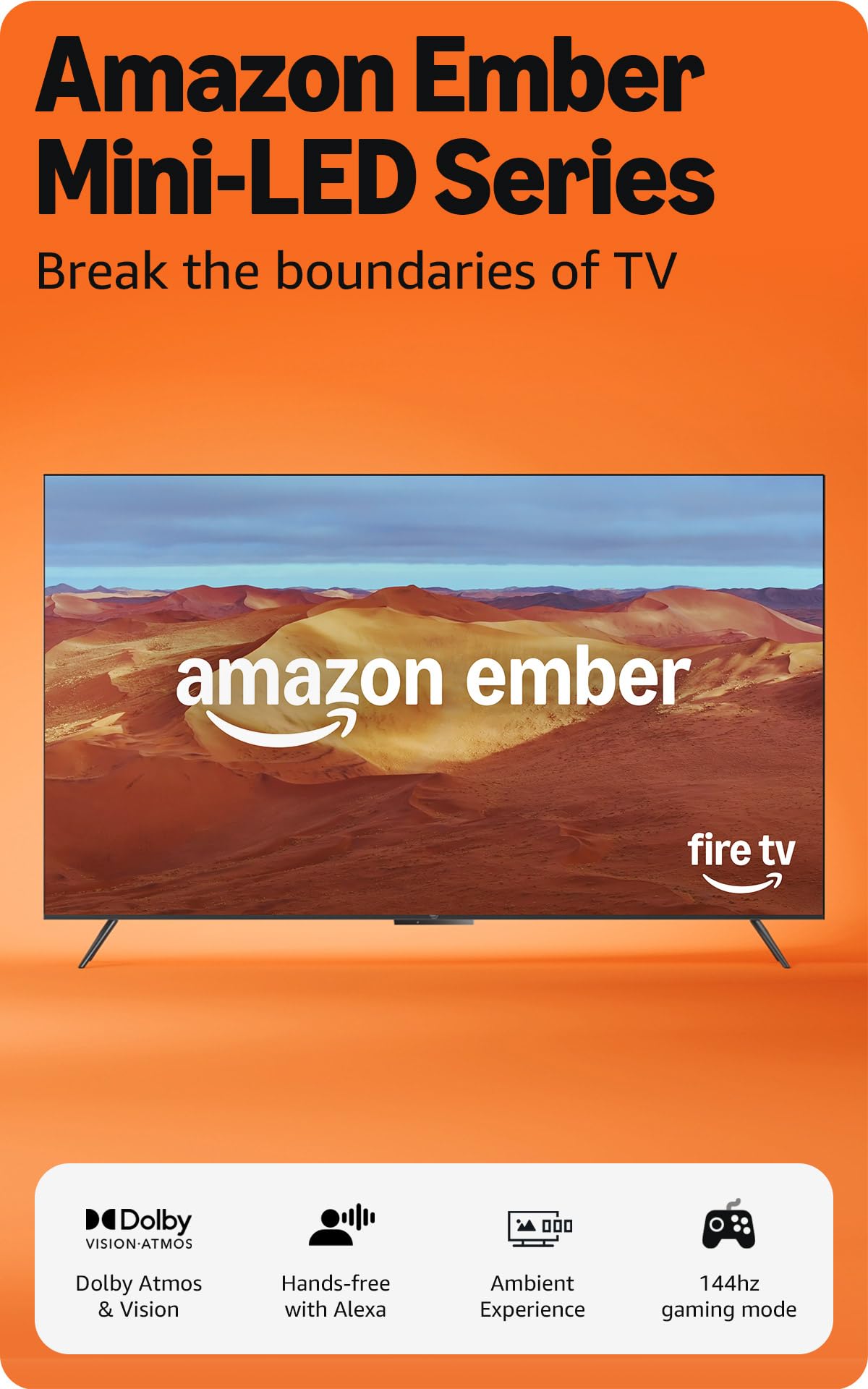
The Amazon Ember line is designed from the ground up for Fire TV integration, and the 75-inch Mini-LED version combines a 4K QLED display with 512 local dimming zones and up to 1,400 nits of peak brightness. The 144Hz panel with AMD FreeSync Premium Pro certification makes it an excellent companion for cloud gaming services, but the real story is how well the Fire TV Intelligent Picture system adapts to sports content in varying room light.
Dolby Vision IQ and HDR10+ Adaptive ensure that the image looks correct whether the room is dim at night or bright during a Sunday afternoon game. The built-in 2.1 Dolby Atmos speakers deliver clean dialogue and modest bass, sufficient for casual viewing. The Omnisense technology that wakes the screen when you enter the room is a neat convenience feature, and the hands-free Alexa support means you can change channels or check scores without the remote.
The software experience is where the Ember stumbles — the Fire TV interface can become sluggish after several months of use, and the home screen is heavy with Amazon promotions. Some users report random reboots as the system ages. For the price, the hardware is impressive, but the software reliability may frustrate those who want a set-and-forget experience.
Why it’s great
- Deep Amazon ecosystem integration with hands-free Alexa and automatic room-adaptive picture
- 512 dimming zones and 1400 nits brightness handle most lighting conditions well
Good to know
- Fire TV interface can become sluggish over time and includes heavy ad placement
- Occasional random reboots reported by some long-term users
11. TCL 75S425 75″

The TCL 75S425 is a budget entry into the big-screen sports world, and it makes no apologies for its limitations. The 4K UHD panel with HDR support produces a decent picture for the price, and the Roku TV interface is the gold standard for simplicity and speed — no ad-heavy home screen, just a clean grid of your apps. The 120Hz CMI (Clear Motion Index) is a marketing number, not a native refresh rate, so motion handling is adequate for slower sports like baseball but will show blur on fast-paced hockey or racing.
The direct-lit LED backlight is uniform enough for general viewing, but black levels are limited, and dark scenes appear grayish in a dim room. The built-in speakers are acceptable for news and dialogue but lack any bass for game-day atmosphere. Connectivity is basic with three HDMI ports, one USB, and an ethernet jack — enough for a streaming box and a game console, but not for a complex home theater setup.
This TV is best suited as a secondary sports screen for a basement, garage, or bedroom where perfect motion handling isn’t the priority. It’s a reliable, no-frills entry point into the 75-inch category that prioritizes ease of use over visual performance. For the serious sports fan, budget for a soundbar and avoid expecting deep blacks or smooth fast motion.
Why it’s great
- Roku interface is fast, simple, and free of intrusive advertisements
- Affordable entry point into a 75-inch 4K screen size
Good to know
- Effective refresh rate is low, causing motion blur on fast sports like hockey or racing
- Limited black level performance with grayish dark scenes
FAQ
Why does hockey look blurry on my current TV?
Is OLED safe for watching sports with static logos?
Final Thoughts: The Verdict
For most users, the big screen tv for sports winner is the LG OLED C1 77″ because its self-lit pixels deliver infinite contrast and perfect black levels that make night games and stadium lights look spectacular, combined with a smooth 120Hz native panel. If you want a TV that handles bright living rooms without compromise, grab the Hisense U8 Series 85″ for its extreme brightness and massive dimming zone count. And for the sheer thrill of a cinema-sized experience, nothing beats the Toshiba 100″ Z670 for turning your living room into a stadium.