
Our readers keep the lights on and the weekend projects moving. As an Amazon Associate, I earn from qualifying purchases.
A surround sound system shouldn’t force you to choose between a decent experience and an empty bank account. The category is filled with “budget” bars that deliver thin, tinny audio, and premium rigs that feel reserved for basements with dedicated seating. The real sweet spot lives in the middle—systems that use smart engineering, like dedicated center channels for dialogue, true wireless rear satellites, and subwoofers with enough driver surface area to pressurize a living room. This guide cuts through the noise to find the setups that deliver genuine spatial audio without the financial hangover.
I’m Rikta — the co-founder and writer behind FitlyFast. My focus has been on dissecting the hardware specifications and real-world performance trade-offs in home theater audio, analyzing dozens of hours of user feedback and technical data to isolate the best values in the market.
Whether you are upgrading from TV speakers or replacing a failing soundbar, finding the right affordable surround sound system means prioritizing the components that actually create immersion: a capable subwoofer, clear mid-range drivers, and reliable wireless connectivity for rear channels.
How To Choose The Best Affordable Surround Sound System
Buying a surround system on a budget requires focusing on the components that provide the most tangible upgrade in immersion: the subwoofer size, the presence of a center channel, and the method used to deliver rear channel audio. You don’t need to spend a fortune, but you must prioritize correctly.
Channel Count and Codec Support
The first number in a system’s designation indicates the main speakers (left, center, right, surrounds). A “5” denotes a full five-channel bed. The second number is the subwoofer count (usually 1). The third number, if present, is the height channels for Dolby Atmos. A 5.1.2 system includes two upward-firing drivers for overhead effects, which significantly enhances the sense of vertical space. Ensure your source devices and TV support Dolby Digital or Dolby Atmos via HDMI eARC for lossless transmission; optical cables are limited to compressed 5.1.
Subwoofer Driver Size and Cabinet Design
Bass is the foundation of a cinematic experience. An 8-inch subwoofer with a ported cabinet is generally the minimum for a medium-sized room (300-400 sq ft) to produce tactile, room-filling bass without distortion. A 10-inch driver can pressurize larger spaces but may become boomy in smaller rooms. Look for “wireless” subwoofers to avoid running a long RCA cable across the room, but be aware that even wireless subs need a power outlet nearby.
Wireless vs. Wired Rear Speakers
True wireless rear speakers receive both power and signal wirelessly (or signal wirelessly with a power cord). Many budget “wireless” sets still require a power cable for each satellite, but the signal path is wireless from the main unit. This is a massive convenience gain over running speaker wire around door frames and under rugs. For the best balance of simplicity and cost, prioritize systems that offer wireless signal transmission to the rear channels, even if they need their own power outlets.
Quick Comparison
On smaller screens, swipe sideways to see the full table.
| Model | Category | Best For | Key Spec | Amazon |
|---|---|---|---|---|
| Klipsch Reference Cinema 5.1.4 | Premium Passive System | Dedicated home theater with AV receiver | 5.1.4 ch with Dolby Atmos | Amazon |
| ULTIMEA Skywave X50 | High-End Soundbar | True wireless Atmos immersion | 760W, 8″ subwoofer, 5.1.4 ch | Amazon |
| Amazon Fire TV Soundbar Plus 5.1 | Mid-Range Soundbar | Easy Fire TV ecosystem integration | 5.1 ch, dedicated center driver | Amazon |
| Bobtot 5.1 System 1200W | Value Passive System | Traditional wired setup with huge bass | 1200W peak, 10″ subwoofer | Amazon |
| ULTIMEA Skywave F40 | Budget Atmos Soundbar | Entry-level Dolby Atmos with app control | 5.1.2 ch, up-firing drivers | Amazon |
| LG S40TR 4.1 ch | Mid-Range Soundbar | Compact 4.1 setup with rear speakers | 4.1 ch, wireless rear speakers | Amazon |
| Polk Audio Signa S2 | Entry-Level Soundbar | Dialogue clarity on a tight budget | VoiceAdjust, wireless subwoofer | Amazon |
| Samsung B-Series HW-B550F | Entry-Level Soundbar | Simple 2.1 upgrade with virtual surround | 2.1 ch, DTS Virtual:X | Amazon |
| Sony CS SS-CS5M2 Bookshelf | Passive Bookshelf | Building a custom system piece by piece | 3-way driver, 53 Hz – 50 kHz | Amazon |
In‑Depth Reviews
1. Klipsch Reference Cinema Dolby Atmos 5.1.4 System

This is the real deal for anyone building a true home theater with an AV receiver. Unlike soundbars, the Klipsch Reference Cinema system is a passive speaker set—you provide the receiver, and in return you get full 5.1.4 Dolby Atmos with dedicated up-firing drivers on all four satellites. The Tractrix horn technology on the aluminum tweeters delivers that famous Klipsch high-end extension and efficiency, meaning you can drive them to reference levels with a moderately powered amp.
The 8-inch subwoofer is a sealed design that integrates well, though some users find it lacking the sheer slam of a larger ported box. The satellite speakers themselves are surprisingly heavy and well-built, with magnetic grills and a premium finish. The crossover points are set at 90Hz for the center and 100Hz for the satellites, which is typical for a system of this size and keeps the subwoofer working in its most linear range.
Setup requires running speaker wire—no wireless option here—but the included down-firing Atmos modules create a convincing overhead effect when ceiling reflections are favorable. This system is an excellent value if you already own or are willing to invest in a quality AV receiver, delivering a level of immersion that no soundbar under a thousand dollars can touch.
Why it’s great
- Full 5.1.4 Dolby Atmos with dedicated up-firing drivers
- Horn-loaded tweeters provide high sensitivity and clean highs
- Solid build quality with magnetic grills
Good to know
- Requires a separate AV receiver (not included)
- Subwoofer may lack punch for very large rooms
- No speaker wire included
2. ULTIMEA Skywave X50 5.1.4ch Wireless Surround Sound System
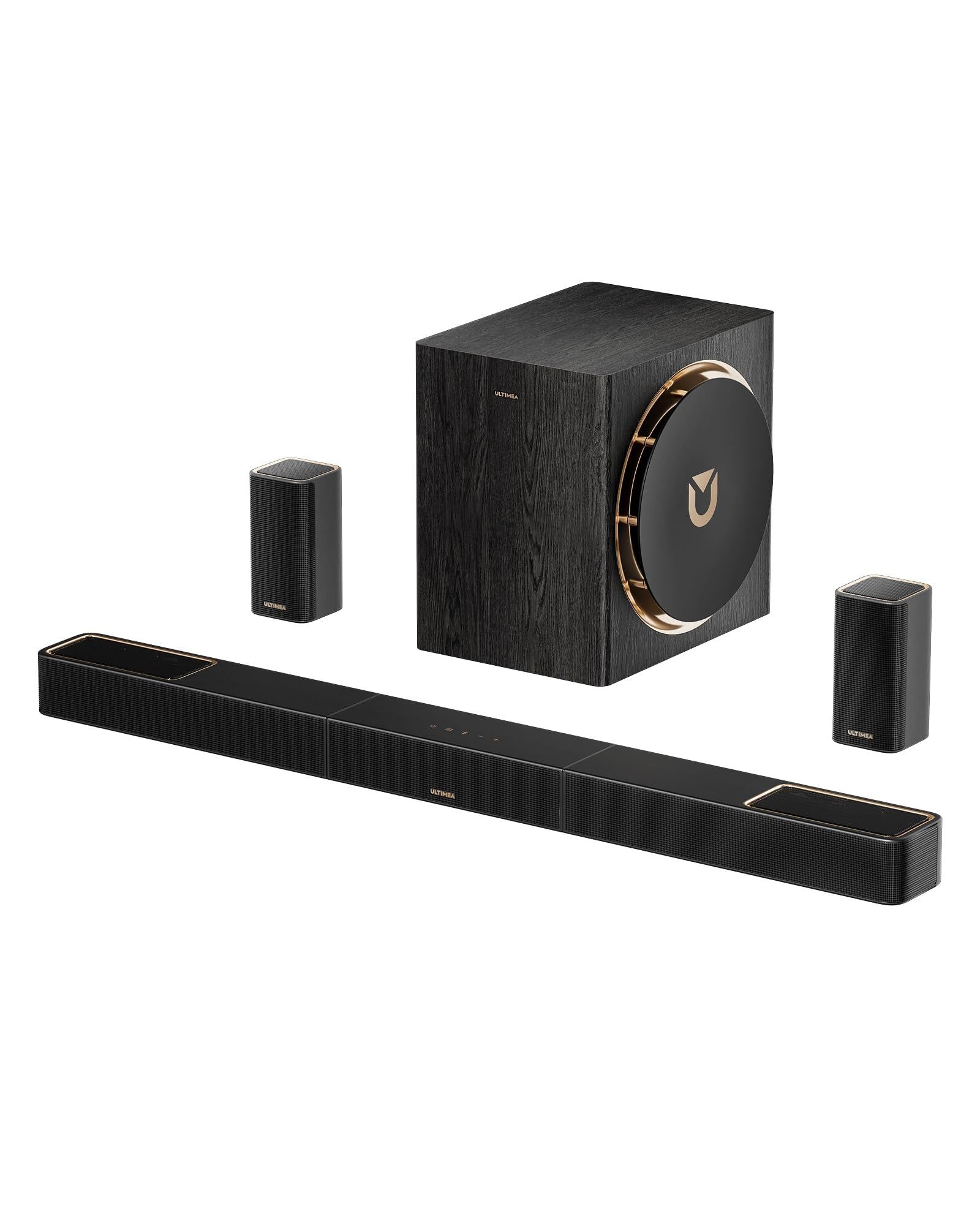
The Skywave X50 is a direct challenge to the notion that you need a separate receiver and wired speakers for a proper Atmos setup. This 5.1.4 soundbar system uses dual 5GHz wireless transmission to connect the rear satellites and 8-inch subwoofer, eliminating the need for any long cable runs. The GaN amplifier is an industry-first in this price tier, delivering 98% efficiency and ultra-clean power with minimal heat generation.
The Gravus Ultra-Linear Bass Technology in the wood-crafted subwoofer extends down to 28Hz, making it one of the deepest-reaching affordable subwoofers on the market. This is not a boomy, one-note bass—it has texture and control. The NeoAcore multi-channel audio engine processes up to 17 channels, ensuring that the up-firing drivers on the main bar and the rear speakers create a cohesive and convincing 3D sound bubble. The app gives you a 10-band EQ, 121 presets, and 13-step level adjustment for each channel.
Aesthetically, it blends metal grilles with rose gold accents and a wood-textured subwoofer. Setup is genuinely plug-and-play: the speakers pair automatically upon power-up. For a mid-range living room, this system provides an experience that rivals sets costing significantly more. The bass can be aggressive in smaller spaces, so careful placement away from corners is recommended.
Why it’s great
- True 5.1.4 Atmos with wireless rear speakers and subwoofer
- GaN amplifier delivers clean, efficient power
- Deep, textured bass down to 28Hz from 8-inch driver
Good to know
- Subwoofer can be overpowering in small rooms
- Rear speakers still need a power outlet
3. Amazon Fire TV Soundbar Plus 5.1 with Subwoofer and Surround Speakers

The Amazon Fire TV Soundbar Plus is engineered for deep integration with the Fire TV ecosystem. The main soundbar houses a dedicated center channel driver specifically tuned for dialogue, and it supports both Dolby Atmos and DTS:X object-based audio. The wireless subwoofer and two surround speakers connect to the bar automatically, providing a proper 5.1 bed without the need for any configuration.
Dialogue clarity is the standout feature here. A five-level dialogue boost setting allows you to lift voices above the mix without making them sound hollow or unnatural. The surround speakers lack up-firing drivers, so the Atmos effect is more diffuse, relying on psychoacoustic processing to create the illusion of height. However, for music and standard 5.1 content, the imaging is precise and the bass is clean and punchy.
Setup is exceptionally simple: plug the HDMI eARC cable into your TV, power the subwoofer and surrounds, and they sync instantly. The system is also compatible with standard smart TVs via optical, but you lose the ability to control everything with one remote. At this price point, the Amazon system offers a complete, hassle-free 5.1 solution that prioritizes ease of use and dialogue clarity over the last ounce of atmospheric detail.
Why it’s great
- Excellent five-level dialogue boost for clear voices
- Wireless subwoofer and surrounds for easy setup
- Supports DTS:X in addition to Dolby Atmos
Good to know
- No up-firing drivers; Atmos is simulated
- Subwoofer requires >12 inches from wall for best bass
4. Bobtot Home Theater System 1200W 5.1 Channel
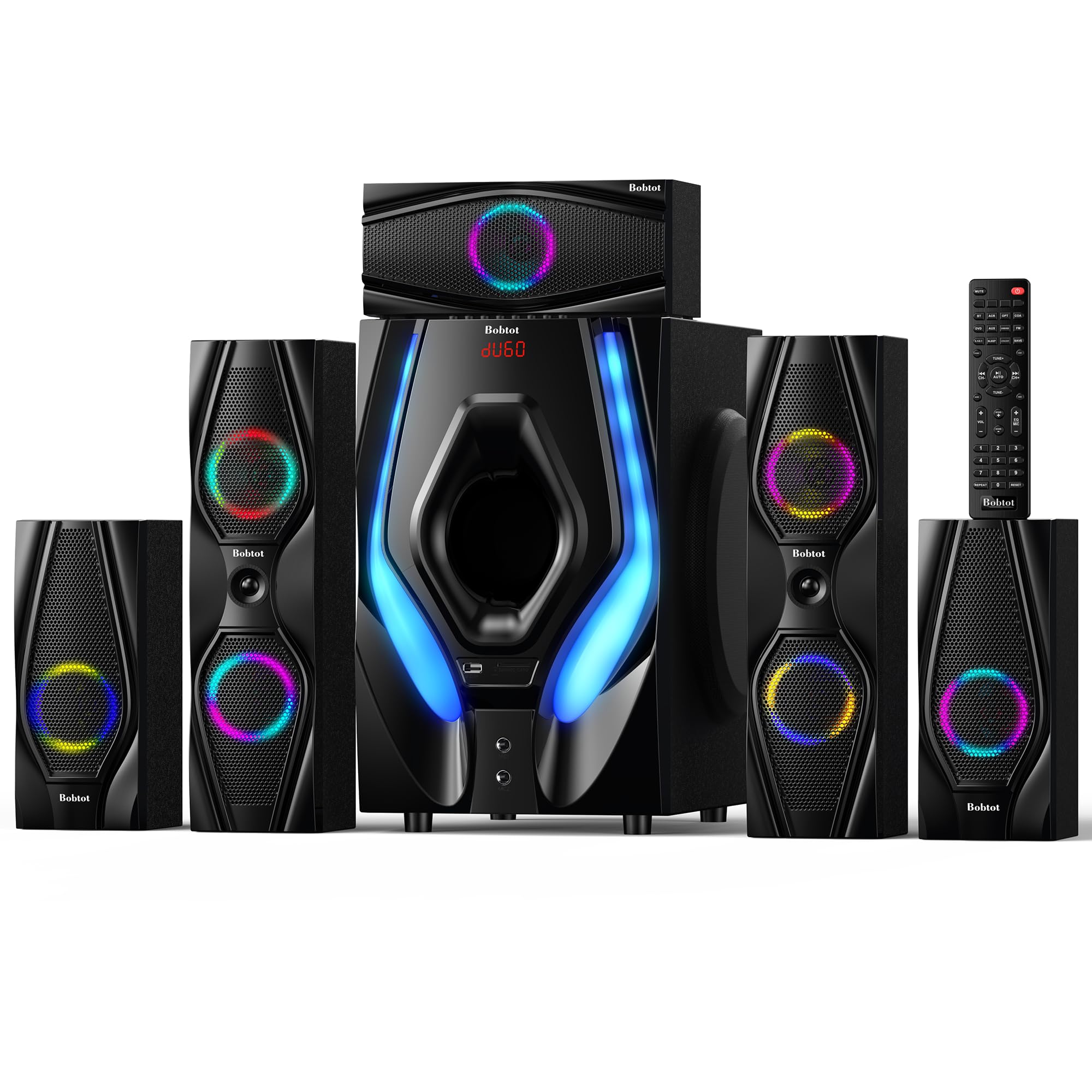
The Bobtot system is a throwback to old-school home theater in a box, but with modern connectivity. The 10-inch subwoofer with a built-in receiver acts as the hub, and the five wired satellites connect to it with cables that are generously long—31 feet for the rears. This is a true passive speaker setup with an integrated amplifier, so you don’t need a separate receiver, but you do need to route speaker wire.
The 1200-watt peak power rating is inflated, but the system can get genuinely loud for parties or movie nights. The bass is thunderous and can dominate the mix, though the independent subwoofer and front speaker volume controls help you dial in some balance. The LED lighting on the subwoofer and center speaker adds a visual element—four modes including a spectrum EQ analyzer and a beat-blinking mode—that appeals to a specific use case.
This system also includes FM radio, USB/SD card playback, and dual 1/4-inch microphone inputs with echo, making it a karaoke and party machine. It works well for gaming and movies, though the highs and mids can get slightly distorted at maximum volume. It is not a subtle system, but for someone who wants a massive, loud, and versatile setup without spending a lot, the Bobtot is a compelling choice. The long-term reliability has been a point of contention among some users.
Why it’s great
- Massive 10-inch subwoofer delivers powerful bass
- All-in-one receiver built into subwoofer, no extra box needed
- Karaoke and FM radio add extra functionality
Good to know
- Wired speakers require cable routing
- Some reports of long-term reliability issues
5. ULTIMEA 5.1.2ch Sound Bar with Dolby Atmos, Skywave F40

The Skywave F40 is a gateway to Dolby Atmos without requiring a large investment. This 5.1.2 channel soundbar includes two up-firing drivers in the main bar, two wired rear surround speakers (they use a 6-meter cable between them), and a 5.25-inch wired subwoofer. The neodymium magnets in the up-firing drivers improve high-frequency dynamics and help project sound toward the ceiling for a convincing overhead effect.
SurroundX technology uses intelligent spatial algorithms to create a 360-degree sound field. While it won’t match the pinpoint accuracy of a dedicated system like the Klipsch, it does a commendable job of placing sounds around the listener. The app is a highlight—it provides a 10-band graphic equalizer, 121 preset sound settings, and individual channel level adjustments. HDMI eARC ensures lossless 5.1.2 audio transmission from compatible TVs.
The bass from the 5.25-inch subwoofer is adequate for small to medium rooms but lacks the depth and authority of larger drivers. It’s clean and present, but don’t expect it to pressurize a large open-concept space. The system is best suited for apartments or smaller living rooms where neighbors are a consideration. Setup is simple, and the system’s auto-on/off via eARC works reliably. It is an excellent first step into immersive audio.
Why it’s great
- Affordable entry point for real Dolby Atmos with up-firing drivers
- Excellent app with 10-band EQ and channel level adjustments
- Simple plug-and-play setup with HDMI eARC
Good to know
- Subwoofer is wired and a bit underpowered for larger rooms
- Rear speakers are wired to each other
6. LG S40TR 4.1 ch Home Theater Soundbar with Rear Speakers

The LG S40TR is a 4.1 channel system that skips a dedicated center channel but adds wireless rear speakers. The main bar uses two full-range drivers and a wireless subwoofer, while the two rear satellites connect wirelessly to the bar for signal, needing only a power cable. This makes it one of the cleanest setups for a small to medium room where you want true surround imaging without running any speaker wire at all.
Dolby Audio and DTS Digital are supported, and the Smart Up-Mixer does a decent job of turning stereo content into a multi-channel experience. The Clear Voice Plus feature analyzes the audio output and emphasizes voices through the left and right channels. While not as effective as a dedicated center channel, it works well enough for most TV shows and movies. The Crest Design metal grille reduces dust intrusion.
The LG Soundbar App allows for 3-band EQ adjustment (bass, mid, treble). The wireless subwoofer delivers solid bass that can be felt in a room of about 500 square feet without being overwhelming. The rear speakers are small and unobtrusive. If you specifically want a 4.1 system with true wireless rear speakers (no wire between them) and you’re willing to forgo a dedicated center channel, this is a polished option. It works best when seating is positioned roughly between the two rear satellites.
Why it’s great
- Truly wireless rear speakers (signal only) for a clean setup
- Clear Voice Plus improves dialogue intelligibility
- Compact design with metal grille for dust protection
Good to know
- No dedicated center channel
- Optimal surround effect requires specific seating position
7. Polk Audio Signa S2 Sound Bar with Wireless Subwoofer

The Polk Audio Signa S2 is a refined 2.1 soundbar that prioritizes dialogue clarity above all else. Its proprietary VoiceAdjust technology offers three levels of vocal enhancement that actually work—lifting voices out of the mix without the tinny, artificial quality that plagues many “dialogue modes.” This makes it an excellent choice for those who frequently struggle to hear conversations in movies and TV shows.
The soundbar itself is impressively slim at just over two inches tall, easily fitting under most TVs without blocking the IR sensor. Inside, five full-range drivers and a wireless subwoofer produce a soundstage that is surprisingly wide for a single-bar system. Dolby Digital decoding keeps the audio clean, and the subwoofer connects wirelessly, auto-syncing every time you power on. The subwoofer is compact but punchy, producing tight bass that enhances action scenes without rattling the walls.
This system is simple: no Dolby Atmos, no rear speakers, no extensive app. It offers Movie, Music, and Night modes, and a remote that is small but functional. It has stood the test of time, with many users reporting problem-free operation for over five years. For someone looking to upgrade from built-in TV speakers on a strict budget and who values clear dialogue above all, the Signa S2 is a proven, reliable choice.
Why it’s great
- Effective VoiceAdjust technology for crystal clear dialogue
- Ultra-slim design fits under nearly any TV
- Proven long-term reliability and easy plug-and-play setup
Good to know
- Only a 2.1 channel system; no true surround sound
- Subwoofer level control lacks visual feedback
8. Samsung B-Series Soundbar HW-B550F 2.1 ch with Subwoofer

The Samsung HW-B550F is a straightforward 2.1 channel soundbar that uses DTS Virtual:X to create a simulated surround sound experience from a single bar and a wireless subwoofer. It does not include rear speakers, but the virtual processing does an admirable job of widening the soundstage and adding a sense of height to movie soundtracks. It’s a massive upgrade over TV speakers.
Bass Boost mode adds meaningful depth, and Adaptive Sound automatically analyzes the content to optimize the frequency response, keeping dialogue clear during quiet scenes and adding punch during action. Voice Enhance Mode amplifies the mid-range frequencies where human speech sits, making it effective for news and dialogue-heavy shows. The subwoofer is wireless and produces punchy, room-filling bass.
Setup is simple: connect via HDMI ARC or optical cable, and the soundbar pairs with the subwoofer instantly. The Samsung B-Series can be expanded later with optional rear speakers (SWA-9200S) for a true surround setup. This makes it a great stepping-stone system. It is an ideal choice for someone on a tight budget who wants a simple, powerful 2.1 upgrade with the option to grow into a full surround system later.
Why it’s great
- DTS Virtual:X creates a convincing simulated soundstage
- Easy to expand with optional wireless rear speakers
- Bass Boost and Voice Enhance modes are well-tuned
Good to know
- No true physical surround channels out of the box
- Bass may be insufficient for bass-heads at moderate volumes
9. Sony CS Speakers SS-CS5M2 3-Way Bookshelf Speakers (Pair)

These are not a self-contained system. The Sony SS-CS5M2 is a pair of passive bookshelf speakers that you build a system around. They are a 3-way, 3-driver design—an unusual configuration at this price point—featuring a dedicated tweeter and super tweeter for high-frequency detail and a 5.12-inch woofer for the low-end. The frequency response extends from 53Hz to 50kHz, making them Hi-Res Audio certified.
The sound signature is detailed and open, with a wide soundstage that reveals subtle details in recordings. They are slightly bright, which some ears may find fatiguing, but this also makes them incredibly revealing. Bass is limited below 60Hz; a subwoofer is essential for a full-range system. The reinforced cellular cone woofer keeps distortion low even at moderate volumes. They are at their best as front left/right speakers in a 5.1 setup powered by a quality AV receiver.
These speakers require a separate amplifier or AV receiver and careful placement—they are rear-ported, so they need clearance from the wall. As a starting point for a custom system, they offer performance that exceeds their purchase price, especially if found on sale. They are not a plug-and-play solution, but for the enthusiast who wants to build a system piece by piece, the Sony CS5M2 is a rewarding foundation.
Why it’s great
- True 3-way design with dedicated super tweeter for detail
- Wide soundstage and excellent clarity for the price
- Great starting point for a custom, expandable system
Good to know
- Requires a separate amplifier or receiver
- Bass is weak without a subwoofer
FAQ
Can I use an optical cable for Dolby Atmos?
What is the difference between a 5.1 and a 2.1 system?
Do I need a subwoofer for a surround sound system?
Will up-firing Atmos speakers work with popcorn ceilings?
Final Thoughts: The Verdict
For most users, the affordable surround sound system winner is the ULTIMEA Skywave X50 because it delivers a true 5.1.4 Dolby Atmos experience with wireless rear speakers, a powerful 8-inch subwoofer, and a GaN amplifier at a price that undercuts traditional receiver-based setups by a wide margin. If you want the absolute best dialogue clarity and simplest setup, grab the Amazon Fire TV Soundbar Plus 5.1. And for the DIY enthusiast who wants to build a reference-grade system piece by piece, nothing beats the Klipsch Reference Cinema 5.1.4 as a foundation.