
Our readers keep the lights on and the weekend projects moving. As an Amazon Associate, I earn from qualifying purchases.
You want a keyboard that actually keeps your child interested—not one that ends up in the closet after a week. The real trick is matching the number of keys, built-in sounds, and physical build to your kid’s age and attention span, because a toy that feels too babyish or too complex will kill the spark fast. This guide walks you through the six best beginner keyboards for kids, from compact starter models to full-size sets with stands and teaching tools, so you can pick the one that fits your child’s hands and your home.
I’m Rikta — the co-founder and writer behind FitlyFast. This guide is built by comparing the manufacturers’ published specifications and the patterns across verified customer reviews, so you get each pick’s real strengths and trade-offs instead of marketing spin.
Whether your child is three or twelve, finding the right beginner keyboard for kids means focusing on the features that support real learning without overwhelming a young player—and that is exactly what these reviews break down.
How To Choose The Best Beginner Keyboard For Kids
Before you browse, you need a quick mental checklist: key count, sound library, teaching features, build quality, and power source. These five specs separate a toy that collects dust from a real learning tool your child will actually use.
Key Count: 44, 49, or 61 Keys
The number of keys determines what songs your child can play. A 44-key keyboard (like the Casio Casiotone SA-81) is great for ages 3–6 because small hands reach all keys easily without stretching. A 49-key board (like the M SANMERSEN) fits ages 5–9 and covers most beginner songs. A 61-key keyboard gives room to grow into two-handed playing and is a better long-term investment for kids 7 and up.
Sound Library: Tones, Rhythms, and Demos
Built-in tones (the sounds the keyboard makes, like piano, guitar, or drums) and rhythms (background beats) keep practice from feeling boring. More options—like 200 timbres (a fancy word for different instrument sounds) on the Ktaxon or 100 tones on the Pitowl—let kids experiment and find sounds they enjoy, which is a big reason they keep playing.
Teaching Features: Lighted Keys and Recording
Lighted keys show which note to press next, so a child can learn a melody like “Twinkle Twinkle Little Star” in minutes without reading sheet music. A recording function lets kids listen back to their playing and hear mistakes, which builds self-correction skills. These two features alone dramatically speed up learning for beginners.
Build Quality and Safety
Look for rounded edges and eco-friendly ABS plastic (a sturdy, non-toxic plastic commonly used in children’s toys). A keyboard that feels too thin or rattles when played will frustrate a child and likely break within months. Reviews on keyboards under frequently mention cheap plastic—so if durability is a concern, spend a little more for a sturdier build.
Power Source: Batteries vs. USB vs. AC Adapter
If your child will use the keyboard in multiple rooms or on car trips, battery power (usually 4 or 6 AA batteries) is essential—but remember, batteries are not included and they drain fast if the keyboard has built-in speakers and lighted keys. A USB power cable or AC adapter (included with most higher-priced models) is better for regular home practice because you never have to stop for dead batteries.
Quick Comparison
On smaller screens, swipe sideways to see the full table.
| Model | Category | Best For | Key Spec | Amazon |
|---|---|---|---|---|
| 61 Keys Kids Piano Keyboard Toy with Mic | Entry-Level | Budget-first families with kids 3+ | 61 keys, 8 tones, 6 demos | Amazon |
| Raimy Piano Keyboard for Beginners | Mid-Range | Kids 3–9 learning hand coordination | 61 keys, 16 tones, 8 rhythms | Amazon |
| M SANMERSEN Kids Piano Keyboard 49 Keys | Mid-Range | Ages 6–12 who want headphones included | 49 keys, 8 rhythms, 22 demos | Amazon |
| Ktaxon 61 Key Keyboard Piano | Premium Set | Full beginner kit with stand and stool | 61 keys, 200 timbres, 200 rhythms | Amazon |
| Pitowl Kids Keyboard Piano | Premium | Lighted keys for self-teaching kids 3–10 | 61 keys, 100 tones, 100 rhythms | Amazon |
| Casio Casiotone SA-81 | Premium Compact | On-the-go practice for very young beginners | 44 mini keys, 100 tones, 50 rhythms | Amazon |
In‑Depth Reviews
1. Ktaxon 61 Key Keyboard Piano with 200 Timbres, 200 Rhythms & 60 Demos
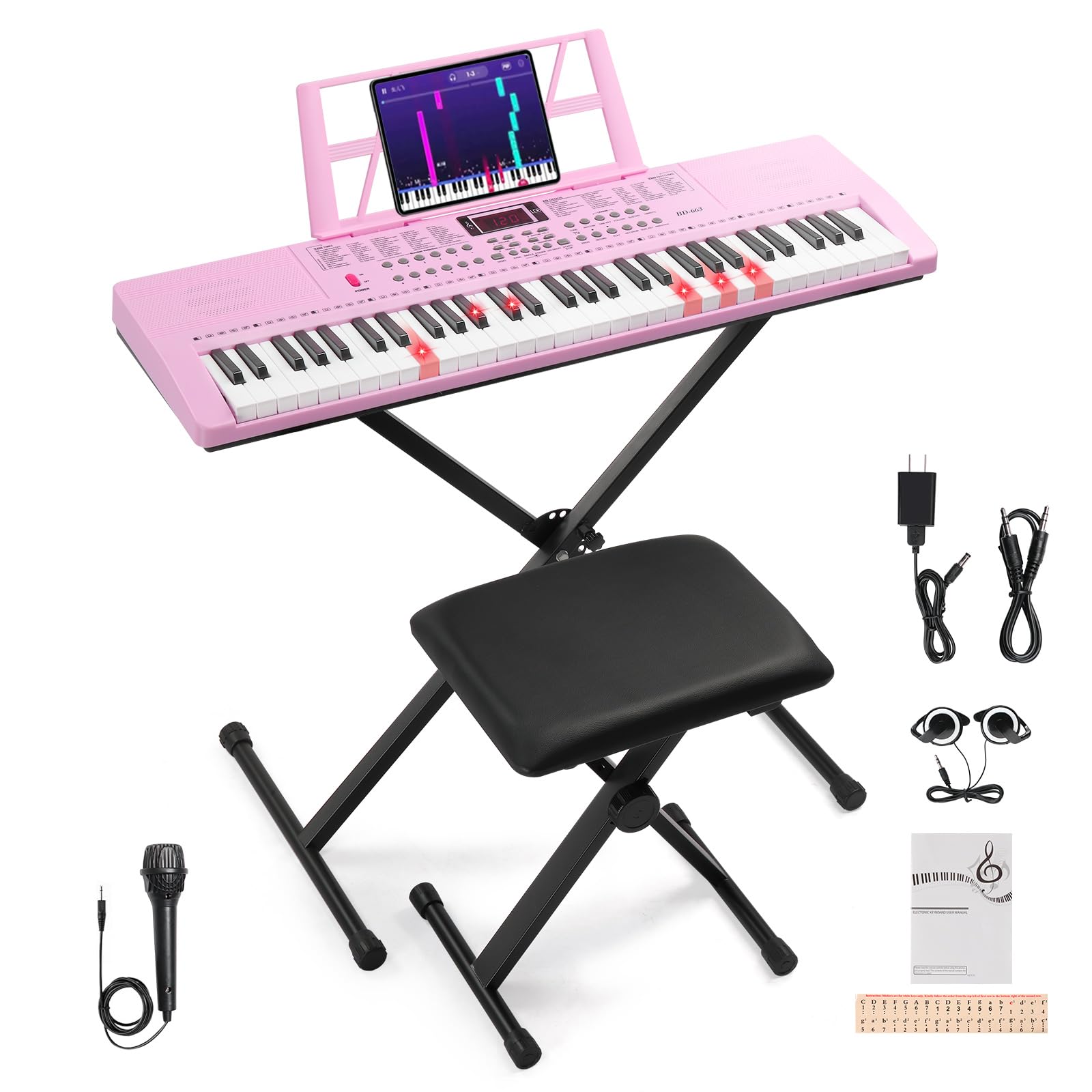
The 200 timbres and 200 rhythms—100 more of each than the Pitowl—make the Ktaxon the top pick for families who want a full 61-key keyboard plus a stand, stool, headphones, and microphone in one box, with no extra parts to buy.
At 33.46 inches wide, the keyboard gives a child enough room for two-handed playing without feeling cramped, and the built-in X-style stand adjusts to three height levels so it grows with your kid. Buyers report “it’s actually pretty amazing for beginners” because of the three teaching modes (One-Key, Follow, and Ensemble) that walk a child through songs step by step.
The catch is that this set costs more than standalone keyboards, but you get the stand, stool, headphones, microphone, music holder, note stickers, and power adapter included—so you are not paying extra for each piece later. If you want a real piano-like experience for a child ready to commit, this is the one.
Why it’s great
- 200 timbres and 200 rhythms give endless sound variety
- Complete set with stand, stool, headphones, microphone, and power adapter included
- Three teaching modes (One-Key, Follow, Ensemble) help beginners learn at their own pace
- 61 full-size keys leave room to grow into two-handed songs
Good to know
- Requires 4 AA batteries for portable use (power adapter included)
- The microphone and power cable are tucked in the foam inside the box—easy to miss at first
- Some users mentioned the stand can feel a bit wobbly on carpet
2. Casio Casiotone SA-81 – Compact Keyboard with 100 Tones & 50 Rhythms
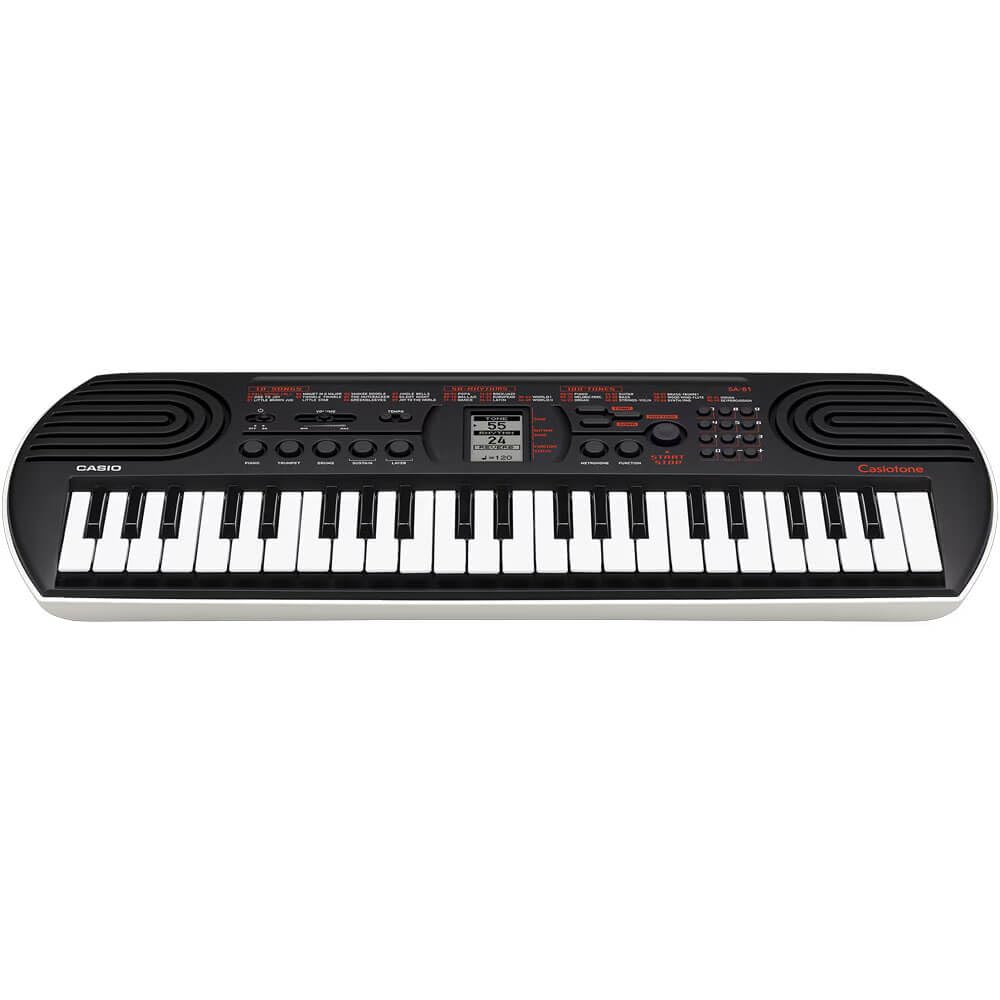
Where the Ktaxon gives you 400 tones, the Casio Casiotone SA-81 gives you 100 tones—but with better sound quality and portability; its 44 mini keys are designed specifically for tiny fingers, so a three- or four-year-old can reach every key without stretching or frustration. At just 3.7 pounds (light enough for a preschooler to carry from room to room), this is the go-to keyboard for families who want a real Casio instrument—not a toy—that travels easily.
It offers 100 tones sampled from actual instruments (not cheap electronic buzzes), 50 rhythm patterns across pop, dance, and ballad styles, and 10 built-in songs like “Ode to Joy” and “Twinkle Twinkle Little Star” that let kids play along. Owners mention the Layer mode (which combines two tones at once) and reverb effects make the sound feel richer than keyboards twice the price, and the keyboard stays in tune even after hours of use.
Choose this over the Ktaxon if your child is under six or needs a keyboard for travel, lessons, or practice in different rooms. The downside is it needs 6 AA batteries (not included) or a separately-purchased AC adapter—so budget for that upfront.
Where it shines
- 44 mini keys are perfect for small hands ages 3–6
- Weighs only 3.7 pounds—truly portable for car trips or moving between rooms
- 100 realistic tones sampled from actual instruments
- Layer mode and 16 scale tunings encourage creative exploration
Worth noting
- Requires 6 AA batteries (not included) or a separately-purchased AC adapter
- 44 keys limit how many two-handed songs a child can play compared to a 61-key model
- No included microphone or stand
3. Pitowl Kids Keyboard Piano, 61 Light-up Key Electric Piano
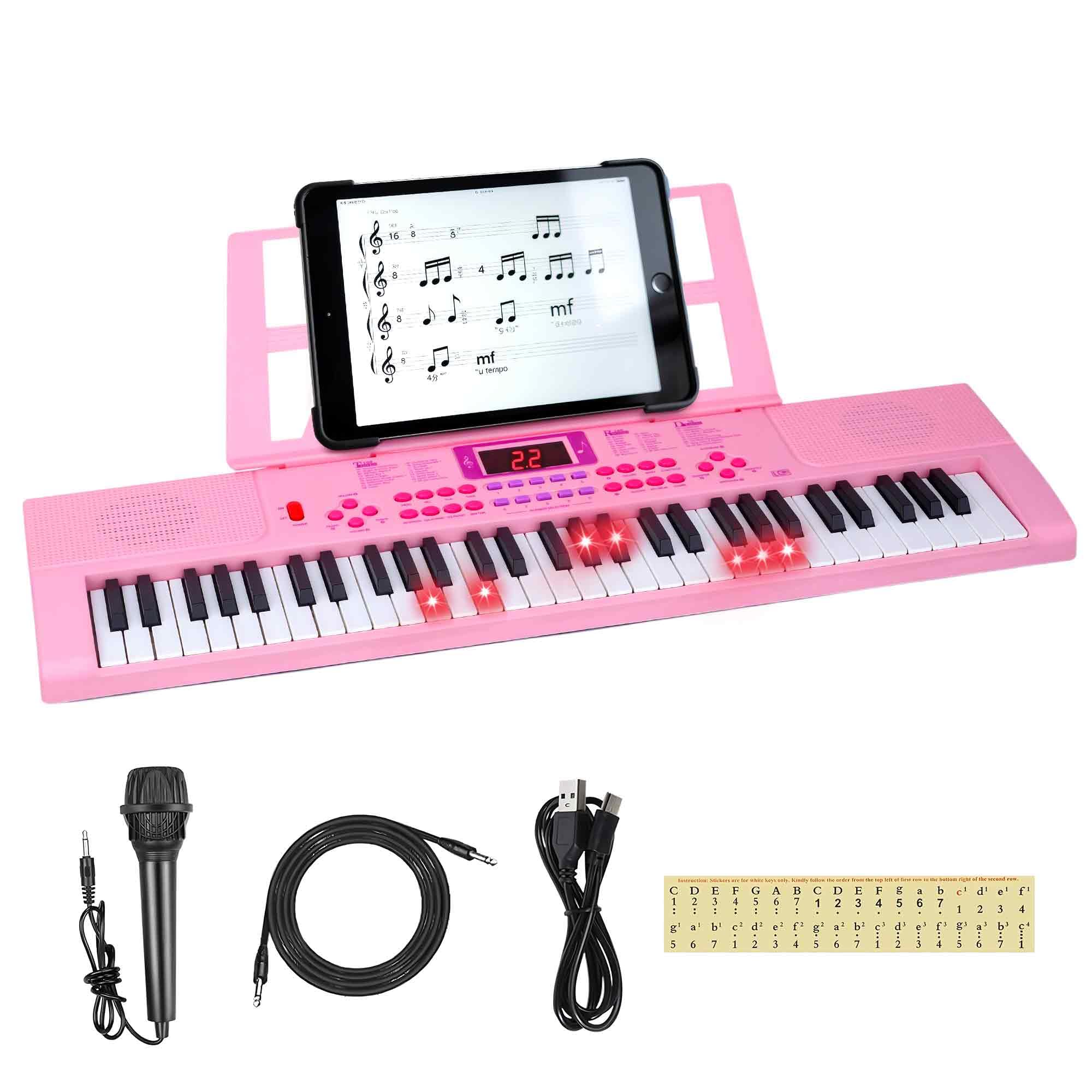
Imagine a keyboard that lights up the exact key your child should press next—that is the Pitowl’s party trick, and it turns “I don’t know how to play” into “I just played Twinkle Twinkle” in minutes. This is the best pick for a child who wants to learn independently without a parent sitting beside them the whole time, because the LED guide system shows which note comes next.
It comes with 100 tones, 100 rhythms, and 70 demo songs—more than double the sounds of the cheaper MusicForset model—plus a built-in LCD screen (a small digital display) that shows the current tone and rhythm so kids know exactly what mode they are in. A buyer mentioned their three-year-old “became more interested in learning instruments” after using it, and the follow-up mode lets kids repeat a section until they master it.
The standout spec here is the complete starter kit: a metal music stand, microphone, audio cable, power cable, note stickers, and instruction manual are all in the box, so you do not need to buy a single extra item to start playing today. The trade-off is that some users reported the keyboard stopped working after a few months, though the same reviews praised the seller’s refund policy.
What stands out
- Lighted keys guide kids note-by-note through songs without sheet music
- 100 tones + 100 rhythms + 70 demo songs offer huge variety for a child to explore
- Full starter kit includes metal music stand, microphone, audio cable, power cable, note stickers, and manual
- 61 full-size keys support longer-term use as skills improve
The trade-offs
- A small number of buyers reported the keyboard stopped working after a few months
- Requires 4 AA batteries for portable use (power cable included)
- The lighted keys can be distracting for some kids who prefer to learn by ear
4. M SANMERSEN Kids Piano Keyboard 49 Keys, Electronic Toy Keyboard Piano with Microphone & Headphone

The single number that matters most in the beginner keyboard category is whether the package includes headphones—because a child who wants to practice at 7 PM without waking a baby sibling or annoying the neighbors needs that quiet option. The M SANMERSEN delivers exactly that: a complete set with microphone and headphones right in the box, which is rare at this price point.
One limitation is the smaller 49-key layout—it has 24% fewer keys than the 61-key Pitowl or Ktaxon, so older kids (ages 9+) may quickly outgrow it for songs that require two hands across a wider range. But for ages 6–12, customers note “all features worked” and “highly recommended” because the bright colors, flashing LED lights, and 22 demo songs keep young beginners engaged without feeling overwhelmed.
If your child is between 6 and 12, this keyboard offers the best value for the money because you get a 49-key board, microphone, headphones, and a USB MP3 input to play along with favorite songs—all at an entry-level cost that leaves room for upgrading later.
The upsides
- Headphones and microphone both included—quieter practice for shared homes
- 22 demo songs and 8 rhythms keep kids engaged with variety
- Bright colors and flashing LED lights make learning feel like play for ages 6–12
- MP3 input lets kids play along to their favorite songs
Keep in mind
- 49 keys are 24% fewer than a 61-key model—older kids may outgrow it sooner
- Requires 4 AA batteries (not included)
- Some users found the plastic feels less durable than higher-end models
5. 61 Keys Kids Piano Keyboard Toy with Mic – MusicForset Portable Electronic Piano
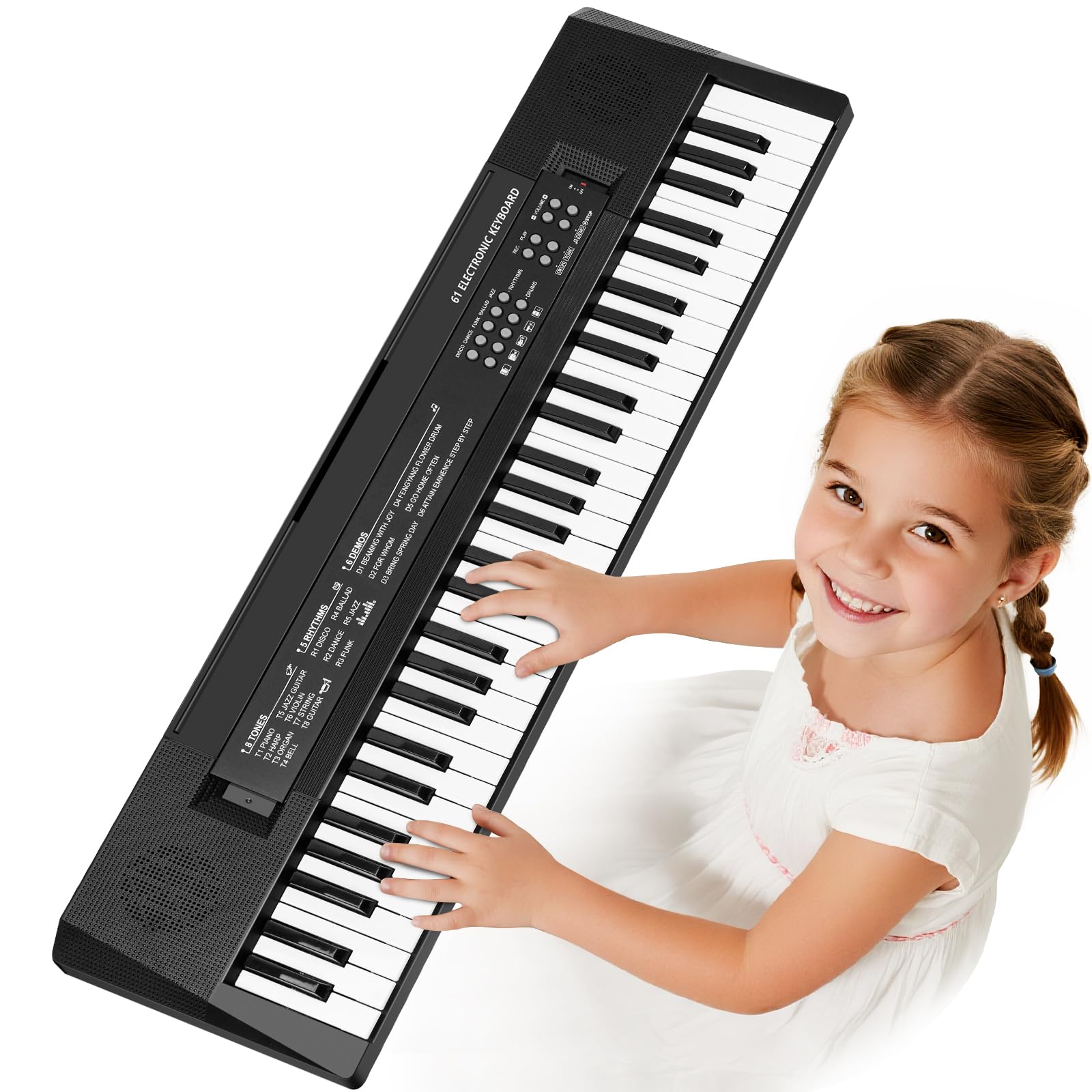
At roughly an entry-level cost, the MusicForset keyboard gives you a full 61-key layout—which is 12 more keys than the M SANMERSEN—so even a child who grows quickly will have room for two-handed songs without being cramped. You get 8 tones, 6 demo songs, 5 rhythms, and a recording/playback function that lets kids hear their own mistakes and improve.
What you give up is sound quality and durability: buyers consistently mention it “feels cheap with thin plastic” and the sound is “inferior to her home piano” according to one grandparent whose seven-year-old uses it for practice. It is not built for years of daily banging, and the 8-tone library is very limited compared to the 100-tone Pitowl or 200-tone Ktaxon.
This is the perfect keyboard for a three- to six-year-old who is just curious about music and might lose interest in three months—you are not spending much, and if they stick with it, you can upgrade to a sturdier model without feeling like you wasted money. One reviewer summed it up well: “Great starter keyboard for kids.”
Why we’d pick it
- 61 full-size keys at an entry-level cost give room to grow
- Recording and playback function helps kids self-correct
- Weighs only 1 pound—easy for a toddler to carry around
- Powered by USB cable (included) or 3 AA batteries
A few caveats
- Only 8 tones and 6 demo songs—very limited sound library
- Thin plastic build reported by multiple buyers; not for heavy daily use
- Requires a separate charging block; only a USB cable is included
6. Raimy Piano Keyboard for Beginners, 61 Keys Portable Electronic Digital Piano with Microphone

The Raimy lands in the middle of the field on price and features—it offers 16 tones, 8 rhythms, and 8 percussion sounds, which is double the tones of the budget MusicForset but still far behind the 200-tone Ktaxon. It is designed specifically with American kids in mind, using keys that measure 2.7 by 0.63 inches (slightly wider than the standard mini key) so fingers fit more naturally.
What that gets you is a keyboard with tempo control, sustain (which makes notes ring longer after you release the key), vibrato (a slight wobble in pitch for a richer sound), and an automatic sleep function that saves battery when the kid forgets to turn it off. The speaker quality is noticeably better than the cheapest models, and reviewers point out it is “great for kids” who are just starting to learn hand coordination.
The honest limit is that some buyers found it “light and flimsy, overpriced” and one unit arrived damaged—so quality control is inconsistent. If you want a dedicated at-home practice keyboard and can stretch your budget a bit, the Ktaxon or Pitowl offer much better build quality for the difference in cost. The Raimy is best as a travel backup or a gift for a very young child who will not be rough on it.
Strong points
- Keys sized at 2.7 x 0.63 inches—designed to fit American kids’ fingers more comfortably
- 16 tones, 8 rhythms, and 8 percussion sounds offer decent variety for beginners
- Tempo control, sustain, vibrato, and automatic sleep function for better learning and battery life
- Powered by 4 AA batteries or USB cable (included)
Before you buy
- Some shoppers say flimsy build quality and units arriving damaged
- Short power cord noted by wheelchair users—may not reach far from an outlet
- Only 16 tones limit long-term exploration compared to 100+ tone models
Understanding the Specs
Key Count (44 vs 49 vs 61)
The number of keys determines the range of notes your child can play. A 44-key keyboard (like the Casio SA-81) covers about 3.5 octaves—enough for simple melodies and beginner songs, but too small for advanced two-handed pieces. A 49-key board covers about 4 octaves, which fits most beginner songbooks. A 61-key keyboard covers 5 octaves, giving your child room to grow into songs that require both hands moving across a wider range. For kids under 6, smaller keys are easier on tiny hands; for kids 7 and up, 61 keys are the better long-term investment.
Tones, Rhythms, and Demos
Tones are the instrument sounds the keyboard can make (piano, guitar, flute, drums, etc.). More tones mean more variety, which keeps kids interested longer. Rhythms are pre-programmed drum beats (rock, pop, waltz) that play in the background so kids can practice timing. Demo songs are short pre-recorded melodies that demonstrate what the keyboard can do—they also serve as practice pieces. A keyboard with 8–16 tones is entry-level; 100–200 tones (like the Pitowl or Ktaxon) gives a child room to explore different musical styles.
Teaching Modes: One-Key, Follow, and Ensemble
These three modes (found on the Ktaxon and some premium models) are step-by-step learning tools. In One-Key mode, the keyboard plays the melody and the child just presses any key to keep the song going—great for very young beginners. Follow mode plays a short phrase and waits for the child to repeat it correctly before moving on. Ensemble mode splits the keyboard into two sections: the child plays the right hand while the keyboard plays the left hand part, or vice versa. These modes build skills progressively without requiring sheet music reading.
Power Options: Batteries vs. USB vs. AC Adapter
How you power the keyboard affects where and how often your child can play. Battery power (usually 4 or 6 AA batteries) is essential for travel, backyard play, or moving between rooms—but batteries drain fast with lighted keys or built-in speakers. USB power (a cable that plugs into a phone charger or computer) is common on budget keyboards and works for home use, but you need a separate wall block (not always included). An AC adapter (a wall plug that comes with the keyboard) is the most reliable for daily practice because you never have to stop for dead batteries. Check the product specs carefully: some keyboards include the adapter, others require a separate purchase.
FAQ
What is the best age to start a child on a keyboard?
Do I need to buy a keyboard with a microphone?
How many keys does my child actually need?
Are lighted keys worth the extra cost?
Can I connect a beginner keyboard to headphones?
Final Thoughts: The Verdict
For most families, the beginner keyboard for kids winner is the Ktaxon 61 Key Keyboard because it gives you a complete setup—stand, stool, headphones, microphone, 200 tones, and three teaching modes—all in one box, so your child has everything needed to start learning immediately without extra purchases. If you want the best learning tool with lighted keys that guide your child note-by-note, grab the Pitowl Kids Keyboard Piano. And for the most portable, travel-friendly option built by a trusted brand, the standout is the Casio Casiotone SA-81.