
Our readers keep the lights on and the weekend projects moving. As an Amazon Associate, I earn from qualifying purchases.
You wake up cold, your hip aches from the hard ground, and the day ahead already feels miserable — that is what happens with the wrong camping bedding. The Wevelel Memory Sleeping Pad solves both problems at once: it has the highest R-value (a warmth rating) of 9.5 in this guide, so you stay warm even in sub-freezing temperatures, and its 3.1-inch thick memory foam keeps your hips off the ground. This guide covers seven pads, each chosen for a specific trip — car camping with the family, ultralight backpacking, or sleeping on a cot — with the exact R-values, thicknesses, weights, and real buyer reports that matter.
I’m Rikta — the co-founder and writer behind FitlyFast. This guide is built by comparing the manufacturers’ published specifications and the patterns across verified customer reviews, so you get each pick’s real strengths and trade-offs instead of marketing spin.
Every product here suits a specific camping scenario — car camping with a family, backpacking with a tiny pack, or sleeping on a cot — so you can match the right bedding for tent camping to your actual trip.
How To Choose The Best Bedding For Tent Camping
You pick a camping pad based on three things: how you sleep, where you camp, and how you get there. A car camper can carry a 7-pound pad; a backpacker cannot. A cold-weather camper needs an R-value (a warmth rating) over 4.5; a summer camper does not. These are the key specs.
R-Value: The Warmth Number
R-value measures how well a pad stops heat from escaping into the cold ground — the higher the number, the warmer you stay. For summer camping, an R-value of 2.0 is enough. For spring and fall, look for 4.0 to 5.0. For winter camping below freezing, aim for 6.0 or higher. A pad with a low R-value on a cold night will pull warmth out of your sleeping bag, no matter how good the bag is.
Thickness and Comfort
A thicker pad keeps your hips and shoulders off the hard ground, which matters most for side sleepers. Pads under 2 inches let you feel rocks and roots. Pads at 3 inches or more give you a mattress-like feel. Closed-cell foam pads (solid foam sheets that never puncture) are thin, around 0.9 inches. Self-inflating and memory foam pads range from 2.5 to 4.3 inches.
Packed Size and Weight
If you hike to your campsite, every ounce counts — the Therm-a-Rest NeoAir Xlite NXT weighs only 13 ounces and rolls to the size of a water bottle. If you drive to camp, weight barely matters, so you can choose a thicker, wider, heavier pad. Always check the packed dimensions before buying.
Quick Comparison
On smaller screens, swipe sideways to see the full table.
| Model | Category | Best For | Key Spec | Amazon |
|---|---|---|---|---|
| Wevelel Memory Sleeping Pad | Self-Inflating Foam | Cold weather car camping | R-value 9.5 | Amazon |
| Sea to Summit Camp Plus | Self-Inflating Foam | All-season car camping | R-value 4.3 | Amazon |
| Acacia 4″ Self Inflating Pad | Self-Inflating Foam | Side sleepers & couples | 4.3 inches thick | Amazon |
| CYMULA 3″ Memory Foam Pad | Roll-Up Memory Foam | Cot sleeping | 3 inches thick | Amazon |
| HomeMate Memory Foam Mattress Pad | Roll-Up Memory Foam | Cot & car camping value | 72 x 24 x 3 inches | Amazon |
| NEMO Equipment Switchback | Closed-Cell Foam | Ultralight backpacking | 16 ounces weight | Amazon |
| Therm-a-Rest NeoAir Xlite NXT | Air-Inflated | Ultralight backpacking | R-value 4.5 | Amazon |
In‑Depth Reviews
1. Wevelel Memory Sleeping Pad

The Wevelel Memory Sleeping Pad earns the top spot because it delivers the highest warmth of any pad here — an R-value (a standard warmth rating) of 9.5 from ASTM testing, so you stay warm even when the ground is below freezing. One buyer, a soldier, reported: “Used this out in the field with the Army, and even when temps were high 30s low 40s I was warm.” That insulation makes this the cold-weather winner for car campers, easily warmer than the Sea to Summit Camp Plus’s 4.3 R-value.
At 3.1 inches thick and 77 inches long by 27 inches wide, this pad keeps your hips and shoulders off the ground. The 50D memory foam (a dense foam far thicker than the 19D found in cheaper pads) spreads your weight evenly so pressure points disappear. It self-inflates in about 30 seconds: open all three valves, let it expand for 10 seconds, close the back two, then step on the front valve for 20 seconds — no manual pumping required.
The honest trade-off is bulk — at 6.6 pounds and a rolled size that takes up real trunk space, this is strictly a car-camping pad. If you drive to camp and want the warmest, most comfortable sleep possible, this is the one to buy.
Why it’s great
- Industry-leading R-value of 9.5 for extreme cold
- 3.1-inch thick memory foam feels like a real bed
- Self-inflates in roughly 30 seconds with simple valves
Good to know
- Heavy at 6.6 pounds — not for backpacking
- Packs bulky; takes up significant car space
2. Sea to Summit Camp Plus Self-Inflating Mat
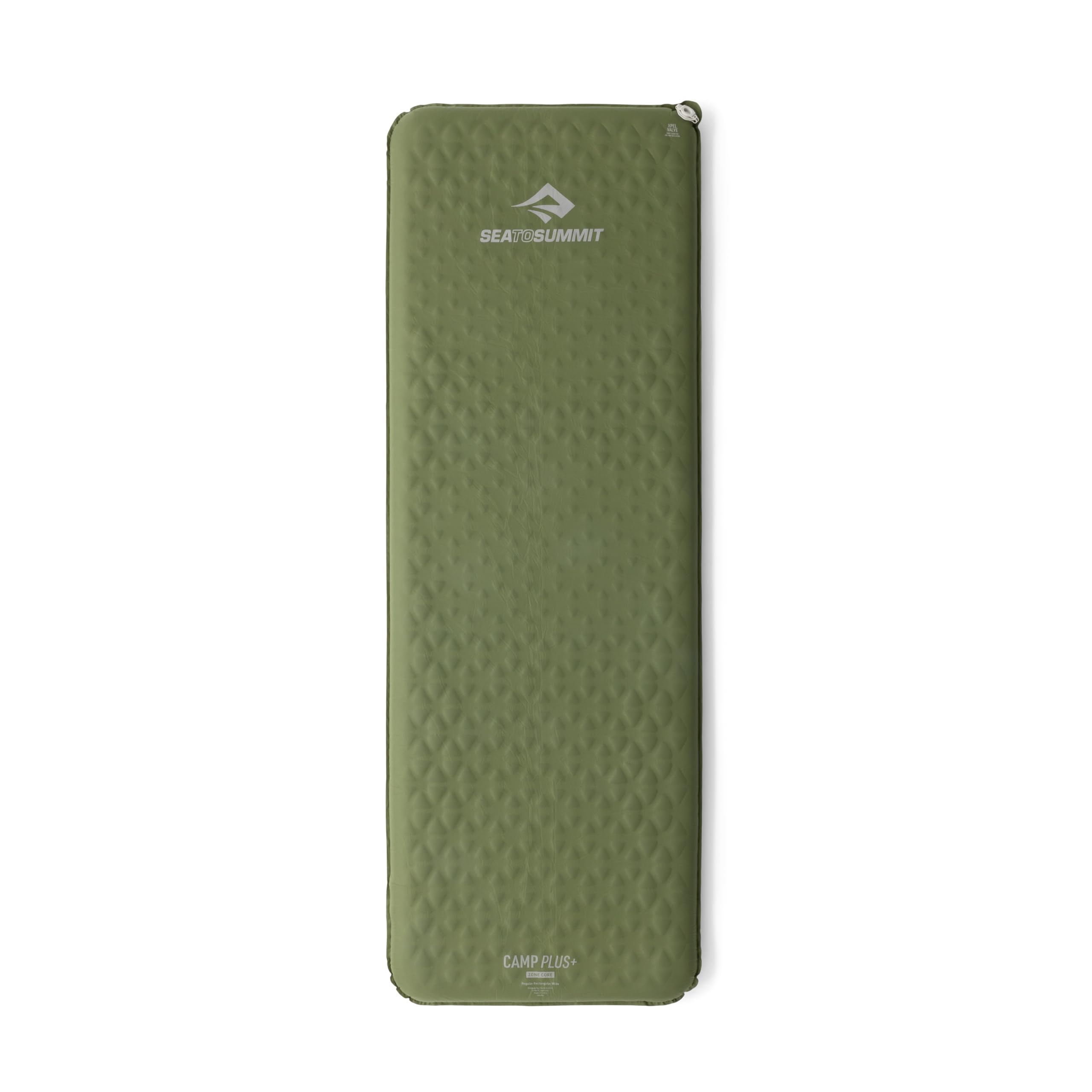
The Sea to Summit Camp Plus delivers a 4.3 R-value (enough for spring, fall, and mild winter) at a packed size of 13 x 7.5 inches — far more compact than the Wevelel’s bulky roll. At 3.2 pounds, it is about half the weight of the Wevelel while still offering 2.6 inches of cushion, a meaningful difference if you haul gear a short walk from the car.
The rectangular shape is 72 inches long and 25.2 inches wide, giving you room to stretch out. The 75D polyester face fabric (a durable fabric with a 75-denier rating) has proven tough — one reviewer tested it through a Death Valley summer on direct sunlight, sand, and rocks without a scratch. The updated Xpel valve lets you fine-tune firmness and deflates quickly for pack-up. Included PillowLock patches let you attach a Sea to Summit pillow so it stays in place overnight.
Choose this over the Wevelel if you want a do-it-all pad that works for car camping but packs small enough to not dominate your trunk. You trade extreme cold insulation (4.3 R-value vs. 9.5) for a much lighter, more portable package.
Where it shines
- R-value of 4.3 for three-season use
- Packs down to 13 x 7.5 inches at only 3.2 lbs
- Extremely durable 75D polyester fabric
Worth noting
- Self-inflation is slow initially — foam takes days to fully expand
- Bulky for backpacking; best for car camping or short carries
3. Acacia 4″ Self Inflating Sleeping Pad

If you sleep on your side and wake up with a sore hip, the Acacia 4″ pad is the solution — its 4.3-inch thickness makes it the thickest pad here, providing enough cushion so your hip and shoulder do not press into the hard ground even when you shift all your weight onto one side, far more forgiving than the Wevelel’s 3.1 inches. The Y-shaped telescopic foam structure (an internal foam skeleton that compresses when rolled) reduces packed bulk by up to 60% compared to a solid foam block of the same thickness, so you get a 4.3-inch mattress that packs to 7 x 7 x 27 inches at 5.3 pounds.
Reviewers consistently call it the most comfortable air mattress for side sleeping. One 60-year-old with back injuries reported it worked well enough for seven trips. The R-value is 6.0, warm enough for winter car camping. The included pump sack lets you top off the firmness — though buyers report a learning curve with the inflation bag.
The standout spec is the 4.3-inch thickness combined with a 28-inch width and 79-inch length — the largest sleep surface here, roomy enough for restless sleepers and wide enough to connect two pads side by side with included buckles for a couple’s setup. Skip this if you are a minimalist backpacker; its 5.3-pound weight and packed size are for car camping.
What stands out
- 4.3 inches thick — best for side sleepers and pressure points
- Large 79 x 28 inch surface with couples-connect buckles
- R-value of 6.0 for cold-weather use
The trade-offs
- Still bulky — packs to the size of a small laundry basket
- Requires a pump sack or electric pump; not truly self-inflating
4. CYMULA 3″ Memory Foam Camping Pad
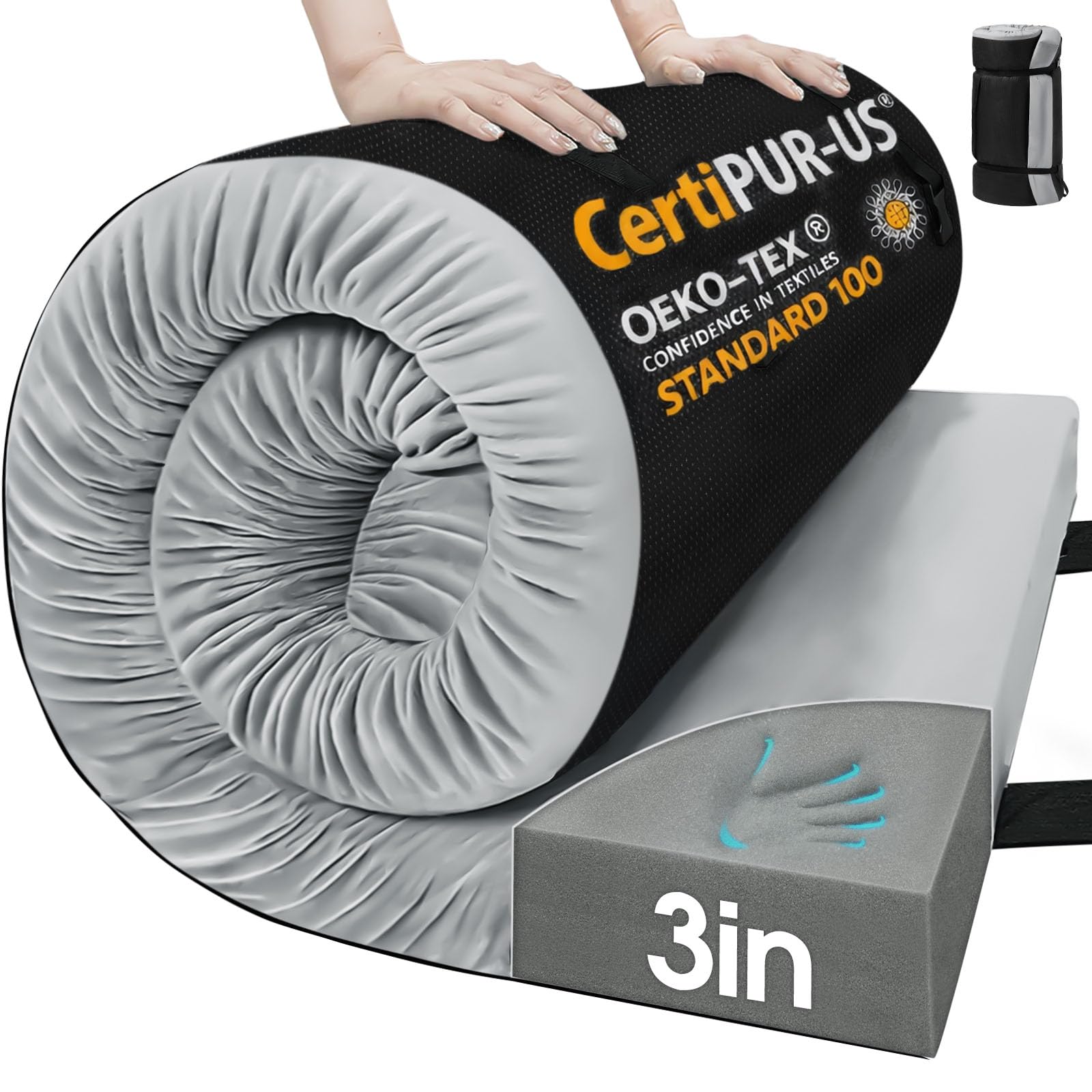
The single number that matters most in this category is thickness — the CYMULA’s 3-inch memory foam layer transforms a hard canvas cot into a surface that feels like a real mattress. Reviewers consistently say this is the most comfortable pad they have used on a cot. One reviewer noted it kept them warm during 30°F camping on a cot; another called it “the best for on top of your cot for camping” because the 72 x 24 inch size fits standard cots perfectly without overhang.
The catch is packed bulk — at 6.4 pounds and a cylinder roughly the size of a large camping pillow, this takes up real trunk space and is not for backpacking. The waterproof bottom with rubberized anti-slip dots keeps the pad from sliding on a cot or tent floor. The removable cover zips off for machine washing, which buyers appreciate after muddy trips.
At this thickness, the CYMULA delivers the same cot comfort as the HomeMate (Product 5) but with a slightly softer feel from its carbon-fiber memory foam blend. If you need a dedicated cot pad without stepping up to the premium Sea to Summit, this offers strong price-to-value.
The upsides
- 3 inches of memory foam makes a cot feel like a real bed
- Removable, machine-washable cover for easy cleaning
- Waterproof, non-slip bottom prevents sliding on cots
Keep in mind
- Bulky and heavy at 6.4 pounds — car camping only
- Included straps are weak; some buyers replaced them
5. HomeMate Memory Foam Camping Mattress Pad
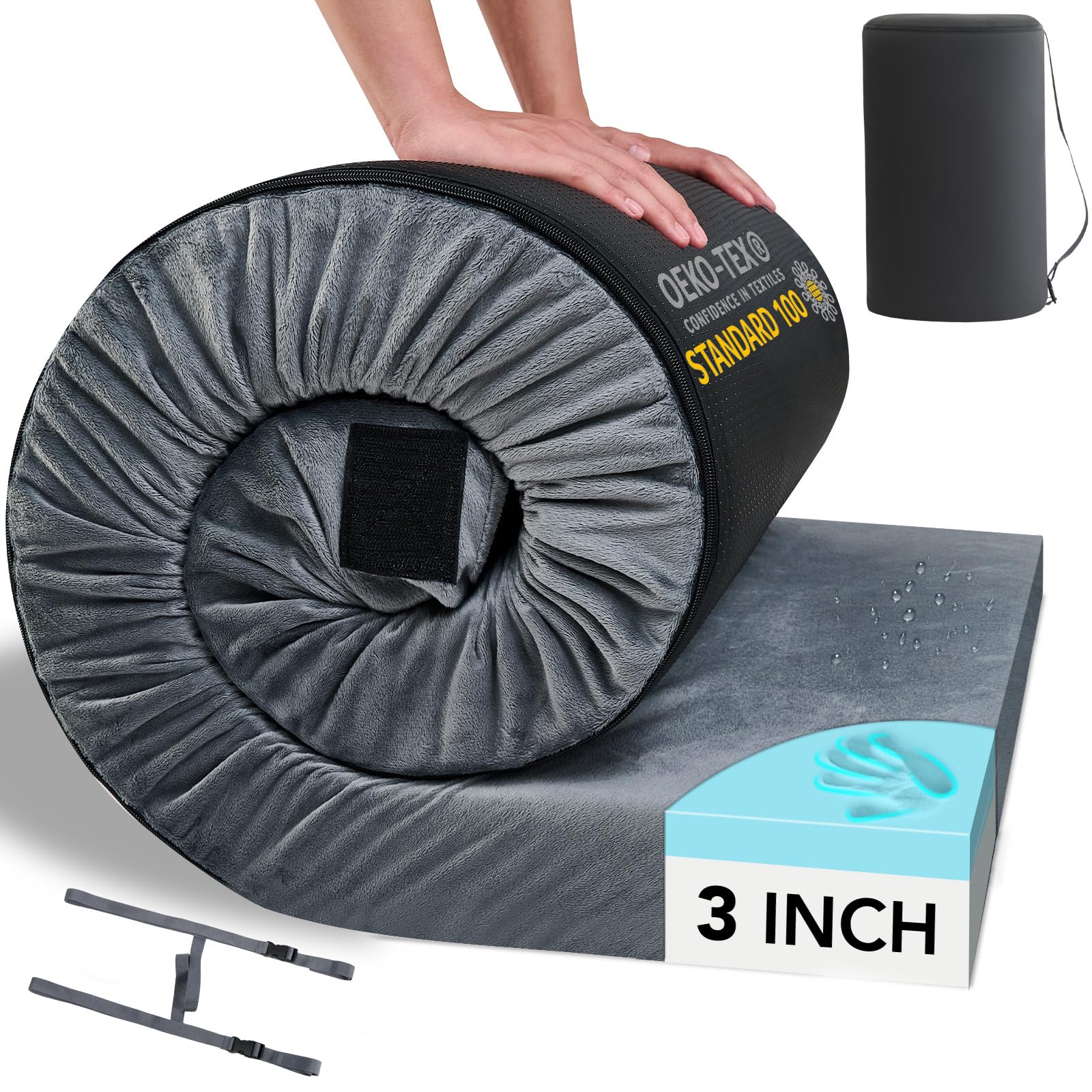
The HomeMate gives you a 3-inch thick, full-size memory foam pad at an entry-level price that undercuts most competitors — you get a 72 x 24 inch sleep surface with a combined memory foam and high-density support foam core that absorbs shock on rough ground. The waterproof bottom and anti-slip design work on tent floors, cots, or SUV cargo areas, and the 7.8-pound weight is manageable for car camping.
The packed size is bulky — one reviewer called it “the size of this when rolled up” as the only real con. The foam takes about 72 hours to fully expand after unboxing, so you need to plan ahead before your trip. The zipper quality on the cover is inconsistent, according to buyers.
This is the pick for a budget-conscious car camper who needs a thick, comfortable pad for a cot or tent floor and does not want to spend a premium for the same 3-inch thickness that the CYMULA offers. If you are outfitting a family or a spare guest room on a tight budget, this pad delivers the core comfort feature — 3 inches of supportive foam — at the lowest entry cost.
Why we’d pick it
- 3 inches of memory foam at a budget-friendly entry price
- Waterproof bottom with anti-slip surface
- Removable, washable cover included
A few caveats
- Zipper quality on cover is inconsistent, per buyer reports
- Needs 72 hours to fully expand after opening
6. NEMO Equipment Switchback Foam Sleeping Pad
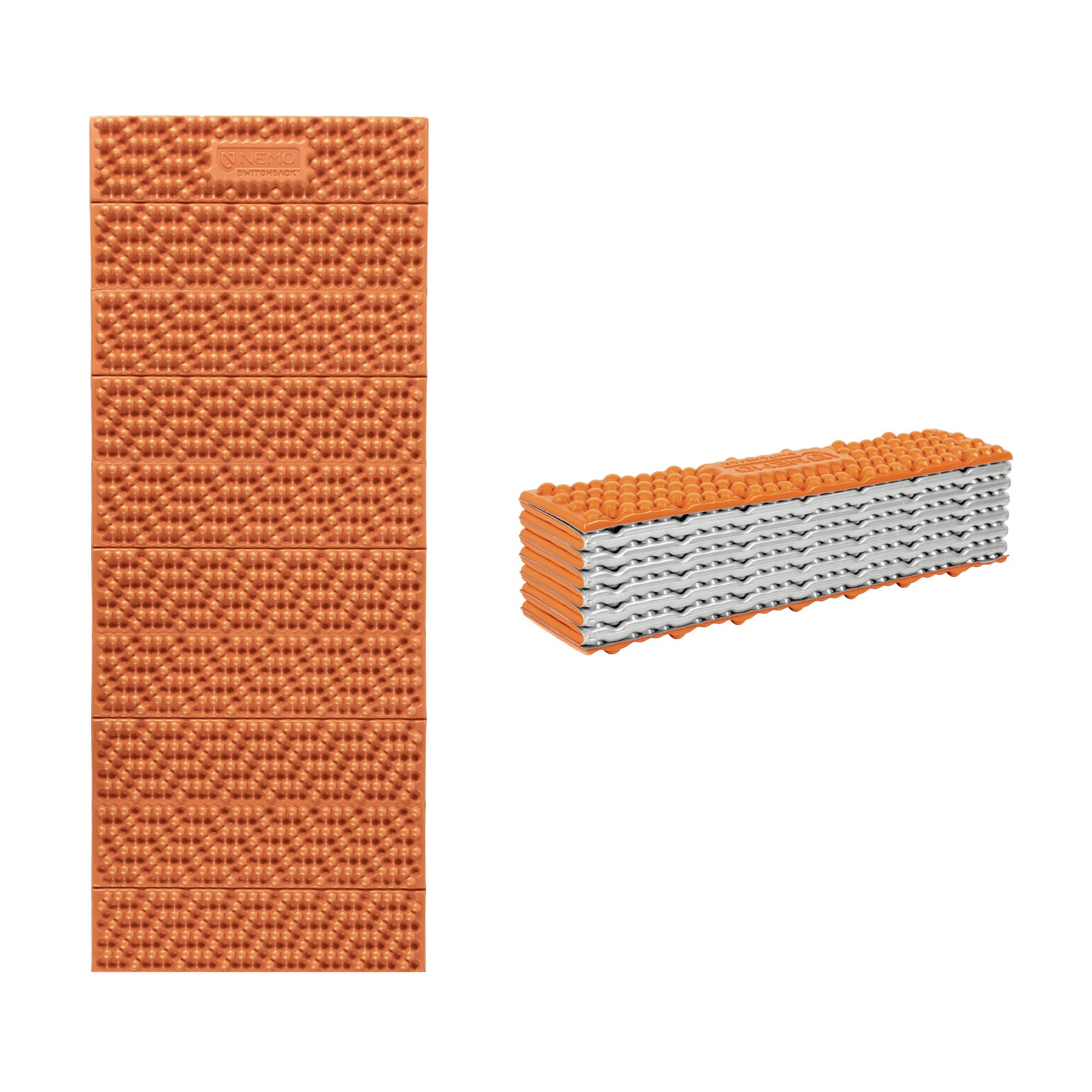
The NEMO Switchback is for backpackers and weight-conscious campers who need a reliable, puncture-proof sleeping pad at just 16 ounces — that is 5.9 pounds lighter than the Wevelel, a difference that matters enormously when carrying everything on your back. It is a closed-cell foam pad (a solid foam sheet that never leaks or punctures) with a hexagonal nesting pattern that gives you significantly more plushness than standard foam pads while still folding flat.
The metallized thermal reflective film on the bottom reflects body heat back to you, providing an R-value of 2.0. One buyer mentioned it “performed great on concrete floor” and blocked pressure points for side sleeping — impressive for a pad only 0.9 inches thick. The dual-density Axiotomic foam (a soft top layer for comfort and a firm bottom layer for support) makes this far more comfortable than standard military-style foam pads. It doubles as a sit pad around camp or a gear mat to keep your pack off wet ground.
The honest limit is that at 0.9 inches thick and 20 inches wide, this is not mattress-level comfort — you will feel rocks and roots on uneven ground, and the 51-inch length means your calves may hang off unless you are under 5’6″. Buy this for its reliability: it will never deflate, never leak, and will last for years of hard backpacking. skip it if you need cushion for side sleeping — the Acacia or Wevelel is far better for that.
Strong points
- Extremely lightweight at only 16 ounces
- Never punctures or deflates — bombproof reliability
- Doubles as a sit pad or gear mat around camp
Before you buy
- Only 0.9 inches thick — less comfort than thick foam pads
- Short 51-inch length not ideal for taller sleepers
7. Therm-a-Rest NeoAir Xlite NXT

The Therm-a-Rest NeoAir Xlite NXT sits at the premium end of the field — it delivers an R-value of 4.5 (warmer than many thick foam pads) at just 13 ounces in the Regular size, giving it the best warmth-to-weight ratio of any pad here. It rolls to about the size of a 1-liter water bottle, so it disappears into a backpack. The 3-inch thickness comes from no foam at all — just air trapped by Therm-a-Rest’s Triangular Core Matrix construction, which minimizes convective heat loss, while the reflective ThermaCapture technology traps radiant heat.
The WingLock valve is dependable; owners mention it takes about 10 full breaths or one pump sack fill to inflate, and deflation is lightning-quick. Earlier NeoAir models were notoriously crinkly and noisy, but the NXT version is described as “nearly silent” by buyers. One reviewer at 5’9″ and 180 pounds found it the most comfortable of three Therm-a-Rest pads they owned; another called it warm in the 30s. This pad is far warmer than the NEMO Switchback’s 2.0 R-value, making it the real ultralight cold-weather choice.
The downside is the price — this is the most expensive pad here by a wide margin — and the 30D ripstop nylon fabric is fragile compared to thick foam pads, requiring careful use on rough ground. A small number of buyers reported valve defects. Choose this if your priority is ultralight backpacking and you need real warmth and comfort without adding bulk — it is the best choice for hikers who count every gram.
What we like
- R-value of 4.5 at only 13 ounces — unbeatable warmth-to-weight
- Packs to the size of a 1-liter bottle
- Near-silent material in the NXT version
The downsides
- Premium price — the most expensive option here
- Thin 30D fabric requires careful use on rough ground
Understanding the Specs
R-Value
R-value measures how well the pad resists heat loss to the cold ground. The higher the number, the warmer you stay. Summer-only pads often have an R-value around 2.0. Three-season pads range from 4.0 to 5.0. Winter pads need 6.0 or higher. The Wevelel’s 9.5 R-value is exceptionally high — it stops nearly all ground cold from reaching your body, even in sub-freezing temperatures.
Thickness
Thickness directly determines how much cushion you feel between your body and the ground. Pads under 2 inches let you feel rocks and roots. Pads at 3 inches or more provide enough depth for your hips and shoulders to sink in without bottoming out — side sleepers should prioritize at least 3 inches. The thickest pad here is the Acacia at 4.3 inches, which feels closest to a home mattress.
Self-Inflating vs Roll-Up vs Air
Self-inflating pads contain open-cell foam that expands when you open the valve, drawing in air automatically — convenient but can be bulky. Roll-up memory foam pads are solid foam slabs that you roll out on the floor; they never deflate but are heavy and large when packed. Air-inflated pads like the Therm-a-Rest have no foam inside — you fill them with breath or a pump sack, giving the best warmth-to-weight ratio but carrying a risk of punctures.
Packed Size and Weight
Packed size and weight determine whether you can carry the pad on your back or only in a car. Backpackers should look for pads under 2 pounds that pack smaller than a Nalgene bottle (like the NEMO Switchback at 16 oz or the Therm-a-Rest at 13 oz). Car campers can ignore weight entirely and prioritize thickness and warmth — the Wevelel at 6.6 lbs is fine for vehicle camping but impossible to hike with.
FAQ
What R-value do I need for winter tent camping?
Should I get a self-inflating pad or a memory foam roll-up pad?
Can I use a camping sleeping pad on a cot?
How thick should my camping pad be for side sleeping?
How do I store a self-inflating foam pad long-term?
Final Thoughts: The Verdict
For most car campers, the bedding for tent camping winner is the Wevelel Memory Sleeping Pad because it combines the highest R-value of 9.5 with 3.1 inches of memory foam comfort — you stay warm and comfortable without spending premium money. If you want a more packable option for shorter carries or trunk space, grab the Sea to Summit Camp Plus. And for side sleepers who need maximum cushion, the Acacia 4″ Self Inflating Pad at 4.3 inches thick is the clear choice.