
Our readers keep the lights on and the weekend projects moving. As an Amazon Associate, I earn from qualifying purchases.
A sprinkler pump that does not push enough water will leave brown patches in your lawn. You need a 2 HP pump strong enough to pop up every sprinkler head, run multiple zones at once, and handle a lake or well water supply without choking. This guide covers eight of the most proven 2 HP sprinkler pumps on the market, with real flow numbers and years of buyer experience baked into every pick.
I’m Rikta — the co-founder and writer behind FitlyFast. This guide is built by comparing the manufacturers’ published specifications and the patterns across verified customer reviews, so you get each pick’s real strengths and trade-offs instead of marketing spin.
Whether you are replacing an aging pump, building a new irrigation system from scratch, or pulling water from a lake or well, this roundup of the best 2 hp sprinkler pump models gives you the hard specs and honest buyer feedback to make the right call.
How To Choose The Best 2 HP Sprinkler Pump
A 2 HP sprinkler pump is a serious piece of equipment, not a weekend gadget. Choosing the wrong one means weak sprinkler coverage, overheating, or a pump that dies within a season. Here are the three specs that separate a lawn-saving pump from a lawn-killing headache.
Flow Rate (GPM) Is The Real Power Number
Horsepower tells you the motor size, but gallons per minute (GPM) tells you how much water actually moves through your sprinklers. A 2 HP pump typically delivers between 69 and 88 GPM. More GPM means you can run more sprinkler heads per zone and keep water pressure high across your whole yard. For a typical suburban lot, you want at least 60 GPM at 30 PSI (pounds per square inch, the measure of water pressure) to run 8–10 standard pop-up sprinkler heads.
Impeller Material Determines How Long It Lasts
The impeller, the spinning fan inside the pump that pushes water, is the most stressed part. Plastic impellers are common in budget and mid-range pumps, but they crack or strip threads when exposed to sand, sediment, or constant high heat. Brass or glass-filled thermoplastic impellers handle abrasive water (lake, pond, or ditch water) far better. If your water source has any grit, spend the extra money on a brass-impeller model.
Self-Priming vs. Manual Priming
A self-priming pump draws water up from a well or lake automatically after you fill the pump housing once. A non-self-priming pump needs you to pour water into the suction pipe every time the pump loses prime (for instance, if the water level drops and air gets in). For sprinkler systems, self-priming is a huge convenience — you do not want to be out in the summer heat re-priming a pump after a brief power outage.
Quick Comparison
On smaller screens, swipe sideways to see the full table.
| Model | Category | Best For | Key Spec | Amazon |
|---|---|---|---|---|
| AQUASTRONG 2 HP | Centrifugal | Best Overall Flow | 86 GPM / 112 ft lift | Amazon |
| Goulds GT20 | Self-Priming | Proven Longevity | 88 GPM / 65 lb | Amazon |
| Red Lion RL-SPRK-200-BR | Brass Impeller | Abrasive Water | 77 GPM / Brass Impeller | Amazon |
| Star HSP20P1 | Self-Priming | American-Made Build | 78 GPM / 60.5 lb | Amazon |
| Wayne WLS200 | Cast Iron Volute | Daily Runner | 72 GPM / 100 ft lift | Amazon |
| Red Lion RL-SPRK200 | Prime-Performance | Head Count Capacity | 76 GPM / 63 lb | Amazon |
| Sta-Rite FP5182-08 | Thermoplastic | Budget Reliability | 69 GPM / 41 lb | Amazon |
| HSPJ20P1 Do It Best | Heavy Duty | Continuous Duty | Dual Voltage / 65.3 lb | Amazon |
In‑Depth Reviews
1. AQUASTRONG 2 HP Shallow Well Jet/Centrifugal Pump

86 GPM and 112-foot lift make the AQUASTRONG 2 HP Shallow Well Jet/Centrifugal Pump the top pick for anyone who needs raw water-moving muscle for a large lawn or multi-zone irrigation. Buyers report it provides 10 more GPM than the old Red Lion they replaced, and its lift is a 22.4x advantage over the Sta-Rite pump’s 5-foot lift.
The entire pump housing is cast iron, so it stands up to years of outdoor exposure without cracking. It also includes built-in automatic thermal overload protection, meaning the motor shuts itself off if it starts overheating, then restarts once it cools down — a real safety net for those hot summer afternoons when the pump runs for hours straight. It runs on 230V (single voltage) and uses a 2-inch NPT suction with a 1.5-inch discharge for maximum water flow.
The catch is that a few buyers experienced motor failure within the first few months, though AQUASTRONG’s customer service team stepped in with replacements and refunds. For most people, the sheer flow output and durable cast iron build make this the most capable pump here. This pump is for you if your sprinkler system demands maximum water volume day after day; skip it if you only have a 115V outlet, because it needs 230V.
Why it is great
- 86 GPM is the highest flow in this class — enough for 20+ sprinkler heads
- 112-foot maximum lift handles deep wells and steep elevation changes
- All cast iron volute for long outdoor life
Good to know
- Motor failure reported in a small number of early units (warranty service responsive)
- 230V only — not convertible to 115V for standard household outlets
2. Goulds GT20 IRRI-Gator Self-Priming Centrifugal Pump
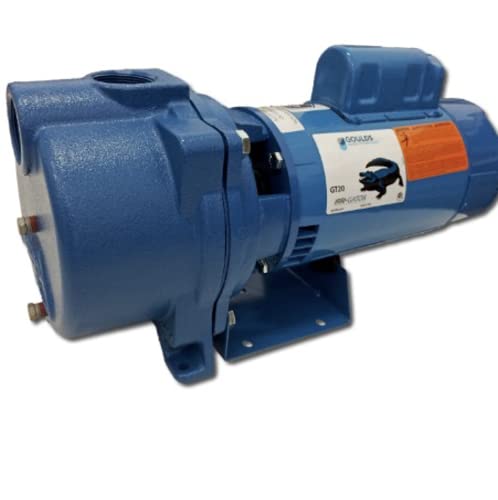
The Goulds GT20 matches the AQUASTRONG on flow (88 GPM vs. 86 GPM) but tops it on long-term reliability reputation — owners mention Goulds pumps lasting 15 to 40 years with minimal repairs. However, it falls short on maximum lift: at only 5 feet, this is strictly for shallow-well or pond applications, unlike the AQUASTRONG’s 112-foot capability. That limits who can use it, but within that range, it is a true workhorse.
This pump uses self-priming design — you fill the housing once, and it pulls water up on its own after that. Customers note it pops up all sprinkler heads without lagging, even on uphill zones. It weighs 65 pounds (about 4.5 pounds heavier than the AQUASTRONG), so you feel the solid cast iron construction the moment you lift it out of the box. It runs on 230V and has an automatic-reset overload protector built into the motor.
One honest limit: the impeller is plastic, and a buyer reported that it separated after one year of use, requiring a rebuild kit. If your water source has sand or sediment, choose the brass-impeller Red Lion instead. But if you have clean water and want a pump that might outlast you, choose this Goulds over the AQUASTRONG for its legendary lifespan.
Why it is great
- Reviewers point out 15–40 year lifespans — unmatched long-term value
- 88 GPM flow rate powers even the largest sprinkler systems
- Self-priming after initial fill eliminates re-priming hassles
Worth noting
- Plastic impeller is a weak point in abrasive water conditions
- 5-foot maximum lift limits use to shallow wells and ponds
3. Red Lion RL-SPRK-200-BR 2HP Sprinkler Pump with Brass Impeller

You are pulling water from a ditch, reservoir, or lake where sand and silt are a daily reality. Plastic impellers will strip their threads or crack within months in that environment. This Red Lion’s brass impeller is specifically designed to handle abrasive water without wearing out — shoppers say it handles residual sand that destroyed their previous plastic-impeller pumps.
The pump delivers 77 GPM at 10 PSI and 64 GPM at 30 PSI, which means it can push up to 21 sprinkler heads with half-inch fittings or 10 heads with three-quarter-inch fittings in each zone. The all-metal cast iron housing also resists the pressure spikes that cause plastic pump cases to crack. One reviewer noted that startup pressure hits 90 PSI briefly before settling to 40 PSI, and the metal case handles that spike without issue.
The one trade-off: at 77 GPM, it gives up roughly 9–11 GPM compared to the AQUASTRONG or Goulds, so if you have an enormous system with 30+ heads per zone, those pumps push more water. But for anyone facing gritty water, the brass impeller is not a luxury — it is the difference between a pump that lasts years and one that dies mid-season. You would be better off with the Goulds if you have clean water and want maximum flow.
Why it is great
- Brass impeller withstands sand and sediment that destroy plastic impellers
- 64 GPM at 30 PSI handles 21 sprinkler heads per zone
- All-metal cast iron housing resists pressure-spike cracking
The trade-offs
- 77 GPM is lower than top-flow models like AQUASTRONG (86 GPM)
- 5-foot maximum lift — only for shallow water sources
4. Star HSP20P1 2 HP Self Priming Lawn Sprinkler Irrigation Pump

In a category where flow rate is king, this Star pump delivers a solid 78 GPM, putting it in the middle of the pack compared to the AQUASTRONG (86 GPM) and Goulds (88 GPM). But its real score is in build quality — it is made in the USA using a majority of US content and weighs 60.5 pounds, making it 19.5 pounds heavier than the Sta-Rite plastic pump. That weight means thicker cast iron and heavier-duty components.
The downside you accept is a modest maximum lifting height of 25 feet — fine for shallow wells and surface water, but nowhere near the AQUASTRONG’s 112-foot capability. The motor is dual voltage (115V/230V), factory-wired for 230V but convertible if you only have a 115V outlet. Buyers report that after over one year of use, the pump still works very well, and one reviewer called it a “rugged, powerful sprinkler pump.”
At this price-to-performance level, the Star is a strong choice if you prioritize American manufacturing and do not need extreme lift height. If your water source is within 25 vertical feet of the pump, this is one of the most trustworthy options you can buy. The value is in knowing exactly where your pump was built.
Why it is great
- Made in the USA with a majority of US content — rare in this category
- 78 GPM flow rate handles large sprinkler systems with ease
- Dual voltage motor (115V/230V) offers installation flexibility
Keep in mind
- 25-foot max lift is fine for shallow water but cannot match deep-well pumps
- Some owners mention cramped electrical connection space
5. Wayne WLS200 2 HP Cast Iron High Volume Lawn Sprinkling Pump

What you actually get at this lower price is a pump that delivers up to 4,310 gallons per hour at 30 PSI (roughly 72 GPM) with a maximum lifting height of 100 feet. That lift is excellent — second only to the AQUASTRONG’s 112 feet — so it works for deeper wells and ponds located farther from the pump.
The trust built over years shows in the buyer reviews. One owner reports that after two years, the pump still runs daily for two hours every summer. Another says it replaced their 1 HP pump and runs a three-zone sprinkler system from a crawlspace without missing a beat. The pump is assembled in the USA using foreign and domestic parts, and the cast iron volute provides solid durability. It runs on 230V and has 2-inch NPT suction and 1.5-inch NPT discharge ports.
The trade-off: it does not come with a priming plug, so you need to add a 3/4-inch fitting and ball valve yourself to prime the pump initially. Also, a small number of buyers received units with manufacturing defects (capacitor failure, shaft issues), though Amazon’s return process resolved them quickly. For the 100-foot lift and daily-running reliability, this is a solid mid-range value — perfect for the budget buyer who needs deep-well lift and daily reliability without paying a premium.
Why it is great
- 100-foot max lift handles deep wells and long horizontal runs
- Buyers confirm daily, multi-hour use for 2+ years
- Proudly assembled in the USA
A few caveats
- No priming plug included — you need to add your own fitting
- Occasional manufacturing defects reported, though easily returned
6. Red Lion RL-SPRK200 230 Volt, 2 HP, 76 GPM Cast Iron Sprinkler/Irrigation Pump
This pump is perfect for the buyer who has clean well or city water and wants proven Red Lion reliability without paying for the brass upgrade. It delivers 76 GPM and can handle up to 21 sprinkler heads with half-inch fittings or 10 heads with three-quarter-inch fittings in each zone.
The pump is self-priming (fill the housing once, and you are done) and uses a rugged cast iron housing with a glass-filled thermoplastic impeller, which is more durable than standard plastic but not as tough as brass in sandy water. One buyer replaced a 15-year-old lake pump with this Red Lion and reports it easily pushes water to 9 zones with over 50 sprinkler heads — all at about one-third the cost of a comparable replacement quote. They also noted it is very quiet compared to their old pump.
One limitation is that a few buyers received what appeared to be pre-owned units with stripped impeller threads, and the manufacturer can be difficult to contact through Amazon’s system. But for someone with clean water who wants Red Lion’s build quality and 76 GPM performance, this is a smart value play that leaves room in your budget for sprinkler heads and piping — just be aware that a small number of units have arrived with damaged impeller threads, so inspect yours carefully upon delivery.
Why it is great
- 76 GPM at a lower price point than the brass-impeller version
- Self-priming after initial fill — no daily fuss
- Buyers confirm quiet operation and powerful multi-zone coverage
Before you buy
- Thermoplastic impeller is not ideal for sandy or abrasive water
- Some reports of used/returned units being sold as new
7. Sta-Rite FP5182-08 Industries 2hp Sprinkler Pump

At 69 GPM and 41 pounds, this Sta-Rite is the lightest and lowest-flow pump in this roundup, but it is also the most affordable — a viable entry point for buyers who need 2 HP power on a tighter budget. It uses a fiberglass-reinforced thermoplastic housing instead of cast iron, which makes it corrosion-resistant but also less durable against physical impacts and pressure spikes.
What that money gets you is a pump that buyers swear by for longevity. One reviewer notes their last Sta-Rite lasted 14 years. Another says it is a direct replacement for the same model they had for 22 years. The pump is self-priming after the housing is initially filled and is capable of operating up to 30 sprinkler heads. It runs on 230V and has a 5-foot maximum lift — so it is strictly for surface water or shallow wells.
The one clear reason to choose it is if you are replacing an existing Sta-Rite and want the exact same footprint and fittings for a zero-hassle swap, or if your sprinkler system does not need high GPM.
Why it is great
- Customers note 14–22 year lifespans — exceptional value at this price tier
- Fiberglass-reinforced thermoplastic housing resists corrosion completely
- Can operate up to 30 sprinkler heads per zone
The downsides
- 41 pounds — much lighter than cast iron pumps, less resistant to physical damage
- 69 GPM is the lowest flow rate in this lineup
8. HSPJ20P1 Do It Best Sprinkler Pump, 2HP
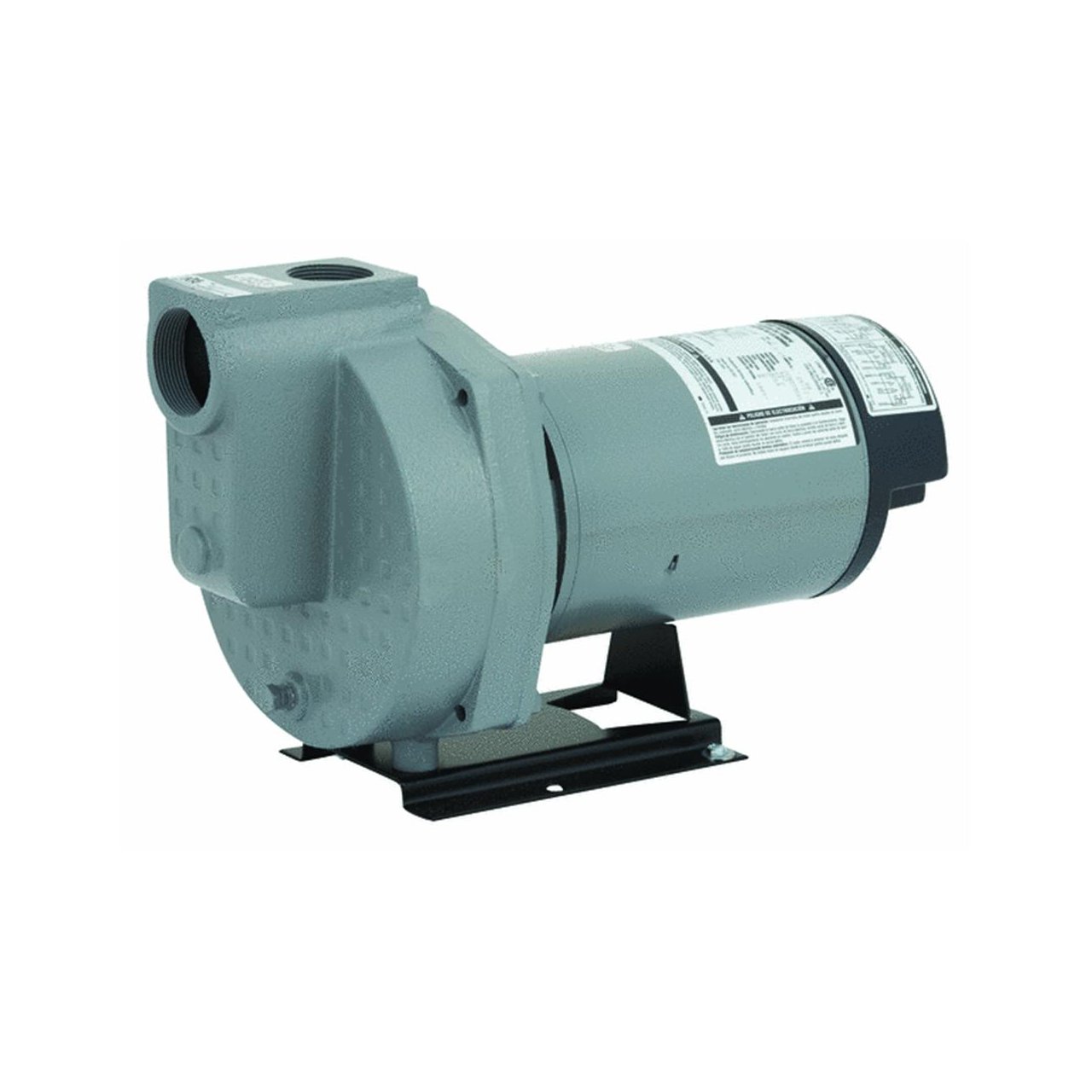
65.3 pounds and continuous-duty design make this the heaviest, most durable pick for anyone running a sprinkler system for hours daily. This Flint & Walling/Star pump (sold under the Do It Best brand) sits at a premium price point, but it is the heaviest pump here at 65.3 pounds and is designed for continuous duty — meaning it can run for hours every day without overheating. For comparison, it is 24.3 pounds heavier than the Sta-Rite plastic pump, and that weight comes from the thick cast iron pump case and diffusers that handle constant use without wear.
What that investment gets you is a pump with sealed bearings for continuous duty, a dual voltage motor (115V or 230V), and rapid self-priming characteristics. One buyer who uses it for lake-fed sprinkler systems says it is “top of the line, just like Rolls Royce” and regrets not buying it from the start after cheaper pumps burned out quickly. Another notes that Flint & Walling pumps have served their irrigation needs for decades. The pump comes with an easy-access drain plug for winterizing.
The main knock from buyers is that a 5-year extended warranty requires filling out a form that is difficult to locate, and a small number of units failed after only a few uses. If you need a pump that runs for long stretches every day and are willing to pay for that capability, this is the one. For lighter use, a less expensive model like the Wayne or Star HSP20P1 will do the job for less money. Verdict: For heavy daily use, this cast-iron workhorse is the top choice.
Why it is great
- 65.3-pound cast iron build for continuous, heavy-duty daily use
- Flint & Walling/Star brand reputation for decades-long service
- Dual voltage motor (115V/230V) for flexible installation
Good to know
- Warranty registration process is poorly documented
- Premium cost — overkill if your pump only runs a few hours per week
Understanding the Specs
Flow Rate (GPM)
Gallons per minute (GPM) measures how much water the pump can move in 60 seconds. Higher GPM means more sprinkler heads can run at once without losing pressure. For a standard 2 HP pump, 70–88 GPM is typical. Calculate your need: each standard pop-up sprinkler head uses about 3–5 GPM, so a pump delivering 76 GPM can comfortably run 15–20 heads in one zone.
Maximum Lift (Feet)
This tells you how high the pump can pull water vertically from a well, lake, or pond. Also called “maximum head,” this number accounts for both vertical lift and the friction of water moving through pipes. A pump with 112 feet of lift can draw water from a 100-foot well, while a pump with only 5 feet of lift needs the water source to be nearly level with the pump.
Impeller Material
The impeller is the rotating part inside the pump that spins water outward under pressure. Plastic impellers are cheapest but crack or strip threads in abrasive water. Glass-filled thermoplastic is stronger — good for clean well water. Brass impellers are the toughest choice, resisting sand, silt, and sediment that would destroy a plastic impeller in months. Always match the impeller material to your water quality.
Self-Priming vs. Manual Priming
A self-priming pump can draw water up from below the pump level (like a well) without you pouring water into the pipe every time it starts. You fill the pump housing with water once, and it creates enough suction to pull water on its own after that. Non-self-priming pumps lose their prime (air gets in the line) and stop moving water if the water level drops or a valve is opened, requiring you to manually re-fill the line each time.
FAQ
How many GPM does a 2 HP sprinkler pump actually need for a standard lawn?
Can I use a 2 HP sprinkler pump for a deep well?
What is the difference between a thermoplastic impeller and a brass impeller?
Do I need a self-priming sprinkler pump or can I use a manual-priming pump?
Final Thoughts: The Verdict
For most buyers, the best 2 hp sprinkler pump winner is the AQUASTRONG 2 HP because it delivers the highest flow (86 GPM) and the deepest lift (112 feet) in one cast iron package, backed by responsive customer service. If you want a pump with the longest reliability track record, grab the Goulds GT20. And for abrasive lake or ditch water, the standout is the Red Lion RL-SPRK-200-BR with its brass impeller that stands up to sand and grit.