
Our readers keep the lights on and the weekend projects moving. As an Amazon Associate, I earn from qualifying purchases.
Your pool pump is the single most important piece of equipment you own — it keeps the water circulating, the filter working, and the algae from turning your backyard into a swamp. But when your old pump finally gives up (or you’re building a new setup), you hit a wall of specs that sound like a foreign language: “self-priming” (pulls water up from the pool without you filling the pipe by hand), “total dynamic head” (the height the pump can push water), “dual voltage” (works on either 115V or 230V power). This guide cuts through that noise, showing you exactly which 2 HP inground pool pump actually delivers on its promises without costing you a fortune in electricity or breakdowns.
I’m Rikta — the co-founder and writer behind FitlyFast. This guide is built by comparing the manufacturers’ published specifications and the patterns across verified customer reviews, so you get each pick’s real strengths and trade-offs instead of marketing spin.
You want a pump that clears your pool fast, runs quietly enough to let you sleep, and doesn’t fail halfway through the season. The right 2 hp inground pool pump balances flow rate (gallons per minute), energy efficiency, and build quality without demanding a second mortgage.
How To Choose The Best 2 HP Inground Pool Pump
Picking the right pump is about more than just grabbing the most powerful motor you can find. You need to match the pump’s flow characteristics to your pool’s size, your plumbing, and your tolerance for noise and power bills. Here are the four factors that actually decide whether you end up happy or ordering a replacement next summer.
Flow rate and head pressure
The real measure of a pump’s performance is how many gallons per minute (GPM) it can move against the resistance of your plumbing system. That resistance is called “head pressure” — the vertical lift from the pool water level to the pump, plus friction from pipes and fittings. A pump rated for 113 GPM at zero head (like the VIVOHOME) will deliver less flow the higher you install it or the longer your pipe runs. If your pump is more than 10 feet above the water line, look for a model with a high maximum lifting height (55-75 feet) so you don’t lose all your circulation speed.
Single-speed, dual-speed, or variable-speed motor
Single-speed pumps run at full power all the time — they move water fast, but they also burn electricity fast. Dual-speed pumps let you switch between a high setting (for heavy cleaning or vacuuming) and a low setting (for daily circulation at half the wattage). Variable-speed pumps take efficiency further, letting you dial in any speed from around 1000 RPM (revolutions per minute) to 4000 RPM. Many utility companies also offer rebates for variable-speed models because they can cut energy use by up to 80% compared to a single-speed pump. If you run your pump 8-12 hours a day, the savings on electricity alone can pay for the upgrade within a couple of seasons.
Voltage and electrical compatibility
Most residential pool pumps run on either 115V or 230V power. A 115V pump plugs into a standard household outlet, but it draws higher amperage (current), which can trip breakers on older wiring. A 230V pump is more efficient (lower amp draw) and is standard for larger inground pools. Some pumps, like the VIVOHOME, offer dual-voltage operation — you can wire them for either voltage, giving you flexibility. Before buying, confirm what voltage your existing timer switch and breaker box support. If you’re replacing an old 230V pump, a new 115V model will require rewiring, which adds cost.
Build materials and seal quality
Pool pumps live outdoors in sun, rain, and chemical fumes — cheap plastic housings can become brittle and crack. Look for pumps with fiberglass-reinforced plastic or corrosion-proof polymeric bodies. The shaft seal (the component that keeps water from entering the motor) should be a 316 stainless steel mechanical seal, which resists rust far better than standard steel. Several buyer reports mention shaft seal failure as the reason a pump died after one season. Spending a little more upfront on a pump with a metal-reinforced housing and a quality seal often saves you the headache of a mid-summer failure.
Quick Comparison
On smaller screens, swipe sideways to see the full table.
| Model | Category | Best For | Key Spec | Amazon |
|---|---|---|---|---|
| Aquastrong Variable Speed | Variable Speed | Max energy savings + smartphone control | 176 GPM | 4000 RPM | Amazon |
| Aquastrong Riptide Series | Dual Speed | Highest lifting power for deep installations | 71 ft max lift | 8586 GPH | Amazon |
| XtremepowerUS | Dual Speed | Reliable mid-range workhorse | 66 ft max lift | UL listed | Amazon |
| VIVOHOME | Single Speed | Best value for basic circulation | 113 GPM | 29.8 lbs | Amazon |
| Aquastrong 2HP Dual Speed Timer | Dual Speed with Timer | Built-in timer for automated scheduling | 5186 GPH | 115V | Amazon |
| Vidapool Dual Speed | Dual Speed | Budget-friendly dual-speed entry | 86 GPM | 5200 GPH | Amazon |
| Vidapool Variable Speed Wi-Fi | Premium Variable Speed | Full smart-home integration | 169 GPM | Wi-Fi app | Amazon |
In‑Depth Reviews
1. Aquastrong Variable Speed Pool Pump
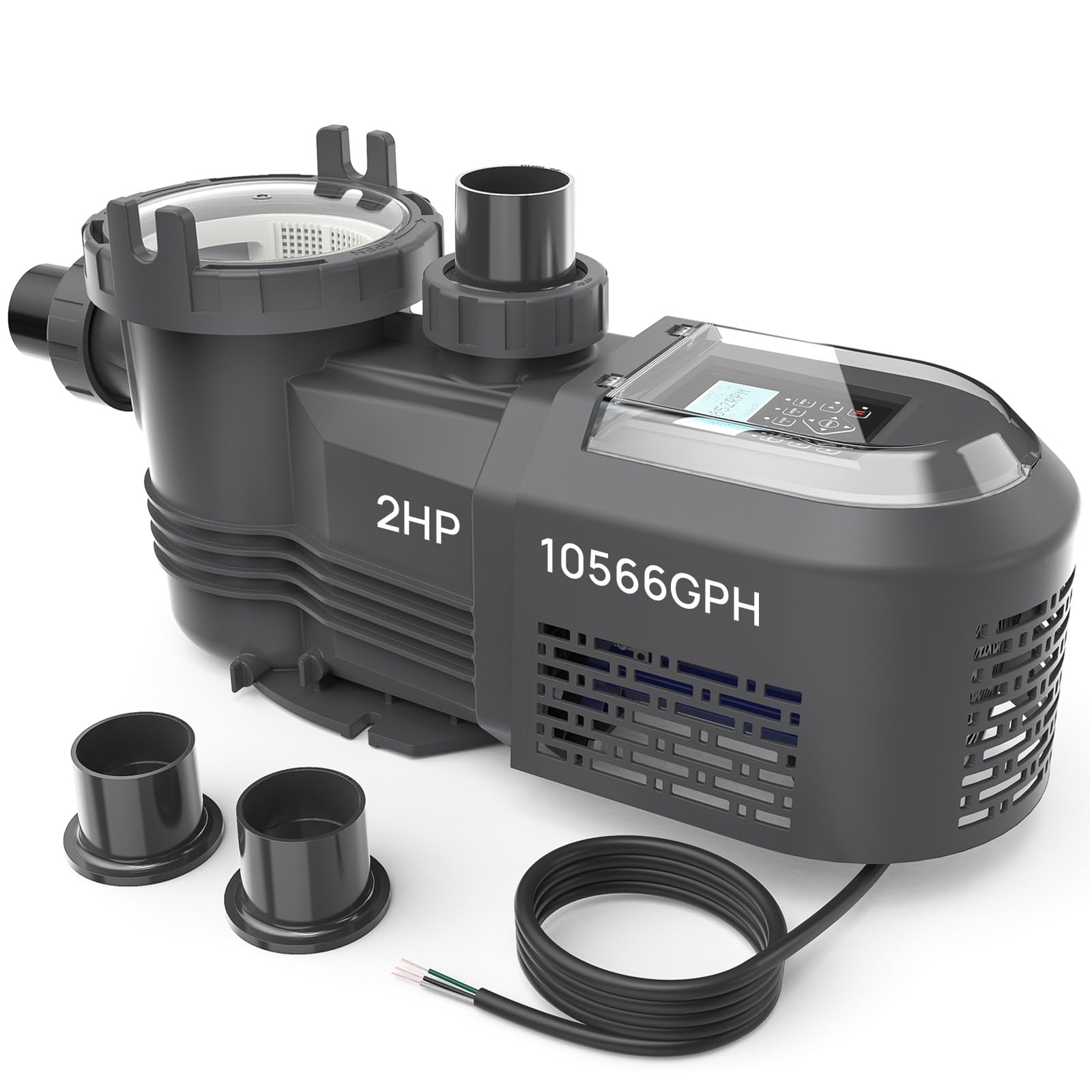
10,566 GPH max flow (176 GPM) and a 75-foot max lift make the Aquastrong Variable Speed Pool Pump the top pick for anyone who wants premium variable-speed features — including four programmable time periods and RPMs from 1200 to 4000 — without paying premium-brand prices. The variable-speed motor lets you dial in any RPM from 1200 to 4000 — it can churn out up to 10,566 GPH (176 GPM) when you need to blast through a green pool, then whisper along at low speed for daily filtration, and buyers report it “reduces monthly electricity costs” significantly compared to their old pumps.
The real win here is the energy savings: variable-speed technology can cut power use by up to 80% over a single-speed pump because you can run at low RPMs for most of the day and only kick it to high when vacuuming or after heavy rain. The pump also lets you program up to four different time periods in a 24-hour cycle — so you can match circulation exactly to when your pool needs it most. It works with both 1.5-inch and 2-inch plumbing adapters, and one reviewer noted it “restored pressure for Polaris cleaner” that their old pump couldn’t handle.
At roughly one-quarter the price of premium variable-speed brands like Pentair or Hayward, this Aquastrong delivers comparable features — especially the customizable speed scheduling — for a fraction of the investment. The max lift of 75 feet also beats most pumps in its class, so it handles deeper installations with room to spare. For the best balance of power, programmability, and savings at a budget-friendly price, this is the pump to buy.
Why it’s great
- Variable-speed motor cuts energy use up to 80%
- Up to 10,566 GPH flow at full speed
- 4 programmable time periods for automated schedules
Good to know
- Higher upfront cost than single-speed or dual-speed models
- At 30 inches tall, check your equipment pad space
2. Aquastrong Riptide Series 2 HP

Where the variable-speed Aquastrong leads on energy flexibility, the Riptide Series crushes it on raw lifting power — its maximum lift height of 71 feet is a full 78% higher than the Vidapool dual-speed pump’s 40 feet. That matters if your pump is located far from the pool or several feet above the water line, because higher head pressure kills flow rates on weaker pumps.
The Riptide runs on 220V with a pure copper motor that owners mention “matches or exceeds Hayward” pumps while costing roughly a third of the price. It pumps up to 8,586 GPH on high speed (enough for a 25,000-gallon pool, according to one reviewer) and drops to a quieter 4,427 GPH on low speed for daily circulation. Reviewers consistently mention it is “very quiet” and “strong water flow” — one buyer running a 25,000-gallon inground pool found the low speed adequate for daily filtration and noted the money saved on electricity compared to their old single-speed pump.
The catch is size: at 30 inches tall and 14 inches wide, this pump is significantly larger than the VIVOHOME (which is 11.5 inches tall) — a 57% difference in one dimension — so measure your equipment pad before buying. The included 1.5-inch and 2-inch adapters make plumbing straightforward, but the large housing means it won’t fit in every cramped pump house. Choose the Riptide Series over the top pick if you need maximum head lift for a distant or elevated pump location and prefer a dual-speed workhorse over variable-speed energy optimization.
Where it shines
- 71-foot max lift handles deep or distant installations
- Pure copper motor runs quieter and cooler than standard motors
- 2-year warranty with responsive customer support
Worth noting
- Large housing requires generous equipment pad space
- Runs on 220V only — check your electrical setup
3. XtremepowerUS 2HP Dual Speed
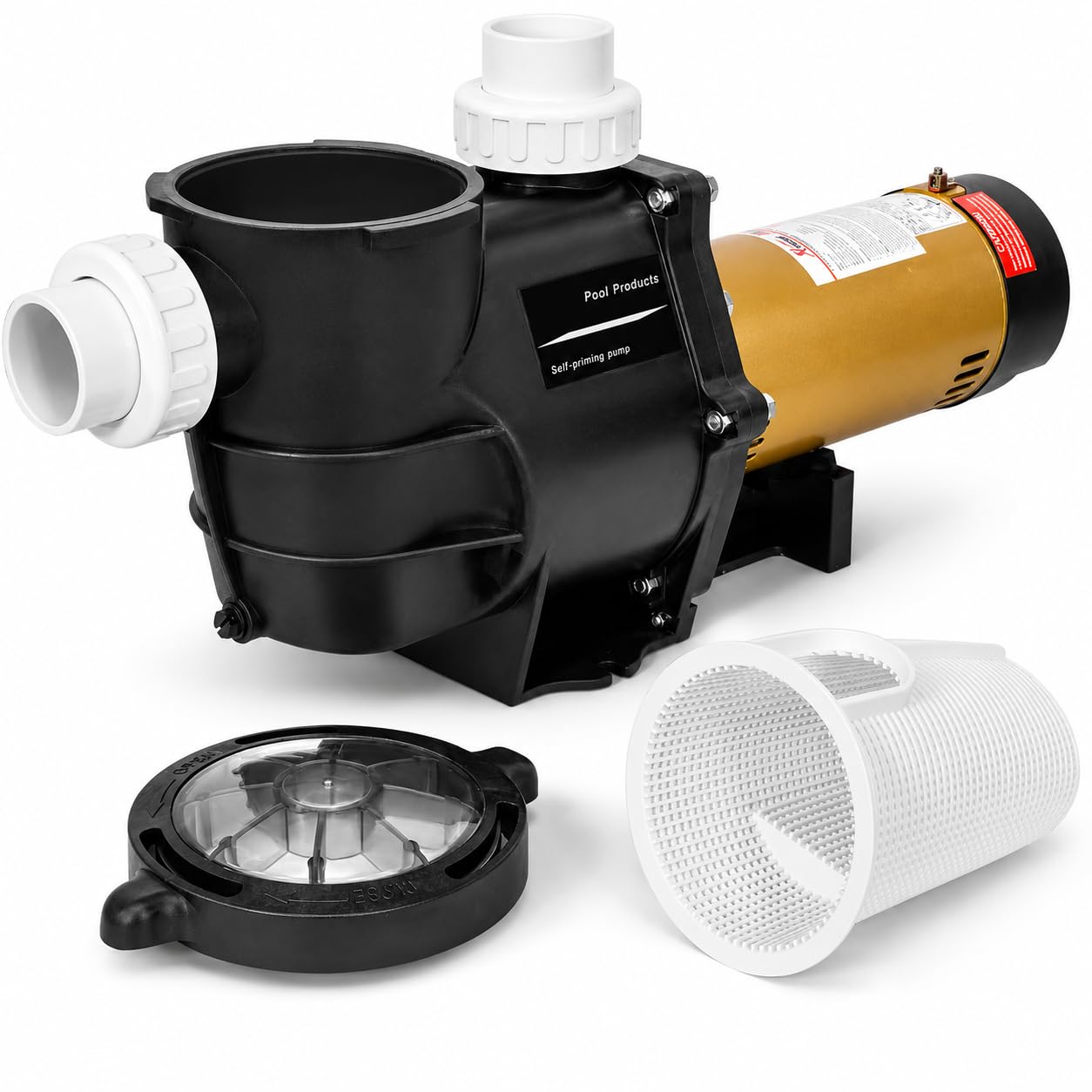
If you are a pool owner who wants a reliable workhorse without spending premium money, the XtremepowerUS 2HP Dual Speed is a solid middle ground between value pricing and performance that lasts. It delivers up to 5,820 GPH with a 66-foot max lift — strong enough for most residential inground pools — and it is UL listed (safety certified by Underwriters Laboratories), meaning it meets recognized safety standards. One buyer mentioned it ran “non-stop for 4.5 years before bearings failed,” which suggests the corrosion-proof polymeric body and thermal overload protection do their job over multiple seasons.
The dual-speed motor (3,450 RPM on high, 1,720 RPM on low) lets you use high speed for initial priming and heavy cleaning, then switch to low speed for quiet, energy-efficient daily filtration. The pump includes a see-through lid so you can check the debris basket without opening it, and a drain plug on the bottom makes winterizing simple. The 2-inch slip-on fitting adapter gives you flexibility if your plumbing uses slip connections instead of threaded unions.
Customers note a couple of real-world quirks: the low speed won’t prime the pump on its own (you must start on high speed), and the instructions could be clearer. One reviewer also cautioned that the motor runs hot and benefits from shade. But for the price, it undercuts Hayward pumps by roughly two-thirds, and the strong flow makes it a practical choice for pool owners who don’t mind basic installation effort. The standout spec is the 66-foot max lift — a number that rivals pumps costing three times as much.
What stands out
- UL listed for safety compliance
- 66-foot lift handles typical inground installations
- Long-term durability reported by buyers
The trade-offs
- Low speed does not self-prime — must start on high
- Motor runs hot; best installed in a shaded location
4. VIVOHOME 2.0HP Pool Pump
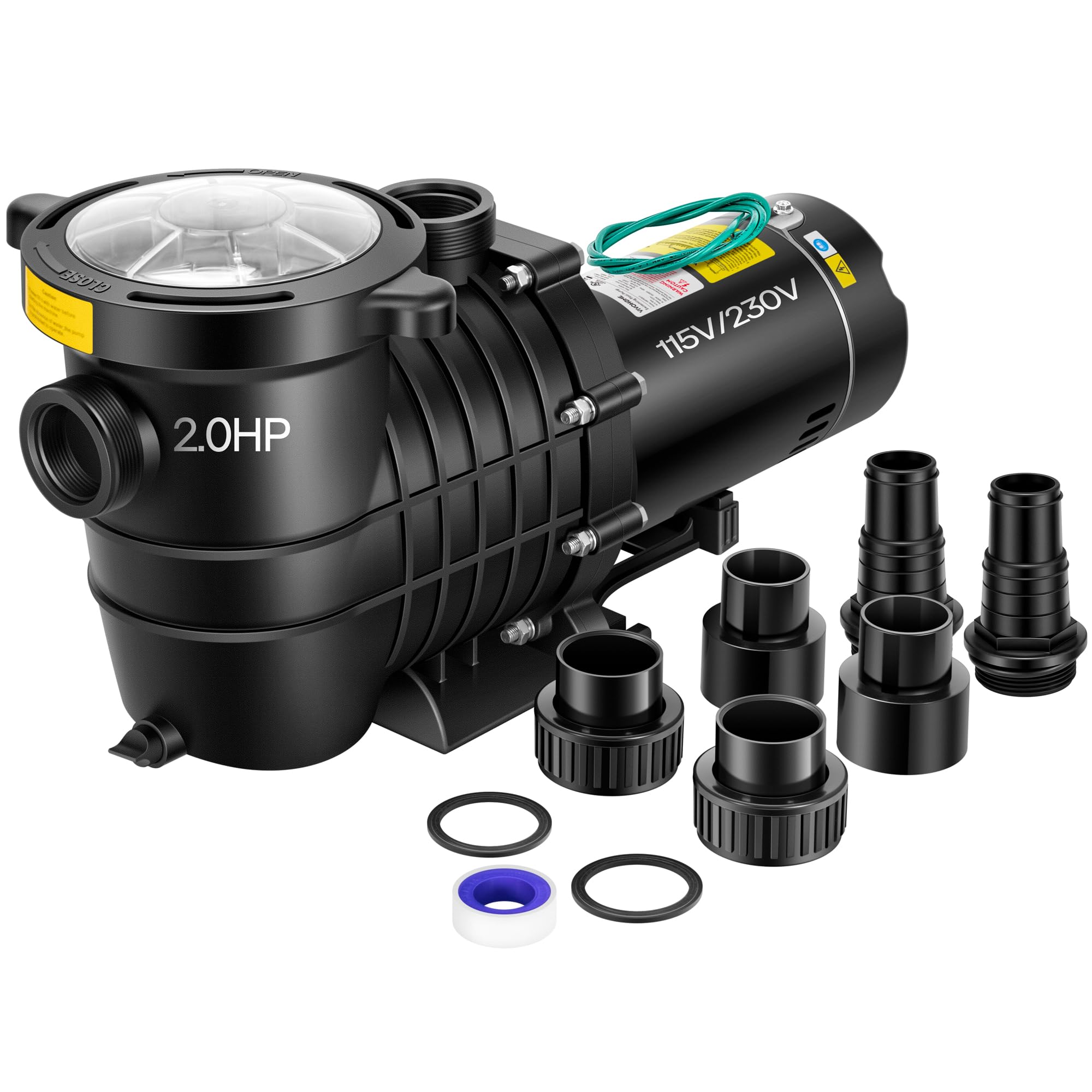
The single number that matters most in this category is flow rate, and the VIVOHOME delivers 113 GPM (6,800 GPH) — that is 31% more flow per minute than the Vidapool dual-speed pump (86 GPM). For a mid-sized inground pool, that extra flow means faster water turnover, which directly translates to clearer water and less work for your filter. One owner reported using it on a “35k gal pool, replaced failed Hayward 1.5HP” and found it worked great through continuous runs for algae cleanup.
The downside is that this is a single-speed pump — it runs at full power all the time, so you don’t get the energy-saving low-speed option that dual-speed and variable-speed models offer. The pump is also relatively compact at 22 inches wide, 9.9 inches deep, and 11.5 inches tall, which makes it easier to fit into tight equipment pads than the larger Aquastrong Riptide. The dual-voltage design (115V/230V) gives you wiring flexibility, and the IPX5 water-resistance rating (protected against water jets and splashes) means it can handle rain and splashing without shorting out.
For the money, the VIVOHOME gives you premium flow numbers at a budget-friendly price, but you accept the higher electricity cost of running a single-speed motor. It is the right choice if your pool needs strong circulation and you don’t mind the extra wattage — or if you plan to run it only a few hours a day.
The upsides
- 113 GPM flow rate — 31% higher than the Vidapool dual-speed pump
- Compact design fits tight equipment pads
- Dual-voltage (115V/230V) for flexible wiring
Keep in mind
- Single-speed motor means higher energy use than dual-speed models
- Some reviewers point out leaking shaft seal after one season
5. Aquastrong 2HP Dual Speed with Timer
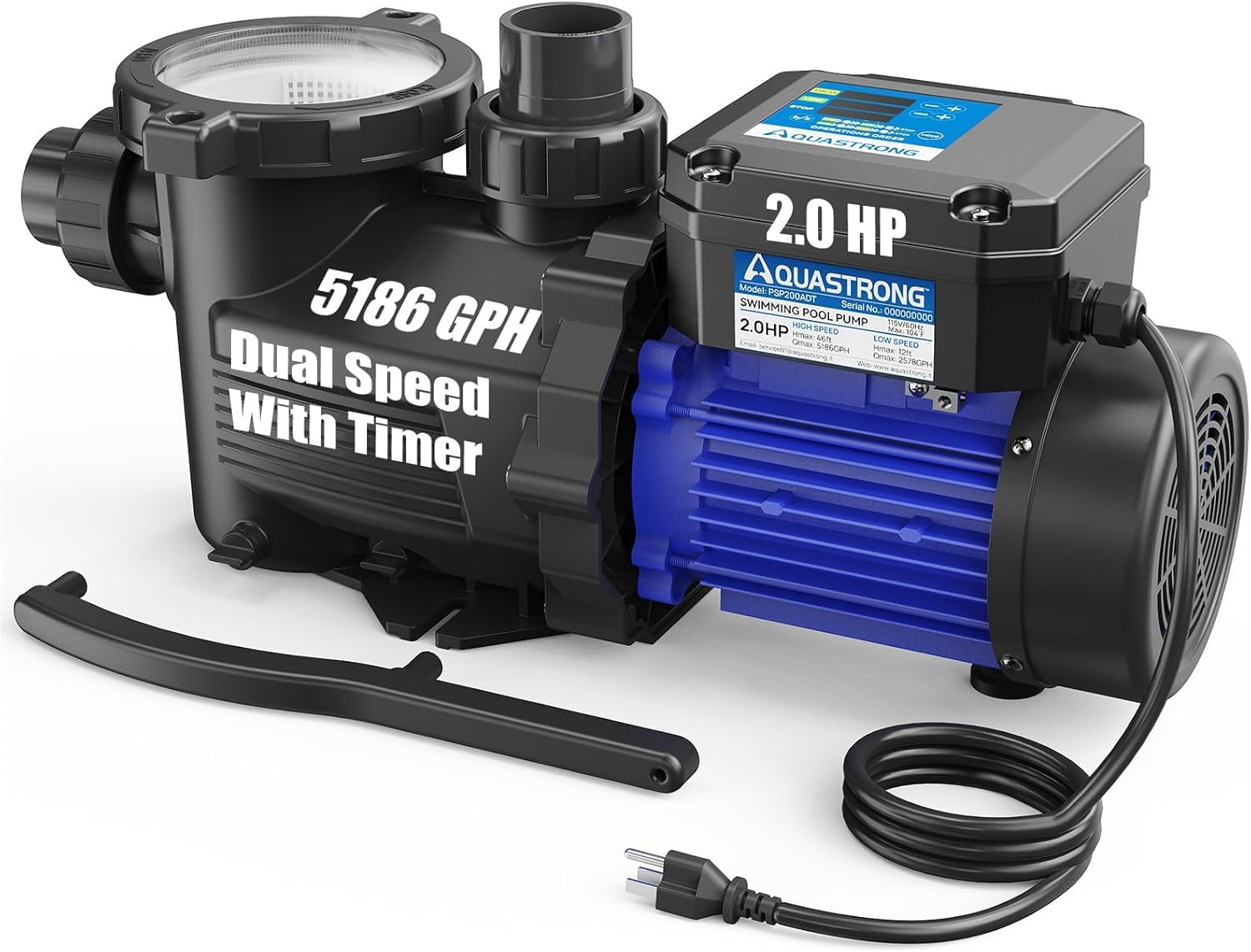
What you actually get at this lower price is a pump that solves a specific annoyance: having to walk outside twice a day to manually switch your pump on and off. The built-in timer lets you program how long the pump runs on high speed and how long on low speed, so you can set it to blast during the afternoon (when debris and sunscreen load the water) and quietly circulate overnight. It delivers 5,186 GPH on high and 2,578 GPH on low — enough for most inground pools under 25,000 gallons.
The pump runs on 115V, which means you can plug it into a standard GFCI outlet without hiring an electrician to run 220V. One buyer called it “whisper quiet” and noted the high/low/off toggle is simple to use, though another reviewer wished the timer could be set to start at a specific clock time rather than just a duration. The ETL-certified motor (a safety certification similar to UL, meaning the electrical parts are built to a recognized standard) gives you peace of mind that the electrical components are built to a recognized standard.
What stands out about this model is the value of the timer feature at this price — most pumps with integrated timers cost more, and external timers add complexity to installation. If you want automated scheduling without paying for a full variable-speed pump, this Aquastrong gives you the convenience without the premium price tag. One customer observed the mode selector (low/high/off) did not work on their unit, but manufacturer support responded quickly with a replacement. This is the exact budget buyer it is perfect for: the pool owner who wants basic automated scheduling without stepping up to a variable-speed pump.
Why we’d pick it
- Built-in timer automates high/low speed scheduling
- Runs on standard 115V — no electrician needed for most homes
- ETL-certified motor for safety compliance
A few caveats
- Timer only sets duration, not specific start time
- A few buyers reported mode selector issues (warranty covered)
6. Vidapool 2HP Dual Speed
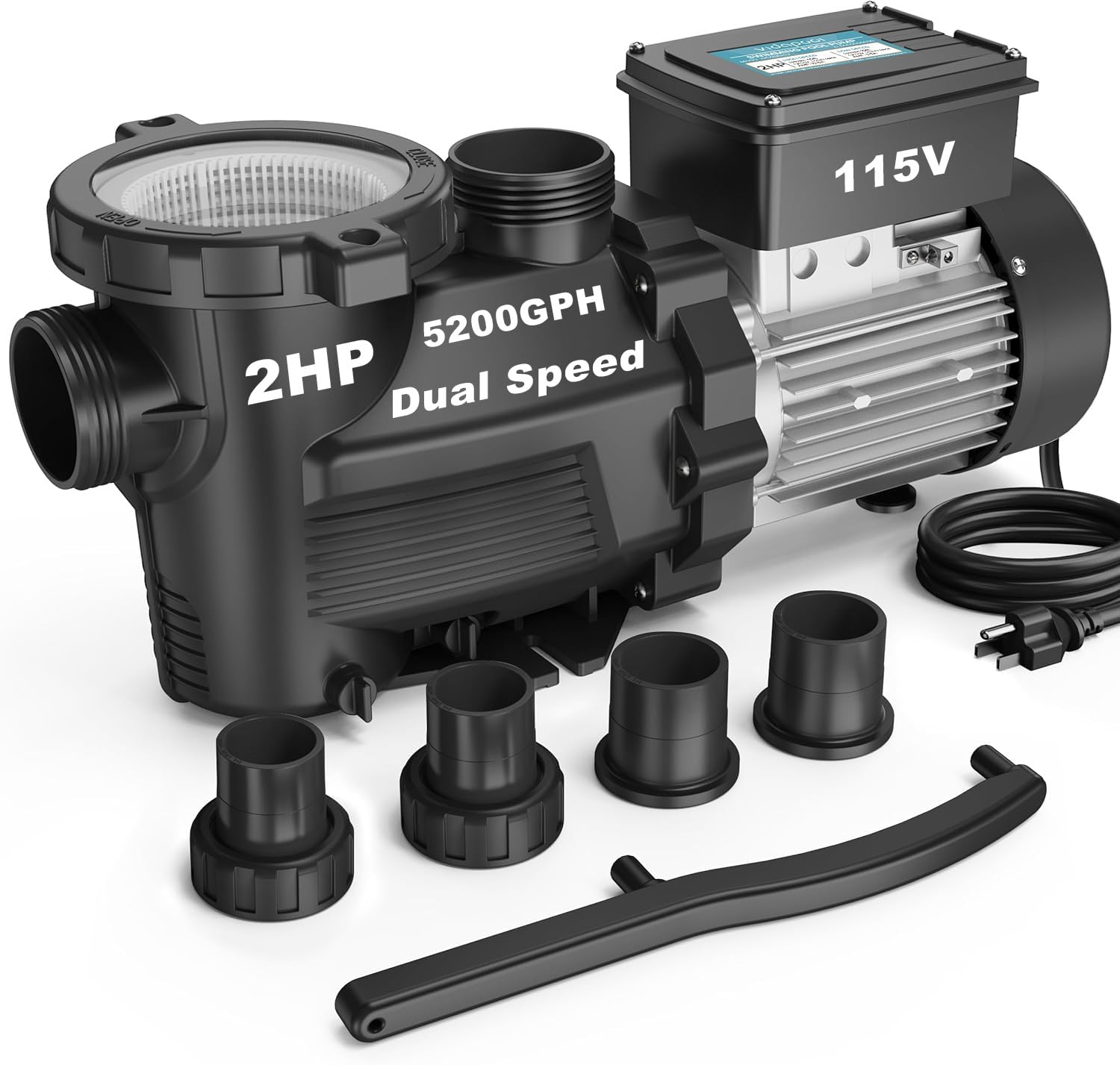
This pump is perfect for the budget-conscious pool owner who wants the energy savings of a dual-speed motor without paying a premium. At this lower price, you get a genuine dual-speed pump with a 2-year warranty and some of the best customer service reviews in the category. It moves 5,200 GPH on high speed (86 GPM) and 2,600 GPH on low, which is enough for pools up to about 20,000 gallons. One user highlighted it “cleared cloudy water fast” after their old pump failed, and multiple reviewers praised the “excellent customer service” — including one who got a replacement within 24 hours after a housing leak developed.
What you give up is flow rate and lift height compared to the pricier options. At 86 GPM, it is 24% slower than the VIVOHOME (113 GPM), and its max lift of 40 feet means it will struggle if your pump is installed far above the water line or if you have long pipe runs. The cast-iron and plastic construction is standard for this tier, but it is not as corrosion-resistant as the fiberglass-reinforced plastic on the XtremepowerUS or the stainless steel shaft on the VIVOHOME.
The Vidapool is the perfect choice for someone on a tight budget who still wants the energy-saving benefit of a low-speed setting. If your installation is straightforward (pump near water level, pool under 20,000 gallons) and you value responsive warranty support over raw power, this pump delivers reliable dual-speed circulation while staying affordable. Just keep in mind that its 40-foot max lift and 86 GPM flow rate may leave you wanting more if your setup demands higher head pressure or longer pipe runs.
Strong points
- Genuine dual-speed operation at a budget price point
- 2-year warranty with reportedly excellent customer service
- Very quiet operation on both speed settings
Before you buy
- 86 GPM flow rate is lower than pricier models
- 40-foot max lift limits installation flexibility
7. Vidapool Variable Speed Wi-Fi
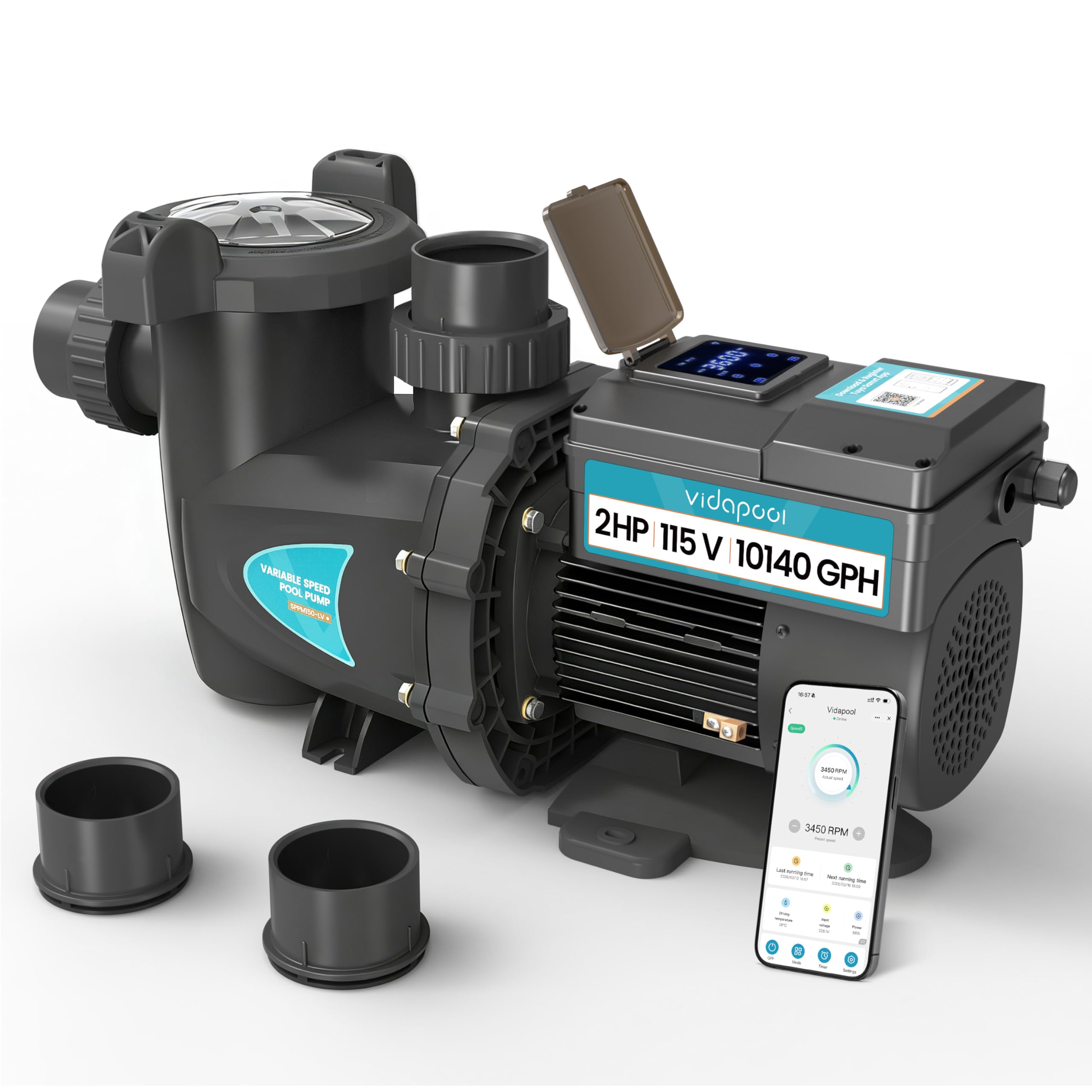
Compared to the Aquastrong variable-speed pump, this model adds one key differentiator: built-in Wi-Fi that lets you control speed and schedules from a smartphone app. It also slightly edges out the Aquastrong on flow rate (169 GPM vs. 176 GPM — actually a wash in real-world terms) but compensates with a responsive app that one buyer called “great” for adjusting pump speeds in 50-RPM increments. On medium-low speed, the pump draws about 100 watts — a fraction of the 1,960 watts it pulls at full throttle — so the potential for electricity savings is enormous.
What that money buys you is a pump that does not just save energy but also fits into a modern smart-home setup. You can schedule filtration cycles remotely, check real-time wattage and RPM from your phone, and adjust speeds without walking outside. One buyer switching from a single-speed 500-watt pump found the Vidapool used only 28 watts at 1,000 RPM — nearly an 18x reduction in power consumption for basic circulation. The 1.5-inch inlet and 2-inch outlet connect to standard plumbing without adapters.
The honest limit here is the app (called Tuna), which buyers describe as “basic but functional” — it lacks advanced scheduling integration with systems like Hayward automation, though that is a niche need. Also worth noting: the manual warns against rain exposure, so you will want to install this pump under cover. The one clear reason to choose it is that it delivers Wi-Fi-enabled variable-speed control and the potential for extreme energy savings at a price that undercuts premium brands offering similar smart features.
What we like
- Built-in Wi-Fi for remote speed and schedule control via smartphone
- Draws as little as 28 watts at low RPM for massive energy savings
- 169 GPM flow rate handles medium to large pools easily
The downsides
- App (Tuna) is functional but basic compared to premium brands
- Manual warns against rain exposure — best installed under cover
Understanding the Specs
Gallons Per Minute (GPM)
This is the real measure of how fast your pump moves water. A higher GPM means faster turnover — your entire pool volume cycles through the filter more times per day. For most residential inground pools, look for at least 80-100 GPM from a 2 HP pump. The VIVOHOME leads here at 113 GPM, while the Vidapool dual-speed delivers 86 GPM. More is not always better, though: too much flow can overload your filter or create excessive suction, so match the GPM to your pool volume and pipe diameter.
Maximum Lifting Height (Feet)
Also called “total dynamic head” (TDS) or “shut-off head,” this spec tells you how high the pump can push water vertically before flow stops entirely. If your pump sits well above the pool water level — say on a raised equipment pad or in a basement — a higher lift number (55-75 feet) prevents flow from dropping off. The Aquastrong Riptide leads at 71 feet. Pumps with a 40-foot lift, like the budget Vidapool, work fine when the pump is close to water level but struggle in elevated installations.
Dual Voltage vs. Fixed Voltage
A dual-voltage pump (like the VIVOHOME) can be wired for either 115V or 230V, giving you flexibility to match your existing breaker and wiring. Fixed-voltage pumps (like the Aquastrong Riptide’s 220V-only design) require you to have that specific setup. If you are replacing a pump, check what voltage your old pump uses and what your breaker box supports before buying. Switching voltages often requires a new breaker and wire gauge changes, which adds cost if DIY or an electrician visit.
Self-Priming
Self-priming means the pump can pull water up from the pool and clear air from the suction line automatically, without you manually filling the pipe. All the pumps on this list are self-priming, but the maximum priming lift varies — typically 6-10 feet. If your pump is more than 10 feet above the water level, it may struggle to prime. The VIVOHOME manual recommends installing within 9.8 feet of the pool for best performance. Always fill the strainer pot with water before starting a new pump to help the priming process.
FAQ
Can I use a pump rated for both in-ground and above-ground pools on my inground pool?
Will a 115V pump work with my existing timer switch?
What is the difference between dual-speed and variable-speed?
How do I know if my pump is actually 2 HP and not a lower rating?
Why does my new pump lose prime after shutting off?
Final Thoughts: The Verdict
If you want one dependable pick, the 2 hp inground pool pump winner is the Aquastrong Variable Speed Pool Pump because it delivers massive energy savings (up to 80% over single-speed pumps) while maintaining excellent flow rates (176 GPM) and offering flexible speed programming. If you want the highest lifting power for deep or distant installations, grab the Aquastrong Riptide Series. And for budget-minded buyers who still want the efficiency of dual-speed operation, the Vidapool Dual Speed provides reliable circulation and responsive warranty support without stretching your wallet.