
Our readers keep the lights on and the weekend projects moving. As an Amazon Associate, I earn from qualifying purchases.
A great 4K HDR monitor should make you forget you are looking at a screen — but the wrong one leaves you squinting at washed-out blacks or fighting glare in dark scenes. The real trick is matching your use: a gamer needs high refresh and low response time, a photo editor needs color accuracy across multiple color spaces, and a general user just wants a sharp, bright image that makes movies and everyday work look excellent. This guide breaks down ten models spanning from to , comparing the specs that actually matter for real-world HDR performance — brightness (measured in nits), contrast ratio (the difference between the brightest white and the darkest black), color coverage (the range of colors the screen can show), and refresh rate (how many times per second the image updates) — so you can choose without guessing.
I’m Rikta — the co-founder and writer behind FitlyFast. This guide is built by comparing the manufacturers’ published specifications and the patterns across verified customer reviews, so you get each pick’s real strengths and trade-offs instead of marketing spin.
Whether you play fast-paced titles, edit color-critical content, or just want a beautiful screen for streaming, the following deep-dive into each monitor’s contrast, luminance (brightness), and gamut (color range) data will steer you toward the right 4k hdr monitor.
How To Choose The Best 4K HDR Monitor
Picking a 4K HDR monitor gets confusing fast because every model lists “HDR” on the box, but the actual brightness, contrast, and local dimming vary wildly. The key is to look past the sticker and focus on three core specs: peak brightness (measured in nits, or candelas per square meter), contrast ratio (how deep the blacks go), and color gamut coverage (especially DCI-P3 percentage — DCI-P3 stands for Digital Cinema Initiatives — P3, a wide color space used in movies and many HDR games). A monitor with HDR10 (a basic HDR format) support but only 250 nits of peak brightness will not give you the same punchy highlights as one hitting 600 or 1000 nits. Here is what to check before you click buy.
Peak Brightness and Local Dimming — The Real HDR Engine
HDR stands for High Dynamic Range — it means the screen can show very bright highlights alongside very dark shadows in the same frame. The spec that matters most here is peak brightness, usually listed in nits (candelas per square meter). For a meaningful HDR experience, you want at least 400 nits peak brightness (VESA DisplayHDR 400 — a certification from the Video Electronics Standards Association that guarantees minimum brightness and color), but 600 nits (DisplayHDR 600) or 1000 nits (DisplayHDR 1000) makes a much bigger visible difference, especially in games and movies with sunlit explosions or starry skies. Equally important is local dimming — the monitor’s ability to dim some parts of the screen while keeping others bright, so dark areas stay dark next to bright spots. Without good local dimming, you get a “halo” effect around bright objects on dark backgrounds.
Panel Technology — IPS, VA, MiniLED, or OLED
The panel type determines the contrast, viewing angles, and speed you get. IPS (In-Plane Switching) panels give wide 178-degree viewing angles and good color, but their native contrast ratio is usually around 1000:1, meaning blacks look more like dark gray. VA (Vertical Alignment) panels offer much higher native contrast (3000:1 or more), so blacks are deeper, but viewing angles are narrower. MiniLED uses thousands of tiny LEDs behind the screen to create local dimming zones, improving contrast significantly on IPS and VA panels. OLED (Organic Light Emitting Diode) panels produce perfect blacks because each pixel lights itself individually — turning off completely when it should be black — giving you the best HDR contrast possible, but they cost more and can be less bright in sustained full-screen scenes.
Color Gamut — What Percent of DCI-P3 Matters
Color gamut tells you how much of the visible color spectrum the monitor can display. The most important standard for HDR content is DCI-P3, a wide color space used in movies and many HDR games. If you do creative work (video editing, photo retouching), look for a monitor covering 90% or more of DCI-P3. For general use and gaming, 80-90% is still very good. The sRGB standard (100% sRGB — the standard color space for web and office content) is narrower and matters more for web and office work. A monitor factory-calibrated to Delta E < 2 (a measure of color error; lower is better) means colors are accurate enough for professional use, so you see what the creator intended — a Delta E of 1 means the color difference is barely visible to the human eye.
Refresh Rate and Response Time — For Gaming vs. Everyday Use
Refresh rate (Hz) is how many times per second the screen updates. A standard 60Hz monitor feels smooth for browsing and movies. For gaming, 120Hz or 144Hz is a big step up — motion looks much smoother, and fast-paced games feel more responsive. Some monitors now offer 160Hz or 240Hz, which competitive gamers will notice but most people find diminishing returns beyond 144Hz. Response time (measured in milliseconds, ms) indicates how fast a pixel changes color. For gaming, look for 5ms or less (1ms is excellent), and for fast competitive shooters, 0.5ms or 0.03ms (OLED) gives near-instant motion clarity with no blur.
Quick Comparison
On smaller screens, swipe sideways to see the full table.
| Model | Category | Best For | Key Spec | Amazon |
|---|---|---|---|---|
| LG 32UR500K-B | Mid-Range | General & Home Office | 32″, VA, HDR10, 250 nits | Amazon |
| AOC U32G4 | Mid-Range | High-FPS Gaming | 32″, IPS, 160Hz/320Hz, 350 nits | Amazon |
| LG 27G810A-B | Mid-Range | Gaming & Creative | 27″, IPS, 180Hz/360Hz, 400 nits | Amazon |
| Samsung ViewFinity S8 | Mid-Range | Office & Creative | 27″, LED, HDR10, 350 nits | Amazon |
| ASUS ProArt PA279CV | Mid-Range | Color-Accurate Work | 27″, IPS, ΔE < 2, 65W USB-C | Amazon |
| KTC M27P6 | Premium | HDR Gaming & Movies | 27″, MiniLED, HDR1400, 1152 zones | Amazon |
| Samsung Odyssey G7 G75F | Premium | Immersive Curved Gaming | 37″, VA, 165Hz, HDR600 | Amazon |
| LG 32GX850A-B | Premium | Competitive & Creative | 32″, OLED, 165Hz/330Hz, 0.03ms | Amazon |
| MSI MPG 321URX | Premium | High-End Gaming | 32″, QD-OLED, 240Hz, 0.03ms | Amazon |
| ASUS ProArt PA32UCDM | Premium | Professional Color Work | 32″, QD-OLED, ΔE<1, 1000 nits | Amazon |
In‑Depth Reviews
1. LG 32GX850A-B 32″ UltraGear Glossy OLED
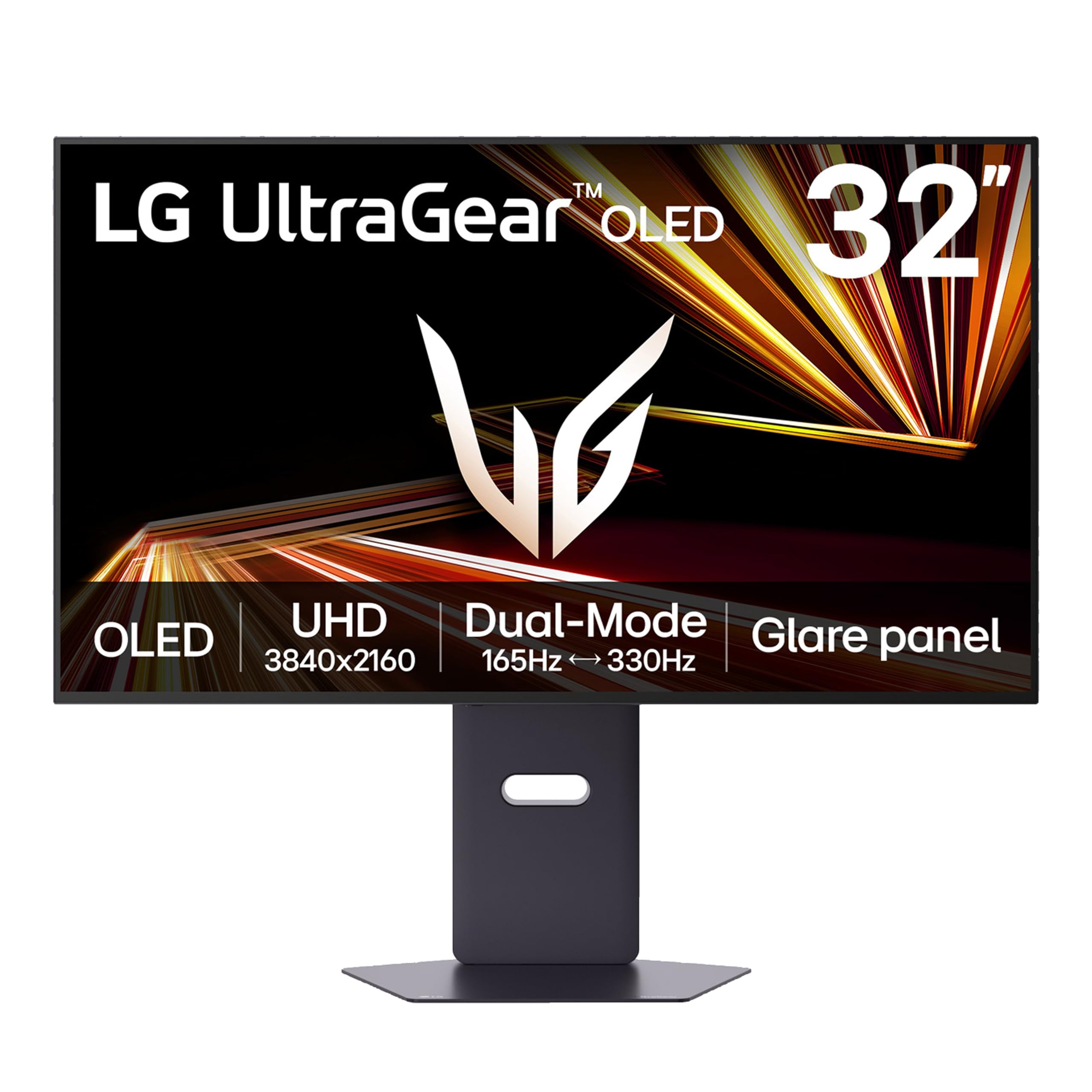
The LG 32GX850A-B delivers a 32-inch 4K UHD glossy OLED panel with a 0.03ms response time — that is about 30 times faster than a typical gaming monitor — so motion blur disappears completely. It is built for the gamer or creative who wants the deepest black levels an OLED can produce, combined with a bright enough screen (275 nits typical) to enjoy HDR content in a moderately lit room.
The 1.5M:1 contrast ratio means blacks are truly black, not dark gray, which makes scenes in games like Cyberpunk 2077 or films like Dune look incredibly lifelike. Buyers report it is a “massive upgrade from 1440p IPS,” praising the perfect blacks and clean image. The dual-mode feature lets you play at 4K 165Hz for story-rich titles or switch to Full HD 330Hz for fast competitive rounds, and the Micro Lens Array+ technology (a film that focuses light more efficiently) boosts brightness enough that colors stay vivid even in bright scenes.
Text clarity on this WOLED panel (White OLED — a type of OLED that uses a white subpixel) is not as razor-sharp as a high-end IPS for spreadsheet work, and one reviewer noted a “dead green subpixel” — so a thorough inspection on arrival is wise. But for the combination of deep blacks, near-instant response, and a glossy finish that makes colors pop, this is the best bang-for-your-buck OLED in the premium tier.
Why it’s great
- Perfect OLED blacks with a 1.5M:1 contrast ratio make HDR scenes look cinematic.
- Dual-mode (4K 165Hz or FHD 330Hz) covers both immersive and competitive gaming.
- UL-certified anti-glare, flicker-free, and low blue light for comfortable long sessions.
Good to know
- Text clarity can seem less sharp than high-end IPS for productivity tasks.
- Typical brightness of 275 nits is lower than MiniLED alternatives.
- Some buyers reported a slight fan noise and a dead subpixel at delivery.
2. MSI MPG 321URX QD-OLED

Compared to the LG 32GX850A-B, the MSI MPG 321URX pushes the refresh rate higher — 240Hz at 4K versus 165Hz — and uses a Quantum Dot OLED panel (QD-OLED — an OLED that adds a layer of quantum dots, tiny crystals that produce more vivid colors) that covers 99% DCI-P3 color gamut, beating the LG’s 98.5% by a small but meaningful margin for color-critical work. It also adds a 90W USB-C port so you can charge a laptop through a single cable, something the LG lacks.
For a gamer who plays fast-paced shooters like Valorant or Overwatch, the 0.03ms response time paired with 240Hz makes every frame feel instant, with no ghosting at all. Reviewers call it “breathtakingly beautiful in HDR” and note that the text clarity is “crisp” — a common weak point on older OLED panels that this QD-OLED handles better. The OLED Care 2.0 system automatically shifts pixels and dims static elements to prevent burn-in (permanent image ghosting from static elements like taskbars), which is a genuine concern if you keep taskbars or HUD elements on screen for hours.
The stand is chunky and lacks full height/swivel adjustment compared to the LG’s more versatile ergonomic stand, and Mac users need a workaround (turning off DSC, Display Stream Compression, and locking to 120Hz) for stable dual-monitor setups. If 240Hz and a wider color gamut matter more to you than ergonomic flexibility, this is the OLED to beat. If you need a highly adjustable stand or run a Mac with multiple monitors, the LG is a safer choice.
Where it shines
- 240Hz refresh rate with 0.03ms response delivers the smoothest gaming motion available.
- 99% DCI-P3 color gamut provides vibrant, accurate colors for HDR movies and editing.
- 90W USB-C charging and KVM support simplify a multi-device desk setup.
Worth noting
- The stand is bulky with limited tilt and height adjustments.
- Mac users may need to cap at 120Hz for reliable dual-monitor behavior.
- A minor purple tint can appear on reflections in very bright rooms.
3. Samsung Odyssey G7 G75F 37” Curved
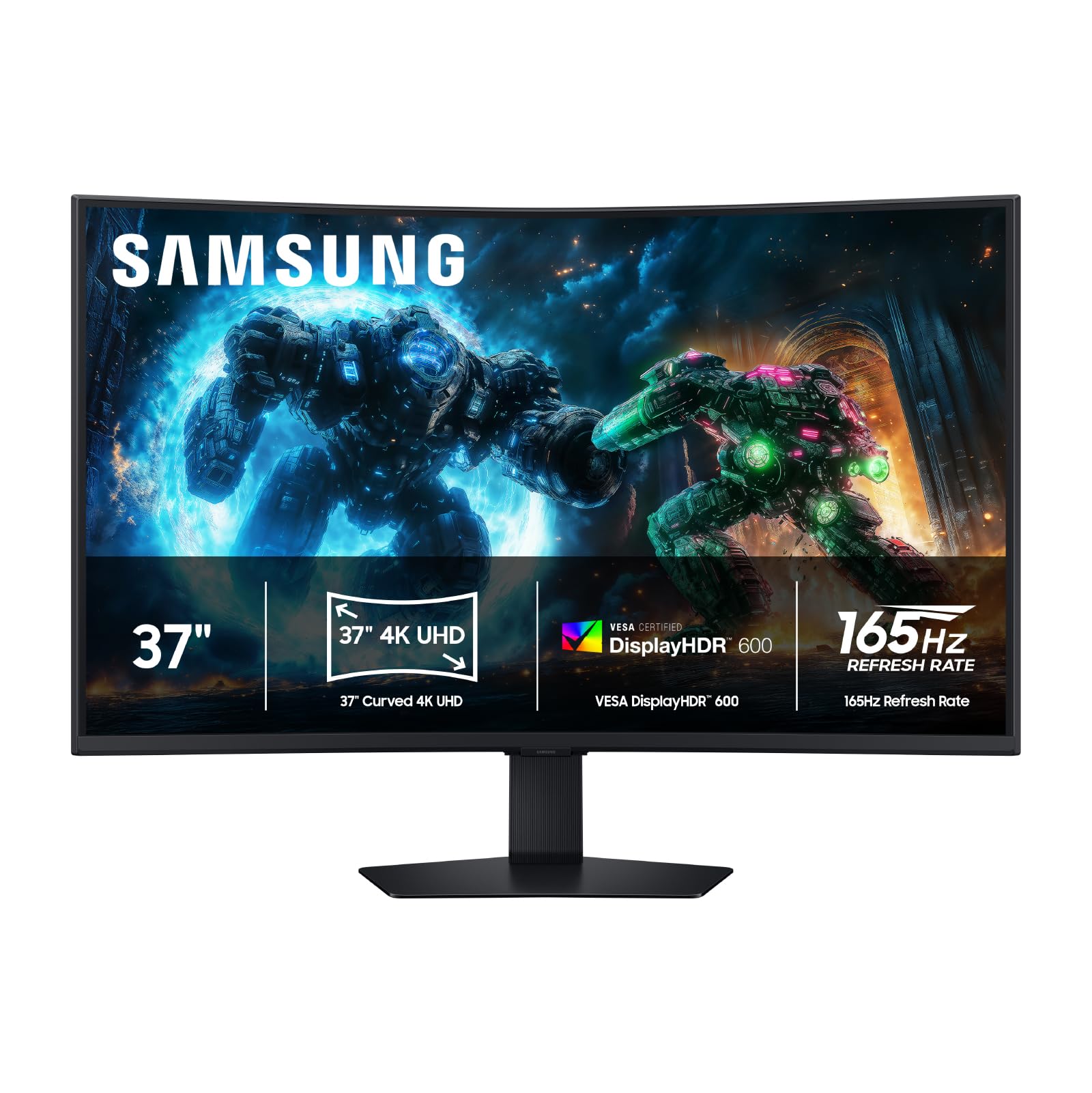
The Samsung Odyssey G7 is the monitor you choose when you want a large, curved screen that wraps around your peripheral vision — its 1000R curve is tighter than most, matching the natural curvature of the human eye, so you feel like you are inside the game world. With a 37-inch VA panel at 4K UHD and a 165Hz refresh rate, it is a serious contender for racing, flight sims, and story-driven single-player games where immersion is everything.
The key spec here is VESA DisplayHDR 600 certification — that is 600 nits peak brightness combined with a native VA contrast ratio of 3000:1, which gives you significantly deeper blacks than any IPS monitor (which typically sits at 1000:1). Owners mention the picture is “absolutely gorgeous” and call it a “significant upgrade over a flat monitor,” especially for reading small subtitles on PS5. The 1ms response time keeps motion crisp enough for competitive gaming, though hardcore eSports players might prefer a smaller, faster panel like the 27-inch LG 27G810A-B.
One downside is the aggressive curve: a few buyers found it “too extreme” for productivity work like spreadsheets or design, where straight lines look bent. If you mostly game and watch movies, this curve enhances immersion — but if you also do a lot of document editing or CAD work, a flat monitor might suit you better. It is a specialty pick that excels in its lane. The price is high, however, and some buyers feel it is overpriced compared to flat OLED alternatives in the same range. A 1000R curve at 37 inches is the closest you can get to a wraparound cockpit without a VR headset.
What stands out
- 1000R curvature with a 37-inch screen creates a wrap-around, cinematic gaming view.
- VESA DisplayHDR 600 at 600 nits peak brightness provides punchy highlights and deep blacks.
- VA panel’s 3000:1 native contrast ratio beats IPS monitors on shadow detail.
The trade-offs
- Strong curve can make straight lines in productivity apps look distorted.
- Some buyers feel it is overpriced compared to flat OLED alternatives in the same range.
- No HDMI 2.1, so console gaming is capped at 120Hz without VRR (Variable Refresh Rate).
4. KTC M27P6 27” MiniLED
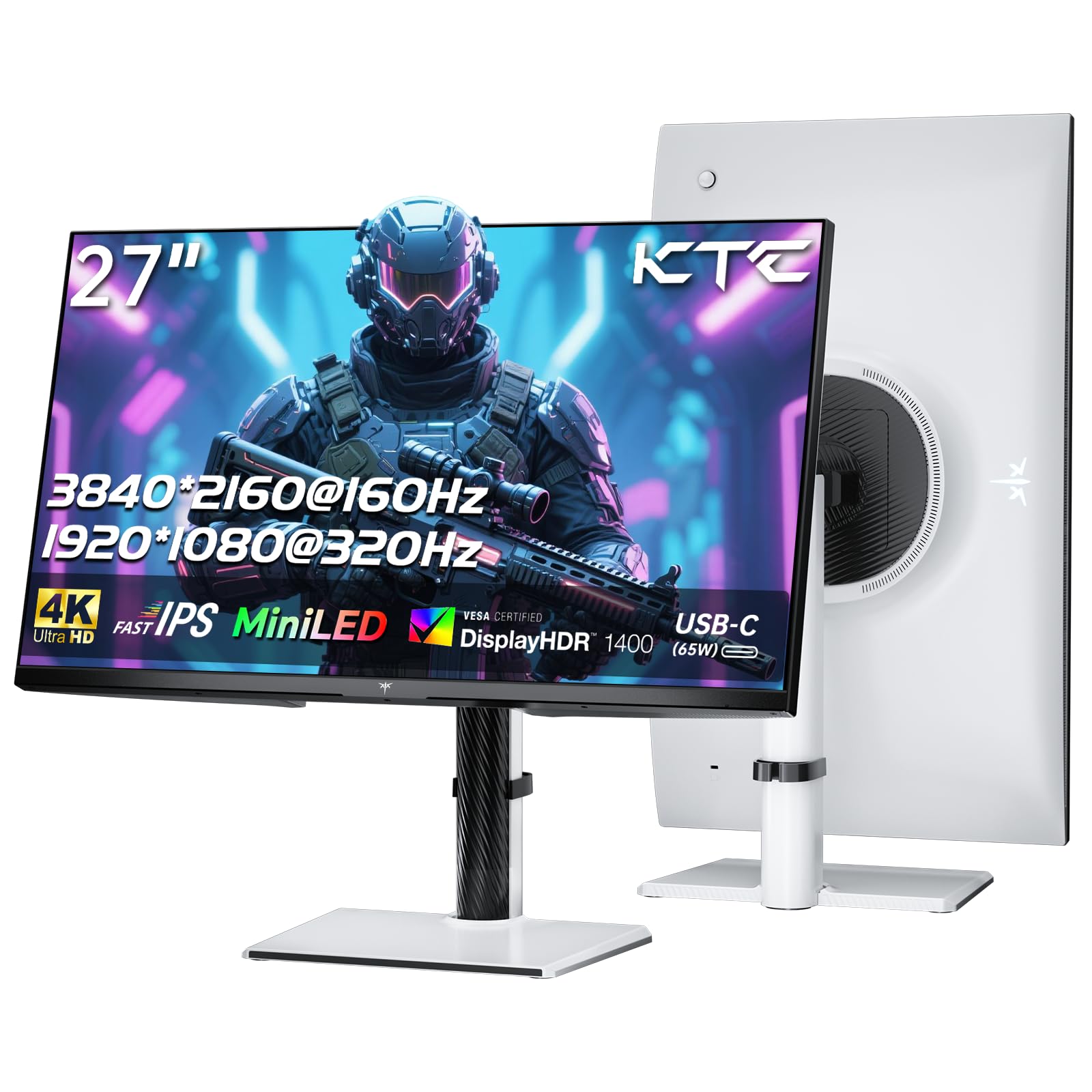
1400 nits peak brightness (HDR1400) — the KTC M27P6 delivers more than double the brightness of the AOC U32G4 (350 nits) and approaches flagship OLED levels, using a 27-inch MiniLED panel with 1152 local dimming zones.
The catch is that MiniLED cannot match pixel-level black depth of OLED — slight haloing may appear around bright objects on black backgrounds in dark scenes — but the Quantum Dot layer covers 99% RGB and 98% DCI-P3, so colors stay vibrant and accurate. The KVM switch and 65W USB-C power delivery let you share the monitor between a work laptop and gaming PC through a single cable.
Customers note HDR is “superb” and deep blacks are “better than IPS,” though SDR color can feel slightly less punchy out of the box, needing quick calibration. If you want the brightest HDR experience without stepping into OLED pricing, the KTC M27P6 is the smart money pick.
The upsides
- 1400 nits peak brightness with 1152 MiniLED zones delivers the brightest HDR at this price.
- 98% DCI-P3 color gamut and Quantum Dot technology create rich, vibrant colors.
- USB-C 65W and KVM make it a practical hub for a dual-device work-and-play desk.
Keep in mind
- MiniLED can produce visible halos around bright objects on dark backgrounds.
- SDR color accuracy may need manual calibration right out of the box.
- The brand’s customer support and warranty experience is less established than LG or ASUS.
5. LG 27G810A-B 27″ UltraGear IPS
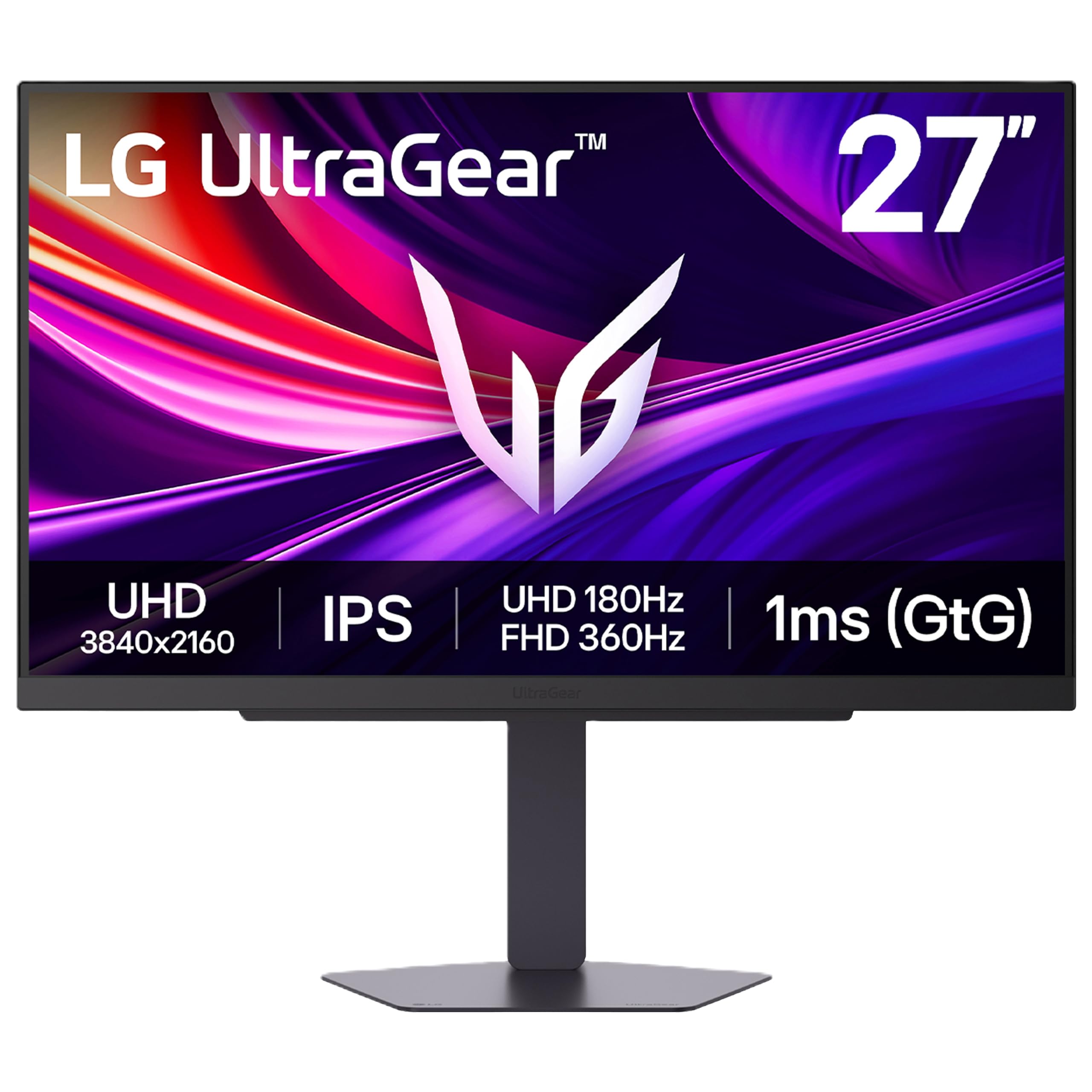
What you actually get at this lower price is a 27-inch 4K IPS gaming monitor with DisplayHDR 400 (400 nits brightness) and a dual-mode refresh that switches between 4K at 180Hz and Full HD at 360Hz — sharp, color-accurate visuals for creative work plus competitive-speed motion for esports in one screen, which is rare at this price tier. It beats the AOC U32G4 here because its 95% DCI-P3 coverage gives you noticeably richer HDR colors, while the AOC has no listed DCI-P3 spec.
Its 95% DCI-P3 color gamut covers the majority of the HDR color space, making it suitable for photo editing and gaming alike — a big step up from the AOC U32G4, which has no listed DCI-P3 coverage. Buyers call it “one of the most impressive monitors I’ve owned” and highlight that the “vibrant colors are near OLED” while adding that the stable stand and easy rear connectivity make setup simple. The 1ms response time keeps fast motion blur-free, and the Black Stabilizer brightens dark areas without washing out the rest of the image.
One catch: the stand sits relatively low at its minimum height, and a few users mention a “noticeable fan noise” from the internal cooling — so if you run a quiet desk setup, this might be audible. This monitor is for you if you want both high-res gaming and reliable color for light creative work without spending OLED money. skip it if you need deep VA-like blacks; this is an IPS panel with a 1000:1 contrast ratio — the exact budget buyer it is perfect for.
Why we’d pick it
- Dual-mode 4K 180Hz and FHD 360Hz covers both story-rich and competitive gaming.
- 95% DCI-P3 color gamut with DisplayHDR 400 provides vibrant, calibrated color.
- Full ergonomic stand with height, tilt, swivel, and pivot adjustments.
A few caveats
- Stand sits low for some users; a monitor arm may be needed for ideal eye level.
- Audible fan noise reported by several buyers in quiet rooms.
- IPS contrast ratio (1000:1) does not deliver deep blacks like VA or OLED.
6. ASUS ProArt PA32UCDM 32” QD-OLED
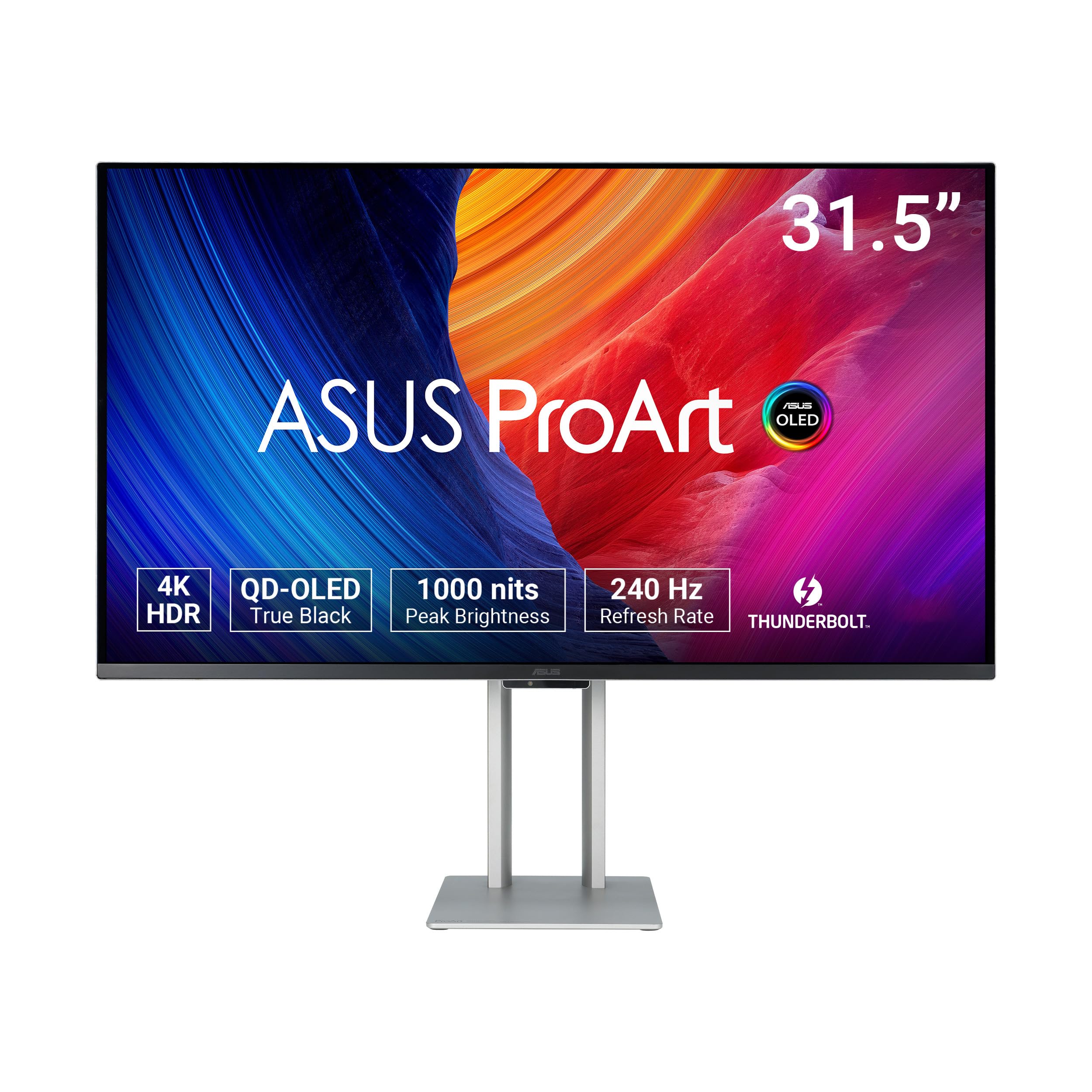
The ASUS ProArt PA32UCDM is built for the creative professional who demands reference-grade color accuracy — it is factory-calibrated to Delta E < 1 (meaning the color error is almost invisible to the human eye) and covers 100% sRGB and 99% DCI-P3. With a 32-inch QD-OLED panel that hits 1000 nits peak brightness and supports Dolby Vision (a premium HDR format that uses dynamic metadata), HLG (Hybrid Log-Gamma, an HDR format for broadcast), and HDR10, it is as close as a monitor gets to a professional reference display under .
For video editors and photographers, the ProArt Hardware Calibration feature lets you adjust and save color profiles directly to the monitor’s internal chip, so you do not need to rely on software that might change after a graphics driver update. Buyers call it “reference-grade” and say it is “a huge upgrade over older LED ProArt” models. The Thunderbolt 4 (a high-speed USB-C connection standard for data, video, and power) and USB-C with 90W Power Delivery make it a one-cable hub for a MacBook Pro or high-end laptop, and the built-in KVM lets you control two computers with one keyboard and mouse.
The biggest catch is the lack of a DisplayPort (a common video connector for PCs) — it relies on HDMI 2.1 and USB-C, which can cause compatibility headaches with some graphics cards and Linux systems. One buyer mentioned a frustrating “initialization” mode that blacks out the screen for minutes during gaming, though a firmware update fixed it. If you need DisplayPort or run an AMD card on Linux, this monitor is not the right fit. It is the priciest pick in this guide, but for color work that demands precision, it justifies its cost.
Strong points
- Factory Delta E < 1 accuracy with 99% DCI-P3 and 100% sRGB for professional color work.
- 1000 nits peak brightness with Dolby Vision, HDR10, and HLG support.
- Thunderbolt 4 and 90W USB-C simplify a single-cable creative workstation setup.
Before you buy
- No DisplayPort, which may cause issues with some GPUs and Linux drivers.
- Firmware bugs can cause random screen blackouts during gaming.
- Very expensive — it is the priciest pick in this guide.
7. AOC U32G4 32” 4K Dual-Mode
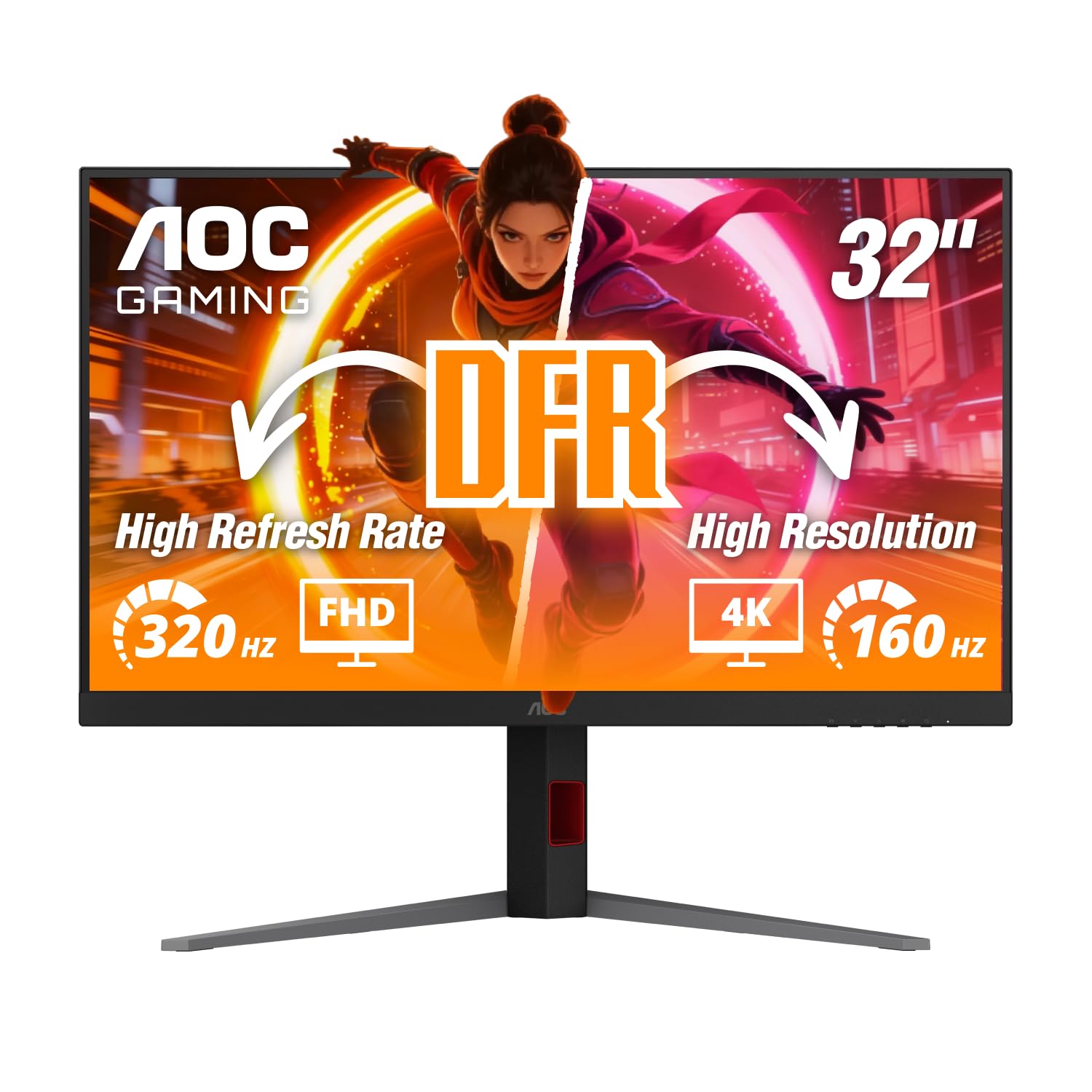
At just over , the AOC U32G4 undercuts most 4K gaming monitors while still delivering a 160Hz refresh rate at 4K and a blazing 320Hz at Full HD — a dual-mode that rivals the premium LG 27G810A-B but at a much lower entry price. It uses an IPS panel with a 0.5ms MPRT (Moving Picture Response Time — a measure of perceived motion blur) response time and G-Sync compatibility, so motion stays smooth and tear-free even in fast shooters.
The contrast ratio, listed at 80,000,000:1, is a dynamic spec (meaning it’s measured under ideal conditions and not representative of real-world use) that cannot compete with the 1.5M:1 of the LG OLED — real-world blacks are typical of IPS (around 1000:1 native). However, its 350 nits brightness is enough to enjoy HDR content without washing out details. Reviewers point out that “4K gaming is wonderful on this monitor once you get it set up and the driver installed,” and many appreciate the fully adjustable stand (height, pivot, tilt, swivel) that is rare at this price.
The main deterrent is the mixed quality control: one buyer received a unit with half the screen black on arrival (DOA, Dead on Arrival), and the on-screen menu buttons are described as “clunky.” It does not have built-in speakers, which the LG 32UR500K-B does include. For the money, you get excellent gaming performance and ergonomics, but the gamble on initial quality is real. This is for the budget-conscious gamer who can tolerate some QC risk.
What we like
- 160Hz at 4K and 320Hz at FHD dual-mode gives you options for both immersion and speed.
- Fully adjustable ergonomic stand (height, pivot, tilt, swivel) at an entry-level gaming price.
- G-Sync compatible and HDMI 2.1 for tear-free gaming on PC and console.
The downsides
- Mixed quality control; some buyers received dead-on-arrival units.
- On-screen menu buttons feel clunky and unresponsive.
- No built-in speakers, despite an audio menu in the settings.
8. ASUS ProArt PA279CV 27”

The ASUS ProArt PA279CV is the top pick for photo and video editors on a mid-range budget, thanks to its factory-calibrated Delta E < 2 color accuracy and 100% sRGB and 100% Rec. 709 coverage. The 27-inch 4K IPS panel delivers wide 178-degree viewing angles and 350 nits brightness for comfortable editing in a well-lit room.
The USB-C port delivers 65W Power Delivery, charging a MacBook Pro or Dell XPS while transferring video and data through a single cable. Shoppers say it “matches the MacBook screen out-of-box for graphic design” and that the “superb picture quality” eliminates the need for a separate reference display for amateur and semi-professional work. The fully adjustable stand (height, pivot, tilt, swivel) and VESA mount support make it easy to set up a multi-monitor editing rig.
The monitor includes a 5-year warranty (3 years plus 2 years with registration), but it is a 60Hz monitor with basic HDR10 support and no local dimming, making it strictly for color-critical work, not gaming or HDR movies. The price-to-capability ratio for creative professionals is the best at this tier.
Why it’s great
- Factory ΔE < 2 accuracy with 100% sRGB/Rec.709 for reliable color-critical editing.
- USB-C with 65W Power Delivery charges a laptop and carries video through one cable.
- Fully adjustable ergonomic stand and 5-year warranty (with registration) provide long-term value.
Good to know
- 60Hz refresh rate only — not suitable for gaming or fast motion work.
- HDR is minimal; no local dimming, so highlights do not pop like high-end HDR monitors.
- Some buyers reported a slight green tint out of the box that needed manual calibration.
9. Samsung ViewFinity S8 S80D 27”
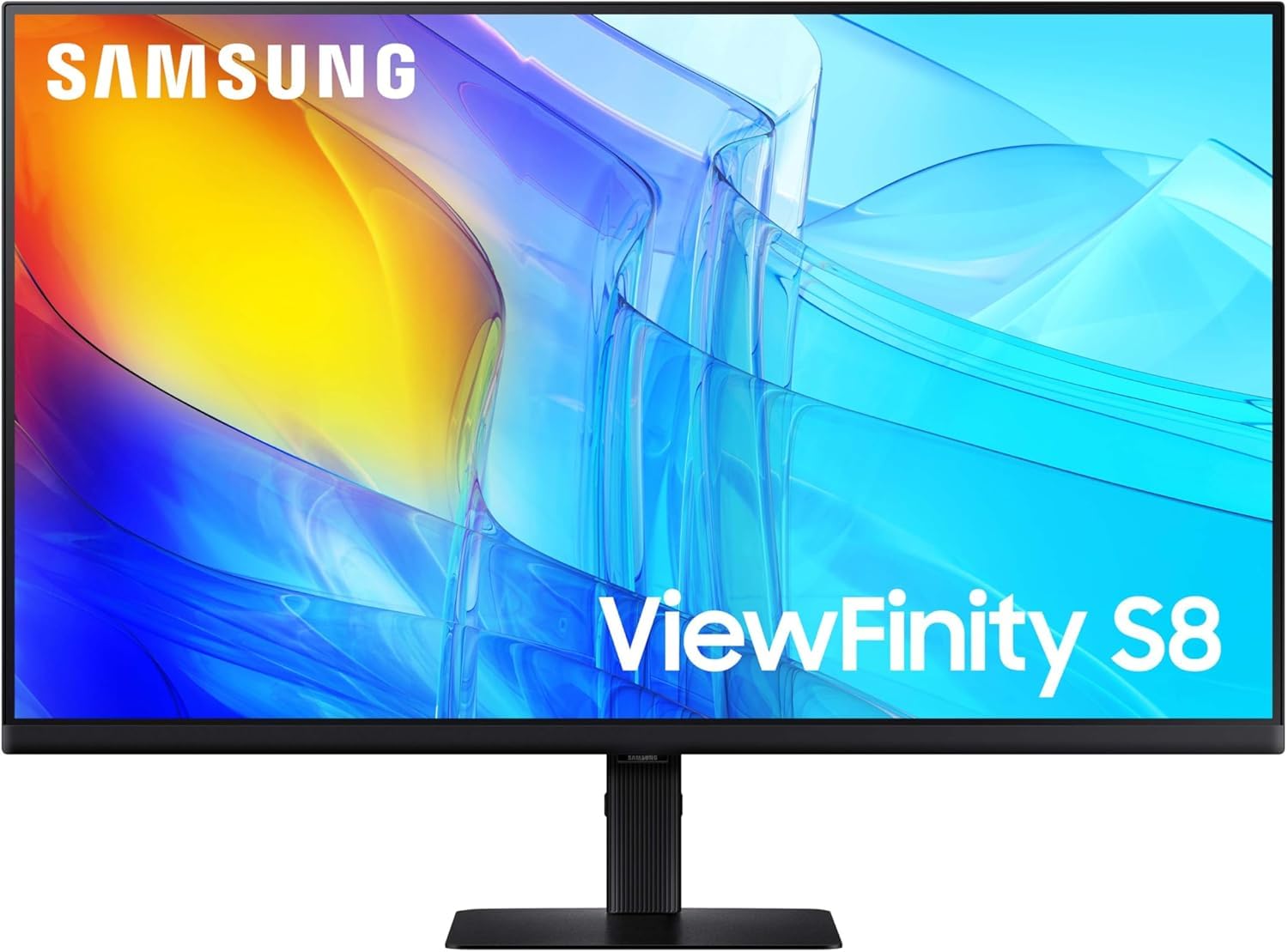
Against the top pick, the Samsung ViewFinity S8 S80D delivers 350 nits of brightness and 80.0% DCI-P3 color gamut, versus the top pick’s higher brightness and wider color coverage; it uses a 27-inch LED panel with HDR10 support, making text and colors vivid without the premium cost of IPS monitors.
Its standout feature is the Easy Setup Stand that requires no tools to assemble, and the full ergonomic adjustments (height, tilt, swivel, pivot to portrait mode) mean you can dial in a comfortable viewing angle in seconds. Buyers report it works “beautifully with the Mac Mini M4” and praise the “sharp text and details,” “good contrast,” and the Eye Saver Mode that reduces blue light automatically based on your room lighting.
The 80.0% DCI-P3 color gamut is lower than the LG 27G810A-B (95%) or the ASUS ProArt, so color-critical creative professionals will notice less saturation in HDR content. It also lacks built-in speakers, and the single-button menu control is “frustrating” with “backwards navigation.” Choose the Samsung ViewFinity S8 S80D over the top pick if you want a reliable, comfortable 4K display for productivity with no gaming or creative color needs; for creative work requiring more color coverage, the ASUS ProArt PA279CV is a better buy.
Where it shines
- Tool-free stand assembly and full ergonomic adjustments (height, pivot, swivel, tilt).
- Eye Saver Mode and TÜV-certified flicker-free technology reduce eye strain during long workdays.
- Multiple connectivity (HDMI, DP, USB-A, USB-B) makes it easy to connect peripherals.
Worth noting
- 80% DCI-P3 coverage is lower than competitors; color saturation may look muted in HDR.
- No built-in speakers, so an external speaker or headset is required.
- Menu navigation uses a single, backward-control joystick that feels unintuitive.
10. LG 32UR500K-B 32”

If you need a large, sharp 4K screen for office work, browsing, and streaming Netflix or YouTube, and you want to keep your budget low, this LG 32UR500K-B is the smartest pick. What you get at the entry-level price is a 32-inch 4K VA panel with HDR10 and built-in stereo speakers — a combination that is hard to find at this cost. The VA panel gives you a 1000:1 contrast ratio (deeper blacks than IPS) and 250 nits brightness, which is enough for basic HDR content, making movies and photos look noticeably better than a standard 1080p monitor.
What you give up are high refresh rate (60Hz), wide color gamut (80% DCI-P3), and advanced local dimming. The LG 32UR500K-B is not built for fast-paced gaming or professional color work — the Dynamic Action Sync (a feature that reduces input lag) and Black Stabilizer features try to reduce input lag, but the 60Hz limit means motion smoothness is not competitive. Buyers call it “a nice monitor at a great price” and note the “large, sharp 4K display with no flicker or dead pixels” and “easy assembly,” making it a reliable daily driver for office tasks and casual media consumption.
For anyone needing gaming speed or high color accuracy, the trade-offs are too big — you would be better served by the AOC U32G4 or the ASUS ProArt PA279CV. A 32-inch 4K VA panel with HDR10 and built-in stereo speakers at this price is a combination that is hard to find.
What stands out
- 32-inch 4K VA panel with a 1000:1 contrast ratio gives richer blacks than comparable IPS monitors at this price.
- Built-in speakers with MaxxAudio provide decent sound without needing external speakers for daily use.
- Easy assembly and a sturdy stand make it a hassle-free setup for home or office.
The trade-offs
- 60Hz refresh rate limits smoothness; not suitable for competitive gaming.
- 80% DCI-P3 color gamut is lower than other options in this guide.
- Brightness at 250 nits is the lowest in the guide; HDR highlights will not pop dramatically.
Understanding the Specs
DisplayHDR Certification
This is a VESA (Video Electronics Standards Association) rating that tells you the monitor’s minimum brightness and color performance for HDR. DisplayHDR 400 means at least 400 nits peak brightness and 95% sRGB coverage. DisplayHDR 600 jumps to 600 nits with better brightness uniformity. DisplayHDR 1000 and 1400 go even higher. True Black 400 and 500 are the OLED/MiniLED variants — they guarantee deep black levels while meeting the 400 or 500 nit minimum. Higher numbers mean brighter, more realistic highlights.
DCI-P3 vs sRGB Color Gamut
Color gamut is the range of colors a monitor can show. sRGB is the standard for web and office content — 100% sRGB is the target for everyday use. DCI-P3 (Digital Cinema Initiatives – P3) is a wider color space used for HDR movies and many games. A monitor covering 90% or more of DCI-P3 will display richer reds and greens than one covering only 70%. For HDR, prioritize DCI-P3 coverage over sRGB.
Local Dimming
Local dimming lets the monitor darken specific areas of the screen while keeping other areas bright, which helps HDR contrast. There are two types: edge-lit dimming (lights along the edges only) and full-array dimming (LEDs behind the entire screen, usually in MiniLED or high-end LCDs). More zones mean better control — for example, 1152 zones (like the KTC M27P6) can create much darker blacks around a bright object than a monitor with only 8 zones. OLEDs do not need zones because each pixel produces its own light.
Refresh Rate and Response Time
Refresh rate (Hz) is how often the screen updates per second — 60Hz is standard, 120-165Hz is smooth gaming, and 240Hz is top-tier competitive. Response time (ms) is how fast a pixel changes color — lower is better. A 1ms GtG (Gray to Gray) response means motion blur is minimal, while 0.03ms (OLED) eliminates it almost entirely. For most people, 60-120Hz is fine; only competitive gamers need 240Hz or higher.
FAQ
Do I need a 4K HDR monitor if I only watch YouTube and browse the web?
What is the minimum brightness for good HDR?
Is OLED or MiniLED better for HDR gaming?
Can I use a 4K HDR monitor with a PS5 or Xbox Series X?
Final Thoughts: The Verdict
For most users looking for the 4k hdr monitor that balances HDR quality, gaming performance, and everyday usability, the winner is the LG 32GX850A-B because it combines perfect OLED blacks with a dual-mode refresh rate and solid build quality. If you want the brightest HDR without stepping into OLED pricing, grab the KTC M27P6. And for color-critical professional work, the standout is the factory-calibrated precision of the ASUS ProArt PA32UCDM.