
Our readers keep the lights on and the weekend projects moving. As an Amazon Associate, I earn from qualifying purchases.
A 12-volt heater isn’t a luxury item — it’s the difference between a windshield that stays clear on a frosty morning and a cabin that keeps you warm when your truck’s factory heat has given up. Whether you need to defrost a windshield in an old single-cab work truck, warm a tiny camper without propane, or keep a piece of equipment running in a frozen trailer, the right 12-volt heater delivers real warmth without needing a generator or a shore power hookup. The real challenge is sorting the units that actually move enough air from the ones that barely take the chill off.
I’m Rikta — the co-founder and writer behind FitlyFast. This guide is built by comparing the manufacturers’ published specifications and the patterns across verified customer reviews, so you get each pick’s real strengths and trade-offs instead of marketing spin.
For this review, I focused exclusively on genuine 12-volt DC heaters — rejecting anything that runs on 120-volt AC wall power — so you can count on every pick below as a genuine 12 volt heater for your vehicle, camper, or off-grid setup.
How To Choose The Best 12 Volt Heater
Picking the right 12-volt heater starts with one question. Do you need heat that uses your vehicle’s own engine coolant, or do you want a separate system that burns its own fuel? Coolant-based heaters (like the JEGS unit) are simpler to install if your vehicle already has a liquid-cooled engine — they tap into the hot coolant loop and blow air over a small radiator (a tiny version of your car’s main heater core). Diesel-fired heaters (like the HCALORY or WAYSKA), on the other hand, burn a small amount of fuel to generate intense heat completely independent of your vehicle’s engine, making them ideal for camping, truck sleepers, and garages. Your choice determines installation time, fuel cost, and how much heat you actually get.
Heat Output: BTUs, Kilowatts, and CFM
Manufacturers rate heaters in different units, which makes comparison confusing. A coolant heater is usually rated in British Thermal Units (BTUs — a unit of heat energy) and cubic feet per minute (CFM — the volume of air the fan moves). The JEGS heater, for example, puts out 28,000 BTU at 260 CFM. Diesel air heaters are rated in kilowatts (kW — a metric power unit). An 8kW heater like the HCALORY or WAYSKA is roughly equivalent to about 27,000 BTU, while a 5kW unit (like the Orion Motor Tech) is around 17,000 BTU. For reference, a small car cabin needs around 5,000-8,000 BTU to stay comfortable in freezing weather, while a large RV or garage might need 20,000-30,000 BTU. So match the number to the space you actually need to heat.
Fuel Type and Tank Capacity
A coolant-based heater uses your engine’s coolant loop, so it has no fuel tank and no fuel cost — but it only works when the engine is warm, and it can’t run independently. A diesel-fired heater needs diesel fuel (or sometimes kerosene) and comes with an integrated tank. Tank sizes range from 1.3 gallons (the HCALORY and Orion Motor Tech) up to 4 gallons (the WAYSKA 15-liter tank converts to about 4 gallons). A 1.3-gallon tank might last 10-15 hours on high or days on low; the WAYSKA’s 4-gallon tank can run for 1.5 days on full blast or over a week on low. If you plan to use the heater for multi-day trips without refueling, a larger tank saves you hassle.
Noise Level
Every 12-volt heater makes some noise, but the source matters. Coolant-based heaters have an electric fan that pushes air — the JEGS unit’s three-speed fan produces a steady “blowing” sound that many buyers describe as “fine” or “acceptable.” Diesel heaters have two noise sources: the fan and the fuel pump. The fuel pump makes a distinct ticking sound that some people find annoying and others barely notice. A few seconds of ticking during startup is normal; buyers report that after the first 2-8 minutes, the ticking often fades into the background, leaving only the sound of the air blowing. If silence is critical (like in a camper van where you sleep nearby), look for models with quieter fuel pumps or read buyer reviews specifically about the ticking volume.
Installation Requirements
This is where the biggest difference between heater types becomes clear. A coolant-based heater like the JEGS or Saihisday requires you to tap into your vehicle’s heater hoses — you need to cut a hose and splice in the heater core, which takes some mechanical know-how but no exhaust routing. A diesel heater, by contrast, requires you to drill a hole through the vehicle floor or wall to vent the exhaust outside (since burning diesel produces carbon monoxide — this is non-negotiable for safety). You also mount the heater unit, the fuel tank, the pump, and the control panel. Every diesel heater includes a safety warning that the exhaust must exit the vehicle. If you don’t want to cut a hole in your floor, stick with a coolant-based heater.
Quick Comparison
On smaller screens, swipe sideways to see the full table.
| Model | Category | Best For | Key Spec | Amazon |
|---|---|---|---|---|
| Orion Motor Tech 5kW | Diesel Air Heater | Quiet all-in-one diesel heat with safety CO alarm | 5kW / 1.3 gal tank | Amazon |
| Saihisday 4-Port | Coolant Heater | Budget underdash defrost on an older vehicle | 7.04 lbs | Amazon |
| HCALORY HBH1S 8kW | Diesel Air Heater | App-controlled heating for RVs up to 256 sq. ft. | 8kW / 1.3 gal tank | Amazon |
| WAYSKA 8kW 15L | Diesel Air Heater | Long-run heat for large campers and RVs | 8kW / 4 gal tank | Amazon |
| JEGS 28,000 BTU | Coolant Heater | High-output cab heat for UTVs and trucks | 28,000 BTU / 260 CFM | Amazon |
In‑Depth Reviews
1. Orion Motor Tech 5kW Diesel Heater
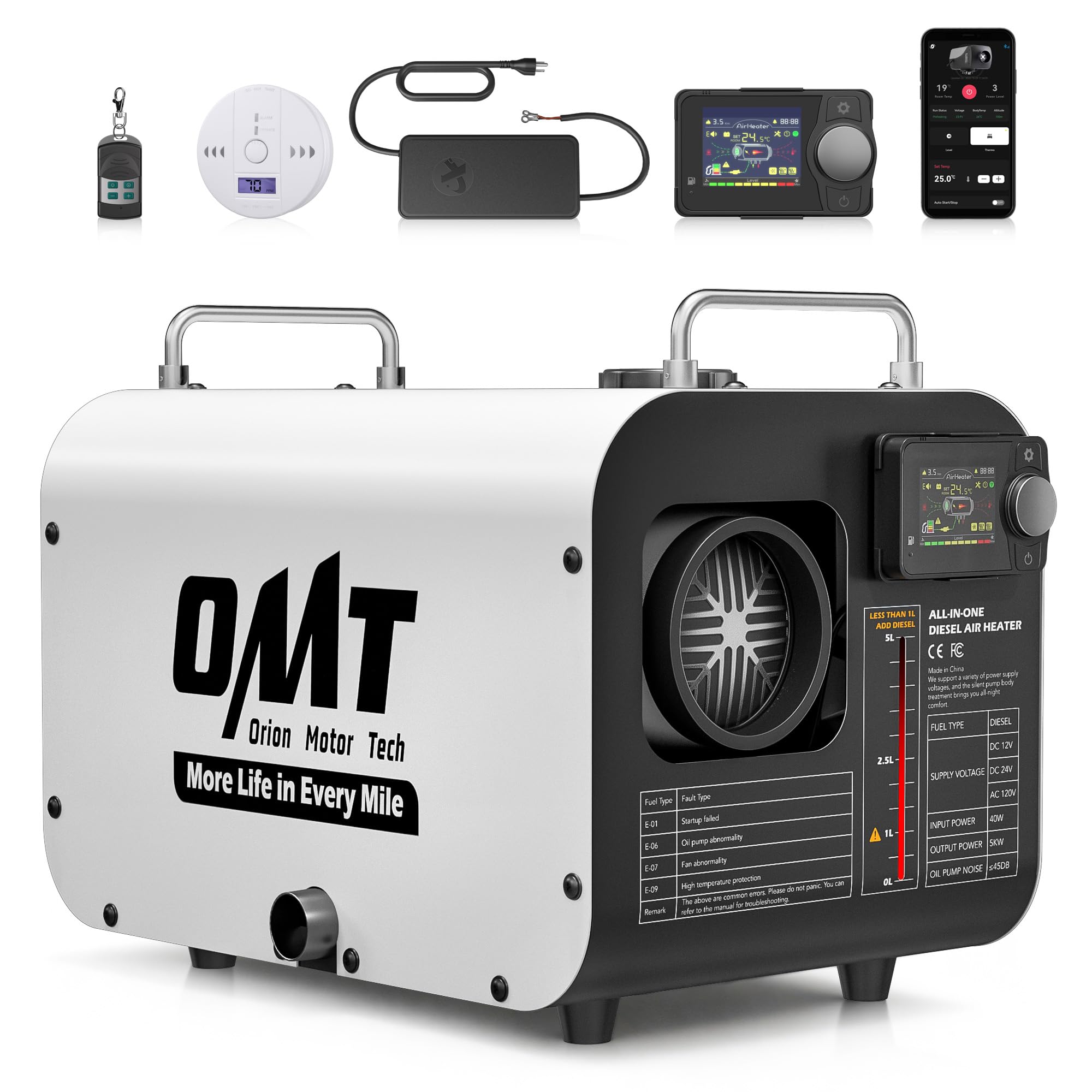
5 kW (roughly 17,000 BTU) makes the Orion Motor Tech 5kW the top pick for anyone needing a diesel heater that can warm a medium RV, truck cab, or small garage for 24 hours on a single 1.3-gallon tank at low settings, all without running the engine.
It includes a built-in CO alarm — a critical safety layer most competing diesel heaters skip — and owners mention it is “extremely quiet (only air blowing sound after 2-8 min startup ticking).” Three control options (smartphone app, long-range remote, clear LCD display) let you adjust temperature from 46°F up to 97°F from inside a sleeping bag, and customers note it self-primes on diesel and “worked all winter even after being bounced around.”
The catch: the unit ships with zero instructions and very short hoses, so you will need to plan your own exhaust and intake routing. If you are comfortable with DIY layout work, this heater’s quiet run, safety features, all-in-one design, and solid heat output make it the most balanced diesel heater in its price tier.
Why it’s great
- Extremely quiet — almost silent after initial 2-8 minute startup
- Includes CO alarm and auto-shutoff if temp exceeds 518°F for safety
- Bluetooth app, remote, and LCD panel control from anywhere
Good to know
- Ships with almost zero instructions, frustrating first-time installers
- Hoses are too short for some vehicle layouts
- Some units reported as dead on arrival (controller failure risk)
2. HCALORY HBH1S 8kW Diesel Heater
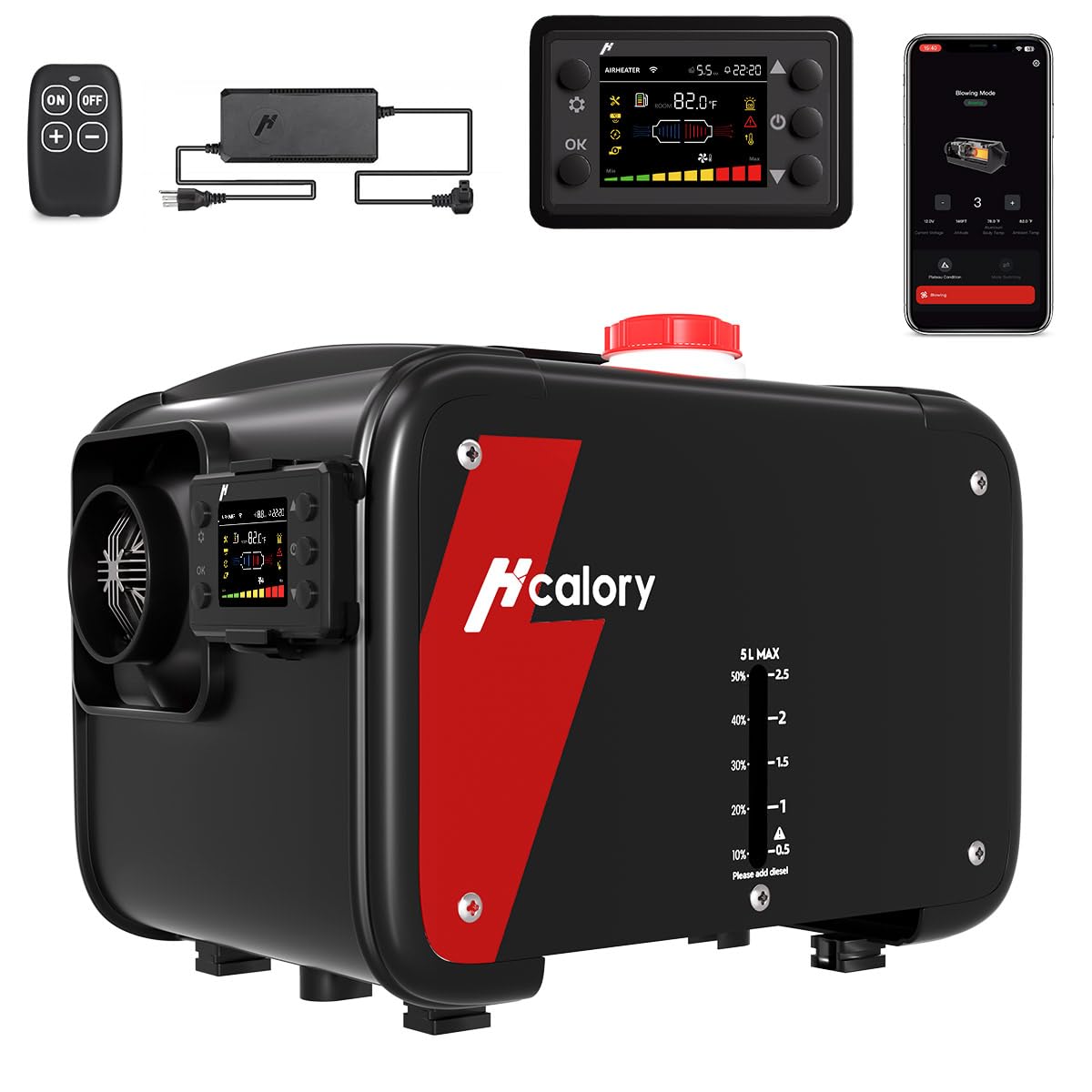
If the Orion Motor Tech is the quiet, safety-focused diesel heater, the HCALORY HBH1S is the one that pushes more heat for about the same money — an 8kW output (about 27,000 BTU) versus Orion’s 5kW, and the brand says it can cover spaces up to 256 square feet. That means you can heat a two-car garage, a large RV, or even a small workshop, whereas the Orion is better suited to a single vehicle cabin or a small camper. Reviewers confirm that it “reaches 122°F in just 3 minutes” and that the 1.3-gallon tank is “fuel efficient” enough to last through a long winter night.
A buyer who installed it in a garage reports it “performed flawlessly all winter long,” calling it a “great value compared to a propane heater” because it doesn’t raise humidity the way propane does — so no fogged-up windows. The smart app gives you “precise control over temperature, timers, power levels, altitude mode” and even supports “auto start-stop,” meaning the heater cycles on and off to maintain your set temperature without wasting fuel. One reviewer summarizes it neatly: “Works out of box; initial white smoke stops after 7 min. Very hot, moderate noise; fuel pump clicking may annoy.”
What you trade for the higher heat output is noise: some owners describe the fuel pump ticking as annoying, and there are isolated reports of the blower motor failing on the first unit. A small number of reviewers received units with a bad glow plug (the component that ignites the fuel) or a failed controller. If you need the extra 3kW of heat for a larger space and are willing to gamble a little on quality control, the HBH1S delivers exceptional warmth per dollar. This one is for the buyer who absolutely needs to heat 256 square feet and values smartphone control over near-silence.
Where it shines
- 8kW heats up to 256 sq. ft. — enough for a two-car garage or large RV
- Smart app with 10 temperature settings, timers, and altitude modes
- Extremely fuel-efficient — 1.3 gal tank lasts days on low setting
Worth noting
- Fuel pump ticking can be annoying in quiet spaces
- QC issues reported — some units arrive with bad glow plugs or loud fans
- Exhaust condensation during startup needs drainage planning
3. WAYSKA 8kW Diesel Heater with 15L Tank

When you need 12-volt heat that runs for days without refueling, the WAYSKA is the unit to beat — its 15-liter tank (about 4 gallons) holds more than three times the fuel of the HCALORY or Orion Motor Tech, which each carry just 1.3 gallons. Reviewers point out that “on low, 2.5 gal diesel lasts ~7 days” in a 39-foot 5th wheel camper, and another owner in South Dakota says the full 15-liter tank lasts “~1.5 days at full blast in 5°F” — enough to thaw a frozen water tank in three hours. At 16.1 pounds, it’s significantly heavier than the 7-pound Saihisday, but that weight difference (2.3x heavier) comes from the large tank and robust diesel-burning components.
One reviewer living in an RV says it “works amazing on high pushes out more heat then our friends diesel heater” and calls it “a great way to heat whole place and it’s cheaper than the cost of propane for the furnace.” The heat output is 8kW (about 27,000 BTU), and the brand says the heater can operate in temperatures as low as -40°C. It includes a ceramic spark plug (a component designed to vaporize the fuel for clean combustion), and the “plateau version thermostat” lets it work reliably at altitudes above 5,500 feet — useful for mountain camping. The LCD monitor and remote control make it simple to adjust without stepping outside.
The downside is durability: a notable number of shoppers say the control screen going blank after just weeks or months, rendering the heater unusable unless you keep the original packaging for returns. One reviewer had a first unit last one month and a replacement last just one week. And at its larger size and weight, installation is more involved than a smaller diesel heater. For RV dwellers or off-grid setups where running out of fuel every day is a real hassle, the WAYSKA’s massive tank and powerful heat are the best choice — assuming you are prepared for the risk of a controller failure down the line.
What stands out
- Huge 15L (4 gal) tank runs for days without refueling
- 8kW output rivals propane furnace heat at lower cost
- Works at altitudes above 5,500 ft and down to -40°C
The trade-offs
- Multiple reports of LCD controller failing after weeks
- Heavy at 16.1 pounds — harder to mount in tight spaces
- Returns are a hassle if original packaging is discarded
4. Saihisday 4-Port Underdash Heater

The single number that matters most in this category is the price-to-heat ratio, and the Saihisday scores well: at 7.04 pounds, it’s lighter than the JEGS or the WAYSKA, and it runs off your existing engine coolant — so there’s no separate fuel, no exhaust vent, and no carbon monoxide risk. One buyer says they “installed in a 1998 Chevy S10 single cab for ” and confirms it “works well for no heat.” That is the real pitch: if your vehicle’s factory heater has failed, this 4-port underdash unit gives you a way to restore defrost and cabin heat without replacing the entire dashboard.
The trade-off is that this is a coolant-based heater, meaning it only produces heat when your engine is warm — it does not generate its own warmth like a diesel burner. And the quality is entry-level: buyers report “the pipe fittings could be made better,” the “fan blower is a little weak,” and at least one owner found the switch defective (needing a wire wiggle to make contact). The plastic hose clamps reportedly “strip easily,” so you may want to replace them with metal clamps during install. It is not a set-it-and-forget-it product; it’s a budget tool that requires a little tinkering.
For what it costs, the Saihisday is a practical heater for a specific situation: you have a single-cab truck, an old van, or a Polaris Ranger that needs basic defrost and a little cab warmth, and you don’t want to spend more on the fix than the vehicle is worth. The 8 amp draw is modest, and the four vents spread heat decently across the dash area. You get what you pay for — but what you pay is low enough that this heater pays for itself the first time you don’t pay a mechanic to fix your factory unit.
The upsides
- Simple coolant-based install — no separate fuel or exhaust needed
- Light weight (7.04 lbs) fits under most dashes easily
- Low cost makes it a practical fix for old vehicles with no heat
Keep in mind
- Only works when engine is warm — no heat at idle or for camping
- Blower fan is weak compared to higher-end coolant heaters
- Hose clamps and fittings feel cheap; replace with metal parts
5. JEGS 28,000 BTU Auxiliary UTV Heater
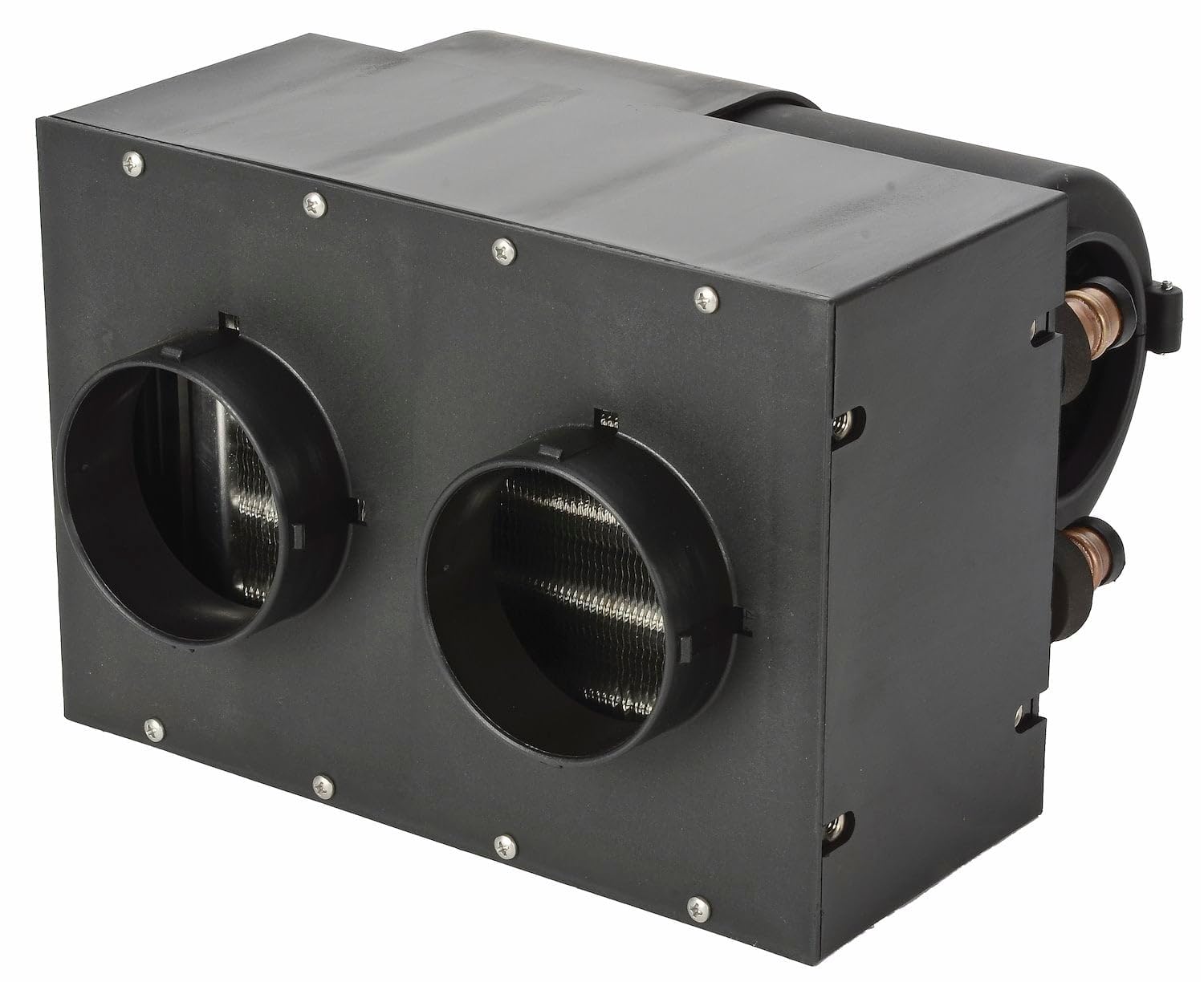
The JEGS is in its own lane — it is the only coolant-based heater on this list that competes with diesel heaters in raw BTUs. At 28,000 BTU and 260 CFM (cubic feet per minute of airflow), this unit moves more heat and more air than any other heater here that doesn’t burn its own fuel. Skid steer operators and UTV owners mention that the “output air is 120 degrees” and that even the “low setting is more than enough to heat the cab.” At 9.8 pounds and a compact 9x9x6-inch size, it fits inside a heavy-equipment cab where space is extremely tight.
Of course, you still need a hot engine to make this work — it taps into your coolant loop, so it is not for camping or off-engine use. Customers note it’s “very loud” even on the lowest fan setting, which is fine for a skid steer but could be annoying in a truck cab. The 9.6 amp draw is reasonable, and the three-speed motor gives you some control over noise versus heat output. The injection-molded nylon construction is noticeably more durable than the Saihisday’s plastic, suggesting this unit would survive the bumps and vibrations of a tractor or side-by-side better.
The honest limit: you need fabrication skills to install this in most UTVs (utility terrain vehicles). One owner who put it in a Polaris RZR XP 1000 notes it “requires glove box removal and fabrication skills” and that it easily replaces -800 factory RZR heaters, but it is not a simple plug-and-play swap. Buyers also warn that reverse polarity (wiring the positive and negative backwards) prevents heating entirely, so wire the polarity correctly. For anyone with a UTV, skid steer, tractor, or work truck who wants maximum cab heat and already has a warm engine, the JEGS delivers more forced-air warmth than any other coolant heater at this size — just budget some time for a proper install.
Why we’d pick it
- Massive 28,000 BTU output rivals many diesel heaters
- 260 CFM airflow moves heat through large cab quickly
- Compact 9x9x6-inch size fits in tight equipment cabs
A few caveats
- Loud even on the lowest fan setting
- Requires moderate fabrication skills for UTV installation
- Some units ship missing parts with slow manufacturer support
Understanding the Specs
BTU vs. kW vs. CFM
You’ll see three different measurement systems on 12-volt heaters, and they don’t convert neatly. A British Thermal Unit (BTU) measures heat energy — the amount of energy to raise one pound of water by one degree Fahrenheit. The JEGS heater puts out 28,000 BTU. A kilowatt (kW) is a metric power unit — an 8kW diesel heater is roughly 27,000 BTU, and a 5kW diesel heater is about 17,000 BTU. Cubic Feet per Minute (CFM) measures airflow volume, not heat — a heater can have high CFM with low BTU (blowing lukewarm air fast) or low CFM with high BTU (blowing very hot air slowly). For a vehicle cabin, look for at least 15,000-20,000 BTU equivalent (around 5kW). For a garage or large RV, 8kW (27,000 BTU) is a safer bet.
Fuel Type: Diesel vs. Coolant
The biggest functional split in this category is whether a heater uses your engine’s coolant (the hot fluid already in your radiator) or burns its own diesel fuel. Coolant heaters (like the Saihisday and JEGS) have no fuel cost and no exhaust, meaning no carbon monoxide risk — but they only produce heat when the engine is warm, and they can’t run independently. Diesel heaters (like the Orion Motor Tech, HCALORY, and WAYSKA) burn a small amount of fuel to generate intense heat anytime, anywhere, but require an exhaust pipe vented outside the vehicle and produce a distinct fuel pump ticking sound. If you need heat for camping or sleeping without the engine running, go diesel. If you only need heat while driving, go coolant.
FAQ
Can I run a 12-volt diesel heater without the vehicle engine running?
Do I still need an exhaust pipe on a diesel heater in a tent?
What size 12-volt heater do I need for a truck cab versus an RV?
Final Thoughts: The Verdict
For the majority of shoppers, the 12 volt heater winner is the Orion Motor Tech 5kW because it offers the best balance of quiet operation, built-in safety (CO alarm), and independent diesel heat without needing your engine running — all at a reasonable price point. If you want the ability to control your heater from a smartphone and need extra 8kW output for a larger space, the HCALORY HBH1S 8kW is a strong step-up for the same money. And for long off-grid trips where refueling every day is a hassle, the WAYSKA with the 4-gallon tank keeps your camper warm for over a week on a single fill.