
Our readers keep the lights on and the weekend projects moving. As an Amazon Associate, I earn from qualifying purchases.
The hardest part about homemade bread has never been the kneading or waiting — it is the second-guessing. Did you proof the yeast long enough? Is the dough too sticky? Did the loaf collapse because the kitchen was drafty? A bread machine takes those variables off your hands, turning fresh, warm bread into something you drop ingredients into before bed and wake up to.
I’m Rikta — the co-founder and writer behind FitlyFast. This guide is built by comparing the manufacturers’ published specifications and the patterns across verified customer reviews, so you get each pick’s real strengths and trade-offs instead of marketing spin.
After sorting through seven leading models — from basic budget loafers to programmable workhorses — these are the best bread makers that reliably deliver a perfect crust and soft crumb, every time. best bread makers.
How To Choose The Best Bread Makers
Not all bread machines are built the same. Some bake a perfect 2-pound sandwich loaf on the first try; others leave you with a dense brick and a crust that pulls your filling out. Here are the four specs that decide which machine earns its spot on your counter.
Pan material and shape
The pan is the part that touches your dough. Two types dominate the market: standard non-stick (usually a PTFE or Teflon coating) and ceramic non-stick (a silica-based coating that is harder and more scratch-resistant). Ceramic pans also heat more evenly, but they cost more. The pan shape matters too — horizontal pans produce a traditional loaf shape that slices evenly, while vertical pans bake a taller, rounder loaf that some buyers report is trickier to cut for sandwiches.
Heating setup: single, dual, or convection
Many entry-level machines use a single heating element at the bottom. That works, but you often get a pale top crust. Dual heaters add a second element at the top, giving you a golden-brown finish on all sides. A convection fan (like the Cuisinart CBK-210) circulates hot air around the pan, which evens out the temperature swings that can cause a gummy center or a burnt edge. If you care about crust color and texture, dual heaters or convection is worth the upgrade.
Programs and custom control
A machine with 12 to 20 preset menus sounds impressive, but the key is whether it has the specific cycles you will actually use. A dedicated gluten-free cycle (which uses a shorter rise and lower bake temperature) matters if you or someone in your house avoids gluten. A sourdough starter cycle is rare and valuable. Most important of all is a custom or homemade program that lets you set your own knead, rise, and bake times — that is the feature that keeps the machine useful once you outgrow the basic recipes.
Motor noise and machine stability
Bread machines knead dense dough, and that creates vibration. A lighter machine (under 12 pounds) can “walk” across your counter during the knead cycle, which is frustrating. A heavier machine stays put and is usually quieter. Check the decibel specs if reviews mention noise — anything under 40 dB is roughly as loud as a quiet conversation, while a machine that hits 50 dB or more will be audible in the next room.
Quick Comparison
On smaller screens, swipe sideways to see the full table.
| Model | Category | Best For | Key Spec | Amazon |
|---|---|---|---|---|
| KITCHENARM 19-in-1 | Mid-Range | Beginners who want a foolproof first loaf | 19 programs, 8.6 lbs | Amazon |
| Starfrit Electric | Mid-Range | Bakers who want a vertical loaf and nut dispenser | 13 programs, automatic nut dispenser | Amazon |
| Hamilton Beach (29987) | Value | Budget buyers who still want 14 settings | 14 settings, 9.3 lbs | Amazon |
| Briskind BM8206 | Mid-Range | Health-conscious bakers wanting a ceramic pan | 19 menus, ceramic pan, 600W | Amazon |
| Neretva PE9706U | Premium | Large families needing 2.2 lb loaves | Dual heaters, 15.8 lbs | Amazon |
| KBS MBF-060 | Premium | Tech-savvy bakers who want custom programs | 20 menus + 2 custom, 750W | Amazon |
| Cuisinart CBK-210 | Premium | Enthusiasts who want convection baking | Convection fan, 16 menus | Amazon |
In‑Depth Reviews
1. KITCHENARM 19-in-1 HANDY Bread Machine
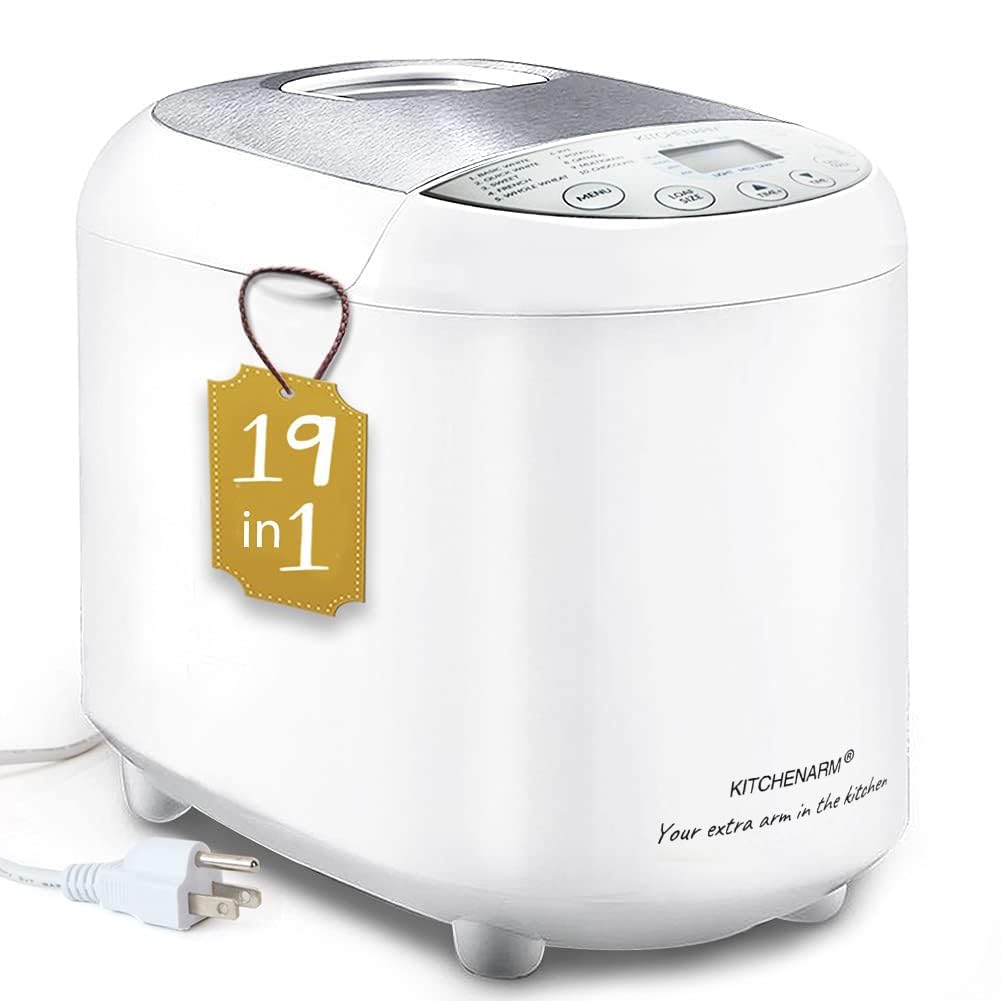
19 preset programs (including a fully programmable Homemade cycle) and a light 8.6-pound body make the KITCHENARM 19-in-1 the top pick for beginners or return bakers who want one machine covering white, whole wheat, gluten-free, and sourdough without a steep learning curve.
What sets it apart is the attention to recipe usability. The included recipe book has 57 recipes, and the KitchenArm Recipe Cloud offers hundreds more. Owners mention that the gluten-free loaf had “bland flavor but wife loved it,” while the sourdough recipes “exceeded expectations.” The 15-hour delay timer means you can load ingredients at night and wake up to a warm loaf. The ADD-NUTS alarm and REMOVE-PADDLE alarm also guide you through the critical mid-cycle steps that beginners often forget.
One honest limit: the manual lists yeast, oil, and honey in spoons rather than grams, which frustrates precise bakers. But for the vast majority of home bakers who just want a consistent, quiet machine that produces a hot loaf without fuss, this is the one to get.
Why it’s great
- 19 programs plus a fully customizable Homemade cycle
- Extensive recipe book and online recipe cloud
- Quiet operation with a longer power cord than comparable models
Good to know
- Measurements given in spoons, not grams — not ideal for precision bakers
- Paddle removal recommended before final rise to avoid a hole in the loaf bottom
2. KBS 750W Programmable Bread Maker
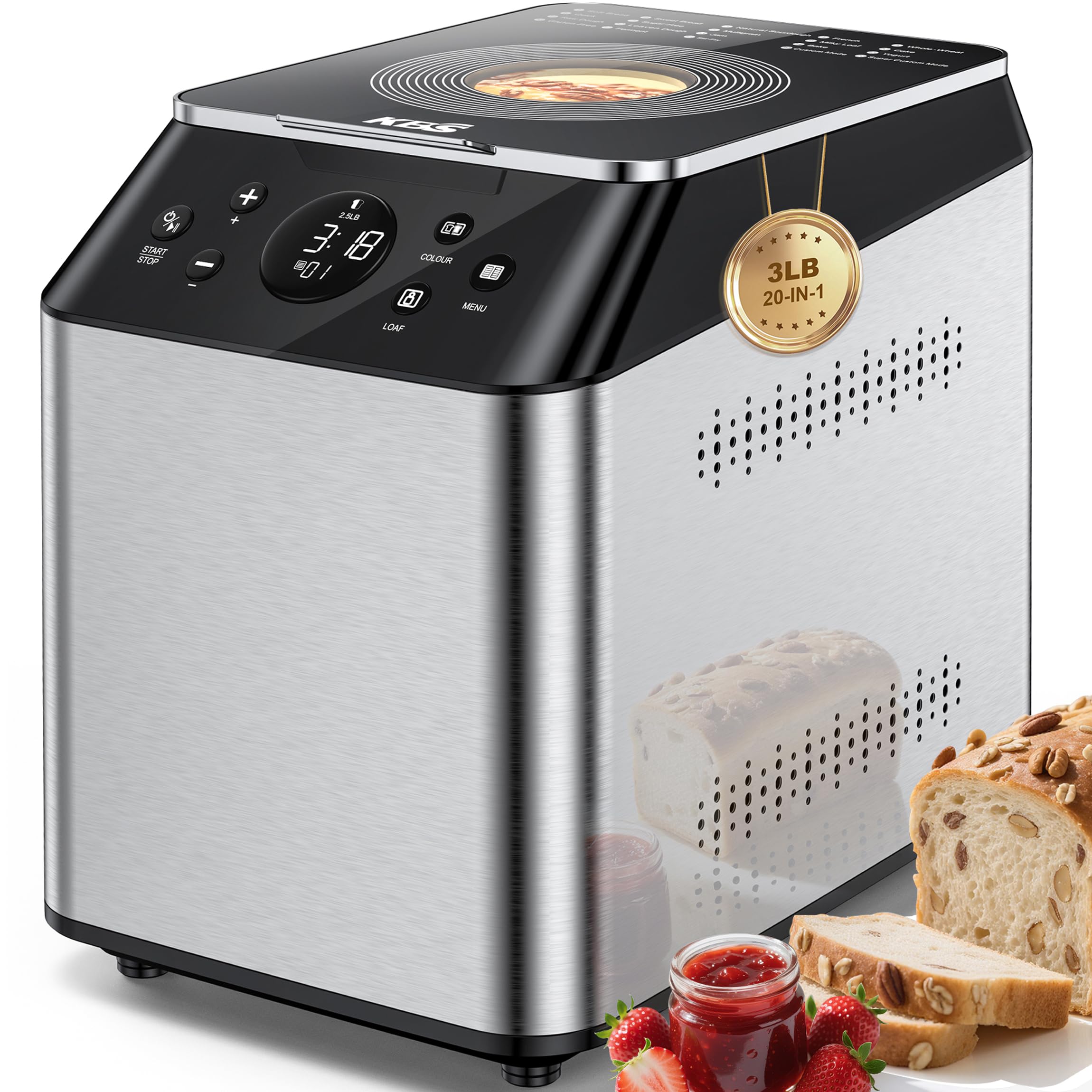
The KBS 750W Programmable Bread Maker beats the top pick on raw specs — it offers more programs (20 vs 19), a larger 3-pound maximum loaf size versus 2 pounds, a stronger 750-watt motor versus 600 watts, and it weighs 17.6 pounds versus 8.6 pounds, which keeps it planted on the counter during kneading. That extra mass matters: customers note that lighter machines sometimes vibrate or walk, but the KBS stays put. It also has two fully customizable programs (Menu 19 and 20), letting you dial in exact times for knead, rest, rise, and bake.
The real-world payoff is a loaf with a crispy crust and a soft, fluffy interior, thanks to the dual infrared heaters that provide 360-degree heating. The quiet brushless motor runs under 25 decibels — quieter than a whisper — so you can run it overnight without waking anyone. Reviewers point out the sourdough setting yields “beautiful loaves” and that the machine is “excellent for the consistent or daily bread maker.” The 15-hour delay timer and 60-minute keep-warm function add convenience for busy schedules.
You should choose the KBS over the top pick if you bake for a larger household (8 to 10 people) or want the extra headroom of a 3-pound loaf. The catch is size: the KBS takes up noticeably more counter space, and some users report that the touch buttons can be unresponsive at times. But for a heavy-duty machine with near-silent operation, it is a standout value at its price tier. A baker who only makes 1-pound loaves occasionally would be better served by the lighter Hamilton Beach.
Where it shines
- 750-watt dual heaters for even, golden-brown crusts
- Ultra-quiet brushless motor (under 25 dB)
- Two fully customizable programs for experienced bakers
Worth noting
- Heavy and large — requires dedicated counter space
- Some users report the touch panel buttons can be sluggish
3. Cuisinart CBK-210 Convection Bread Maker
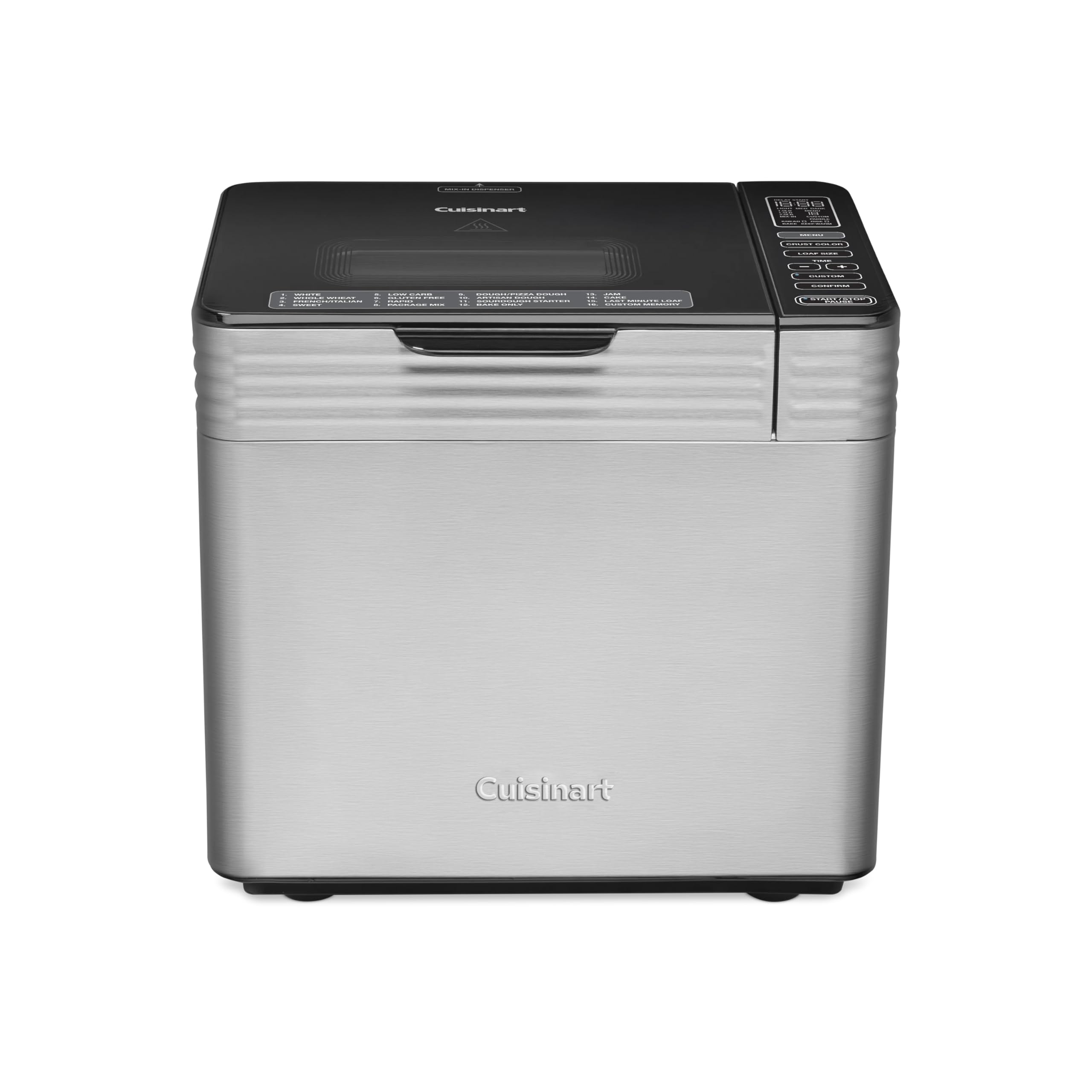
The Cuisinart CBK-210 is for the home baker who notices the small differences — a crust that is evenly bronzed on all sides, a crumb that is soft without being gummy, and the ability to use the machine as a mixing and kneading station even when you want to bake the loaf in your own oven. The convection fan circulates hot air around the pan, which is the main reason this machine produces a more consistent bake than models that rely on a single bottom element.
You get 16 menu options including dedicated cycles for gluten-free, whole wheat, and artisan dough, plus an automatic fruit and nut dispenser that drops add-ins at the optimal moment. The horizontal bread pan makes it easier to extract a traditional loaf shape, and the bright LCD screen with a confirm button reduces accidental menu changes. Shoppers say the CBK-210 “performs beautifully” for weekly use and that the custom timing feature gives you “full control over the baking process.” The machine weighs 10.8 pounds, which is heavy enough to stay stable but light enough to move.
One standout detail: unlike most machines that only beep when the paddle needs removing, the Cuisinart sounds 10 beeps to get your attention, which buyers find genuinely helpful. The downside is that the crust color settings (light, medium, dark) are less effective than advertised — some users report little visible difference between them. But for the convection quality alone, this is the machine that most closely mimics a pro bakery. If you bake artisan-style loaves and care about even crust color, get this over the KBS.
What stands out
- Convection fan circulates hot air for superior crust and texture
- Horizontal bread pan for traditional loaf shape
- Automatic fruit and nut dispenser with loud 10-beep reminder
The trade-offs
- Crust color settings show limited visible difference between levels
- Premium price point may be overkill for occasional bakers
4. Briskind BM8206 Bread Maker

The single number that matters most in this category is 600 watts, and the Briskind BM8206 scores it with a ceramic non-stick pan — ceramic is free of PTFE and PFOA (chemicals sometimes used in standard non-stick coatings that can release fumes at high temperatures), and Briskind’s pan is fired at high temperatures for extra scratch resistance. For anyone concerned about what touches their food, the ceramic pan alone makes the BM8206 worth a close look. It also offers 19 preset menus, a 15-hour delay timer, and a 1-hour automatic keep-warm function.
The trade-off is that the BM8206 has no automatic fruit and nut dispenser; instead it beeps and flashes a reminder for you to add them manually. That is a minor inconvenience, and buyers report the machine is “stable, quiet, and easy to read” thanks to the angled glass touch panel with a white backlit LCD. The horizontal ceramic pan twists into place and produces evenly baked bread with a “firm spongy texture and great flavor.” One reviewer noted the “add remainder” chime is too quiet to hear from another room.
At its price point, you are paying primarily for the ceramic pan and the 19-menu variety — including a dedicated sourdough starter cycle, which is rare at this level. If you plan to bake frequently and want to avoid chemical coatings, this is the best price-to-performance option on the list for health-focused bakers. The Cuisinart CBK-210 is a better choice if you prize convection baking over pan material.
The upsides
- Ceramic non-stick pan — no PTFE or PFOA chemicals
- Angled glass touch panel and backlit LCD are easy to read
- 19 menus including sourdough starter cycle
Keep in mind
- No automatic nut dispenser — chime reminder is quiet
- Pan requires turning clockwise to lock, which some find tricky
5. Neretva 2.2LB 15-in-1 Bread Machine
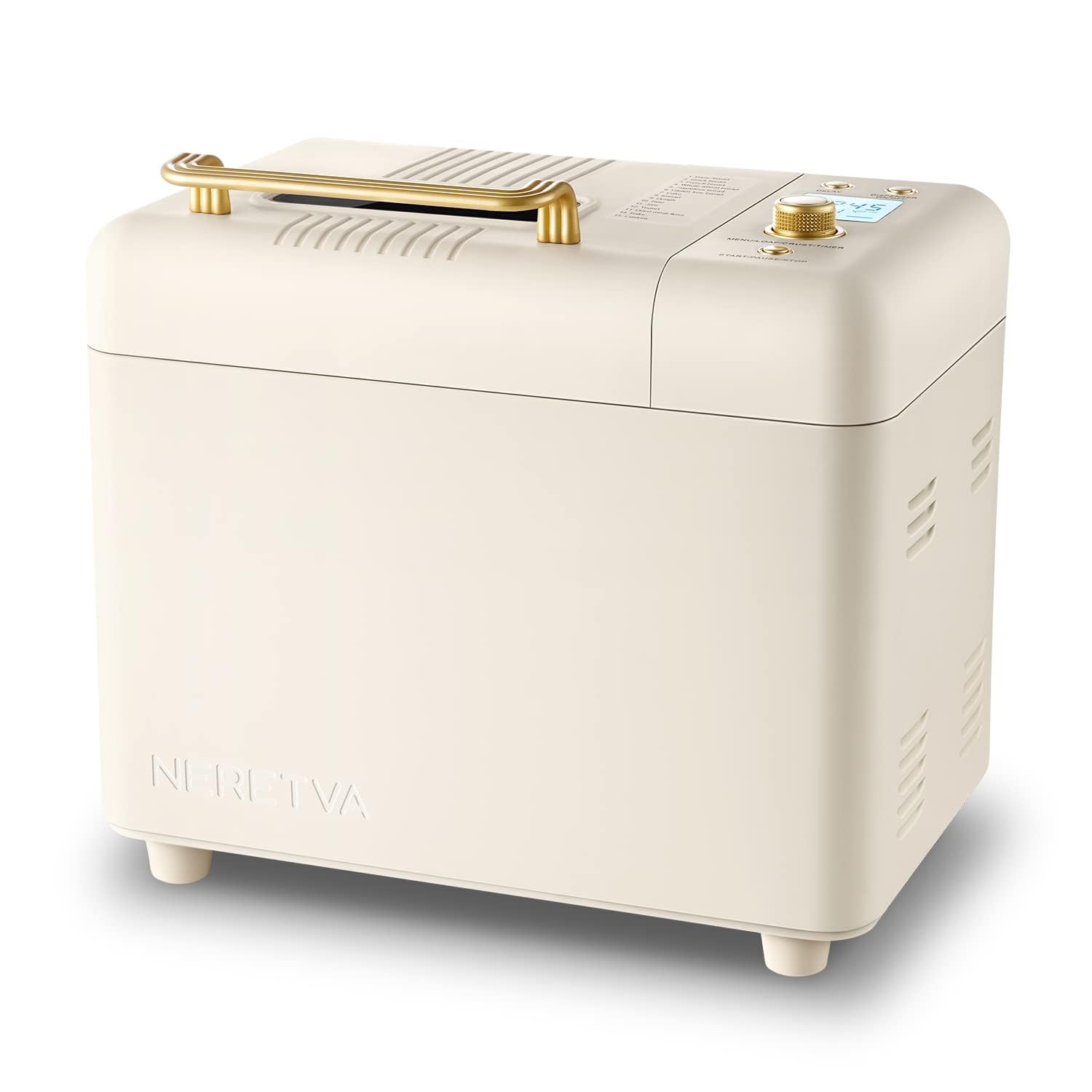
At this lower price, you get a 15.8-pound machine with dual heaters (one at the bottom, one at the top) providing 360-degree surrounding heat for a golden-brown crust on the top and sides, not just the bottom. The maximum loaf size is 2.2 pounds, serving 6 to 7 people comfortably, and the weight directly translates to stability during kneading — it is the second-heaviest machine in this lineup, only the KBS is heavier.
The 15 preset programs cover the basics plus a dedicated sugarless setting and a homemade mode. The automatic fruit and nut dispenser is removable and releases add-ins at the optimal time, so raisins or walnuts get evenly distributed rather than sinking to the bottom. Owners mention the machine is “easy to use and clean” and that the bread comes out “crispy outside, moist inside.” One buyer mentioned that the kneading arm leaves a small hole in the loaf bottom, but a hook is included to remove the paddle after the final knead to fix that.
The honest limit is noise — at 40 decibels during kneading, the Neretva is noticeably louder than the KBS or KITCHENARM. If you plan to run it overnight, you might hear it from the bedroom. But for a dual-heater machine with a large ceramic pan and a 15-hour delay timer, the value here is strong for family-sized baking. This is the exact budget buyer it is perfect for: someone who wants a dual-heater machine for family-sized loaves, does not need a 3-pound loaf, and is willing to accept a slightly higher noise level to save money.
Why we’d pick it
- Dual heaters for even browning on top and bottom
- Large 2.2 lb loaf capacity — serves 6-7 people
- Automatic fruit and nut dispenser
A few caveats
- Audible during kneading (around 40 dB) — not ideal for overnight use
- Kneading arm leaves a small hole if not removed before final rise
6. Hamilton Beach Digital Bread Maker (29987)

This machine is perfect for the budget-conscious buyer who mainly bakes 1-pound or 1.5-pound loaves and does not mind the occasional mess at the full 2-pound capacity.
It weighs 9.3 pounds — about the same as the KITCHENARM — and it is compact enough to fit under most upper cabinets. For a budget-friendly machine, it covers a surprising number of bases. What you give up is build refinement. Customers note that the lid is too short for a 2-pound loaf — the dough touches the lid during rising and leaves a mess. There is also an initial strong chemical smell that fades after a few empty cycles. The kneading paddle coating can wear off after two months, according to some users, and the machine is loud enough during kneading that it may not suit an open-plan kitchen. On the plus side, the removable non-stick pan and paddle are dishwasher-safe, making cleanup easy.
If your priority is keeping the initial investment low while still getting a reliable loaf, the Hamilton Beach delivers — just stick to the smaller loaf sizes. If you can stretch your budget, the KITCHENARM gives you quieter operation and more programs.
Strong points
- 14 settings including three express cycles for quick baking
- Removable non-stick pan and paddle are dishwasher-safe
- Compact and lightweight — easy to store
Before you buy
- Lid is too short for 2 lb loaves — dough can touch and create a mess
- Initial chemical smell requires a few empty cycles to dissipate
7. Starfrit Electric Bread Maker
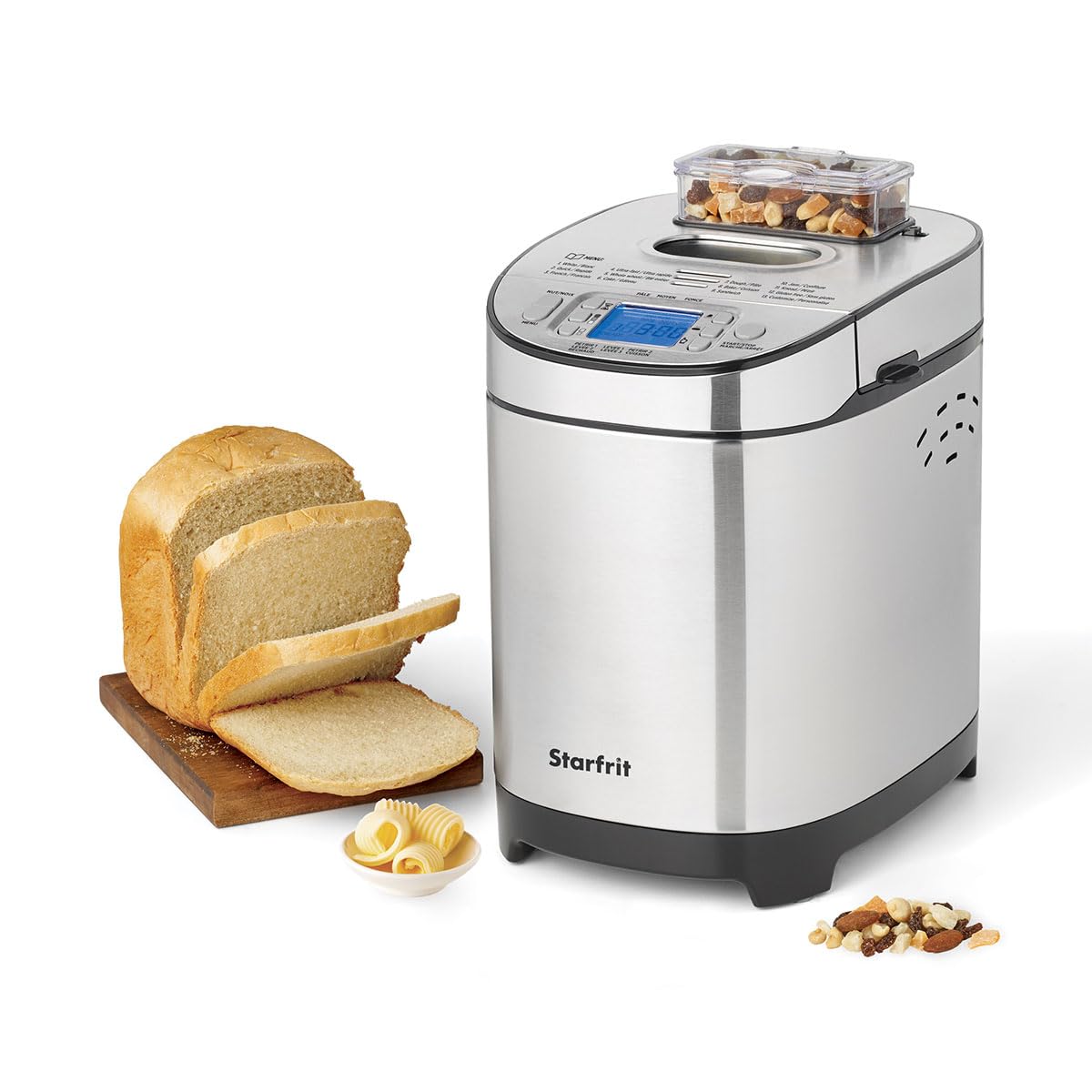
The Starfrit Electric Bread Maker sits in a similar price range to the Hamilton Beach but takes a different approach — it offers 13 preset programs versus 14, but it includes an automatic nut dispenser and a gluten-free setting that the Hamilton Beach lacks at this price level. It also has a large viewing window so you can watch the loaf rise without opening the lid. For the buyer who wants a few more conveniences without jumping to a premium price, this is the middle-ground option.
What that money gets you is a stainless steel body, a removable non-stick pan with a single kneading blade, and a 13-hour delay timer. The machine bakes 1.5-pound or 2-pound loaves, and the vertical pan shape produces a taller loaf that some buyers find less convenient for sandwich slices. One reviewer who “chosen on friend’s recommendation” reports that the machine “works great” and the nut dispenser is a nice plus, though they dislike the vertical loaf shape. The machine is also hand-wash only, which adds a step to cleanup compared to dishwasher-safe competitors.
The one clear reason to choose the Starfrit over the field is if you value the automatic nut dispenser and want a gluten-free cycle in a price-conscious package. It is not the most refined machine on the list, but for the features it packs at this cost, it represents a solid entry-level choice that punches slightly above its weight. If a horizontal loaf shape matters for your sandwiches, the Briskind BM8206 is a better fit.
What we like
- Automatic nut dispenser for evenly distributed add-ins
- Large viewing window to monitor the bake
- Stainless steel body for durability
The downsides
- Vertical loaf shape can be less practical for sandwich slicing
- Hand wash only — not dishwasher safe
Understanding the Specs
Loaf Size and Capacity
Most bread machines let you choose between 1-pound, 1.5-pound, and 2-pound loaves. A 2-pound loaf serves about 4 to 6 people for sandwiches. Models like the KBS go up to 3 pounds, which is useful for larger households but takes up more counter space and produces a taller loaf that may not fit all toasters. Pick your capacity based on how much bread your household actually eats in a day or two — bread stored longer than that tends to go stale, even in a sealed bag.
Dual Heaters vs Single Heaters vs Convection
A single bottom heating element is the most basic setup — it works, but the top of the loaf often stays pale. Dual heaters add a top element, which gives you a golden-brown crust all around. A convection fan (found on the Cuisinart CBK-210) actively moves hot air around the pan, reducing hot spots and giving you more even browning. If you bake bread that you serve without slicing — like artisan rounds or boules — dual heaters or convection makes a visible difference in the final appearance.
Preset Programs and Custom Cycles
The number of preset programs (12, 15, 19, 20) sounds impressive, but what actually matters is whether the machine has the cycles you will use. A gluten-free cycle adjusts the rise and bake time for flours like almond or rice that behave differently than wheat. A sourdough starter cycle is rare and valuable if you want to maintain your own starter. A custom or homemade program that lets you set your own knead, rise, and bake times is the most future-proof feature — it keeps the machine useful once you graduate from the included recipes.
Motor Power and Noise Level
Motor power is measured in watts (typically 550W to 750W for bread machines). A higher wattage motor can knead stiffer doughs (like whole wheat or rye) more effectively, but it also creates more vibration. Noise level is measured in decibels (dB). For comparison: a quiet library is about 30 dB, normal conversation is 40-60 dB, and a vacuum cleaner is about 70 dB. Machines under 40 dB are unlikely to disturb you in another room. Heavier machines (over 12 pounds) tend to be quieter because the extra mass absorbs vibration. If you plan to run the machine overnight, prioritize a model with a brushless motor — these are significantly quieter than traditional motors.
FAQ
Can I use regular all-purpose flour instead of bread flour in a bread machine?
Why does my bread machine loaf have a hole in the bottom?
How long does homemade bread from a bread machine stay fresh?
Can I bake gluten-free bread in any bread maker?
What is the difference between a ceramic pan and a regular non-stick pan?
Final Thoughts: The Verdict
Across the board, the best bread makers winner is the KITCHENARM 19-in-1 because it balances 19 programs, a quiet motor, and a beginner-friendly experience at a price that undercuts many competitors. If you want the largest loaf capacity and near-silent operation, grab the KBS MBF-060. And for convection baking that produces consistent, bakery-quality crusts, the standout is the Cuisinart CBK-210.