
Our readers keep the lights on and the weekend projects moving. As an Amazon Associate, I earn from qualifying purchases.
Specs are compiled from manufacturer listings and verified buyer reviews and can change over time — please confirm the key details on the product page before buying.
An all-in-one computer tucks a full desktop inside your screen, so you skip the separate tower that eats up desk space. The hard part is finding one that feels fast for your daily jobs without sneaking past your budget, especially when a sluggish machine can turn checking email into a chore.
I’m Rikta — the founder and writer behind FitlyFast. This guide is built by comparing the manufacturers’ published specifications and the patterns across verified customer reviews, so you get each pick’s real strengths and trade-offs instead of marketing spin.
If you are setting up a home office, helping a student, or just want a cleaner desk, this breakdown of the best all in one computer under 1000 focuses on the specs that actually decide how long the machine will stay fast and useful.
Quick Picks
- Acer Aspire C24 AIO Desktop — Best Overall
- HP 24 Touchscreen All-in-One Desktop — Touchscreen Pick
- HP 24 inch All-in-One Desktop PC, AMD Ryzen 7 — Premium Pick
- Dell 24 All-in-One Desktop (EC24250) — Reliable Choice
- Lenovo IdeaCentre All-in-One Desktop — Best Value
- Lenovo 24″ FHD All-in-One Desktop, 16GB RAM — 16GB Budget
- HP 21.5″ FHD All-in-One Desktop — Compact Design
- STGSivir All in One Desktop Computer — Budget Pick
- 24″ All-in-One Desktop PC with Windows 11 (Core Innovations) — Entry Level
How To Choose The Best All In One Computer Under 1000
Picking an all-in-one under is a trade-off between a snappy processor, enough memory for your apps, and a screen that is easy on your eyes. Here is what to check before you buy.
Processor (CPU): The Engine of Your Computer
The processor decides how quickly your computer responds. For under, you will see Intel N-series chips (N100, N5095) and AMD Ryzen 5 or Intel Core i5/i3. An AMD Ryzen 5 or Intel Core i3/i5 is generally much faster than an Intel N-series for multitasking and running heavier software.
Memory (RAM) and Storage: The Key to Long-Term Speed
RAM lets your computer work on several tasks at once. Aim for at least 8GB, but 16GB is far better for keeping things smooth over the next few years. Storage speed matters as much as space: a solid-state drive (SSD) is much faster than an old-style hard drive. Avoid computers with only 64GB or 128GB of storage as Windows 11 updates can quickly fill it up.
Display: What You Look at All Day
A Full HD (1920×1080) IPS display gives you good colors and wide viewing angles. An anti-glare coating helps if you sit near a window. A 120Hz refresh rate, like on the Acer Aspire C24, makes the screen feel exceptionally smooth when you move your mouse or scroll through web pages.
Quick Comparison
| Model | Best For | CPU Max Speed | RAM | Storage | Amazon |
|---|---|---|---|---|---|
| Acer Aspire C24 | Best Overall Performance | 4.3 GHz | 16 GB | 512 GB SSD | Amazon |
| HP 24 Touchscreen | Touchscreen & Large Storage | 3.4 GHz | 16 GB | 1 TB SSD | Amazon |
| HP AMD Ryzen 7 | Premium Processor Power | — | 16 GB | 512 GB SSD | Amazon |
| Dell 24 | Reliable Brand & Service | 4.7 GHz | 8 GB | 512 GB SSD | Amazon |
| Lenovo IdeaCentre | Best Value for Home Office | 3.4 GHz | 8 GB | 512 GB SSD | Amazon |
| Lenovo 24″ 16GB | Budget with 16GB RAM | 3.4 GHz | 16 GB | 128 GB SSD | Amazon |
| HP 21.5″ | Small Desk Setup | 3.4 GHz | 8 GB | 128 GB SSD | Amazon |
| STGSivir i5 | Large 1TB Storage on a Budget | 3.6 GHz | 16 GB | 1 TB SSD | Amazon |
| Core Innovations 24″ | Entry-Level / Basic Tasks | 2.9 GHz | 4 GB | 128 GB | Amazon |
In‑Depth Reviews
1. Acer Aspire C24 AIO Desktop
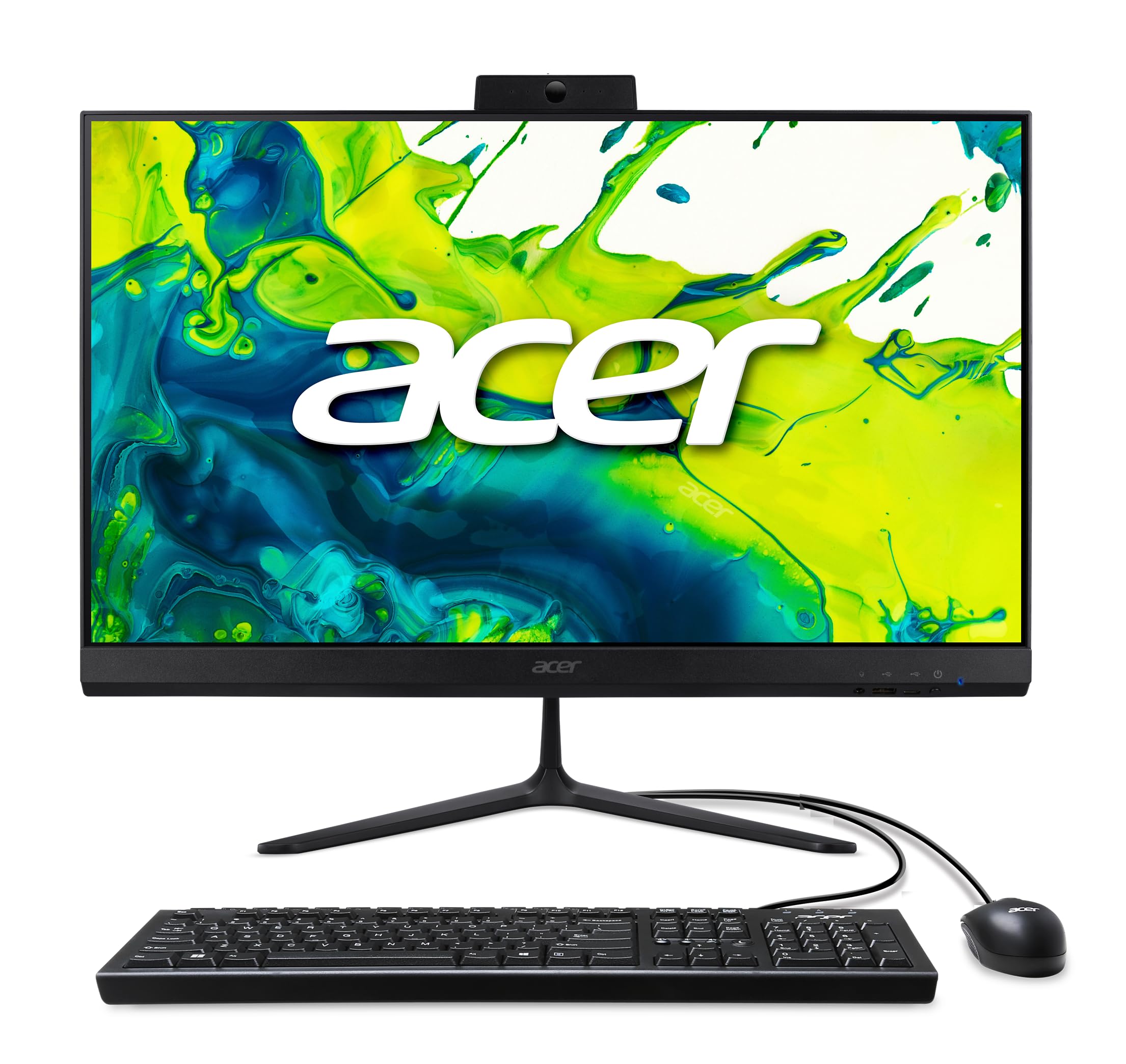
The one that makes everyday computing feel buttery smooth with a fast screen and processor.
This Acer gives you an experience that feels a step above the rest, thanks to its 23.8-inch Full HD IPS display with a 120 Hz refresh rate. That higher refresh rate means the mouse cursor glides smoothly and scrolling through web pages feels fluid, a big improvement over standard 60Hz screens.
Inside, the AMD Ryzen 5 7430U hexa-core processor (which boosts up to 4.3 GHz) and 16 GB of DDR4 RAM handle a dozen browser tabs, video calls, and office documents without hesitation. Its 512 GB PCIe NVMe SSD is plenty fast for starting up in seconds, and the Wi-Fi 6E connection keeps downloads speedy. Buyers report that the performance is smooth and the display is sharp, though some mention the fan can be quite loud straight from the start—one reviewer noted it caused anxiety and they returned it.
Why It Leads
- 120Hz display is noticeably smoother than a standard 60Hz screen
- AMD Ryzen 5 7430U processor (up to 4.3 GHz) beats the Intel N100 chips found in cheaper models
- 16GB of RAM and a 512GB SSD give you a responsive feel for years
The Trade-offs
- Fan noise can be noticeable from the start; one review called it “very loud”
- Some users reported difficulty with connecting certain printers
The smart buy: If you want a machine that feels fast today and will still feel fast a few years from now, this Acer is the one to get.
One thing to know: The fan can run loud; adjusting your power settings might help, but it is a known quirk of this model.
2. HP 24 Touchscreen All-in-One Desktop

The touchscreen machine that puts 1TB of storage right at your fingertips.
If you like tapping and swiping on your screen, this HP is the obvious choice. It has a 23.8-inch Full HD IPS touch display with anti-glare technology, so you can interact with apps directly without a mouse.
It runs on an Intel N100 processor with 16GB of DDR4 RAM, and the biggest storage in this roundup: a 1TB PCIe SSD. That is double the space of most rivals, meaning you can keep all your photos, videos, and files on the machine itself. One buyer mentioned they “love the touchscreen” and found the setup quick and easy. The downside is that the Intel N100 processor is not as powerful as the AMD Ryzen 5 in the Acer or the Dell, so heavy multitasking might feel slower.
Standout Features
- 23.8-inch Full HD IPS touchscreen with anti-glare finish
- Massive 1TB PCIe SSD for all your files
- 16GB of DDR4 RAM for smooth everyday multitasking
Points to Consider
- The Intel N100 processor is not as fast as the Ryzen 5 or Core i3 in other picks
- Some buyers found a learning curve moving from Windows 10
Reach for this if: You want a touchscreen for easier navigation or you need a full terabyte of storage for your files.
Look elsewhere if: You need raw processing power for demanding software—the N100 chip is a basic processor.
3. HP 24 inch All-in-One Desktop PC, AMD Ryzen 7

Serious processor power that cuts your workload time down, paired with a sharp display.
This HP packs the most powerful processor on this list—an AMD Ryzen 7 7730U—which is a big jump from the Intel N100 chips. A buyer reported that tasks which used to take an hour were cut to 30 minutes with this machine, so you feel the speed immediately when editing photos, doing video calls, or running several apps at once.
It has a 23.8-inch Full HD three-sided micro-edge display, 16GB of RAM, and a 512GB SSD. The pop-up privacy camera and dual array microphones with noise reduction make it a strong choice for Zoom calls and remote work. Reviewers also praise the bright display and the better-than-average 8MP camera, though some note it needs an extra USB port and the stand does not adjust for height.
Why It Stands Out
- AMD Ryzen 7 7730U is the fastest processor in this price range
- 512GB SSD is 15x faster than a traditional hard drive, per the spec
- Pop-up privacy camera and noise-reduction microphones for clear calls
Things to Note
- The stand is not adjustable, so you need to set the screen height carefully
- A few buyers wished for one more USB port on the back
Best for power users: If you run demanding software or multitask heavily, this Ryzen 7 machine is the premium pick for speed.
The catch: You lose out on an adjustable stand and you only get the basic port selection.
4. Dell 24 All-in-One Desktop (EC24250)

A solid, quiet machine from a major brand that comes with onsite service if something goes wrong.
This Dell brings the confidence that comes with 1 Year Onsite Service—if a hardware issue pops up, Dell comes to you to fix it. The 23.8-inch FHD IPS display covers 99% sRGB for accurate colors and includes ComfortView Plus to cut down on blue light for longer work sessions.
It is powered by an Intel Core 3 100U processor (up to 4.7 GHz) with 8GB of DDR5 RAM and a 512GB SSD. If you keep many browser tabs open or run heavy spreadsheets, you may feel the limit.
What Makes It Reliable
- 1 Year Onsite Service from Dell for hardware repairs
- Intel Core 3 100U processor (up to 4.7 GHz) is very fast for daily tasks
- ComfortView Plus reduces blue light for comfortable long viewing
Points to Consider
- Only 8GB of RAM, which limits heavy multitasking
- No fingerprint reader biometric security feature
Go for it if: You want a Dell with reliable service and a great display for office work, and you do not need more than 8GB of RAM.
skip it if: You are a heavy multitasker or gamer who really needs 16GB of RAM for smooth performance.
5. Lenovo IdeaCentre All-in-One Desktop
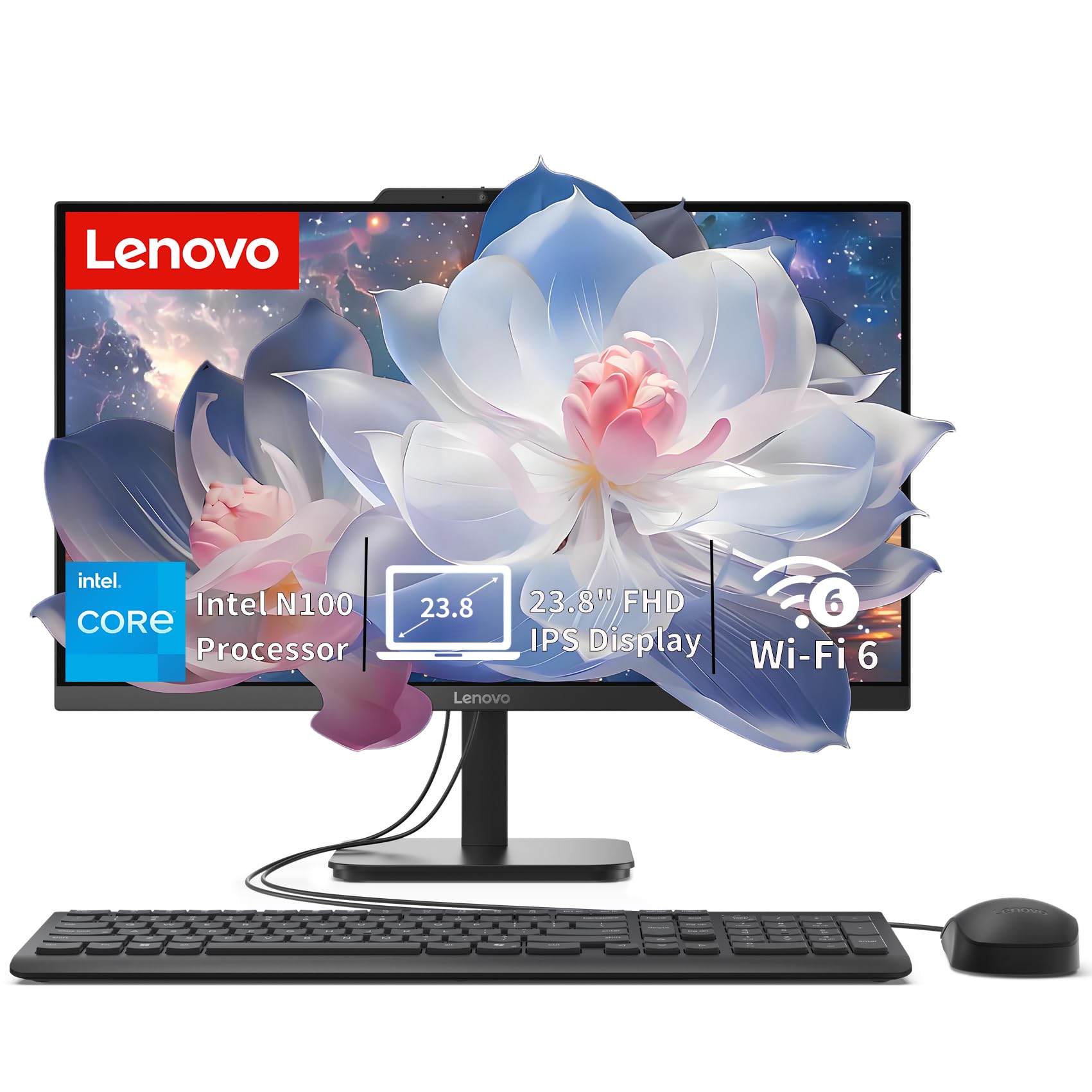
A well-rounded, anti-glare workhorse that punches above its price for home office use.
This Lenovo gives you a solid all-around package without the premium price. The 23.8-inch Full HD IPS anti-glare display has 250 nits brightness and 99% sRGB color coverage, so it looks vibrant even in a bright room.
Inside, an Intel N100 processor (up to 3.4 GHz), 8GB of DDR4 RAM, and a fast 512GB PCIe SSD handle everyday tasks smoothly. The Wi-Fi 6 and Bluetooth 5.2 connectivity are modern and reliable. One buyer who got it as an open box said it is an “excellent machine” and a “steal deal,” praising the stunning display. The main trade-off is the 8GB RAM, which matches the Dell but falls short of the 16GB found in the Acer and the HP Ryzen 7 models.
What Shines
- 23.8-inch FHD IPS anti-glare display is excellent for a bright home office
- 512GB PCIe SSD provides fast boot and app launch speeds
- Modern Wi-Fi 6 and Bluetooth 5.2 for reliable wireless
Things to Know
- 8GB of RAM is fine for light work but may limit heavy multitasking
- The USB port locations on the back are hard to reach, per some user reviews
Best for home offices: If you want a sharp, anti-glare screen and fast storage for a fair price, this Lenovo is a top value pick.
A limitation: If you are a power user who opens dozens of tabs, you will want the 16GB RAM models above.
6. Lenovo 24″ FHD All-in-One Desktop, 16GB RAM
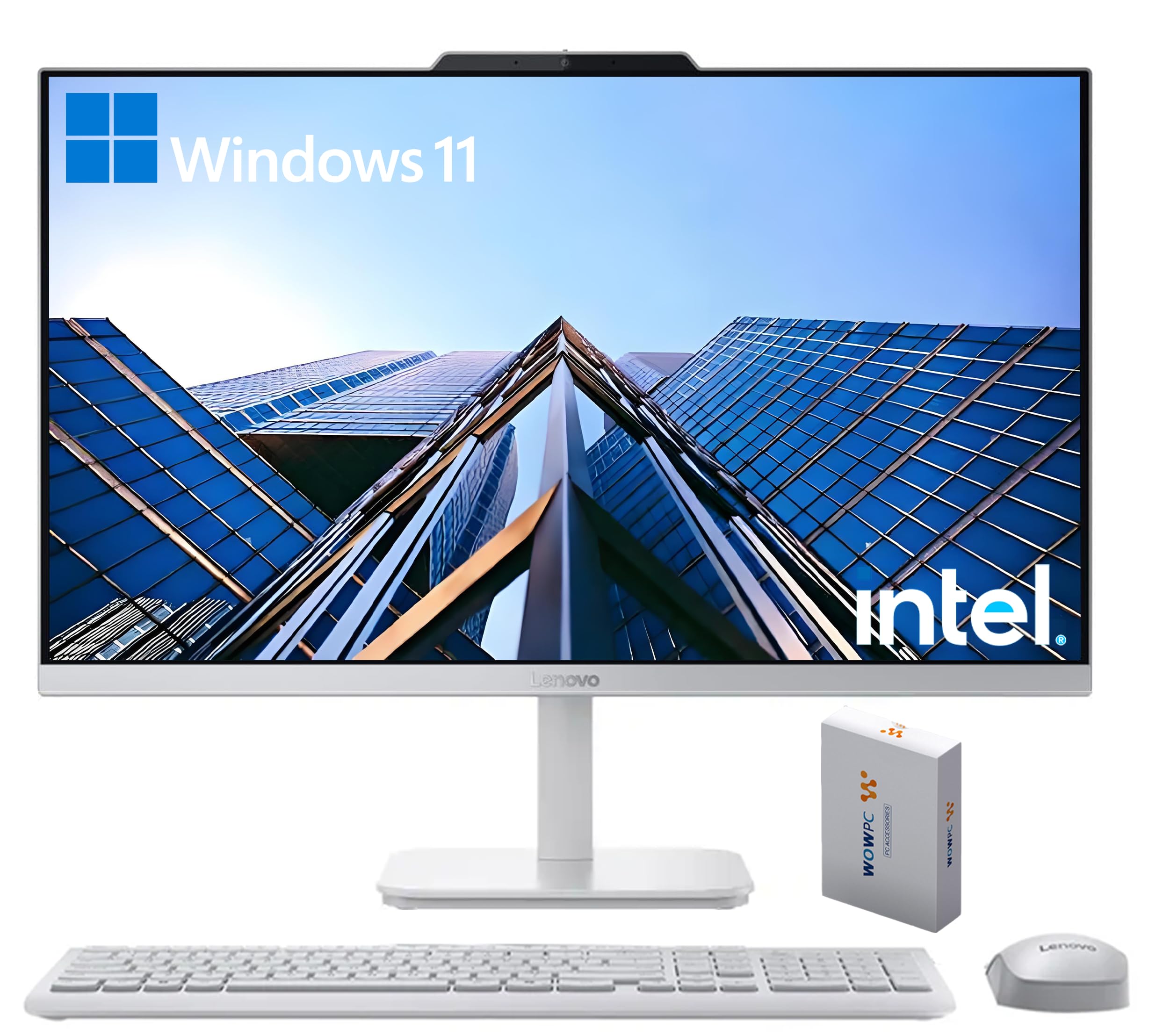
A budget-friendly way to get 16GB of RAM, but with a small storage limit.
This Lenovo is a clever choice if you need 16GB of RAM for smooth multitasking but cannot stretch your budget further. The extra memory means you can keep many browser tabs and apps open without slowdowns, unlike the 8GB models.
It runs on an Intel N100 processor (up to 3.4 GHz) and has a 23.8-inch FHD IPS display. The trade-off is the storage: only a 128GB PCIe SSD, which is a tiny fraction of the 512GB you get on the Acer. Windows 11 and your essential apps will fill that 128GB quickly. Some buyers reported keyboard issues where the @ symbol did not type where it should. If you are comfortable managing external storage, the 16GB RAM is a big plus for this price.
The Big Draw
- 16GB DDR4 RAM handles heavy multitasking well
- 23.8-inch FHD IPS anti-glare display with 99% sRGB
- Modern Wi-Fi 6 and Bluetooth 5.2 connectivity
The Limitation
- 128GB SSD is very small; you’ll need external storage or cloud drives quickly
- Some buyers reported keyboard mapping issues with special characters
Reach for this if: You want 16GB of RAM on a tight budget and are okay using a cloud service or an external hard drive for extra space.
Look elsewhere if: You need to store many local files—128GB fills up fast with Windows and a few apps.
7. HP 21.5″ FHD All-in-One Desktop
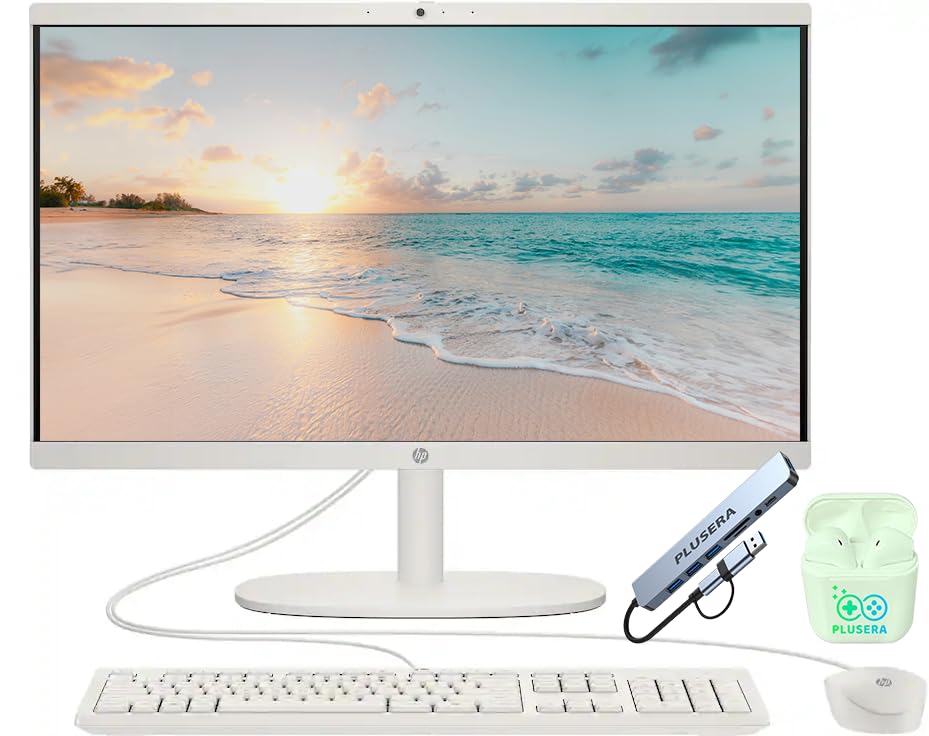
A smaller, space-saving screen with a clever docking station for extra storage.
If your desk is tight, this HP’s 21.5-inch display is a good fit, and it still delivers Full HD resolution (1920×1080) on its VA display. It is powered by the Intel N100 processor with 8GB of RAM and a 128GB SSD, plus an included docking station that adds 256GB of additional storage (for a total of 384GB).
The speakers are tuned by DTS Audio, and the stand adjusts from -6° to 21° tilt. Owners mention it is “super sexy” and “super fast” and that it runs with no bloatware. One review noted facial recognition sign-in feels a bit clumsy. The 8GB of RAM is adequate for basic tasks like web browsing and document editing, but the smaller 21.5-inch screen might feel cramped if you are used to a 24-inch monitor.
Strengths
- Compact 21.5-inch screen saves desk space
- Total storage of 384GB (128GB internal + 256GB docking station)
- Adjustable tilt stand ( -6° to 21° ) for comfort
Weaknesses
- 21.5-inch screen is smaller than the standard 24-inch picks
- Only 8GB of RAM for everyday multitasking
Best for tight desks: If you have limited space and need a compact, good-looking machine, this HP is a solid choice.
Not for you if: You want a larger display or need more than 8GB of RAM for heavy work.
8. STGSivir All in One Desktop Computer
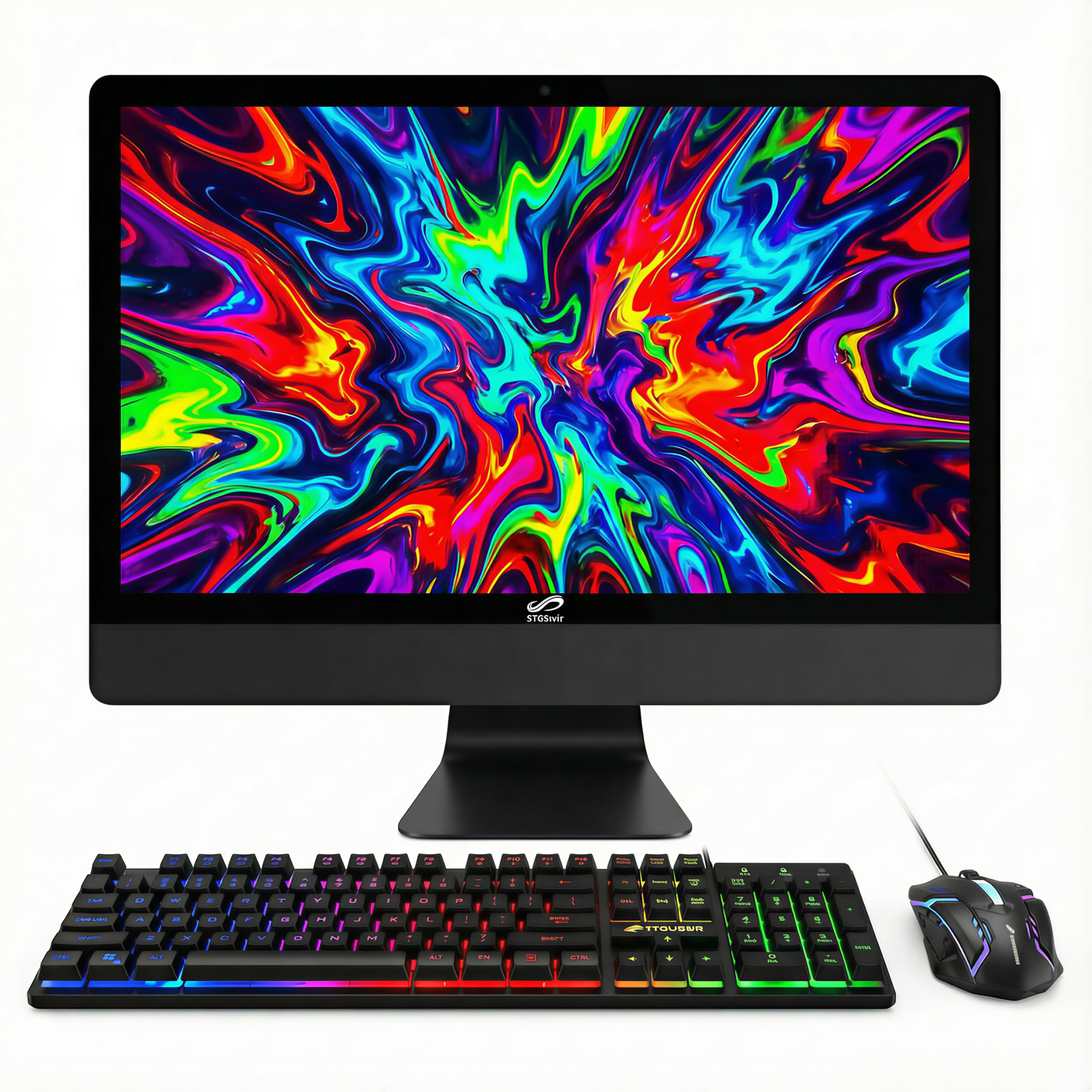
Big storage and an older Core i5 processor at a price that is tough to top.
This STGSivir machine stands out for its specs at a very competitive price: an Intel Core i5 3470T processor (up to 3.6 GHz), 16GB of RAM, and a huge 1TB solid-state drive.
It features a 24-inch Full HD LED display and comes with an RGB keyboard and mouse for a bit of flair. However, the Core i5 3470T is an older processor, and the brand carries some reliability risk. A buyer reported the computer failed after 2 uses within 30 days, getting a blue screen on the third boot. Another less serious issue: the colorful keyboard lights turn off periodically. The one-year parts and labor warranty is a nice safety net, but build quality is a concern.
Specs That Pop
- 16GB of RAM and a spacious 1TB SSD for storage and multitasking
- Intel Core i5 processor (up to 3.6 GHz) for decent speed
- Includes RGB keyboard and mouse; one-year parts & labor warranty
Real Buyer Concerns
- A buyer reported the computer failed after only 2 uses (blue screen on third boot)
- The CPU is an older generation compared to the N100 or Ryzen 5
For the bargain-hunter: If you are willing to trade some reliability for a huge 1TB drive and 16GB of RAM, this could be worth the gamble.
Serious caveat: Several reviews point to early failures, so the build quality is not as consistent as with the Acer, Dell, or Lenovo options.
9. 24″ All-in-One Desktop PC with Windows 11 (Core Innovations)

The most affordable way to get a 24-inch screen, but with strict limits on performance.
This Core Innovations machine is the cheapest entry point into the all-in-one world. It has a 24-inch Full HD IPS display and runs on a 2.9 GHz Intel Celeron N5095 processor with 4GB of RAM and 128GB of storage. That 4GB of RAM is just a quarter of the 16GB found in the Acer, making it only suitable for very light tasks like a single browser window or a word processor.
Some customers note it is “good for school use” and works well for basic tasks. But a very serious review warned “All four units defective within eight months,” saying the manufacturer refused warranty support. The screen stand does not tilt, so you may need a riser to get a comfortable angle. If your budget is absolutely tight, this works; otherwise, spending a bit more gets you a much more reliable machine.
The Upside
- Big 24-inch Full HD IPS screen at the lowest possible entry price
- Comes with Windows 11 and a keyboard
The Downsides
- Only 4GB of RAM (a 4.0x gap vs the Acer’s 16GB) — too little for smooth Windows 11 multitasking
- Multiple buyers reported units failing within months with no warranty support
- The stand does not tilt, causing an awkward viewing angle
Only for the truly tight budget: If you absolutely cannot spend more and just need a screen for a very simple task, it will work.
Strongly consider skipping: The reliability reviews are alarming; spending a bit more on the Lenovo IdeaCentre or another pick will give you a vastly better and more reliable experience.
Understanding the Specs
RAM (Memory)
RAM is your computer’s short-term memory for the tasks you are doing right now. More RAM means you can keep more browser tabs, documents, and apps open at the same time without the computer slowing down. For a smooth Windows 11 experience, 8GB is the bare minimum, but 16GB is the balance for comfortable multitasking over several years. Systems with only 4GB of RAM will feel sluggish quickly.
Storage Drive (SSD vs HDD)
The storage drive is where all your files and the operating system live permanently. A solid-state drive (SSD) is much faster than an old mechanical hard drive (HDD), meaning your computer starts up in seconds and apps open almost instantly. Look for at least a 256GB SSD. A 512GB or 1TB SSD is even better. Avoid machines that still use a HDD as the main drive, as they will feel far slower.
FAQ
Can I upgrade the RAM or storage in an all-in-one PC?
Is an Intel N100 processor fast enough for Windows 11?
What is the difference between an IPS and a VA display?
How much RAM do I really need in 2024 for a home office computer?
Can I use an all-in-one PC as a monitor for another computer?
What does a 120Hz refresh rate do on an all-in-one?
Do all-in-one computers have built-in webcams and microphones?
What is the difference between a 128GB SSD and a 512GB SSD for storage?
Will a cheap all-in-one under run video editing software?
Do all-in-one PCs get slower over time?
Final Thoughts: The Verdict
For most people, the all in one computer under 1000 winner is the Acer Aspire C24 because it combines a fast AMD Ryzen 5 processor, a smooth 120Hz display, and a generous 16GB of RAM and 512GB SSD, making it feel premium without the high price. If you want top-tier processing power for demanding tasks, grab the HP with the AMD Ryzen 7. And for a touchscreen experience with the largest 1TB storage, the standout is the HP 24 Touchscreen.
How We Picked
We do not accept paid placement. Every pick is matched to a real buyer and a real use-case; we do not hands-on test units.
Sources & Methodology
Specifications: manufacturer listings and product documentation. Review insights: verified customer reviews, as of July 2026. Pricing: not shown on this page (it changes often); check the current price via the retailer link.
As an Amazon Associate, FitlyFast earns from qualifying purchases. This does not affect which products we feature.