
Our readers keep the lights on and the weekend projects moving. As an Amazon Associate, I earn from qualifying purchases.
Specs are compiled from manufacturer listings and verified buyer reviews and can change over time — please confirm the key details on the product page before buying.
Imagine grabbing your go-bag and needing it to hold food, water, and shelter for miles of walking without wrecking your shoulders. Your pack has to balance real storage space with a frame that shifts the weight to your hips, so you can keep moving when it counts. This guide breaks down five options, from a budget-friendly 50-liter starter to a premium 36-liter load hauler built for serious miles, so you can match the right bag to your body and your plan.
I’m Rikta — the founder and writer behind FitlyFast. This guide is built by comparing the manufacturers’ published specifications and the patterns across verified customer reviews, so you get each pick’s real strengths and trade-offs instead of marketing spin.
Knowing which bag for bugging out actually carries weight well, survives rough handling, and keeps your gear organized is what separates a useful pack from a painful mistake on the trail.
Quick Picks
- Large Internal Frame Backpack Tactical MOLLE Pack for Camping Backpacking Hunting Bushcraft Adventure 70L (by XMILPAX) — Best Overall
- Kelty Redwing Tactical Backpack – Built to Military Specification, 50L — Versatile Workhorse
- 5.11 Tactical Backpack, RUSH 24 2.0, 37L — Compact Survivor
- MAXPEDITION Gyrfalcon Backpack, 36L — Premium Hauler
- Mardingtop 50L Hiking Backpack — Budget Starter
How To Choose The Best Bag For Bugging Out
Picking a bug-out bag means matching volume, weight, and durability to your specific scenario. Too small and you leave gear behind; too large and you haul empty space that slows you down. Here are the three criteria that matter most when you are shopping for a survival pack that actually gets used.
Capacity — Match Liters to Your Mission Duration
Capacity is measured in liters, and it is the single biggest factor that decides how many days of gear the pack can hold. A 70-liter bag is large enough for a multi-day trek with a sleeping bag, extra clothes, and a solid food supply. A 37-liter pack is tighter and better suited for a 48-hour window where you carry only the essentials — it forces discipline and keeps the weight down on your back. Look for a volume that gives you room for water, food, a first-aid kit, a shelter system, and a change of clothes without having to lash gear to the outside unless you want to.
Frame Design — Internal Frame Transfers Weight to Your Hips
An internal frame backpack uses a stiff panel inside the bag to transfer the load from your shoulders down to a padded hip belt. That design keeps the weight centered on your hips, which are built to carry it, instead of hanging off your shoulders and straining your neck. Every pack on this list uses an internal frame, but the quality of the frame and the padding varies — a well-padded hip belt with stabilizer straps makes a noticeably bigger difference on a long walk.
MOLLE Webbing — Modular Attachment for Extra Gear
MOLLE webbing (a grid of heavy-duty nylon straps sewn onto the pack) lets you attach pouches, tool rolls, and other accessories directly to the outside of the bag. That means you can organize small items — a multi-tool, compass, flashlight, or admin pouch — without digging through the main compartment. A pack covered in MOLLE gives you room to grow your loadout as your needs change, but if you prefer a clean, low-profile bag, MOLLE can also just sit there unused.
Quick Comparison
| Model | Best For | Capacity | Weight | Material | Amazon |
|---|---|---|---|---|---|
| XMILPAX 70L | Long-Duration Hauls | 70L | Not Listed | 1000D Polyester | Amazon |
| Kelty Redwing 50 | Daily Carry + Bug Out | 50L | 4.1 lbs | Nylon | Amazon |
| 5.11 RUSH 24 2.0 | Urban to Trail Versatility | 37L | Not Listed | 1050D Nylon | Amazon |
| Maxpedition Gyrfalcon | Rugged Long Treks | 36L | Not Listed | 1000D Ballistic Nylon | Amazon |
| Mardingtop 50L | Budget-First Setup | 50L | 4.5 lbs | 600D Polyester | Amazon |
In‑Depth Reviews
1. Large Internal Frame Backpack Tactical MOLLE Pack for Camping Backpacking Hunting Bushcraft Adventure 70L (by XMILPAX)

70 liters of space with a rugged frame built for serious multi-day hauling.
The 1000D polyester fabric (a thick, heavy-duty woven material that resists tears) gives it a rugged feel, and the entire exterior is covered in MOLLE webbing so you can strap on pouches, a hatchet, or a tent without taking anything out. One buyer, a 6’1″ Marine vet, called it a rugged pack that held up well.
The internal frame uses a padded hip belt and load lifter straps to transfer weight off your shoulders, which makes a difference when you are carrying a heavy load on a long trek. The main compartment is top-loading with a heavy-duty zipper, and there is a front-loading panel underneath the outer pocket so you can reach gear near the bottom without unpacking everything. The real trade-off is the size — you can overpack this bag easily, and the dimensions (11″D x 13″W x 30″H) mean it is not a low-profile pack for tight spaces.
What Shines
- Massive 70L capacity for extended missions
- Thick 1000D polyester with smooth zippers
- Full MOLLE coverage plus padded hip belt
- Hydration bladder compatible with tube ports
The Snags
- Heavy when fully loaded; side pocket zipper curves hinder access
- MOLLE webbing is tight on some non-C-clip attachments
- Not waterproof; rain cover included but needs to be used
Ideal for: The XMILPAX 70L suit anyone who needs a single pack to carry a full base camp for three or more days and wants the modular flexibility of MOLLE webbing without spending premium-tier money.
One real limitation: If your bug-out plan involves moving quickly through dense brush or tight vehicles, this bag’s 30-inch height and large profile will feel bulky — it is a hauler, not a grab-and-go day pack.
2. Kelty Redwing Tactical Backpack – Built to Military Specification, 50L
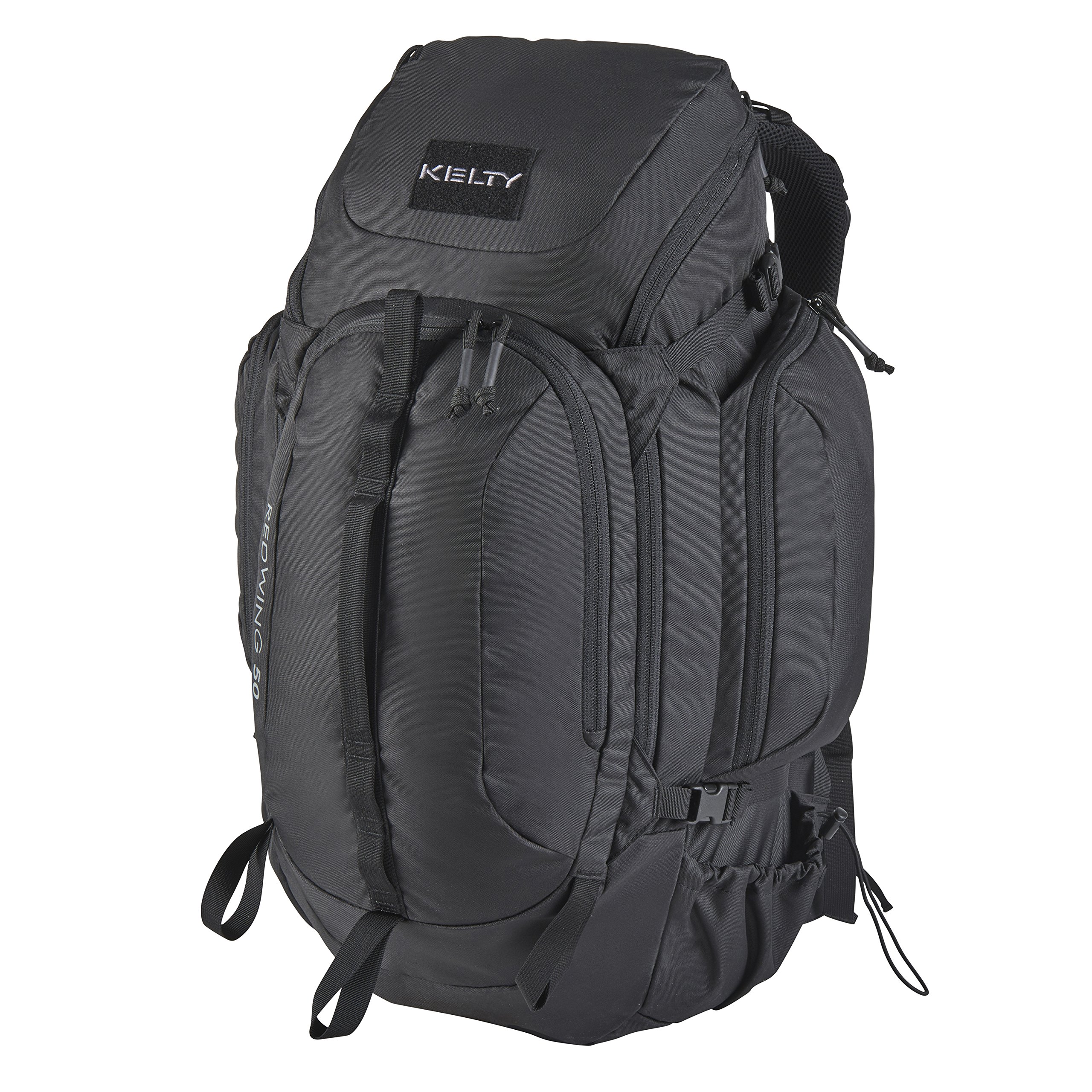
A 50-liter pack that balances daily carry with bug-out readiness at just 4.1 pounds.
At 4.1 pounds, the Kelty Redwing is a full 0.4 pounds lighter than the Mardingtop 50L, which matters on a long walk because every ounce you do not have to carry is energy saved for the trail. The hybrid-loading U-zipper design lets you open the main compartment like a suitcase, so you can pack and repack quickly without digging through a dark tube. Buyers report that it hauls 30 lbs for 2 miles daily and that the removable waist belt makes it easy to switch between a bug-out loadout and an everyday laptop bag.
The Dynamic AirFlow back panel (a ventilated foam structure that creates a gap between you and the pack) is a real comfort boost compared to the Mardingtop’s solid foam back — you stay cooler when you are moving hard. The 16-inch depth is noticeably deeper than the XMILPAX’s 11 inches, which gives you more front-to-back room for bulky gear like a sleeping bag. One reviewer noted that the side pockets are deep enough to hold a rifle buttstock rather than water bottles, so plan your accessory layout around that quirk.
Strong Points
- U-zipper full opening for easy packing
- Ventilated back panel for cooler carry
- Removable waist belt for daily versatility
- AL6061 aluminum stays for a supportive frame
Weak Points
- Side pocket shape limits water bottle options
- No top or side MOLLE webbing for extra pouches
- Bag does not stand upright on its own when unloaded
Who it fits: The Kelty Redwing is for the person who wants a single pack that works for a daily commute and still performs as a 50-liter bug-out bag without screaming “tactical” — it is low-profile enough for civilian life but rugged enough for the trail.
The honest trade-off: If you need extensive MOLLE webbing for attaching pouches to the sides and top, this bag is not the one — its PALS webbing is limited to the bottom and waist, so you will rely on the internal organization instead.
3. 5.11 Tactical Backpack, RUSH 24 2.0, 37L

37 liters of organized carry in a slim profile that moves from truck to trail without fuss.
The RUSH 24 2.0 is built from 1050D nylon (a water-repellent, heavy-duty fabric that resists abrasion and holds its shape), which is a step up in toughness from the 600D polyester on the Mardingtop. The 37-liter capacity keeps the bag compact enough to fit in an overhead bin or behind a car seat, yet the internal organization is excellent — dual top zippered pockets, a large front admin panel with slots for pens and tools, and a full main compartment with multiple mesh pockets. One owner confirmed it fits a 17-inch laptop in the padded sleeve, making it a viable EDC (everyday carry) pack that doubles as your bug-out rig.
The contoured yoke shoulder strap system and back panel ventilation channels are designed to reduce contact area and improve airflow, which is noticeable when you are moving fast in warm weather. Unlike the Maxpedition Gyrfalcon at 36L, the RUSH 24 2.0 offers a full MOLLE web platform across the front and sides, so you can attach pouches directly without needing adapters. The catch is the 37-liter volume — compared to the XMILPAX’s 70L, you are giving up a lot of cargo space, so you will need to pack lean and prioritize only the essentials for a 48-hour window.
Why It Wins
- 1050D nylon is extremely tough and water-repellent
- Excellent internal admin panel for gear organization
- Padded laptop sleeve fits up to 17-inch laptops
- Comfortable yoke strap system with ventilation
Where It Falls Short
- 37L is tight for multi-day trips beyond 48 hours
- Heavier fabric adds weight even when empty
- No dedicated hydration bladder port in the main compartment
Best for: The 5.11 RUSH 24 2.0 fits the person who wants one bag for the gym, the office, and the go-bag — it is organized, tough, and compact enough for daily use while still capable for a quick bug-out scenario.
Think twice if: You need to carry a full sleep system and multiple days of rations — at 37 liters, this pack forces hard choices on what makes the cut, so only buy it if your plan stays under 48 hours.
4. MAXPEDITION Gyrfalcon Backpack, 36L

36 liters of ballistic-nylon toughness with a detachable waist pack for on-the-go access.
The Gyrfalcon is built from 1000D ballistic nylon with a Teflon coating, which makes it both water-repellent and abrasion-resistant — the same class of material used in heavy-duty military gear. The cleverest feature is the detachable 6-liter lower pouch that clips onto the removable waist belt, turning into a standalone fanny pack or belt pack for quick access to a compass, radio, or snacks without dropping the main bag. One buyer mentioned carrying a 60-pound load for 5 miles with minimal shoulder strain, which speaks to the quality of the internal frame and padded contoured shoulder straps.
At 36 liters, this bag is almost identical in volume to the 5.11 RUSH 24 2.0, but it is built with a different philosophy — fewer internal pockets and more reliance on the MOLLE/PALS webbing (a grid of nylon straps for attaching pouches) to let you customize the layout. Genuine YKK zippers (a Japanese brand known for smooth and durable zippers) run throughout, and the leather bottom prevents moisture wicking from wet ground. The trade-off: the harness system is not adjustable for torso length, so if you are shorter or taller than average, the fit may not be as dialed as the Kelty Redwing’s system.
what separates it
- Detachable 6L waist pack for quick-access gear
- 1000D ballistic nylon with Teflon coating is waterproof-rated
- Genuine YKK zippers for durability
- Leather bottom prevents ground moisture wicking
The Drawbacks
- Non-adjustable torso harness limits fit range
- 36L is small for multi-day gear; forces lean packing
- Middle outer pouch makes back pouch hard to reach when full
Reach for this if: The Maxpedition Gyrfalcon is for the serious prepper who wants bombproof construction and modular customization — the detachable waist pack alone makes it more versatile than any other bag here for quick-access scenarios.
Look elsewhere if: You are not built for a one-size-fits-most torso harness — try the Kelty Redwing instead if you need adjustable harness height for a custom fit.
5. Mardingtop 50L Hiking Backpack
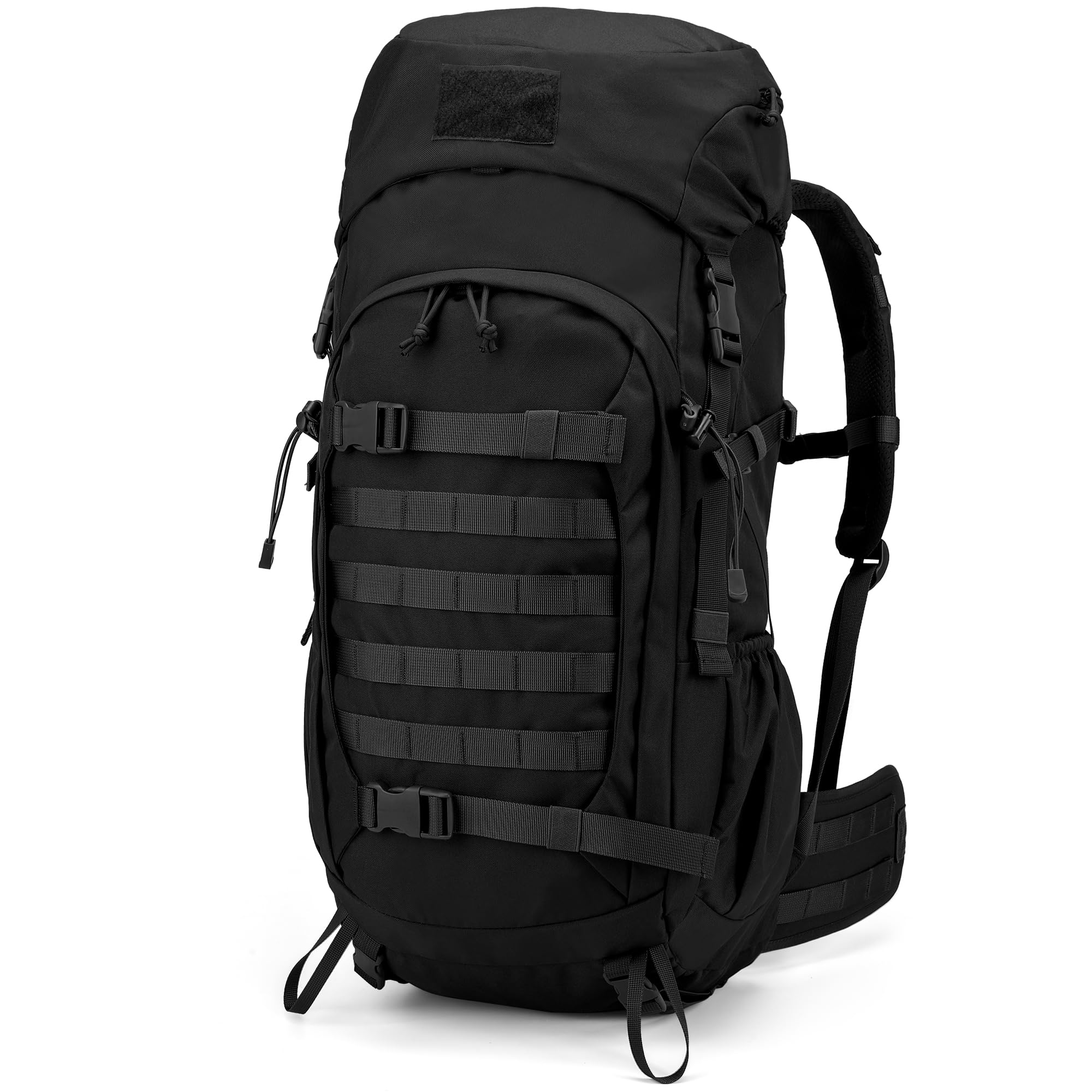
A 50-liter pack that delivers respectable capacity for the lowest entry price in this guide.
The Mardingtop is made from 600D polyester (a mid-weight woven fabric that is lighter and less abrasion-resistant than 1000D nylon) and includes a rain cover to keep your gear dry in a downpour. It is the only pack here that offers hydration compatibility up to a 5-liter bladder, which is generous — you can carry enough water for a full day without needing to refill. One owner reported using it on a 6-mile ruck and said it was great, though they noted the frame is not a full hard frame, so load transfer to the hips is softer than the XMILPAX or Kelty Redwing.
The MOLLE webbing lets you attach pouches, and the adjustable sternum strap and hip belt help customize the fit for different body sizes. At 4.5 pounds, it is the heaviest of the 50-liter options here — 0.4 pounds heavier than the Kelty Redwing — so you are paying a small weight penalty for the lower cost. Some buyers reported that the plastic buckles slip over time and that the internal organization is minimal (only a main compartment and a top pocket), so you will need packing cubes or pouches to keep smaller items from becoming a jumbled mess inside.
The Good
- 50L capacity at a budget-friendly price point
- Includes a rain cover for wet-weather protection
- Hydration sleeve fits up to a 5-liter bladder
- MOLLE webbing and adjustable straps for customization
The Not-So-Good
- Buckles can slip and may need replacement
- Minimal internal pockets; gear can jumble
- Heavier than comparable 50L packs at 4.5 lbs
- Frame is soft, less effective at weight transfer
Who this works for: The Mardingtop is a solid entry-level choice if you are on a tight budget and want a 50-liter bag that can handle a weekend bug-out scenario without a premium outlay — just plan to add some compact pouches for organization.
Who should skip it: If you plan to carry heavy loads over long distances regularly, the soft frame and slipping buckles will become frustrating — invest in the Kelty Redwing or the XMILPAX 70L for better load transfer and more durable hardware.
Understanding the Specs
Capacity in Liters
Liters measure the total internal volume of the pack. A 70-liter bag holds roughly four times the gear of a 37-liter bag — enough for a multi-day loadout with a sleeping bag, stove, food, and spare clothes. A 36-liter bag forces you to pack light and is better for a 24-to-48-hour window. Match the liter count to how many days you realistically plan to be on the move before resupplying.
Denier Fabric Weight
Denier (D) is the thickness of the nylon or polyester threads woven into the fabric. 1000D nylon is very thick and hard-wearing — it survives dragging through brush and rocky terrain. 600D polyester is lighter and cheaper but tears more easily under sharp abrasion. For a bug-out bag that will see rough use, stick to 1000D nylon or 1000D ballistic nylon for maximum durability.
FAQ
How many liters do I need in a bug-out bag?
What is the difference between 600D and 1000D fabric for bug-out bags?
Will a 36-liter bag fit a sleeping bag and a tent?
Do I need a hydration bladder in my bug-out bag?
What does MOLLE webbing mean on a backpack?
Can I use a bug-out bag as an everyday backpack?
How much weight should a bug-out bag carry?
What is the difference between a framed and frameless backpack for bugging out?
Final Thoughts: The Verdict
For the majority of shoppers, the bag for bugging out winner is the XMILPAX 70L Tactical MOLLE Pack because its 70-liter capacity, full MOLLE coverage, and thick 1000D polyester fabric give you the room and durability for extended missions without the premium price. If you want a daily-carry pack that can still bug out, grab the Kelty Redwing 50L. And for the person who values bombproof construction and modular customization above all, the standout is the Maxpedition Gyrfalcon 36L.
How We Picked
We do not accept paid placement. Every pick is matched to a real buyer and a real use-case; we do not hands-on test units.
Sources & Methodology
Specifications: manufacturer listings and product documentation. Review insights: verified customer reviews, as of July 2026. Pricing: not shown on this page (it changes often); check the current price via the retailer link.
As an Amazon Associate, FitlyFast earns from qualifying purchases. This does not affect which products we feature.