
Our readers keep the lights on and the weekend projects moving. As an Amazon Associate, I earn from qualifying purchases.
Specs are compiled from manufacturer listings and verified buyer reviews and can change over time — please confirm the key details on the product page before buying.
The real challenge is a fan that cools without sounding like a helicopter. Most fans push noise into your sleep along with air. Today’s quiet bedroom fans deliver powerful airflow while staying nearly silent, so you wake up refreshed.
I’m Rikta — the founder and writer behind FitlyFast. This guide is built by comparing the manufacturers’ published specifications and the patterns across verified customer reviews, so you get each pick’s real strengths and trade-offs instead of marketing spin.
if you need a small desk model for your nightstand or a tall tower that blends into your decor, understanding the key specs and noise levels will help you choose the right quiet bedroom fan for your space and your sleep.
Quick Picks
- DREO Smart Fan for Bedroom — Best Overall
- Rowenta Turbo Silence VU2730 — Premium Pick
- Vornado 673T Whole Room Air Circulator — Vortex Mover
- EasyAcc 12 Inch Quiet Desk Fan — Best Value
- PELONIS 7-Inch Pedestal Air Circulator — Budget Pick
- Lasko Oscillating Tower Fan T42954 — Slim Tower
How To Choose The Best Quiet Bedroom Fan
Choosing a quiet bedroom fan depends on three factors: airflow, noise level, and size. Here is what to check.
Noise Level — The Decibel Number
The most important spec for a quiet fan is its decibel (dB) rating. Because sound is logarithmic, a fan at 25 dB is about half as loud as one at 35 dB. Look for ratings at or below 30 dB on the lowest speed — that is whisper-quiet territory where the fan will not disturb your sleep. A fan advertising “silent” mode should list its dB level for direct comparison.
Airflow — Cubic Feet Per Minute (CFM)
CFM (cubic feet per minute, the volume of air the fan pushes each minute) measures how much air the fan moves. A higher CFM means more cooling power, but it often comes with more noise. The trick is finding a fan with a broad, usable speed range: a low setting around 300 CFM that is barely audible, and a high setting north of 500 CFM when you need rapid cooling. Avoid fans that jump from gentle to hurricane-force with no middle ground.
Motor Type — DC vs. AC
A brushless DC motor (direct current, which uses electronics to control speed) is almost always quieter and more energy-efficient than a standard AC motor (alternating current). DC motors also allow more speed steps — some have nine or twelve — giving you finer control over the noise-to-cooling balance. If quiet is your priority, a DC motor is a near-essential feature.
Oscillation and Size
A fan that oscillates (swivels side to side and up and down) spreads air more evenly, letting you run it at a lower, quieter speed. Pay attention to the oscillation degrees — 90° horizontal plus vertical tilt is a solid range for a bedroom. Size matters too: a 12-inch desk fan fits a nightstand, while a 42-inch tower fan covers a large room. Pick the size that matches your space so you are not running a massive fan on low all night.
Quick Comparison
| Model | Best For | Noise Level | Airflow (CFM) | Max Air Reach | Amazon |
|---|---|---|---|---|---|
| DREO Smart Fan | Smart home integration | 20 dB | 950 CFM | 85 ft | Amazon |
| Rowenta VU2730 | Ultra-quiet on low | 38 dB(A) | 1589 CFM | — | Amazon |
| Vornado 673T | Whole room circulation | — | 333 CFM | — | Amazon |
| EasyAcc 12 Inch | 3D oscillation | 25 dB | 339 CFM | 65 ft | Amazon |
| PELONIS Pedestal | Budget-friendly circulation | — | 549 CFM | 60 ft | Amazon |
| Lasko T42954 | Basic tower reliability | — | 262 CFM | — | Amazon |
In‑Depth Reviews
1. DREO Smart Fan for Bedroom
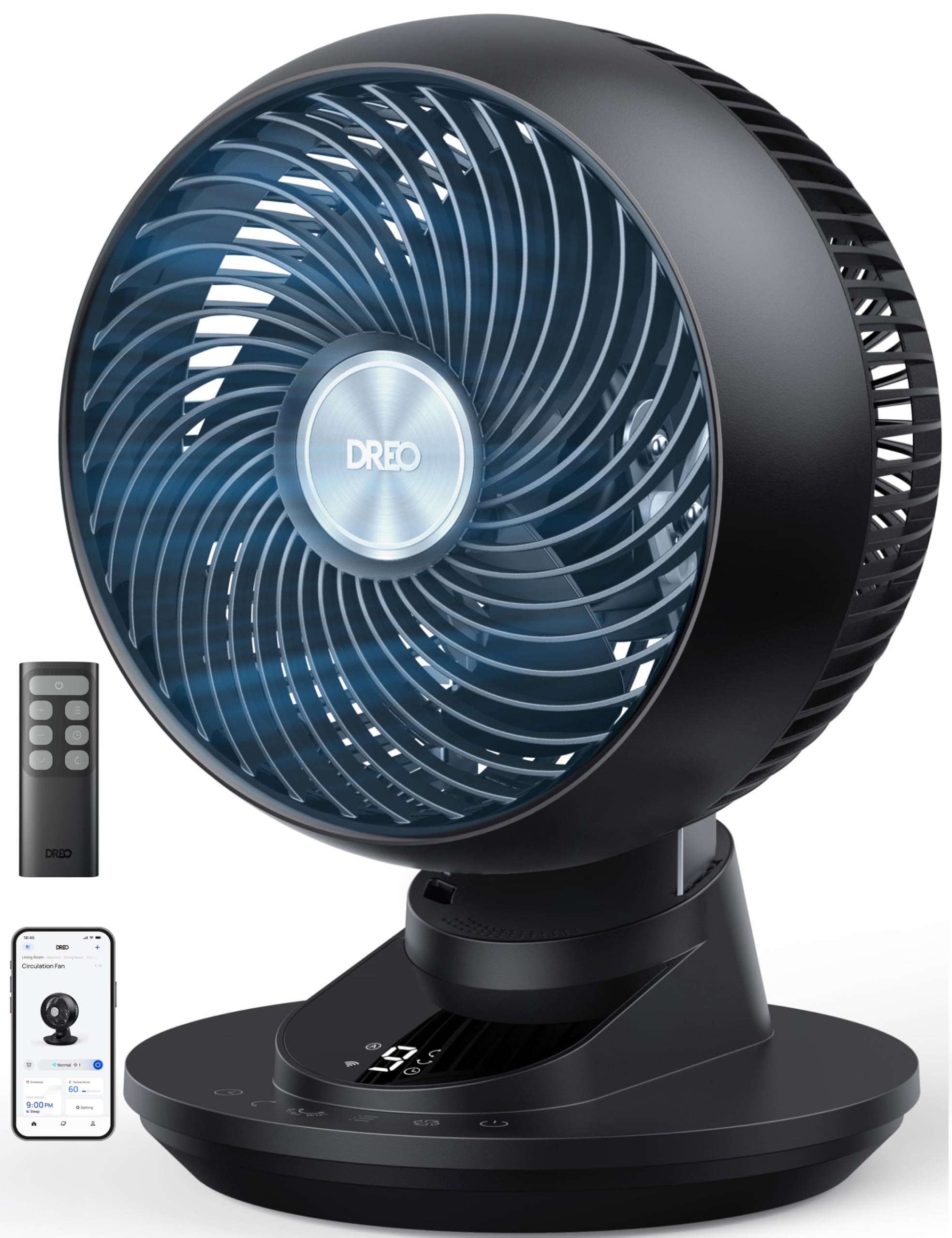
A desktop powerhouse that drowns out heat, not conversation.
This 12-inch fan delivers 950 CFM of airflow versus the Vornado 673T’s 333 CFM, so one reviewer says it covers about 500 square feet and let them reset their AC from 70°F to 74°F because the fan handled the cooling alone. The brushless DC motor (a quiet, energy-efficient type) runs as low as 20 dB on the lowest speed, which is about as loud as leaves rustling. Air reaches up to 85 feet away. You get 9 speed settings to dial in the right mix of breeze and silence for your sleep.
Unlike many desk fans, the DREO oscillates (swivels) 90° both horizontally and vertically. Buyers report the app and Alexa voice control work smoothly. The trade-off: a 7.13-inch blade diameter moves air efficiently as a room circulator rather than blasting you from inches away. At 9.45 inches deep, it needs a spot on your nightstand or desk.
Smart & Silent Strengths
- 20 dB low speed — quieter than a library.
- 950 CFM airflow versus the Vornado 673T’s 333 CFM.
- App, voice (Alexa/Google), and remote controls give you full command from your bed.
- Auto mode adjusts speed based on room temperature.
Compact Considerations
- Small blade (7.13 inches) means less direct blast — better for whole-room circulation, not a personal breeze.
- At 9.45 x 9.45 x 12.2 inches, it needs a dedicated spot on your nightstand or desk.
Ideal for: Anyone who wants smart-home integration, whisper-quiet sleep, and enough power to cool a medium bedroom without cranking the AC.
One trade-off: The compact size means you trade a little direct-blast intensity for excellent whole-room air movement.
2. Rowenta Turbo Silence VU2730

French engineering that turns air movement into an art of silence.
If your priority is barely-audible nighttime cooling, the Rowenta delivers 1589 CFM at full speed but operates at only 38 dB(A) (decibels measured on the A-weighted scale, close to human hearing) on its lowest setting — that is quieter than most refrigerators hum. The 12-inch blade oscillates (swivels) 120° to spread air across a wide arc. Unlike the DREO, this is a simpler machine: a manual turn dial with 4 speeds including a Silent Night mode and a Turbo Boost for maximum airflow.
One buyer reports they have “had a Rowenta fan in bedroom for over 5 years running nonstop.” The biggest drawback is the lack of a carry handle — owners mention it is “lightweight” but “awkward to carry or reposition.” At 23 x 14 inches, it is a floor-standing desk fan, so it takes up more footprint than a tower but less than a pedestal.
Silent Powerhouse
- 38 dB(A) on low — barely audible while sleeping.
- 1589 CFM is the highest airflow in this lineup.
- 120° wide oscillation covers a large room area.
- Proven long-term reliability: one owner reports 5+ years of nonstop use.
Missing Touches
- No carry handle makes repositioning awkward.
- Only 4 speeds — less granular control than the DREO’s 9 speeds.
- No remote control (manual dial only).
Your go-to if: You value silent operation above all else and want a proven, durable fan without a lot of fancy features.
Reconsider if: You need app control, a remote, or easy portability between rooms.
3. Vornado 673T Whole Room Air Circulator

A column of air that shifts the whole room’s temperature, not just your face.
The Vornado 673T uses deep-pitched blades (angled to grab more air) and an enclosed air duct to create a vortex that circulates air throughout the entire room — it mixes the air so the temperature feels even everywhere. Its 9.16-inch blade is larger than the 7-inch blade on the PELONIS circulator. One buyer says the “Vornado 673T moves a column of air, creating a vortex that shifts room temperature.” On low speed, reviewers call it “whisper-quiet,” though some report a “smooth hum on high” that acts as white noise. A buyer who owned a previous Vornado for 10-15 years says this model is “slightly smaller” but still “moves impressive air quietly.” The catch: at 333 CFM (cubic feet per minute), it pushes less air than the DREO’s 950 CFM, so it works best in small to medium rooms for air mixing rather than a strong breeze.
Vortex Benefits
- 9.16-inch deep-pitched blade moves air farther than standard fans.
- Whisper quiet on low — easy to sleep with.
- 5-year warranty shows manufacturer confidence.
- Solid build — no flimsy plastic feel.
Limited Reach
- 333 CFM is low compared to the DREO’s 950 CFM.
- Only 3 speeds — less customization for sleep.
- No remote control or timer.
Best suited for: Small to medium bedrooms where you want even air mixing and a proven, durable fan that lasts for years.
Skip for: Large rooms or direct high-velocity cooling — you need higher CFM and more speed options.
4. EasyAcc 12 Inch Quiet Desk Fan

A tiny 12-inch that makes hot corners a thing of the past.
At 25 dB on its lowest setting, the EasyAcc is one of the quietest fans in this list — quieter than a whisper. The 3D oscillation (swiveling side-to-side and up-and-down) is the standout: 90° automatic horizontal plus 120° adjustable vertical tilt. That means it sends air both ways, unlike the Vornado which only moves up and down. One buyer says it “keeps the room that it sits in 10° cooler than the rest of the house.” The airflow is 339 CFM with a reach of 65 feet, so it covers a medium bedroom well. The remote control and touch panel give you 4 fan speeds, 2 airflow modes (normal and natural breeze), and an 8-hour timer. The screen dims after 60 seconds to keep your bedroom dark. One reviewer noted the remote initially didn’t work, but customer support “replaced the whole fan” within days. At 11 inches tall, it fits neatly on a nightstand — a strong alternative to the DREO if you want quiet features without the price tag.
Quiet & Clever
- 25 dB on low — barely audible during sleep.
- 3D oscillation covers both horizontal and vertical planes.
- One buyer reports a 10°F drop in room temperature.
- Remote control with 8-hour timer.
Minor Gripes
- 339 CFM is modest — best for small to medium rooms.
- Occasional remote QC issues reported by a buyer.
- No smart home or app control.
Reach for this if: You want near-silent cooling with 3D oscillation for even room temperature, without spending premium money.
Look elsewhere if: You need app integration or your bedroom is large (over 300 sq ft).
6. PELONIS 7-Inch Pedestal Air Circulator
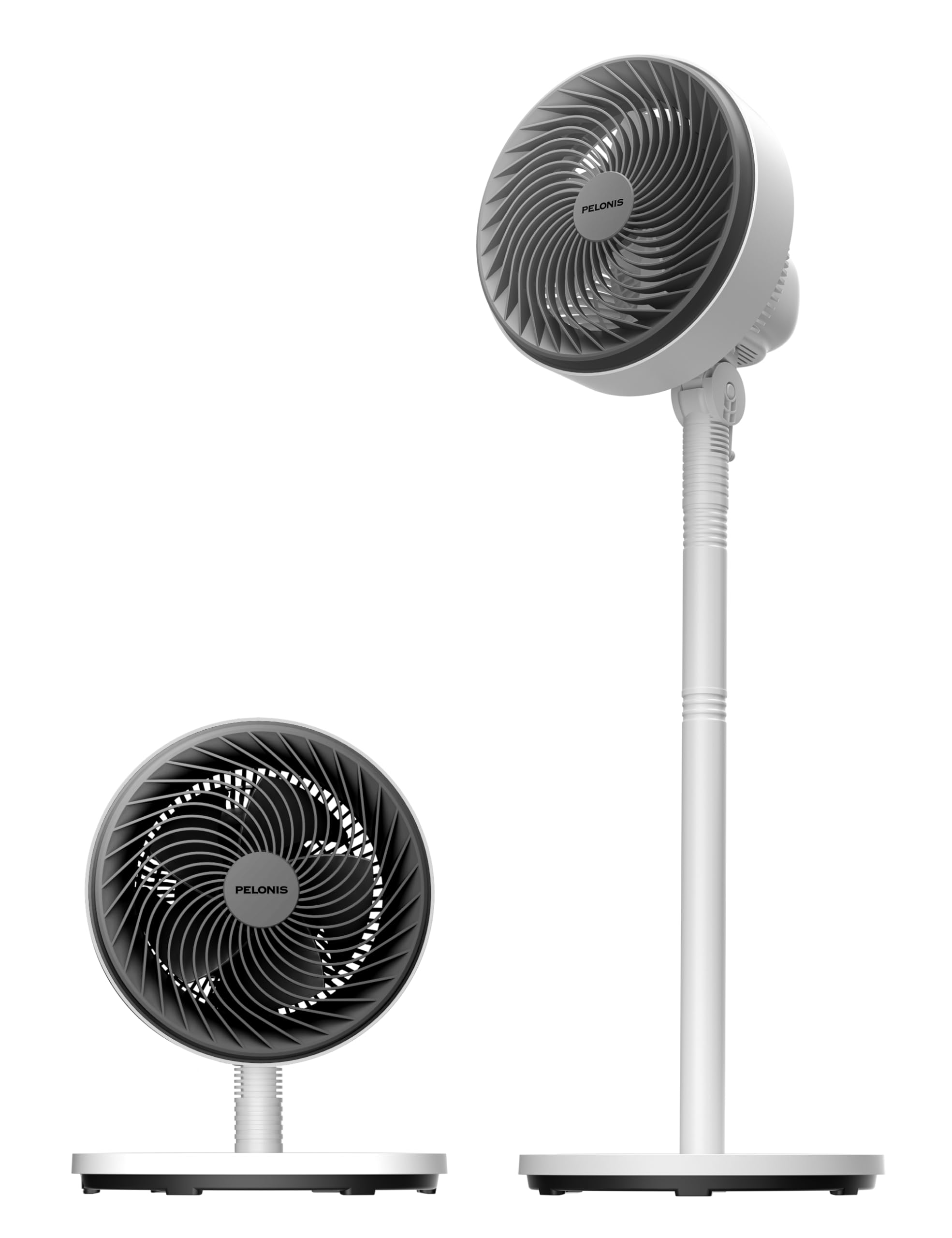
A pedestal fan that stands tall on a budget without making noise about it.
The PELONIS uses a 5-blade design to push 549 CFM of air up to 60 feet, versus the Vornado 673T’s 333 CFM. The adjustable height reaches 43.31 inches, letting you use it as a tabletop or floor-standing fan. It oscillates 75° vertically and 90° horizontally to spread air widely. Multiple buyers call it “virtually silent,” with one reviewer saying they were “surprised how quiet this fan is.” A few reviewers point out the low speed is “still kinda high,” meaning the quietest setting is more airflow than a gentle breeze. Height adjustment is step-based (two screw-in pole sizes), not a continuous slider. It includes a remote, though one buyer had to return theirs due to a non-functioning unit.
Budget Brilliance
- 549 CFM airflow versus the Vornado 673T’s 333 CFM.
- Buyers call it “virtually silent” and quiet.
- Adjustable height for table or floor use.
- Remote control included at a budget price.
Minor Quirks
- Low speed might still be too strong for a gentle breeze.
- Height adjustment is step-based (two pole lengths).
- Plastic casing feels less premium than the Vornado.
Ideal budget choice for: People who want a quiet pedestal fan that moves plenty of air for a medium bedroom.
Not great for: Those who need a super-gentle low setting or continuous height adjustment.
7. Lasko Oscillating Tower Fan T42954
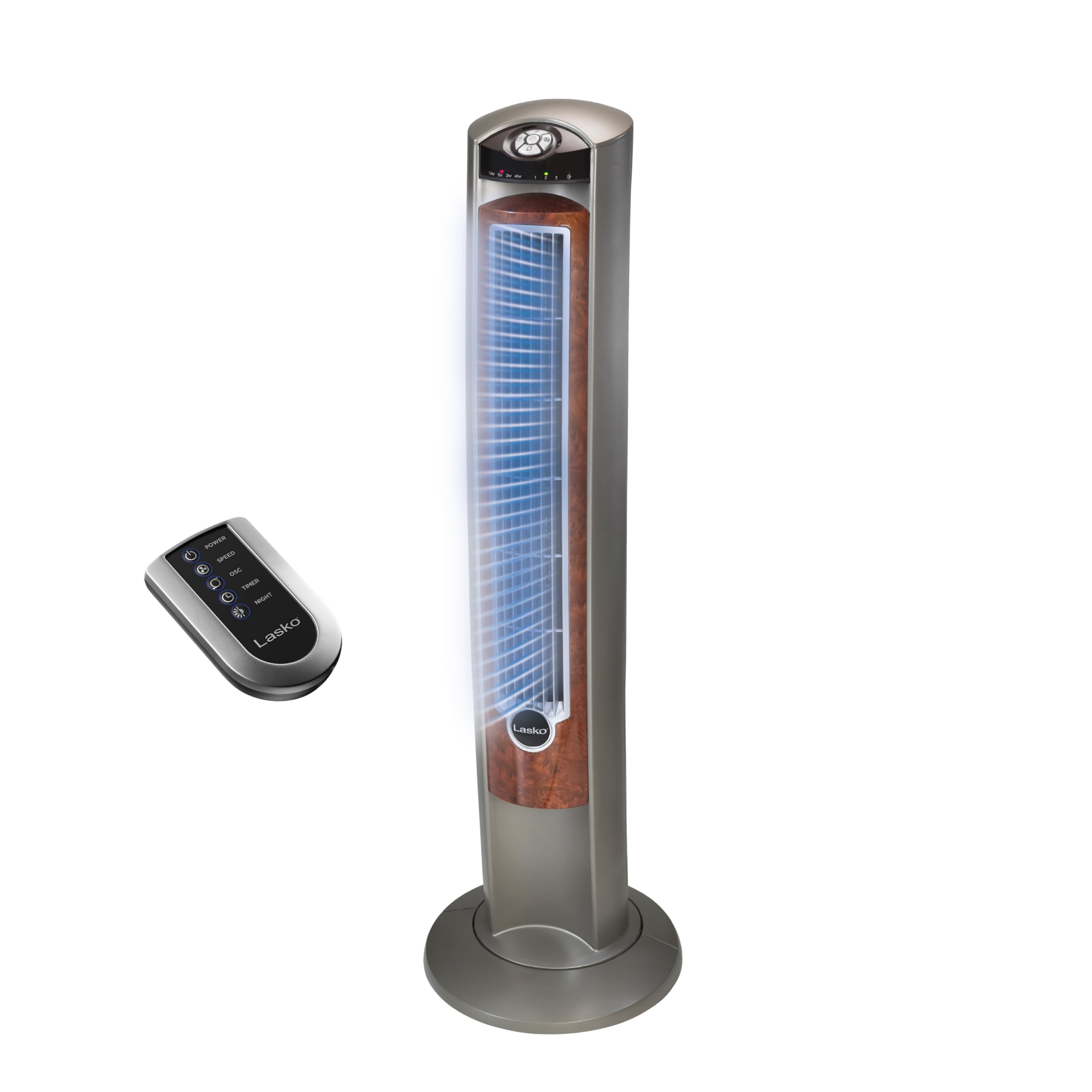
A slim, reliable tower that has earned its keep through years of nightly use.
The Lasko Wind Curve tower fan stands 42 inches tall with a slim footprint, so it slides into tight spaces between the bed and wall. Quiet operation on its three speeds is a consistent theme: shoppers say it is “quiet” enough for sound sleep, and one owner says it “still runs like a champ after 2 years of nightly use.” The 60-degree oscillation (swiveling side to side) keeps a gentle breeze moving. The remote handles power, speeds, oscillation, and a 7.5-hour timer. Where the Lasko falls short is raw power: 262 CFM (cubic feet per minute) is the lowest airflow here — it is strictly for small rooms. Night mode dims the LED lights and reduces speed, but buyers report the night setting is not very effective. The bottom plate can pop off easily, and one reviewer’s unit lasted 6 years before the motor failed.
Reliable & Sleek
- Quiet operation — buyers praise it for sleep.
- Proven durability: one owner reports 2+ years nightly use.
- Carry handle makes it portable between rooms.
- Slim design fits tight spaces.
Power Limits
- 262 CFM is the lowest airflow here — small rooms only.
- Night mode is reported as ineffective by buyers.
- Bottom plate can pop loose easily.
Best for: Small bedrooms where you need a slim, quiet tower fan that has a proven track record of lasting for years.
Consider alternatives if: Your room is medium-to-large and you need powerful airflow — the Lasko won’t cut it for whole-room cooling.
Understanding the Specs
CFM — Cubic Feet per Minute
This number tells you how much air the fan pushes each minute. It is the single best measure of raw cooling power. A fan rated at 950 CFM moves more air than one rated at 333 CFM. For a medium bedroom (200-300 sq ft), look for at least 300-500 CFM. For a large room, aim for 700+ CFM. But remember: higher CFM often means more noise, so check the dB rating at that speed too.
dB — Decibel Rating
Decibels measure sound pressure. The scale is logarithmic, meaning every 10 dB increase sounds about twice as loud. A fan at 20 dB is whisper-quiet (like leaves rustling). At 30 dB, it is still very quiet (a soft whisper). At 40 dB, it becomes noticeable (a quiet library). For sleep, aim for 30 dB or lower on the lowest speed. Some fans list dB at specific speeds; always check the lowest setting for the most relevant sleep number.
Air Reach (ft)
This spec tells you how far the fan can effectively push air. A fan with a 65-85 ft reach can cool the far end of a large bedroom or open-concept living area. A fan without a reach spec is likely designed for close-up, personal use. The reach depends partly on blade pitch, motor power, and the duct design — a Vornado with deep-pitched blades can move air farther than its modest CFM suggests.
Oscillation — Degrees of Coverage
Oscillation sets how wide the fan sweeps. Standard horizontal oscillation (60-120°) spreads air from side to side. Vertical oscillation or tilt (0-90°) lets you direct air up or down. A fan with both horizontal and vertical oscillation (sometimes called 3D oscillation) covers the whole room, eliminating hot spots. For a bedroom, 90° horizontal plus vertical tilt is ideal because it prevents you from feeling a direct blast while still circulating air.
FAQ
Is a higher CFM always better for a quiet bedroom fan?
What is the difference between a fan and an air circulator?
Can I use a quiet bedroom fan with a smart home system?
How many CFM do I need for a 200-sq-ft bedroom?
Are tower fans quieter than desk fans?
What does 3D oscillation mean for a bedroom fan?
How often should I clean my quiet bedroom fan?
Can I use a quiet bedroom fan with a heater in winter?
Is a DC motor fan better than an AC motor for quiet operation?
How long should a quiet bedroom fan last before needing replacement?
Final Thoughts: The Verdict
Across the board, the winner is the quiet bedroom fan — the DREO Smart Fan because it delivers 950 CFM at just 20 dB on low with app control and 9 speeds. For a budget-friendly option that moves 549 CFM quietly, the PELONIS Pedestal Circulator covers your basics.
How We Picked
We do not accept paid placement. Every pick is matched to a real buyer and a real use-case; we do not hands-on test units.
Sources & Methodology
Specifications: manufacturer listings and product documentation. Review insights: verified customer reviews, as of July 2026. Pricing: not shown on this page (it changes often); check the current price via the retailer link.
As an Amazon Associate, FitlyFast earns from qualifying purchases. This does not affect which products we feature.