
Our readers keep the lights on and the weekend projects moving. As an Amazon Associate, I earn from qualifying purchases.
Specs are compiled from manufacturer listings and verified buyer reviews and can change over time — please confirm the key details on the product page before buying.
Your basement floor takes a constant beating — moisture pushing up from below, heavy storage boxes scraping across it, and the occasional oil drip from a lawnmower or car. A good epoxy coating turns that tired concrete into a tough, glossy surface you can hose down and walk on the next day. The matvio Two-Part Epoxy Floor Paint (4:1) is the pick for most people because it gives you a 4H hardness rating (meaning a hard pencil lead won’t scratch it) and a self-leveling formula that hides minor flaws, all for a price that beats premium kits. This guide shows you exactly which kits deliver that kind of durability and which ones will leave you with a scuffed floor in a week.
I’m Rikta — the founder and writer behind FitlyFast. This guide is built by comparing the manufacturers’ published specifications and the patterns across verified customer reviews, so you get each pick’s real strengths and trade-offs instead of marketing spin.
The right basement floor epoxy gives you a waterproof, chemical-resistant finish that brightens the room and survives whatever you throw at it — if you need a budget-friendly kit for a workshop or a premium system for a finished living space.
Quick Picks
- matvio Two-Part Epoxy Floor Paint (4:1) — Best Overall
- matvio 2-Part Epoxy Floor Coating (1:1) — Easy Mix
- Magic Resin Clear Floor Epoxy Resin — Clear Coat King
- Rust-Oleum 391282 EpoxyShield Basement Floor Coating Kit — Brand Trust
- ANE Garage Floor Epoxy Kit (Self-Leveling) — Showroom Shine
- Yawanwan Self-Leveling Epoxy Colored Sand Floor Paint — Heavy Duty
How To Choose The Best Basement Floor Epoxy
Picking the wrong epoxy kit means ending up with a floor that peels, scratches, or yellows within months. Focus on three things: the hardness rating, the mix ratio, and the total coverage you need. Here is what matters most.
Hardness and Wear Resistance
The “4H pencil-hardness” rating you see in many listings is not marketing fluff — it means the cured coating resists scratches from tools, furniture legs, and foot traffic. Kits that do not list a hardness rating tend to be softer and more prone to scuffing, especially if you move heavy appliances across the floor.
Mix Ratio and Working Time
Epoxy comes as two parts (resin and hardener) that you combine. A 4:1 mix ratio usually gives a thinner consistency and longer working time, while a 1:1 ratio tends to be thicker and sets faster. Beginners often prefer the 4:1 for its forgiving open time, but 1:1 kits can be more straightforward to measure. Look for “low VOC” on the label — that means lower odor and safer use in attached basements.
Coverage and Cost Per Square Foot
Most kits claim 250–300 square feet per coat, but real-world coverage depends on your concrete’s porosity. Rough, old concrete soaks up more epoxy, so you might need an extra coat or a larger kit. Measure your floor and buy slightly more than the math suggests — running out partway through is a headache no one wants.
Quick Comparison
| Model | Best For | Mix Ratio | Coverage Per Coat | Hardness | Amazon |
|---|---|---|---|---|---|
| matvio 2-Part Epoxy Floor Paint (4:1) | Best Overall Durability | 4:1 | 270 sq. ft. | 4H | Amazon |
| matvio 2-Part Epoxy Floor Coating (1:1) | Easy Mixing | 1:1 | 250 sq. ft. | 4H | Amazon |
| Magic Resin Clear Floor Epoxy | Versatile Clear Coat | — | ~225–300 sq. ft. | — | Amazon |
| Rust-Oleum EpoxyShield Basement Kit | Trusted Brand, One-Coat | 2-part | 250 sq. ft. | — | Amazon |
| ANE Garage Floor Epoxy Kit | Showroom Shine | Self-leveling | ~150–300 sq. ft. | — | Amazon |
| Yawanwan Quartz Floor Coating | Heavy-Duty Slip Resistance | Self-leveling | — | — | Amazon |
In‑Depth Reviews
1. matvio Two-Part Epoxy Floor Paint (4:1)
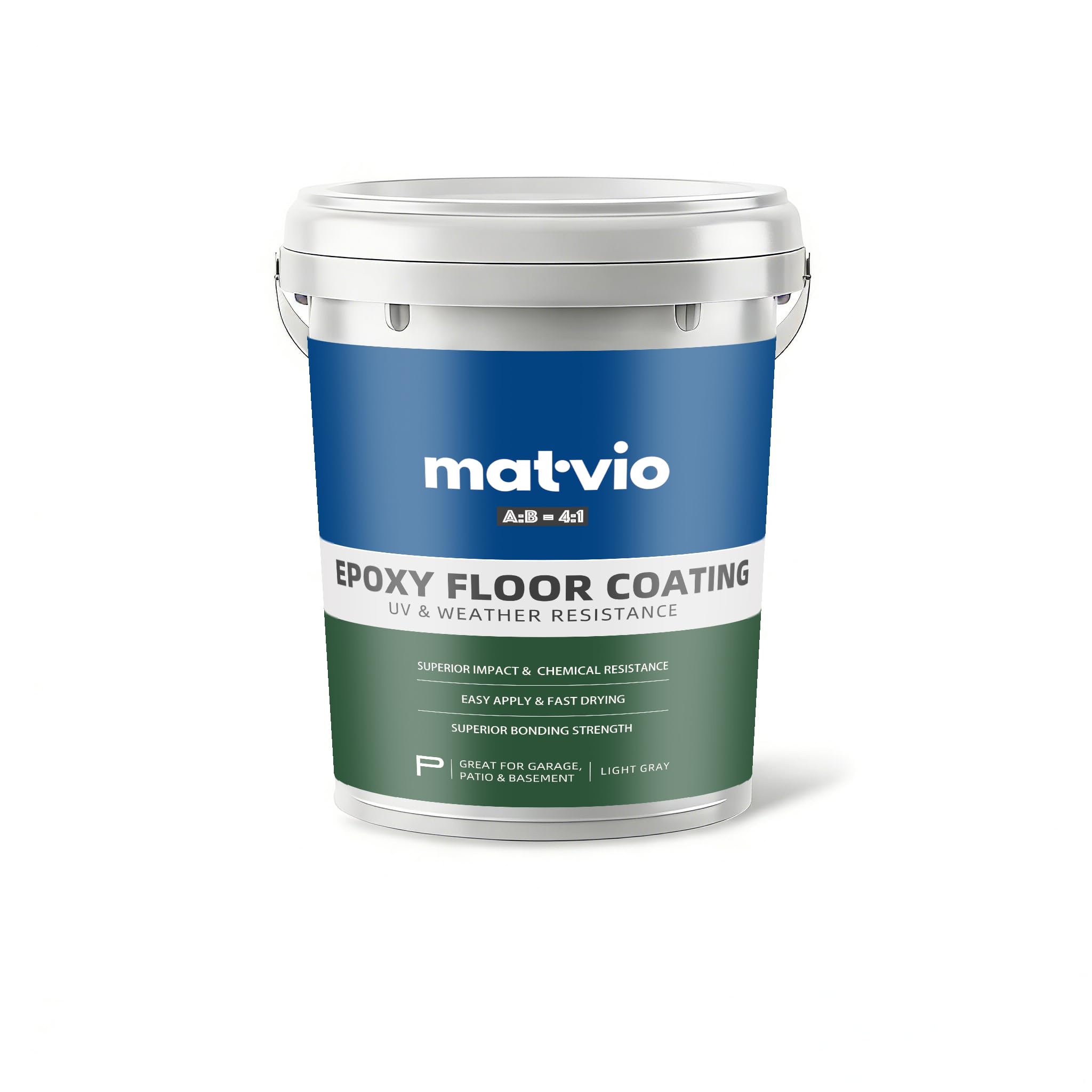
The 4:1 mix that gives beginners a longer working window without sacrificing toughness.
You get a water-based, low-VOC formula that cures to a 4H pencil-hardness surface — meaning it resists tool drops, car tires, and daily foot traffic without scratching easily. The self-leveling technology (it flows out smooth on its own) hides minor concrete imperfections and leaves a high-gloss light gray finish that brightens a dark basement. Two coats are recommended on older or dusty concrete: the first seals loose particles, the second delivers the durable top layer.
Coverage is rated at 270 square feet per coat, but buyers report that each gallon actually stretched to cover about 300 square feet per coat when applied thinly. The 4:1 mix ratio gives you more working time than a thicker 1:1 kit, which helps if you are a DIYer moving at a relaxed pace. The subtle anti-slip texture means the glossy floor does not become a skating rink when wet.
Buyers mention that tiny concrete holes and surface imperfections may not fill completely — the self-leveling action bridges minor gaps but deeper pits need a separate filler. One owner noted that the floor scuffed when moving a washer and dryer with a dolly on day 6, suggesting the full cure might need longer than a week for heavy loads.
Why It Earns the Top Spot
- 4H pencil-hardness rating for real scratch resistance
- Self-leveling formula hides brush marks and minor flaws
- Low VOC and low odor for attached basements
- Anti-slip texture built in — no extra additive needed
What to Watch For
- Does not fill deep concrete holes or cracks
- Some owners mention packaging is messy to open
- Full cure may take longer than a week for heavy loads
Reach for this if: you want the best balance of ease, durability, and coverage for a typical basement — the 4:1 ratio and 4H hardness beat most kits near this price.
Look elsewhere if: your concrete has deep cracks or uneven areas that need filling before coating, or you need a clear or colored finish rather than light gray.
2. matvio 2-Part Epoxy Floor Coating (1:1)
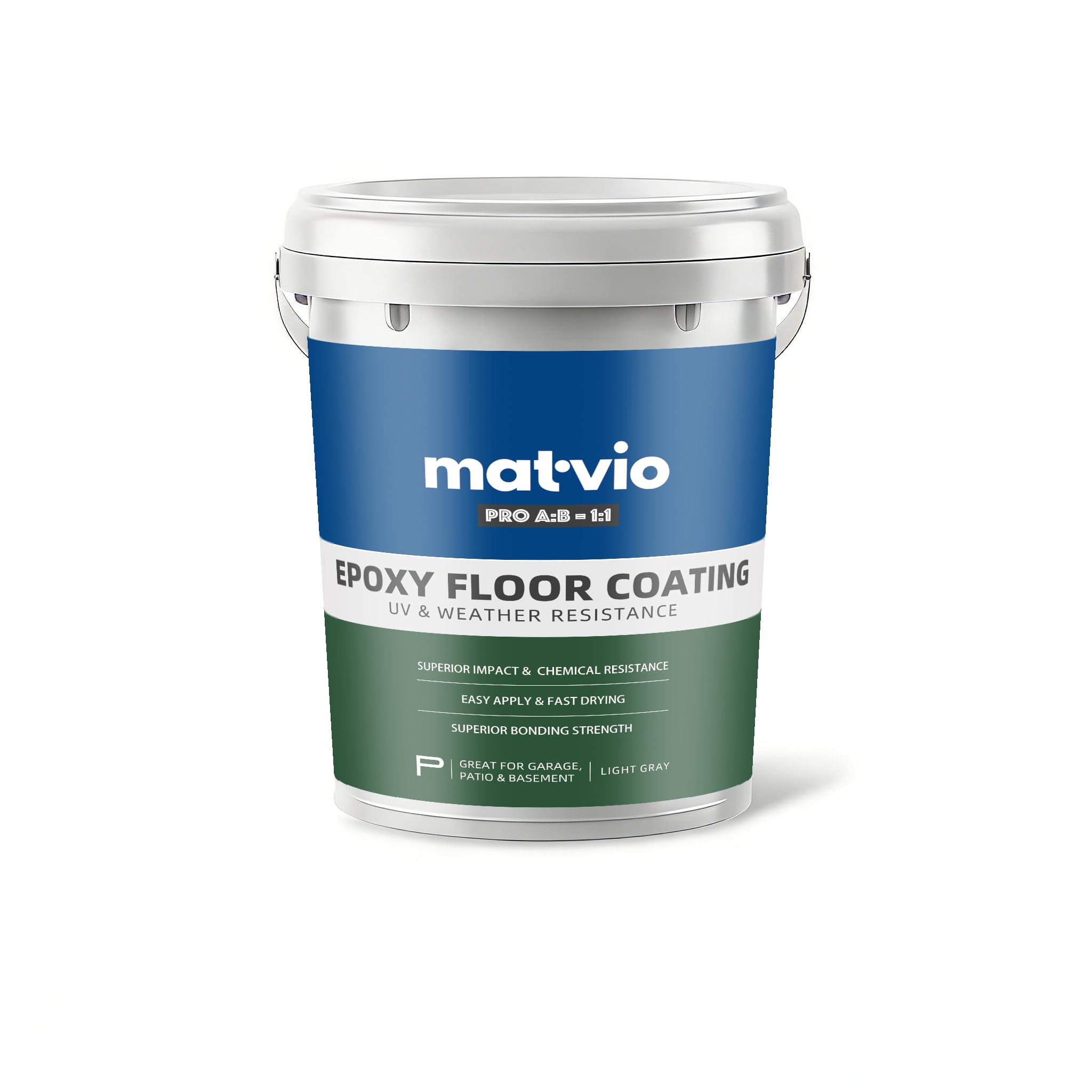
A pre-measured 1:1 kit that removes guesswork but sets faster than its 4:1 sibling.
The complete A+B system comes in one bucket with a 1:1 mix ratio, so you just pour and stir without measuring cups or scales. It still delivers a 4H pencil-hardness surface and a satin finish (less glossy than the 4:1 version, which some homeowners prefer for a more subtle look). The self-leveling technology works the same way, smoothing out brush marks and minor imperfections for a smooth coat. Coverage is listed at 250 square feet per coat, though buyers found one 1.06-gallon kit covered about 250 square feet of garage floor well with careful application.
Compared to the 4:1 matvio kit above, this one is listed at 250 square feet per coat versus 270 square feet for the 4:1 version, but the 1:1 ratio means you do not have to calculate partial mixes — just empty both parts in and stir. The water-based, low-VOC formula makes it safe for attached garages and basements, though the satin finish does not brighten a space as dramatically as high-gloss options.
One reviewer noted a peeling spot caused by poor surface prep, reinforcing that concrete must be clean and slightly etched for any epoxy to bond well. Another buyer mentioned the floor scuffed when moving appliances on day 6, similar to the 4:1 kit — these water-based epoxies need their full cure time before heavy loads roll over them.
Grab this for: the convenience of a simple to use 1:1 mix and a satin finish that hides minor dust and footprints better than high-gloss.
Skip it if: you need maximum brightness from a glossy finish, or you have a large area where 250 square feet of coverage per coat versus 270 square feet for the 4:1 kit means buying an extra can.
3. Magic Resin Clear Floor Epoxy Resin

A crisp kit that lets you show off stained or painted concrete underneath.
Unlike pigmented epoxies that lock you into a gray or tan color, this clear resin is designed to be a transparent top coat or a standalone sealer. The 1.5-gallon kit covers roughly 225–300 square feet, depending on whether you roll it on or use a squeegee for a flood coat. Customers note that a 1.5-gallon kit covered a garage floor well, producing a durable, scratch-resistant, high-gloss finish that resists stains and chemicals. One reviewer called it a “transformative” result for the space.
The full cure time is 7 days, which is longer than many pigmented epoxies (most are ready for light foot traffic in 24 hours). If you need the floor functional quickly, that wait could be a dealbreaker. The clear formula also makes surface prep more critical — every dust speck or roller bubble shows through. Multiple reviewers warn against using a roller because it introduces bubbles; a squeegee is the recommended tool for a flawless result.
On the downside, some batches arrived with expired, putty-like resin, and a few buyers reported the finish turning yellow and separating over time. This makes it a higher-risk pick than the pigmented options, though the manufacturer’s customer service was praised for quickly replacing bad batches.
Why It Stands Out
- Clear finish lets you customize with stains, dyes, or paint
- High-gloss, scratch-resistant surface
- Versatile for basements, garages, and retail spaces
The Trade-Offs
- 7-day full cure is much longer than pigmented epoxies
- Quality control issues with expired resin in some batches
- Yellowing reported by some buyers over time
Best for: DIYers who want to show off a colored or patterned concrete floor and are willing to wait the full week for the cure.
Not ideal if: you need a quick turnaround or want a pigmented, one-step finish — the risk of yellowing and the long cure time make it a specialty pick.
4. Rust-Oleum 391282 EpoxyShield Basement Floor Coating Kit

A trusted name that gets your basement walkable in 8 hours and fully cured in 24.
Rust-Oleum’s EpoxyShield is a water-based, two-part epoxy designed specifically for interior concrete. The kit includes the activator, base, decorative color chips, stir stick, and instructions — everything but the roller. A single coat covers up to 250 square feet with no primer needed, and you can walk on it in 8 hours. Full foot traffic is fine after 24 hours, making this one of the fastest-turnaround options on the list. One buyer used it on a 1969 basement floor with settlement cracks and was happy with the blue-gray color and coverage (~289 square feet per can).
The satin finish (not high-gloss) means it hides dust and minor flaws better than a mirror-shiny coat, and the included decorative chips add a subtle textured look. Buyers warn that the coating is slippery when wet — a non-slip additive is recommended for anyone parking cars or walking through in socks. Prep with TSP cleaner and a light etch is critical; one reviewer who power-washed and used TSP reported good results after 4 months, noting the coating held up well but dried too quickly, leaving roller overlap marks that a second coat fixed.
Compared to the matvio 4:1 kit, the Rust-Oleum has a lower coverage rating (250 vs. 270 sq. ft.) and no 4H hardness claim, but the brand’s decades of concrete coatings give buyers confidence in longevity. One buyer mentioned the coating lasted over 10 years with proper prep.
What You Gain
- Walk-on in 8 hours, full traffic in 24 hours
- One-coat coverage, no primer needed
- Includes decorative color chips for a custom look
- Long proven track record from a major brand
What You Give Up
- Slippery when wet — non-slip additive recommended
- Satin finish is not as bright as high-gloss
- No 4H hardness rating listed
Reach for this if: you want the fastest cure time and the confidence that comes with a brand that has coated millions of garage floors — plus decorative chips for a finished look.
Look elsewhere if: you need a non-slip surface straight from the kit, or you prioritize maximum hardness and gloss over brand familiarity and quick turnaround.
5. ANE Garage Floor Epoxy Kit (Self-Leveling)
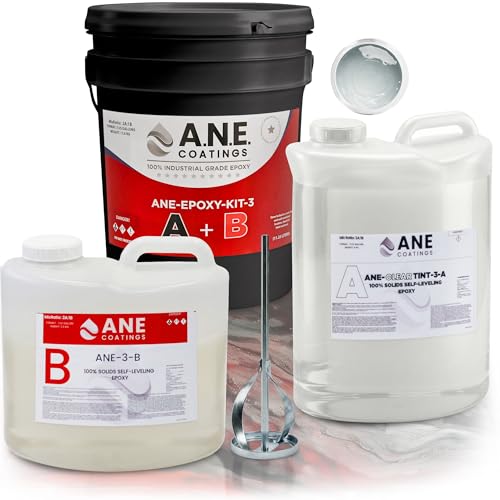
A solvent-free, self-leveling epoxy that aims for a mirror-smooth, “you-can-eat-off-it” finish.
ANE’s kit is a clear epoxy resin that self-levels to eliminate ripples and seams, leaving a glass-like coating on concrete floors. The product includes an anti-slip additive for grip, which is a welcome feature since most glossy epoxies become dangerously slippery when wet.
The full cure time is 72 hours, which is faster than the Magic Resin clear epoxy (7 days) but slower than the Rust-Oleum (24 hours). This makes it a middle-ground choice if you need the floor usable over a long weekend rather than overnight. The clear formula means you can tint it with pigments or use it as a protective top coat over stained concrete. Reviewers point out it is DIY-friendly but note that the working time is short — you need to pour the mixture onto the floor and spread it immediately, because it hardens fast in the bucket.
One owner mentioned it scratches easily and recommended a matte top coat for durability. Another praised the company’s support team for helping with application questions. On balance, this kit delivers a beautiful finished look but demands precise technique and generous material to get the promised coverage.
Impressive Features
- Self-leveling for a smooth, high-gloss finish
- Anti-slip additive included for safety
- Solvent-free and low-VOC for indoor use
Heads Up
- Coverage is often less than advertised — plan for extra
- Short working time requires fast application
- Clear surface shows every imperfection; prep must be perfect
Best for: homeowners who want a gallery-quality, clear, self-leveling floor and are comfortable buying extra product to compensate for optimistic coverage numbers.
Not for: budget-focused buyers or anyone hoping to cover a large area with a single kit — the coverage discrepancy makes cost hard to predict.
6. Yawanwan Self-Leveling Epoxy Colored Sand Floor Paint
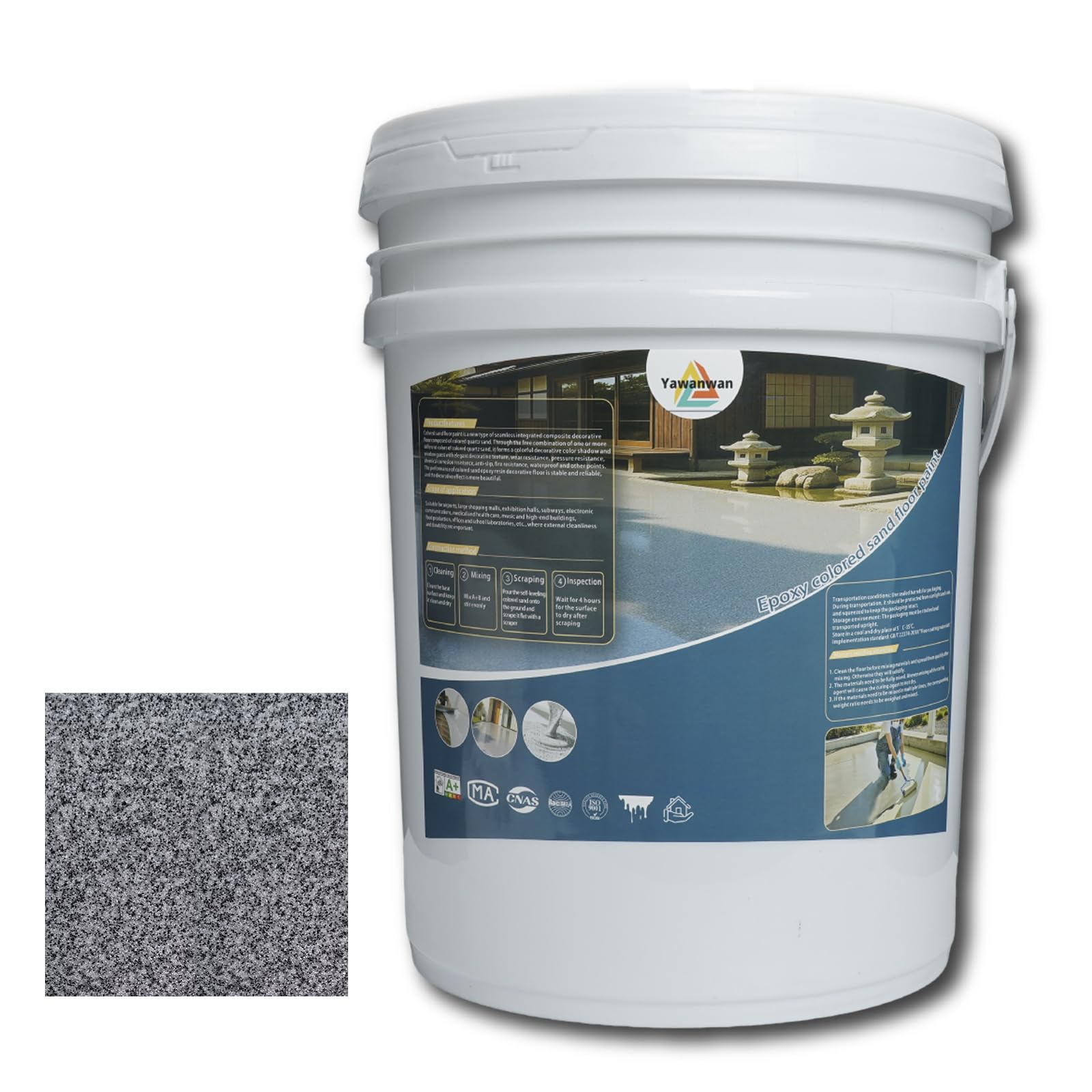
A quartz-reinforced coating that trades a smooth mirror for serious slip-resistant texture.
This is the outlier on the list: instead of a smooth, glossy finish, Yawanwan’s kit uses high-strength colored sand to create a textured surface designed to resist heavy vehicle traffic, impacts, and scratches. The sea-gray color and quartz aggregate give it an industrial look that hides dirt and tire marks better than any smooth epoxy. It is described by the manufacturer as waterproof, UV-resistant, and safe for outdoor use as well, so it works for a basement workshop where you roll heavy tool chests and park motorcycles.
The formula is self-leveling, meaning it flows over concrete imperfections on its own, but buyers consistently report that the coverage is nowhere near what the listing suggests. One owner reported a single bucket only covered 4 feet by 4 feet, and another found the 20kg bucket to be half-empty, with the hardener and tools sitting on top of a sack of sand mixture. Multiple buyers noted the kit is expensive for the small area it actually covers — plan to buy more than you expect. The instructions were also criticized as insufficient, so you will need to research application techniques beforehand.
On the positive side, those who got it right praised the slip resistance and durability. If you are willing to invest in multiple kits and put in the prep work, the finished floor can handle oily drips, chemical spills, and heavy machinery without staining or peeling. This is a specialty product for a specific need, not a general-purpose basement coating.
What Makes It Unique
- Quartz aggregate for superior slip resistance
- Withstands heavy vehicles, impacts, and chemicals
- UV-resistant for outdoor and garage use
The Hard Truth
- Coverage is far less than advertised — budget for extra kits
- Expensive per square foot compared to standard epoxies
- Poor instructions and packaging complaints from buyers
Reach for this if: your basement doubles as a workshop or garage where spills, heavy tools, and wet shoes are daily realities — the textured quartz floor will outlast a glossy epoxy.
pass on it if: you want a smooth, easy-to-clean finish for a finished living space, or you are trying to cover a large area on a moderate budget.
Understanding the Specs
4H Pencil Hardness
This is the number that tells you how scratch-resistant the epoxy really is. A 4H rating means a pencil with a 4H lead (a hard graphite grade) will not dig into the cured coating. In everyday terms, it means dragging a metal tool box or sliding a heavy chair across the floor will leave no mark. Kits without this rating are often softer and more prone to scuffing when you move appliances or drop tools.
Mix Ratio (4:1 vs 1:1)
This is the proportion of resin to hardener. A 4:1 ratio is thinner and gives you a longer “pot life” (the time before the mixture starts to harden), which is helpful if you are a beginner covering a large area. A 1:1 ratio is thicker and sets faster, but is easier to measure—you just pour equal amounts. Both can yield the same hardness, but the 4:1 formula is more forgiving for DIYers working at a relaxed pace.
Self-Leveling vs. Rolled Application
Self-leveling epoxy flows out on its own to create a smooth, bubble-free surface without brush or roller marks. You pour it onto the floor and spread it with a squeegee. Rolled epoxy is thicker and needs to be spread with a paint roller, which can leave texture marks. Self-leveling is ideal for showroom-quality results, but it requires more material and a longer cure time. Rolled coatings are easier for smaller DIY projects and dry faster.
Low VOC and Water-Based Formulas
VOC stands for volatile organic compounds—the fumes that give traditional epoxy its strong smell and potential health risks. Low-VOC, water-based epoxies drastically reduce those fumes, making them safe to use in attached basements and garages without wearing a respirator. They still cure to a hard, durable surface but with much less odor, which matters when you are coating a space connected to your living area.
FAQ
Can I apply basement floor epoxy over old paint or sealer?
How long does basement floor epoxy last before needing a recoat?
Will basement floor epoxy make the floor slippery?
Do I need to etch the concrete before applying epoxy?
Can I use basement floor epoxy in a damp or wet basement?
How many coats of epoxy do I need for a basement floor?
What is the difference between epoxy paint and epoxy coating?
Will the epoxy yellow over time in a basement?
Can I walk on basement floor epoxy while it is curing?
Do I need a primer before applying epoxy to my basement floor?
Final Thoughts: The Verdict
For most homeowners, the basement floor epoxy winner is the matvio Two-Part Epoxy Floor Paint (4:1) because it combines a 4H hardness rating, self-leveling ease, low-VOC safety, and real-world coverage that matches or beats its 270-square-foot claim. If you want a trusted brand with the fastest cure time, grab the Rust-Oleum EpoxyShield Basement Kit. And for a showroom-clear finish that shows off stained concrete, the standout is the Magic Resin Clear Floor Epoxy—just budget extra time for the 7-day cure.
How We Picked
We do not accept paid placement. Every pick is matched to a real buyer and a real use-case; we do not hands-on test units.
Sources & Methodology
Specifications: manufacturer listings and product documentation. Review insights: verified customer reviews, as of July 2026. Pricing: not shown on this page (it changes often); check the current price via the retailer link.
As an Amazon Associate, FitlyFast earns from qualifying purchases. This does not affect which products we feature.