
Our readers keep the lights on and the weekend projects moving. As an Amazon Associate, I earn from qualifying purchases.
Specs are compiled from manufacturer listings and verified buyer reviews and can change over time — please confirm the key details on the product page before buying.
A board game for a four-year-old needs to hit a balance: simple enough that they can follow the rules on their own, but engaging enough that you do not mind playing it for the twentieth time. The best games at this age ditch long instructions and lean into pure fun—matching, catching, moving, and laughing together. This guide breaks down the top picks so you can hand a box to your kid and know the fun is real.
I’m Rikta — the founder and writer behind FitlyFast. This guide is built by comparing the manufacturers’ published specifications and the patterns across verified customer reviews, so you get each pick’s real strengths and trade-offs instead of marketing spin.
Whether you are shopping for a birthday, a holiday, or just a rainy afternoon, these board games for kids 4 and up have been vetted for playability, durability, and keeping the whole family at the table.
Quick Picks
- Hasbro Gaming Clue Junior Board Game — Best Overall
- Bed Bugs Board Game — Action Pick
- NATIONAL GEOGRAPHIC My First Safari Board Game — Cooperative Star
- Jax SEQUENCE for Kids — Strategy Favorite
- ThinkFun Zingo Bingo — Classic Value
How To Choose The Best Board Games For Kids 4 And Up
A 4-year-old’s attention span is short, so the box needs to deliver big fun in a small window. The best games for this age use pictures instead of words, involve everyone at the same time (no sitting and waiting), and are built tough enough to survive a spill or two.
Picture-Based Play
Reading is not a skill most 4-year-olds have yet. Games with pictures, colors, or symbols on the cards and board let kids jump right in without needing a grownup to decode every instruction. Look for “no reading required” on the box if you want true independence.
Cooperation vs. Competition
At this age, losing a round can derail the whole mood. Cooperative games—where players team up to beat the game itself—teach teamwork and keep everyone smiling. If a game has a competitive edge (like a race to catch bugs), make sure the rounds are short and the fun stays light.
Grow-With-Me Potential
The sweetest games have two difficulty levels or a double-sided board. A child can play the simpler side at age four and flip to the harder version a year later. This “grow-with-me” feature gives the box a much longer life on your shelf.
Quick Comparison
| Model | Best For | Players | Playing Time | Key Skill | Amazon |
|---|---|---|---|---|---|
| Hasbro Gaming Clue Junior | Logic & deduction newbies | 2–6 | 15–20 min | Logical thinking | Amazon |
| Bed Bugs Board Game | Active, giggly play | 2–3 | 20 min | Color matching & reflexes | Amazon |
| NATIONAL GEOGRAPHIC My First Safari | Cooperative animal learning | 2–5 | — | Strategy & teamwork | Amazon |
| Jax SEQUENCE for Kids | Strategy without reading | 2–4 | — | Logical thinking | Amazon |
| ThinkFun Zingo Bingo | Language & matching skills | Up to 7 | — | Reading (pre-reader level) | Amazon |
In‑Depth Reviews
1. Hasbro Gaming Clue Junior Board Game

The grow-with-you mystery that turns little detectives into logical thinkers.
This is the rare game that actually grows with your child because the double-sided game board hides two completely different mysteries. The Level 1 side (Playground Mix-up, for ages 4+) has players working together to find out what item is missing from a backpack. Flip it over and Level 2 (Science Lab Mystery, for ages 5+) turns into a competitive race where kids practice deduction skills on their own. Unlike the more chaotic Bed Bugs game below, this one rewards sitting still and thinking before you move.
Buyers report that their 4-year-olds pick it up quickly—one reviewer noted “my daughter is 4 years old and she likes it”—and the cooperative first level means nobody feels left out while they are learning. The box includes 6 character pawns, 6 furniture tokens, 3 dice, and detective notepads, so everything you need for a full family night (2 to 6 players) is inside. No batteries required, and games run around 15-20 minutes, which is the perfect attention span for this age.
The catch is the setup: a few buyers mentioned the first playthrough takes some preparation and an adult should guide the rules. But once the kids understand the pattern—search, match, deduce—they will ask to play again and again.
Why families love it
- Two levels of play extend the game’s lifespan across multiple years
- Cooperative first level teaches teamwork before the competitive version
- No batteries required for setup or play
One thing to know
- Initial setup is a bit involved, and an adult should guide the first round
Your best bet if: you want a game that challenges a 4-year-old’s logical thinking and still works for a 6-year-old.
Look elsewhere if: your child cannot sit still for 15 minutes and needs a more active, physical game.
2. Bed Bugs Board Game
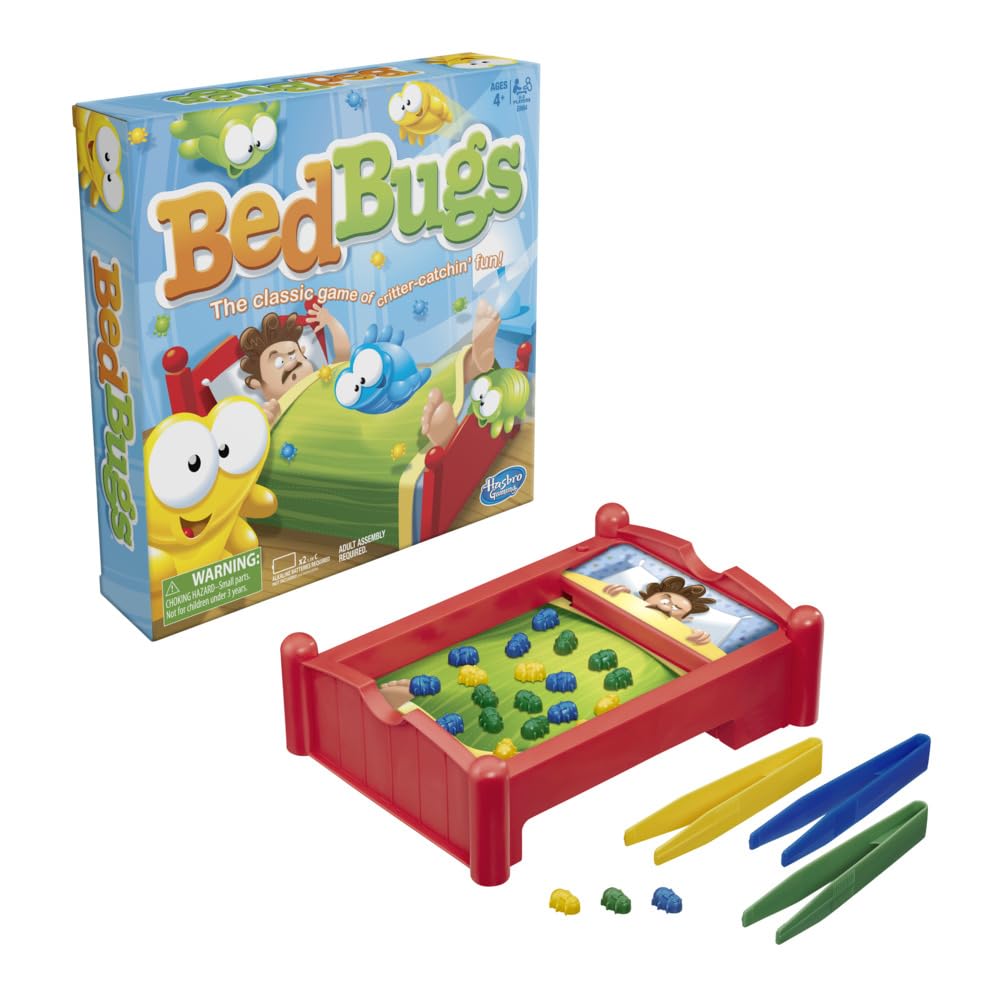
A side-splitting, vibrating bug hunt that tests reflexes, not reading.
While the Clue Junior game is all about quiet deduction, this one is pure physical chaos—and that is exactly what some 4-year-olds need. The motorized game board (“bed”) vibrates to make 36 plastic bugs hop and bop across the surface, and players use tongs to catch bugs that match their tong color (blue, yellow, or green). The first player to clear all their matching bugs out of the bed wins. It is loud, fast, and guaranteed giggles.
Owners mention their “granddaughters (4 & 6) love it; they win due to faster reflexes.” The game helps develop color recognition, hand-eye coordination, and quick thinking, and the estimated playing time is 20 minutes. It is a noticeably smaller package than the National Geographic Safari game (2.5 x 10.5 x 10.5 inches), but it packs a lot of action. The box includes the bed frame, 3 tongs, and 36 plastic bugs, and requires no assembly.
The main trade-off: the game is best with 2 to 3 players only, so larger families may need to take turns. A few reviewers noted the game can feel repetitive after several rounds, and pressing too hard on the board stops the vibration mid-round. But for high-energy playdates or one-on-one time, it is a total hit.
The fun factor
- Motorized board creates unpredictable, hilarious bug movement every round
- Teaches color matching and fine motor skills through active play
- Easy to learn in 30 seconds, no reading required
The limitation
- Supports only 2–3 players, so bigger groups need to rotate
- Game can feel repetitive after several back-to-back rounds
Reach for this: when you need a loud, active game that burns off energy and makes everyone laugh.
skip it if: your child prefers quiet puzzles or you have more than 3 kids wanting to play at once.
3. NATIONAL GEOGRAPHIC My First Safari Board Game

A collaborative animal adventure where everyone wins—or loses—together.
Unlike the head-to-head race in Bed Bugs, this game is all about teamwork. Players work together as a team of 5 Safari Explorers to see all the animals on the board before the sun token reaches “sunset.” The included full-color Learning Guide teaches fun facts about 21 animals, from elephants and cheetahs to gorillas and hippos—so it sneaks in a biology lesson while the kids think they are just playing. The cooperative mechanic means no crying over losing; the group either wins or loses as one.
Customers note it is a “great game, played with my grandkiddos!” and that the three difficulty levels let you adjust the challenge as kids improve. The game board dimensions are 9.06 x 6.5 x 1.57 inches (a compact box compared to the Sequence for Kids game), and the set includes 36 item cards, 13 sun cards, and the Learning Guide. A reviewer with a 3-year-old and 5-year-old reported it was a great way to teach decision-making and strategy.
The honest catch from buyers: the little safari explorer character stands are surprisingly hard to push into their bases. Several reviewers warned that you have to be very gentle or risk bending the figures. It is a small annoyance for an otherwise excellent cooperative game.
What makes it special
- Cooperative play keeps everyone positive—no “loser” at the table
- Three difficulty levels grow with the child from age 4 to 6
- Learning Guide makes animal facts part of the fun
The assembly snag
- Player stands are difficult to insert without risking damage
Ideal for: families who want a screen-free activity that teaches teamwork and animal facts without competition.
Not great if: your kids are impatient with fiddly assembly and want to start playing immediately.
4. Jax SEQUENCE for Kids

The classic game of Sequence, simplified so pre-readers can master strategy.
If your 4-year-old is ready for something that feels like a “real” game (like the grownup version of Sequence), this is the one. Play a card from your hand, find the matching animal character on the board, and place a chip there. Get four chips in a row and you win. Reading is not required—only picture matching—so kids as young as 3 can play without any help. It targets ages 3–6 and supports 2–4 players.
Buyers rave that “our 2 through 6 year olds ask to play Sequence on every visit,” underscoring how the simple mechanics hook a wide age range. The game has an educational objective of STEM thinking, and the included components—a folding game board, 42 playing cards, and 84 playing chips (21 of each color)—are sturdy and bright. Unlike the National Geographic Safari game’s compact box, this board measures 11 inches across, giving kids plenty of room to place their chips.
The trade-off here is that it is a strategy game at heart, so very young 4-year-olds who do not yet grasp the concept of four-in-a-row might need a few guided rounds. But once they catch on, it is remarkably replayable and actually helps develop logical thinking skills.
Why kids call for it
- No reading required—pure picture matching makes it accessible
- Bright colors and sturdy components survive rough play
- A true strategy game that prepares kids for the adult version later
The learning curve
- Very young 4-year-olds may need adult help grasping the four-in-a-row concept
Best for: the kid who sees the grownups play Sequence and wants their own version—no reading, all strategy.
pass on it if: your child is still at the stage where any game with turns longer than 2 minutes causes fidgeting.
5. ThinkFun Zingo Bingo

The beloved picture-matching bingo that teaches reading without a single worksheet.
Zingo is among the most popular preschool games for good reason: it looks and feels like bingo, but uses pictures instead of numbers. Players slide the Zinger device to reveal two picture tiles, then race to match the tiles to the pictures on their individual Zingo cards. The first player to fill their card shouts “Zingo!” and wins. The new edition includes an extra card so up to 7 players can join, making it the largest player count in this list—perfect for playdates or bigger families.
Reviewers point out the “durable thick board & plastic pieces” hold up to repeated use, and children ages 3 to 8 find it engaging. The educational objective is reading, and the cards come with two difficulty levels (picture-only on one side, picture-with-word on the other), so it grows from a pure matching game into a reading game as the child progresses. A reviewer noted their 4-year-old “absolutely loves it especially when he beats me.”
A small organizational note from buyers: the Zinger device holds tiles that can spill if tipped over, and some families prefer to set aside unused tiles to avoid opening the holder repeatedly. Still, the fast-paced, adjustable play keeps kids “engaged for hours,” per one parent, making it a solid value for the entry-level price point.
What stands out
- Up to 7 players can play at once—biggest group capacity on this list
- Two difficulty levels double as a pre-reader and early-reader game
- Durable thick board and plastic pieces survive family use
Something to watch
- Tiles inside the Zinger can spill if the device is handled roughly
Reach for this if: you need a game that works for a crowd of kids aged 3 to 7 and subtly builds reading skills.
Look elsewhere if: your child needs more physical activity than sitting at a table to match tiles.
Understanding the Specs
Cooperative vs. Competitive Play
Cooperative games (like the National Geographic My First Safari) have everyone working toward a shared goal, so there is no single loser. Competitive games (like Bed Bugs) have one winner. For 4-year-olds, cooperative games tend to cause fewer meltdowns, while competitive games teach good sportsmanship in quick, low-stakes rounds.
Grow-With-Me Features
A double-sided game board (like Clue Junior) or two difficulty levels on cards (like Zingo) means the same box stays fun for years. The easier side works at age 4, and the harder side challenges the same child at age 6. This is the single best way to get more plays out of one purchase.
FAQ
What if my 4-year-old cannot read yet?
How long does a typical game last for this age group?
Can a 4-year-old play without an adult helping?
Which game supports the most players at once?
Is there a game that teaches both reading and strategy?
Why do some games have a “cooperative” label?
Are these games durable enough for rough play?
What is the difference between SEQUENCE for Kids and the adult version?
Final Thoughts: The Verdict
If you want one dependable pick, the board games for kids 4 and up winner is the Hasbro Gaming Clue Junior because its double-sided game board gives you two completely different games in one box, growing with your child from a cooperative mystery at age 4 to a competitive deduction game at age 5+. If you want a loud, active game that burns off energy, grab the Bed Bugs Board Game. And for a cooperative adventure that teaches animal facts and teamwork, the standout is the National Geographic My First Safari.
How We Picked
We do not accept paid placement. Every pick is matched to a real buyer and a real use-case; we do not hands-on test units.
Sources & Methodology
Specifications: manufacturer listings and product documentation. Review insights: verified customer reviews, as of July 2026. Pricing: not shown on this page (it changes often); check the current price via the retailer link.
As an Amazon Associate, FitlyFast earns from qualifying purchases. This does not affect which products we feature.