
Our readers keep the lights on and the weekend projects moving. As an Amazon Associate, I earn from qualifying purchases.
Specs are compiled from manufacturer listings and verified buyer reviews and can change over time — please confirm the key details on the product page before buying.
If you’ve ever killed a houseplant, you know the dread: the slow yellowing, the silent leaf drop, the guilty watering schedule. The right beginner indoor bonsai tree should forgive your learning curve, not punish it. This guide focuses on the species and setups that actually survive life inside a standard home — not a greenhouse.
I’m Rikta — the founder and writer behind FitlyFast. This guide is built by comparing the manufacturers’ published specifications and the patterns across verified customer reviews, so you get each pick’s real strengths and trade-offs instead of marketing spin.
Every tree reviewed below arrives as a live plant in a bonsai pot, ready to place on a desk or shelf. If you want a beginner indoor bonsai tree that has a real shot at thriving in your living room, these are the five most-recommended options that balance survival ease with genuine bonsai character.
Quick Picks
- Brussel’s Bonsai – Live Golden Gate Ficus Bonsai Tree — Best Overall
- Brussel’s Bonsai Live Ginseng Grafted Ficus — Premium Display
- Brussel’s Bonsai – Live Dwarf Jade Bonsai Tree — Compact Value
- Brussel’s Bonsai Live Hawaiian Umbrella Bonsai Tree — Entry-Level Price
- American Plant Exchange Live Dwarf Jade Tree — Drought-Tolerant Budget Pick
How To Choose The Best Beginner Indoor Bonsai Tree
Most bonsai species will die inside your home because they need winter dormancy or six hours of direct sun. To get an indoor tree that actually survives, you need a tropical or subtropical species that handles the low humidity of a heated room and the weak light of a north-facing window. The three best options are Ficus microcarpa (the Golden Gate and Ginseng Grafted varieties), Portulacaria afra (Dwarf Jade), and the Hawaiian Umbrella tree (Ardisia crenata) — each sold as a live specimen in a bonsai pot, not a seed kit.
Light and watering expectations
The single biggest reason a new bonsai dies indoors is overwatering paired with poor light. Most of the trees here need “moderate watering” (the soil surface should dry slightly between drinks) and bright, indirect light. A humidity tray — a shallow dish with pebbles and water that sits under the pot — raises the moisture around the leaves without drowning the roots.
Age and trunk character
A three-year-old bonsai already has a woody trunk and visible branch structure; a six-year-old like the Ginseng Grafted Ficus shows exposed, thickened roots. Older trees cost more but look like a bonsai from the start rather than a cutting in a pot. The trade-off is price — a tree grown for six years in a nursery costs more than a three-year cutting, but you skip the years of patient training.
Quick Comparison
| Model | Best For | Species | Age | Height | Amazon |
|---|---|---|---|---|---|
| Golden Gate Ficus | Best Overall | Ficus microcarpa | 4 Years | 8–16″ | Amazon |
| Ginseng Grafted Ficus | Premium Display | Ficus microcarpa | 6 Years | 8–12″ | Amazon |
| Dwarf Jade (Brussel’s) | Compact Value | Portulacaria afra | 3 Years | 5–8″ | Amazon |
| Hawaiian Umbrella | Entry-Level Price | Ardisia crenata | 3 Years | 4–7″ | Amazon |
| Dwarf Jade (American Plant Exchange) | Drought-Tolerant Budget Pick | Portulacaria afra | — | — | Amazon |
In‑Depth Reviews
1. Brussel’s Bonsai – Live Golden Gate Ficus Bonsai Tree
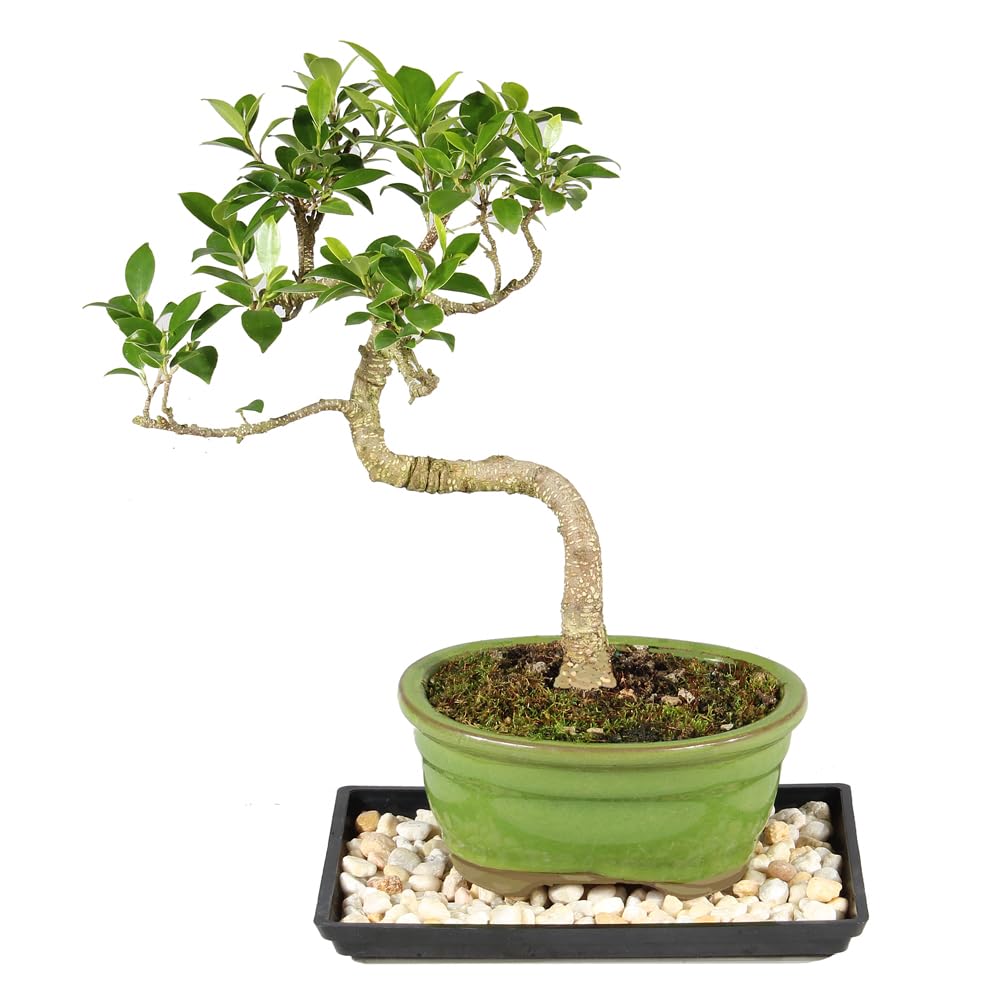
The forgiving ficus that builds your confidence before you pick up pruning shears.
For most new owners, the Golden Gate Ficus is the safest bet in the category. It’s a tropical plant that tolerates indoor light better than a juniper or a pine and will not drop every leaf the moment you open the box. At 4 years old, this tree already has a spiraling trunk (a trained moyogi style according to buyers) and dark, glossy leaves that signal health before you even unwrap the soil. The package includes a ceramic pot and a humidity tray, so you have everything you need to put it on a desk or a coffee table immediately.
Buyers report that a “beginner bonsai arrived perfectly packaged, healthy 10-inch tree in rectangular ceramic pot with drip tray and gravel.” Several reviews mention active growing tips and thick wire holding the tree in place during transit. At 6 pounds the pot has a solid, grounded feel — the humidity tray underneath catches drips so you do not ruin a wood surface. The ficus microcarpa species adapts to “bright light and regular watering,” which means it will bounce back even if you forget to water for a couple of days.
Compared to the 3-pound Hawaiian Umbrella tree below, this tree is 2 pounds heavier (6 lbs vs 3 lbs), which reflects the larger pot and older root system. The catch is shipping in cold weather: some buyers reported trees arriving with black, crispy leaves when temperatures dropped below freezing. Brussel’s recommends shipping only when nighttime temps exceed 50°F between Mississippi and your door. If you live in a cold climate, wait for spring or pay for insulated shipping.
What works
- Spiraling trunk gives it a classic bonsai look right from the start
- Includes ceramic pot and humidity tray — display-ready
- Ficus microcarpa forgives missed waterings and low indoor light
What to watch
- Cold-sensitive: shipping below 50°F can kill it
- Pot color and shape vary — you won’t know exactly what you get
Reach for this if: you want the most beginner-friendly indoor bonsai that already looks like a miniature tree, not a cutting — the 4-year age and ficus genetics give you the widest margin for error.
Look elsewhere if: your home stays below 60°F in winter or you need a plant that thrives on total neglect — this one still needs weekly attention.
2. Brussel’s Bonsai Live Ginseng Grafted Ficus

Six years of growth packed into a single pot, with roots that look older than they are.
The Ginseng Grafted Ficus is the showpiece of this list. At 12 pounds and 6 years old, it is easily the heaviest and most mature tree here — the exposed roots and thick trunk are the whole point. The “ginseng” shape comes from grafting ficus branches onto a rootstock with a swollen base, which gives the illusion of a centuries-old tree in a compact 8-to-12-inch package. It arrives in a ceramic pot with a humidity tray identical to what the Golden Gate Ficus includes, but the visual weight of the trunk is on another level.
Buyers describe it as “the prettiest little tree” and note that packaging was strong enough to survive rough UPS handling with only one leaf missing. The care guide is included, and the species tolerates the same moderate watering and bright indirect light as the other ficus trees on this list. At 12 pounds this is a desktop statement piece rather than a shelf accent — it demands a sturdy surface. The Ginseng graft is notoriously resilient, which makes it a strong candidate for someone who wants the bonsai experience without constant worrying.
One review warns that “one whole side of plant died off! Dropped all leaves and died!” — a risk with any shipped plant, but the ficus genus recovers faster than most if the roots stay healthy. The 6-year age means it has a thicker, more established woody structure, so it handles acclimation stress better than a younger tree. If you are choosing between this and the Golden Gate Ficus above, the main trade-off is price: you pay more for the older, more dramatic trunk, but the day-to-day care is almost identical.
What stands out
- Exposed root structure and thick trunk look impressive immediately
- 6-year maturity means a sturdy woody frame that handles transport stress
- Ficus genetics give it the same forgiving care as the Golden Gate
Before you buy
- 12-pound weight requires a sturdy table or stand — not a flimsy shelf
- Higher price point makes a shipping accident more painful to absorb
Perfect for: someone who wants an instant “old tree” look and is willing to pay a premium for the 6-year head start — the rooted base is the main reason to pick this over the other ficus options.
Not for: tight budgets or anyone who wants a tiny, lightweight plant that moves easily between rooms.
3. Brussel’s Bonsai – Live Dwarf Jade Bonsai Tree
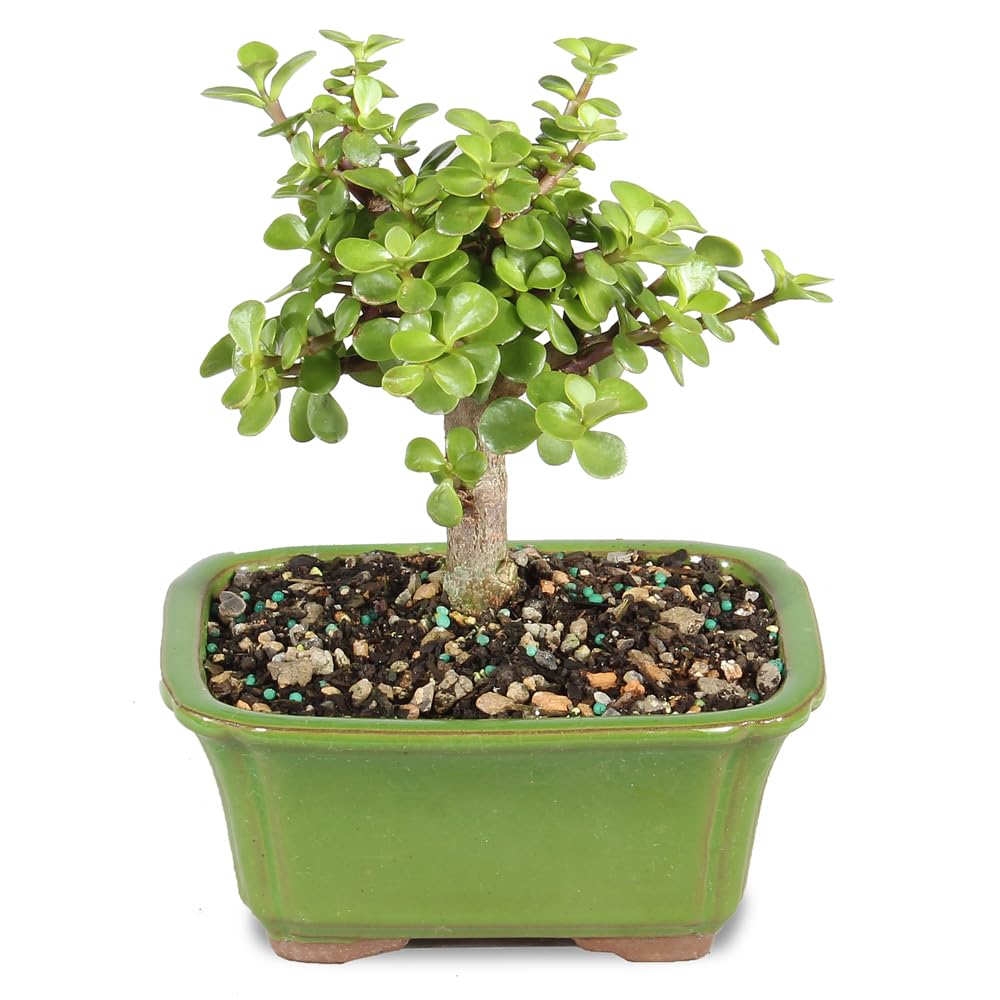
A succulent that stores water in its leaves, so your forgetfulness becomes a feature.
Dwarf Jade (Portulacaria afra) is not a true ficus — it is a succulent, which changes the care rules. The thick, fleshy leaves hold water just like a jade plant, which means you can safely let the soil dry out between waterings without seeing leaf drop. At 3 pounds and 5-to-8 inches tall this is the smallest potted tree in the mid-range, and the 3-year age gives it a woody trunk that already looks like a miniature tree rather than a cutting. It arrives in a ceramic bonsai pot, but no humidity tray is included — you have to supply your own tray or saucer.
One reviewer noted the “great price for a 3 year old bonsai” and described it as a perfect gift for a plant-lover. Another reviewer mentioned the tree came in a navy blue pot as a pleasant surprise, with soil still moist and undisturbed after shipping. The drought tolerance is the key difference here: while the ficus trees need regular watering, the Dwarf Jade can go a week or more without attention. It needs “bright light” to stay compact — without enough sun it gets leggy, stretching toward the window like a regular succulent.
The trade-off against the Golden Gate Ficus is visual impact. The Dwarf Jade’s leaves are smaller and rounder, and the trunk does not have the spiraling character of a trained ficus. At 3 pounds it is half the weight of the Golden Gate Ficus (6 lbs), which makes it easy to move, but also means the pot is smaller and the overall presence is more modest. Buyers who want a desktop companion they can ignore for a few days will prefer this; buyers who want a dramatic display tree should stick with the ficus.
Why it works
- Drought-tolerant succulent — ideal for people who travel or forget to water
- Thick, woody trunk at 3 years old gives real bonsai character
- Only 3 pounds, easy to reposition on different shelves or desks
The downsides
- No humidity tray included — you must buy one separately
- Needs bright light to stay compact; low light makes it stretchy
Choose this if: you want a low-water companion that a ficus would hate — the succulent leaves make it the most forgiving plant on this list by far.
Avoid if: you want a humidity tray included in the box or you need a tall, dramatic display piece for a large room.
4. Brussel’s Bonsai Live Hawaiian Umbrella Bonsai Tree

The lowest-cost route to a live potted bonsai, if you accept the leaf-drop risk.
The Hawaiian Umbrella tree (Ardisia crenata) is the least expensive live bonsai in this guide, but it is also the most sensitive. At 3 pounds and 4-to-7 inches tall, it is noticeably smaller than the mid-range options. Its glossy leaves cluster tightly into a dense canopy that looks charming on a windowsill. It arrives in a ceramic pot with a stand, so it is display-ready right away. This species is “non-flowering” and needs the same moderate watering as the ficus varieties.
Buyers have mixed experiences. One wrote that “it says it should loose about 21 leaves to adjust to the new environment,” which is normal acclimation for this species — Hawaiian Umbrella trees are known for shedding leaves when brought indoors. Another buyer described it as “absolutely beautiful” with excellent packaging. However, there are reports of the tree losing “too many leaves” with owners asking for help saving it. The leaf-drop is not necessarily a sign of death — the tree often regrows once it settles into its new indoor spot — but it can be alarming for a first-time owner.
Compared to the Dwarf Jade above, this tree has less drought tolerance and a narrower comfort zone. The 3-year-old Hawaiian Umbrella is smaller than the 3-year-old Dwarf Jade (4–7 inches vs 5–8 inches), and its leaves are more prone to dropping. The upside is cost: this is a genuine bonsai at a price that lets you practice without a big financial commitment. If you are unsure whether you will stick with the hobby, this is the least risky entry point — just do not panic when the first batch of leaves falls.
The good
- Lowest price among all live, potted bonsai options here
- Glossy umbrella-shaped leaves create a unique, cheerful look
- Ceramic pot and stand included — no extra purchases needed
The risk
- Frequent leaf-drop during acclimation can discourage a beginner
- Less forgiving of overwatering than the Dwarf Jade or Ficus varieties
Best for: a cautious first-timer who wants the lowest financial commitment — if you lose it, you are out less than a dinner out.
skip it if: you want immediate, drama-free greenery; the Golden Gate Ficus is a better bet for confidence.
5. American Plant Exchange Live Dwarf Jade Tree

A starter plant shaped like a bonsai, sold in a nursery pot instead of a ceramic bonsai pot.
The American Plant Exchange Dwarf Jade is the odd one out in this lineup — it arrives in a standard 6-inch nursery pot rather than a ceramic bonsai container. That is the defining trade-off: you get the same Portulacaria afra species (drought-tolerant, glossy leaves, woody trunk) at a lower price point, but you do not get the presentation. Several buyers mention the plant “arrived healthy” and is currently “thriving” after being repotted into a dedicated bonsai pot with bonsai soil and fertilizer. That is the path to take if you buy this — treat it as a raw plant and pot it yourself.
The biggest warning from the reviews is real: one buyer mentioned that the “plant dropped all leaves within a month” despite being an “avid plant owner.” Another received a tree with broken branches, soaked packaging, and black leaves. That variability is higher here than with the Brussel’s Bonsai products, which have more consistent packaging reviews. The drought tolerance is the same as the Dwarf Jade from Brussel’s, but the shipping risk and the lack of a bonsai pot make this a better choice for someone who already owns a ceramic bonsai pot and wants to save money on the tree itself.
At 4 pounds and in a 6-inch pot, this tree is physically larger than the 3-pound Brussel’s Dwarf Jade, but most of that size is the nursery container, not the tree. If you compare the two Dwarf Jades head to head, the Brussel’s version is display-ready; this one is a DIY project. Buyers who want a gift-ready tree should go with Brussel’s. Buyers who want to practice repotting and are comfortable with shipping risk can save a little money here.
Why consider it
- Dwarf Jade succulent is nearly impossible to kill with neglect once established
- Lower upfront cost than the Brussel’s Dwarf Jade
- Larger 6-inch pot gives root room for growth
Why pause
- Comes in a plain nursery pot — not a bonsai container
- Several owners mention the plant arrived damaged or dropped all leaves
- No humidity tray or decorative pot included
Go for this if: you already own a bonsai pot and want to buy the raw plant for less — you will repot it yourself and save a few dollars.
Pass if: you want a gift-ready tree that looks good on arrival without any extra work; the Brussel’s Dwarf Jade above is a safer bet.
Understanding the Specs
Tree Age (Years)
Manufacturers label bonsai by age — 3 years, 4 years, 6 years. This matters because an older tree has a thicker, woodier trunk and a more developed root structure, which makes it more resilient to shipping shock and beginner mistakes. A 3-year-old tree is cheaper but more fragile; a 6-year-old tree costs more but already looks like a miniature version of a full-grown tree. The age is not a guarantee of survival — care still matters — but an older tree has a wider safety margin.
Species (Ficus vs Succulent)
The biggest factor in an indoor bonsai’s survival is the species. Ficus microcarpa (Golden Gate, Ginseng Grafted) tolerates low humidity and inconsistent watering better than most trees. Portulacaria afra (Dwarf Jade) is a succulent that stores water in its leaves, so it forgives neglect outright. Ardisia crenata (Hawaiian Umbrella) is cheaper but sheds leaves during acclimation. For your first tree, pick a ficus or a succulent — they give you the widest room for error.
FAQ
What is the easiest indoor bonsai tree for a complete beginner?
Will my bonsai tree lose leaves when it arrives?
Do I need a humidity tray for my indoor bonsai?
How often should I water a beginner indoor bonsai?
Can I keep a bonsai tree in a low-light room?
What is the difference between a 3-year-old and a 6-year-old bonsai?
Should I repot my bonsai immediately after arrival?
Why did my bonsai tree arrive with wet soil?
Final Thoughts: The Verdict
For most people, the best beginner indoor bonsai tree winner is the Brussel’s Bonsai Golden Gate Ficus because its 4-year-old spiraling trunk, included humidity tray, and forgiving ficus genetics give you the widest safety net for your first bonsai experience. If you want a drought-tolerant tree you can occasionally ignore, grab the Brussel’s Dwarf Jade. And for a dramatic display piece that already looks centuries old, the Ginseng Grafted Ficus brings 6 years of root character to your desk with minimal extra care.
How We Picked
We do not accept paid placement. Every pick is matched to a real buyer and a real use-case; we do not hands-on test units.
Sources & Methodology
Specifications: manufacturer listings and product documentation. Review insights: verified customer reviews, as of July 2026. Pricing: not shown on this page (it changes often); check the current price via the retailer link.
As an Amazon Associate, FitlyFast earns from qualifying purchases. This does not affect which products we feature.