
Our readers keep the lights on and the weekend projects moving. As an Amazon Associate, I earn from qualifying purchases.
Specs are compiled from manufacturer listings and verified buyer reviews and can change over time — please confirm the key details on the product page before buying.
I’m Rikta — the founder and writer behind FitlyFast. This guide is built by comparing the manufacturers’ published specifications and the patterns across verified customer reviews, so you get each pick’s real strengths and trade-offs instead of marketing spin.
Quick Picks
- Behringer X AIR XR18 — Best Overall
- Yamaha MG10XU — Studio Standard
- Behringer FLOW 8 — Tactile Digital
- Mackie 802VLZ4 — Broadcast Choice
- Pyle PMXU128BT — Budget-Friendly Big Deck
- MAONO MaonoCaster AME2 — Podcast Commander
- Mackie 402VLZ4 — Ultra-Compact Clean
- Behringer XENYX 802S — Streaming Workhorse
- Depusheng DT8 — Budget Board
How To Choose The Best Audio Mixer
The main question you need to answer first is simple: how many sound sources do you need to plug in at once? One mic and a phone? That is a 2-4 channel job. A full band with four mics, two keyboards, and a guitar? You are looking at 8 to 12 channels. Every decision about an audio mixer flows from that number — it determines the size, the features, and the price.
Channel count
Count every microphone, instrument, and media player you plan to plug in at the same time. A 4-channel mixer like the Mackie 402VLZ4 works for a solo podcast with one or two mics. An 8-channel board handles a small band or a multi-mic live stream. Go with 12 or more channels — like the Pyle PMXU128BT — when you need inputs for a full drum kit plus vocals. Always add one or two spare channels for future expansion.
Analog vs. digital
An analog mixer (like the Yamaha MG10XU or the Mackie 802VLZ4) gives you physical knobs and faders for every channel. You twist what you hear — instant, no menu scrolling. A digital mixer (the Behringer FLOW 8 or the Behringer X AIR XR18) lets you save and recall scenes, use app-based remote control, and apply more sophisticated processing like compression (reducing loud peaks) and reverb on each channel. Digital is flexible; analog is tactile and immediate. Pick based on whether you prefer to save settings or just turn knobs.
USB audio interface
If you plan to record or stream to a computer, you need a mixer with a built-in USB audio interface (a chip that turns the analog mix into digital audio the computer understands). That USB connection turns the mixer into a sound card your computer recognizes. The Behringer XENYX 802S streams directly via USB. The Yamaha MG10XU is class-compliant, meaning it works with tablets without extra drivers. Without this feature, you would need a separate audio interface to get sound into your computer.
Preamps and phantom power
The preamp is the circuit that boosts your microphone’s weak signal to a usable level. Mixers with higher-quality preamps, like the Mackie Onyx or the Yamaha D-PRE, sound cleaner and capture more detail. 48-volt phantom power (an electrical current sent through the XLR cable) is essential for condenser microphones (mics that need external power to work). Most mixers in this guide offer it, but double-check if you plan to use a condenser mic.
Quick Comparison
| Model | Best For | Channels | Weight | Noise Level | Amazon |
|---|---|---|---|---|---|
| Behringer X AIR XR18 | Full band/live digital control | 18 (16 Midas preamps) | 7.1 lbs | — | Amazon |
| Yamaha MG10XU | Home studio/podcasting | 10 | 7.3 lbs (3300g) | — | Amazon |
| Behringer FLOW 8 | Mobile DJ/compact digital | 8 | 3.1 lbs (1400g) | 3 dB | Amazon |
| Mackie 802VLZ4 | Live sound/broadcast | 8 | 4.5 lbs | 60 dB | Amazon |
| Pyle PMXU128BT | Multi-mic live events | 12 | 10.6 lbs | — | Amazon |
| MAONO MaonoCaster AME2 | Podcaster/streamer | 10 | 2.1 lbs (0.95 kg) | 60 dB | Amazon |
| Mackie 402VLZ4 | Ultra-compact broadcast | 4 | 2.5 lbs | 60 dB | Amazon |
| Behringer XENYX 802S | USB streaming/podcasting | 8 | 3.5 lbs (1610g) | — | Amazon |
| Depusheng DT8 | Budget live sound | 8 | 7.5 lbs (3.4 kg) | 80 dB | Amazon |
In‑Depth Reviews
1. Behringer X AIR XR18

A 16-preamp digital powerhouse you control from a tablet — this is for the band that wants pro features without a full-size console.
The XR18 is the ultimate step up for live sound. It packs 18 input channels with 16 Midas-designed programmable mic preamps (preamps known for their clean, warm sound), all inside a compact metal box you can rack-mount or set on a stage corner. You control everything through an iPad or Android app — you can even use the built-in Wi-Fi router to connect directly, no external router needed. That 18 x 18 bidirectional USB interface (meaning it sends and receives 18 separate audio streams) means you can record every channel individually into a laptop or iPad while you mix live.
Buyers report that the wireless connection can get flaky in crowded venue environments, so many recommend hard-wiring via Ethernet for critical shows. The feature set is remarkable: per-channel compression, gate (a filter that silences noise between sounds), parametric EQ (precise tone shaping), and effects, plus a Dugan-style auto-mixer that manages multiple live mics intelligently. The downsides are few: no time-alignment for speaker processing (though a workaround exists using effects), and the iPad app lacks a built-in real-time analyzer (an RTA, which visually shows the frequency balance of your mix).
Why it wins
- 16 award-winning Midas programmable mic preamps deliver studio-grade audio quality
- 18 x 18 USB interface for multi-track recording directly to a computer or iPad
- Built-in Wi-Fi router allows full wireless control via tablet app
- Compact and rack-mountable (3U) for easy transport and installation
The trade-offs
- Wi-Fi can be unreliable in crowded RF environments (areas with lots of wireless signals); a wired Ethernet connection is recommended for critical events
- No AES50 digital snake port for very large system expansion
- Learning curve for the app-based workflow if you are used to physical knobs
Reach for it if: you need a full 16-input digital rig for a band, theater, or house-of-worship and want remote mixing from a tablet.
skip it if: you prefer the immediate tactile feel of physical faders or only need to mix a simple podcast with one or two mics.
2. Yamaha MG10XU

A 10-channel analog board with Yamaha’s D-PRE preamps — rich, clear sound that skips the sterile digital edge.
The Yamaha MG10XU is a versatile workhorse that bridges analog simplicity and digital convenience. At its heart are four D-PRE microphone preamps, designed with a discrete inverted Darlington circuit (a specific transistor layout that reduces noise) that delivers a transparent, natural sound with plenty of headroom (room to handle loud peaks without distortion). You get three dedicated stereo line channels, a 3-band EQ (bass, mid, treble controls) on each mono channel, and a 1-knob compressor for straightforward dynamics control on your mics. The class-compliant USB 2.0 connection lets you record or stream directly to a computer or tablet without installing drivers.
Owners mention that the built-in SPX effects processor, with 24 different effects (reverb, delay, chorus), is excellent for adding polish to vocals or instruments during a live stream. At 7.3 pounds, it is not the lightest desk mixer, but the build quality inspires confidence for home studios and small gigs. Some users mention the form factor is a bit wider than expected for a desk setup, but the sound clarity and the simplicity of the single-knob compressors make it a favorite for podcasters and vocalists who want to avoid complex menus.
Key strengths
- D-PRE mic preamps provide clean, transparent sound with natural detail
- 1-knob compressors on mono channels make dynamics control simple and effective
- Class-compliant USB 2.0 works with computers and tablets without extra drivers
- SPX processor includes a broad suite of 24 quality effects
Potential drawbacks
- Heavier than some comparable mixers at 7.3 pounds
- Only four microphone inputs may limit a band with many vocalists
- No Bluetooth input for wireless audio streaming
Solid pick for: home studio owners, vocalists, and podcasters who want Yamaha’s renowned preamp quality and a simple integrated USB interface.
Better to pass if: you need more than four XLR inputs for a live band or you require Bluetooth audio streaming.
3. Behringer FLOW 8

A digital mixer built for one-handed tweaking — 60 mm faders meet app control in a box barely larger than a laptop.
The FLOW 8 is designed for mobile DJs, small-venue performers, and content creators who need digital processing without losing the feel of physical controls. It gives you 8 input channels (with two Midas microphone preamps), 60 mm channel faders, and a master rotary control with a color-changing LED collar. The EZ-Gain function analyzes your signal and automatically sets the optimal gain, which is a genuine time-saver during setup. The FLOW 8 runs on 5V USB-C power, so you can run it from a standard power bank.
Buyers praise the dramatic improvement in clarity and headroom over basic analog mixers. The Bluetooth audio input streams backing tracks from a phone, and the companion FLOW app for iOS/Android allows wireless remote control. The catch, as some customers note, is that the headphone amp is a bit weak, and channels 3-4 can introduce a touch more noise than the pristine Midas inputs. The micro-USB port for power feels fragile, with owners recommending a right-angle extension cable to reduce strain.
What stands out
- Two Midas microphone preamps deliver excellent sound quality and low noise
- EZ-Gain function automatically sets levels for optimal headroom
- 60 mm faders provide precise physical control for a compact mixer
- Bluetooth remote control via the FLOW app for iOS/Android
Limitations
- Headphone amplifier output is less powerful than desktop mixers
- Fragile micro-USB power port; a right-angle extension is a smart add-on
- Channels 3 and 4 are noisier than the Midas inputs on channels 1-2
Grab this for: mobile DJs, solo musicians, and streamers who want digital effects and app control with real faders in a highly portable package.
Avoid if: you need a large number of analog inputs for a full band, or if a strong headphone feed for studio monitoring is a priority.
4. Mackie 802VLZ4
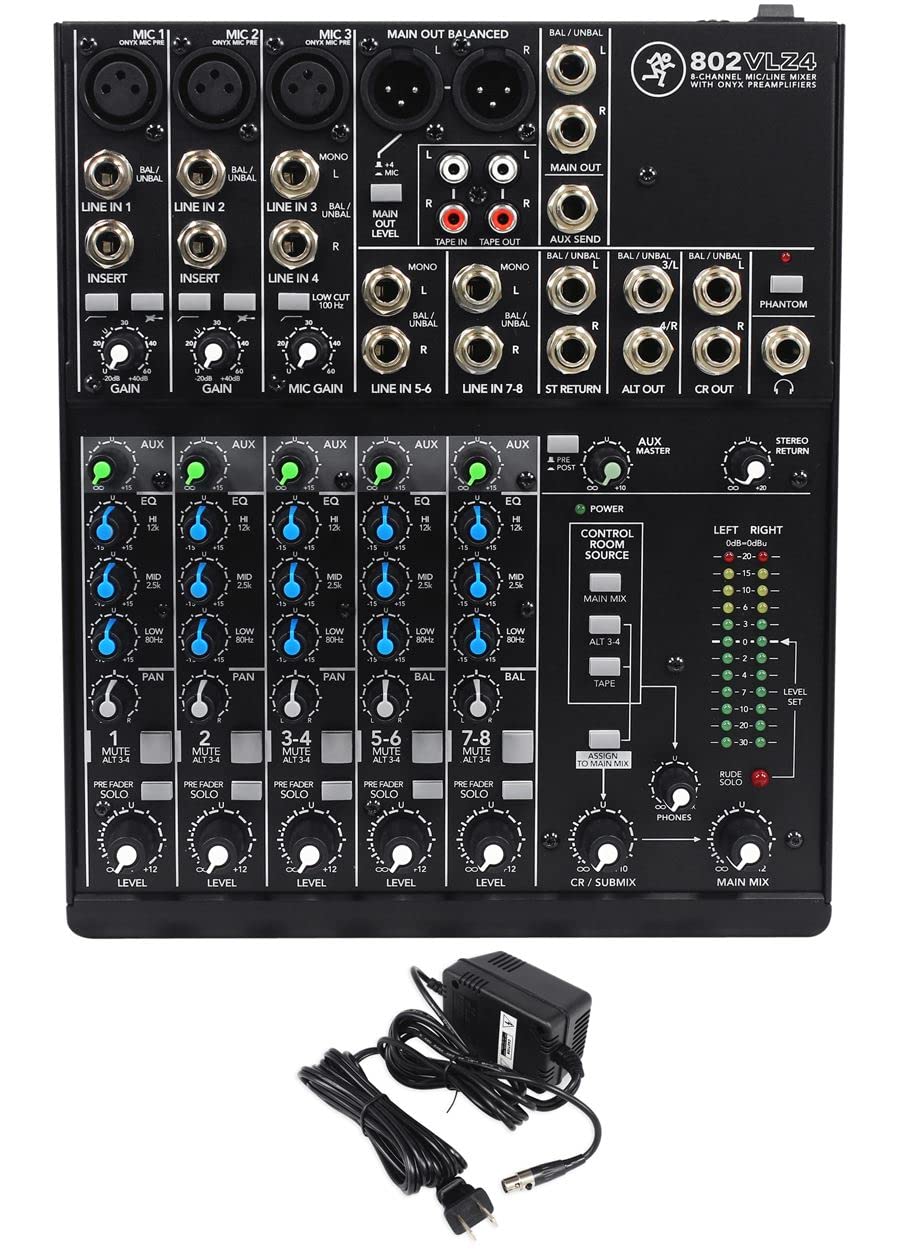
An 8-channel analog board with three Onyx preamps and RF rejection — built for clean sound in broadcasting and live settings.
The Mackie 802VLZ4 is the big brother of the 402VLZ4 and follows the same no-nonsense philosophy: high-headroom, low-noise design with three boutique-quality Onyx mic preamps and improved RF rejection (which means it is less likely to pick up radio interference, important for broadcast). It offers 8 high-headroom line inputs and a 3-band EQ on every channel. This is a purely analog mixer — no built-in effects, no USB interface — which is exactly what many live sound engineers and broadcasters prefer for simplicity and reliability.
Buyers highlight the all-metal construction and the fact that the preamps are clean and powerful. The outboard power supply keeps the chassis compact for tight spaces. Unlike the FLOW 8 or the XENYX 802S, this Mackie does not stream audio via USB, so you will need a separate audio interface to record to a computer. Compared to the 4-channel 402VLZ4, the 802VLZ4 is 15.8 inches deep versus 5 inches for the 402VLZ4, so it takes more desk space, but you gain four more channels and an aux send (an extra output for monitors or effects) with pre/post switching.
What works
- Three Onyx mic preamps deliver exceptionally clean, powerful sound
- All-metal chassis is built to survive regular transport and gigging
- Improved RF rejection makes it ideal for broadcast and radio use
- True analog signal path with no digital conversion — what you hear is instant and pure
What does not
- No built-in USB interface for recording or streaming to a computer
- No on-board digital effects like reverb or delay
- Larger footprint (15.8 inches deep) may not fit all desk setups
Ideal for: live sound engineers, broadcasters, and musicians who want rock-solid analog performance with excellent preamps and no digital menus.
Not for you if: you need a USB audio interface or built-in effects for a simple home studio.
5. Pyle PMXU128BT

12 channels and a 7-band EQ for under — a deck built for live events where inputs multiply fast.
When your setup demands a high channel count without a high price, the Pyle PMXU128BT delivers. It packs 12 XLR combo inputs, a 12-segment stereo output meter, and a 7-band graphic EQ (a visual equalizer with seven sliding controls) on the master output, giving you precise control over the final mix. The Bluetooth input allows wireless streaming from any phone or tablet, which is useful for playing background music during a live event. It also includes a USB soundcard interface for recording to a computer, plus 16 DSP effects for adding reverb or delay to individual channels.
Buyers describe this as a “tank” — it is built to survive transport, and the effects are surprisingly usable, especially for adding depth to snares and toms in a live drum mix. One experienced musician noted it sounds great with classical, flamenco, and electric guitar. The main real-world trade-off is that the USB connection outputs a single stereo mix (not multi-track), so you cannot record each channel individually. A few users also mention the USB connection needs an occasional re-insertion to maintain connection. At 10.6 pounds, it is heavy enough to stay put on a desk during active use.
Why it fits
- 12 XLR combo inputs offer serious channel count for multi-mic live setups
- 7-band graphic EQ lets you shape the master output with precision
- Bluetooth input and 16 DSP effects add flexibility for live events
- Sturdy, road-worthy build at a price that suits a tight budget
Where it cuts corners
- USB interface only records a single stereo mix, not individual channels
- Heavier than many compact mixers at 10.6 pounds
- Some users report USB occasionally drops the connection
Choose this for: church PA, school events, and budget-conscious live performers who need a high number of input channels and a graphic EQ.
Look elsewhere if: you need multi-track recording or a lightweight mixer for mobile streaming.
6. MAONO MaonoCaster AME2

A 10-channel streamer’s tool with customizable sound pads and auto-tune — built for content, not concerts.
The MaonoCaster AME2 is a digital podcast mixer and audio interface designed specifically for streaming, recording, and content creation. It offers 10 channels with a preamp that supports ultra-low noise gain up to 60dB and 48V phantom power for condenser mics. The headline feature is the 11 customizable sound pads — three support up to 60 seconds of audio each with one-key looping, perfect for intro music or repeated sound effects. The remaining eight pads can hold up to 20 seconds of sound. You can upload audio via Bluetooth, PC, or directly from your smartphone.
Reviewers point out that the sound quality is excellent with no mic clipping, and the dual output design is handy for connecting both a phone and a computer simultaneously. The integrated effects are deep for this compact unit, including six reverb modes, 12-step auto-tune, three modifiable tone knobs, and a pitch changer. One recurring note from reviewers is that the headphone monitoring sound differs slightly from the final recorded stream, so spoken-word podcasters may need to adjust their workflow.
Designed for creators
- 11 customizable sound pads with one-key looping for dynamic live streams
- Ultra-low noise preamp (60dB gain) with 48V phantom power for condenser mics
- Built-in auto-tune, reverb, and pitch changer for vocal processing
- Extremely lightweight at just 2.1 lbs (0.95 kg) for easy transport
Build concerns
- Some units reportedly experience USB-C port failure after about a year of use
- Headphone monitor sound differs from the final stream mix
- Not ideal for live music mixing; limited to 5V power with fewer XLR inputs than dedicated boards
Great for: podcasters, Twitch streamers, and vocal content creators who want sound effects, voice processing, and a simple all-in-one interface.
Not the right fit for: live bands, because the 10-channel label includes digital sound pads, and the total XLR inputs are limited.
7. Mackie 402VLZ4

A pint-sized mixer with a pro preamp that cleans up a cluttered desk — two Onyx mics in one tiny chassis.
Sometimes you only need a few inputs, and you do not want a mixer that takes up half your desk. The Mackie 402VLZ4 is a 4-channel ultra-compact mixer that measures 5 inches deep by 12.5 inches wide, while the Behringer XENYX 802S is listed at 19.69 inches deep. It features two boutique-quality Onyx mic preamps, phantom power for condenser microphones, and four high-headroom line inputs. The all-metal construction and improved RF rejection make it an excellent choice for broadcast, especially if you are mixing a single microphone with a line-level source.
Buyers consistently praise the solid, professional build and the fact that the preamps add no audible noise. Reviews note the Quick Start guide is thin and a full manual would be more helpful, but the mixer itself performs exactly as expected. The main limitation is the 4-channel count, which means it is only suitable for very simple setups. Compared to Maono’s AME2, the Mackie 402VLZ4 has 4 channels versus 10 channels, so it is a different class of device for a very different use case — focused simplicity over streaming features.
What it excels at
- Two Onyx mic preamps deliver pro-level clarity in a tiny footprint
- Small size (5 x 12.5 x 12.5 inches) fits in a laptop bag or small broadcast desk
- All-metal build is incredibly sturdy for its weight (2.5 lbs)
- Pure analog signal path with no added noise for clean broadcast sound
Where it limits you
- Only 4 channels total — two mics max if you use the line inputs
- No USB interface or digital effects built in
- Headphone output is not independent of the main mix
Perfect for: a simple broadcast setup, a field recording rig, or a clean way to combine a microphone and a media player for a small podcast table.
Not enough for: anyone who needs more than two XLR mics or wants to stream directly to a computer without extra gear.
8. Behringer XENYX 802S

A no-nonsense 8-input analog mixer that streams directly into your computer — built for the daily streamer or podcaster.
The XENYX 802S is designed for a specific job: mix your microphones and audio sources, then send that mix straight to a computer over a single USB cable. It is an 8-input mixer with a built-in stereo USB audio interface. The ultra-low noise design keeps the signal path quiet, and the 3-band EQ on each mono channel lets you shape vocals and instruments. Unlike the FLOW 8 above, this is a fully analog mixer, meaning all audio processing is done on the physical board — no app, no menus, just knobs you twist.
The unit is praised for its quiet operation — shoppers say no hum or white noise, and it only needs half the fader travel to reach a good mixing level. However, at 19.69 inches deep versus 5 inches for the ultra-compact Mackie 402VLZ4, this mixer takes up much more desk space, so measure your space before buying.
Where it delivers
- Built-in stereo USB audio interface for direct streaming to a PC
- Ultra-low noise design keeps the signal clean during operation
- Reliable for daily use in live streaming and podcasting
- Physical controls with 3-band EQ on each mono channel for quick sound shaping
Physical trade-offs
- Very large footprint at 19.69 inches deep — requires significant desk space
- No Bluetooth or digital effects (reverb/delay) onboard
- Only two mono mic preamps for the 8-channel input count
Best for: daily streamers and content creators who need a quiet, reliable mixer with a built-in USB interface for a simple computer recording workflow.
Less suitable for: mobile performers or small desk setups, given its large frame and lack of digital features.
9. Depusheng DT8

An 8-channel analog mixer at the no-frills price — a functional starting point for live drums and open mics.
The Depusheng DT8 is the most affordable way to get 8 channels in one box. It offers XLR and 1/4-inch inputs with +48V phantom power, a 3-band EQ on each channel, Bluetooth wireless streaming, and USB/MP3 playback. The steel chassis is rugged, with sealed rotary controls that resist dust — a thoughtful detail for a stage environment. It is a straightforward analog board with no digital interface, but it does include a basic USB-only recording function for capturing a stereo mix.
Buyers report it works well as a pre-mix tool for live drums and is perfectly functional for open mic nights. The onboard effects (reverb/delay) are considered weak and better left unused — one review called them “terrible” — but the basic mixing and amplification are solid for the price. One reviewer noted that after 7 months the headphone jack failed, which highlights the trade-off you make at this budget level. It also has the highest noise level among this group at 80 dB, versus 60 dB for the Mackie 402VLZ4, Mackie 802VLZ4, and MAONO MaonoCaster AME2, meaning the signal is less clean than those units.
What you get
- 8 channels at a budget price, great for learning live sound
- Bluetooth streaming for wireless playlist management
- Rugged steel chassis with dust-resistant sealed controls
- 48V phantom power for condenser microphones on all channels
What you give up
- Higher noise floor (80 dB) than cleaner mixers like the Mackie or MAONO (60 dB)
- Onboard effects are weak and not usable for quality recording
- Long-term reliability concerns reported in some units after 7+ months
Right for: a budget-conscious drummer needing an inexpensive 8-channel mixer for live practice, or a first-time buyer learning the basics of mixing.
Pass on this if: you need clean preamp sound for a quiet podcast or reliable long-term daily use for streaming.
Understanding the Specs
Channel Count
The number of separate audio sources you can plug in and control independently. A “channel” is a single input path (usually one microphone or one instrument). A 4-channel mixer lets you plug in four mics or a mix of mics and line sources. An 8-channel board is for a small band. Digital boards like the Behringer XR18 count 18 channels because they can process many inputs, but the physical XLR jacks may be fewer — always count the physical XLR combo jacks (the combined XLR and 1/4-inch sockets) for your actual mics.
Noise Level (dB)
This number describes how much background hiss or hum the mixer adds to your signal when nothing is playing — the lower the number, the cleaner the silence. The Mackie 402VLZ4, Mackie 802VLZ4, and MAONO MaonoCaster AME2 are listed at 60 dB, while the Depusheng DT8 is listed at 80 dB. The Depusheng DT8 is more affordable but will add a faint hiss to your output that becomes audible during quiet moments in a podcast or recording.
FAQ
What does 48V phantom power do on a mixer?
Can I use an audio mixer as a USB interface for my computer?
How many microphones do I need to connect at once?
What is the difference between analog and digital mixers?
Can I connect a USB microphone to an audio mixer?
Is a 4-channel mixer enough for a podcast?
What does a “preamp” do and why does it matter?
How do I add reverb or effects to my mix?
Will a mixer work with my headphones and speakers at the same time?
Can I use an audio mixer for guitar or bass?
Final Thoughts: The Verdict
If you want one dependable pick, the best audio mixer winner is the Behringer X AIR XR18 because its 16 Midas preamps, full digital control via tablet, and 18-channel USB recording set the standard for small-to-medium live sound and studio work. If you want a simple analog mixer with superior preamps for a home studio, grab the Yamaha MG10XU. And for a pure broadcast-quality analog board that is compact and rugged, the Mackie 802VLZ4 is tough to top.
How We Picked
We do not accept paid placement. Every pick is matched to a real buyer and a real use-case; we do not hands-on test units.
Sources & Methodology
Specifications: manufacturer listings and product documentation. Review insights: verified customer reviews, as of July 2026. Pricing: not shown on this page (it changes often); check the current price via the retailer link.
As an Amazon Associate, FitlyFast earns from qualifying purchases. This does not affect which products we feature.