
Our readers keep the lights on and the weekend projects moving. As an Amazon Associate, I earn from qualifying purchases.
Specs are compiled from manufacturer listings and verified buyer reviews and can change over time — please confirm the key details on the product page before buying.
You can get a sharp, bright pair of binoculars for under $100 — but you need to know which specs matter. A bigger objective lens (the second number in “12×50”) lets in more light, while BAK4 prisms keep the image from looking cut off at the edges. The four picks here cover everything from pocket-ready travel sets to high-magnification tripod models.
I’m Rikta — the founder and writer behind FitlyFast. This guide is built by comparing the manufacturers’ published specifications and the patterns across verified customer reviews, so you get each pick’s real strengths and trade-offs instead of marketing spin.
No matter if you want a compact set for a day hike or a larger lens for spotting animals at dawn, the choices below show the real differences in magnification, lens diameter, and build quality for the best binoculars under $100.
Quick Picks
- Occer 12×50 Bird Watching Binoculars for Adults — Best Overall
- Sogries 20×60 Binoculars for Adults High Powered — Longest Reach
- Hontry 12×25 Compact Binoculars for Adults and Kids — Best Value Travel
- OPAITA 20×32 Compact Binoculars for Adults — Budget Compact
How To Choose The Best Binoculars Under $100
The first real spec to check is the objective lens size — the second number in the pair (like the “50” in “12×50”). A bigger lens lets in more light, so you see a brighter image at dawn or dusk. In this budget range, a 50mm lens is the largest you will find, and it makes a noticeable difference compared to a 25mm lens in low light.
Magnification and Stability
Higher magnification, like 20x, pulls distant subjects in closer, but the image shakes more with hand movement because you are zoomed in tighter. For general birdwatching or hiking at this price point, a 12x magnification is easier to hold steady without a tripod. If you go for 20x, plan to rest your elbows on a solid surface or use a tripod.
Prisms and Coatings
BAK4 prisms and fully multi-coated lenses are the two features to look for here. BAK4 is a type of glass with a higher refractive index, so the image stays round and bright rather than clipped at the edges. Multi-coated lenses cut glare and reflections, which makes colors look truer on an overcast day. Both of these are common in the under-$100 range, but not every model has them.
Quick Comparison
| Model | Best For | Magnification | Objective Lens | Field of View | Amazon |
|---|---|---|---|---|---|
| Occer 12×50 | Best Overall / Low-light use | 12x | 50 mm | 8.3 Degrees | Amazon |
| Sogries 20×60 | Highest magnification / Stationary use | 20x | 60 mm | 7.2 Degrees | Amazon |
| Hontry 12×25 | Travel / Everyday carry | 12x | 25 mm | 288 Feet | Amazon |
| OPAITA 20×32 | Budget-friendly compact | 20x | 32 mm | 235 Feet | Amazon |
In‑Depth Reviews
1. Occer 12×50 Bird Watching Binoculars for Adults

A 50mm objective lens makes this the brightest view you can get under $100 — you see clear images at dawn and dusk.
The image stays bright and vivid even at dawn or dusk, which is exactly when many animals are active, thanks to the 50mm objective lens and BAK4 prism (glass that keeps the view round and bright instead of clipped at the edges). The 12x magnification gives you a close-in look without the jitter that comes with higher zoom, and the 4.17-millimeter exit pupil (the circle of light leaving the eyepiece) is big enough to keep your view from dimming when the sun drops. The field of view measures 8.3 degrees, which is wide enough to track a moving bird across a tree line without losing it.
Unlike the compact Hontry 12×25 below, this model is heavier at 800 grams and does not slip into a jacket pocket — it rides in the included carrying case. Buyers report that you get “excellent clarity and brightness via BAK4 prism” and praise the smooth center focus and twist-up eyecups for glasses wearers. The enclosure is ABS, and the diopter adjustment (a ring that lets you fine-tune focus for each eye) covers plus or minus 5 diopters, so it works across a wide range of prescriptions.
Why it wins the top spot
- Large 50mm objective gives you usable low-light performance — true for early morning birding or stargazing with a tripod
- BAK4 prisms and fully multi-coated coatings deliver sharp, color-accurate images
- IPX7 waterproof (protected against immersion in one meter of water) and fog-proof build (mentioned by verified reviewers) so a light rain or humid air won’t fog the glass
Where you make a trade-off
- At 800 grams, it is noticeably heavier than the palm-sized Hontry model, so you feel the weight on a multi-hour hike
- Manual focus only — no auto-adjust for fast-moving scenes like sports
Reach for these if: you want a bright, stable image for birdwatching, hunting, or stargazing in low light, and you don’t mind the extra bulk in your daypack.
Look elsewhere if: your priority is pocket-size portability for a concert or quick travel grab.
2. Sogries 20×60 Binoculars for Adults High Powered
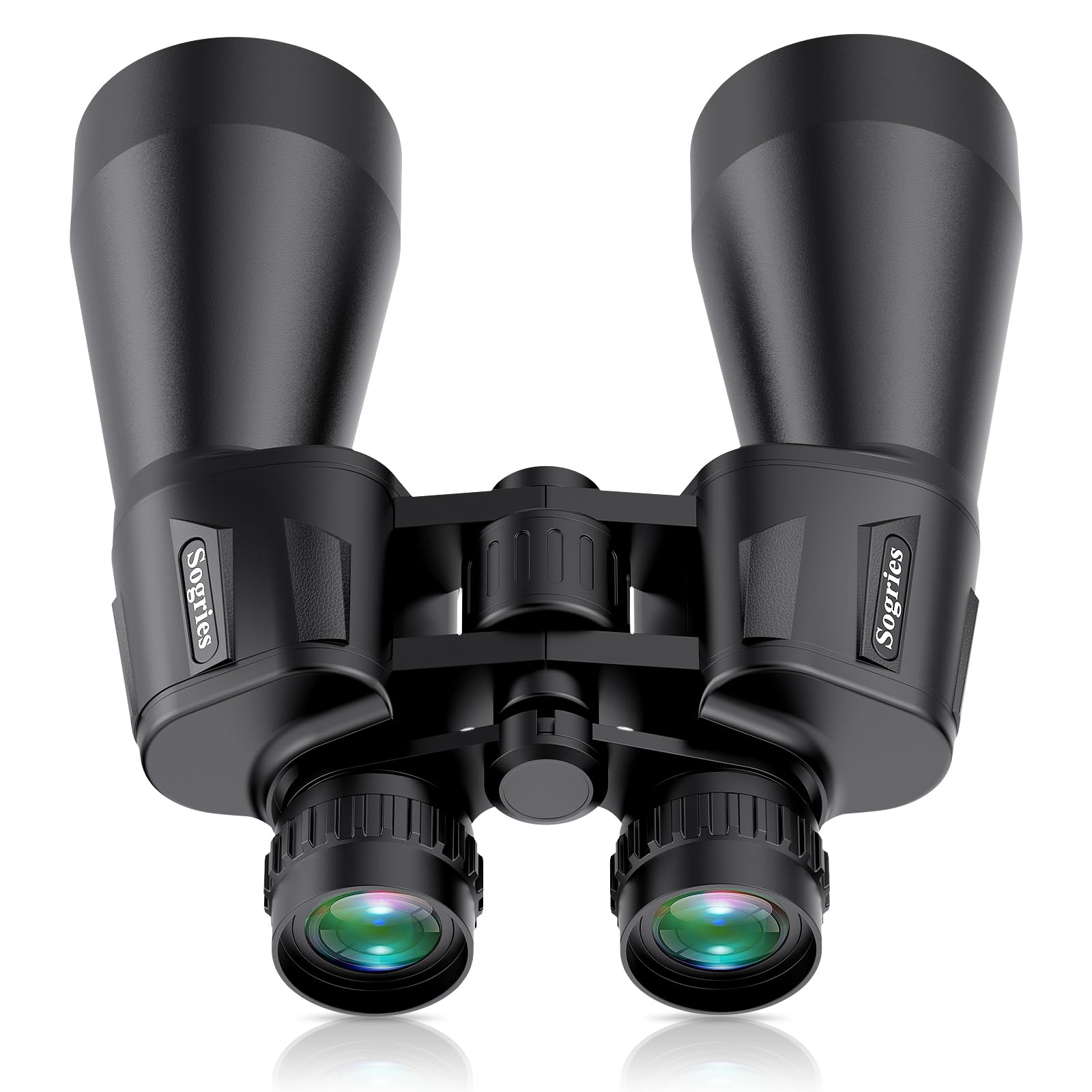
The 20x magnification brings Jupiter’s rings into view — but you need a tripod to keep the image steady.
If you need to see the texture on a mountain ridge or the rings of Jupiter, the 20x magnification on this pair pulls you extremely close, helped by a 60mm objective lens that is 2.4x larger than the 25mm lens on the compact Hontry model. That large lens collects more light, but the trade-off is clear: at 1.42 pounds and with a length of 8.6 inches, this is a heavy unit that demands a steady rest. The manufacturer notes it includes a tripod adapter, and buyers confirm you need a tripod for a shake-free view at 20x.
The multilayer-coated aspherical lenses (curved lenses that cut distortion) deliver 99.8% light transmission according to the manufacturer, so the image stays bright even when you zoom all the way in, and the BAK4 Porro prism design (a traditional prism shape that improves depth perception) sharpens color. Owners mention the 20x magnification provides “clear, detailed distant views” and praise the waterproof build for outdoor use — though the manual says do not immerse them in water, meaning they handle rain but not a dunk. The field of view is 7.2 degrees, narrower than the Occer 12×50’s 8.3 degrees, which is expected at higher magnification.
The standout strengths
- 20x magnification brings distant subjects incredibly close — useful for astronomy, long-range hunting, or scanning far-off terrain
- 60mm objective lens with multilayer coating keeps the view bright and minimizes distortion
- Metal enclosure feels solid and impact-resistant; the included tripod adapter lets you lock in a stable image
The practical limits
- Heavy at 1.42 pounds and long; you will struggle to hold it steady without a tripod or braced support
- Narrow field of view means you lose track of moving subjects like birds in flight
- Lens caps are thin and untethered according to one reviewer — easy to misplace
Choose this one for: stationary, long-distance use — stargazing, hunting from a blind, or watching a far-off ridgeline from a campsite.
Skip it for: hiking, birding on the move, or any activity where you need to pan and scan quickly.
3. Hontry 12×25 Compact Binoculars for Adults and Kids
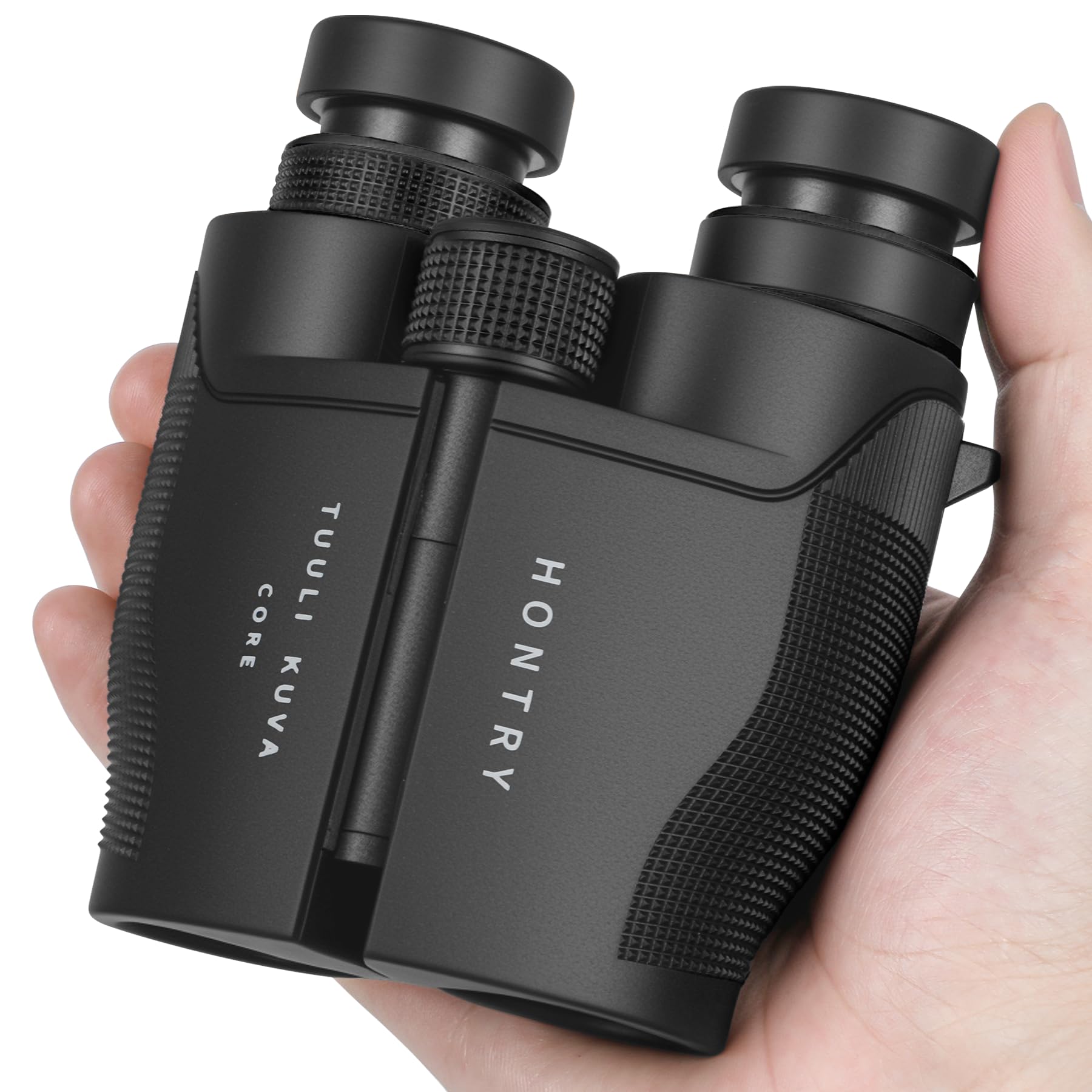
The 10.6-ounce weight disappears in a jacket pocket — this is the grab-and-go binocular for concerts and day hikes.
Weighing only 0.66 pounds (10.6 ounces) and measuring 4.3 inches long, these slip into a jacket pocket or glove box without a second thought. The 12x magnification — which is the same power as the Occer 12×50 model above — means you get a tight view of distant subjects, but the 25mm objective lens lets in far less light, so you lose brightness in the hour after sunrise. The field of view is 288 feet at 1000 yards, which is 23% wider than the 235 feet on the OPAITA 20×32, so scanning a shoreline or treeline feels comfortable.
BAK4 prisms and fully coated lenses are inside the compact body, delivering a sharp, contrast-rich image. One reviewer noted that the “close focus is 11ft/3.3m,” which is noticeably better than the 21ft/6.5m they got from an 18×50 model — useful for getting a tight view of a nearby butterfly or flower without losing focus. The adjustable interpupillary distance of 60 to 75 mm (the space between your eyes) works for both kids and adults, and the twist-up eyecups help if you wear glasses. A small downside: some reviewers felt the included case and strap were lower quality than the optics themselves.
What makes this a top travel pick
- Ultra-light 10.6 oz design fits anywhere — no excuse to leave them behind on a hike or trip
- Wider field of view (288 ft) than the OPAITA 20×32 model, so you scan more area at once
- Close focus of 11 feet lets you see nearby details that other binoculars blur
Where it loses light
- 25mm objective lens limits how much light reaches your eye — dim view in heavy shade, dawn, or dusk
- Case and strap feel cheap, according to verified buyers; you may want to upgrade the carry solution
Grab this if: you need a lightweight, packable binocular for daytime use at concerts, day hikes, or keeping in the car for road trips.
Not the one if: you plan to watch wildlife at sunrise or in deep woodland shade.
4. OPAITA 20×32 Compact Binoculars for Adults

The 20x zoom fits in a small frame — but the 1.6-millimeter exit pupil makes it a daytime-only glass.
At first glance, a 20x magnification paired with a 32mm objective lens sounds like an exciting combination — you get the zoom of the Sogries 20×60 model in a much smaller package. But the compact lens means you only get a 1.6-millimeter exit pupil, which is the circle of light that reaches your eye. That is 2.6x smaller than the 4.17-millimeter exit pupil on the Occer 12×50, so the image dims quickly in anything other than full daytime sun. On a bright day at the beach or a football game, the view is crisp. In the early morning woods, it looks gray.
BAK4 prisms and fully multi-coated lenses are present, which helps the image stay sharp and color-accurate given the price. The field of view is 235 feet at 1000 yards, narrower than the Hontry 12×25’s view as noted above, so tracking a fast bird or a player running across the field takes more head movement. One buyer on an Alaskan cruise shared that they “saw lots of whales that I would have missed if I didn’t have these,” which speaks to the usefulness of the reach in good light. A reviewer also flagged that one lens came apart in a backpack and had to be glued back with Loctite — so the build quality is not as rugged as the rubber-armored Occer.
Why it is a value pick
- 20x zoom in a lightweight, compact body that fits in a small bag — ideal for concerts and cruises
- BAK4 prisms and multi-coated coatings give a clear image in good light conditions
- Affordable enough to be a casual grab-and-go set that you do not baby
The compromises you see
- Small 1.6 mm exit pupil means a dim, small image in low-light settings — not for dawn or dusk
- Some quality control issues reported: one reviewer had a lens detach in their bag
- Narrower field of view than the Hontry 12×25, so scanning is less natural at high zoom
This works best as: a budget-friendly daytime-only binocular for events and trips where you want big reach without a big price.
Pass if: you need a rugged, all-purpose glass for varied lighting or regular outdoor use.
Understanding the Specs
Magnification and Objective Lens
The first number (the magnification) tells you how many times closer an object appears. The second number (the objective lens diameter in millimeters) tells you how much light the lens lets in. A larger number after the “x,” like 50mm versus 25mm, means a brighter image, especially in low light. But a higher first number, like 20x, makes the image shake more because you are zoomed in further — it is harder to hold steady.
Exit Pupil and Field of View
The exit pupil is the circle of light you see when you hold the binoculars at arm’s length. A larger exit pupil (over 3mm) means a brighter visible image in dim conditions. The field of view describes how wide an area you see — measured in feet at 1000 yards. A wider field of view makes it easier to scan for birds or follow a fast-moving animal, while a narrower one is fine for focusing on a single distant object.
FAQ
What do the numbers “12×50” or “20×60” mean on binoculars?
Is a higher magnification always better under $100?
What does BAK4 prism mean for image quality?
Do I need a tripod for binoculars under $100?
What is the best field of view for birdwatching?
Can I use binoculars under $100 for stargazing?
How do I clean the lenses without scratching them?
What is the best exit pupil size for low-light binoculars under $100?
Are cheap binoculars under $100 worth buying?
Final Thoughts: The Verdict
If you want one dependable pick, the best binoculars under $100 winner is the Occer 12×50 because its 50mm lens and BAK4 prism give you the brightest low-light image per dollar. If you want a compact travel set that disappears in a jacket, grab the Hontry 12×25. And for long-range stationary use like stargazing or scanning far ridgelines, the Sogries 20×60 offers the highest magnification you can afford in this budget.
How We Picked
We do not accept paid placement. Every pick is matched to a real buyer and a real use-case; we do not hands-on test units.
Sources & Methodology
Specifications: manufacturer listings and product documentation. Review insights: verified customer reviews, as of July 2026. Pricing: not shown on this page (it changes often); check the current price via the retailer link.
As an Amazon Associate, FitlyFast earns from qualifying purchases. This does not affect which products we feature.