
Our readers keep the lights on and the weekend projects moving. As an Amazon Associate, I earn from qualifying purchases.
Specs are compiled from manufacturer listings and verified buyer reviews and can change over time — please confirm the key details on the product page before buying.
Picking your first camera for photography is where most beginners overthink it—you worry about specs and megapixels, but what really matters is finding a camera that grows with you without hurting your wallet. The best beginner camera for photography is the one that makes you want to pick it up every day, and that balance changes as you go from learning the basics to chasing specific shots.
I’m Rikta — the founder and writer behind FitlyFast. This guide is built by comparing the manufacturers’ published specifications and the patterns across verified customer reviews, so you get each pick’s real strengths and trade-offs instead of marketing spin.
Whether you lean toward a classic DSLR or a modern mirrorless model, the right beginner camera for photography should feel natural in your hands and deliver the image quality you expect without needing a manual to start shooting.
Quick Picks
- Sony ZV-E10 Mirrorless Camera with 16-50mm Lens, 128GB Extreme Speed Memory, Wide Angle & 2X Lenses, Case, Tripod, Filters, Hood, Grip, Spare Battery & Charger, Editing Software Kit – Deluxe Bundle — Best Overall
- Fujifilm X-S20 Mirrorless Camera Body — Color Master
- Canon EOS R50 Mirrorless Camera Kit – APS-C RF Camera with 18-45mm Lens, 4K Video, Dual Pixel AF II & Vari-Angle Touchscreen — Best Value Hybrid
- Canon EOS R100 Mirrorless Camera RF-S18-45mm F4.5-6.3 IS STM Lens Kit, 24.1MP APS-C Sensor, 4K Video, Wi-Fi & Bluetooth — Budget Mirrorless
- Canon EOS RP Full-Frame Mirrorless Interchangeable Lens Camera + RF24-105mm Lens F4-7.1 IS STM Kit — Full-Frame Pioneer
- Nikon D3400 Digital SLR Camera & 18-55mm VR DX AF-P Zoom Lens (Black) – (Renewed) — Budget DSLR
How To Choose The Best Beginner Camera For Photography
A great starter camera feels like a tool you want to master, not a puzzle you have to solve. Before you buy, focus on three key areas that define every beginner photographer’s experience: how the camera handles autofocus, what you get with the included lens, and whether the system lets you upgrade later without starting over.
Autofocus Points and Accuracy
Autofocus points are the little zones the camera uses to lock onto your subject. More points generally mean better tracking, especially when you are shooting moving subjects like pets or kids. A camera with 425 autofocus points, for instance, lets you track a runner across the frame, while a camera with only 11 points struggles to keep the same subject in focus as it moves. For a beginner, eye and face detection — technology that tells the camera to focus on a person’s eye or face automatically — makes a massive difference in getting sharp portraits on your first try.
Kit Lens Quality and Reach
The lens that comes in the box — called the kit lens — is often the only lens you will use for months. Look for something in the 18-55mm range, which covers wide-angle for landscapes and a mild zoom for portraits. A lens with image stabilization (a system inside the lens that counteracts your shaky hands) helps you get sharper photos in low light without a tripod. The aperture range, listed as something like f/3.5-5.6, tells you how much light the lens lets in; a lower number at the short end (f/3.5) is better for indoor shots.
System Growth and Lens Ecosystem
You are not just buying a camera — you are buying into a family of lenses and accessories. Canon’s RF mount and Sony’s E-mount both offer a wide range of lenses from budget prime lenses (a lens that does not zoom but takes sharper photos) to high-end zooms. Nikon’s F-mount is older but has lots of affordable used lenses. Fujifilm’s X-mount is known for compact, high-quality lenses that match their cameras well. Check that the brand you pick has the lenses you might want a year from now, so you are not stuck wishing you had picked a different system.
Quick Comparison
| Model | Best For | Sensor | Autofocus Points | Max FPS | Amazon |
|---|---|---|---|---|---|
| Sony ZV-E10 Bundle | Vlogging & fast autofocus | 24.2 MP APS-C | 425 | 11 fps | Amazon |
| Fujifilm X-S20 | Color science & video hybrid | 26.1 MP APS-C | 399 | 20 fps | Amazon |
| Canon EOS R50 Kit | All-around beginner hybrid | 24.2 MP APS-C | — | — | Amazon |
| Canon EOS R100 | Budget mirrorless entry | 24.1 MP APS-C | 143 | 6.5 fps | Amazon |
| Canon EOS RP Kit | Full-frame for less | 26.2 MP Full-Frame | — | — | Amazon |
| Nikon D3400 (Renewed) | Budget DSLR entry | 24.2 MP DX-Format | 11 | — | Amazon |
In‑Depth Reviews
1. Sony ZV-E10 Mirrorless Camera with 16-50mm Lens, 128GB Extreme Speed Memory, Wide Angle & 2X Lenses, Case, Tripod, Filters, Hood, Grip, Spare Battery & Charger, Editing Software Kit – Deluxe Bundle

The hybrid that nails autofocus and comes with everything but the kitchen sink.
This Sony ZV-E10 delivers what beginners actually struggle with: keeping your subject sharp without fiddling with settings. It packs 425 autofocus points — a 38.6x gap over the Nikon D3400’s 11 points — so your camera locks onto a moving dog or a baby’s eyes and stays there. The 24.2MP APS-C Exmor CMOS sensor (the light-sensitive chip inside) gives you clean, detailed photos in everyday light, and the bundle adds a spare battery, charger, tripod, and even a photo editing software kit so you can start shooting the day it arrives.
Buyers report that the battery lasts a couple of days for typical use, and they love the quality of video and pictures. The side flip-out touchscreen makes it easy to frame yourself for vlogging or group shots, and the up to 11-fps shooting speed means you can catch a burst of action without missing the perfect moment. The included E PZ 16-50mm f/3.5-5.6 OSS lens covers wide-angle to mild zoom, with Optical SteadyShot (built-in vibration correction) to keep handheld shots steadier in dim light.
The trade-off is that the kit lens is a bit slow in low light, and some buyers mention that the software codes and one of the bundled lenses can sometimes be missing in the box. If you want the most complete starter package with autofocus that rivals cameras costing twice as much, this is your pick.
What New Owners Love
- 425 autofocus points with real-time eye and face tracking for sharp shots every time
- Comprehensive bundle includes spare battery, charger, tripod, and editing software
- 24.2MP APS-C sensor paired with 14-bit color depth for rich image quality
What to Watch For
- Kit lens aperture range (f/3.5-5.6) limits low-light performance without raising the ISO
- Some owners mention missing items like the software bundle or extra lenses
Reach for this if: you want the best autofocus system in a beginner camera and a bundle that covers almost every accessory you will need for your first year.
Look elsewhere if: you plan to shoot mainly in very dim indoor spaces without adding a faster lens — the kit lens will make you work harder there.
2. Fujifilm X-S20 Mirrorless Camera Body

Straight-out-of-camera colors so good you might skip editing entirely.
The Fujifilm X-S20 is built around the company’s famous color science — the way the camera processes colors and tones to mimic classic film stocks — so your photos look punchy and professional with zero editing. Its 26.1-megapixel X-Trans CMOS 4 sensor (a type of sensor that reduces moiré patterns without a blurring filter) paired with the X-Processor 5 engine delivers sharp, vibrant images at up to 20 fps in electronic shutter mode. The five-axis in-body image stabilization gives you up to seven stops of correction — a huge help when you are shooting handheld in twilight or walking while recording video.
Customers note that the video quality is vastly improved over older Fuji models, with no time limits on recording and superb 4K output. The NP-W235 battery delivers an impressive 750 frames per charge in normal mode — more than double the previous model — so you can shoot an entire day trip without reaching for a spare. The 180-degree vari-angle LCD touchscreen makes awkward overhead or selfie shots a breeze, and the deep handgrip gives you a secure hold even with heavier lenses attached.
The one gap is that this camera body does not include a lens, so you will need to budget for one separately. A few buyers also noted that the camera can overheat and shut down after about 8 minutes of continuous recording in warm weather, and there is no weather sealing, so you will want to keep it dry in light rain.
Why It Stands Out
- Fujifilm’s acclaimed color science produces beautiful images straight out of camera
- Up to 7 stops of in-body image stabilization for handheld low-light and video shooting
- 750 frames per charge battery life — enough for a full day of casual shooting
Consider Before Buying
- Body-only — you need to purchase a separate lens to start shooting
- Can overheat during extended 4K video recording in warm conditions; no weather sealing
Best suited for: the photographer who wants gorgeous images without post-processing and values a compact, lightweight body with top-tier stabilization.
skip it if: you want a complete kit from the start with a lens included, or you live in a hot climate where long video sessions are part of your plan.
3. Canon EOS R50 Mirrorless Camera Kit – APS-C RF Camera with 18-45mm Lens, 4K Video, Dual Pixel AF II & Vari-Angle Touchscreen
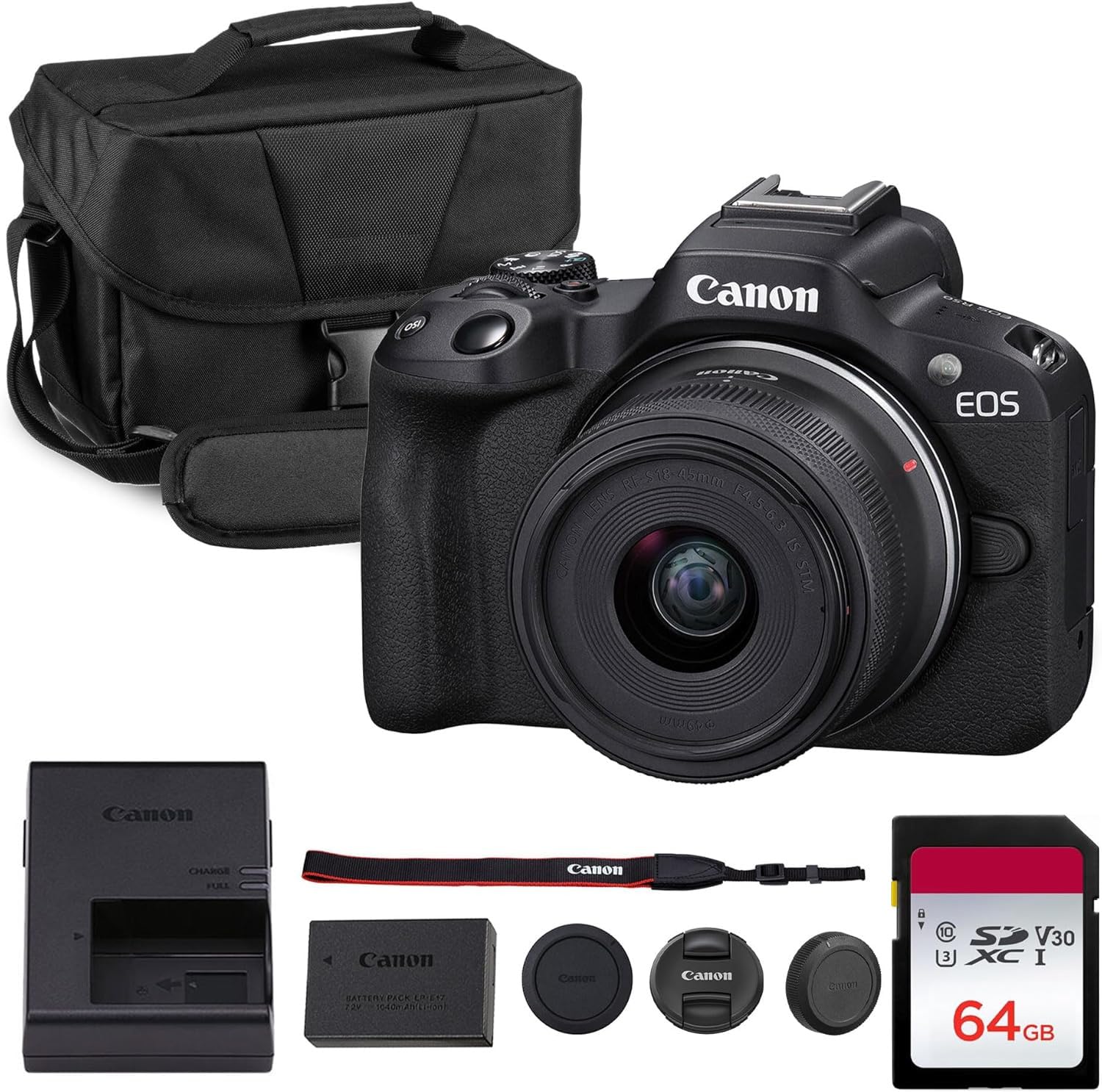
The Canon that pairs fast autofocus with an 18-45mm kit and a vari-angle screen for easy selfies.
This Canon EOS R50 kit is designed as a step-up from phone photography that does not overwhelm you. It uses Canon’s Dual Pixel CMOS AF II, a phase-detection autofocus system (a method where the camera splits incoming light to judge distance instantly) that covers the whole frame with face, eye, and animal detection — so your cat or your kid stays in focus even when they are moving. The kit includes the versatile RF-S 18-45mm f/4.5-6.3 IS STM lens, which has image stabilization built in to keep your shots steady during handheld video or low-light snaps.
Reviewers point out that the camera is lightweight, easy to use, and produces good image quality from the start, with one reviewer noting it is a great replacement for the G7X without the heavy price tag. The vari-angle touchscreen lets you tilt the screen out and swivel it to face you for vlogging, and the Creative Assist feature guides you through visual effects without needing to learn shutter speed and aperture concepts first. The kit also includes a shoulder bag and a 64GB SD card, so everything is ready to go.
Reviewers point out that the camera lacks in-body stabilization, so you rely solely on the lens for shake reduction, and the buffer fills quickly when shooting continuous bursts. The battery charges reasonably fast, but you should plan for a spare if you shoot for a full day.
What Makes It Easy
- Dual Pixel CMOS AF II with subject detection (face, eye, animal) for reliable focus
- Kit includes lens, bag, and 64GB card — everything you need in one box
- Vari-angle touchscreen and Creative Assist mode simplify composition and editing
What Holds It Back
- No in-body image stabilization — steady shots depend entirely on the lens IS
- Buffer fills quickly during high-speed continuous shooting, limiting action sequences
Go for it if: you want a complete mirrorless starter kit with reliable autofocus and a screen that works well for selfies and vlogging without extra accessories.
Consider alternatives if: you plan to do a lot of fast-action sports or wildlife photography where the shallow buffer would frustrate you.
4. Canon EOS R100 Mirrorless Camera RF-S18-45mm F4.5-6.3 IS STM Lens Kit, 24.1MP APS-C Sensor, 4K Video, Wi-Fi & Bluetooth

The lightest Canon R-series body that introduces you to mirrorless without the learning curve.
At the smallest and lightest body in the EOS R series, the R100 is built for people who want interchangeable lens quality in a jacket-pocket-friendly package. Its 24.1-megapixel CMOS (APS-C) sensor and DIGIC 8 processor work together to give you detailed, natural-looking photos and 4K video at up to 24 fps. The kit lens, the RF-S18-45mm F4.5-6.3 IS STM, has image stabilization that provides up to 4 stops of shake correction — substantial help when you are shooting in a dimly lit room without a tripod. Dual Pixel CMOS AF gives you 143 zones of autofocus coverage with face and eye detection, a large jump from the 11 points on the Nikon D3400.
Shoppers say that the camera is affordable, ideal for beginners, and delivers amazing quality for the price, with one reviewer saying it is like getting the G7X for half the cost. The continuous shooting rate of up to 6.5 shots per second in One-Shot AF means you can catch a series of action shots, and the Wi-Fi and Bluetooth let you transfer photos to your phone for quick sharing. The camera’s simple menu and good grip make it comfortable to handle even for extended photo walks.
The biggest practical issue reported by buyers is that the battery lasts about a day of casual shooting, and the camera does not include a charger — you recharge through the USB port. There is also no in-body stabilization, so you are relying entirely on the lens IS to keep things steady.
Why Beginners Like It
- Lightest and smallest body in the EOS R series — easy to take everywhere
- 143-zone Dual Pixel CMOS AF with face and eye detection for reliable portraits
- Kit lens offers up to 4 stops of shake correction for steady handheld shots
Where It Cuts Corners
- No charger included — battery recharges through the camera’s USB port
- Battery lasts about a day of casual shooting, so plan for a spare card or charger
A good fit for: anyone wanting an entry-level mirrorless camera that is small enough to carry daily and has a modern autofocus system that keeps faces sharp.
Not ideal for: heavy video shooters who need long battery life or in-body stabilization — consider the R50 if those matter to you.
5. Canon EOS RP Full-Frame Mirrorless Interchangeable Lens Camera + RF24-105mm Lens F4-7.1 IS STM Kit

Your first taste of full-frame photography without the usual four-figure panic.
The Canon EOS RP kit introduces you to full-frame — a sensor size that matches the old 35mm film frame and gives you better low-light performance and shallower depth of field (the effect where your subject is sharp and the background blurs beautifully) than any APS-C camera can match. The 26.2-megapixel full-frame sensor, paired with the DIGIC 8 processor, delivers exceptionally detailed images with smooth color transitions. The included RF24-105mm F4-7.1 IS STM lens gives you a wide to short-telephoto reach — great for landscapes at 24mm and portraits at the longer end — with up to 5 stops of optical image stabilization built into the lens.
Buyers who upgraded from entry-level DSLRs, like the T7 or D3500, report that the jump in image quality and low-light performance is huge, and the lightweight body makes it comfortable for travel. The electronic viewfinder shows you exactly what the final shot will look like before you press the shutter, and the flip-out touchscreen helps with tough angles. With a minimum focusing distance of 0.66 feet in auto focus, you can get surprisingly close to small subjects for detailed close-ups.
The RF24-105mm kit lens has a variable aperture that gets slower at the long end, which can challenge you in dimmer scenes. Some reviewers also note that the kit lens edges are a bit soft, especially at the widest aperture, and you will want to stop down to around f/8 for the sharpest results. The camera is not built for fast-action sports or birds in flight — its autofocus system, while reliable, does not have the tracking speed of pricier Canon bodies.
Why It Impresses
- Full-frame 26.2MP sensor produces dramatically better low-light photos and natural bokeh
- RF24-105mm lens provides up to 5 stops of image stabilization for steady handheld work
- Compact and lightweight — among the most portable full-frame mirrorless kits available
What You Should Know
- Kit lens aperture narrows to f/7.1 at the long end, which limits light in dim settings
- Not designed for fast action or sports — autofocus tracking is decent but not pro-level
Pick this if: you want the full-frame advantage for portrait and landscape photography on a budget, and you are okay with a slower kit lens that rewards a steady hand.
Pass on it if: you mainly shoot fast-moving subjects or need a more rugged build for outdoor adventures — the R50 might serve you better.
6. Nikon D3400 Digital SLR Camera & 18-55mm VR DX AF-P Zoom Lens (Black) – (Renewed)

The classic DSLR that teaches you photography basics on a tight budget.
If you want to experience the traditional DSLR process — looking through an optical viewfinder, feeling the mechanical shutter, learning to adjust aperture and shutter speed manually — the Nikon D3400 is the affordable way to get there. Its 24.2-megapixel DX-Format CMOS sensor and EXPEED 4 image processor (the computer inside the camera that handles color and noise) produce clean, detailed photos in good light. The included AF-P DX NIKKOR 18-55mm VR lens has vibration reduction (Nikon’s term for image stabilization) to help with handheld shots in moderate light.
Buyers report that the condition of this renewed unit is excellent, often looking like new with screen film intact, and that it takes beautiful pictures even for first-time DSLR owners. The SnapBridge Bluetooth connectivity lets you transfer photos to your phone automatically, which is handy for social media without needing a computer. The camera is not too heavy, and the autofocus is reasonably fast for a budget body.
The major limit is the 11 autofocus points — a 38.6x gap compared to the 425 points on the Sony ZV-E10 — which means you will need to use the center point and recompose frequently, and tracking moving subjects is difficult. Some owners mention that the included battery does not hold a charge for more than 2-3 hours, and the battery charger can be non-functional. This is not the camera for video either — it records 1080p at 60 fps, but lacks the modern autofocus tools and 4K recording that cheaper mirrorless options now offer.
What Works
- Classic DSLR design with optical viewfinder teaches manual photography fundamentals
- 24.2MP DX-format sensor delivers clean, detailed images in good lighting
- Bluetooth SnapBridge transfer for quick smartphone photo sharing
Where It Is Outdated
- Only 11 autofocus points — very limited for tracking moving subjects
- Battery and charger reliability issues reported; some units arrive with dead batteries
- No 4K video and basic video autofocus — modern mirrorless options outclass it here
Solid for: the absolute beginner on a strict budget who wants a traditional DSLR to learn on and does not need 4K video or advanced autofocus.
Not for: anyone who wants modern features like face-detection AF, 4K video, or a system that can track kids or pets — spend a bit more for a mirrorless body.
Understanding the Specs
Autofocus Points
Autofocus points are the tiny sensors on the camera’s imaging chip that measure distance to your subject. More points mean the camera can lock focus on a subject anywhere in the frame, not just the center. For a beginner, a camera with around 100 or more points with face and eye detection makes a huge difference — the camera spots a person’s face and keeps it sharp without you moving the focus point around manually. The Sony ZV-E10’s 425 points and the Fujifilm X-S20’s 399 points give you far more flexibility than the Nikon D3400’s 11 points.
Image Stabilization
Image stabilization (IS) works like a tiny suspension system that cancels out your hand shake, letting you shoot at slower shutter speeds without getting a blurry photo. Some cameras have stabilization built into the body (IBIS), while others rely on the lens to do the work (OIS). In-body stabilization, as found in the Fujifilm X-S20 with up to 7 stops of correction, is a huge advantage because it works with any lens you attach, even old manual-focus lenses. Lens-based stabilization, like the Canon R100’s kit lens at 4 stops, works only when you use that specific lens.
Sensor Size: APS-C vs Full-Frame
The sensor is the light-sensitive rectangle inside the camera that captures the image. APS-C sensors (found in the Sony ZV-E10, Canon R50, R100, and Fujifilm X-S20) are smaller, making cameras and lenses more affordable and compact. Full-frame sensors (found in the Canon EOS RP) are larger, letting in more light for cleaner images in dim situations and giving you that creamy background blur (bokeh) that many beginners love. The catch is that full-frame cameras and their lenses generally cost more and are larger. For most beginners, an APS-C sensor is plenty — it is the same sensor size used by many professional photographers.
Kit Lens and Aperture Range
The kit lens is the zoom lens that comes in the box, and it typically covers a range like 18-55mm or 24-105mm. The number after the “f/” — for example f/3.5-5.6 — tells you the maximum aperture (the opening that lets in light) at the wide and zoomed ends of the lens. A lower number, like f/3.5, lets in more light, which is better for indoor shots without flash. A lens that starts at f/2.8 or wider is faster and more expensive, but the kit lenses on beginner cameras usually start around f/3.5-4.5. That is fine for daytime, but you might need to raise your ISO or use a tripod for evening shots.
FAQ
Is a mirrorless camera better than a DSLR for a beginner?
What does APS-C mean and should I care about it?
Do I need a full-frame camera as a beginner?
How many autofocus points do I really need as a beginner?
Will the kit lens be enough for learning photography?
What is image stabilization and do I need it?
How important is battery life for a beginner camera?
Can old DSLR lenses work on modern mirrorless cameras?
Should I buy a renewed/refurbished camera for my first one?
What is the difference between 4K and 1080p for a beginner camera?
Final Thoughts: The Verdict
For most people, the best beginner camera for photography is the Sony ZV-E10 Deluxe Bundle because it combines a class-leading 425-point autofocus system with a comprehensive kit that covers almost every accessory a new shooter needs. If you want straight-out-of-camera images that look like you know how to edit, grab the Fujifilm X-S20. And for a budget-friendly mirrorless that still delivers Canon’s reliable autofocus in the lightest body on the list, the Canon EOS R100 is the best entry-level value.
How We Picked
We do not accept paid placement. Every pick is matched to a real buyer and a real use-case; we do not hands-on test units.
Sources & Methodology
Specifications: manufacturer listings and product documentation. Review insights: verified customer reviews, as of July 2026. Pricing: not shown on this page (it changes often); check the current price via the retailer link.
As an Amazon Associate, FitlyFast earns from qualifying purchases. This does not affect which products we feature.