
Our readers keep the lights on and the weekend projects moving. As an Amazon Associate, I earn from qualifying purchases.
Specs are compiled from manufacturer listings and verified buyer reviews and can change over time — please confirm the key details on the product page before buying.
You want bigger, clearer TV sound without a rack of gear and a second mortgage. But every audio soundbar promises “rich cinema audio” — and the real question is which one actually delivers clean dialogue, real bass, and easy setup in your actual room, at a price that makes sense.
I’m Rikta — the founder and writer behind FitlyFast. This guide is built by comparing the manufacturers’ published specifications and the patterns across verified customer reviews, so you get each pick’s real strengths and trade-offs instead of marketing spin.
if you need booming bass for action movies or a slim profile for a bedroom TV, the audio soundbar that fits your space is the one that matches your room size and listening habits — not the one with the flashiest spec sheet.
Quick Picks
- Samsung Q990D 11.1.4ch Soundbar — Best Overall
- Sonos Arc Ultra Soundbar — Premium Pick
- Nakamichi Shockwafe Ultra 9.2.4 — Bass King
- Bose Smart Dolby Atmos Soundbar — Sleek Performer
- Klipsch Flexus CORE 100 2.1 — Music First
- JBL Bar 2.1 Deep Bass (MK2) — Bass Specialist
- ULTIMEA 5.1.2ch Skywave F40 — Complete Atmos Value
- TCL S55H 2.1 Sound Bar — Budget Calibration
- Samsung HW-N300 TV Mate — Compact Dialog Booster
How To Choose The Best Audio Soundbar
A soundbar is only as good as how well it fits your TV, your room size, and how you actually listen. Here are the three specs that separate the winners from the noise.
Start with the channel count
The first number tells you how many speakers point at you, the second number is for the subwoofer, and the third (if there is one) is for upward-firing height speakers. A 2.1 system (two channels plus a sub) works fine for small rooms and news. A 5.1.2 or higher is what you want for Dolby Atmos movies where helicopters need to sound like they are above you.
Check the subwoofer size and type
A wireless subwoofer with a driver between 5.25 inches and 10 inches makes the difference between a polite thump and a chest-thumping rumble. Bigger drivers move more air, but a smaller sub with good placement can still fill a medium room. Wired subs tend to have less latency, but wireless ones let you put the bass anywhere near a power outlet.
Don’t overlook HDMI eARC
HDMI eARC (enhanced Audio Return Channel) lets your TV send uncompressed Dolby Atmos to the soundbar over a single cable. Without it, you are stuck with compressed audio over optical. If you stream from Netflix or watch Blu-rays, eARC is the difference between hearing rain above you versus just hearing it get louder.
Quick Comparison
| Model | Best For | Channels | Power (Watts) | Bluetooth Range | Amazon |
|---|---|---|---|---|---|
| Samsung Q990D | True cinema immersion | 11.1.4 | — | 10 Meters | Amazon |
| Sonos Arc Ultra | Spatial audio + multi-room | 9.1.4 | — | — | Amazon |
| Nakamichi Shockwafe Ultra | Massive bass + surround | 9.2.4 | 1300 | — | Amazon |
| Bose Smart Dolby Atmos | Compact all-in-one clarity | — | — | 30 Feet | Amazon |
| Klipsch Flexus CORE 100 | Music-first stereo sound | 2.1 | — | 10 Meters | Amazon |
| JBL Bar 2.1 Deep Bass (MK2) | Thumping bass on a budget | 2.1 | 300 | 10 Meters | Amazon |
| ULTIMEA 5.1.2ch Skywave F40 | Multi-speaker Atmos value | 5.1.2 | — | 15 Meters | Amazon |
| TCL S55H 2.1 | Budget-friendly room calibration | 2.1 | 220 | 10 Meters | Amazon |
| Samsung HW-N300 TV Mate | Compact dialog booster | 2.0 | — | 10 Meters | Amazon |
In‑Depth Reviews
1. Samsung Q990D 11.1.4ch Soundbar

The king of soundbars that makes your ceiling disappear during action scenes.
You get eleven front-facing speakers, one subwoofer, and four upward-firing channels (the 11.1.4 arrangement) that bounce sound off your ceiling for overhead effects. Samsung’s Q-Symphony technology lets the soundbar’s speakers work together with a compatible Samsung TV’s built-in speakers, so the whole front of the room feels like one giant speaker array. The included rear speaker kit fires up and sideways to create dense layers of all-around sound from any seat in the room.
Buyers report the system is “crazy loud and clear” and that the satellite speakers alone have six drivers total. One reviewer noted that after 1.5 years, the dialogue clarity is vastly improved over TV speakers — they no longer need subtitles. The SpaceFit Sound Pro feature automatically analyzes your room’s acoustics and adjusts the audio so it sounds accurate regardless of furniture placement or wall materials.
The 300W JBL Bar 2.1 Deep Bass below is a good step-up from basic TV sound, but the Samsung’s separate rear speakers and four up-firing channels create a genuinely three-dimensional sound field that the JBL’s 2.1 layout simply cannot match. If you want actual cinema immersion — helicopters circling overhead, rain falling from above — this is the soundbar that delivers it right from the start without adding extra speakers later.
What makes it the top pick
- Complete 11.1.4 system with rear speakers included — no extra purchases needed
- Q-Symphony pairs with Samsung TVs for unified front-stage audio
- Adaptive Sound analyzes scenes in real time to keep dialogue crisp
- Game Mode Pro uses up-firing speakers and strong woofers for 3D gaming audio
Things to be aware of
- One buyer mentioned random one-second audio dropouts via eARC with a non-Samsung TV
- Heavy build — not a simple wall-mount project
- Full surround performance depends on having a Samsung TV for Q-Symphony
Who this is for: Anyone building a dedicated home theater who wants true Dolby Atmos with rear speakers and room calibration — no extra boxes, no separate amplifier.
The honest catch: If you do not own a Samsung TV, you lose the Q-Symphony integration, and the eARC dropout issue has been noted by some LG OLED owners.
2. Sonos Arc Ultra Soundbar

The all-in-one that creates a 9.1.4 soundstage from a single bar.
The Arc Ultra uses Sonos’ Sound Motion technology — a new acoustic architecture — to pack nine channels of sound, one subwoofer channel, and four height channels into a single slim bar that sits under your TV. You do not need a separate subwoofer or rear speakers to get rich Dolby Atmos, though you can add a Sonos Sub and Era 300 rears later for the full surround experience. The AI-powered Speech Enhancement feature detects human voices in real time and clarifies every word without raising the overall volume.
Owners mention the soundstage is “wide” for Dolby Atmos movies and that the bar excels at music — one owner reported it “reveals new instrumentation” in familiar tracks. Another reviewer mentioned the bar is “practically perfect” for dialogue clarity and that the Trueplay tuning feature (which uses your iPhone’s microphone to measure the room) fine-tunes the sound for your exact seating position. Setup requires a single HDMI eARC connection to your TV and step-by-step guidance from the Sonos app.
Unlike the Nakamichi Shockwafe Ultra’s dual 10-inch subwoofers designed for chest-pounding bass, the Sonos Arc Ultra keeps its bass integrated and balanced — solid but not overwhelming on its own. The trade-off is that for the same price as the Nakamichi, you get one bar without surround speakers, while the Nakamichi includes four rear satellites and two subs in the box. The Sonos ecosystem (multi-room streaming, Apple AirPlay 2, Spotify Connect) is the reason to choose this over raw bass output.
Why this stands out
- 9.1.4 spatial audio from a single bar — no external sub or rears required
- AI Speech Enhancement keeps dialogue clear without raising volume
- Trueplay room calibration adjusts audio to your specific room shape
- Expandable ecosystem: add Sonos speakers to other rooms for whole-home audio
What limits it
- Optimal Dolby Atmos performance really needs the Sub and Era 300 rears — which raises the total cost significantly
- No DTS support natively; relies on TV passthrough
- Setup and control rely entirely on the Sonos app (no physical input selector)
Best suited for: Music lovers and multi-room audio enthusiasts who want the cleanest single-bar design with expandability — and are willing to pay for the ecosystem.
Where it falls short: If you want bone-rattling bass and rear speakers included in the box, the Nakamichi Shockwafe Ultra delivers more hardware for a similar price.
3. Nakamichi Shockwafe Ultra 9.2.4
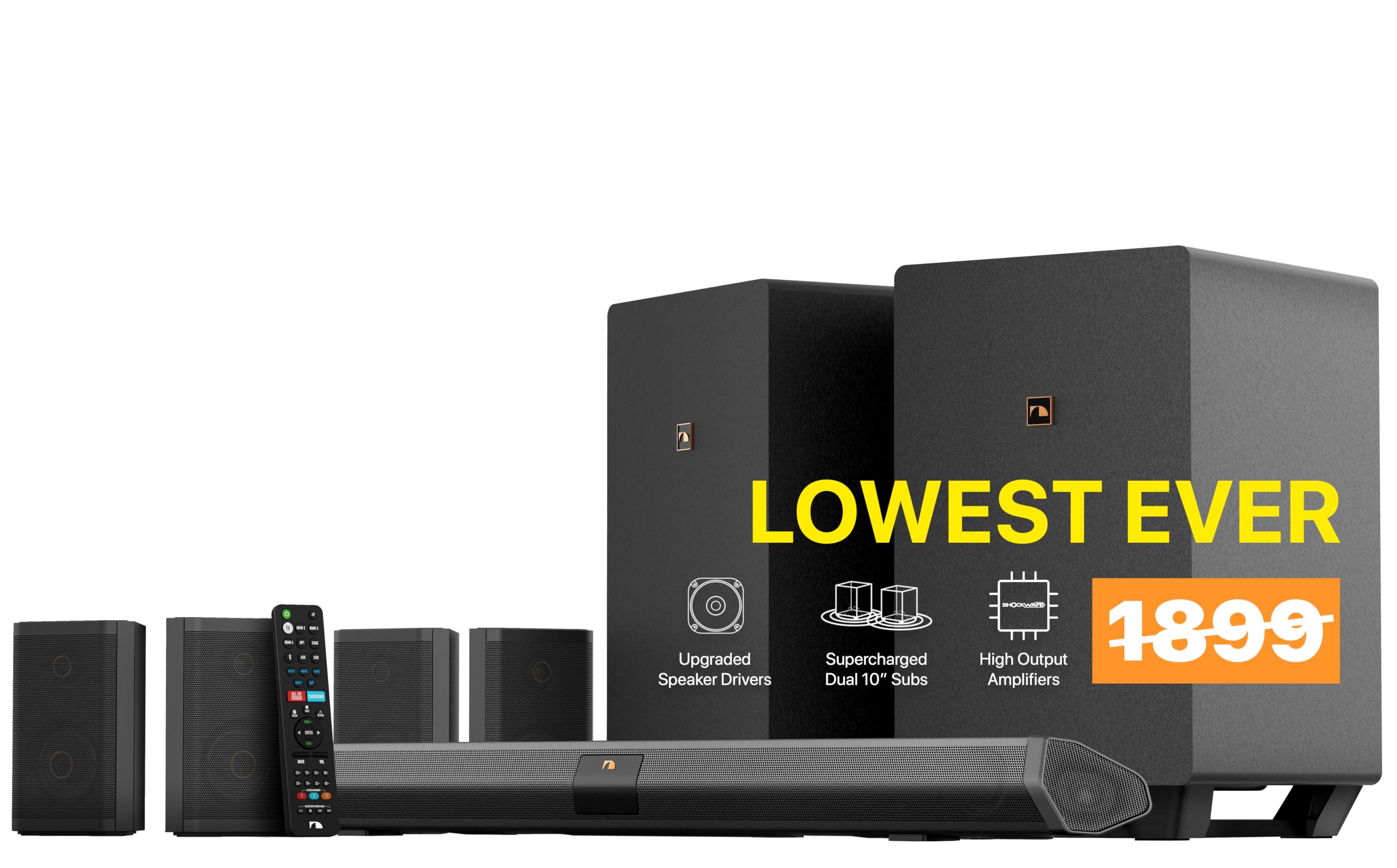
Two 10-inch subwoofers and four rear speakers — the soundbar that treats bass like a primary ingredient.
This is the only soundbar on the list with dual 10-inch wireless subwoofers (an industry exclusive, according to the maker) and four modular surround speakers. The 1300 watts maximum output power drives the 9.2.4 channel layout: nine main channels, two subwoofer channels for the twin subs, and four height channels for Atmos overhead effects. Each of the four surround speakers connects to the subwoofer using included RCA cables — they are not wireless to the soundbar, but the subs connect wirelessly to the main bar.
Customers note the dual 10-inch subs deliver bass that is “felt, not just heard” — one reviewer upgraded from the Nakamichi elite 7.2 and said the Ultra provides “deep, distortion-free rumble” with superior highs that never get drowned out by the subs. Another reviewer mentioned the included hardware is generous: wall mounts, Duracell batteries, an Ultra High Speed HDMI cable, and a 4-foot setup guide with QR codes. The SSE MAX engine processes Dolby Atmos and DTS:X to create a 360-degree sound field from the four surrounds.
This is a different philosophy from the Sonos Arc Ultra above — Nakamichi puts everything in the box (two subs, four satellites, the soundbar) for a complete system. The Sonos gives you a single bar with expandability; the Nakamichi gives you the full surround experience from day one. One trade-off is the physical footprint — each subwoofer is 20.2 inches tall and weighs 23.8 pounds, so this system demands floor space and a commitment to placement.
What makes it special
- Dual 10-inch wireless subwoofers deliver room-filling bass without localization — you feel the rumble evenly
- Four rear surround speakers create a true 360-degree sound field for precise directional effects
- 1300W power output handles demanding action movie soundtracks without distortion
- HDMI eARC plus three HDMI inputs with Dolby Vision and 4K HDR pass-through
Important trade-offs
- Massive physical size — each sub weighs 23.8 lbs and stands 20.2 inches tall
- Surround speakers connect to sub via RCA cable (not fully wireless)
- One customer observed surround speakers have audible static when idle, and the included power cable does not lie flat against the wall
Perfect for: Home theater purists who want the most hardware in the box — dual subs and four rears included, no upgrade path needed.
Consider skipping if: You have limited floor space for large subwoofers, or you want a minimalist single-bar look like the Sonos Arc Ultra offers.
4. Bose Smart Dolby Atmos Soundbar

A compact bar that uses AI to upmix everything into multidimensional sound.
Bose packs five transducers (including two that fire upward) into a small frame, then uses its proprietary TrueSpace technology to analyze non-Atmos content — regular stereo or 5.1 — and upmix it into a multi-channel experience. So even if you are watching an old TV show that was never mixed for Dolby Atmos, the bar intelligently spreads the sound around the room. The A.I. Dialogue Mode balances voices against surround effects in real time, so characters’ words stay crisp without making explosions sound weak.
Reviewers point out the sound is “phenomenal” for its size and that setup is as simple as plugging in, downloading the Bose app, and following the prompts. One reviewer who uses it primarily for music noted it reveals “new instrumentation” in familiar tracks and connects smoothly to the Bose Bass Module 5 via 3.5mm for deeper low-end. The Bluetooth range is 30 feet, and the bar includes built-in Amazon Alexa and Bose Voice4Video for controlling your TV and cable box by voice.
The Bose lists a Bluetooth range of 30 feet, while the ULTIMEA 5.1.2ch lists 15 meters, giving you more flexibility to stream music from across the house. But unlike the ULTIMEA, which includes a separate subwoofer and two rear speakers, the Bose is a self-contained bar — you will want to add the Bass Module later if you crave deep movie bass. One user highlighted that from the start, the bar is “great for a single speaker” but that they would pair it with a sub for a more theater-like experience.
Why this is a smart buy
- TrueSpace technology upmixes stereo content to create rich multi-channel sound even without native Atmos
- A.I. Dialogue Mode ensures voices stay clear even during loud action scenes
- Ultra-compact design with five transducers fits under nearly any TV size
- Built-in Alexa, AirPlay 2, Spotify Connect, and Chromecast give you flexible music streaming
What to think about
- No included subwoofer — bass is decent for a single bar but lacks the rumble of systems with a separate sub
- One reviewer received a unit that appeared to be a returned product, with a nearly dead remote battery
- Cannot expand to rear surround speakers; it is a standalone system
Reach for this if: You want the smallest possible footprint with smart upmixing that makes everything sound bigger — and you are okay adding a sub later.
Look elsewhere if: You need room-filling bass and rear surround channels included in the box without extra purchases.
5. Klipsch Flexus CORE 100 2.1

Klipsch acousticians and Onkyo engineering meet in a soundbar that loves music as much as movies.
This 2.1-channel soundbar is driven by Onkyo’s audio expertise — the collaboration infuses “hundreds of years of combined expertise” into the tuning, according to the maker. It uses two 2.25-inch ceramic drivers and dual 4-inch built-in subwoofers for “top-tier bass without requiring a separate subwoofer,” as the product description states. The bar runs on Klipsch Transport technology, which allows you to add Flexus Surrounds and a Flexus Subwoofer (or two) later via a proprietary wireless connection, turning this into a full home theater system over time.
Shoppers say that the CORE 100 has “significant bass improvement” over previous soundbars and that no external subwoofer is needed for normal TV and music listening. One reviewer who purchased the larger CORE 200 model (with a wired subwoofer output) praised its “solid wood and metal build” and excellent soundstage. Another reviewer noted that the soundbar “fills a ~200 square foot room” easily and that the dedicated center channel makes dialogue “crisp.” The bar connects via Bluetooth, HDMI eARC, Optical, or USB, and supports Dolby Atmos processing for height-channel effects.
Compared to the Samsung Q990D at the top of this list, the Klipsch Flexus is a 2.1 system versus an 11.1.4 setup — the Samsung creates a bubble of sound with rear speakers, while the Klipsch delivers a wide front soundstage with strong integrated bass. The trade-off is simplicity: the Flexus takes up less physical space and requires no separate subwoofer, making it a cleaner fit for living rooms where you do not want a black box in the corner.
What earns its spot
- Dual 4-inch built-in subwoofers deliver real bass without a separate box
- Klipsch Transport technology lets you add surround speakers and subwoofers wirelessly later
- Powered by Onkyo engineering for refined musical accuracy and detail
- Solid build quality with metal and wood enclosure materials
Where it holds back
- 2.1 channel layout means no rear surround speakers included — you need to buy the Flexus Surrounds separately
- A dedicated subwoofer is still recommended for deep movie bass below the ~50-55 Hz range
- One shopper added HDMI ARC stopped working after a week (though Toslink worked fine)
Best for: Audiophiles who play a lot of music and want a soundbar that doubles as a high-fidelity stereo system — without a separate sub cluttering the room.
Consider another if: You need rear surround speakers included in the box for movie immersion; the ULTIMEA 5.1.2ch includes those at a lower price point.
6. JBL Bar 2.1 Deep Bass (MK2)

A 2.1 system where the 6.5-inch subwoofer does the heavy lifting for movies and music.
The JBL Bar 2.1 Deep Bass (MK2) delivers 300 watts of total system power, with a wireless 6.5-inch subwoofer that handles the low-end frequencies. Unlike the TCL S55H below at 220W, the JBL is rated at 300W versus 220W, which translates to more headroom for action movie peaks without distortion. The subwoofer has three practical bass settings (Low, Mid, High) that replace the older model’s confusing 1-20 level scale, making it easier to dial in the right amount of rumble for your room.
Buyers report that the earlier version had “clearer mids and highs” and that the MK2 is “a much improved JBL soundbar” with solid lows. One reviewer who is a musician tested the bass with Anita Baker’s “Mystery” and found it performed excellently for music. Another reviewer noted that even on the Low setting, the bass can feel “a little deep for most shows,” so if you watch a lot of news or dialog-heavy content, you may want to keep the subwoofer level at its lowest setting. The bar connects via Bluetooth for wireless music streaming from your phone or tablet.
Compared to the TCL S55H which also runs a 2.1 setup at 220W, the JBL’s 300W output and 6.5-inch subwoofer deliver noticeably more punchy, room-filling bass. However, the TCL includes AI Sonic Auto Room Calibration via its app — a feature you do not get with the JBL. The TCL also offers Dolby Atmos and DTS Virtual:X processing, while the JBL sticks with standard Dolby Digital for a simpler, more traditional surround experience.
Why it stands out
- 300W total power with a 6.5-inch wireless subwoofer for deep, impactful bass
- Three practical bass settings (Low/Mid/High) make it easy to avoid overwhelming dialog
- JBL Surround Sound technology expands the soundstage without extra speakers
- Easy Bluetooth streaming from any mobile device
Honest limitations
- No Dolby Atmos or DTS:X processing — it is a standard 2.1 surround system
- No room calibration feature — you have to set the bass level manually
- The first unit one reviewer received was defective (no power, poor packaging), though the replacement worked perfectly
Best for: Bass fans who watch a lot of action movies and want a wireless subwoofer that can shake the sofa without breaking the budget.
skip it if: You need Dolby Atmos height effects or room calibration — the TCL S55H offers both at a lower price point.
7. ULTIMEA 5.1.2ch Skywave F40
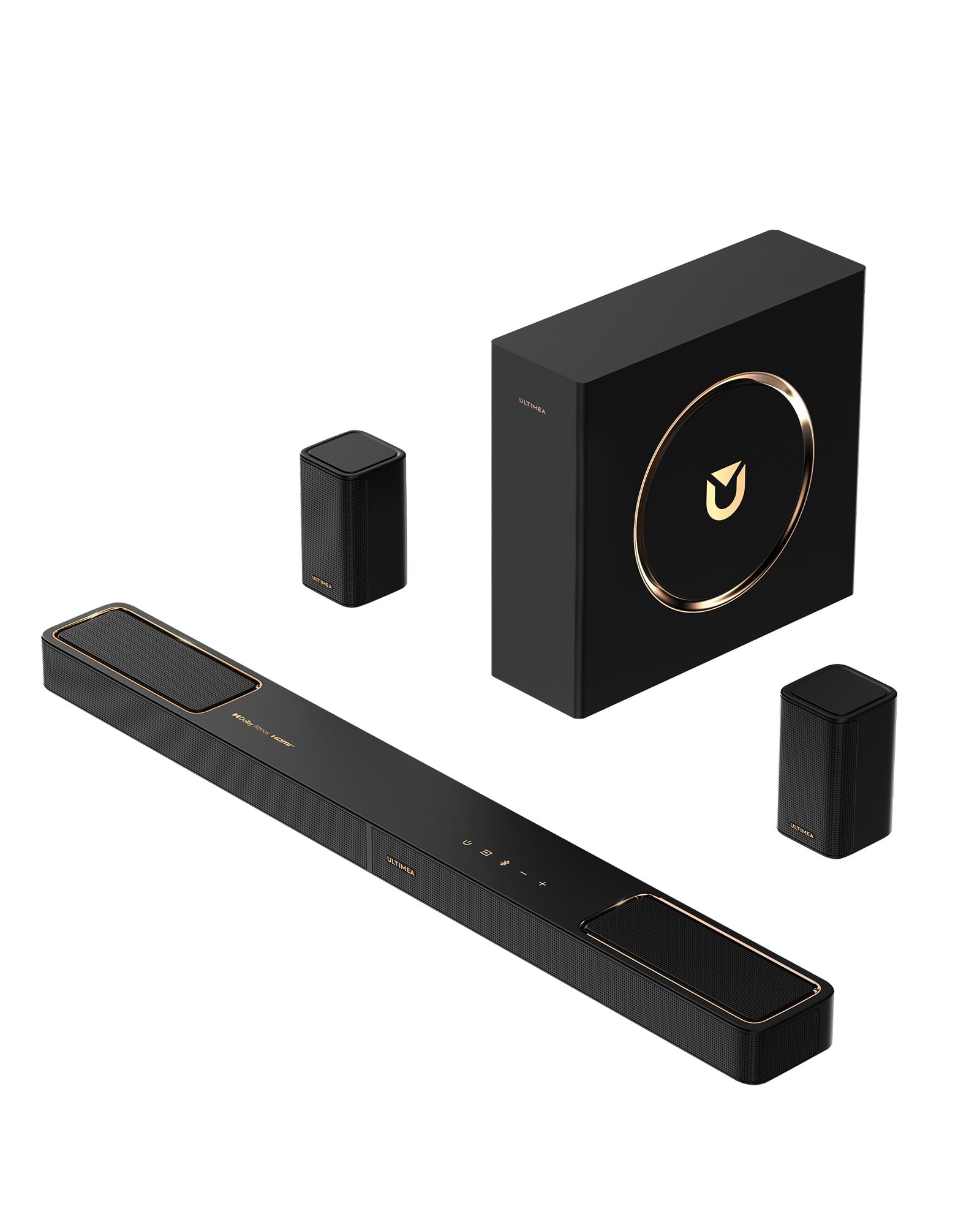
A 5.1.2-channel surround system with up-firing Atmos drivers at a price that surprises you.
The ULTIMEA Skywave F40 is a 5.1.2-channel system that includes a soundbar, two rear surround speakers, and a 5.25-inch wired subwoofer. The “.2” in 5.1.2 comes from two upward-firing drivers (the “height” channels) that use neodymium internal magnets and 18-core large voice coils to project sound toward the ceiling for overhead effects — rain falling from above, helicopters circling overhead. The SurroundX technology combines the two rear speakers with the up-firing Atmos drivers to build a 360-degree sound field around your seating position.
Owners mention the system is “loud at 25% volume” with “deep bass, crisp highs” and that it is excellent value for small to medium rooms. One reviewer noted the rear speakers are small but sound great, needing only a power outlet — no cable running across the floor between them, though each rear speaker does require a cable to the other rear speaker. The app provides 13-step level adjustment (-6 to +6) for each surround channel, a 10-band graphic equalizer, and 121 preset sound settings. The Bluetooth range is 15 meters, while the TCL S55H’s is 10 meters, giving you more freedom to stream from across the house.
Unlike the Klipsch Flexus CORE 100 above, which is a 2.1 system that requires separate purchases for rear speakers, the ULTIMEA gives you all five channels plus two height channels in one box. The trade-off is that the ULTIMEA’s subwoofer is wired (it connects via cable to the soundbar), while the Klipsch’s built-in dual 4-inch subs mean no subwoofer box at all. The ULTIMEA also lacks DTS compatibility — it is Dolby Atmos only.
What you get for the price
- Complete 5.1.2 system with rear speakers and up-firing Atmos drivers — no extra purchases needed
- 15-meter Bluetooth range gives you more placement flexibility than the typical 10-meter limit
- Advanced app control with 10-band EQ, 121 presets, and 13-step surround level adjustment
- HDMI eARC supports lossless 5.1.2-channel audio at up to 37Mbps bandwidth
What to watch for
- Subwoofer is wired (connected to soundbar via cable), not fully wireless
- Not compatible with DTS content — Dolby Atmos and standard formats only
- One buyer mentioned the bass is “slightly soft” and “decent” rather than deep and punchy
Grab this if: You want a complete Dolby Atmos system with rear speakers and height channels at a mid-range price, and you have a small to medium room.
Think twice if: You need DTS support, or you prefer a fully wireless subwoofer that you can tuck anywhere without cable routing.
8. TCL S55H 2.1 Sound Bar

The budget soundbar that calibrates itself to your room using AI.
The TCL S55H is a 2.1-channel system with a wireless subwoofer that delivers 220 watts of power. Its standout feature is AI Sonic Auto Room Calibration — built-in AI technology that adjusts the audio to your unique room layout and listening position. You run a one-time setup through the TCL app, and the soundbar measures the room’s acoustics to balance frequencies automatically. This is a feature typically found on premium systems like the Samsung Q990D’s SpaceFit Sound Pro, making it rare at this price point.
Customers note the TCL S55H “works perfectly in a 15′ x 25′ room” — one reviewer’s exact words — and that the sound quality exceeds expectations for the price. Another reviewer mentioned the subwoofer “adds richness” and that after using the TCL app for calibration and a firmware update, the dialogue became “clearer with hearing aids” and the volume needed “10 clicks less” than before. The bar measures 31.89 inches wide, making it a good fit for 55-inch and smaller TVs. Connectivity includes HDMI eARC/ARC, optical, Bluetooth (10-meter range), and AUX.
The 220W power output is lower than the JBL Bar 2.1 Deep Bass’s 300W, and the Bluetooth range is 10 meters versus the ULTIMEA’s 15 meters. But the TCL compensates with room calibration and Dolby Atmos/DTS Virtual:X processing — features the JBL does not offer. The wireless subwoofer (7.68 x 12.60 x 7.68 inches) is compact enough to tuck beside a sofa without dominating the room. The catch, as one owner reported, is that the bass remote control did not work with their Samsung TV and the subwoofer occasionally needed re-sync after a TV restart.
What makes it a value standout
- AI Sonic Auto Room Calibration adjusts the audio to your specific room shape and furniture layout
- Dolby Atmos and DTS Virtual:X processing in a sub- system
- Wireless subwoofer is compact enough for small apartments and bedrooms
- Includes HDMI eARC cable, wall mount kit, and remote with batteries — everything in the box
Small compromises
- One customer observed the bass remote didn’t work with a Samsung TV, and the sub required re-sync after TV restart
- Bass is described as “minimal” by one reviewer — it adds depth but is not for chest-thumping bass heads
- No built-in voice assistant; app control is the smartest feature
Great for: Small to medium rooms where you want automatic room calibration and decent Dolby Atmos processing without spending on a premium system.
Not for: Bass enthusiasts who need subwoofer output to match the JBL’s 300W or the Nakamichi’s dual 10-inch subs.
9. Samsung HW-N300 TV Mate

A 2-channel soundbar that solves the one problem every TV owner hits: quiet, muddy dialog.
The Samsung HW-N300 is a 2-channel soundbar with a built-in woofer — no separate subwoofer box required. It is designed specifically to fix the problem of TV speakers that make dialog sound distant and hollow. The Surround Sound Expansion feature widens the listening area both sideways and upward to create a broader soundstage without needing physical rear speakers. You connect wirelessly to a compatible Samsung TV via Bluetooth (10-meter range), or plug in a USB drive with your music files and play them through the built-in USB 2.0 port.
Reviewers point out the HW-N300 “improves TV volume” and makes it “easier to hear dialog at low volumes (under 10) vs. TV speakers (40+)” — a direct quote from one reviewer who found the front-facing speakers clarify speech much better than downward-firing TV speakers. Another reviewer noted the sound is “much clearer and fuller compared to built-in TV speakers, and the bass is surprisingly strong for the size.” The bar is slim enough to fit under an 85-inch TV while still being mountable. The Samsung Audio Remote app lets you control key functions and play music from your phone over Bluetooth.
This is the simplest, most affordable option in the list — a 2.0 channel bar with no subwoofer and no Dolby Atmos. Compared to the TCL S55H above, the HW-N300 lacks a wireless subwoofer and room calibration, but it is smaller and requires no subwoofer placement thought. It is a pure dialog booster for people who find their TV’s built-in speakers hard to hear, not a home theater system. One limitation is the lack of HDMI — it connects via Bluetooth or optical cable — so you cannot get lossless audio from your TV.
What it does well
- Compact 2-channel design with built-in woofer — no separate subwoofer needed
- Direct-facing speakers clarify dialog much better than downward-firing TV speakers
- Easy Bluetooth pairing with Samsung TVs (no optical cable needed for compatible models)
- Built-in USB port lets you play music directly from a flash drive
What it does not do
- No Dolby Atmos, no DTS, no height channels — it is a basic 2.0 stereo soundbar
- No HDMI connection — limited to Bluetooth and optical for audio input
- No room calibration or app-based tuning beyond the basic Samsung Audio Remote app
Ideal for: Anyone frustrated by muffled TV dialog in a bedroom or small living room — this is the simplest fix for hearing words clearly without a complex setup.
Move up if: You want actual bass from a subwoofer or Dolby Atmos effects for movies — the TCL S55H or ULTIMEA give you that for a reasonable step up in price.
Understanding the Specs
Channel Count (X.Y.Z)
The first number (X) is the number of main speakers around you — more means wider surround. The second number (Y) is the subwoofer count — 1 means one sub, 2 means two. The third number (Z) is the height channels — upward-firing speakers that bounce sound off the ceiling for overhead effects. A 2.1 bar (like the JBL or TCL) gives you stereo sound plus bass. A 5.1.2 bar (like the ULTIMEA) adds rear speakers and height channels. An 11.1.4 bar (like the Samsung Q990D) creates a full bubble of sound around you.
Power Output (Watts)
This tells you how loud the system can go before distorting. More watts generally means more headroom for action movie peaks. The JBL Bar 2.1 runs 300W, while the TCL S55H runs 220W, which you will notice during loud explosions or music. But raw wattage only matters if paired with efficient speakers. A 300W system with a good subwoofer and clean amplification often sounds better than a 500W system with cheap drivers. Room size matters too — 220W fills a small to medium room, while the Nakamichi’s 1300W is built for large home theater spaces.
Bluetooth Range
Measured in meters or feet, this is the maximum distance between your phone or tablet and the soundbar for wireless music streaming. The ULTIMEA leads the budget tier at 15 meters, while the TCL, Samsung HW-N300, JBL, and Klipsch models list 10 meters. The Bose Smart Soundbar lists its range at 30 feet (about 9 meters). Longer range is useful if you want to stream from another room or keep your phone on the kitchen counter while music plays in the living room.
HDMI eARC vs ARC
eARC (enhanced Audio Return Channel) is the newer standard that sends uncompressed, high-bitrate audio from your TV to the soundbar over a single HDMI cable. This is essential for lossless Dolby Atmos soundtracks from Blu-rays and streaming services. Regular ARC compresses the audio, so you lose some detail in the surround and height channels. Every soundbar on this list that supports Dolby Atmos (the Samsung Q990D, Sonos Arc Ultra, Nakamichi, Bose, ULTIMEA, and TCL) uses eARC to get the best possible audio quality. The Samsung HW-N300 uses Bluetooth and optical only — no HDMI at all.
FAQ
Do I need a soundbar with a separate subwoofer?
Will a soundbar work with my older TV that only has optical audio?
How many channels do I actually need for a 10×12 bedroom?
What is the difference between Dolby Atmos and DTS:X?
Can I use a soundbar with a projector?
Will a soundbar improve dialog if I have hearing difficulties?
How long do soundbars typically last before needing replacement?
Can I add rear speakers to a soundbar that did not come with them?
Is a soundbar better than a home theater in a box system?
Final Thoughts: The Verdict
For most buyers, the audio soundbar winner is the Samsung Q990D because it delivers the most complete home theater experience — 11.1.4 channels, rear speakers included, room calibration, and voice assistant support — all at a price that undercuts premium competitors. If you want spatial audio in a single bar with room for future expansion, grab the Sonos Arc Ultra. And for bass that transforms your living room into a cinema with dual 10-inch subwoofers and four surround speakers from the start, the standout is the Nakamichi Shockwafe Ultra.
How We Picked
We do not accept paid placement. Every pick is matched to a real buyer and a real use-case; we do not hands-on test units.
Sources & Methodology
Specifications: manufacturer listings and product documentation. Review insights: verified customer reviews, as of July 2026. Pricing: not shown on this page (it changes often); check the current price via the retailer link.
As an Amazon Associate, FitlyFast earns from qualifying purchases. This does not affect which products we feature.