
Our readers keep the lights on and the weekend projects moving. As an Amazon Associate, I earn from qualifying purchases.
Specs are compiled from manufacturer listings and verified buyer reviews and can change over time — please confirm the key details on the product page before buying.
If your lower back or the arch of your foot aches by lunchtime, you know the problem isn’t your job — it’s the boot you’re standing in. This guide ranks four pairs built with real, built-in arch support that will actually hold up after the first month of wear.
I’m Rikta — the founder and writer behind FitlyFast. This guide is built by comparing the manufacturers’ published specifications and the patterns across verified customer reviews, so you get each pick’s real strengths and trade-offs instead of marketing spin.
Whether you are on concrete, gravel, or a shop floor, the right pair of arch support work boots can keep your feet, knees, and back lined up from the first step to the last.
Quick Picks
- Orthofeet Men’s Orthopedic Granite Waterproof Slip Resistant Work Boot — Best Overall
- Carhartt Men’s Chelsea Boots – Wedge Style Slip On Work Boots with Insite Technology Footbeds & Slip-Resistant Outsoles — Best Value
- ROCKROOSTER Gammon Men’s Slip On Work Boots, 6″ Steel Toe Chelsea Work Boots — Budget Champion
- Carolina Linesman 10″ Composite Toe Work Boots for Men — Premium Pick
How To Choose The Best Arch Support Work Boots
Grabbing the cheapest boot with a squishy insole will leave you with a pancake by week three and a sore arch for months. What actually keeps your foot supported is a combination of the footbed’s structure, the midsole’s stiffness, and the shank that prevents the boot from twisting under load. Here is what to look for.
Built-in orthotic system vs removable insole
A boot that depends entirely on a thin removable insole will lose its support fast. What you want is a footbed that has a molded arch shape built into the chassis — like the Orthofeet Ortho-Cushion system or the Carhartt Insite footbed. These designs resist compression because the support is part of the boot’s structure, not just a glued-in slab of foam.
Shank type and sole flexibility
The shank is a stiff piece running between the outsole and the insole — usually steel, nylon, or composite. A nylon shank, like the one in the ROCKROOSTER, gives enough rigidity for standing on ladders or uneven ground without making the boot feel like a ski. A thicker Goodyear welt construction, found on the Carhartt and Carolina, adds torsional stiffness that protects your arch when carrying loads on uneven terrain.
Safety ratings and toe protection
Arch support work boots often come with an ASTM safety tag. Look for the specific standard — ASTM F2413-18 covers impact and compression protection (I/75 C/75 means it resists a 75-pound impact and a 2,500-pound crush). The EH (Electrical Hazard) rating means the boot can reduce the flow of electricity through the sole, a critical detail if you work near live circuits.
Quick Comparison
| Model | Best For | Toe Type | Safety Rating | Construction | Amazon |
|---|---|---|---|---|---|
| Orthofeet Granite | All-day pain relief | Soft toe | Not specified | Ortho-Cushion system | Amazon |
| Carhartt Chelsea | Easy on/off + fast cushion | Steel or soft | Not specified | Goodyear welt | Amazon |
| ROCKROOSTER Gammon | Budget value + steel toe | Steel toe | ASTM F2413-18 I/75 C/75 EH | Direct attach | Amazon |
| Carolina Linesman | Maximum ankle height | Composite toe | ASTM F2413-18 | Goodyear welt | Amazon |
In‑Depth Reviews
1. Orthofeet Men’s Orthopedic Granite Waterproof Slip Resistant Work Boot

The premium pick that delivers cushion built into the boot itself, not a flimsy insole.
If your arch pain flares up before lunchtime, the Orthofeet Granite is the closest thing to a custom orthotic in a work boot. It uses the brand’s Ortho-Cushion system, which combines a built-in orthotic insole, a shock-absorbing sole, and a pressure-free fit that keeps your foot aligned. The toe box is notably roomier than most work boots — reviewers mention that their “big toes were miserable every day after work” until they switched, and now the pain is “gone almost entirely.” Unlike the ROCKROOSTER, which uses a direct-attach construction, the Orthofeet is built for buyers who prioritize foot-bed structure over sheer ruggedness.
The waterproof claim holds up on wet ground, and the slip-resistant outsole gives you a secure step on shop floors. One reviewer who works 55+ hours a week as a heavy highway laborer reports wearing the same pair for six months with the leather and sole still “in solid condition.” That is a longer useful life than the discontinued design ROCKROOSTER buyers are mourning. It is note the leather is softer than traditional work boots, but that softness is what reduces break-in time to almost zero — no blisters on the heel, no stiff tongue digging into your shin.
The catch: this boot does not carry an ASTM safety rating, meaning it is best suited for light industrial environments or warehouse floors rather than jobsites that demand a stamped steel or composite toe. A few reviewers noticed the insoles compress after a couple of months and recommend swapping in a custom orthotic if you weigh over 220 pounds or walk on concrete for 12-hour shifts.
Built-in Support That Works
- Ortho-Cushion system with built-in arch support — no removable insole to flatten
- Roomy toe box relieves pressure on bent or sensitive toes
- Waterproof and slip-resistant outsole holds up on wet, greasy ground
Limits to Consider
- No ASTM safety rating — not suitable for jobs requiring a steel or composite toe
- Insoles may compress after several months of heavy daily use
- Soft leather shows wear faster than thicker work-boot leathers
Reach for this if: You need the best arch support for long hours on your feet and can skip a safety toe.
Look elsewhere if: Your job requires a steel-toe safety rating or you need a boot that survives extreme abuse for multiple years.
2. Carhartt Men’s Chelsea Boots – Wedge Style Slip On Work Boots with Insite Technology Footbeds & Slip-Resistant Outsoles

Slip-on convenience meets podiatrist-designed arch support that wears in fast and stays cushioned.
The Carhartt Chelsea is the boot you pull on when you are already running late for the morning shift. The twin gore panels on the sides let you slide in and out in seconds, but the real story is the Insite footbed — a podiatrist-designed insole that delivers high-rebound cushioning and a molded arch that actually contours to your foot. Buyers report these are “perfect for standing for long periods at work,” and one repeat buyer says “this is my husband’s 2nd pair” — a strong sign the support does not collapse after a few months.
Unlike the Orthofeet, which uses a non-safety soft toe, the Carhartt is available in both steel toe and soft toe versions. The dual-density rubber outsole is slip-resistant across typical jobsite surfaces, and the Goodyear welt construction gives the boot a degree of durability that the direct-attach ROCKROOSTER cannot match. The wedge-style sole also provides a wider contact patch, which improves stability when you are carrying loads up a ladder or standing on uneven ground.
The oil-tanned leather scuffs more easily than the thick harness leather on the Carolina Linesman, and a few owners mention that “they scratch very easily” against metal edges. The Chelsea design also lacks a padded collar, so if you have had ankle issues from boots in the past, you might prefer the 10-inch shaft of the Carolina.
Easy On, Long Wear
- Insite footbed with podiatrist-designed arch support — high-rebound foam resists flattening
- Goodyear welt construction provides durable torsional stiffness without a long break-in
- Available in steel toe or soft toe to match your safety requirements
Few Trade-offs
- Oil-tanned leather scratches more easily than heavier work boot leathers
- No tall ankle collar — less ankle wrap compared to 8-inch or 10-inch boots
- Not explicitly waterproof — moisture can seep through the gore panels in deep puddles
Your best bet if: You want the quickest on/off of any boot here plus built-in arch support that feels good immediately.
Not ideal for: Heavy-mud or standing-water environments where a waterproof membrane is essential.
3. ROCKROOSTER Gammon Men’s Slip On Work Boots, 6″ Steel Toe Chelsea Work Boots

A steel-toe Chelsea boot with genuine arch support that costs significantly less than the competition.
For a little over a hundred dollars, the ROCKROOSTER Gammon brings features you normally pay much more for: an ASTM F2413-18 I/75 C/75 steel toe that can take a 75-pound impact, an Electrical Hazard (EH) rating for work near live circuits, and a nylon shank that keeps the boot rigid under load without weighing you down. The RC920 insole provides arch support that customers note lasts through 10 to 12-hour days — one reviewer noted “I have been wearing them daily for about the past 3 months” and reports the sole is “holding up well even when exposed to oils” and standing water.
That is a meaningful durability advantage over the Carhartt Chelsea, which costs more but depends on a thinner insulating layer. The boot also features a Poron XRD heel pad that absorbs shock with each step, which helps reduce the jolt that travels up your knee and hip when you are stomping around on concrete. The oiled crazy horse leather resists deep scuffs, though it will show lighter surface marks over time.
The steel toe adds noticeable weight, and a few buyers have pointed out that the leather can rub against the ankle bone if you are not wearing crew socks. The boot also runs slightly large, so you may want to order a half size down — a common tip in the reviews. If you are debating between this and the Carolina, know that the Carolina offers a taller 10-inch shaft and a Vibram outsole for heavy-duty traction, but the ROCKROOSTER gives you the same safety rating at a fraction of the upfront cost.
Surprising Value
- ASTM F2413-18 steel toe and EH rating — full safety protection at an entry-level price
- Poron XRD heel pad and RC920 insole provide real shock absorption and arch support
- Nylon shank adds torsional rigidity without making the boot excessively heavy
Things to Watch
- Steel toe creates noticeable front-heaviness during long walking shifts
- Leather can rub the ankle bone — crew socks are a must to avoid blisters
- Runs slightly large; plan to size down by half from your usual boot size
Go for it if: You need a fully safety-rated steel toe with arch support but are working with a budget that rules out premium picks.
Think twice if: You are on your feet more than 12 hours a day and require a higher ankle shaft for lateral stability on steep terrain.
4. Carolina Linesman 10″ Composite Toe Work Boots for Men
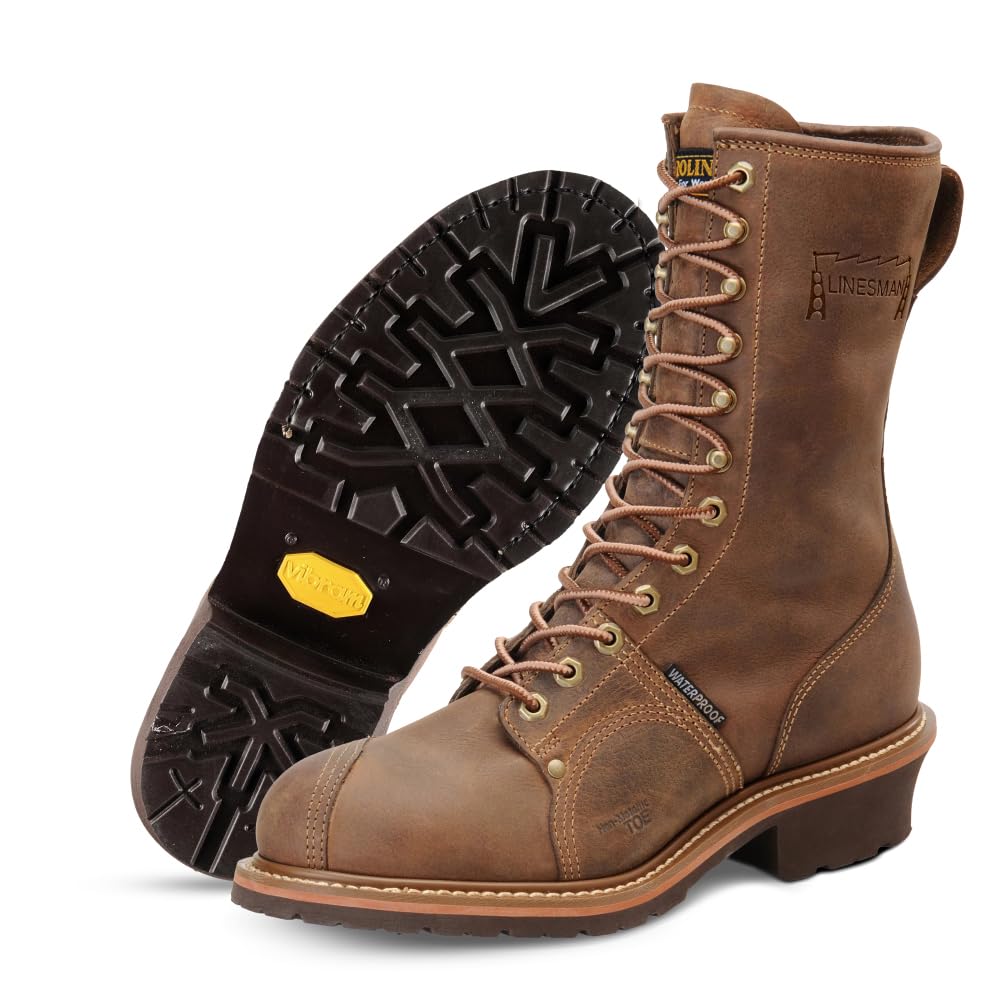
Tall, tough, and rebuildable — the 10-inch work boot that serious tradespeople buy for the long haul.
The Carolina Linesman is built for the person who spends all day on a ladder or uneven ground and needs ankle support that climbs as high as the boot itself. At 10 inches tall with a composite toe, an AG7 footbed with built-in arch support, and a Vibram rubber outsole with a defined heel, this boot is designed to resist twisting when you are carrying a heavy load up a pole or across a roof. Unlike the slip-on style of the Carhartt or the 6-inch ROCKROOSTER, the Carolina uses full laces that let you lock your heel in place and wrap the ankle firmly — a feature reviewers point out is essential when “climbing poles with crampons.”
The Goodyear welt construction means the sole can be replaced when the tread wears out, extending the life of the boot far beyond what a direct-attach or cemented sole can offer. One reviewer who has owned Carolina boots for two decades notes that “if you clean and polish weekly” and apply leather moisturizer, the boots “will last decades.” The composite toe provides impact protection without the cold-conducting downside of steel, and the boot carries an ASTM F2413-18 safety rating and electrical-hazard protection. The boot also features a waterproof Scubaliner membrane, so your feet stay dry during wet shifts — an advantage over the non-waterproof Carhartt Chelsea.
The break-in period is longer than any other boot here — expect several days of stiffness around the ankle and instep before the harness leather starts to conform to your foot. That trade-off is why the Carolina wins for tradespeople who need maximum ankle protection over raw footbed comfort.
Built for the Long Run
- AG7 footbed with arch support and Goodyear welt construction for decades of use with re-soling
- 10-inch shaft provides maximum ankle support for climbing and uneven terrain
- Vibram rubber outsole with heel lug delivers reliable traction on ladders and loose ground
Heavier Investment
- Long break-in period — expect stiffness for the first several days of wear
- Noticeably heavier than the Orthofeet and Carhartt — less suited for all-day walking on flat surfaces
- Harness leather requires regular oiling to maintain water resistance and prevent drying
Choose this if: Your work demands a tall boot that locks the ankle, stands up to extreme abuse, and can be rebuilt rather than replaced.
skip it if: You need a lightweight boot for long shifts on flat, indoor surfaces or you do not have the patience for a multi-day break-in period.
Understanding the Specs
ASTM F2413-18 Safety Rating
This is the standard that tells you the boot’s toe can resist crushing under a specific load. The “I/75 C/75” label means the toe survived a 75-pound impact from a falling object and a 2,500-pound compression force. The “EH” mark (Electrical Hazard) means the outsole and heel have enough electrical resistance to reduce the flow of electricity through the boot, which matters if you work near live circuits. Not all work boots carry this rating — the Orthofeet Granite does not, so it is best for dry indoor environments rather than construction sites.
Goodyear welt vs Direct attach construction
The Goodyear welt method sews the upper leather to a strip (the welt), then stitches the outsole to the welt. This makes the boot resoleable — a cobbler can peel off the worn sole and stitch on a fresh one without destroying the upper. The Carolina and Carhartt use this construction, so they can last for years. Direct-attach (used by the ROCKROOSTER) bonds the outsole directly to the upper with heat and pressure. It is lighter and more flexible, but when the sole wears out, the whole boot is done.
FAQ
Do I need steel toe boots for arch support, or can I get good arch support in a soft toe boot?
How long do arch support work boots typically last before the support breaks down?
Yes, arch support work boots reduce plantar fasciitis pain by keeping your foot aligned and absorbing ground impact.
What is the difference between a nylon shank and a steel shank in a work boot?
How do I know if a boot has true built-in arch support versus just a thick removable insole?
Can I wear custom orthotics in arch support work boots?
How do I break in stiff leather work boots with arch support?
Are waterproof arch support work boots necessary for indoor work?
What is the EH (Electrical Hazard) rating and do I need it?
How much do arch support work boots typically weigh compared to regular work boots?
Final Thoughts: The Verdict
For the majority of shoppers, the best arch support work boots pick is the Orthofeet Granite because its built-in Ortho-Cushion system provides real, lasting arch support without the weight of a steel toe. If you need slip-on ease with podiatrist-designed support that works immediately, grab the Carhartt Chelsea. And for maximum ankle protection from a rebuildable boot that can handle pole climbing and years of abuse, the standout is the Carolina Linesman.
How We Picked
We do not accept paid placement. Every pick is matched to a real buyer and a real use-case; we do not hands-on test units.
Sources & Methodology
Specifications: manufacturer listings and product documentation. Review insights: verified customer reviews, as of July 2026. Pricing: not shown on this page (it changes often); check the current price via the retailer link.
As an Amazon Associate, FitlyFast earns from qualifying purchases. This does not affect which products we feature.