
Our readers keep the lights on and the weekend projects moving. As an Amazon Associate, I earn from qualifying purchases.
Specs are compiled from manufacturer listings and verified buyer reviews and can change over time — please confirm the key details on the product page before buying.
That nagging ache between your shoulder blades, the forward slump you catch yourself in by 2 PM, or the habit of rolling your shoulders forward when you sit — upper back pain is rarely about a single injury. It is usually about how you hold your body all day, every day. A good brace does not just hold you in place; it trains your muscles to remember the right position on their own, so the relief lasts beyond the hours you wear it.
I’m Rikta — the founder and writer behind FitlyFast. This guide is built by comparing the manufacturers’ published specifications and the patterns across verified customer reviews, so you get each pick’s real strengths and trade-offs instead of marketing spin.
The right back brace for upper back pain works as a daily trainer that builds muscle memory while providing immediate relief from tension and slouching.
Quick Picks
- Copper Compression Back Brace Posture Corrector — Best Overall
- Bodywellness Fix Upper Back Brace — Smart Trainer
- Kizu Spine Posture Corrector — Desk Worker Favorite
- DeepLibral Back Posture Corrector Brace for Men — Heavy Build Pick
How To Choose The Best Back Brace For Upper Back Pain
Upper back braces come in two main designs: a simple figure-8 strap system that pulls your shoulders back, and a full torso wrap that adds lower back stabilization. For upper back pain and rounded shoulders, the figure-8 style is usually the right starting point because it directly targets the area between your shoulder blades. You want a brace that tugs gently, not one that forces you rigid — your muscles need to learn to hold the position on their own.
Fit and sizing are everything
A brace that is too loose will not pull your shoulders back far enough to relieve the pain. One that is too tight will dig into your armpits, limit your breathing, and leave you wanting to rip it off after ten minutes. Most figure-8 braces are sized by chest circumference, so measure around the fullest part of your chest before you order. Many buyers report that the first wear feels awkward and slightly sore — that is normal. Your muscles are being asked to sit in a new position for the first time.
Material and comfort for all-day wear
Breathable neoprene or a soft cotton-polyester blend is best if you plan to wear the brace under your clothes at work. Look for straps that are wide enough to distribute pressure — narrow straps are the main cause of armpit chafing and irritation. Several reviews mention that a thin undershirt worn between the brace and your skin prevents the Velcro from snagging your clothes and keeps the brace from shifting.
Quick Comparison
| Model | Best For | Design Type | Material | Adjustable Range | Amazon |
|---|---|---|---|---|---|
| Copper Compression Back Brace | Immediate posture improvement for severe spinal issues | Figure-8 | Copper-infused fabric | One-size (follow sizing guide) | Amazon |
| Bodywellness Fix Upper Back Brace | Gentle muscle retraining with easy daily adjustment | Figure-8 with front Velcro | Soft strap material | 70–120 cm chest (28″–47″) | Amazon |
| Kizu Spine Posture Corrector | Low-profile comfort for desk workers | Neoprene vest with padded spine panel | Breathable neoprene | 28″–48″ chest | Amazon |
| DeepLibral Back Posture Corrector Brace | Heavy-duty upper and lower back support for larger builds | Back-anchored with waist wrap | Breathable mesh and neoprene | XS/S 24–31″, M 32–41″, L/XL 42–51″ | Amazon |
In‑Depth Reviews
1. Copper Compression Back Brace Posture Corrector

The brace that gets relentless reviews for immediate posture correction without the itchy rub.
This copper-infused figure-8 brace weighs 4 ounces and measures 9 x 5 x 0.5 inches, while the Bodywellness brace weighs 4.16 ounces. compact for tucking under a shirt. Owners mention immediate posture improvement for severe spinal injuries and that it stops shoulders from rolling forward — one reviewer specifically noted that the Velcro is non-itchy and well-made, a real comfort win for a brace you will wear for hours.
The copper infusion is designed to wick away sweat and generate a gentle warmth that helps loosen muscles. The brand recommends starting with one-hour sessions, then building up. Some reviewers mention the straps can dig into armpits if not perfectly adjusted, and a few smaller-framed users found the one-size design too large at 5’5″, 115 lbs. But several 5-star reviews describe it as comfortable and effective, noting it allows freedom of movement while constantly reminding you to sit straight.
Unlike the Bodywellness brace that functions more as a gentle trainer, the Copper Compression is positioned for immediate posture correction and injury or recovery support. If you need that kind of structural support, this is the stronger option.
Why it stands out
- Designed for immediate posture correction with a figure-8 support layout
- Copper fabric wicks sweat and stays odor-free with regular use
- Several users call it comfortable and adjustable even during sleep
Where it falls short
- One-size design may be too large for very petite frames (under 120 lbs)
- Strap placement near the armpit can irritate if you move your arms a lot
Who it fits: Anyone with moderate to severe upper back pain who wants firm, immediate posture correction and can follow the sizing guide carefully.
The trade-off: Smaller or very slender users may struggle with the fit because the brace does not come in multiple sizes.
2. Bodywellness Fix Upper Back Brace

The tricky part is that this one is not a brace — it is a trainer that teaches your muscles to hold themselves upright.
At 4.16 ounces and 8.46 x 6.57 x 1.18 inches, the Bodywellness weighs 4.16 ounces versus the Copper Compression at 4 ounces, but its design takes a fundamentally different approach. This is a figure-8 brace with a clever front Velcro closure that lets you tighten the straps by pulling them in front of your shoulders — much easier to adjust on your own than the back-loop style many competitors use.
One buyer who tried seven different posture correctors wrote that this one was the best compromise of all: the straps are wide and soft enough to be comfortable, and the front-adjust design solves the problem of having to ask someone to help you put it on. That same reviewer warned that this brace slips out of place when you move your arms a lot, so it works best for seated, desk-based use. Another reviewer noted that it took about two weeks of wearing it for 3–4 hours every day before the muscle memory started to stick.
Unlike the Kizu brace which uses a neoprene vest for a more structured feel, the Bodywellness is almost entirely strap-based. It does not force you into position; it just makes slouching uncomfortable enough that you notice and correct yourself. That is exactly how muscle retraining works, but if you want something that holds you rigidly, this will feel too loose.
Why it works
- Front Velcro closure makes independent daily adjustment genuinely easy
- Wide, soft straps distribute pressure better than narrow alternatives
- Teaches lasting muscle memory rather than forcing a position you lose when removed
Where it slips
- Can shift out of place during active arm movement — best for seated wear
- Some users with sensitive skin got underarm irritation from the strap material
Best suited for: Anyone who is patient and wants to build long-term posture habits, especially people who spend hours at a desk and can re-adjust once or twice during the day.
Not for: Anyone who needs a rigid, low-maintenance brace for immediate structural support during an active job or recovery.
3. Kizu Spine Posture Corrector
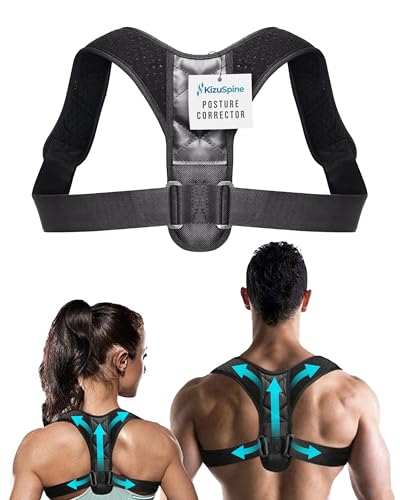
A neoprene vest that feels like a shirt more than a brace — great for staying discreet under clothes.
Weighing only 3 ounces, the Kizu is a full ounce lighter than the Copper Compression and over an ounce lighter than the Bodywellness. It uses breathable neoprene and a padded spine panel, fitting chest sizes from 28 to 48 inches. That wider size range makes it a more reliable fit for both smaller and larger frames than the one-size Copper Compression.
Reviewers consistently mention that it reduces neck and shoulder tension during desk work without feeling restrictive. One reviewer noted it significantly reduced their neck and shoulder tension, and that the breathable fabric made it comfortable to wear through a full workday. The design includes detachable Velcro straps that attach to the front, so you can loosen or tighten the tension without taking the vest off. A few users noted that the Velcro failed after about 20 days of daily use, which is a quality concern for heavy wearers. The manufacturer recommends wearing it over a thin fitted undershirt to prevent the neoprene from irritating your underarms.
Compared to the Bodywellness, the Kizu provides a more structured, vest-like feel that stays put when you move. It will not shift the way a strap-only brace does. But it is also less customizable — the neoprene panels are fixed, so the only adjustment is in the strap tension. If you need a brace that stays rock-solid while you are typing or driving, this one delivers.
What makes it different
- Ultra-light at 3 ounces and low-profile under shirts
- Breathable neoprene padding reduces armpit pinch compared to thin straps
- Fits a wider chest range (28–48 inches) than most competitors
What to watch for
- Some users report the Velcro loses grip after a few weeks of daily use
- Neoprene can cause allergic skin reactions — test before committing
Ideal for: Office workers who want something comfortable enough to wear for 4–6 hours under a polo or button-down without anyone noticing.
Not ideal for: Heavy daily use where the Velcro might wear out quickly, or anyone with a neoprene allergy.
4. DeepLibral Back Posture Corrector Brace for Men
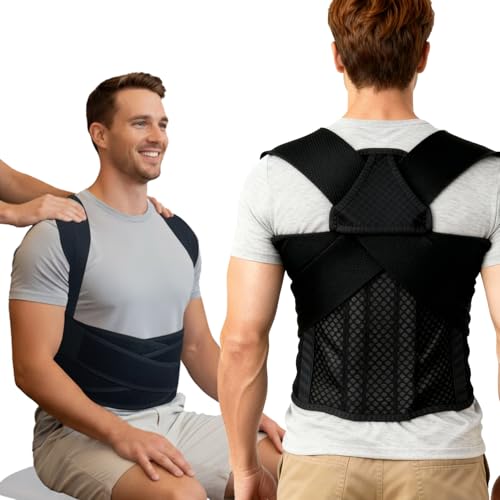
The only brace on this list that anchors to your waist as well as your shoulders — built for broader, heavier frames.
This is a different category of brace. Instead of a simple figure-8, the DeepLibral uses a back-anchored design with a waist wrap that holds the lower portion in place, then shoulder straps that pull your upper back into alignment. The straps are 3.1 inches wide — significantly broader than the 1.5-inch straps typical on the Copper Compression and Bodywellness — which means the pressure spreads across your shoulders rather than digging into one spot. It weighs 0.55 kilograms (about 1.2 pounds), which is noticeably heavier than the other picks but makes sense for the added structure.
The design also includes a lower spine support component, so it covers both your upper back and the lumbar area. Customers note that it has been a back saver for lifting-heavy jobs like inventory work, helping with proper lifting techniques. The main complaint across reviews is difficulty fastening the shoulder straps alone — several users mentioned needing another person to help get the tension right. The sizing is waist-based: XS/S 24–31 inches, M 32–41 inches, L/XL 42–51 inches, which makes it more reliable than a one-size chest measurement for bigger builds.
Compared to the Kizu vest, the DeepLibral is less discreet under clothes (the waist wrap adds bulk) but offers far more adjustability and structural support for both upper and lower back.
What it does well
- 3.1-inch wide straps reduce painful armpit digging — the widest of the four
- Waist anchor keeps the brace from sliding up during movement
- Waist-based sizing fits larger body types reliably
Where it struggles
- Difficult to put on and adjust by yourself — you will likely need help
- Heavier and bulkier than the other options — less under-clothes friendly
Reach for this if: You have a wider build (42–51 inch waist range), need combined upper and lower back support, or want the most structural holding power available here.
Look elsewhere if: You work in an environment where you need to adjust the brace frequently on your own, or you want something that disappears under a fitted dress shirt.
Understanding the Specs
Figure-8 vs Back-Anchored Design
A figure-8 brace wraps over both shoulders and crosses between your shoulder blades. It is the most common design for upper back pain because it directly pulls your shoulders back and prevents forward slumping. A back-anchored brace adds a waist strap that holds the bottom of the brace in place, so it does not ride up when you move. The trade-off is that back-anchored braces are harder to put on alone and are bulkier under clothes. Choose figure-8 for desk work or casual daily wear; choose back-anchored if you move around a lot or need lower back support too.
Material and Breathability
Most upper back braces use neoprene, cotton-polyester blends, or a copper-infused fabric. Neoprene is stretchy and conforms to your body, but it does not breathe as well and can cause skin irritation if you are sensitive to it. Cotton-polyester blends are more breathable and gentler on skin, but they can stretch out over time and lose their shape. Copper-infused fabric is designed to wick sweat and resist odor, and the copper fibers will not wash away — so the brace stays fresh longer. Whichever material you choose, always wear a thin undershirt underneath to prevent chafing from the Velcro or strap edges.
FAQ
Can I wear a back brace for upper back pain all day?
Will a posture corrector fix my upper back pain permanently?
How tight should I wear an upper back brace?
Will the brace work if I have a larger chest or broad shoulders?
Is it safe to wear a back brace while sleeping?
Can I wear a posture corrector under my clothes at work?
Do copper-infused braces actually do anything for upper back pain?
How do I clean my upper back brace without damaging it?
Why does my posture corrector dig into my armpits and hurt?
Should I get a back brace with or without a waist wrap for upper back pain?
Final Thoughts: The Verdict
For most people looking for a back brace for upper back pain, the best balance of comfort, effectiveness, and ease of daily use is the Copper Compression Back Brace — it gives immediate shoulder retraction, uses sweat-wicking fabric, and has the strongest track record across reviews for actually reducing pain. If you want a trainer-style brace that teaches your muscles to hold good posture on their own (rather than forcing it), the Bodywellness Fix Upper Back Brace is the smarter pick for desk workers. And if you need the widest size range for a broader frame and want lower back support too, the DeepLibral Back Posture Corrector Brace is your best option.
How We Picked
We do not accept paid placement. Every pick is matched to a real buyer and a real use-case; we do not hands-on test units.
Sources & Methodology
Specifications: manufacturer listings and product documentation. Review insights: verified customer reviews, as of July 2026. Pricing: not shown on this page (it changes often); check the current price via the retailer link.
As an Amazon Associate, FitlyFast earns from qualifying purchases. This does not affect which products we feature.