
Our readers keep the lights on and the weekend projects moving. As an Amazon Associate, I earn from qualifying purchases.
Specs are compiled from manufacturer listings and verified buyer reviews and can change over time — please confirm the key details on the product page before buying.
Nothing says I actually know what I’m doing in the workshop like a drawer full of tight, clean box joints. But the route from a pile of scrap to that perfect finger-locked corner is littered with loose fits, tear-out, and jigs that fight you harder than the wood does. The right jig changes that—it makes repeatable, gap-free joints feel almost automatic, so you can spend your time building instead of fiddling with setup.
I’m Rikta — the founder and writer behind FitlyFast. This guide is built by comparing the manufacturers’ published specifications and the patterns across verified customer reviews, so you get each pick’s real strengths and trade-offs instead of marketing spin.
Whether you’re working on a router table or a table saw, the box joint jig you choose determines whether your joints come out snug the first time or you spend an afternoon chasing a gap that keeps shifting.
Quick Picks
- JessEm 06300 Precision Box Joint Jig — Best Overall
- Woodhaven 4555 Box Joint Jig — Most Versatile
- Rockler Router Table Box Joint Jig (422866) — Best for Small Projects
- POWERTEC 71759 Adjustable Box Joints Jig — Dual-Tool Pick
How To Choose The Best Box Joint Jig
You need a box joint jig that fits your table saw and lets you cut the exact finger width your project demands. The key specs are the range of pin widths it supports (for example, 1/4″ to 1/2″) and how precisely you can set the gap between the pin and the blade. A jig limited to 1/2″ fingers won’t work for small jewelry boxes that need 1/4″ joinery, and loose adjustment threads will frustrate you before you cut a single joint.
Pin Width Range
Look for a jig that covers the three most common finger widths: 1/4″, 3/8″, and 1/2″. That range handles everything from small keepsake boxes up to full-size drawers and cabinets. Some jigs offer adjustable pin plates that let you dial in any width between two extremes, while others rely on interchangeable indexing keys for each size.
Precision Adjustment
The single most frustrating part of using a box joint jig is getting that first test cut to come out snug—not too loose, not too tight. A true micro-adjustment mechanism makes this repeatable. Jigs that rely on loosening and re-tightening bolts against a T-track are harder to dial in and tend to drift between cuts.
Compatibility
Not all jigs work on both router tables and table saws. Some are designed exclusively for one or the other. Check that the jig’s miter slot hardware matches your table’s slot width (most are 3/4″) and that the sled or platform is the right size for your work surface.
Quick Comparison
| Model | Best For | Pin Width Range | Weight | Key Material | Amazon |
|---|---|---|---|---|---|
| JessEm 06300 | Router table precision | 1/4″, 3/8″, 1/2″ | 9.35 lb | Aluminum | Amazon |
| Woodhaven 4555 | Versatile miter-gauge jig | 1/8″ to 13/16″ | 5.64 lb | Aluminum (pins) | Amazon |
| Rockler 422866 | Small one-off projects | 1/4″, 3/8″, 1/2″ | — | Brass (keys) | Amazon |
| POWERTEC 71759 | Table saws and router tables | — (adjustable plates) | — | — | Amazon |
In‑Depth Reviews
1. JessEm 06300 Precision Box Joint Jig
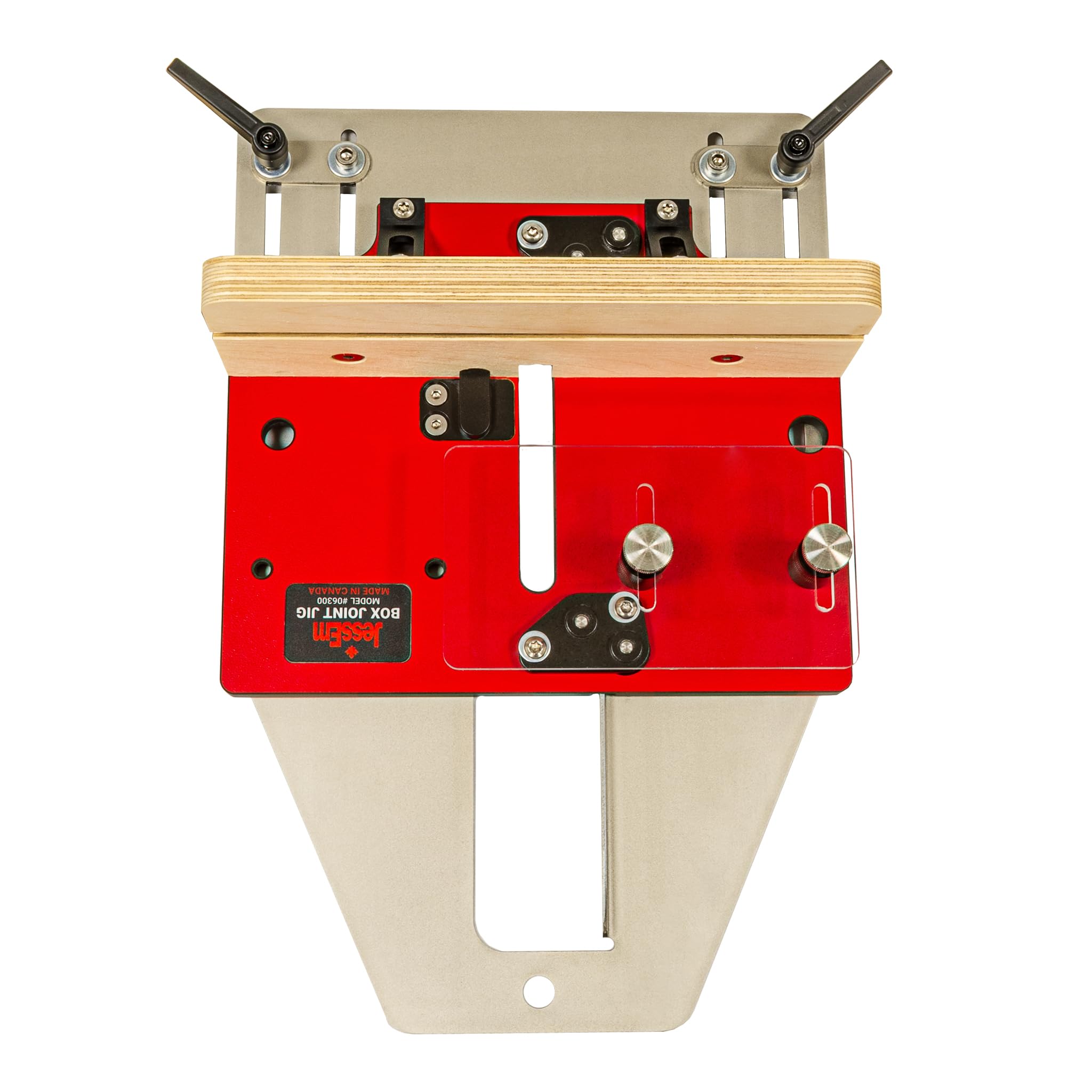
The pro pick that makes glue optional thanks to dead-on precision right from the start.
If you want your box joints to look like they were cut by a CNC machine, this is the jig. Buyers report it makes box joints in minutes that hold even without glue, which tells you how tight the fit is. The secret is the smooth bearing glide system—four R4 bearings that give 4-1/4″ of low-friction travel, so every pass is repeatable without fighting drag or binding.
The jig comes with 1/4″, 3/8″, and 1/2″ aluminum indexing keys plus matching Baltic birch fences, so swapping between finger sizes is tool-free. Weighing in at 9.35 pounds, it is noticeably heavier than the 5.64-pound Woodhaven 4555, which adds stability during cuts. The built-in dovetail slot accepts Micro-Jig MatchFit clamps for secure workpiece holding, and the adjustable bit guard keeps your fingers away from the spinning router bit.
One caveat: some owners mention it lacks a built-in micro adjuster for fine-tuning pin fit. JessEm reportedly has one in development with no ETA, but several users say a DIY adjuster is easy to rig. For the price, this is the jig that delivers professional results with the least fuss.
Why it wins
- Smooth R4 bearing glide system for repeatable cuts
- Aluminum indexing keys in three sizes with Baltic birch fences
- Heavy 9.35-pound build adds stability during routing
- MatchFit clamp compatible for secure workpiece holding
The trade-off
- No built-in micro adjuster for pin fit (DIY solution or waiting for accessory required)
- Heavier than some competitors, less portable
Your best match if: You want the smoothest, most repeatable box joint jig for your router table and are willing to DIY a micro adjuster.
Think twice if: You need a jig that works on a table saw, or you prefer a built-in micro adjustment mechanism right now.
2. Woodhaven 4555 Box Joint Jig

The work-moves-over-the-jig design that cuts error and leaves other jigs in the dust.
Unlike most jigs where you move both the workpiece and the jig for every cut, the Woodhaven 4555 keeps the work sliding over the jig. That means less chance for cumulative error, and first-time users consistently report tight joints after only a few test cuts. It handles any box joint from 1/8″ up to 13/16″, which is an unusually wide range—far beyond the standard 1/4″, 3/8″, 1/2″ you get from most competitors.
The jig includes a 24″ aluminum Ultra Track with a bit/blade cutout and replaceable sub-fences. Adjustable aluminum pins prevent the work from slipping mid-cut. It attaches to any miter gauge (sold separately), and the package dimensions of 24.5 x 4.8 x 4 inches make it bulkier than the JessEm’s 16.42 x 11.69 x 4.02-inch package. At 5.64 pounds versus the JessEm 06300 at 9.35 pounds, it’s easier to move around the shop.
Buyers rave about the customer service—one reviewer noted the owner himself answered the phone and helped with setup. The lifetime guarantee and US-made build quality add confidence. A few users note it lacks a micro-adjuster from the start, and the supplied instructions can feel sparse, but the design itself is proven over many years.
The edge it holds: wider pin range than any other jig here (1/8″ to 13/16″) and a work-over-jig design that reduces errors.
The honest catch: setup instructions assume some workshop experience, and true micro-adjustment requires a DIY stop block or investing in the 4553 upgrade kit.
Reach for this when: You want the widest possible pin range and prefer a jig that moves the work rather than the whole assembly.
skip it if: You want a drop-in solution with built-in micro-adjustment and detailed step-by-step instructions for beginners.
3. Rockler Router Table Box Joint Jig (422866)
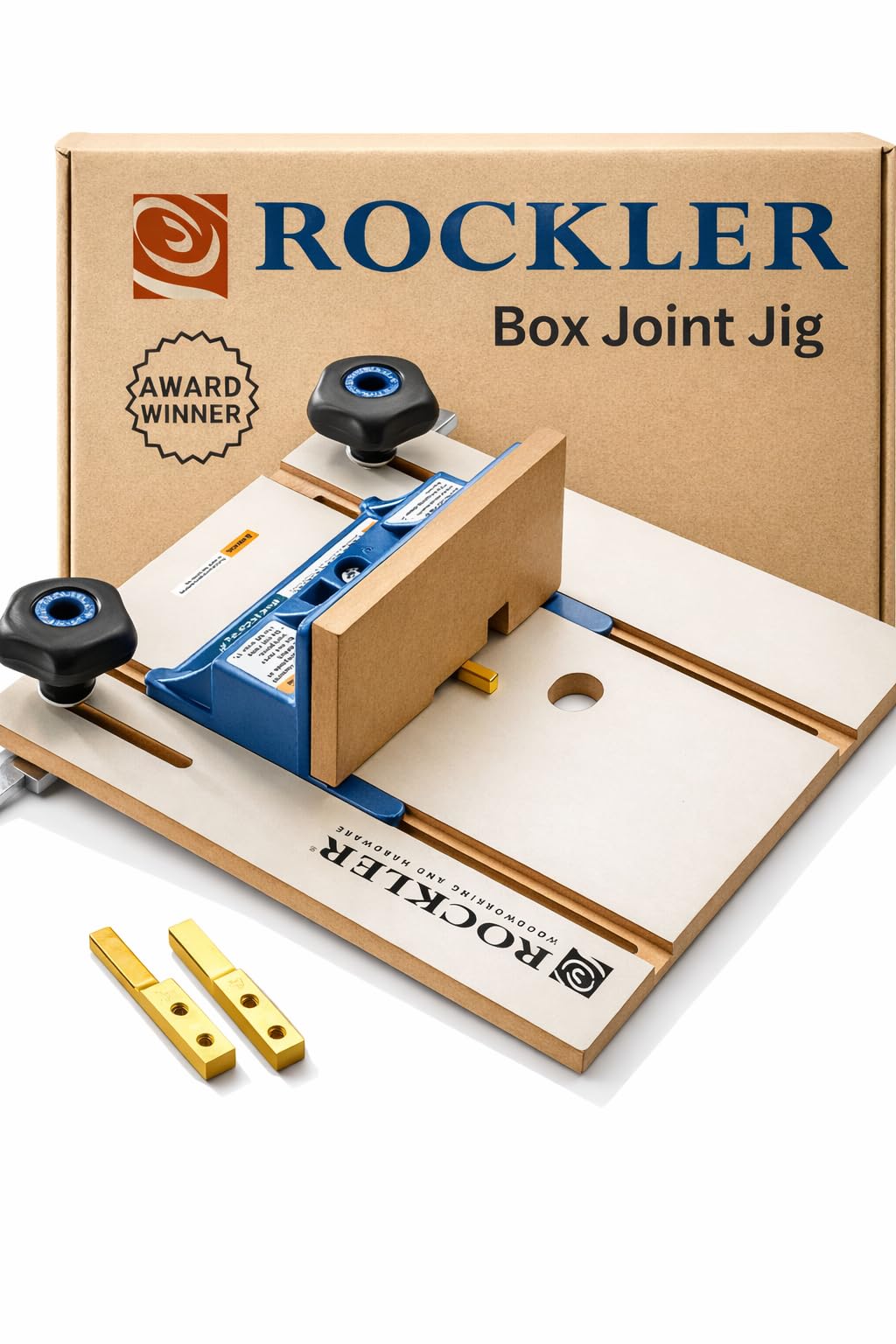
A smart, compact sled with solid brass keys that shines on small one-off box projects.
This Rockler jig uses precision-machined solid brass indexing keys in the three most common widths—1/4″, 3/8″, and 1/2″—so switching between finger sizes is as simple as swapping a key. Unlike the Woodhaven’s adjustable aluminum pins, these keys are dedicated to a single width, which some users say delivers more consistent spacing once dialed in. The keys store right in the sled, so you won’t lose them.
The melamine-coated MDF platform rides on long “skis” that keep the sled square to the router bit, with tabs on the bottom that stop the sled at the end of each cut. The ergonomic knobs lock everything into a 3/4″ miter slot. One buyer mentioned that after setup, they cut 20 drawers in a weekend, praising the fit and finish. The jig’s compact glass-filled nylon sled (12.99 x 11.26 x 3.7 inches) makes it easy to store.
The catch: a few reviewers mention the plastic sled parts have some play, which can make achieving tight joints harder than with an all-metal jig like the JessEm. Waste buildup under the sled between cuts requires frequent cleaning. This jig rewards patience and precision during the initial dial-in—once set, it works reliably for smaller projects.
What stands out
- Solid brass indexing keys store neatly in the sled
- Low-friction melamine-coated MDF platform slides smoothly
- Compact design stores easily in a small shop
What holds it back
- Plastic sled parts have some play, affecting joint tightness
- Requires precise measurement tools (calipers, height gauge) for setup
- Waste buildup under sled requires frequent cleaning mid-project
Best suited for: Woodworkers who already own digital calipers and a height gauge and want a reasonably priced jig for small, one-off box projects.
Not the best fit if: You want an all-metal build that stays tight without periodic re-calibration, or you plan to cut large production runs.
4. POWERTEC 71759 Adjustable Box Joints Jig

A versatile dual-platform jig that tackles box joints on both table saws and router tables.
Most jigs are laser-focused on either a router table or a table saw, but the POWERTEC 71759 works on both, giving you flexibility if you switch between tools. It comes with a wide MDF sub-fence, adjustable and fixed stop plates, safety blade guard, and even an extra expansion disc. The wide fence lets you securely clamp larger workpieces, which is helpful when you’re cutting long boards into finger-jointed panels.
Owners mention that after assembly and test cuts it worked as expected, and one user plans to make an additional MDF piece to use it as a 90-degree miter fence too. The jig includes a safety blade guard and a clamp guard for safer operation, and the adjustment knob controls the distance between the pin plates for different finger widths.
The biggest recurring complaint is the fine adjustment mechanism. Several customers note the “fine” adjustment for pin spacing is sloppy, requiring multiple cycles of tightening and backing off to get a snug fit. One reviewer returned the jig specifically because the adjustment part floats in the T-track with no precise control, calling it “macro, not micro.” If you can tolerate a fiddly setup, the jig is solid once dialed in—but getting there takes patience.
Why it appeals
- Works on both table saws and router tables for flexible use
- Wide fence securely clamps larger workpieces
- Includes safety blade guard and clamp guard
Where it struggles
- Fine adjustment mechanism is imprecise and can be frustrating
- Assembly instructions are unintuitive and may require multiple attempts
- Price point is high for a jig with macro-only pin adjustment
Choose this if: You need a single jig that works on both your table saw and router table, and you don’t mind spending extra setup time to dial it in.
Look elsewhere if: Precise micro-adjustment is your top priority, or you want a jig that delivers tight joints quickly without repeated re-tightening.
Understanding the Specs
Indexing Keys vs Adjustable Pin Plates
Indexing keys are dedicated blocks for each finger width—slip in the 1/4″ key, get 1/4″ fingers. They are dead-simple to swap but lock you into a few specific sizes. Adjustable pin plates let you set any width between two extremes, which is more flexible but can be harder to dial in precisely. For most hobbyists, three key sizes (1/4″, 3/8″, 1/2″) cover everything from small boxes to full drawers.
Miter Slot Compatibility
Your router table or table saw has a T-shaped groove called a miter slot, usually 3/4″ wide. The jig’s guide bar and locking hardware must match this slot exactly. If the hardware is loose, your cuts will wander. If the bolts are too big, they won’t fit at all. Always check that the jig comes with T-bolts or knobs sized for your specific table’s slot before buying.
FAQ
Can I use a box joint jig on both a router table and a table saw?
What finger widths should my jig support?
Why do my box joints keep coming out loose?
Is a heavier jig always better?
What is the difference between brass and aluminum indexing keys?
Do I need digital calipers to set up a box joint jig?
How do I clean a box joint jig between uses?
Can I make half-blind dovetails with a box joint jig?
What is the 4553 Upgrade Kit for the Woodhaven 4555?
Will a box joint jig fit my Incra miter gauge?
Final Thoughts: The Verdict
For most people, the best box joint jig is the JessEm 06300 because its R4 bearing glide system and aluminum indexing keys deliver professional-grade repeatability with minimal setup fuss. If you need the widest pin range and prefer a jig that moves the work over the jig, grab the Woodhaven 4555. And for small one-off projects on a budget, the Rockler 422866 gives you brass-key precision in a compact, affordable package.
How We Picked
We do not accept paid placement. Every pick is matched to a real buyer and a real use-case; we do not hands-on test units.
Sources & Methodology
Specifications: manufacturer listings and product documentation. Review insights: verified customer reviews, as of July 2026. Pricing: not shown on this page (it changes often); check the current price via the retailer link.
As an Amazon Associate, FitlyFast earns from qualifying purchases. This does not affect which products we feature.