
Our readers keep the lights on and the weekend projects moving. As an Amazon Associate, I earn from qualifying purchases.
Specs are compiled from manufacturer listings and verified buyer reviews and can change over time — please confirm the key details on the product page before buying.
If you have ever pulled a loaf from the oven only to find it dense, flat, or crumbly, the flour is likely the culprit—not your technique. Bread flour is simply wheat flour milled to a higher protein content (typically 12% to 14%), and that extra protein forms the gluten network that traps gas and gives your loaf lift, chew, and structure. The challenge is that supermarket shelves are packed with options that vary wildly in protein percentage, freshness, and whether they are bleached or organic, so picking the wrong bag can sabotage your bake before you even add water.
I’m Rikta — the founder and writer behind FitlyFast. This guide is built by comparing the manufacturers’ published specifications and the patterns across verified customer reviews, so you get each pick’s real strengths and trade-offs instead of marketing spin.
Whether you are shaping artisan sourdough, bagels, or a simple sandwich loaf, choosing the best bread flour means matching protein level and purity to your baking style and dietary needs.
Quick Picks
- King Arthur 100% Organic Bread Flour, Unbleached, 5 lb (Pack of 2) — Best Overall
- Palouse Brand Certified Glyphosate Residue Free Bread Flour | 3 LBS — Clean Label Champ
- King Arthur High Gluten Flour, 3 lb (Pack of 2) — High-Gluten Star
- Sunrise Flour Mill Heritage Organic Bread Flour Blend – 5 lbs — Heritage Pick
- White Lily Bread Flour, 5 lb Bag (Pack of 2) — Southern Favorite
- Bob’s Red Mill Artisan Bread Flour, 3 Pound (Pack of 4) — Best Value Bulk
- King Arthur Flour Sir Lancelot Hi-Gluten Flour – 50 Pounds — Bulk Sourdough Beast
How To Choose The Best Bread Flour
You pick a bread flour based on three things that change how your dough feels and how your loaf turns out. Protein percentage (the amount of gluten-forming protein in the flour) is the first: 12.7% works for everyday sandwich loaves, while 14% or higher gives bagels and artisan breads that chewy bite you want. Organic certification matters if you want to avoid pesticide residues and synthetic additives. The milling source—whether commodity wheat or heritage varieties—can change both digestibility and flavor depth. A fourth factor is freshness: flour that has sat on a shelf for months absorbs moisture unevenly and makes weaker dough.
Match Protein to Your Recipe
A standard loaf, pizza dough, or rolls performs well with 12.5% to 13% protein. Bagels, pretzels, and long-fermentation sourdoughs need 14% or more to maintain structure through aggressive shaping and extended proofing. Using a low-protein flour for a bagel recipe yields a flat, dense result because the gluten network cannot hold the shape.
Decide on Organic and Additives
Unbleached and unbromated flours like those from King Arthur and Bob’s Red Mill skip chemical maturing agents. For bakers concerned with glyphosate residue, look for third-party certifications such as the Detox Project seal found on Palouse Brand flour. Organic heritage flours (Turkey Red, White Sonora) are often milled from older wheat strains that some people find easier to digest.
Check Freshness and Storage
Flour is a perishable ingredient. Bags with a milled-on or “best by” date closer to your purchase mean livelier yeast activity and better oven spring. Once opened, store bread flour in an airtight container in a cool, dark place—or freeze it for longer shelf life—to prevent rancidity and pest infiltration.
Quick Comparison
| Model | Best For | Protein | Weight | Type | Amazon |
|---|---|---|---|---|---|
| King Arthur 100% Organic Bread Flour | Everyday artisan & sandwich loaves | 12.7% | 10 lbs | Organic, unbleached | Amazon |
| Palouse Brand Glyphosate-Free Bread Flour | Clean-label whole-wheat baking | — | 3 lbs | Whole wheat, glyphosate-free | Amazon |
| King Arthur High Gluten Flour | Bagels, pretzels, high-hydration dough | 14% | 6 lbs | High-gluten, unbleached | Amazon |
| Sunrise Flour Mill Heritage Organic Bread Flour | Sensitive stomachs & heritage flavor | — | 5 lbs | Organic heritage wheat | Amazon |
| White Lily Bread Flour | Southern-style soft bread & rolls | — | 10 lbs | Unbleached hard wheat | Amazon |
| Bob’s Red Mill Artisan Bread Flour | Budget-friendly bulk artisan baking | — | 12 lbs | Unbleached, unbromated | Amazon |
| King Arthur Sir Lancelot Hi-Gluten Flour | High-volume sourdough & professional use | 14.2% | 50 lbs | High-gluten, unbleached | Amazon |
In‑Depth Reviews
1. King Arthur 100% Organic Bread Flour, Unbleached, 5 lb (Pack of 2)
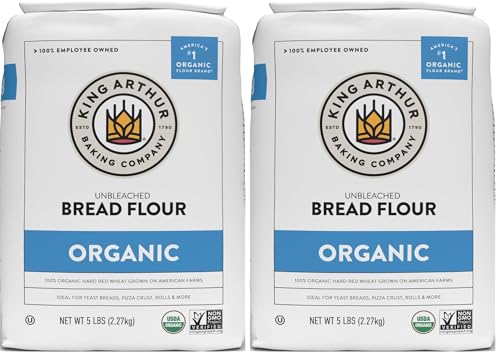
The organic workhorse that gives consistent lift to everything from sourdough to pizza crust.
This is the bag most home bakers reach for when they want a reliable, organic flour that does not require special handling. At 12.7% protein, it sits a full point above many generic supermarket brands, which means you get noticeably better oven spring and a more open crumb without having to adjust your hydration or kneading time. The 10-pound pack (two 5-pound bags) is a practical size—large enough for weekly baking but small enough to fit in a standard pantry shelf.
Versatility is its real selling point. You can use it straight for artisan loaves and rolls, or blend it with whole wheat flour to add extra lift to denser grain breads. Buyers report that a 24-hour cold rise yields great oven spring, and the clean, slightly sweet flavor comes through even in long-fermentation sourdough. The King Arthur 100% Organic Bread Flour holds 160 ounces of flour compared to the Palouse Brand’s 48 ounces, giving you more than three times the volume for a similar per-bag price.
One trade-off: at 10 pounds total, this is not the cheapest option per pound on the list, but the consistent performance across batches justifies the premium for most regular bakers.
What Bakers Love
- Reliable 12.7% protein delivers strong rise and elastic dough every time
- USDA Organic, Non-GMO Project Verified, and Kosher with no preservatives
- Fine, consistent texture that measures and mixes easily
- Versatile enough for sandwich loaves, artisan breads, and pizza crust
A Couple of Limits
- Not ideal for bagels or high-hydration recipes that need 14%+ protein
- Bulk pack may be more than occasional bakers need before it loses freshness
Reach for this if: you bake 2-3 times a week and want one organic flour that works for nearly every yeast-risen recipe without guesswork.
Look elsewhere if: you specifically need a higher-gluten flour (14% or more) for bagels or extremely high-hydration sourdough.
2. Palouse Brand Certified Glyphosate Residue Free Bread Flour | 3 LBS

A stone-ground whole-wheat flour from a family farm that skips the chemicals without skipping flavor.
If your priority is knowing exactly where your flour comes from and what is—or is not—on the wheat, this 3-pound bag from Palouse Brand is a standout. It is Certified Glyphosate Residue Free by the Detox Project, and the wheat berries are grown on the Mader family’s 125+ year-old Washington farm, then triple-cleaned and stone-milled. The flour is genuinely whole grain, meaning nothing is stripped away, so you get all the bran, germ, and endosperm in every scoop.
Owners mention that the resulting bread has about a 5:1 carb-to-fiber ratio, which keeps good texture without the bitterness some whole wheat flours carry. It has a slightly sweet, nutty taste rather than the harsh edge you sometimes get from commodity whole wheat. The 3-pound bag is noticeably smaller than the King Arthur Organic’s 10-pound offering—a 48-ounce vs 160-ounce gap—so it suits bakers who make one or two loaves a week and want to use it up while it is freshest.
The newer packaging no longer stands upright on the counter, which some buyers find inconvenient for scooping, and the whole-grain nature means you will get denser results compared to a white bread flour unless you adjust hydration downward.
Why It Stands Out
- Third-party certified glyphosate residue free—one of the cleanest options available
- Traceable from a single family farm with stone-milling for fresh flavor
- Nutty, slightly sweet whole wheat taste without bitterness
- Perfect 5:1 carb-to-fiber ratio praised by regular buyers
Keep in Mind
- 3-pound bag goes fast if you bake multiple loaves per week
- New bag design does not stand upright for easy measuring
- Denser crumb than white bread flour; best for lower hydration recipes
Grab this for: clean-label whole-wheat baking where glyphosate residue is a dealbreaker and farm-to-table traceability matters.
Not for you if: you need a large bulk bag or prefer the lighter texture of white bread flour for sandwich loaves.
3. King Arthur High Gluten Flour, 3 lb (Pack of 2)
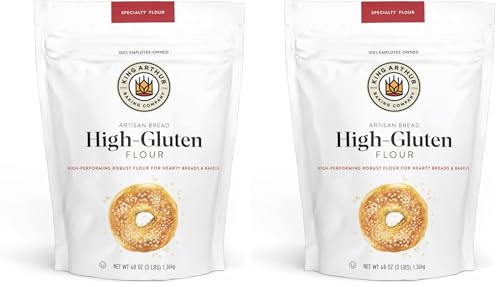
The 14% protein booster that turns slack dough into chewy, lofty bagels and artisan breads.
This is the flour you reach for when standard bread flour (around 12.7%) is not enough. The extra gluten creates a dough that holds its shape during boiling (for bagels) and resists collapsing under the weight of mix-ins like seeds or dried fruit.
Customers note using it as a substitute in sourdough rye at 80% high-gluten and 20% rye, getting better oven spring and dough strength than they could with standard bread flour alone. That same buyer noted it allows higher hydration without the dough turning into a sticky mess. At 6 pounds total (two 3-pound bags), it is a more focused purchase than the 10-pound organic pack—you buy it specifically when you need that extra protein punch, not as an everyday all-purpose flour.
The catch: it is not organic, and some buyers wish it were, so you are trading the organic label for the functional protein boost.
What It Does Best
- 14% protein creates chewy, crusty bagels and artisan loaves with tall rise
- Great for boosting whole-grain blends—adds structure to rye or whole wheat doughs
- Allows higher hydration without losing dough integrity
- Fine texture blends easily with other flours
Two Drawbacks
- Not organic, which may disappoint clean-label bakers
- Overkill for soft sandwich bread or delicate rolls that need a tender crumb
Perfect for: bakers who make bagels, pretzels, or high-hydration sourdough regularly and need the strongest gluten network available.
Not the right pick if: you bake mostly sandwich loaves and standard dinner rolls—the extra chew can feel tough.
4. Sunrise Flour Mill Heritage Organic Bread Flour Blend – 5 lbs
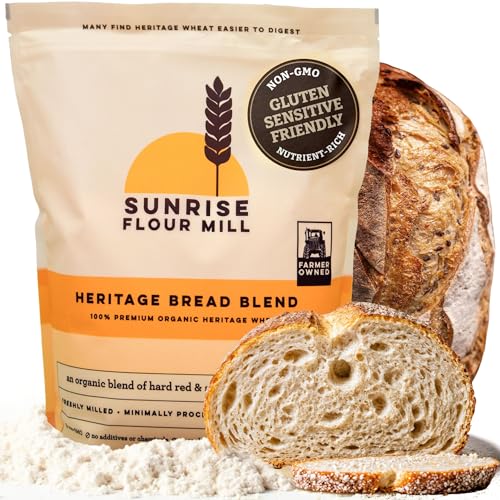
A heritage wheat blend that bakes like modern flour but treats your stomach like old-school grain.
This flour is milled from pre-hybridized wheat varieties—Turkey Red and White Sonora—that have not been through intensive scientific breeding. The result, according to the maker, is improved digestibility compared to modern wheat, and buyers consistently report that it does not trigger the bloating or gut discomfort they experience with standard flours. One reviewer noted that 66% hydration works well with this blend, and another mentioned that a 24-hour cold fermentation makes it extremely digestible even for severe IBS.
The flour has a nutty, smooth flavor and a creamy-gold color that produces soft, airy breads with a beautiful golden crust. It uses a unifine milling process from the 1930s that gives it a super-fine, fluffy texture—noticeably lighter than many stone-ground whole-grain flours. At 5 pounds, it is a mid-size bag that works well for testing heritage flour without committing to a bulk purchase.
The price per pound is higher than commodity organic flours, and the heritage protein content is not listed, so if you need an exact protein number for formula adjustments, you will have to test it yourself.
Why Bakers Switch
- Pre-hybridized heritage wheat reported easier to digest with less bloating
- Nutty, rich flavor with a creamy-gold crumb color that looks bakery-quality
- USDA Organic and milled from Turkey Red and White Sonora varieties
- Unifine milling produces a super-fluffy texture ideal for soft, airy loaves
What to Consider
- No protein percentage listed, making it harder to predict dough behavior
- Premium pricing compared to standard organic bread flours
- 5-pound bag yields roughly six 1.5-lb loaves—modest for heavy bakers
Choose this for: digestive sensitivity or a desire to bake with older wheat strains that offer a flavor profile you cannot get from commodity flour.
skip it if: you need a known protein percentage for consistent recipe scaling or want the lowest cost per pound.
5. White Lily Bread Flour, 5 lb Bag (Pack of 2)
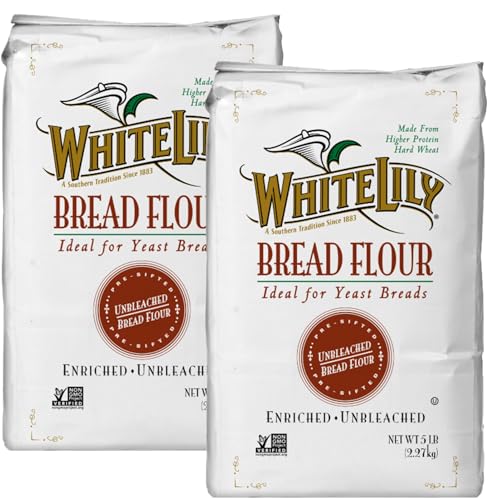
The Southern mill that gives sourdough bakers the same reliable structure bag after bag.
White Lily is a name long associated with Southern baking, and their bread flour is formulated specifically for yeast-risen loaves, rolls, and pizza dough. It is made from premium hard wheat with a higher protein level meant to promote gluten development, producing a soft yet sturdy crumb with a good crust. Reviewers point out it is excellent for sourdough, with consistent dough handling and reliable structure, and one buyer mentioned the quality stays steady from bag to bag—important when you are dialing in a starter or a hydration ratio.
The 10-pound pack (two 5-pound bags) is a practical size, and the flour delivers a texture that falls between standard bread flour and a high-gluten flour, though the exact protein percentage is not printed on the packaging. The biggest roadblock for many buyers is availability: if you do not have a local store that stocks White Lily, ordering through Amazon solves that problem, but you are paying a premium for the shipping logistics.
Compared to the King Arthur High Gluten Flour, White Lily does not give you a specific protein number to work with, which can frustrate bakers who calculate precise dough formulas.
What Fans Say
- Consistent performance bag-to-bag for sourdough, rolls, and artisan loaves
- Produces a soft, sturdy crumb with a professional-quality crust
- 10-pound bulk pack ideal for weekly bakers
- Reliable choice when you cannot find it locally but trust the brand
Considerations
- Protein percentage is not listed on the packaging
- Premium price compared to commodity bread flours of similar size
- Not organic—no USDA Organic or Non-GMO certification listed
Best for: sourdough bakers who already trust White Lily and want a bulk supply without hunting local store shelves.
Pass if: you need a precise protein percentage for recipe development or prefer an organic flour.
6. Bob’s Red Mill Artisan Bread Flour, 3 Pound (Pack of 4)
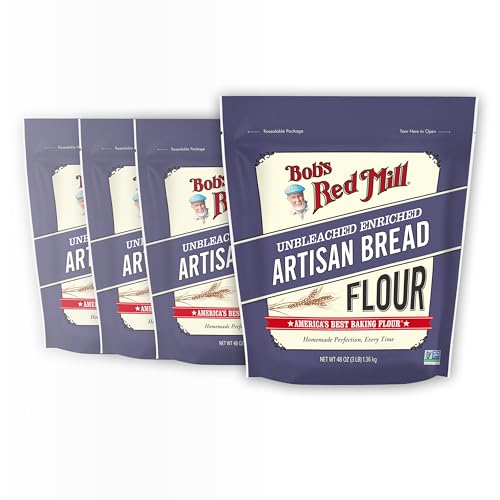
A 12-pound pantry-busting pack that delivers consistent artisan results without the organic markup.
Bob’s Red Mill Artisan Bread Flour is designed specifically for yeast-risen goods—sourdough, pizza crusts, baguettes, and focaccia. It is unbleached, unbromated, and enriched with malted barley flour, which encourages yeast activity and improves rise. The 12-pound bundle (four 3-pound bags) is the largest total volume on this list besides the 50-pound commercial bag, giving you a bulk option that still comes in manageable 3-pound resealable pouches that tuck into a pantry shelf.
Shoppers say that no-knead breads bake nicely with this flour, producing good flavor and texture, and one reviewer specifically called out the nutty golden dusting it leaves on biscuits as a pleasant sign of quality. The Non-GMO Project Verified label adds confidence for shoppers avoiding genetically modified ingredients. At this price, the per-pound cost undercuts most organic and heritage options, making it the strongest value proposition for heavy weekly bakers.
The caveat, mentioned by several buyers, is that the 12-pound total takes up significant shelf space, and the bags can explode flour dust on opening if you are not careful. It is not organic, so if you require USDA Organic certification, look at the King Arthur Organic or Sunrise Heritage picks instead.
The Upside
- 12 pounds of flour at a very competitive per-pound cost
- Unbleached, unbromated, and Non-GMO Project Verified
- Malted barley flour improves rise and yeast activity
- Resealable 3-pound bags keep the rest fresh while you use one
The Downside
- Not organic—no USDA Organic certification
- Large footprint in the pantry; 12 lbs is a lot of flour
- Some bags can puff flour dust when first opened
Ideal for: regular bakers who go through several pounds a week and want the lowest cost per loaf without sacrificing quality.
Not for you if: you need organic certification or have limited pantry space for a 12-pound stash.
7. King Arthur Flour Sir Lancelot Hi-Gluten Flour – 50 Pounds

A 50-pound protein powerhouse that serious sourdough bakers finish in a month.
Sir Lancelot is King Arthur’s highest-protein retail flour at 14.2%—marginally above the standard high-gluten flour’s 14% and designed for bakers who need maximum gluten strength for extra-chewy artisan breads and loaves packed with heavy whole grains. It is milled from hard red spring wheat and is never bleached or bromated. One owner reported making six sourdough loaves a week and going through the full 50 pounds in a single month, calling it a “sourdough rock star” that dramatically improved their novice results.
The 50-pound bag is shipped in a ply-lined paper bag inside a heavy-duty cardboard box, so it arrives intact. If you have the storage space and bake at high volume, this is the most economical way to get a premium high-gluten flour—the per-pound cost is significantly lower than buying multiple 3- or 5-pound bags. Buyers also note it works just as well as expensive imported Italian flours for sourdough, with one reviewer stating it has the best flavor among several brands they tried.
The obvious barrier is the sheer size. Unless you bake multiple loaves per week, the flour will lose freshness before you use it all, and storing 50 pounds requires a dedicated container or a cool, dry closet. It is also not organic, which may be a non-starter for some.
Why Go This Big
- Highest protein at 14.2%—gives maximum oven spring and chew for bagels, sourdough, and whole-grain blends
- Best per-pound value on this list for high-gluten flour
- Proven in high-volume sourdough baking; buyers report loaves equal to premium imported flours
- Never bleached or bromated
The Catch
- 50 pounds requires serious storage space and a plan to use it before staling
- Not organic—organic certification is absent
- Overkill for bakers who make one or two loaves per week
For the dedicated baker who: goes through 10+ pounds of flour per month and wants the strongest gluten network available at the lowest bulk cost.
Don’t buy if: you bake less than once a week or lack airtight, cool storage for a 50-pound bag.
Understanding the Specs
Protein Percentage
This is the single most important number on a bag of bread flour. Protein content directly determines how much gluten your dough can develop. Standard bread flour runs 12%–13% and works for most sandwich loaves, rolls, and pizza. High-gluten flour at 14% or higher is designed for bagels, pretzels, and whole-grain blends that need extra structural support. The protein percentage on the label tells you what the flour is built to do, so matching it to your recipe prevents flat, dense results.
Gluten and Hydration
Gluten is the protein network that traps gas bubbles during fermentation and gives bread its chew and rise. A higher-protein flour can absorb more water—meaning you can use a higher hydration ratio (more water relative to flour), which typically yields a more open, airy crumb. If you switch from a 12.7% flour to a 14% flour, you may need to increase the water in your recipe by a few percentage points to avoid a stiff, dry dough.
FAQ
Can I use bread flour for recipes that call for all-purpose flour?
What is the difference between bread flour and high-gluten flour?
Does organic bread flour taste different from conventional bread flour?
How long does bread flour stay fresh after opening?
What does the term unbleached mean on a bag of bread flour?
Is bread flour the same as strong flour?
Can I use bread flour in a bread machine?
Why does my bread flour dough feel stiffer than all-purpose dough?
What is the difference between bromated and unbromated bread flour?
Does heritage wheat bread flour really cause less bloating?
Final Thoughts: The Verdict
For most buyers, the best bread flour overall is the King Arthur 100% Organic Bread Flour because its 12.7% protein, organic certification, and consistent performance across every yeast-risen recipe make it the one bag that covers nearly everything a home baker does. If you want the highest gluten strength for bagels and high-hydration sourdough, grab the King Arthur High Gluten Flour at 14% protein. And for a bulk value that still delivers artisan quality, the Bob’s Red Mill Artisan Bread Flour 12-pound pack gives you the most flour per dollar without sacrificing performance.
How We Picked
We do not accept paid placement. Every pick is matched to a real buyer and a real use-case; we do not hands-on test units.
Sources & Methodology
Specifications: manufacturer listings and product documentation. Review insights: verified customer reviews, as of July 2026. Pricing: not shown on this page (it changes often); check the current price via the retailer link.
As an Amazon Associate, FitlyFast earns from qualifying purchases. This does not affect which products we feature.