
Our readers keep the lights on and the weekend projects moving. As an Amazon Associate, I earn from qualifying purchases.
Specs are compiled from manufacturer listings and verified buyer reviews and can change over time — please confirm the key details on the product page before buying.
If you have a good old stereo, a set of powered speakers, or a car radio that predates Bluetooth, you do not need to replace the whole system. A single small box called a Bluetooth Receiver plugs into your existing gear and lets you stream music wirelessly from your phone, tablet, or laptop. The trick is picking the one that actually delivers clear sound, a stable connection, and the right outputs for your gear.
I’m Rikta — the founder and writer behind FitlyFast. This guide is built by comparing the manufacturers’ published specifications and the patterns across verified customer reviews, so you get each pick’s real strengths and trade-offs instead of marketing spin.
The three receivers below each serve a different setup, from a simple home stereo to a pro DJ rig, and together they cover what actually matters when you shop for a bluetooth receiver.
Quick Picks
- 1Mii B06Pro+ Hi-Fi Bluetooth 5.3 Audio Receiver — Best Overall
- NVX XUBT3 Universal Bluetooth Audio Receiver — Car Install
- blafili B3 Bluetooth Receiver for Mixers, DJ, PA & Stereo Systems — Pro Grade
How To Choose The Best Bluetooth Receiver
Buying a Bluetooth Receiver seems simple — plug it in and pair your phone — but the sound quality and connection reliability vary a lot between models. Three decisions will make or break your experience: the audio codec support, the output connections, and the antenna design.
Audio Codec Support — What Your Ears Actually Hear
The Bluetooth codec decides how your music is compressed before it travels wirelessly. Basic SBC (the default codec) can sound thin and compressed. If your phone and receiver both support LDAC or aptX HD, the audio stays much closer to the original recording — you hear the details, the bass punch, and the spatial separation that gets lost with standard Bluetooth. Check what your phone supports before buying.
Output Connections — Match Your Gear
Look at the back of your stereo, amplifier, or powered speakers. If it has RCA inputs, you need a receiver with RCA outputs. If you have a modern soundbar or AV receiver with an optical input, an optical output gives you a cleaner signal than a 3.5mm jack. Pro audio gear with balanced XLR inputs needs a receiver with XLR outputs. Buy the one that physically fits your equipment.
Antenna and Range — Real-World Connection
Indoor range is often shorter than advertised because walls, Wi-Fi routers, and metal shelves interfere with the signal. A receiver with a removable external antenna (RP-SMA connector) lets you upgrade to a bigger antenna if your setup is far from your listening spot. Dual antennas or class 1 Bluetooth radios also help push through obstacles.
Quick Comparison
| Model | Best For | Audio Codecs | Outputs | Range (Indoors) | Amazon |
|---|---|---|---|---|---|
| 1Mii B06Pro+ | Home stereo upgrade with LDAC | LDAC, aptX HD, aptX LL, AAC | 3.5mm, Optical, Coaxial | 60–100 ft (20–30m) | Amazon |
| NVX XUBT3 | Vehicle dash or glovebox install | SBC | 3.5mm, RCA | — | Amazon |
| blafili B3 | Pro / audiophile systems with XLR | LDAC, aptX HD, aptX LL, AAC | XLR, RCA, Optical, Coaxial | Up to 33m (100 ft) | Amazon |
In‑Depth Reviews
1. 1Mii B06Pro+ Hi-Fi Bluetooth 5.3 Audio Receiver
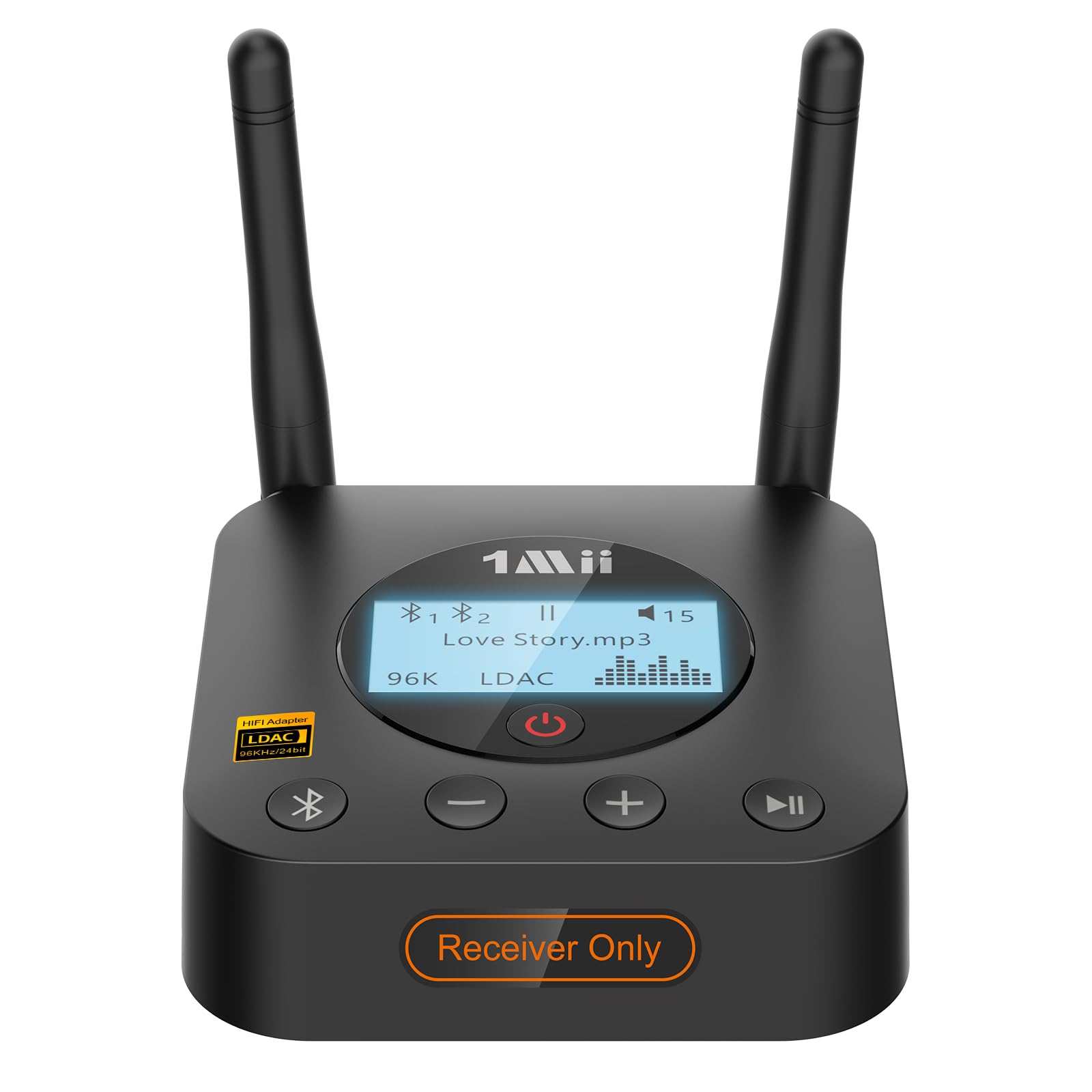
The one that adds lossless wireless audio to any vintage stereo with a visible LCD.
You get high-fidelity streaming through LDAC (a high-resolution audio codec that preserves more musical detail than standard Bluetooth) and aptX HD, so your phone wirelessly feeds your old amplifier with sound that rivals a wired connection. The built-in audiophile-grade ESS DAC (a digital-to-analog converter chip from ESS Technology that reduces distortion) handles the decoding, which means the music coming out of your speakers sounds cleaner and more lifelike compared to budget receivers that skip a dedicated DAC.
The dual antennas and class 1 Bluetooth radio give you an impressive indoor range of up to 60–100 feet (20–30 meters) through walls, well beyond the typical 30-foot limit of most receivers. You also get a small LCD display that shows the song name, volume level, and active Bluetooth codec — a rare convenience at this price. Unlike the blafili B3 below, the 1Mii uses a 3.5mm jack, optical, or coaxial output, so it fits standard home stereos and powered speakers but lacks XLR for pro audio gear.
Buyers report that setup is truly plug-and-play: connect the included 3.5mm-to-RCA cable or optical cable, pair your phone, and the LCD confirms the codec. The volume knob on the unit also lets you skip tracks by holding it for two seconds.
What stands out
- LDAC and aptX HD deliver near-lossless wireless audio — your music sounds full and detailed
- Dual antennas push indoor range up to 60–100 ft, so your phone stays connected across the house
- LCD display shows song name and active codec, so you always know what you are hearing
The limitations
- No XLR output — pro mixers and studio monitors need the blafili B3 instead
- Built-in lithium-ion battery means the unit cannot be powered indefinitely without recharging if you unplug it
The sweet-spot pick: Ideal for anyone with a traditional home stereo, powered speakers, or an old amp who wants high-quality wireless streaming with a visual status display.
Leave it on the shelf if: You need balanced XLR outputs for a professional DJ setup or studio monitors — that is the blafili B3’s job.
2. NVX XUBT3 Universal Bluetooth Audio Receiver
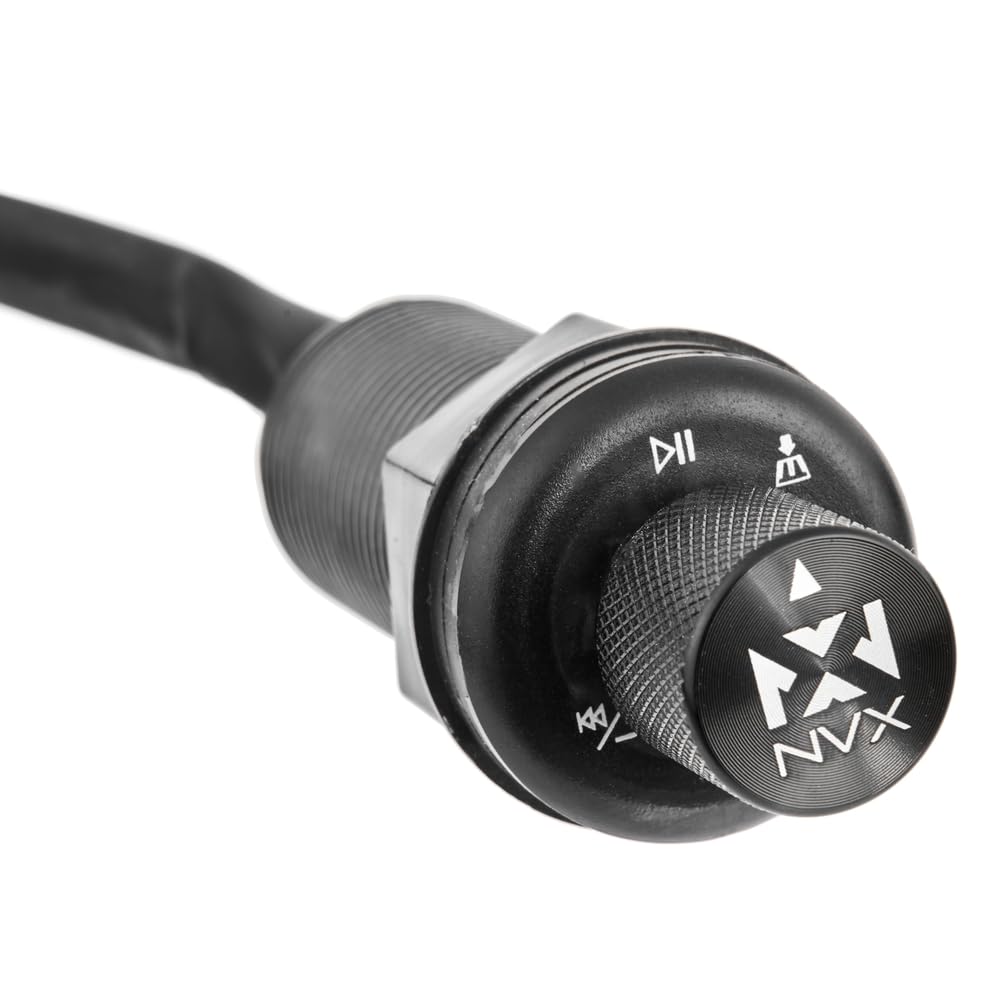
The tiny knob you bury in your dash for one-handed track and volume control on the road.
This receiver is built specifically for vehicles, motorcycles, ATVs, and boats — not for your living room stereo. The single mechanical knob controls track skip, pause, and volume, so you can adjust music without looking away from the road. It weighs just 4 ounces and offers flush in-dash or under-dash mounting, which means it disappears into your vehicle’s interior instead of dangling from the aux port.
Unlike the 1Mii and blafili models above, the NVX lacks high-resolution codecs (LDAC, aptX HD) and a dedicated DAC chip. It uses standard Bluetooth SBC (the basic codec that every phone supports but compresses audio noticeably). This is fine for talk radio, podcasts, or casual music listening in a noisy car cabin, but you will hear the difference if you compare it side-by-side with an LDAC receiver on a quiet home system. The outputs are a 3.5mm jack and RCA, so it pairs with any stereo or amplifier that has an aux input.
Owners mention the knob feels solid and the connection is reliable once paired. The rubber mounting grommets make it easy to cut a hole in a plastic dash panel and lock the unit in place.
Vehicle-friendly design
- Mechanical knob controls track, pause, and volume in one hand — no phone touching needed while driving
- Weighs only 4 oz and mounts flush in dash or under dash, so it does not clutter your cabin
- Works with any stereo that has a 3.5mm aux input
Sound compromise
- No LDAC or aptX HD — audio quality is limited to basic SBC Bluetooth
- No optical or coaxial output — cannot connect to modern soundbars or AV receivers
Best for drivers: Grab this if you want clean one-knob music control in your car, truck, boat, or ATV without a touchscreen or head unit upgrade.
Skip it for home use: If you are adding Bluetooth to a living room stereo, the 1Mii or blafili will sound noticeably better and offer more connection options.
3. blafili B3 Bluetooth Receiver for Mixers, DJ, PA & Stereo Systems

The one with balanced XLR outputs and a silent pairing experience for pro audio rigs.
The blafili B3 is the only receiver in this list with XLR output (a balanced audio connection used in professional sound systems that cancels out electrical noise over long cable runs), making it the natural choice for DJ mixers, PA systems, studio monitors, and high-end home theater gear. It also outputs through RCA, coaxial, and optical simultaneously, so you can feed multiple devices — such as a powered subwoofer and a stereo amplifier — from the same receiver without a splitter.
Inside, it pairs Qualcomm’s QCC5125 chipset (a low-power Bluetooth chip that supports LDAC and aptX HD) with ESS’s ES9018K2M DAC (a high-end digital-to-analog converter known for low distortion and high dynamic range). Customers note that the sound is “strong and clear with no distortion” and that it “transformed” the experience on a tube amplifier. One reviewer who used it for a year with Fosi mono amps reported zero issues and excellent audio quality via LDAC. Another noted a rock solid connection from a MacBook Pro at 25 feet through a wall — a real-world range figure close to the 33m (100 ft) spec with the included RP-SMA external antenna.
A standout feature: the B3 does not play any pairing beeps, connection tones, or voice prompts — silent pairing only. That matters in a quiet listening room or when you are recording. You can also request software from the manufacturer to customize the Bluetooth broadcast name and set a 4-digit passcode for security. Unlike the 1Mii B06Pro+, the B3 also works as a USB DAC for your computer, supporting up to 16-bit 48kHz audio resolution over a USB-C cable.
Pro-level connectivity
- XLR, RCA, optical, and coaxial outputs all active simultaneously — feed multiple devices at once
- Qualcomm QCC5125 + ESS ES9018K2M DAC delivers low distortion, high dynamic range, and support for LDAC and aptX HD
- Silent pairing with no beeps or voice prompts, perfect for quiet listening environments
- Removable RP-SMA antenna lets you upgrade range if your gear is far from your phone
- Doubles as a USB DAC for your computer (16-bit 48kHz)
Know before you buy
- No power adapter included — you need your own USB-C 5V power source
- Does not stream over Wi-Fi — Bluetooth and USB audio only
The professional’s choice: If your system has XLR inputs — DJ mixer, PA speakers, studio monitors — or you want to feed multiple audio devices from one receiver, this is the one that fits.
An honest caveat: For a simple home stereo with RCA inputs only, the 1Mii B06Pro+ costs less and still delivers excellent LDAC sound without the pro features you would not use.
Understanding the Specs
Bluetooth Codecs (LDAC, aptX HD, SBC)
A codec is the method your phone and Bluetooth receiver use to compress and send music over the air. SBC (the default codec on every phone) compresses audio the most, which can make it sound flat or fuzzy. LDAC (developed by Sony) supports bitrates up to 990 kbps, while SBC typically runs at lower bitrates, so you can hear more detail, deeper bass, and clearer highs. aptX HD is a close alternative. Both your phone and the receiver must support the same high-quality codec for it to work — check your phone’s Bluetooth settings to see what codecs it supports before buying.
DAC Chip (Digital-to-Analog Converter)
A receiver without a dedicated DAC uses a basic chip inside the Bluetooth module that can introduce noise (a faint hiss or hum) and distort the audio signal. A separate audiophile-grade DAC, like the ESS ES9018K2M in the blafili B3 or the ESS chip in the 1Mii B06Pro+, converts the digital stream into an analog signal with much less distortion and a wider dynamic range (the gap between the quietest and loudest sounds). The result is cleaner, more detailed sound, especially noticeable on good speakers or headphones.
FAQ
Can I use a Bluetooth Receiver with passive speakers that have no power cable?
What is the difference between a Bluetooth Receiver and a Bluetooth Transmitter?
Will LDAC work with my iPhone?
How do I connect a Bluetooth Receiver to a car stereo without an aux input?
Do all Bluetooth Receivers support the same range?
What cables do I need to buy separately?
Can I stream from a computer to a Bluetooth Receiver?
Will a Bluetooth Receiver work with a TV that only has optical output?
How do I stop the receiver from making loud pairing sounds?
What does “simultaneous outputs” mean on the blafili B3?
Final Thoughts: The Verdict
Across the board, the bluetooth receiver winner is the 1Mii B06Pro+ because it delivers LDAC, aptX HD, a dedicated ESS DAC, and a range well beyond typical receivers — all while being easier to set up than the competition. If you need balanced XLR outputs for a pro audio rig, grab the blafili B3. And for a simple vehicle install where the priority is one-handed knob control, the standout is the NVX XUBT3.
How We Picked
We do not accept paid placement. Every pick is matched to a real buyer and a real use-case; we do not hands-on test units.
Sources & Methodology
Specifications: manufacturer listings and product documentation. Review insights: verified customer reviews, as of July 2026. Pricing: not shown on this page (it changes often); check the current price via the retailer link.
As an Amazon Associate, FitlyFast earns from qualifying purchases. This does not affect which products we feature.