
Our readers keep the lights on and the weekend projects moving. As an Amazon Associate, I earn from qualifying purchases.
Specs are compiled from manufacturer listings and verified buyer reviews and can change over time — please confirm the key details on the product page before buying.
You want that deep rumble you can feel in your chest during a movie explosion or a bass-heavy track. A bass subwoofer delivers that pressure, but the wrong one can turn dialogue into mud. This guide picks the best options for home theater, studios, and music listening, matching power and size to your room and budget.
I’m Rikta — the founder and writer behind FitlyFast. This guide is built by comparing the manufacturers’ published specifications and the patterns across verified customer reviews, so you get each pick’s real strengths and trade-offs instead of marketing spin.
Choosing the right bass subwoofer depends on matching driver size (8-inch vs 12-inch), amplifier power (RMS, which is Root Mean Square, the continuous wattage it can handle), and room size to get that chest-thumping low end without rattling your walls apart.
Quick Picks
- Rockville Rock Shaker 12 Black Powered 12-Inch Home Theater Subwoofer — Best Overall
- JBL Professional LSR310S – Studio Monitor Subwoofer, 10-Inch — Studio Grade
- Klipsch SPL-120 Powered Subwoofer 12 inches, Black — Home Theater Beast
- SVS SB-1000 Pro Subwoofer (Black Ash) — Music Lover’s Choice
- PreSonus Eris Sub 8BT — 8″ Inch Powered Subwoofer — Studio & Streaming
- Audioengine S8 Powered Subwoofer – 250W 8-Inch — Desktop Powerhouse
- Polk Monitor XT12 Powered Sub – 12″ Balanced Woofer — Budget 12-Inch
- Rockville Rock Shaker 10 Black 600W Powered Subwoofer — Best Value 10-Inch
- Dayton Audio Classic CS800 – 8″ 150W Powered Subwoofer — Compact & Clean
How To Choose The Best Bass Subwoofer
Picking a subwoofer is about more than just raw power. You need to match the driver size to your room, understand amplifier ratings (especially RMS vs peak), and get the right connections for your gear. Here is what matters most.
Match the Driver Size to Your Room
An 8-inch driver works well in a small office or bedroom, offering tight, punchy bass that blends cleanly with bookshelf speakers. A 12-inch driver moves more air, which is essential for filling a large living room or dedicated home theater with deep, room-shaking low frequencies (the deep rumbles below 50Hz).
Understand RMS vs Peak Power
RMS (Root Mean Square — continuous power rating) is the wattage a subwoofer can handle for long periods — that is the number to trust for real-world loudness and clarity. Peak power is a short burst rating, often much higher, but it is not a measure of sustained performance. Comparing the RMS between subs gives you a fair comparison.
Check Crossover and Connectivity
A subwoofer needs to blend smoothly with your main speakers. An adjustable crossover (usually 50Hz to 150Hz) lets you set where the sub takes over. Look for LFE input (Low-Frequency Effects — the standard for home theater receivers) for home theater receivers, and RCA or speaker-level inputs if you are connecting to a stereo amp or older gear.
Quick Comparison
| Model | Best For | Driver Size | RMS Power | Frequency Response | Amazon |
|---|---|---|---|---|---|
| Rockville Rock Shaker 10 | Budget-friendly home theater | 10 Inches | 300W RMS | 20Hz–200Hz | Amazon |
| Dayton Audio Classic CS800 | Tight bass in small rooms | 8 Inches | 150W RMS | 35 Hz | Amazon |
| Rockville Rock Shaker 12 | Deep bass for large rooms | 12 Inches | 400W RMS | 50Hz–150Hz (crossover range) | Amazon |
| PreSonus Eris Sub 8BT | Studio monitoring with Bluetooth | 8 Inches | 100W RMS | 30 Hz | Amazon |
| Audioengine S8 | Desktop and near-field listening | 8 Inches | 250W | — | Amazon |
| JBL Professional LSR310S | Professional studio accuracy | 10 Inches | — | 20 Hz region | Amazon |
| Klipsch SPL-120 | Home theater impact | 12 Inches | 600W | — | Amazon |
| Polk Monitor XT12 | Value home theater upgrade | 12 Inches | 100W Class A/B | 24 Hz | Amazon |
| SVS SB-1000 Pro | Sealed precision for music | 12 Inches | 325W RMS | — | Amazon |
In‑Depth Reviews
1. Rockville Rock Shaker 12 Black Powered 12-Inch Home Theater Subwoofer

The 12-inch brute that brings chest-thumping bass while staying affordable.
This sub delivers deep, room-filling bass for movies and music thanks to an 800W peak and 400W RMS amplifier (the continuous power it can handle) pushing a 12-inch woofer. Buyers report the “12” Rockville subwoofer” produces “deep, powerful, room-filling bass with crisp low notes.” The 50Hz–150Hz adjustable crossover (the frequency where the sub takes over from your main speakers) lets you dial in the blend precisely.
The MDF (medium-density fiberboard) cabinet and detachable foam grill give it a solid feel. Connectivity covers RCA (the standard red/white cable) and speaker-level inputs, so it works with most receivers. The 8.0x power gap over the PreSonus Eris Sub 8BT — 800W peak versus 100W — is massive; this Rockville will pressurize a large living room without breaking a sweat.
What really works
- Massive 800W peak power for deep, distortion-free output
- Adjustable crossover and phase controls for fine-tuning
- Versatile RCA and speaker-level inputs for nearly any system
Know before you buy
- A few owners mention dull thumping after extended use
- Large cabinet may dominate a small room
Ideal for: anyone wanting maximum low-end power for a home theater on a mid-range budget, where splurging on a premium brand is not the goal.
Watch out for: the inconsistent quality reports — a small number of units sound muddy, so buy from a source with easy returns.
2. JBL Professional LSR310S – Studio Monitor Subwoofer, 10-Inch

The precision tool for producers who need accurate sub-bass, not hype.
Built for the studio, the JBL LSR310S uses a 10-inch driver and a patented port design to deliver deep, dynamic bass down into the 20 Hz region (the range of very low, subsonic frequencies), with 113 dB peak output (maximum loudness in decibels). The XLF setting adds extra low-end emulation for dance music production, a handy feature when you want to hear how a track will sound in a club. It uses balanced XLR (the three-pin professional audio cable) and 1/4-inch inputs, the standard for professional gear, so it integrates smoothly with studio monitors.
Customers note it pairs perfectly with the JBL 308 monitors, offering a “smooth 80Hz crossover” that makes blending easy. One owner mentioned it lasted over a decade. Unlike the Rockville Rock Shaker 12, which uses RCA inputs typical for home theater, this JBL is designed for accurate reproduction, which is why it is the go-to for content creation. Unlike the PreSonus Eris Sub 8BT, the JBL is noticeably less punchy from the start, but its flat response (without extra boosting) is precisely what mixing engineers need.
For the mix engineer
- Accurate, flat bass response down to 20 Hz region
- Balanced XLR and 1/4-inch inputs for professional gear
- XLF tuning emulates club-style bass for dance production
The trade-off
- Not as punchy or chest-thumping as a home theater sub
- Exposed driver needs careful placement
Grab this if: you produce or mix music and need a sub that tells the truth about your low-end, without adding extra boom.
Look elsewhere if: you just want to shake the room for movies — a ported home theater sub will give you more impact for the money.
3. Klipsch SPL-120 Powered Subwoofer 12 inches, Black
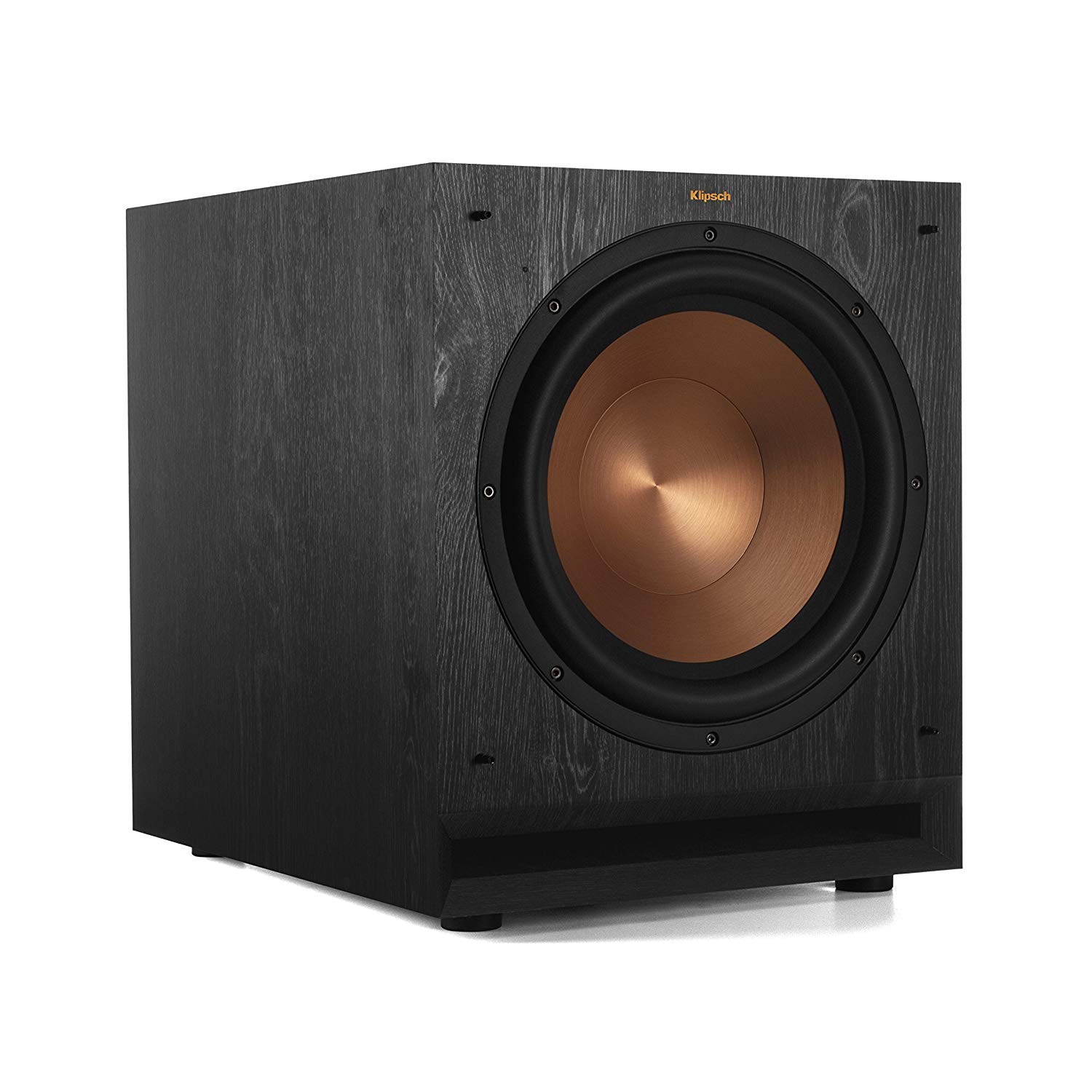
A 12-inch Cerametallic monster that turns movie nights into an event.
The Klipsch SPL-120 packs a 12-inch long-throw Cerametallic woofer (a hard, lightweight metal-composite cone) and 600W of power, hitting a maximum acoustic output of 118dB (decibels — a measure of loudness). That is enough to pressurize a large room and make explosions feel physical. It offers adjustable crossover, phase control, and a scratch-resistant ebony finish, plus the option to go wireless with the Klipsch WA-2 accessory. One reviewer called it “an absolute beast” that transformed their home theater, delivering “tight, more effective” bass than a sub that originally.
This sub outperforms the Polk Monitor XT12 in raw output — the Klipsch’s 600W versus the Polk’s 100W Class A/B amplifier means you get more headroom for loud, dynamic passages. Reviewers point out it blends naturally with high-end speakers like B&W CM9s. Where the SVS SB-1000 Pro excels in precision for music, this Klipsch is built for the sheer impact of cinema.
Why it rules
- Brutal 600W power and 118dB max output for theater-level sound
- Cerametallic woofer resists distortion at high volumes
- Adjustable controls and optional wireless kit for flexible placement
Considerations
- Large footprint demands significant floor space
- Price is premium, though one buyer called it “value priced” for the performance
Best for: the home theater enthusiast who wants a sub that can rattle the house without distorting, and values adjustability and build quality.
Not for: small rooms where this much power would be overwhelming, or listeners wanting a flat, studio-accurate response.
4. SVS SB-1000 Pro Subwoofer (Black Ash)
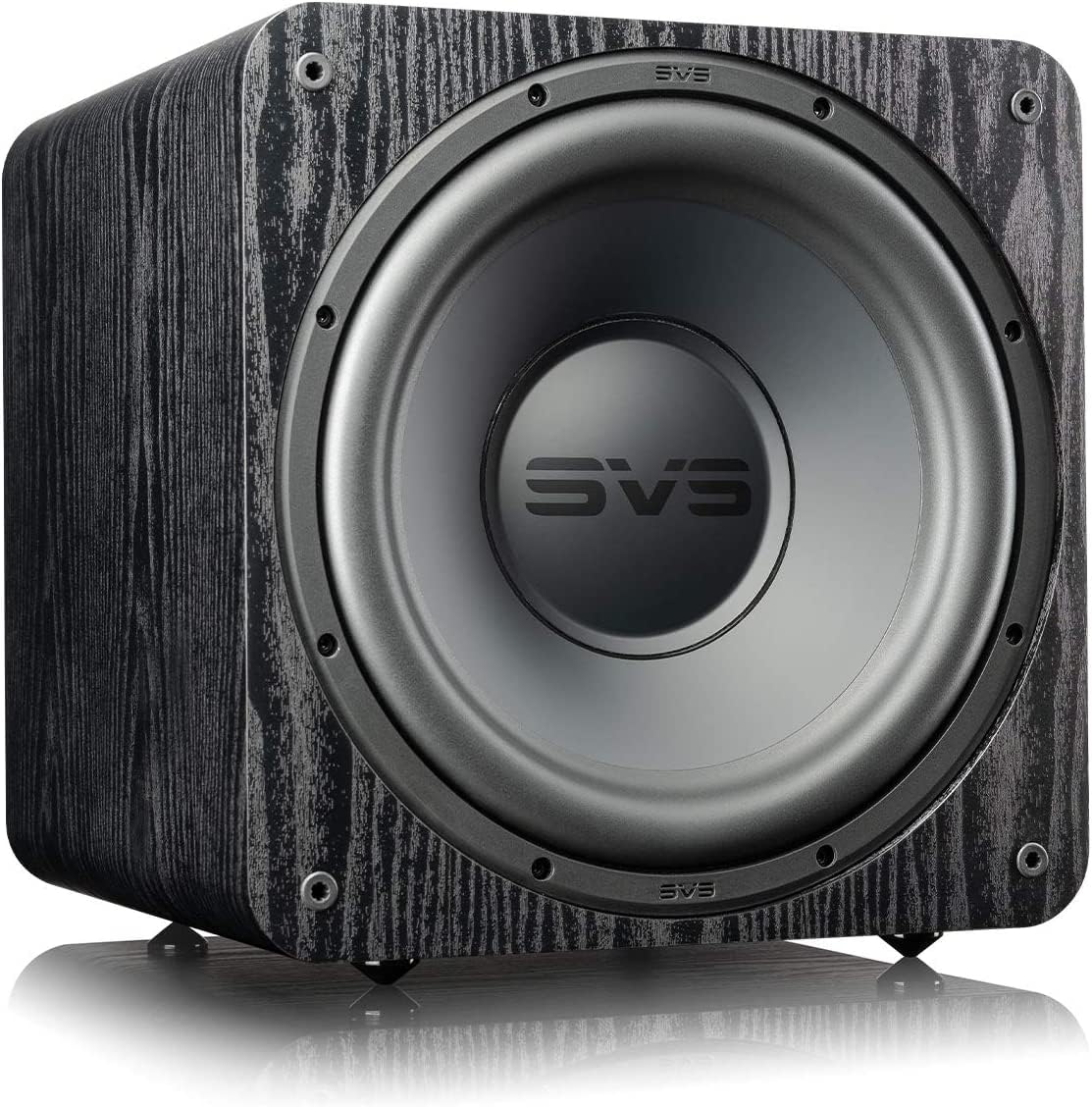
Sealed-cabinet precision that delivers tight, musical bass without the boom.
The SVS SB-1000 Pro is a sealed 12-inch subwoofer (closed cabinet for faster, more controlled sound) driven by a 325W RMS (820+ watt peak) Sledge STA-325D amplifier. Its sealed design means faster, more accurate bass compared to a ported sub, making it a favorite for music where you want the low end to be punchy and controlled, not boomy. The 50MHz Analog Devices Audio DSP (Digital Signal Processor — a chip that handles real-time tuning) lets you adjust the response precisely, and the smartphone app is a standout feature that one reviewer called a “standout” for setup and adjusting volume from your listening position.
Unlike the Rockville Rock Shaker 12 with its 400W RMS ported output designed for raw pressure, the SVS focuses on finesse. Shoppers say it pairs beautifully with compact speakers like Kanto YU4s and fills the room with 20Hz rumble when using two subs. The sealed cabinet is also more compact than ported 12-inch rivals, fitting into tight spaces more easily. Buyers report it is 100% bigger sounding than a 10-inch sub, yet it fits under a desk.
What makes it special
- App-based control for volume, presets, and room tuning from your seat
- Sealed enclosure delivers tight, accurate bass ideal for music
- High-excursion 12-inch driver with 820+ watt peak amplifier
One note
- Sealed design produces less peak output than a similarly sized ported sub for movie explosions
- Pricing is premium, justified by build and DSP features
Reach for this if: music is your priority and you want deep, articulate bass that blends smoothly with quality bookshelf speakers.
Consider the PB-1000 Pro instead if: you primarily watch movies and want more raw rumble from a ported design.
5. PreSonus Eris Sub 8BT — 8″ Inch Powered Subwoofer

A compact studio sub that adds wireless convenience without sacrificing accuracy.
The PreSonus Eris Sub 8BT uses an 8-inch paper-composite driver and a 100W amplifier (RMS — continuous output) to deliver clean, punchy bass down to 30 Hz (it can reproduce deep, rumbling notes that low). Its defining feature is Bluetooth 5.0 wireless connectivity, allowing you to stream from a phone or tablet for casual listening or quick reference checks in a studio setting. Owners mention it is a “powerful 8-inch subwoofer with clean, punchy bass down to ~30Hz” and call it a “massive improvement” to their desktop setups. It includes high-pass (filters out low frequencies sent to your main speakers) and low-pass (controls what goes to the sub) filter controls, so you can dial in exactly where the sub takes over from your main monitors.
Unlike the Dayton Audio CS800, which is purely wired, the Eris adds Bluetooth for flexibility, making it ideal for a desktop that switches between music production and casual listening. It is also a strong value play against the Audioengine S8 — while the Audioengine S8 has more amplifier power (250W vs 100W) and a down-firing design, the PreSonus offers studio-grade connectivity with 1/4-inch TRS (balanced) inputs (Professional audio jacks) and a front-panel aux input, giving it more versatility for content creators.
Why it stands out
- Bluetooth 5.0 wireless input for streaming from any device
- 30 Hz low-end extension for a compact 8-inch cabinet
- Front-panel headphone output with built-in amplifier
Limitations
- 100W amplifier is less powerful than some similarly priced wired subs
- Single 8-inch driver may not fill a large living room
Perfect for: a home studio or desktop setup where you need accurate bass and the convenience of wireless streaming for casual use.
Skip it for: a large home theater or any situation where headroom and raw output are the priority.
6. Audioengine S8 Powered Subwoofer – 250W 8-Inch

A compact down-firing sub that adds big low-end to a desktop audio system.
The Audioengine S8 is an 8-inch, down-firing subwoofer (the driver points at the floor to spread bass evenly) with 250W of power. Its down-firing design makes placement more flexible because the bass radiates evenly through the room. This is a huge advantage for desktop setups where floor space is tight. Customers note it is a perfect match for Audioengine’s A5+ bookshelf speakers, calling the combination a “huge upgrade” that delivers tight, punchy bass without overpowering the mids and highs. One reviewer noted using it in a 4.1 computer setup alongside four A5+ speakers, calling the result “the ultimate computer sound setup.”
Compared to the PreSonus Eris Sub 8BT, the Audioengine S8 has significantly more amplifier power (250W vs 100W). However, the S8 is purely wired (RCA only), lacking Bluetooth, so it is less friendly for phone streaming. The down-firing design also means you need a hard floor surface — thick carpet can absorb some of the energy. It includes a sleep mode that auto-powers down when not in use, saving energy without sacrificing readiness.
What works
- 250W amplifier provides strong output for a compact sub
- Down-firing design allows flexible placement near desks or walls
- Sleep mode for energy efficiency
Considerations
- No Bluetooth or wireless connectivity
- Sharp cone-shaped feet can scratch hardwood floors
Best suited for: a high-quality desktop audio system or near-field listening setup where you want clean, musical bass without sacrificing floor space.
Not ideal for: a large room home theater or if you need wireless streaming options.
7. Polk Monitor XT12 Powered Sub – 12″ Balanced Woofer

An affordable 12-inch sub that brings deep, clean low-end to a budget-conscious home theater.
The Polk Monitor XT12 pairs a 12-inch Dynamically Balanced Woofer with a 100W Class A/B amplifier (a traditional amplifier design known for clean sound, not just efficiency), delivering bass down to 24 Hz. That 24 Hz extension is impressive for the price, meaning you hear — and feel — deep subsonic rumble in action movies. It offers volume, variable crossover (80-160Hz), and phase polarity (0/180) controls, plus both LFE (Low-Frequency Effects) and line-level RCA inputs for easy integration with modern A/V receivers. Reviewers point out it is “deep, powerful, clean bass for movies and music” and that a budget Polk/Denon setup “performs like 3-4x cost.”
While the Polk delivers deeper extension than the Rockville Rock Shaker 12’s ported design, its 100W amplifier is far less powerful than the Rockville’s 400W RMS. That means the Polk will play deep but cannot get as loud before distortion. It is also less powerful than the Klipsch SPL-120’s 600W, but costs significantly less. One reviewer called it a “very good quality inexpensive sub” that replaced their expensive Velodyne. It is Dolby Atmos and DTS:X compatible (modern surround sound formats that include height channels), making it a perfect match for modern surround sound receivers.
Why choose it
- Deep 24 Hz low-end extension for subsonic movie effects
- Dolby Atmos and DTS:X compatible
- Rigid MDF cabinet minimizes resonance for cleaner sound
Know the limits
- 100W amplifier limits maximum volume compared to more powerful subs
- Large cabinet may need careful placement in smaller rooms
Ideal for: home theater builders on a budget who want the deep extension of a 12-inch driver for movie bass without spending for a high-power amplifier. The Polk can reach 24 Hz, a frequency you feel as a room rumble, but at lower volumes than more costly subs.
Better choices exist if: you need chest-thumping loudness for a large room — look at the Klipsch SPL-120 or Rockville Rock Shaker 12 for more amplifier headroom.
8. Rockville Rock Shaker 10 Black 600W Powered Subwoofer

A budget-friendly 10-inch sub that delivers a serious thump for its price and size.
The smaller sibling to the Rock Shaker 12, this 10-inch model still packs a punch with 600W peak and 300W RMS power (continuous output it can maintain). It uses a Class-D amplifier (a power-efficient design that runs cooler) and is housed in a durable MDF (medium-density fiberboard) enclosure with a high-grade vinyl finish. The adjustable crossover, volume, and phase controls give you plenty of tuning flexibility. Buyers confirm it produces “powerful chest-thumping bass” and call it the “cheapest way to add a lot of low end to your system.” One owner runs it with a soundbar via an HDMI ARC audio extractor, proving it works even without a traditional A/V receiver.
Compared to the Rockville Rock Shaker 12, this 10-inch version has less peak power (600W vs 800W) and a smaller driver, but it is noticeably more compact and cheaper, making it a smarter fit for medium-sized rooms where you want deep bass without overwhelming the space. Unlike the Dayton Audio CS800, the Rockville offers higher RMS power (300W vs 150W), giving you more headroom for louder playback.
What you get
- Strong 300W RMS output for room-filling bass
- Adjustable crossover, volume, and phase controls
- Flexible RCA and high-level inputs for any setup
Trade-offs
- Some shoppers say slightly loose bass compared to pricier subs
- Auto-off feature may not work perfectly with all receivers
Grab this for: a medium-sized room where you want a significant low-end upgrade on a tight budget, or as a starter sub to learn what you like.
Look at the Rockville Rock Shaker 12 if: you have a large room and need the extra 200W peak and larger driver for more pressure.
9. Dayton Audio Classic CS800 – 8″ 150W Powered Subwoofer
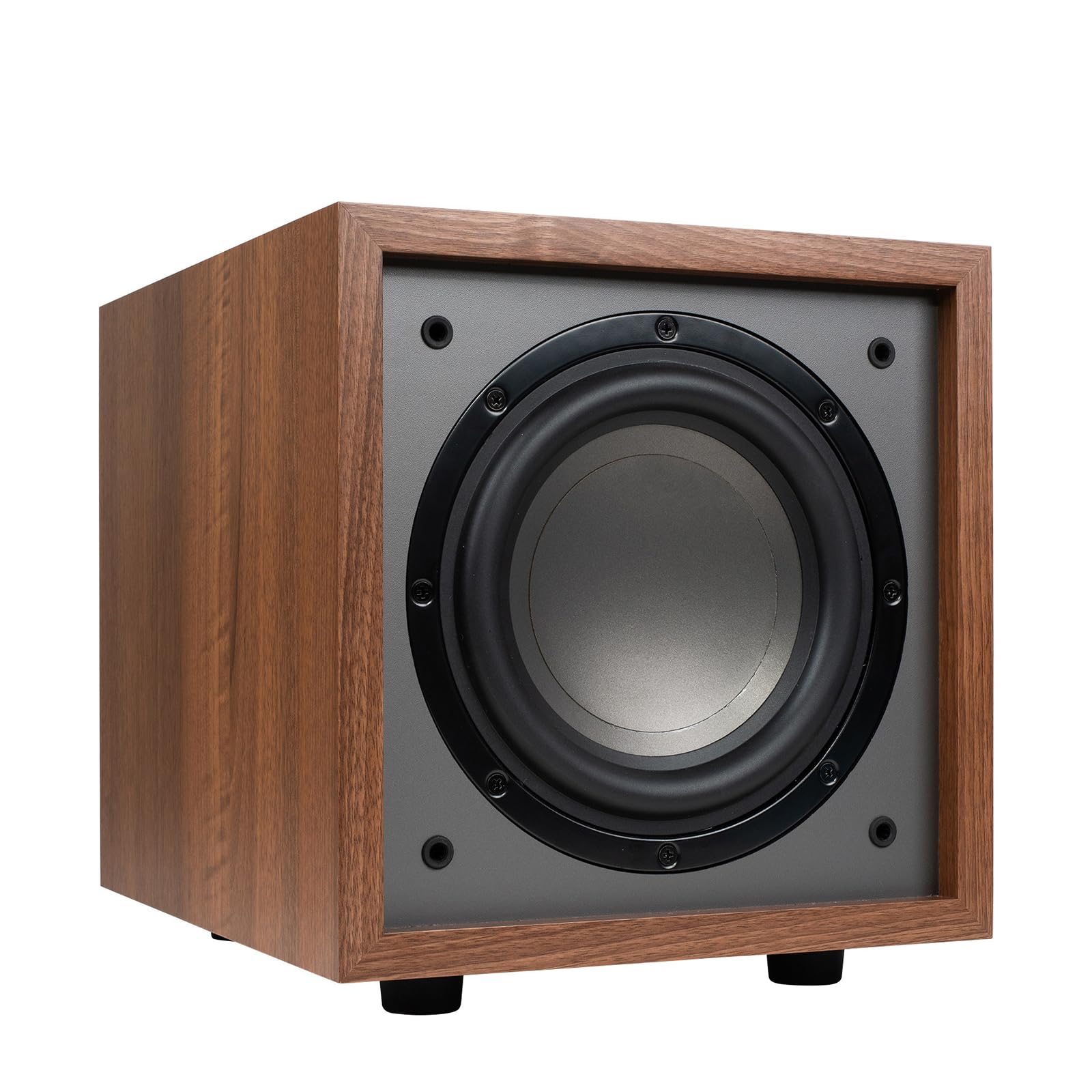
A compact 8-inch sub that delivers tight, accurate bass without taking over your room.
The Dayton Audio CS800 is an 8-inch powered subwoofer with a 150W Class-D amplifier (efficient, stays cool), housed in a rigid, braced cabinet. It is designed for small to medium-sized rooms where you want to reinforce the low end without the rumble of a larger 12-inch sub. It offers stereo RCA, LFE (Low-Frequency Effects input — for home theater receivers), and speaker-level inputs, plus an auto-on feature for convenience. Reviewers call it “fantastic value” and say it outperformed their previous 12-inch sub in tightness and accuracy. One owner noted it adds “clear low end” to a 15-year-old Yamaha receiver.
The 8-inch driver size means it cannot plumb the depths like the 12-inch Polk Monitor XT12 (35 Hz vs 24 Hz), but in a small office or bedroom, that extra deep extension is often wasted anyway. The Dayton excels at blending with bookshelf speakers without drawing attention to itself. It also comes with a 5-year warranty, which is unusually generous at this price point and speaks to Dayton Audio’s confidence. Unlike the Rockville Rock Shaker 10, the CS800 focuses on accuracy over raw output, making it a better choice for music listening.
What works well
- Tight, accurate bass that blends cleanly with small speakers
- 5-year warranty for long-term confidence
- Multiple input options including LFE and speaker-level
Limits to know
- 35 Hz response means it rolls off before the deepest sub-bass
- Some buyers report woofer screws can vibrate loose over time
Perfect for: a small desk setup or bedroom where you want clean, musical bass that does not overwhelm the space, backed by a solid warranty.
Not enough for: a living room home theater where you want deep 20 Hz rumble — a 12-inch sub is the better tool for that job.
Understanding the Specs
RMS vs Peak Power
RMS (Root Mean Square — continuous wattage) is the real-world number for loudness and clarity your sub can handle for long periods. Peak power is a short burst rating, often double or more of the RMS, mostly used for marketing. When comparing subs, always compare the RMS numbers.
Driver Size and Cabinet Design
Driver size (8-inch, 10-inch, 12-inch) directly affects how much air the sub can move. A 12-inch driver can produce deeper, louder bass than an 8-inch, but needs a larger cabinet. Sealed cabinets (like the SVS SB-1000 Pro) deliver tighter, faster bass ideal for music. Ported cabinets (like the Rockville Rock Shaker 12) are tuned for more low-end output, making them better for home theater impact.
Frequency Response
This shows the range of low frequencies the sub can reproduce, measured in Hz (Hertz — cycles per second). Lower numbers mean deeper bass — a sub that goes down to 24 Hz can reproduce the subsonic rumble of an explosion, while one that stops at 35 Hz will feel less visceral. Look for a low-end extension below 30 Hz for a truly room-shaking experience.
Connectivity and Controls
LFE input (Low-Frequency Effects — the standard for home theater receivers) is the standard connection for modern home theater receivers. RCA inputs (the familiar red/white cable) work with most stereo amps and older gear. Speaker-level inputs let you connect to a receiver without a dedicated subwoofer output. Adjustable crossover and phase controls let you blend the sub with your main speakers, avoiding muddy or hollow sound.
FAQ
Do I need a subwoofer if my bookshelf speakers already have decent bass?
Can I use a studio subwoofer like the JBL LSR310S for home theater?
What is the difference between a sealed and a ported subwoofer?
How do I connect a subwoofer to a receiver without a dedicated subwoofer output?
How much power (watts) do I really need from a subwoofer?
Will an 8-inch subwoofer be enough for my room?
What is a crossover and how do I set it?
Can I use a subwoofer with a soundbar?
Final Thoughts: The Verdict
For the majority of shoppers, the best bass subwoofer winner is the Rockville Rock Shaker 12 because it delivers massive 800W peak power through a 12-inch driver at a mid-range price, giving you room-shaking output without the premium cost of high-end brands. If you want studio-grade accuracy for music production, grab the JBL Professional LSR310S. And for a compact desktop upgrade with the flexibility of Bluetooth, the PreSonus Eris Sub 8BT adds wireless convenience without the rumble of larger subs.
How We Picked
We do not accept paid placement. Every pick is matched to a real buyer and a real use-case; we do not hands-on test units.
Sources & Methodology
Specifications: manufacturer listings and product documentation. Review insights: verified customer reviews, as of July 2026. Pricing: not shown on this page (it changes often); check the current price via the retailer link.
As an Amazon Associate, FitlyFast earns from qualifying purchases. This does not affect which products we feature.