
Our readers keep the lights on and the weekend projects moving. As an Amazon Associate, I earn from qualifying purchases.
Specs are compiled from manufacturer listings and verified buyer reviews and can change over time — please confirm the key details on the product page before buying.
At eight months old, your baby is ready to hold the bottle, sit up during feeds, and drink faster — but that also means you are suddenly fighting a new problem: milk shooting out too fast, a nipple that does not match your baby’s pace, or a bottle that leaks the moment you turn it sideways. The wrong bottle turns a calm feeding into a gagging, messy struggle, especially when your baby is now strong enough to grab the bottle and tip it any which way. You need a bottle with a controlled flow rate and enough capacity — 8 oz (240 mL) or more — so you are not refilling mid-feed while your baby waits.
Rikta, the founder of FitlyFast, built this guide from the manufacturers’ published specs and patterns across verified customer reviews. You get the real strengths and trade-offs of each pick instead of marketing claims.
The best match for your situation is the one that controls the flow without frustrating your baby — whether that is a weighted straw for self-feeding or a breast-like nipple to stop gagging. The bottle for 8 month old you choose depends on which problem you are solving first: the flow speed, the gas, or the independence.
Quick Picks
- Philips Avent Natural Baby Bottles with Natural Response Nipples (Medium Flow, Flow 3), 9oz — Best Overall
- Thyseed PPSU Anti-Colic Baby Bottle, 8 oz, 2 Pack — Breastfed Baby Hero
- Self Grip Baby Bottles 8oz with “L” Flow Rate Nipples for 6-12 Months, 2 Pack — Self-Feeding Master
- MAM 9oz Easy Start Anti-Colic+ Wide Neck Baby Bottle — Colic Crusher
How To Choose The Best Bottle For 8 Month Old
By eight months, your baby is moving fast — sitting up, grabbing objects, and wanting to feed independently. The three factors that matter most at this age are the nipple flow rate, the bottle capacity, and the venting system that prevents your baby from swallowing air while gulping.
Nipple Flow Rate Is Everything
An 8-month-old is no longer a slow sipper. You need a nipple marked “medium flow” (stage 2 or 3 for most brands) or “L” flow (fast flow for 6-12 months). A newborn slow-flow nipple will frustrate your baby, while a too-fast flow — as buyers of one bottle here report — “shoots up water too fast or too strong” and makes your baby choke. The right flow lets your baby drink at a natural pace without gulping air.
Capacity: 8 Ounces or More
At this age, most babies take 6 to 8 ounces (about 180-240 mL) per feed. A bottle holding at least 8 oz (240 mL) means you are not refilling mid-feed or switching bottles. Every pick on this list meets that threshold, with the largest offering 9 oz (270 mL) to handle a full feeding without running out.
Anti-Colic Venting
An 8-month-old drinking faster means more air can get swallowed, which leads to gas and reflux. A bottle with a vented base or an anti-colic valve (a small passage in the nipple or base that lets air in without letting it mix with the milk) keeps air away from your baby’s tummy. Some designs use a vented base; others use a nipple valve — both work, but the base-vent styles are easier to clean.
Quick Comparison
| Model | Best For | Capacity | Nipple Flow | Material | Amazon |
|---|---|---|---|---|---|
| Philips Avent Natural 9oz | Paced feeding + combo feeding | 9 oz | Medium (Flow 3) | Plastic | Check Price on Amazon |
| Thyseed PPSU 8oz | Breastfed babies who refuse other bottles | 8 oz | Medium fast (3m+) | PPSU | Check Price on Amazon |
| Self Grip 8oz Bottles | Self-feeding with a straw | 8 oz | “L” flow (6-12 months) | Plastic | Check Price on Amazon |
| MAM 9oz Easy Start | Severe colic / reflux relief | 9 oz | Medium flow | BPA-free plastic | Check Price on Amazon |
In‑Depth Reviews
1. Philips Avent Natural Baby Bottles with Natural Response Nipples (Medium Flow, Flow 3), 9oz
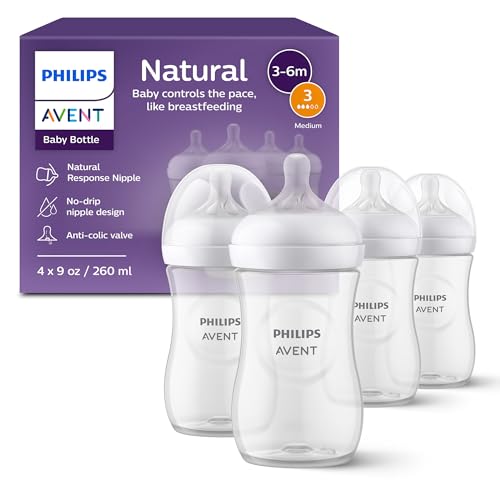
The paced-feeding champion that only releases milk when your baby actively drinks.
If you are combining breastfeeding with bottle feeding, this is the one that makes the switch smooth. The defining feature here is the Natural Response nipple (a wide, breast-shaped nipple with a unique opening at the tip) — it only releases milk when your baby actively sucks, and when your baby pauses to swallow or breathe, no milk flows at all. That means your eight-month-old controls the pace, not the bottle, which is why one reviewer noted it is a “great bottle, first one my lip tied son can drink from easily without issues.” The 9 oz (270 mL) capacity holds a full feeding for this age, beating the 8 oz (240 mL) of the Self Grip bottle by a 12% margin. Reviewers consistently say the bottles are easy to clean with fewer parts and do not leak — unlike Dr. Brown’s, several reviewers volunteered.
The wide breast-shaped nipple is made from soft silicone that mimics the shape and feel of a breast, and the anti-colic valve (a small slit in the nipple that keeps air out of your baby’s tummy) helps reduce colic and discomfort. The catch is that the Flow 3 (medium flow) is appropriate for a younger baby too, so this may not be the fastest flow if your eight-month-old is already gulping and impatient. But if controlled, baby-led feeding is your priority, this is the safest pick.
Paced feeding perfected: The only bottle in this lineup where the milk stops flowing the moment your baby stops sucking — ideal for preventing gulping.
The one trade-off: The medium flow (Flow 3) may run slightly slow for a very hungry eight-month-old who is used to faster gulping. Some kids will want a Flow 4 nipple, which you can buy separately.
Reach for it if: your baby switches between breast and bottle and you want to avoid nipple confusion or gulping issues.
Look elsewhere if: your baby is already using a fast-flow straw bottle and would find the medium flow too slow.
2. Thyseed PPSU Anti-Colic Baby Bottle, 8 oz, 2 Pack
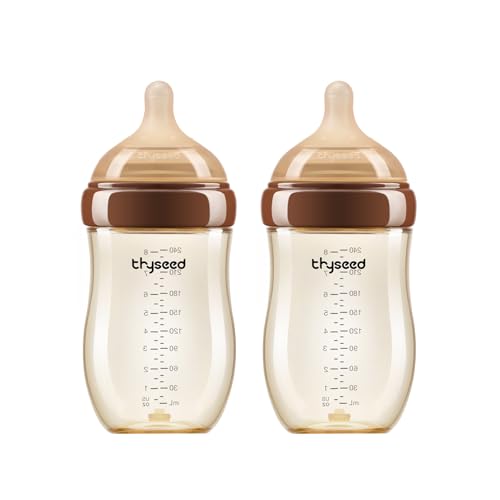
The expensive-but-works bottle that breastfed babies who refuse everything else will finally take.
This is the bottle that brings crying, panicking parents to tears of relief. The Thyseed is made from PPSU (a lightweight, amber-colored plastic that is tougher and more heat-resistant than standard baby-bottle plastic), and it features a patented base-vent design (a one-way valve in the bottom of the bottle that lets air out before it mixes with the milk) to keep gas and spit-up at bay. The soft silicone nipple is shaped to support a natural latch, and the milk only releases when your baby actively sucks — a baby-led flow system similar to the Philips Avent but with a different vent setup. One buyer captured the emotion perfectly: “He latched for about two minutes which is a huge success for us.”
Reviewers who tried bottles from Philips, Dr. Brown’s, Tommee Tippee, and MAM before finding this one report it is the only bottle that did not cause their baby to gag or refuse. The 8 oz (240 mL) capacity is enough for an eight-month-old’s feed, and the multi-stage flow system (choose from different flow options) means you can adjust as your baby gets older. It is pricier than the others here, but multiple reviewers call it “worth every penny” because it solved a feeding crisis.
The honest catch: the bottle does leak when held upside down, as one reviewer confirmed, because the base vent is not designed to be leak-proof if shaken or tipped. You need to heat it with the base on to avoid drips. This makes it less portable than the Philips Avent, which buyers report does not leak.
Last-resort bottle: For breastfed babies who gag on, scream at, or refuse every other brand — the Thyseed is the one that finally works.
What buyers warn about: “When held upside down the bottle does leak” — this is not a throw-it-in-the-diaper-bag bottle. It works best when upright during feeds.
Reach for it if: you have tried four or five other bottles and your baby still refuses to feed from a bottle. This is the specialist.
skip it if: your baby already feeds well from a general-purpose bottle — you do not need the extra expense and the leak risk.
3. Self Grip Baby Bottles 8oz with “L” Flow Rate Nipples for 6-12 Months, 2 Pack

The weighted-straw bottle that lets your baby drink any-way-up without tipping the bottle.
If your eight-month-old is determined to hold the bottle themselves — and they will be at this age — this is the one designed for that exact moment. The Self Grip bottle comes with ergonomic handles for small hands and a weighted straw (a small ball at the end of the straw that sinks to the lowest point of the bottle so your baby can drink from any angle, even sitting up or lying down). You do not have to tilt the bottle. The “L” flow rate nipple is specifically labeled for 6-12 months, which matches your baby’s developmental stage. One happy buyer summed it up: “No need to tilt the bottle when feeding the baby. It’s convenient when baby is sitting drinking the milk.”
The bottle is made from food-grade, medical-grade material that is BPA-free, Phthalates-free, and PVC-free, and every part can go in the dishwasher, microwave, sterilizer, or even the freezer. It comes with a straw cleaner wand, which owners mention makes it easier to clean than the Nuby alternative. The handles are removable, so you can just use it as a standard bottle if your baby is not ready for self-feeding yet.
The honest problem: several customers note the flow is too fast for some babies. One reviewer wrote plainly: “But it shoots up the water either too fast or too strong, my baby chokes every time when drinking it from the bottle.” This is a real risk for a baby who is not used to a fast straw flow — you may need to test it carefully before handing it over. For comparison, the Philips Avent Flow 3 nipple stops flow when your baby pauses, giving you a safer alternative if choking is a concern.
Why self-feeders love it
- Weighted straw works at any angle — no need to tilt the bottle
- Easy-grip handles for little hands to hold independently
- Buyers call it a “standout” for babies who want to sit up and drink alone
The real flow risk
- “It shoots up the water either too fast or too strong” — the “L” flow may be too aggressive for a slower drinker
- Only 8 oz (240 mL) capacity, which is one ounce (30 mL) less than the Philips Avent 9 oz (270 mL) bottle
Reach for it if: your baby is eager to hold the bottle and feed independently without your help tipping it.
Look elsewhere if: your baby still chokes on faster flows or needs a slower, paced drinking rhythm.
4. MAM 9oz Easy Start Anti-Colic+ Wide Neck Baby Bottle
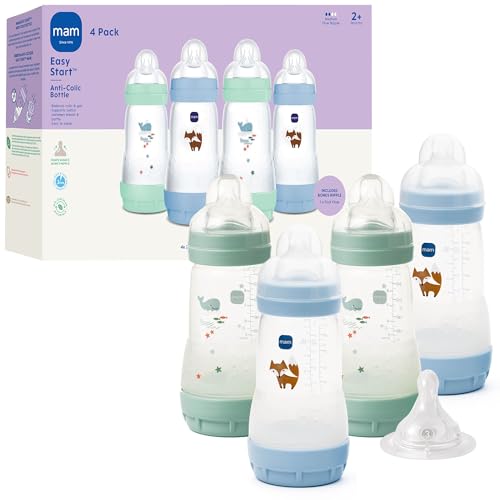
The vented-base bottle that one mom said turned a baby with reflux into a calm feeder overnight.
If your eight-month-old has struggled with gas, reflux, vomiting, or gagging, this MAM bottle is the one to try before giving up on bottle feeding entirely. The defining feature is the Anti-Colic+ Dual System — a vented base (a removable disc at the bottom that has a small air channel) that prevents air from mixing with the milk, combined with a SkinSoft nipple that lets your baby feed at their own pace. The manufacturer reports that the Anti-Colic+ system is clinically proven to reduce colic symptoms in 80% of babies. One buyer who switched from Boon after five weeks of misery wrote: “Switched from Boon; baby had gas, reflux, vomiting, gagging, latching issues for 5 weeks. First day on MAM: zero issues.”
The bottle holds 9 oz (270 mL) — tied with the Philips Avent for the largest capacity here — and the medium flow nipple is suitable for an eight-month-old who is drinking at a steady pace. The bottle also self-sterilizes in just 3 minutes in the microwave and stays clean for up to 48 hours, which is handy for parents who do not want to run a full sterilizer cycle every time. The bottle is made in Europe from bio-circular, BPA-free and BPS-free materials, and it comes with a bonus fast-flow nipple so you can switch as your baby grows.
The honest catch: the medium flow is not labeled for 8 months specifically — MAM recommends it from 2+ months. So if your baby is already used to a fast flow from a straw bottle, the medium flow may feel too slow. But for a baby with reflux or colic, the slower, controlled flow is exactly the point. Unlike the Self Grip bottle, this one has no handles or straw for self-feeding.
Reflux relief expert: The only bottle here with a vented base designed to keep air separate from milk, which multiple reviewers point out ended their baby’s vomiting and gas issues.
What is missing: No weighted straw or ergonomic handles for self-feeding — this is a parent-holds bottle, best for controlled, upright feeds.
Reach for it if: your baby has persistent gas, reflux, or colic symptoms that other bottles have not solved.
pass on it if: your baby is already feeding well from a bottle and you are just looking for a straw option or self-feeding bottle — look at the Self Grip instead.
Understanding the Specs
Nipple Flow Rate (Stage / “L” Flow)
This is the single most important spec for an 8-month-old. A stage 1 or newborn flow is too slow and will frustrate your baby, while a flow that is too fast can cause choking. “Medium flow” (stage 2 or 3) or “L” flow (labeled for 6-12 months) means the nipple has a wider opening that lets milk flow faster without shooting out. The Philips Avent uses Flow 3 (medium), while the Self Grip uses “L” flow — both are right for this age, but “L” flow is typically faster. If your baby gags on one, switch to a slower flow nipple from the same brand.
Anti-Colic Valve vs Vented Base
An anti-colic valve is a small slit in the nipple that lets air into the bottle so a vacuum does not form — this keeps air out of your baby’s stomach. A vented base (like the MAM and Thyseed use) is a disc at the bottom of the bottle with a tiny channel that lets air in from below, so the milk never touches the air. Both work, but vented-base bottles are harder to clean because you have to remove the base disc. Bottles with a nipple valve (like the Philips Avent) have fewer parts to wash but may need the baby to suck harder.
FAQ
Can I use a newborn nipple on an 8-month-old?
What is the difference between “L” flow and stage 3 nipple?
Will a weighted straw bottle work for my 8-month-old?
Can I use the MAM bottle for a breastfed 8-month-old?
Is PPSU better than regular baby-bottle plastic?
What bottle is best for an 8-month-old who chokes on fast flow?
Can I microwave or sterilize these bottles?
Is it normal for an 8-month-old to still need a bottle at night?
What is the difference between the MAM vented base and the Thyseed base vent?
Do these bottles fit standard bottle warmers?
Final Thoughts: The Verdict
For most families, the bottle for 8 month old that covers the most ground is the Philips Avent Natural 9oz — it controls the flow so your baby does not gulp air, and it works for both breastfed and formula-fed babies. If your breastfed baby refuses every bottle you have tried, grab the Thyseed PPSU 8oz — it is expensive, but shoppers say it is the only one that works for picky breastfed babies. And if your baby is ready to hold the bottle and feed independently, the Self Grip 8oz with weighted straw is the one that lets them drink at any angle — just watch for the fast flow.
How We Picked
We do not accept paid placement. Every pick is matched to a real buyer and a real use-case; we do not hands-on test units.
Sources & Methodology
Specifications: manufacturer listings and product documentation. Review insights: verified customer reviews, as of July 2026. Pricing: not shown on this page (it changes often); check the current price via the retailer link.
As an Amazon Associate, FitlyFast earns from qualifying purchases. This does not affect which products we feature.