
Our readers keep the lights on and the weekend projects moving. As an Amazon Associate, I earn from qualifying purchases.
Specs are compiled from manufacturer listings and verified buyer reviews and can change over time — please confirm the key details on the product page before buying.
You have a drawer full of orphan batteries and no idea which ones are actually dead. A good AA battery tester settles the argument in seconds. It tells you the exact remaining voltage so you stop tossing batteries that still have plenty of life left. This roundup covers six testers, from basic analog needles to feature-packed digital units with smiley faces.
I’m Rikta — the founder and writer behind FitlyFast. This guide is built by comparing the manufacturers’ published specifications and the patterns across verified customer reviews, so you get each pick’s real strengths and trade-offs instead of marketing spin.
These picks cover the full span of what a useful aa battery tester should do, from a budget-friendly pack of four analog units to a premium rechargeable model with a magnetic grip.
Quick Picks
- KKEANIC SL-049 Battery Tester — Best Overall
- Dlypow DB1 Digital Battery Tester — Most Versatile
- Amprobe BAT-250 Battery Tester — Best Load Tester
- Dlyfull B2 Universal Battery Tester — Compact & Handy
- Tenergy T-333 Universal Battery Tester — Pro Load Tester
- VTECHOLOGY BT-168 4-Pack Battery Tester — Budget Champion
How To Choose The Best AA Battery Tester
Grabbing the first cheap tester you see is tempting, but a few key decisions separate a useful tool from a frustrating one that gives you inconsistent results. The big distinction is whether the tester puts a load on the battery or just reads its open-circuit voltage (the resting voltage with no device attached).
Load Testing vs. Voltage Only
A plain voltage reading can trick you—an old alkaline battery often shows near-full voltage with no load, then drops instantly when you put it in a radio. A load tester applies a resistor (like 5.5 ohms for AA batteries) and reads the voltage under that real-world drain. That tells you the true remaining life. All four picks above the budget tier do load testing.
Analog Needle vs. Digital LCD
Analog testers are dirt cheap and need no internal battery, but their needle can be sticky or hard to read precisely. Digital LCD testers show exact voltage and a bar graph, making it easy to tell “1.2V” from “1.3V.” Many digital units need a small AAA battery to run the screen. Neither is “better” universally—the analog ones are simpler and cheaper, while the digital ones give you a number you can trust.
Battery Compatibility Range
If you only ever test AA cells, almost any tester works. But a versatile unit also checks AAA, C, D, 9V, button cells, and coin cells (small flat batteries used in watches and calculators). Some even handle 1.2V Ni-MH rechargeables (nickel-metal hydride) and 3.7V lithium cells. The more slots your tester has, the fewer tools you need to keep around.
Quick Comparison
| Model | Best For | Display Type | Load Test | Battery Types | Amazon |
|---|---|---|---|---|---|
| KKEANIC SL-049 | Precise digital readout | LCD + bar graph | Yes (20Ω-1KΩ) | AA, AAA, C, D, 9V, button cells, 1.2V rechargeable | Amazon |
| Dlypow DB1 | Rechargeable & portable | Backlit LCD | No (open-circuit) | AA, AAA, C, D, 18650, CR123A, button cells, 3.7V Li-ion | Amazon |
| Amprobe BAT-250 | Accurate load testing | Analog + color scale | Yes (5.5Ω / 215Ω) | AA, AAA, C, D, 9V, 1.5V button cells | Amazon |
| Dlyfull B2 | Compact universal tester | LCD (bars) | No (open-circuit) | AA, AAA, C, D, 9V, CR123A, button cells | Amazon |
| Tenergy T-333 | Load testing with LCD | LCD | Yes (uses AAA battery) | AA, AAA, C, D, 9V, CR123A, CR2, CRV3, 2CR5, button cells | Amazon |
| VTECHOLOGY BT-168 | Budget 4-pack | Analog needle | No (open-circuit) | AA, AAA, C, D, 9V, button cells | Amazon |
In‑Depth Reviews
1. KKEANIC SL-049 Battery Tester

The KKEANIC SL-049 earns the top spot because it load-tests your battery with a real resistor (so the reading matches how the battery performs in a motor or flashlight), not just the idle voltage.
This tester puts a genuine load on the battery: 20Ω (about 75mA) for AA/AAA/C/D cells and 30Ω (about 40mA) for 1.2V rechargeables—so the reading reflects how the battery will perform inside a motor or a flashlight. The clear LCD shows the exact voltage plus a colored power bar (Good, Weak, Poor), and the whole readout refreshes in just 0.1 seconds. Unlike the simpler Dlyfull B2, this one handles both 1.2V rechargeable AA/AAA and LR44 button cells with dedicated resistor loads (1KΩ at around 1.5mA). Buyers report the reading accuracy of ±(1% of reading + 0.02V) makes it more reliable than a basic multimeter check, and one owner noted it “tests batteries under load for accurate health reading.” It is more informative than the Amprobe BAT-250 because you get a precise number instead of a needle on a colored scale.
The compact body measures 4.69 x 2.87 x 1 inches and weighs only 3.52 ounces, so it lives easily in a drawer or tool bag. There is no backlight on the screen, and the tester auto-shuts off after 3 seconds of non-operation to save the internal AAA battery (not included). A buyer did mention the screen is hard to read in bright light, but that is a minor trade-off for the depth of information you get.
Real-world test king: The load resistors give you the same kind of reading a pro-grade Fluke with an inline resistor would, making this the most trustworthy pick of the bunch.
Minor catch: No battery storage case and no backlight, so you need decent lighting to read the display.
Grab this if: You want the most accurate digital readout under load, including support for rechargeable cells and 9V. skip it if you need a backlit screen or a tester that comes with its own battery included.
2. Dlypow DB1 Digital Battery Tester
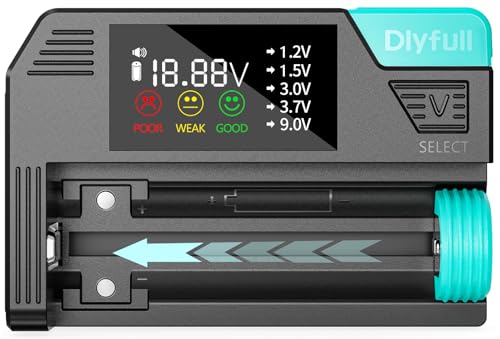
The Dlypow DB1 is the only tester here with a built-in rechargeable battery and USB-C charging, so you never hunt for a spare AAA to power the tester.
It tests 1.2V Ni-MH/CD (nickel-metal hydride), 1.5V alkaline, 3.0V lithium, 3.7V Li-ion, and 9.0V batteries, including 18650 cells—a range none of the other picks can match. The backlit LCD shows voltage with ±0.03V accuracy (owners mention it matches well against a Fluke or Brymen DMM) and uses smiley faces to indicate Good, Weak, or Replace status. That visual cue is a small touch, but it makes the reading instantly clear for anyone who does not want to interpret numbers. The tester also has magnetic ends that help hold the battery in place, and the max cylindrical battery length is 76.8mm.
On standby, the internal battery lasts 2 to 3 months per full charge. One caveat: the DB1 is larger at 3.8 x 2.5 x 1.2 inches, and customers note it is not great for travel. It also does an open-circuit test rather than a load test, so the reading can be slightly optimistic compared to the KKEANIC SL-049 which applies a real resistor load. The LCD can flicker on video, though that does not affect the readout in normal use.
Chemistry king: No other tester here covers 18650 (a common rechargeable lithium cell used in flashlights and vapes), 3.7V Li-ion, and button cells with a USB-C rechargeable battery—this is the most versatile lab tool in the lineup.
Open circuit limitation: Because it does not load the battery, the reading is less accurate for predicting real-world performance compared to the KKEANIC or Amprobe.
Perfect for: Households with a mix of rechargeable Ni-MH, alkaline, and lithium cells who want a rechargeable tester with a clear backlit display. If you only test standard alkalines, the KKEANIC is more accurate for the same money.
3. Amprobe BAT-250 Battery Tester

The Amprobe BAT-250 applies a genuine 5.5-ohm load for AA cells (that is the strictest load test on this list) and needs no internal battery to do it.
It uses an analog needle and a color-coded scale (Good, Low, Replace/Recharge) to show battery health, and it applies a real load: 5.5 ohms for AA, AAA, C, D, and coin cells, and 215 ohms for 9V. Load testing is the gold standard because a battery may show a decent open-circuit voltage but collapse under a real draw. Buyers confirm it “works with Ni-MH and alkaline batteries under load” and that reverse-polarity insertion does not damage the tester. The V-shaped holder secures the battery firmly, and clear orientation markers make it easy to line up the terminals. One reviewer noted the 4-ohm load for 1.5V cells means good/low threshold is 1.0V and low/replace is 0.9V, giving you a concrete decision point. That stricter load test makes it better than the Tenergy T-333 for predicting if a battery can handle a high-drain device like a digital camera.
At 6.42 x 3.2 x 3.5 inches, the BAT-250 is about 50% larger than the compact Tenergy T-333, so it takes up more drawer space. The build feels lightweight (0.09 kilograms) and cheaply constructed, but it is functional. Unlike the Tenergy T-333, the Amprobe does not need an internal AAA battery—it is powered entirely by the battery you test. That means one fewer battery to replace, though the needle can be sticky on some units. A buyer described it as “slightly awkward but functional,” and it works best for light household use.
Load testing advantage
- Applies a real 5.5-ohm load for AA/AAA cells
- No internal battery required
- Reverse-polarity safe—won’t damage the tester
Only as good as its needle
- Analog needle can stick or give imprecise readings
- Feels cheaply built despite being functional
- Larger footprint at 6.42 inches tall
Stick with this if: You want no extra batteries to manage and a genuine load test for alkaline and Ni-MH cells. If you prefer a digital number, the KKEANIC is a better bet.
4. Dlyfull B2 Universal Battery Tester
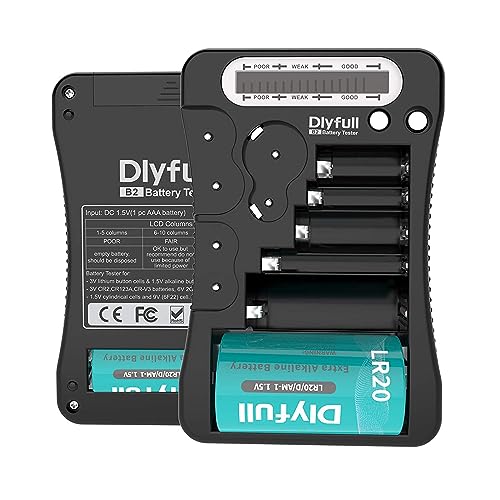
At 0.94 inches thick, the Dlyfull B2 is the thinnest tester in the lineup and the quickest way to sort alkaline piles.
It tests AA, AAA, C, D, 9V, CR123A, N cells, CR2, CRV3, 2CR5, CR-P2, and a wide array of button cells. The LCD shows a three-bar scale for poor, weak, or good condition rather than an exact voltage number. Reviewers point out it “clears up guesswork” and is “so easy to use, all you do is insert the battery.” The anti-slip finish gives you a firm grip while sliding in batteries.
Unlike the Tenergy T-333, the Dlyfull B2 does not perform load testing—it is an open-circuit check only. One important limitation: the manufacturer explicitly warns not to test rechargeable batteries with this unit, so pass on it if you primarily use Ni-MH cells. The unit comes with one AAA alkaline battery included, and the compact design means it stores easily in a junk drawer. A buyer who used it for testing batteries in remotes, sensors, and air tags found it “saves money by eliminating guesswork and needless replacements.” If you only need to sort alkaline piles, this is the simplest, most compact option.
Drawer-friendly size: The thinnest tester in the lineup at 0.94 inches, with a grip that keeps the tester stable—no slipping while you check a 9V.
Rechargeable warning: Not compatible with rechargeable batteries, so limit this to alkaline household cells only.
Reach for this if: You want a no-frills digital bar tester for alkaline household batteries and prefer something ultra-slim. If you need to test rechargeables, pick the KKEANIC instead.
5. Tenergy T-333 Universal Battery Tester
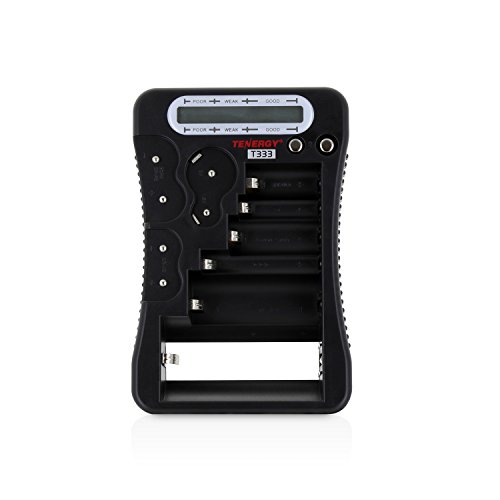
The Tenergy T-333 uses its own AAA battery to perform a load test, delivering a digital readout that matches real-world drain better than any open-circuit tester.
That internal battery powers a small load circuit so the tester actually draws current from the battery you check, providing a realistic readout. It supports 12 different battery sizes: AAA, AA, C, D, 9V, CR123A, CR2, CRV3, 2CR5, CR-P2, and various button cells. The clear LCD instantly shows battery status, and shoppers say it “truly works great” and that the “battery assisted load testing makes it outstanding.” At 5.25 x 3.5 x 1 inches, it is slightly larger than the Dlyfull B2 but still drawer-friendly.
One trade-off is that the T-333 lacks a storage case, so the unit can slide around in a drawer. Another is that it depends on that internal AAA battery—if that battery dies, the tester stops working until you replace it. A buyer noted the slots are snug, which ensures accurate reads but can be a tiny bit more effort to insert the battery. Compared to the Amprobe BAT-250, the T-333 has a digital LCD instead of an analog needle, which some users find easier to read precisely. The build quality feels solid, and the tester handles rechargeable and alkaline alike.
Load test that works
- Uses a AAA battery to apply a real load during testing
- Works with 12 sizes including CR123A and CR2
- Clear, instant digital readout
Battery-powered quirk
- Needs a live AAA battery to operate—if it dies, no test
- No storage case included
Best for: Anyone who wants the load-testing accuracy of the Amprobe but prefers a digital LCD readout over an analog needle. If you hate replacing small batteries, the KKEANIC also does load testing without needing its own cell.
6. VTECHOLOGY BT-168 4-Pack Battery Tester
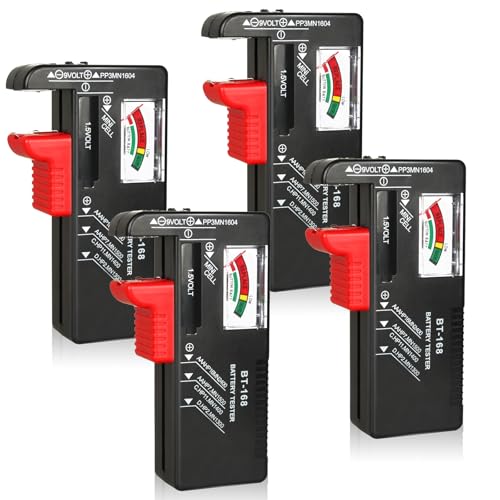
The cheapest option on the list: a four-pack of ultra-simple analog testers you can scatter across every drawer and glove box.
Each unit is powered entirely by the battery you insert—no internal battery to replace. The analog needle points to a color zone: green for Good, yellow for Low, red for Replace/Recharge. It checks AA, AAA, C, D, 9V, and 1.5V button cells. The units are tiny at 4.13 x 1.57 x 0.78 inches each, so they disappear into any drawer. At about one-quarter the cost of a single digital tester, this 4-pack is the most affordable way to put a tester in every room.
That said, buyers report “cheap construction with inconsistent readings between units and sticky needle.” The needle is the big problem: one tester in the pack might read a battery as Good while another reads it as Low. And these testers do not perform a load test—they only read open-circuit voltage. That means a weak battery can still look fine on the scale. So treat these as a rough gauge rather than a precision tool. One buyer loved them for the price, noting the “low cost makes breakage/loss acceptable.”
Best use: Toss one in the kitchen, one in the workshop, one in the car—cheap enough that losing one is no big deal.
Accuracy warning: The analog needle varies between units in the same pack, so do not rely on these for precise capacity decisions.
Buy these if: You need a cheap, disposable tester for each room and do not need exact voltage numbers. If you want repeatable results, the KKEANIC or Amprobe are much better choices.
Understanding the Specs
Load Testing
A load test puts a resistor across the battery terminals while measuring voltage, mimicking the kind of draw a motor or a bright flashlight would demand. A battery that reads 1.5V with no load might drop to 1.0V under load—that is the real story. The KKEANIC uses 20Ω resistors for AA cells (about 75mA drain), while the Amprobe uses 5.5Ω. Higher drain (lower resistance) simulates heavier use, so a 5.5Ω test is stricter than a 20Ω test. Testers without load, like the Dlyfull B2, show you only the resting voltage, which can be misleading.
Display Type: LCD vs. Analog
LCD displays give you an exact voltage number and often a bar graph (Good/Weak/Poor). That is useful for sorting batteries into bins by remaining voltage. The Dlypow DB1 even adds a backlit screen with smiley faces. Analog testers use a moving needle across a printed scale. They do not need their own battery, but the needle can stick or bounce, and the printed scale is harder to read precisely. If you want a specific number, go LCD. If you just want a quick ballpark check, analog is fine.
FAQ
Can a battery tester test rechargeable Ni-MH batteries?
Do I need a tester that requires its own battery?
Will a battery tester work with lithium 3.0V CR123A batteries?
How long does a typical battery tester last?
Is an under-load test more accurate than a multimeter voltage check?
What does the “Good/Low/Replace” scale mean?
Can I test a 9V battery with these testers?
Why do some testers only use bars and not a voltage number?
Are analog testers with sticky needles still usable?
Does the Dlypow DB1 work with 18650 lithium-ion batteries?
Final Thoughts: The Verdict
For the majority of shoppers, the aa battery tester winner is the KKEANIC SL-049 because it combines a digital LCD readout, load testing across multiple resistor values, and compatibility with 1.2V rechargeable cells in a compact, affordable package. If you want a tester that needs no internal battery and still gives you a real load test, grab the Amprobe BAT-250. And for the most versatile chemistry support with a rechargeable USB-C battery, the standout is the Dlypow DB1.
How We Picked
We do not accept paid placement. Every pick is matched to a real buyer and a real use-case; we do not hands-on test units.
Sources & Methodology
Specifications: manufacturer listings and product documentation. Review insights: verified customer reviews, as of July 2026. Pricing: not shown on this page (it changes often); check the current price via the retailer link.
As an Amazon Associate, FitlyFast earns from qualifying purchases. This does not affect which products we feature.