
Our readers keep the lights on and the weekend projects moving. As an Amazon Associate, I earn from qualifying purchases.
Specs are compiled from manufacturer listings and verified buyer reviews and can change over time — please confirm the key details on the product page before buying.
You are building a home studio, or you just want sound that is honest enough to make you feel like the musician is in the room. The search for audio monitors can feel like walking into a language you do not speak yet — watts, crossover points, drivers, room modes. You do not need to master the vocabulary to hear the difference. You need to know which pair gives you the real recording, not a hyped-up version of it. This guide breaks down nine of the most talked-about powered studio monitors, matching each to a specific kind of listener.
I’m Rikta — the founder and writer behind FitlyFast. This guide is built by comparing the manufacturers’ published specifications and the patterns across verified customer reviews, so you get each pick’s real strengths and trade-offs instead of marketing spin.
The difference between a true studio monitor and a “hi-fi” speaker is the first step toward a setup you can trust. A studio monitor aims for a “flat response” (it reproduces every frequency at the same volume, without adding bass or treble to make it sound notable). That flatness is what lets you mix audio that sounds correct on any playback system. This guide helps you find the best audio monitors for your space and your workflow.
Quick Picks
- YAMAHA Hs5 Powered Studio Monitor, Pair — Best Overall
- KALI AUDIO LP-UNF Ultra Nearfield Monitor System — Ultra Nearfield
- JBL 305P MkII 5″ 2-Way Active Powered Studio Reference Monitors (Pair) — Wide balance
- ADAM Audio T5V Studio Monitor (Single) — High-Freq Detail
- KRK Classic 5 Powered Studio Monitor (Pair) — Versatile Classic
- Edifier MR5 Studio Monitor Bookshelf Speakers (Pair) — 3-Way Precision
- PreSonus Eris E3.5 Near Field Studio Monitors (Pair) — Entry Level
- M-AUDIO Forty Eighty 8″ Studio Monitor (Single) — Bass Heavyweight
- KRK RP5G5 ROKIT 5 Generation Five Powered Studio Monitor (Pair) — Next Gen Classic
How To Choose The Best Audio Monitors
Picking the right studio monitor is less about brand loyalty and more about what your room and your ears need. The biggest mistake first-time buyers make is grabbing the biggest woofer they can find without thinking about how close they will sit. Here are the three decisions that actually matter.
Driver Size and Room Size
A 5-inch woofer (like the one in the Yamaha HS5 or JBL 305P MkII) is the near-field balance. “Near-field” means you sit one to two meters (about three to six feet) away. A 5-inch driver gives you enough low-end to judge your mix without overwhelming a small or untreated room. An 8-inch woofer (like the M-AUDIO Forty Eighty) digs deeper into the bass, but it needs a bigger room and careful placement to avoid muddy, boomy low frequencies. If your desk is in a bedroom or a corner of the living room, stick with 4.5-inch to 5-inch drivers.
Connectivity and Your Audio Interface
Most professional monitors use XLR (a three-pin balanced audio connector) or 1/4-inch TRS (a balanced connector for instruments and audio gear) inputs. That means you cannot just plug them into your computer’s headphone jack without an audio interface (a small box that converts your computer’s digital signal into a clean analog signal for the monitors). A few models, like the KALI AUDIO LP-UNF and Edifier MR5, include Bluetooth and USB inputs for direct connection — a big convenience if you do not own an interface yet.
Room Tuning Controls
Every room colors sound differently — a corner placement boosts bass, a bare wall reflects high frequencies. Good monitors include high-frequency and low-frequency trim switches (sometimes called “acoustic tuning” or “boundary EQ”) on the back. These let you cut or boost specific ranges to compensate for your room’s imperfections. If a monitor lacks these controls, you are stuck with whatever sound your room gives you.
Quick Comparison
| Model | Best For | Driver Size | Amplifier Power (RMS) | Frequency Response | Amazon |
|---|---|---|---|---|---|
| Yamaha HS5 (Pair) | Industry-standard reference mixing | 5-inch | 70W (45W LF + 25W HF) | 54 Hz – 30 kHz | Amazon |
| KALI AUDIO LP-UNF (Pair) | Ultra-nearfield desktop clarity | 4.5-inch | — | 39 Hz – 25 kHz | Amazon |
| JBL 305P MkII (Pair) | Wide, rich soundstage | 5-inch | 82W (41W per speaker) | — | Amazon |
| ADAM Audio T5V (Single) | High-frequency detail with U-ART tweeter | 5-inch | — | — | Amazon |
| KRK Classic 5 (Pair) | Versatile studio monitoring with bass boost | 5-inch | — | Up to 35 kHz | Amazon |
| Edifier MR5 (Pair) | 3-way driver accuracy with Bluetooth | 5-inch | 110W RMS | 46 Hz – 40 kHz | Amazon |
| PreSonus Eris E3.5 (Pair) | Budget-friendly entry-level desktop monitoring | 3.5-inch | 50W (25W per speaker) | — | Amazon |
| M-AUDIO Forty Eighty (Single) | Deep bass for beat-making and DJing | 8-inch | 150W | — | Amazon |
| KRK RP5G5 ROKIT 5 (Pair) | Modern refinement of a studio classic | 5-inch | — | — | Amazon |
In‑Depth Reviews
1. YAMAHA Hs5 Powered Studio Monitor, Pair

The studio standard that shows you the raw recording, not a flattering version of it.
You see the Yamaha HS5 in pro studios, bedroom setups, and everything in between. Its goal is sonic purity without any coloring or alteration of the original sound. With a 5-inch cone woofer, a 1-inch dome tweeter, and a 70-watt bi-amp system (bi-amped means 45W dedicated to the low frequencies plus 25W dedicated to the high frequencies, so bass does not steal power from the treble), this pair delivers a frequency response of 54 hertz to 30 kilohertz. That means you hear exactly what was captured: no fake bass boost, no hyped treble, so your mixes sound right on car stereos and earbuds. One reviewer noted that the HS5 was a huge upgrade from their previous PreSonus Eris 4.5s, revealing more detail and a wider stereo field.
The trade-off is that this honesty can feel harsh or bright if you are used to consumer speakers. Some buyers report ear fatigue sets in faster compared to softer-sounding monitors. These also demand an audio interface with XLR or TRS inputs — you cannot plug them directly into a laptop. Compared to the JBL 305P MkII, the HS5 leans brighter and more analytical, while the JBL feels slightly fuller in the low-mids.
What earns its place
- Industry-standard reference — your mixes will translate to other systems
- Solid cabinet build that feels dense and well-damped
- Excellent stereo imaging for near-field positioning
What to weigh
- Bright character can cause ear fatigue during long sessions
- Requires an audio interface for connection
The gold standard for accuracy: Reach for the HS5 if you are mixing or mastering and your mix needs to sound right on every playback system — car, earbuds, big speakers.
Not a casual listen: If you want a warm, forgiving sound for just enjoying music, a hi-fi speaker will be more pleasing for daily listening.
2. KALI AUDIO LP-UNF Ultra Nearfield Monitor System

Tiny cabinet, giant soundstage — a revelation for cramped desktop spaces.
The KALI AUDIO LP-UNF is designed specifically for ultra-nearfield listening — that is, sitting less than one meter (about three feet) away from them. Despite a compact 4.5-inch driver, these monitors hit down to 39 hertz, which is genuine sub-bass territory (you feel it in your chest). One buyer mentioned they actually looked under their desk after hearing them, convinced a subwoofer was still connected. The 3D Imaging Waveguide creates a stereo image so wide and precise that reviewers described hearing center-channel vocals floating in front of them — a rare feat for small speakers. Bluetooth connectivity and a touch-sensitive volume slider on the front panel make them unusually convenient for a studio monitor.
The biggest catch is the proprietary cable that links the two speakers. Also, there is no subwoofer output, so adding a sub later is not straightforward. Compared to the Yamaha HS5, the LP-UNF is much less fatiguing for long listening sessions and has a smoother, more forgiving top end.
Why desk workers love it
- Surprisingly deep bass (39 Hz) from a 4.5-inch driver — no sub needed for most music
- Bluetooth and USB connectivity remove the need for an audio interface
- Wide, holographic stereo image at close listening distances
Layout limitations
- Proprietary interconnect cable is short and feels poorly seated
- No subwoofer output for easy expansion
Perfect for tight desks: If your setup is a laptop on a small desk and you want massive sound without a subwoofer, this is the most impressive option for the size.
One cable quirk: If you need to place the monitors far apart (over five feet), you will have to buy a longer proprietary cable directly from Kali.
3. JBL 305P MkII 5″ 2-Way Active Powered Studio Reference Monitors (Pair)

Dual 41-watt amplifiers and a waveguide that lets you move your head without losing the mix.
The JBL 305P MkII uses dual 41-watt Class-D amplifiers (82 watts total for the pair) to drive a 5-inch woofer and a separate tweeter. JBL’s patented Image Control Waveguide is the real story here — it delivers a wide balance, meaning you can shift side to side at your desk without the stereo image collapsing. That is a big advantage if you share a workspace or move around while you work. Boundary EQ and HF Trim switches let you adjust the sound for wall proximity and bright rooms. One owner reported an immediate improvement over PreSonus E3.5s in width, depth, low-mid fullness, and cleaner bass.
The JBLs sound fuller in the low-mids compared to the brighter Yamaha HS5, which makes them more forgiving for long mixing sessions but slightly less analytical for critical mastering. They also require XLR or TRS connections — no RCA (the red-and-white analog cables) or Bluetooth. A reviewer mentioned they are “quiet” with no hissing when idle, which is a common complaint with cheaper monitors.
Room-friendly features
- Wide balance lets you move freely without losing the mix
- Boundary EQ helps compensate for desk and wall placement
- No hiss or noise when no audio is playing
Connectivity check
- Only XLR and TRS inputs — no RCA or Bluetooth for direct device hookup
- Requires an audio interface for full quality
Great for flexible workspaces: If you share your desk or need to move around while listening, the wide balance makes the JBL 305P MkII a practical upgrade from smaller monitors.
Needs an interface: If you do not own an audio interface yet, factor that into your budget — these monitors need one to connect to a computer.
4. ADAM Audio T5V Studio Monitor (Single)
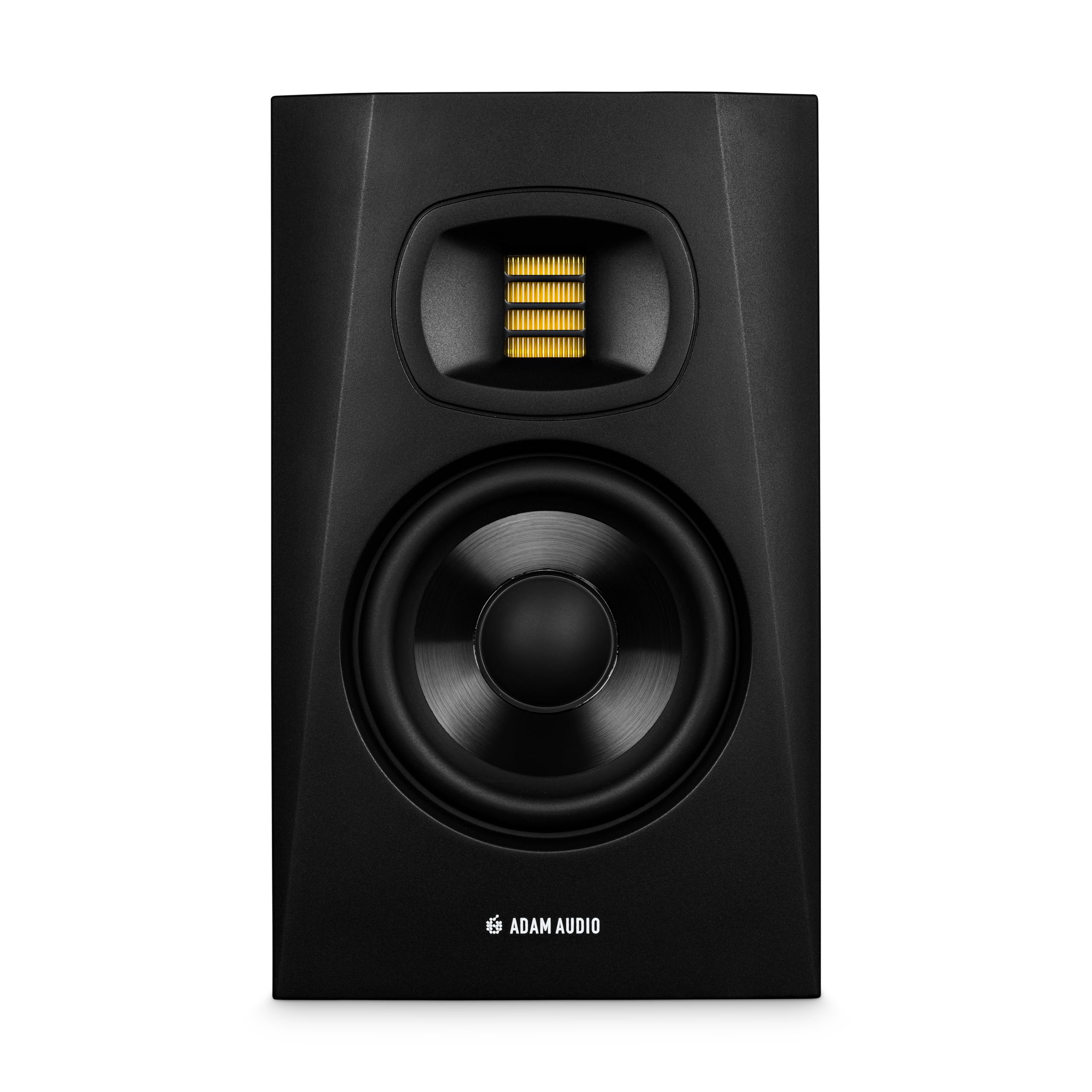
ADAM’s ribbon-like U-ART tweeter reveals details cheaper monitors simply hide.
The ADAM Audio T5V is sold as a single speaker, so you need to order two for a stereo pair. What you pay for is the U-ART tweeter (Accelerating Ribbon Technology) — a folded ribbon design that moves air much faster than a conventional dome tweeter. This gives you extremely detailed high-frequency reproduction, which is critical for spotting sibilance (harsh “s” and “t” sounds), reverb tails, and editing errors in a mix. The 5-inch woofer and HPS waveguide deliver a balanced, spacious sound. One reviewer called it a “solid and spacious sound” with a flat frequency response and ±2dB adjustable highs and lows.
At this price point, the ADAM T5V competes directly with the Yamaha HS5. The ADAM is less bright and harsh than the HS5 — one customer observed it has less high-end sparkle than the Emotiva Airmotiv 4, but is more balanced overall. The rear-firing bass reflex port means you need some space behind the speaker for the port to breathe, which can be tricky in tight desk setups.
Where it stands out
- U-ART tweeter provides exceptional high-frequency detail and clarity
- DSP-based high and low shelf filters adapt the sound to your room
- Built in Berlin with a reputation for build quality
Single vs pair
- Sold as a single monitor — budget for two for stereo
- Rear-firing port needs space from the wall behind
Tweak your high end: If you edit podcasts or vocals and need to hear every breath, pop, and sibilant clearly, the T5V’s tweeter is a legitimate advantage over similarly-priced monitors.
Remember to buy two: Do not forget you need a pair — ordering one by mistake is a common first-time buyer error here.
5. KRK Classic 5 Powered Studio Monitor (Pair)

The KRK sound that launched a million bedroom studios — now with a flat mode for honest mixes.
KRK monitors have a legendary reputation in hip-hop, EDM, and pop production, in large part because of the iconic yellow cone and the +2 dB bass boost option (so kick drums and bass lines hit harder). The Classic 5 features a 5-inch glass-aramid composite woofer and a soft-dome tweeter that extends up to 35 kHz. The flat low frequency adjustment setting lets you turn off the bass boost for a more accurate reference — a major improvement over older KRK models that were almost always bass-heavy. One user highlighted these “rock and pound beats” while noting you can customize them with the adjustable knobs.
Compared to the Yamaha HS5, the KRK Classic 5 is warmer and punchier in the low end. That makes them more fun for listening and beat-making, but less accurate for critical mastering. Another reviewer mentioned they need a subwoofer for real bass extension, and that they work perfectly with a Mackie Big Nob and Logic Pro X for EQ variations. These come with a pair of XLR cables and a phone holder in the bundle.
Who it suits
- +2 dB bass boost gives you that punchy KRK sound for beats and bass-heavy music
- Flat mode lets you switch to an accurate reference for critical mixing
- Classic design and comfortable, non-fatiguing sound signature
What it lacks
- Bass extension is limited without a subwoofer for serious low-end work
- Not as revealing in the high frequencies as the ADAM T5V
Beat-makers and bass lovers: If you produce hip-hop or EDM and want a fun, punchy sound that still has a flat mode for final mixing, the Classic 5 is a versatile entry point.
Mastering purists: If you need total neutrality for mastering, the Yamaha HS5 or KALI LP-UNF will be more honest from the start.
6. Edifier MR5 Studio Monitor Bookshelf Speakers (Pair)

A 3-way system — woofer, mid, and tweeter — that packs studio accuracy into a compact, Bluetooth-friendly box.
Most studio monitors in this price range use a 2-way design: one woofer for lows and mids, one tweeter for highs. The Edifier MR5 uses a 3-way active crossover (a 3-way crossover splits the audio into three separate bands: lows, mids, and highs, each sent to its own dedicated driver) with a 5-inch long-throw woofer, a 3.75-inch mid driver, and a 1-inch silk dome tweeter. That extra mid driver means vocals and instruments in the critical midrange get their own dedicated driver, which reduces distortion and improves clarity. The frequency response stretches from 46 hertz to 40 kilohertz with 110 watts RMS of Class D amplification, hitting a peak SPL of 101 dB. One reviewer called them “crisp” and said they hear instruments and placement they had never heard before.
The MR5 also supports Bluetooth 6.0 with LDAC (high-resolution wireless audio up to 24-bit/96kHz) and the Edifier ConneX app for room compensation and EQ. The trade-off is that the app itself is clunky, and physical controls (treble/bass knobs on the back) are hard to reach once the speakers are placed. Compared to the Yamaha HS5, the MR5 is less fatiguing and more versatile for general listening, but slightly less analytical for dedicated mixing.
Multimedia mastery
- 3-way design with dedicated mid driver means clearer vocals and instrument separation
- Bluetooth with LDAC for high-resolution wireless streaming
- Room compensation app helps tune sound to your space
App and ergonomics
- Physical EQ knobs on the back are awkward to reach in most setups
- Edifier ConneX app is functional but not polished
The versatile all-rounder: If you want one pair of speakers for both mixing and enjoying music, plus Bluetooth convenience, the MR5 packs features that no other monitor at this price offers.
App-over-physical controls: If you prefer old-school tactile knobs within easy reach, the rear-panel adjustments might frustrate you — plan to rely on the app.
7. PreSonus Eris E3.5 Near Field Studio Monitors (Pair)

The cheapest true studio monitor that still gives you acoustic tuning and a front headphone jack.
The PreSonus Eris E3.5 is the most affordable entry point into real studio monitoring. With 3.5-inch woven composite drivers and 1-inch ultra-low-mass silk-dome tweeters, powered by 50 watts of Class AB amplification (25 watts per speaker), these are small enough for any desk. The acoustic tuning controls on the back — high, mid, and low adjustments — let you compensate for bad room acoustics, a feature rarely seen at this price. A front-panel stereo aux input and headphone jack make them convenient for quick switching between monitors and private listening. One reviewer called them “the best monitors you’ll find for the price,” praising their neutral sound and accurate soundstage.
The obvious limitation is the small woofer size. Bass response is weak — one reviewer described it as a “losing proposition” for chest-pounding low end and paired them with a 10-inch subwoofer. The cabinet build feels a bit cheap, and some owners mention receiving a wrong power cord (a figure-8 style plug versus the correct one). Compared to the JBL 305P MkII, the E3.5s lack the same clarity and power, but they cost significantly less and include RCA and aux inputs for direct connection to a phone or laptop.
Why beginners pick it
- Acoustic tuning controls help correct for poor room placement
- Front aux and headphone jack for easy daily use
- Very affordable entry into flat-response monitoring
What you trade
- Weak bass below about 80 Hz — you will want a subwoofer for bass-heavy music
- Build quality feels a bit plasticky and cheap
Try before you invest: If you are curious about studio monitors but not ready to spend hundreds, the E3.5 is a risk-free way to hear what flat response sounds like.
Not for bass lovers: If your mixes rely on kick drums and 808s, you will outgrow these quickly — save for a 5-inch model instead.
8. M-AUDIO Forty Eighty 8″ Studio Monitor (Single)

150 watts, an 8-inch Kevlar woofer, and Bluetooth — built for beat-makers who need to feel the kick.
The M-AUDIO Forty Eighty is a single monitor designed for DJs, beat-makers, and content creators who need serious low-end extension. The 8-inch Kevlar woofer, driven by 150 watts of bi-amplified power, delivers bass that you feel in your chest — not just hear. A Burr-Brown analog-to-digital converter and DSP (digital signal processing) handle the crossover and EQ with precision. Bluetooth 5.3 True Wireless Stereo (TWS) lets you stream wirelessly and pair two of these for a stereo setup. The M-AUDIO Control App gives you a 5-band EQ and customizable presets, plus FLAT mode for uncolored reference and HYPE mode to simulate how your mix will sound on consumer earbuds or car stereos.
The biggest catch: this box contains ONE speaker, not a pair. As one frustrated reviewer put it, “this is the Zoolander of products, it only goes left.” You need to buy two for stereo. Also, the 8-inch woofer will sound boomy in small or untreated rooms — this monitor demands space. An isolation pad is included in the box, which helps decouple the speaker from the desk so bass does not rattle the surface.
Built for power
- 8-inch Kevlar woofer delivers deep, punchy bass ideal for bass-heavy genres
- 150 watts of bi-amplified power for room-filling volume
- FLAT and HYPE modes help you check mix translation
Warnings for buyers
- Sold as a single speaker — budget for two for stereo
- 8-inch woofer needs a room with some space to avoid boomy bass
For the bass heads: If you produce or DJ genres where sub-bass is everything, and you have a room that can handle an 8-inch woofer, this is a powerful, feature-rich option.
Check the cart: Do not accidentally buy just one — this is a common mistake that leaves you with a mono setup.
9. KRK RP5G5 ROKIT 5 Generation Five Powered Studio Monitor (Pair)

The fifth generation refines a studio legend with DSP-driven room tuning and a new silk dome tweeter.
The KRK RP5G5 ROKIT 5 is the latest iteration of the monitor that defined a generation of home studios. Generation Five introduces custom-designed Class D power amplifiers that run cooler and cleaner than previous generations, a new 1-inch silk dome tweeter for improved high-frequency and phase performance, and a Low Diffraction Baffle Design that reduces distortion and improves stereo imaging. The key upgrade is DSP-driven room tuning, which uses digital processing to adjust the monitor’s output to your space. Each pair also includes acoustic foam wedge isolation pads (Iso-foam pads) to decouple the speakers from the desk. One reviewer called them “the BEST desktop speakers,” better than Audioengin HD6 and A5 models.
Despite the improvements, reliability concerns from previous generations linger. One shopper added that their previous generation (4) power supply failed after one year, though they noted the Gen 5 sound is “marginally cleaner” and they hope the power supplies are better now. Compared to the KRK Classic 5, the RP5G5 is more refined, with tighter bass and a more neutral top end. Without a subwoofer, they are adequate for casual listening, but serious low-end work benefits from pairing with the KRK S10.4 sub.
What Gen 5 brings
- DSP-driven room tuning for precise adaptation to your space
- New silk dome tweeter for smoother, more detailed highs
- Includes Iso-foam isolation pads for proper setup
History of concern
- Some users report reliability issues with previous generations’ power supplies
- Still benefits from a subwoofer for full-range low-end work
Upgrade for KRK loyalists: If you already love the KRK sound and want the latest features like DSP room tuning, the RP5G5 is a meaningful step forward from the Classic 5 or older ROKITs.
Warranty matters: Given past reliability reports, buy from a seller with a solid return policy and register your product for warranty support immediately.
Understanding the Specs
Frequency Response
This is the range of pitches a monitor can reproduce, measured in hertz (low) to kilohertz (high). A spec like “54 Hz – 30 kHz” means the speaker can produce a low bass note at 54 vibrations per second up to a very high treble note at 30,000 vibrations per second. Human hearing typically tops out around 20 kHz (20,000 vibrations per second), so anything above that ensures the highs are clean. The lower number is more important for bass: 39 Hz (KALI LP-UNF) means deeper bass than 54 Hz (Yamaha HS5), so you hear and feel more sub-bass in your music.
Bi-Amplification (Bi-Amp)
Bi-amping means the monitor has two separate amplifier channels inside — one dedicated to the woofer (low frequencies) and one dedicated to the tweeter (high frequencies). This prevents the bass from draining power needed for the highs, resulting in cleaner, more controlled sound at higher volumes. Most monitors in this guide are bi-amped (the Yamaha HS5 uses a 45W + 25W bi-amp system). Single-amp designs are cheaper but less precise, meaning the sound can get muddy when you turn up the volume.
Active vs Passive
All the monitors reviewed here are “active” or “powered” — meaning the amplifier is built into the speaker cabinet. You just plug in power and an audio cable. “Passive” speakers require a separate external amplifier (like a home stereo receiver), which adds cost and complexity. For a desktop or home studio, active monitors are the standard choice because they are self-contained and the amplifier is matched to the drivers for optimal performance.
Room Tuning (Acoustic Tuning / Boundary EQ)
These are switches or knobs on the back of the monitor that let you cut or boost specific frequency ranges to compensate for your room’s acoustics. For example, placing a monitor close to a wall boosts bass by several decibels (called “boundary effect”). A Boundary EQ switch lets you cut the low end to restore a flat response. The PreSonus Eris E3.5 has acoustic tuning controls; the JBL 305P MkII has Boundary EQ. Without these, your monitor will lie to you about how much bass is actually in your mix, leading to mixes that sound boomy on other systems.
FAQ
Do I need an audio interface for studio monitors?
What size monitor is best for a small bedroom?
Can I use studio monitors for watching movies and gaming?
What does “near field” mean?
Should I buy a pair or a single monitor?
Do I need a subwoofer with studio monitors?
What does “flat response” mean?
Is Bluetooth on a studio monitor a gimmick?
How do I position my studio monitors correctly?
What cables do I need to buy separately?
Final Thoughts: The Verdict
The Yamaha HS5 (Pair) earns the top spot because its flat response (54 Hz – 30 kHz) and 70W bi-amp design give you an industry-standard sound that translates your mixes accurately to any system, backed by a build that survives years of use. If you need deep bass for beat-making and DJing, grab the M-AUDIO Forty Eighty — its 8-inch Kevlar woofer and 150 watts deliver chest-pounding low end (remember to buy two). And for a compact desk setup, the KALI AUDIO LP-UNF hits 39 Hz from a 4.5-inch driver with Bluetooth convenience, making it the most impressive option for cramped spaces.
How We Picked
We do not accept paid placement. Every pick is matched to a real buyer and a real use-case; we do not hands-on test units.
Sources & Methodology
Specifications: manufacturer listings and product documentation. Review insights: verified customer reviews, as of July 2026. Pricing: not shown on this page (it changes often); check the current price via the retailer link.
As an Amazon Associate, FitlyFast earns from qualifying purchases. This does not affect which products we feature.