
Our readers keep the lights on and the weekend projects moving. As an Amazon Associate, I earn from qualifying purchases.
Specs are compiled from manufacturer listings and verified buyer reviews and can change over time — please confirm the key details on the product page before buying.
Finding a 3D printer your teenager will actually use — and not get frustrated with — depends on one thing: does it work right from the start? Many so-called “beginner” printers require hours of calibrating, leveling, and troubleshooting that kills the fun before a single layer is printed. The best options in this list are either fully assembled or incredibly simple to set up, with reliable auto-leveling, a large library of ready-to-print models, and enough speed to keep a young maker engaged from idea to finished object.
I’m Rikta — the founder and writer behind FitlyFast. This guide is built by comparing the manufacturers’ published specifications and the patterns across verified customer reviews, so you get each pick’s real strengths and trade-offs instead of marketing spin.
Here is what actually matters when picking the right 3d printer for teenagers: a machine that prints reliably without constant tweaking, a big library of fun models to start with, and a safe enclosed design you can feel good about leaving in their room.
Quick Picks
- AOSEED X-Maker Joy AI+ — Best Overall
- Entina Tina2 Plus — Fastest Print Speed
- Entina TINA2S — Best Value Pick
- HEPHi3D TINA2S — Lightest & Quietest
- Toybox Alpha Three — Licensed Toy Maker
How To Choose The Best 3D Printer For Teenagers
A teen’s first 3D printer needs to be a creative outlet, not a repair project. The three specs below separate the printers that build confidence from those that build frustration.
Auto Bed Leveling and Setup Time
Manual bed leveling (turning knobs to get a sheet of paper to drag just right at four corners) is the single biggest beginner-killer. Every printer on this list has auto bed leveling, and most are sold as fully assembled — meaning you open the box, plug it in, and print within minutes. Reviewers confirm this: one parent wrote that the Entina TINA2S was “unboxed and printing in 15 min.” If setup sounds like a chore, your teen will lose momentum before the first print finishes.
Print Speed and Build Volume
Speed matters directly to a teenager’s attention span. Slower printers turn a simple fidget toy into a multi-hour wait. These models range from 200 mm/s to a peak of 400 mm/s, with the premium AOSEED completing small toy projects in as little as 20 minutes. The trade-off is build volume: faster, more compact machines usually print smaller objects (around 4 inches cubed), which is fine for phone stands, mini figures, and desk organizers but limits bigger helmet or prop projects.
App Library and Safe, Enclosed Design
A printer that requires a teenager to design an original CAD file on day one is a recipe for abandonment. Models that bundle 1,500 to 8,000 ready-to-print models in their companion app let a beginner experience success immediately. For safety, look for a partially enclosed frame that separates hot moving parts from curious hands — all five picks here are partially or fully enclosed, and the Toybox specifically emphasizes a kid-safe, lightweight design with non-toxic PLA filament.
Quick Comparison
| Model | Best For | Print Speed | Print Volume | Weight | Amazon |
|---|---|---|---|---|---|
| AOSEED X-Maker Joy AI+ | AI-powered creativity & huge library | 400 mm/s peak | — | 8.82 lbs | Amazon |
| Entina Tina2 Plus | Fast 250 mm/s speed & value | 250 mm/s | — | 9.93 lbs | Amazon |
| Entina TINA2S | Quiet operation & 1,500+ models | 200 mm/s | 3.9 x 4.7 x 3.9 inches | 9.08 lbs | Amazon |
| HEPHi3D TINA2S | Lightweight & quiet printing | 200 mm/s | — | 5.68 lbs | Amazon |
| Toybox Alpha Three | Licensed toys & kid-safe design | Faster than Alpha Two | ~3 inch cube | 8.88 lbs | Amazon |
In‑Depth Reviews
1. AOSEED X-Maker Joy AI+
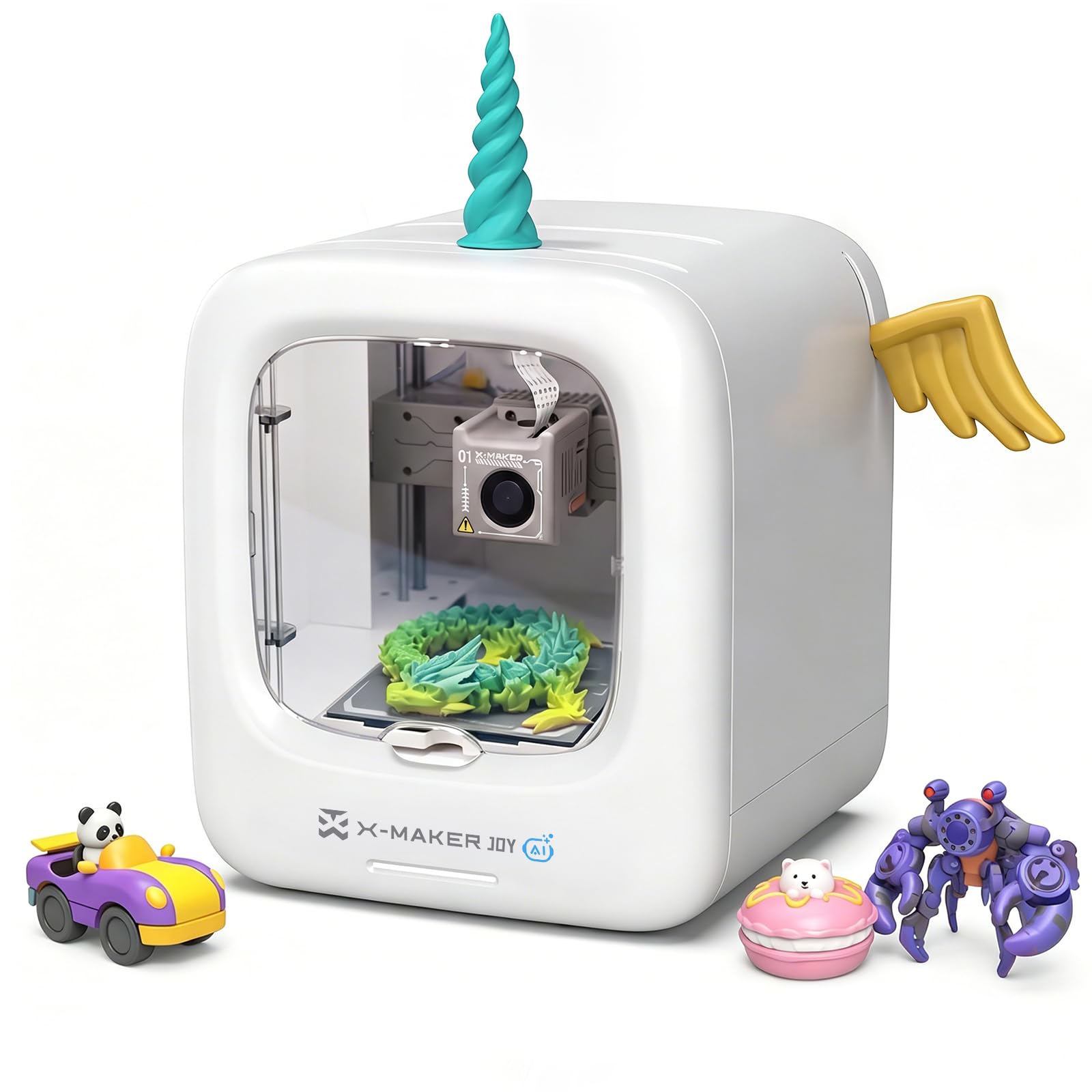
The smartest pick for teens who want to design, not just download.
This is the only printer in the list with a built-in AI that turns a teenager’s voice, text, or photo into a printable 3D model — no design software needed. The AI Doodle feature and AI MiniMe tool (which creates a cartoon-style figure from a photo) are exactly the kind of instant-gratification hooks that keep a creative teen invested. The printer comes with access to 8,000+ digital models and 17 themed design modules, so the library alone could keep a curious mind busy for years.
On speed, the X-Maker Joy AI+ delivers precision up to 0.05 mm and a peak print rate of 400 mm/s, with typical speeds in the 220–250 mm/s range. That means a small toy can finish in as little as 20 minutes — fast enough that a teen stays excited from idea to finished object. It also includes a built-in camera that creates time-lapse videos of the print, which is a fun way to share the process with friends. But buyers should be aware of a caution: some reviewers report that roughly one in three prints failed, with parts needing super glue to fit, and one owner returned theirs for a Bambu after the customer support experience soured. At 8.82 pounds, it is noticeably heavier than the HEPHi3D TINA2S (5.68 pounds), so it sits more firmly on a desk, but that weight also means it is less portable.
What Makes It Stand Out
- AI voice/text/image-to-model for instant custom designs
- 8,000+ preloaded models with no design work required
- Peak speed of 400 mm/s completes small toys in ~20 minutes
- Built-in camera for time-lapse sharing
Real-World Trade-Offs
- Some buyers report frequent print failures and poor support
- App can malfunction on tablets, according to a reviewer
- Not as polished a beginner experience as the simpler Entina picks
Perfect for: a creative teen who wants to design custom toys and figures using AI, and who doesn’t mind some trial-and-error with settings.
Consider a simpler pick if: your teen has low frustration tolerance — the AOSEED’s failure rate and app quirks may test patience early on.
2. Entina Tina2 Plus

The value king that prints at 250 mm/s versus 200 mm/s on the base TINA2 models.
At 250 mm/s, the Tina2 Plus runs faster than the standard TINA2S at 200 mm/s, which means school projects finish with less waiting time. It also features a ceramic hotend that heats to printing temperature in just 40 seconds — a small convenience that adds up when a teen wants to print after school without a long warm-up delay. Like the rest of the Entina family, it comes fully assembled and unboxed-to-printing in roughly 15 minutes according to multiple buyer reports, and the Poloprint Cloud app gives access to 1,500+ ready-to-print models.
At 9.93 pounds versus the 5.68-pound HEPHi3D TINA2S, it stays put rather than sliding around. The partially enclosed frame separates hot components from fingers, and the PEI spring steel build plate makes removing finished prints satisfyingly easy. But the trade-off is that the compact build volume limits object size: you are looking at small figures, phone stands, and desk organizers, not helmets or large props. Reviewers consistently praise the low noise level (one called it “very quiet”) but note that print quality, while good for the price, is not perfect — small layer lines are visible on detailed curves. A few buyers have also reported nozzle clogs after repeated use, so keeping a spare nozzle on hand is wise.
Why It’s a Top Performer
- 250 mm/s print speed — faster than the standard TINA2S
- 40-second ceramic hotend gets printing started quickly
- Fully assembled; several buyers confirm a 15-minute setup
- Quiet operation fits a bedroom or classroom environment
The Catch
- Small build volume limits project size to small objects
- Some reports of nozzle clogs over extended use
- Print quality is good but not flawless at this price tier
Best for: a teen who values speed and quiet operation for small, frequent prints — badges, mini figures, and desk accessories.
Consider another if: you need larger build volume or a more refined print surface finish.
3. Entina TINA2S
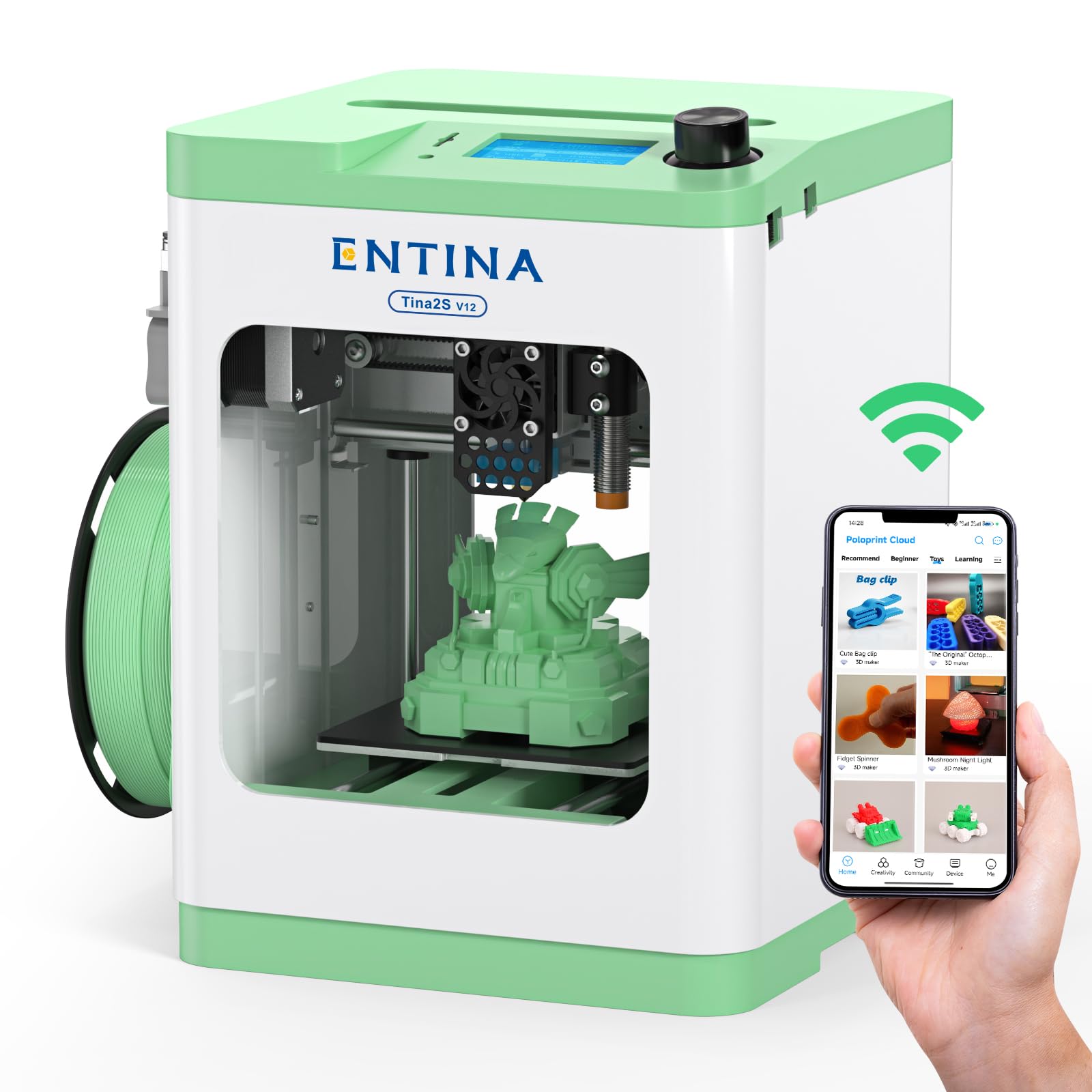
The entry-level workhorse that gets out of your way and lets you print.
This is the model that multiple parents describe as “perfect for 10yo beginner” and “unboxed and printing in 15 min” — and those exact phrases appeared across verified reviews for both the TINA2S and the Tina2 Plus, which speaks to how consistent the Entina experience is. The TINA2S delivers a straightforward, low-friction intro at 200 mm/s print speed with a 0.04 mm layer precision that produces smooth, detailed results for small objects. The print volume is listed at 3.9 x 4.7 x 3.9 inches, which is enough for most fidget toys, phone stands, and miniatures but not for larger projects.
One standout feature is the quiet operation: the low-noise motherboard makes it genuinely usable in a bedroom or shared study space without bothering anyone. The LED lighting helps a teen check print progress at a glance without leaning in. At 9.08 pounds versus the 5.68-pound HEPHi3D TINA2S, it feels more substantial on a desk. The companion app includes auto-support generation, which reviewers found helpful — prints get scaffolding automatically for overhanging parts. The main trade-off reported is speed: a reviewer who compared it to a Flashforge Adventurer 5M noted small prints taking 2–3 hours versus 10–30 minutes on the faster machine. A few buyers also reported nozzle clogs and unresponsive customer support when issues arose.
The Upside
- Truly beginner-friendly; multiple buyers confirm 15-minute setup
- Very quiet — low-noise motherboard suitable for a bedroom
- App auto-generates supports, reducing failed prints
- 1,500+ models in the app keep things interesting
The Downside
- Slow compared to premium models (2–3 hours per small print)
- Some reports of nozzle clogs and weak support
- Not ideal for large or tall prints
Reach for this if: your main priority is a quiet, pre-assembled printer that just works, with zero learning curve for a younger teen.
Look elsewhere if: your teen has the patience for faster, higher-output machines and doesn’t mind a higher price tag.
4. HEPHi3D TINA2S
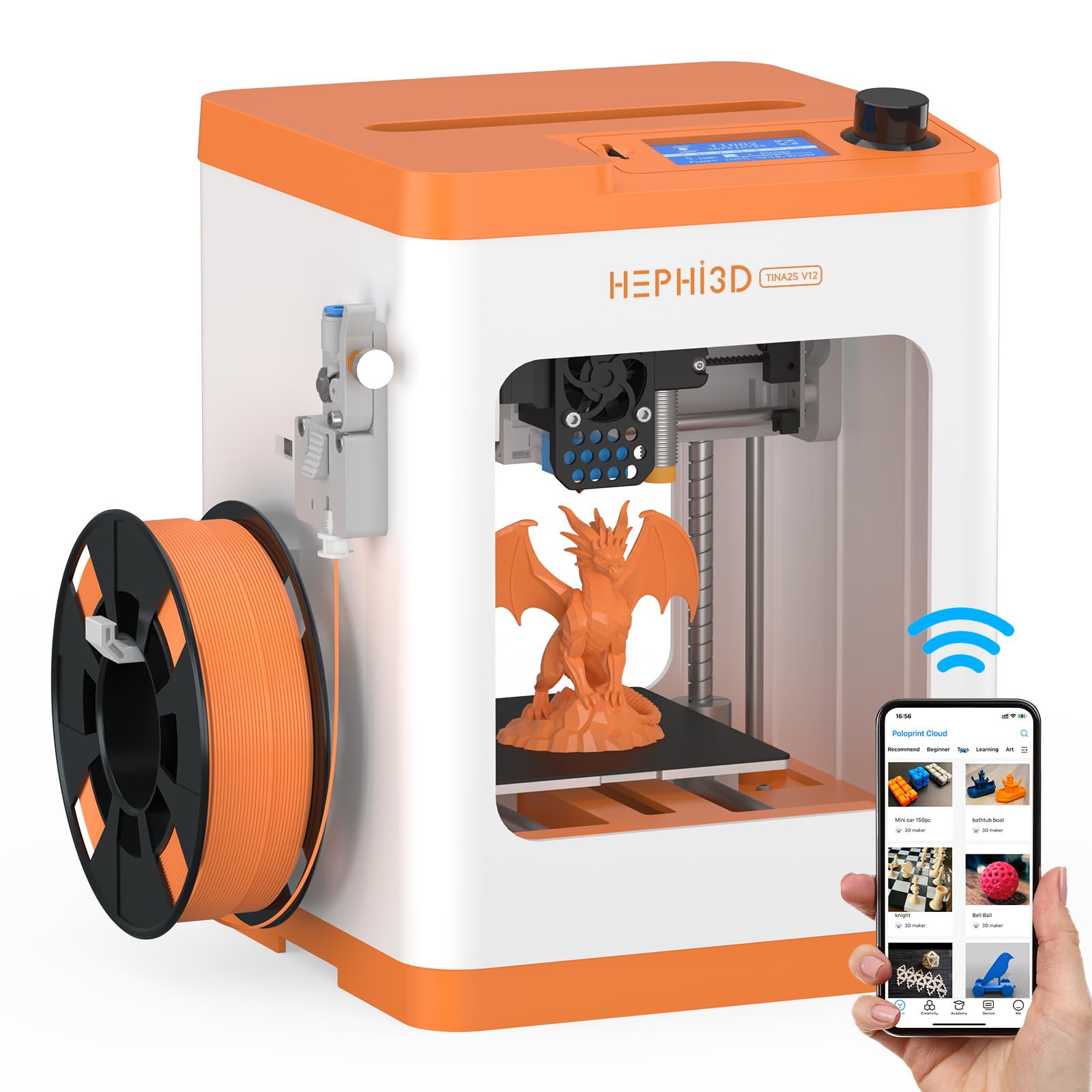
The featherweight that slips into a backpack shelf without disturbing anyone.
At just 5.68 pounds versus the 9.93-pound Entina Tina2 Plus, this is the lightest printer on the list. That makes it easy to move between a desk and a shelf, or even to bring to a friend’s house for a project session. It shares the same core TINA2S design (auto leveling, 200 mm/s speed, fully assembled) but trims the weight significantly. The noise level is rated at 40–50 dB, which is quieter than a normal conversation, so it won’t interrupt homework or sleep in a shared room.
The open-source design means it works with Wiibuilder, Cura, Kiri (Chromebook compatible), and PrusaSlicer, giving a teen room to grow into professional-grade slicing software later. It also includes a filament sensor and power-loss resume — so if a print gets interrupted, it picks up where it left off rather than starting over. The compact footprint is 8.27 x 8.72 x 11.42 inches, while the Entina Tina2 Plus is listed at 11.4 x 8.6 x 8.6 inches. One reviewer, however, pointed out two consistent complaints: “print drift on larger objects” and “annoying unchangeable spaceship noises during printing” — the latter being a quirky sound effect baked into the machine that cannot be turned off. Another reviewer noted that while setup is fast, the initial experience is not truly beginner-friendly without an adult: you need a computer app and a memory card to get going, and it helps to know the filament size beforehand. The spaceship noise makes it a worse choice for a quiet bedroom than the Entina TINA2S.
What Works
- Lightest option at 5.68 lbs — easy to move and store
- Very quiet printing at 40–50 dB
- Open-source software compatibility for future growth
- Power-loss resume and filament sensor included
What Doesn’t
- Print drift on larger objects, per buyer reports
- Inescapable spaceship noise during printing
- Setup requires an adult with a computer on first use
Ideal for: a teen who needs a portable, quiet printer for a small desk and doesn’t plan to print large models.
skip it if: the spaceship noise would drive you crazy, or if your teen wants to print objects bigger than a few inches.
5. Toybox Alpha Three
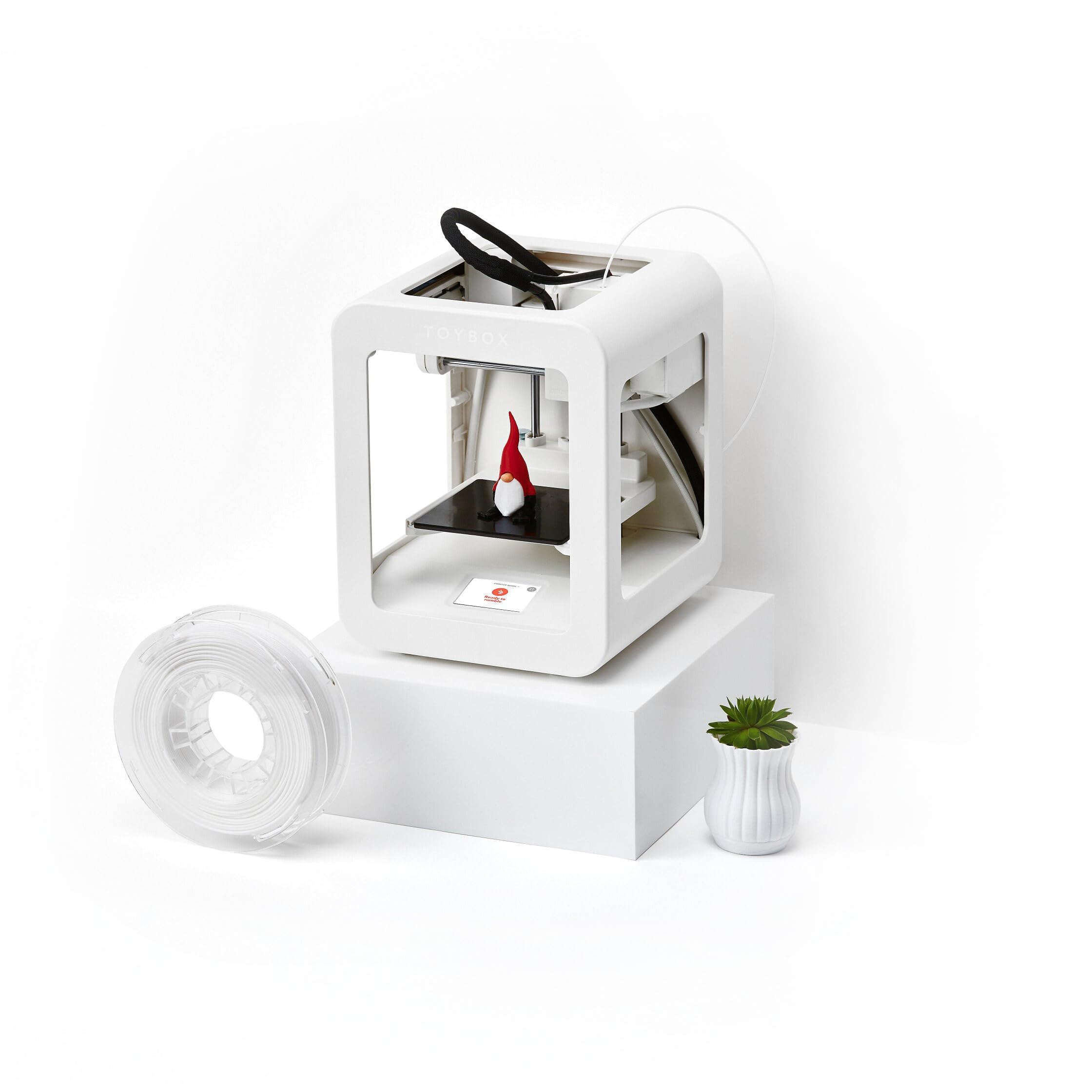
The printer that prints SpongeBob and Batman before you finish reading the manual.
The Toybox Alpha Three is uniquely positioned as the only printer on this list with officially licensed toy models — think SpongeBob, Batman, and How to Train Your Dragon characters available to print straight from the app. With access to 7,000+ ready-to-print designs, this is the machine for a teen who wants to print recognizable toys, not just generic geometric shapes. It is described as faster and more detailed than the previous Toybox Alpha Two, and the tool-free calibration means there is no fumbling with knobs or allen wrenches.
The design is deliberately kid-safe: a lightweight, durable frame and non-toxic PLA filament. The build volume is the trade-off — it is roughly a 3-inch cube, which limits projects to small toys, charms, and accessories. Reviewers are split: some parents say a 7-year-old can use it alone and “kids use it constantly,” while others report frequent print failures (material not sticking, nozzle clogs) and a frustrating reliability record — one reviewer noted their second unit arrived dead from the start. The Toybox app (iOS, Android, Web) allows uploading custom STL, OBJ, and gCode files, so a teen can grow beyond the library later. However, the inconsistency in build quality and the small build volume make it a niche pick rather than a universal recommendation. Pick the Entina Tina2 Plus for reliability instead.
The Hooks
- Officially licensed toys (SpongeBob, Batman, etc.) for instant appeal
- 7,000+ designs in the app with one-tap printing
- Tool-free calibration — no setup frustration
- Kid-safe lightweight frame and non-toxic PLA
The Reality
- Small 3-inch build volume limits project size
- Multiple reports of dead-on-arrival units and clogged nozzles
- Frequent print failures reported by some buyers
- Expensive for the print size you get
Best suited for: a younger teen or pre-teen who is obsessed with licensed characters and wants a simple, safe machine to print toys.
Not for: anyone who wants reliable, consistent output or plans to print objects bigger than a typical action figure.
Understanding the Specs
Auto Bed Leveling
This is the sensor that measures the build plate’s surface and adjusts the printer’s nozzle height automatically, so the first layer of plastic sticks evenly. Without it, a beginner has to manually adjust four corner knobs with a piece of paper — a process that can take 20 minutes and still fail. Auto leveling is standard on every printer here, which is the main reason these are ready-to-print from the start.
Print Speed (mm/s)
Measured in millimeters per second (mm/s), this tells you how fast the print head moves as it lays down plastic. The range here goes from 200 mm/s on the base TINA2S models up to 400 mm/s peak on the AOSEED. Faster speeds mean a small toy finishes in 20–30 minutes instead of 2–3 hours, which matters a lot for an impatient teen. The trade-off is that cranking speed too high can reduce surface detail — so look for machines that mention good quality at 200–250 mm/s for a balance.
Build Volume (inches)
This is the maximum size of object the printer can make, typically listed as width x depth x height. Most compact “beginner” printers like the Entina TINA2S top out around 4 inches per side — enough for phone stands, fidget toys, and mini figures, but not for large masks or props. If your teen wants to print cosplay helmets or big sculptures, you will need a larger machine; for everything else, this range is plenty.
Fully Assembled vs. Kit
Every printer on this list ships fully assembled (some even say “ready to print in 15 minutes” in verified reviews). A kit printer requires the buyer to attach the frame, wire the electronics, and calibrate the bed — often taking 2–6 hours of assembly. For a teenager’s first machine, “fully assembled” is non-negotiable because the initial experience determines whether 3D printing feels like a hobby or a chore.
FAQ
Can a teenager set up one of these printers without adult help?
What is the difference between the HEPHi3D TINA2S and the Entina TINA2S?
Is the Toybox Alpha Three worth the higher price for a teen?
How loud are these printers in a bedroom?
Can these printers use materials other than PLA?
What happens if the filament runs out mid-print?
How do I know which printer has the largest build volume?
Can my teen print their own designs from Tinkercad or Blender?
Final Thoughts: The Verdict
For most teenagers and families, the 3d printer for teenagers that hits the best balance is the Entina Tina2 Plus because it delivers faster 250 mm/s printing, a 40-second warm-up, and a proven 15-minute setup at a price that doesn’t hurt. If your teen wants to design custom models using AI without learning CAD, grab the AOSEED X-Maker Joy AI+. And for a younger teenager who just wants to print recognizable characters and toys without any fuss, the Toybox Alpha Three delivers that specific experience — but be ready for a smaller print size and mixed reliability.
How We Picked
We do not accept paid placement. Every pick is matched to a real buyer and a real use-case; we do not hands-on test units.
Sources & Methodology
Specifications: manufacturer listings and product documentation. Review insights: verified customer reviews, as of July 2026. Pricing: not shown on this page (it changes often); check the current price via the retailer link.
As an Amazon Associate, FitlyFast earns from qualifying purchases. This does not affect which products we feature.