
Our readers keep the lights on and the weekend projects moving. As an Amazon Associate, I earn from qualifying purchases.
Specs are compiled from manufacturer listings and verified buyer reviews and can change over time — please confirm the key details on the product page before buying.
You need parts that won’t snap under pressure—drone frames, automotive brackets, tool handles. Standard PLA bends and breaks. Carbon-fiber-reinforced filament solves that, but it requires a printer that handles abrasive materials and high heat. Here are three machines that genuinely support carbon fiber, from a ready-out-of-the-box workhorse to a chamber-heated powerhouse for engineering filaments.
I’m Rikta — the founder and writer behind FitlyFast. This guide is built by comparing the manufacturers’ published specifications and the patterns across verified customer reviews, so you get each pick’s real strengths and trade-offs instead of marketing spin.
You will find the best 3d printer for carbon fiber for your budget and skill level—if you need a pre-calibrated beginner-friendly model or a high-temperature machine for advanced filaments.
Quick Picks
- ELEGOO Centauri Carbon 3D Printer — Best Overall
- FLASHFORGE AD5M Pro 3D Printer — Quiet Speed
- QIDI Q1 Pro 3D Printer — Engineering Grade
How To Choose The Best 3D Printer For Carbon Fiber
Carbon fiber filament is hard on printers and harder on beginners. You need a hardened nozzle—usually a brass-steel alloy or bimetal (a nozzle made from two fused metals)—that survives the abrasive fibers without wearing out mid-print. The other non-negotiable is a direct-drive extruder (the motor that pushes filament is mounted right above the hot end), because carbon fiber is stiff and brittle; a Bowden tube setup (where the motor is far away) keeps snapping it. Beyond that, look for an enclosed frame and, ideally, a heated chamber, because carbon fiber blends often print at 260°C or higher, and any draft causes layer separation.
Hardened Nozzle Temperature Range
The nozzle is the first part carbon fiber kills on a standard printer. You need a nozzle rated to at least 300°C—the ones here range from 320°C to 350°C—and made from a hardened material like a brass-steel alloy or bimetal. A standard brass nozzle wears out after a few spools, leading to uneven extrusion and failed prints.
Build Volume and Enclosure
If you print functional carbon fiber parts, you probably need room. A 256mm cube (roughly 10 inches) is the practical size for items like drone arms or automotive brackets. An enclosed frame traps heat and keeps the chamber warm, which prevents warping on materials like Nylon-CF or Polycarbonate-CF. A fully enclosed printer also helps contain fumes if you print indoors.
Auto Leveling and CoreXY Speed
Manual bed leveling is a headache with any 3D printer, but it becomes a deal-breaker when you dial in a carbon fiber profile. Look for full-auto leveling with a sensor that measures the bed’s surface and adjusts for it—you never touch a knob. A CoreXY motion system (the print head moves on two belts fixed to the frame, not on a moving bed) is a bonus. It lets you run at 500-600mm/s without losing precision on tough materials.
Quick Comparison
In‑Depth Reviews
1. ELEGOO Centauri Carbon 3D Printer
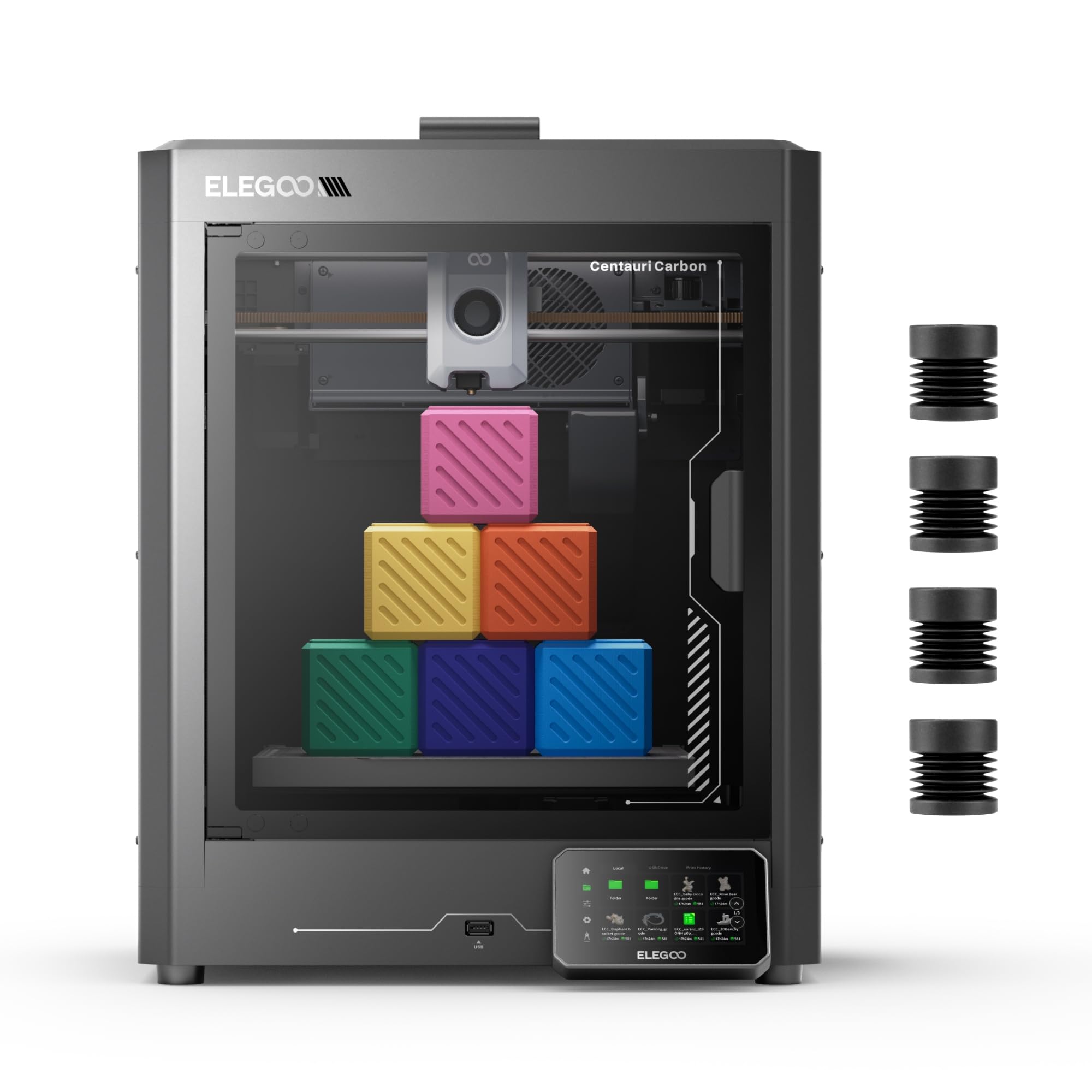
You get a print-ready machine that handles carbon fiber in under 15 minutes from the box.
The Centauri Carbon arrives fully assembled—no frame bolts or leveling knobs to adjust. Its 320°C brass-hardened steel nozzle survives carbon fiber blends without wearing down, and the enclosed chamber traps heat to stop warping on materials like ABS-CF (a blend of ABS plastic and carbon fibers). It prints at 500 mm/s—that is 20% slower than the FLASHFORGE AD5M Pro’s 600 mm/s, but fast enough for most functional parts, and you get a larger 256mm cube build volume (about 10 inches per side).
Buyers report setup is genuinely simple. One reviewer went from unboxing to an 18-minute benchy (a small boat test print) almost immediately, calling it the “best bang for your buck.” The die-cast aluminum frame keeps vibrations low at high speeds, and the auto bed leveling (a sensor that measures and adjusts the build plate) means you never touch a knob. One catch: a minority report that their first unit failed after 6 days with a hot end (the heating block + nozzle assembly) communication error, and tech support for US buyers takes a few days per ticket. Still, the 320°C nozzle open up materials the FLASHFORGE below cannot reach, like Nylon-CF.
If you want carbon fiber parts without hours of calibration, this is your printer. The 38.5-pound weight gives stability, and the built-in camera with dual LED lighting lets you watch prints remotely. It is the easiest path to strong, heat-resistant parts for drones, vacuum-forming molds, or automotive brackets.
What makes it stand out
- No assembly required — ready to print in minutes
- 320°C hardened steel nozzle handles carbon fiber without wearing down
- Die-cast aluminum frame stays rigid at 500 mm/s
What to watch for
- Some units arrive with a hot end communication error
- Support for US customers can be slow
- Side spool mount feels flimsy for heavier rolls
Grab this if: you want a carbon fiber printer that works from the start with zero assembly, auto-leveling, and a 256mm build volume.
Pass if: you need a heated chamber above 60°C for filaments like PEEK (a high-temp engineering plastic)—this printer relies on the bed and enclosure, not an active chamber heater.
2. FLASHFORGE AD5M Pro 3D Printer

This is the fastest and quietest pick, but the 280°C nozzle caps the carbon fiber blends you can use.
The AD5M Pro leads this group in raw speed at 600 mm/s—20% faster than the ELEGOO Centauri Carbon’s 500 mm/s—and it is the lightest at 33 pounds, so you can move it around easily. The fully enclosed design includes a dual filtration system and an activated carbon filter (absorbs fumes), so you can run it in a shared space without gassing out the room. It uses a 280°C direct-drive extruder with quick-detach nozzle cartridges (0.25/0.4/0.6/0.8mm) that snap in and out—swapping to a 0.4mm or 0.6mm nozzle for carbon fiber takes seconds.
Owners mention the printer comes with half a roll of PLA, not carbon fiber, so budget for a separate spool of PLA-CF or PETG-CF (carbon-fiber blends of PLA or PETG plastic) right away. One reviewer with 30-plus prints says they all came out well, but success depends on your room environment and slicer settings—it is not fully plug-and-play like the Centauri Carbon. Another owner who bought two backup units for a large project calls it “great for a beginner,” citing the auto-leveling and user-friendly slicer. The catch: the 280°C maximum nozzle temperature limits you to PLA-CF and PETG-CF; you cannot reach 320°C or 350°C for Nylon-CF or PC-CF (polycarbonate with carbon fibers) like the QIDI Q1 Pro can.
If you value quiet, fast printing in a bedroom or classroom, and your carbon fiber needs stick to PLA-CF or PETG-CF, this is the strongest mid-range pick. The dual filtration system is a real bonus, and the Orca-Flashforge slicer supports multi-printer monitoring if you scale up.
Where it shines
- 600 mm/s max speed — the fastest on this list
- Operating noise down to 50 dB, plus a silent mode for focused spaces
- Dual filtration system and activated carbon filter for safer air in shared rooms
Where it falls short
- 280°C nozzle limits carbon fiber support to PLA-CF and PETG-CF
- Nozzle cartridges are proprietary and cost extra for each diameter
- Frustrating calibration troubles reported — one reviewer went through 4 spools with inconsistent prints
Pick this if: speed is your priority and you only print PLA-CF or PETG-CF blends.
Choose the QIDI instead if: you need a nozzle above 300°C for Nylon-CF, PC-CF, or glass-fiber filaments—this printer simply lacks the temperature headroom.
3. QIDI Q1 Pro 3D Printer

An actively heated chamber makes this the only printer here that can reliably print engineering-grade carbon fiber filaments.
At 43.9 pounds, the Q1 Pro is the heaviest and most solid machine on this list—and for a reason. It has an active 60°C chamber heating system (a separate heater and fan warm the interior), not just an enclosed box. That means you can print Nylon-CF, Polycarbonate-CF, and ABS-CF without layer warping, because the chamber stays hot throughout the entire print. The 350°C bimetal nozzle (two metal layers fused for wear resistance) handles abrasive carbon fibers and gives you headroom for glass fiber filament too. It matches the FLASHFORGE at 600 mm/s max speed, but the active chamber gives it a real edge for functional parts that need heat resistance.
Reviewers consistently call it a workhorse. One owner says the value was so good they bought a second unit, and another reports flawless out-of-box prints with PLA and ASA (acrylonitrile styrene acrylate, a UV-resistant plastic) without any adhesive. A minor gripe: the built-in exhaust fan is weak, and there is no included carbon filter, so particles can escape during high-temp prints. Buyers also mention the side spool mount is unstable for heavier 2-kg rolls, but that is an easy fix with a printed upgrade. The machine runs fully open-source Klipper firmware (a fast, customizable control system), so you can tweak profiles deeply.
If your carbon fiber parts need to survive engine compartments, high-traffic tools, or structural loads, the Q1 Pro is the only option here with a 350°C nozzle and an actively heated 60°C chamber—specs the ELEGOO and FLASHFORGE cannot match. The auto-leveling sensor hits a repeatability of 0.015mm (fifteen micrometers), so your first layer on carbon fiber is reliably squished without manual Z-offset adjustments.
Its strongest points
- 350°C bimetal nozzle handles carbon fiber, glass fiber, and high-temp blends
- Active 60°C heated chamber prevents warping on Nylon-CF and PC-CF
- Fully open-source Klipper firmware for custom tuning and profiles
Its honest trade-offs
- No built-in HEPA or carbon filter — particles escape during high-temp prints
- Side spool holder feels flimsy and can tip with heavy filament rolls
- Bulky footprint (18.39 x 18.78 x 19.25 inches) takes up desk space
Made for engineers printing Nylon-CF, PC-CF, or glass-fiber parts where layer adhesion and warp control matter most.
Not ideal if you only want PLA-CF or PETG-CF quick prints—the ELEGOO or FLASHFORGE do the same job for less money and take up less space.
Understanding the Specs
Nozzle Temperature
The maximum temperature your nozzle can reach before the heater or thermistor (a sensor that measures temperature) fails. Carbon fiber filaments typically need 260°C to 320°C to melt properly, and a standard 260°C hot end will struggle. A 350°C bimetal nozzle (like on the QIDI Q1 Pro) gives you headroom for Nylon-CF and PC-CF, while a 280°C nozzle (like on the FLASHFORGE) works for PLA-CF and PETG-CF but no further. The material of the nozzle also matters—a brass-steel alloy resists wear from the abrasive carbon fibers, whereas a plain brass nozzle will enlarge after a few spools and cause under-extrusion (too little plastic coming out).
Heated Chamber vs Enclosure
An enclosed printer simply keeps the heat from the bed contained, which helps a bit with warping but does not actively raise the air temperature in the chamber. A heated chamber (like the 60°C active system on the QIDI Q1 Pro) uses a separate heater and fan to keep the interior warm, which is critical for materials like ABS, Nylon, and Polycarbonate—they contract differently as they cool, and an enclosure alone will not stop them from lifting off the build plate. If you plan to print mostly PLA-CF or PETG-CF, a good enclosure is enough; for engineering-grade CF blends, a heated chamber is a real advantage.
FAQ
Can I print carbon fiber filament on a standard PLA printer?
Is carbon fiber filament stronger than regular PLA?
What nozzle diameter should I use for carbon fiber filament?
Will a 280°C nozzle work for all carbon fiber filaments?
How do I dry carbon fiber filament before printing?
Can I use a carbon fiber printer unattended overnight?
Do I need a direct-drive extruder for carbon fiber?
How loud are these printers with carbon fiber?
What is the difference between CoreXY and Cartesian bed-slinger for carbon fiber?
Do I need a fume extractor for carbon fiber printing?
Final Thoughts: The Verdict
For most people, the best 3d printer for carbon fiber is the ELEGOO Centauri Carbon because it gives you a 320°C hardened nozzle, a 256mm build volume, and fully assembled setup at a price that undercuts the competition while covering the widest range of carbon fiber blends. If you need an actively heated chamber and a 350°C nozzle for engineering-grade Nylon-CF or PC-CF parts, the QIDI Q1 Pro is the only real option here. And for a quiet, air-filtered machine that prints PLA-CF and PETG-CF at top speed, the FLASHFORGE AD5M Pro is a strong mid-range pick.
How We Picked
We do not accept paid placement. Every pick is matched to a real buyer and a real use-case; we do not hands-on test units.
Sources & Methodology
Specifications: manufacturer listings and product documentation. Review insights: verified customer reviews, as of July 2026. Pricing: not shown on this page (it changes often); check the current price via the retailer link.
As an Amazon Associate, FitlyFast earns from qualifying purchases. This does not affect which products we feature.