
Our readers keep the lights on and the weekend projects moving. As an Amazon Associate, I earn from qualifying purchases.
Specs are compiled from manufacturer listings and verified buyer reviews and can change over time — please confirm the key details on the product page before buying.
Trying to find a fast, reliable 3D printer under $400 that also does multi-color can feel like searching for a unicorn. Most budget machines are slow, require fiddly manual leveling, and print only one color at a time. But several new models have changed that — they deliver CoreXY speed (a fast, stable belt-driven print-head movement system), automatic bed leveling, and even four-color printing, all for well under $400.
I’m Rikta — the founder and writer behind FitlyFast. This guide is built by comparing the manufacturers’ published specifications and the patterns across verified customer reviews, so you get each pick’s real strengths and trade-offs instead of marketing spin.
From silent operation to clog-free extruders and built-in AI cameras, these picks cut out the guesswork. This is your complete guide to finding the best 3d printer under $400 that actually fits your workspace and your projects.
Quick Picks
- Bambu Lab A1 3D Printer — Best Overall
- FLASHFORGE AD5X Multi-Color 3D Printer — Speed Star
- Anycubic Kobra X Multicolor 3D Printer — Big Build Value
- ELEGOO Centauri Carbon 3D Printer — Enclosed Performer
- FLASHFORGE AD5M Pro 3D Printer — Quick-Swap Enclosure
- Creality K1C 3D Printer — Clog-Free Carbon
How To Choose The Best 3D Printer Under $400
The $400 cap once meant slow, assembly-heavy machines. Today it gets you CoreXY speed, auto-leveling, and even multi-color capabilities. Here is what actually separates the keepers from the time-wasters.
CoreXY vs. Bed Slinger — the speed difference
A “bed slinger” moves the print bed back and forth, which limits speed and can wobble tall prints. A CoreXY machine moves only the print head — lighter, faster, and more stable. Models like the ELEGOO Centauri Carbon and FLASHFORGE AD5X use CoreXY to hit 500–600 mm/s without shaking your desk apart.
Auto-leveling and vibration compensation
Manual bed leveling is a frustrating ritual where you turn knobs under the bed to get it perfectly flat. Auto-leveling uses sensors to measure the bed and adjust the nozzle height automatically — a huge time saver. Vibration compensation then corrects for tiny shakes during fast printing, so your first layer sticks without uneven ridges.
Multi-color printing — the real add-on cost
Several printers in this range support multi-color via an add-on unit. The Bambu Lab A1 needs the separate AMS lite (an Automatic Material System add-on for four colors), while the Anycubic Kobra X comes with 4 built-in colors and can expand to 19 with additional ACE 2 Pro units. Factor in that extra cost: the printer itself might fit your budget, but the multi-color upgrade can push the total over $400.
Quick Comparison
| Model | Best For | Max Speed | Build Volume | Weight | Amazon |
|---|---|---|---|---|---|
| Bambu Lab A1 | Quiet, beginner-friendly precision | 10,000 mm/s² acceleration | 256×256×256 mm | 18.26 lb | Amazon |
| FLASHFORGE AD5X | Multi-color speed demon | 600 mm/s | 220×220×220 mm | 24.2 lb | Amazon |
| Anycubic Kobra X | Budget multi-color, big build area | 600 mm/s | 260×260×260 mm | 20.9 lb | Amazon |
| ELEGOO Centauri Carbon | Enclosed, rigid frame for carbon fiber | 500 mm/s | 256×256×256 mm | 38.5 lb | Amazon |
| FLASHFORGE AD5M Pro | Enclosed, 3-second nozzle swaps | 600 mm/s | 220×220×220 mm | 32.2 lb | Amazon |
| Creality K1C | Carbon fiber & clog-free reliability | 600 mm/s | 220×220×250 mm | 27.5 lb | Amazon |
In‑Depth Reviews
1. Bambu Lab A1 3D Printer

The bedside-quiet printer that beginners can run straight from the start.
You get a 256×256×256 mm build volume — the same sizable cube as the ELEGOO Centauri Carbon — but at just 18.26 pounds, it is 33% lighter than the FLASHFORGE AD5X, making it much easier to move around. The A1 handles all calibration automatically: Z-offset (nozzle-to-bed gap), bed-leveling, and vibration compensation (built-in “input shaping”) happen without you touching a knob. That means your first layer sticks every time, so you can focus on designing rather than tweaking.
Buyers report the silent mode is quiet enough for TV in a small room, thanks to active motor noise canceling that keeps it at or below 48 dB. The trade-off is that multi-color printing requires the separate AMS lite unit (a four-spool add-on), which adds to the total cost. For someone printing in PLA (polylactic acid, a standard easy-print plastic), PETG (polyethylene terephthalate glycol, stronger than PLA), or TPU (thermoplastic polyurethane, a flexible rubber-like material) who values low-maintenance starts and a peaceful workspace, this is the pick.
Why it wins
- Fully automatic leveling — zero manual setup
- 18.26 pounds, easy to relocate
- ≤48 dB quiet mode fits in a living room
- 1-Clip quick-swap nozzle for maintenance
The trade-off
- AMS lite sold separately for multi-color
- Bed-slinger design can wobble on light desks
Reach for this if: you want the least friction getting from unboxing to a finished print — especially in a quiet home or apartment.
Look elsewhere if: multi-color printing is a must-have right now; the AMS lite pushes you past $400.
2. FLASHFORGE AD5X Multi-Color 3D Printer
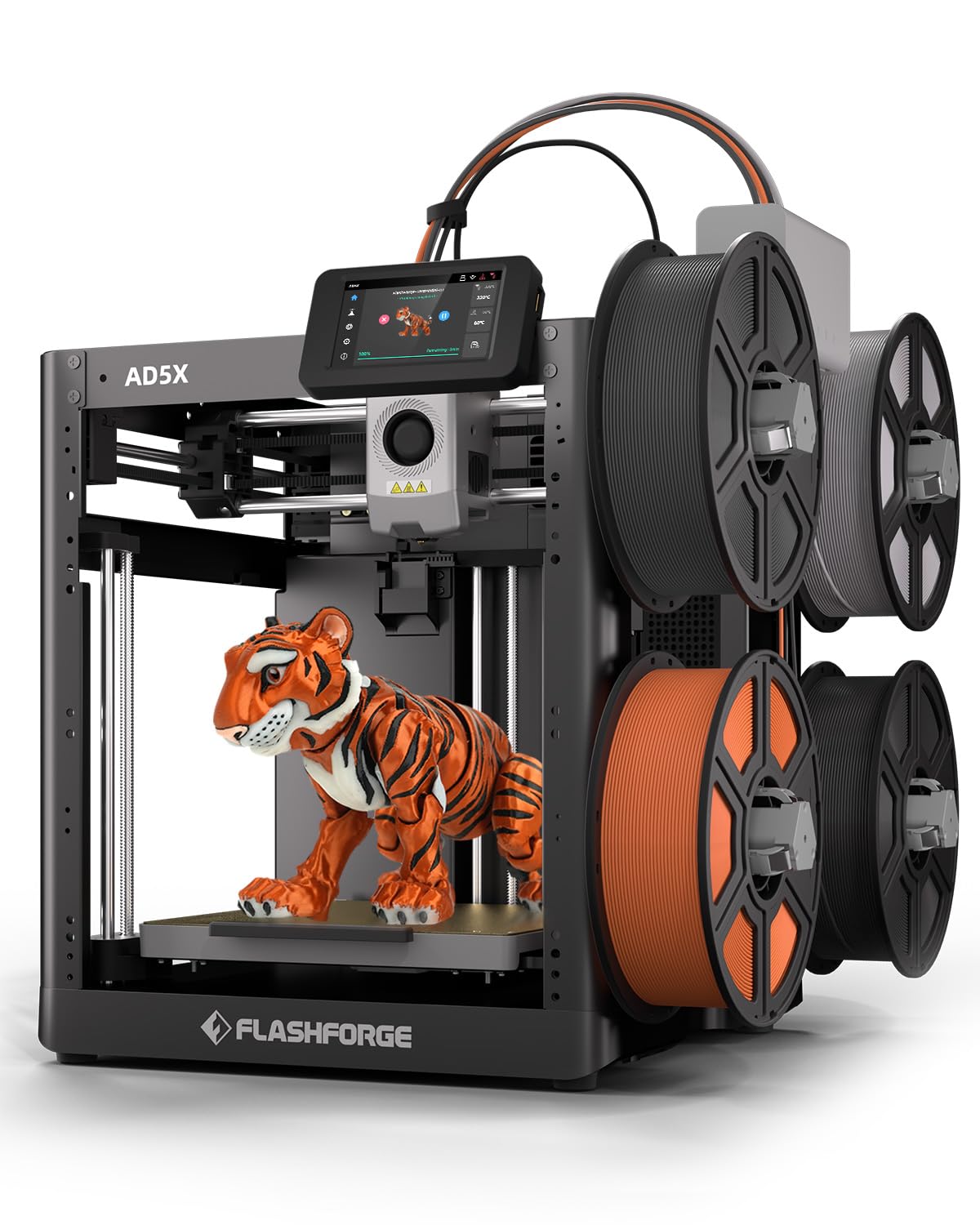
CoreXY speed with built-in 4-color printing — and a setup measured in minutes.
The AD5X hits 600 mm/s and 20,000 mm/s² acceleration — 20% faster than the ELEGOO Centauri Carbon’s 500 mm/s top speed. For perspective, a 600 mm/s print head covers a 220 mm cube in a little over a third of a second, making the AD5X the fastest in this list. Owners mention a quick setup under 30 minutes, helped by 1-click auto-leveling that gets the bed ready on its own. The direct-drive extruder (the motor is right at the print head) reaches 300°C, handling PLA, ABS (acrylonitrile butadiene styrene, a tough plastic used in LEGO bricks), PETG, and flexible TPU, and you can swap between four nozzle sizes (0.25 to 0.8 mm) for detail work or fast, chunky parts.
At 24.2 pounds it is 6 pounds heavier than the Bambu A1 but still manageable, and the 220×220×220 mm build volume is about 16% smaller than the 256 mm cube of the Centauri Carbon. A built-in resume-printing function handles power loss, and you monitor prints remotely through the Flash Maker mobile app. The multi-color unit is integrated, so you do not need a separate add-on — unlike the Bambu A1, which requires the separate AMS lite.
Why it stands out
- 600 mm/s CoreXY speed — the fastest in this list
- Built-in 4-color printing, no extra unit required
- Four nozzle sizes for detail or speed
- 1-click auto-leveling for quick starts
Where it gives ground
- 220 mm cube is smaller than several competitors
- Multi-color purging can be noisy — enclosure helps
- Software (Orca fork) has a learning curve
Best suited for: makers who want multi-color and blistering speed without buying an add-on module.
skip it if: you need a 256 mm or larger build volume for big single-piece models.
3. Anycubic Kobra X Multicolor 3D Printer
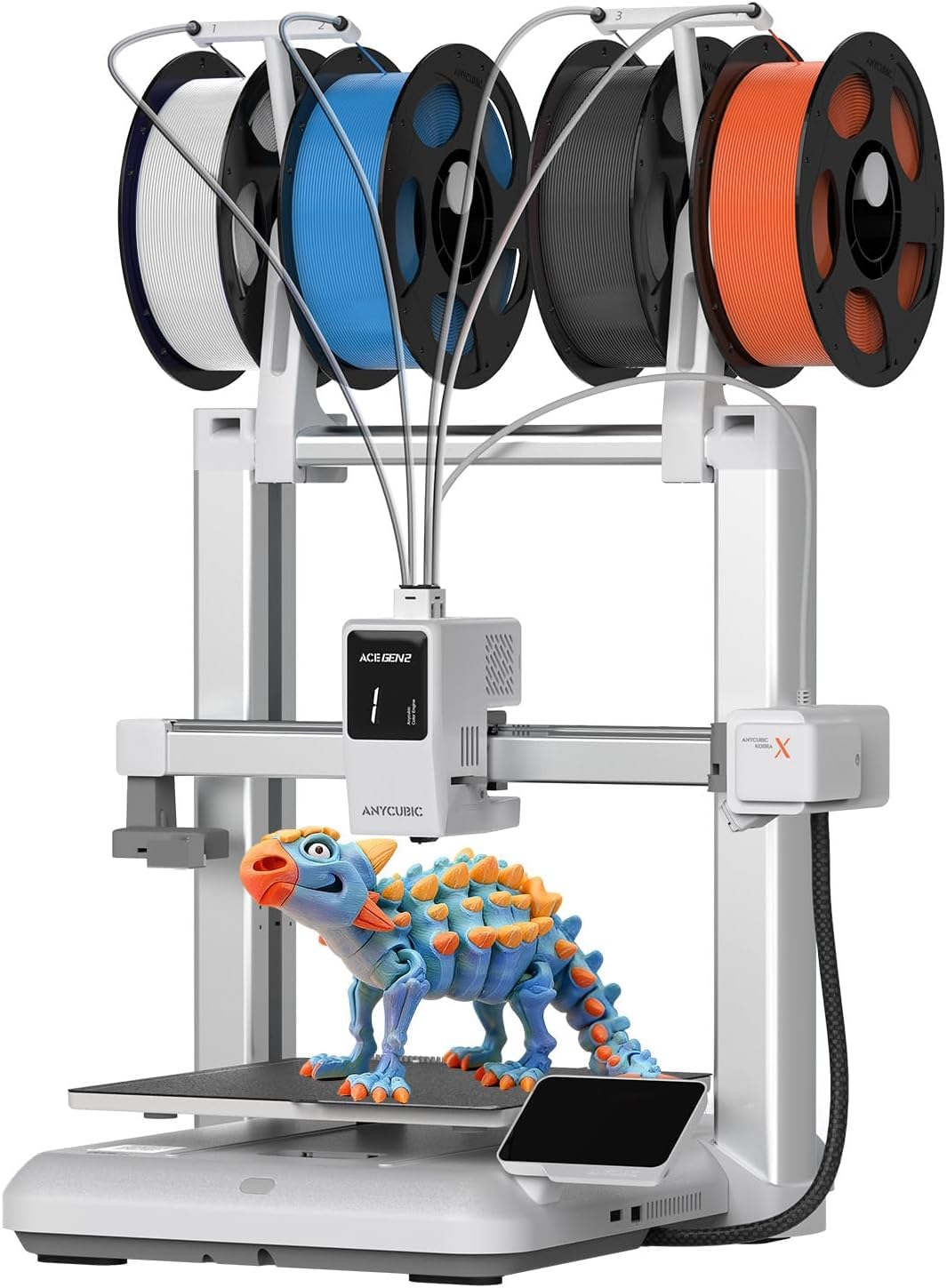
The largest build volume in this list with native 4-color printing — a genuine value surprise.
The Kobra X gives you a 260 mm cube — bigger than the 256 mm cubes of the Bambu A1 and ELEGOO Centauri Carbon, and a full 44% more space than the FLASHFORGE AD5X’s 220 mm across. That extra 40 mm per side means you can print a full-size bike helmet in one piece rather than assembling separate sections. It comes with 4-color printing built in, expandable to 19 colors with up to four ACE 2 Pro units (add-on color-changing modules). The speed matches the AD5X at 600 mm/s, and the LeviQ 3.0 auto-leveling uses a 49-point calibration to guarantee a flat first layer.
Customers note 265 hours of printing across PLA, PETG, and TPU with only one user-error failure — a sign of real reliability. The AI camera (artificial intelligence) detects spaghetti failures (tangled stringy messes) and foreign objects, so you can walk away and check in via the Anycubic App. At 20.9 pounds it is lighter than the AD5X. One reviewer noted some layer lines with stone PLA (a textured PLA) and said the slicer software (the program that converts 3D models into printer instructions) had glitches, so the software side is less polished than Bambu’s ecosystem.
What makes it a standout
- 260 mm³ build volume — biggest in the group
- 4-color built-in, expandable to 19 colors
- 600 mm/s speed with hardened steel nozzle
- AI camera for spaghetti and object detection
What holds it back
- Slicer software reported as glitchy by some users
- GEN 2 ACE system not compatible with older ACE Pro
Grab this for: the biggest build area and multi-color versatility at a price that undercuts most rivals.
Think twice if: you want the most polished, glitch-free software experience straight from the start.
4. ELEGOO Centauri Carbon 3D Printer
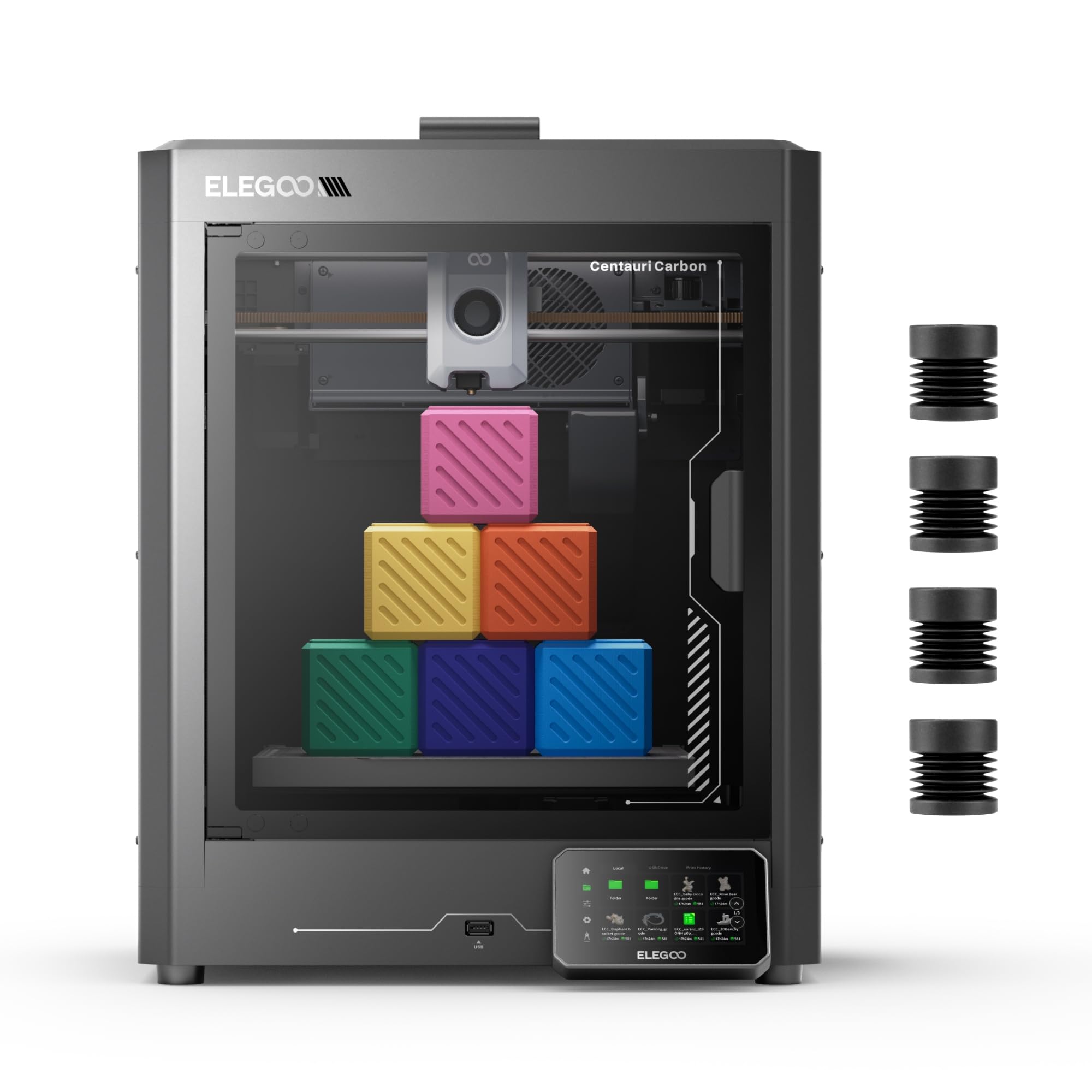
A rock-solid enclosed CoreXY machine that handles carbon fiber and stays true at speed.
The Centauri Carbon uses a rigid, integrated die-cast aluminum frame that quells vibration even at 500 mm/s with 20,000 mm/s² acceleration. That stiffness, combined with automatic vibration compensation and pressure advance (software that adjusts the filament flow before cornering), means smooth first layers and consistent quality across long prints. The 256×256×256 mm build volume matches the Bambu A1’s capacity. Its brass-hardened steel nozzle reaches 320°C, so you can print carbon fiber reinforced filaments like PLA-CF and PETG-CF — strong, lightweight parts for drones or automotive use.
Reviewers point out it vibrates noticeably on a flimsy desk but prints well. The built-in chamber camera with dual LED lighting lets you monitor prints and capture time-lapses remotely. One reviewer praised the “set and forget” auto-leveling and said after 300–400 hours of PETG/PLA+ printing, bed adhesion remained excellent. Compared to the Creality K1C, the Centauri Carbon is 11 pounds heavier (38.5 lb vs. 27.5 lb) due to its die-cast frame, offering more vibration damping for demanding materials.
Why it justifies the cost
- Die-cast aluminum frame for vibration-free high-speed printing
- 320°C nozzle handles carbon fiber filaments
- Fully enclosed with dual-layer cooling
- Built-in camera with time-lapse and remote monitoring
What to watch for
- 38.5 pounds — not a machine you move often
- USB-C cable on moving part can fail; replacement unit was reliable
- ElegooSlicer crashed on complex STL with older laptop per one review
Ideal for: makers who print advanced materials like carbon fiber and want an enclosed, vibration-free workhorse.
Not for: anyone who needs a portable machine or a smaller footprint.
5. FLASHFORGE AD5M Pro 3D Printer

A fully enclosed machine with a 3-second nozzle change — built for classrooms and shared spaces.
The AD5M Pro matches the AD5X’s 600 mm/s CoreXY speed but adds a fully enclosed chamber with dual-layer filtration (a carbon filter and a HEPA-like mesh) that blocks dust and smoke, making it suitable for a classroom or studio. You can swap between the included 0.4 mm and 0.6 mm nozzles in 3 seconds — no tools, no disassembly — and the direct-drive extruder handles flexible TPU just as easily as PLA, ABS, and PETG. The built-in camera lets you check prints remotely via the Maker app.
At 32.2 pounds it is 8 pounds heavier than the AD5X but lighter than the Centauri Carbon. The 220×220×220 mm build volume is identical to the AD5X, so the same size constraint applies. Another noted the software on the included USB is outdated and suggests downloading the latest version directly. The enclosed chamber also reduces the noise of multi-color purging compared to the open AD5X.
What makes it useful
- Fully enclosed with dual-layer filtration for clean air
- 3-second quick-swap nozzles for different filament types
- 600 mm/s CoreXY speed with vibration compensation
- Filament runout detection and power-loss recovery
Where it falls short
- 220 mm build volume — smaller than the Bambu and ELEGOO
- Software on USB is outdated; needs manual download
- Enclosure adds weight — 32.2 pounds
Choose this if: you print in a shared or indoor space and want the filtration plus fast nozzle swaps.
Pass on it if: you want the largest possible build volume or an integrated multi-color unit.
6. Creality K1C 3D Printer

A clog-free extruder and a tri-metal nozzle that handles carbon fiber without hesitation.
The K1C inherits the CoreXY structure from the K1 series, hitting 600 mm/s with 20,000 mm/s² acceleration, and its clog-free extruder is rated by Creality for 1,000 hours of trouble-free extrusion. The tri-metal nozzle and thermal barrier are one unit, which blocks heat creep (heat moving up the nozzle and softening filament too early) and makes replacement easy. This printer is explicitly built for carbon fiber filaments (PLA-CF, PETG-CF), using a hardened steel nozzle tip and a closed chamber to manage the abrasive material. The silent mode drops noise to ≤45 dB; the Bambu A1 is listed at ≤48 dB.
At 27.5 pounds it splits the difference between the AD5X and the Centauri Carbon. The 220×220×250 mm build volume adds 30 mm of height over the FLASHFORGE AD5X, useful for taller parts like a vase or a model airplane fuselage. The AI camera proactively alerts you to print failures and supports time-lapse recording. One reviewer with over 200 prints in TPU, PETG, and PLA called it a major upgrade from an Ender 3 and said the self-leveling was flawless. A separate buyer mentioned the air filter is ineffective and the documentation is thin, recommending YouTube videos for setup. Compared to the ELEGOO Centauri Carbon, the K1C is 11 pounds lighter and has a taller build volume (250 mm vs. 256 mm high) but a smaller footprint (220×220 mm base).
Why it earns its place
- 1,000-hour clog-free extruder rating (per Creality)
- Tri-metal nozzle handles carbon fiber and high-temp filaments
- 600 mm/s speed with 20,000 mm/s² acceleration
- Silent mode at ≤45 dB
What could be better
- Air filter reported as ineffective by some users
- Documentation is thin — YouTube recommended for setup
- Customer service noted as slow by one reviewer
Pick this for: carbon fiber projects and long, unattended print runs where a clog would waste hours.
pass on it if: you need a simple, manual-free setup experience — the K1C rewards someone willing to research online.
Understanding the Specs
CoreXY vs. Bed Slinger
CoreXY moves only the print head along two belts, staying light and fast — ideal for 500–600 mm/s speeds. A bed slinger (like the Bambu A1) shifts the whole bed back and forth, which is quieter but can wobble tall prints at speed. CoreXY is better for rapid prototyping; bed slingers are often easier to calibrate.
Build Volume — the 220-to-260 mm gap
Build volume is the tallest, widest, and deepest shape the printer can make in one piece. A 220 mm cube fits most phone cases and smaller masks; a 256 or 260 mm cube can handle helmets, drone frames, and larger cosplay parts. The difference between 220 and 260 mm means about 44% more usable space in each dimension.
Nozzle Temperature and Materials
Standard PLA prints at around 200–230°C. A nozzle capable of 300°C or higher opens up ABS, PETG, TPU, and carbon fiber filaments. Brass nozzles wear quickly with abrasive materials like carbon fiber; hardened steel or tri-metal nozzles (Creality K1C, ELEGOO Centauri Carbon) last much longer.
Auto-Leveling and Vibration Compensation
Auto-leveling uses a sensor to measure the print bed at multiple points and adjust the nozzle to stay perfectly parallel — the LeviQ 3.0 on the Anycubic Kobra X uses 49 points. Vibration compensation (often called “input shaping”) counteracts shaking during fast moves, keeping layers aligned. Together they turn a 20-minute manual ritual into a tap of a button.
FAQ
Can a 3D printer under $400 really print multiple colors?
How do I choose between a CoreXY and a bed-slinger printer at this price?
Is the ELEGOO Centauri Carbon worth the extra weight?
Which printer has the largest build volume under $400?
Can I print carbon fiber filaments with these printers?
How noisy are these printers during operation?
Do these printers come fully assembled?
What is the difference between the FLASHFORGE AD5X and the AD5M Pro?
How many hours can I expect these printers to run reliably?
Final Thoughts: The Verdict
For most people, the 3d printer under $400 winner is the Bambu Lab A1 because it combines beginner-friendly auto-calibration, 48 dB silent operation, and a 256 mm build volume at a price that leaves room for filament. If you want multi-color speed, grab the FLASHFORGE AD5X. And for the largest build volume with built-in 4-color printing, the standout is the Anycubic Kobra X.
How We Picked
We do not accept paid placement. Every pick is matched to a real buyer and a real use-case; we do not hands-on test units.
Sources & Methodology
Specifications: manufacturer listings and product documentation. Review insights: verified customer reviews, as of July 2026. Pricing: not shown on this page (it changes often); check the current price via the retailer link.
As an Amazon Associate, FitlyFast earns from qualifying purchases. This does not affect which products we feature.