
Our readers keep the lights on and the weekend projects moving. As an Amazon Associate, I earn from qualifying purchases.
Specs are compiled from manufacturer listings and verified buyer reviews and can change over time — please confirm the key details on the product page before buying.
Cutting porcelain, glass, or hard tile without chipping the edge is the single biggest headache in tiling — a bad blade leaves a ragged finish that no amount of grout can hide. The right 7-inch wet tile saw blade changes that completely, giving you a smooth, clean cut on every pass.
I’m Rikta — the founder and writer behind FitlyFast. This guide is built by comparing the manufacturers’ published specifications and the patterns across verified customer reviews, so you get each pick’s real strengths and trade-offs instead of marketing spin.
Whether you are wrapping up a backsplash or cutting your own stone, choosing the right 7 inch wet tile saw blade is the difference between a crisp professional finish and wasted material you will have to replace.
Quick Picks
- MK Diamond 158434 7″ MK-225 Hot Dog Premium Thin-Rim Blade — Top Performer
- QEP 7″ Black Widow Premium-Grade, Thin Rim Diamond Blade 6-7008BW — Fast Cutter
- QEP 6-7006GLQ 7-Inch Continuous Rim Glass Tile Diamond Blade — Glass Specialist
- Kingthai 7 Inch for Cutting Porcelain Tiles Ceramic Continuous Rim Diamond Saw Blade — Budget Champion
How To Choose The Best 7 Inch Wet Tile Saw Blade
A 7-inch wet tile saw blade is a specific tool for a specific job, and picking the wrong one usually means edge chipping, wasted tiles, and slower cutting. Here is what actually matters when you compare them.
Rim Thickness and Rim Height
Rim thickness affects how much material the blade removes — called the kerf. A thinner rim (around 1.7 millimeters) removes less tile, so the saw has an easier time and you get less waste. Rim height (the depth of the diamond edge on the blade) determines how many cuts you get before the blade wears down. A 7-millimeter rim height typically lasts longer than a shorter one.
Continuous Rim vs Segmented Rim
A continuous rim blade has one smooth diamond edge with no gaps. This design gives you the cleanest finish with almost no chipping, making it the right choice for glass, glazed ceramic, and polished porcelain. Segmented or micro-segmented rims have small slots — they cut faster and stay cooler on heavy jobs, but you may see more edge chipping on delicate materials.
Arbor Size
The arbor is the hole in the center of the blade that sits on the saw’s shaft. Most 7-inch wet saw blades use a 5/8-inch arbor, which fits the majority of brands. Some blades come with reducer rings to fit smaller arbors, but you should always check your saw’s arbor size before buying.
Quick Comparison
| Model | Best For | Rim Thickness | Rim Height | Arbor | Amazon |
|---|---|---|---|---|---|
| MK Diamond 158434 Hot Dog | Hard porcelain and natural stone | — | — | 5/8″ | Amazon |
| QEP Black Widow 6-7008BW | Fast cutting hard masonry tile | 3 Millimeters | 7mm | 5/8″ | Amazon |
| QEP 6-7006GLQ | Glass tile and thin ceramic | 7 Millimeters | 7mm | 5/8″ | Amazon |
| Kingthai 7 Inch | Budget-friendly small tile jobs | 1.7 Millimeters | 1.7mm | 22.23mm | Amazon |
In‑Depth Reviews
1. MK Diamond 158434 7″ MK-225 Hot Dog Premium Thin-Rim Blade

The thin-rim specialty blade for hard tile and stone that cuts fast without chipping.
This blade is built for the tough stuff — porcelain, hard vitreous tile, slate, limestone, granite, marble, and even hard quartz. The stiffening and cooling slots keep the blade running straight through dense materials, so you don’t fight a wandering cut. Buyers report it cuts in about 2 minutes what other blades took 15 minutes to do on rocks like agates, which gives you a real sense of its speed.
The Hot Dog has a noticeably thinner kerf than many competitors, meaning it removes less tile and puts less strain on your saw. One reviewer noted it measures under 10 thousandths of an inch of runout (wobble), which is significantly flatter than the QEP Black Widow’s roughly 20 thousandths. That straightness lets you cut down to 1-millimeter strips without breaking them — something thicker blades struggle with.
On the flip side, buyers also mention the diamonds may wear faster on dense porcelain because the blade is tune for cut quality over longevity. One reviewer working on a large project with thick tiles went through three blades. If you have a massive tiling job with tons of bevel cuts, you may want to keep a spare on hand.
Why It Leads
- Very low runout (under 10 mil) gives straight cuts and thin strips down to 1mm
- Thinner kerf (50 mil vs 64 mil) reduces saw load and cuts faster
- Handles porcelain, granite, marble, slate, and agates well
The Trade-off
- Diamonds can wear faster on heavy duty jobs with thick porcelain
- Wander can occur if your saw arbor has any misalignment
Sharp pick for: anyone cutting hard porcelain, stone, or thick tile who wants the straightest, thinnest cut possible with minimal chipping.
Consider the alternative if: your daily job is cutting hundreds of feet of standard ceramic tile — you may wear this blade faster than a thicker rim one.
2. QEP 7″ Black Widow Premium-Grade, Thin Rim Diamond Blade 6-7008BW

A workhorse blade that slashes through porcelain in seconds without breaking your budget.
The Black Widow is a fast cutter, plain and simple. Owners mention that on a Rigid wet saw, this blade cuts through porcelain in about 3 to 4 seconds compared to over 15 seconds with the stock OEM blade — a massive time save on a big floor or wall project. The micro-segmented rim cuts aggressively while keeping the finish clean, and the unique diamond-shaped laser cutouts help keep the blade cool and reduce wobble.
At 0.69 pounds, it is noticeably heavier than the MK Hot Dog at 0.45 pounds — that extra mass and a 3-millimeter thickness give it a feel of durability. One buyer mentioned their first Black Widow was still going strong after a full bathroom remodel. It also handles cutting aluminum Schluter edging, a bonus if you are finishing tile edges with metal trim.
The catch is that some customers note it has about double the runout (wobble) compared to the MK Hot Dog, which means it may chip thicker pieces and cannot cut quite as thin strips. For standard tile thickness and straight cuts, you will not notice it — but for precision 1-millimeter strips, the Hot Dog is the better choice.
Strengths
- Extremely fast cuts on porcelain (3-4 sec vs OEM blade’s 15+ sec)
- Thin kerf and micro-segmented rim reduce chipping
- Long-lasting — survives full bathroom remodels
Limitations
- Higher runout (~20 mil) than premium competition
- Not ideal for cutting very thin (under 2mm) strips
Grab this if: you need a fast, durable blade for everyday porcelain and ceramic tile work and value cut speed over ultra-precision.
skip it if: you regularly cut thin strips under 2mm or demand the flattest possible blade for glass-like finish.
3. QEP 6-7006GLQ 7-Inch Continuous Rim Glass Tile Diamond Blade

A smooth-cutting blade built specifically for glass and delicate tile that stops chipping cold.
If you are cutting glass tile, this blade is the standout choice. Its continuous rim design gives you a smooth, fine finish that standard segmented blades cannot match. Reviewers point out it cut over 100 beer bottles and 20 wine bottles cleanly without any chipping or unevenness — a real indicator of how gentle it is on fragile surfaces. The 7-millimeter rim height gives it good longevity for a blade in this category.
The rim thickness is 7 millimeters, which is the thickest in this lineup and far thicker than the Kingthai’s 1.7-millimeter rim — a 4.1 times gap. That thick rim makes the blade stable and reduces vibration, which matters when you need a dead-straight cut on a glass mosaic. One reviewer called it a huge improvement over a regular tile blade for a 1-inch glass tile backsplash, saying it performs as well as 80-dollar blades for much less.
On the downside, a thick rim means the blade removes more material (a wider kerf), and you may need to sand edges for a truly polished finish on glass. The blade also sprays more water than other options, which is fine with a wet saw but something to be aware of if your workspace is tight.
Why It Works
- Continuous rim gives the cleanest, most chip-free cut on glass and glazed tile
- 7mm rim height provides good blade life for the price
- A solid performer that rivals blades costing twice as much
The Downside
- Thicker rim (7mm) creates a wider kerf and removes more material
- Edges may still need light sanding for a fully polished finish
Best suited for: glass tile backsplashes, mosaic work, and any delicate tile where chipping is your biggest worry.
Not the best choice for: heavy production cutting of thick porcelain — the thick rim makes it slower on dense materials.
4. Kingthai 7 Inch for Cutting Porcelain Tiles Ceramic Continuous Rim Diamond Saw Blade
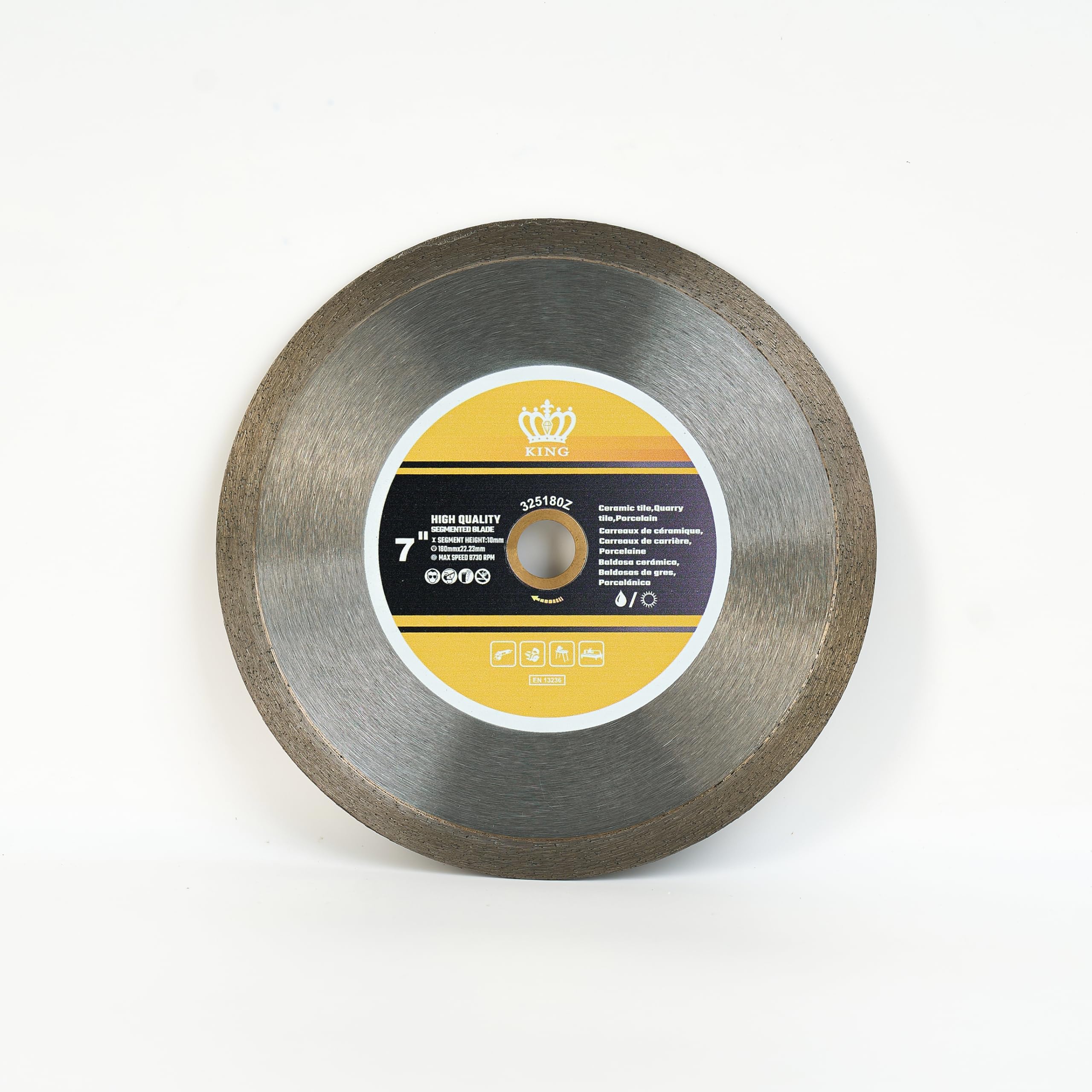
A thin-rim budget blade that delivers a perfect cut — for about five tiles.
The Kingthai blade has the thinnest rim in this lineup at only 1.7 millimeters, which means it removes the least material of any blade here. Shoppers say that it cut the first five tiles like butter with edges that were perfect. On a small repair or a single backsplash splash of a few tiles, that is exactly what you want — a clean, smooth cut at the lowest possible cost.
The continuous rim design and hot-pressed sintered technology aim to give good segment density and connection strength. For its intended use — ceramic and porcelain tile cutting on an angle grinder, circular saw, or wet saw — it works as intended. Multiple reviewers mentioned it slices through ceramic tile cleanly with no better or worse performance than other comparable brands.
Where this blade falls short is longevity. One detailed review noted that after just ten cuts, the blade started showing chatter marks, glazing, and chips on the tile edges — and by then it was worse than the worn-out blade it was meant to replace. If your project is five tiles, you are fine. If it is any larger, you would be better off with a mid-range or premium option.
What You Get
- Very thin 1.7mm rim for a narrow kerf and less waste
- Hot-pressed continuous rim for smooth cuts when new
- Affordable price for small one-off tiling jobs
The Catch
- Wears out fast — some buyers saw chipping after only 10 cuts
- Not suitable for large projects or heavy daily use
Reach for this if: you have a small job involving five or fewer tiles and want a blade that works well for that specific task without spending much.
Look elsewhere if: you need a blade that will survive a full project with dozens or hundreds of cuts — the performance drop is noticeable and rapid.
Understanding the Specs
Rim Thickness
Rim thickness is the width of the diamond cutting edge on the blade, measured in millimeters. A thinner rim (like 1.7mm) removes less tile — this gives a narrower kerf, less dust, and puts less strain on your saw. A thicker rim (like 7mm) creates a wider cut but tends to last longer and vibrate less. For delicate materials like glass, a thicker rim can actually help keep the blade stable. For fast production cutting of porcelain, a thinner rim is usually better.
Arbor Size
The arbor is the center hole of the blade that fits onto your saw’s shaft. The standard for most 7-inch wet tile saw blades is 5/8 inch, which fits the vast majority of brands like MK Diamond, QEP, Rigid, and Husky. Some blades have a 22.23mm arbor or come with reducer rings to adjust the fit. You should always check your saw’s manual for the correct arbor size before buying a blade — a mismatch means the blade simply will not mount.
FAQ
Will a 7 inch wet tile saw blade fit my brand of saw?
What is the difference between a continuous rim and a segmented rim blade?
Can I use a 7 inch wet blade on a dry saw?
How long does a 7 inch wet tile saw blade last?
Why does my blade chip the tile edges?
What does “rim height” mean on a tile saw blade?
Can these blades cut materials other than tile?
Is a thinner blade always better for cutting tile?
Final Thoughts: The Verdict
For most people, the 7 inch wet tile saw blade winner is the MK Diamond 158434 Hot Dog because it delivers the straightest, thinnest cut on hard tile and stone with minimal chipping, backed by the lowest runout in the group. If you need fast everyday cutting of porcelain and ceramic, grab the QEP Black Widow. And for glass tile and delicate work, the standout is the QEP 6-7006GLQ.
How We Picked
We do not accept paid placement. Every pick is matched to a real buyer and a real use-case; we do not hands-on test units.
Sources & Methodology
Specifications: manufacturer listings and product documentation. Review insights: verified customer reviews, as of July 2026. Pricing: not shown on this page (it changes often); check the current price via the retailer link.
As an Amazon Associate, FitlyFast earns from qualifying purchases. This does not affect which products we feature.