
Our readers keep the lights on and the weekend projects moving. As an Amazon Associate, I earn from qualifying purchases.
Specs are compiled from manufacturer listings and verified buyer reviews and can change over time — please confirm the key details on the product page before buying.
You plug a cellular SIM into a 5g wifi router with sim card slot, and within moments you get a full home or office network — no cable company needed, no fiber trenching, no landlord permission. You might live in a rural dead zone, work from an RV, or need a backup when your wired internet drops. The real question is not “should I get one” but “which one stays connected without constant rebooting.” All the routers here accept a nano SIM, support 5G NR (both standalone and non-standalone modes), and create a Wi-Fi 6 network. The difference between a steady 200 Mbps and a router that crashes every two days depends on the modem chipset, the antenna setup, and the quality of the firmware underneath.
I’m Rikta — the founder and writer behind FitlyFast. This guide is built by comparing the manufacturers’ published specifications and the patterns across verified customer reviews, so you get each pick’s real strengths and trade-offs instead of marketing spin.
The key specs that matter most are the data transfer rate (how fast the cellular connection pushes data), the Wi-Fi generation (Wi-Fi 6 matters for multiple devices), and the physical antenna configuration — stronger antennas mean better reception in weak-signal areas. This guide walks through seven of the best 5G WiFi routers with SIM card slots based on what actual long-term buyers report after months of daily use.
Quick Picks
- GL.iNet GL-X3000 (Spitz AX) — Best Overall
- Hitron D60 5G Cellular Router — Fastest Modem
- SquareWiz RM520N AX3000 WiFi 6 5G Router — Wide Coverage
- UOTEK 5G SIM Card Router CPE — Pocket-Friendly
- GL.iNet GL-XE3000 (Puli AX) — Road Warrior
- Cudy P5 5G NR SA NSA AX3000 CPE Router — Control Freak
- Yeacomm NR610 Outdoor 5G Router — Outdoor Beast
How To Choose The Best 5G WiFi Router With SIM Card Slot
The biggest mistake is shopping by Wi-Fi speed alone. A router that claims AX3000 Wi-Fi on the box but uses a weak modem chipset will still give you sluggish internet because the 5G connection itself — not the Wi-Fi — is the bottleneck. You want a router where the cellular modem and the Wi-Fi chipset are matched in capability.
Modem chipset and carrier certification
The Qualcomm Snapdragon SDX62 is the modem you see in the most reliable picks here — it supports 5G NR sub-6 GHz on both standalone (SA) and non-standalone (NSA) architectures and can handle downlink speeds up to 3.4 Gbps on NSA. Carrier certification is just as critical: if the router is not certified for T-Mobile, AT&T, or Verizon (depending on your carrier), you risk it failing to connect or being limited to slower 4G speeds. Check that the router is certified with your specific carrier before you buy.
Antenna configuration — internal vs. detachable
Routers with internal antennas are sleeker and simpler to set up — just place them near a window and go. Detachable antennas let you replace the stock antennas with larger outdoor or directional ones, which is often the only way to get a usable signal in metal buildings, basements, or locations with heavy tree cover. If you are in a strong urban signal area, internal antennas are fine; if you are in a fringe area, detachable antennas are non-negotiable.
Single SIM vs. dual SIM and failover
Dual-SIM routers let you insert two SIMs from different carriers and set one as the primary and the other as the backup. If the primary carrier goes down, the router automatically fails over to the secondary SIM. Some dual-SIM routers support load balancing — using both connections at once — but most in this price range use failover only (one active, one waiting). If uptime is critical for work or a small business, dual-SIM with automatic failover is worth the premium.
Quick Comparison
| Model | Best For | Data Transfer Rate | Wi-Fi Standard | Antenna Type | Amazon |
|---|---|---|---|---|---|
| GL.iNet GL-X3000 | Advanced customization & dual-SIM failover | 3000 Mbps | Wi-Fi 6 (AX3000) | 6 detachable | Amazon |
| Hitron D60 | Rural plug-and-play with failover | 3.4 Gbps | AX3000 Wi-Fi 6 | Internal | Amazon |
| SquareWiz RM520N | Large homes with many connected devices | 3400 Mbps | AX3000 Wi-Fi 6 | 9 detachable | Amazon |
| UOTEK 5G CPE | Budget-friendly indoor use | 1800 Mbps | Wi-Fi 6 | Internal | Amazon |
| GL.iNet GL-XE3000 | Portable power-outage backup with battery | 3000 Mbps | Wi-Fi 6 (AX3000) | Retractable | Amazon |
| Cudy P5 | Advanced network controls & band locking | 2976 Mbps | AX3000 Wi-Fi 6 | Detachable | Amazon |
| Yeacomm NR610 | Outdoor pole-mount installation in harsh weather | 4.67 Gbps | Wi-Fi 2.4 GHz (bridge mode) | Internal (built-in) | Amazon |
In‑Depth Reviews
1. GL.iNet GL-X3000 (Spitz AX)

The tinkerer’s dream with a 5G modem that actually keeps the connection alive.
If you want to tweak every setting — from VPN encryption method to which cellular band the router locks onto — this is the one. The GL-X3000 runs on GL.iNet’s own firmware based on OpenWrt, giving you access to over 5,000 plug-ins for customizing how the router behaves. The modem supports both NSA and SA 5G standards and includes a dual-SIM setup with automatic failover, so if one carrier goes down, the other SIM takes over without you lifting a finger. Reviewers report it works well with T-Mobile and AT&T IoT plans, and one owner noted that the automatic network switching between the two SIMs worked “awesome” after some initial tweaking.
On the Wi-Fi side, you get up to 574 Mbps on the 2.4 GHz band and 2402 Mbps on the 5 GHz band, using Wi-Fi 6 with MU-MIMO (multiple-user, multiple-input, multiple-output — meaning it handles several devices at once without slowing each one down). The six detachable antennas give you room to upgrade the cellular antenna if you are in a weak-signal spot. Compared to the Hitron D60 below, the GL-X3000 gives you far more control over firmware and advanced routing features, but owners mention that the router can slow down after days of uptime, needing a reboot to clear latency spikes — one reviewer switched to a different brand because of this issue.
what separates it
- Dual-SIM with automatic failover gives true carrier redundancy
- OpenWrt-based firmware with deep customization and a large plugin library
- Six detachable antennas for upgrading reception in fringe locations
A real limitation
- Some customers note latency spikes and speed drops after extended uptime, requiring a periodic reboot
- Limited to dual-band carrier aggregation, which might not match routers with quad-band aggregation on the same modem
Reach for this if: You want full control over your router’s software and need dual-SIM failover for backup internet in an RV or remote office. The OpenWrt community means you can solve almost any network problem yourself.
Look elsewhere if: You just want to plug in a SIM and never touch settings again — the GL-X3000 rewards owners willing to spend an hour on initial configuration and occasional maintenance.
2. Hitron D60 5G Cellular Router
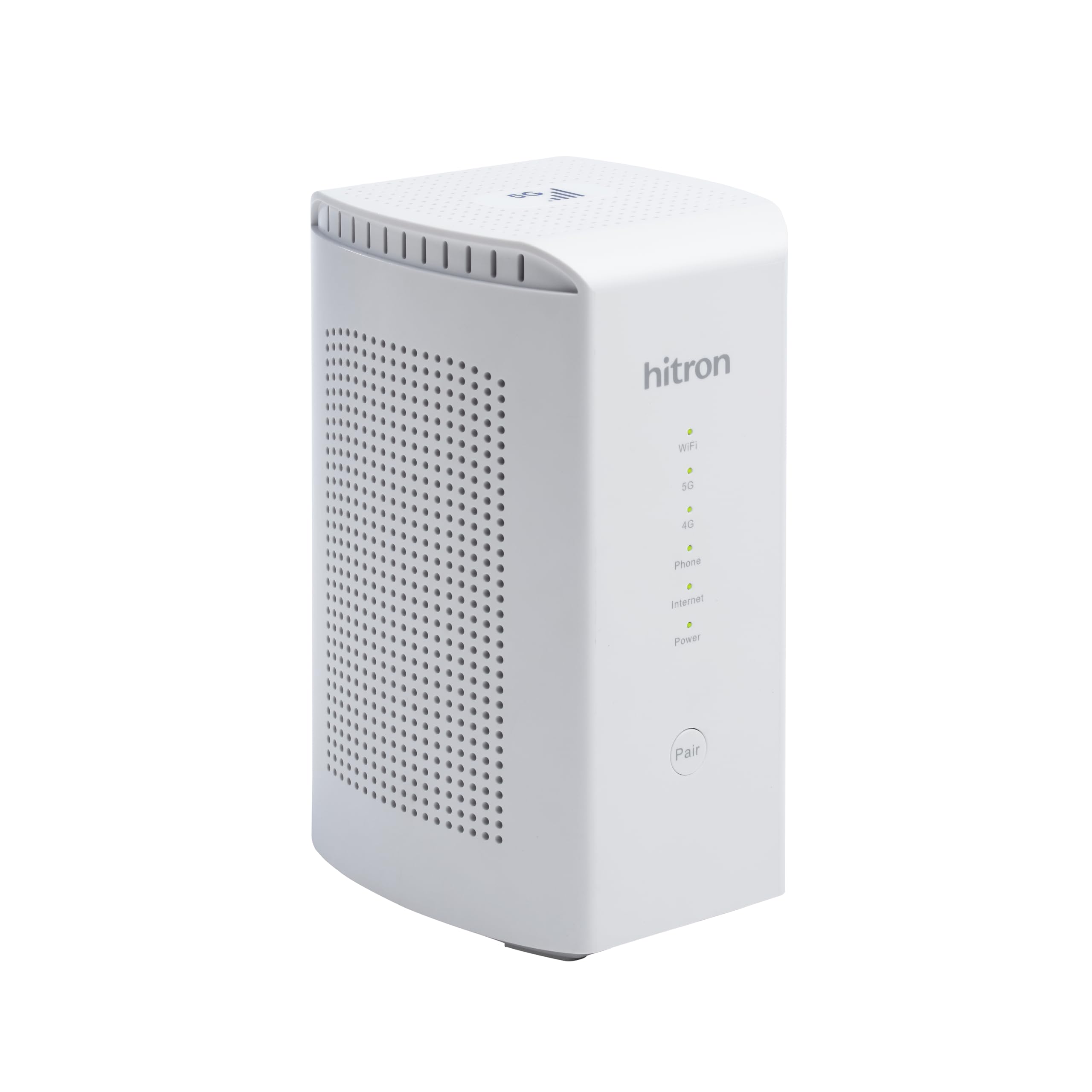
The get-online-fast box that hits 200 Mbps in a rural house minutes after opening.
This is the simplest on the list to set up — reviewers point out that it is essentially plug-and-play. You insert a nano SIM from AT&T, T-Mobile, or US Cellular (it is certified with all three), power it on, and within minutes you have a Wi-Fi 6 network running at AX3000 speeds. The data transfer rate is rated at 3.4 Gbps on 5G NSA, which translates to real-world speeds over 200 Mbps in the rural house of one reviewer, and around 300 Mbps from a T-Mobile SIM in a basement location that another owner reported. That is a 2.1x theoretical speed gap over the slower 1800 Mbps UOTEK router below.
The D60 also works as a 4G LTE router and supports cellular failover — if your wired internet goes down, the SIM automatically takes over so your home office stays online. Unlike the GL.iNet picks later in this list, the Hitron uses internal antennas, so you cannot upgrade them for weak-signal spots. One reviewer praised it as a “fast modem” with very low latency compared to a GL.iNet device, but also noted a major caveat: after 6-48 hours of uptime the device sometimes crashes, with only the power LED staying lit, requiring a full power cycle. That reliability gap is the main reason it sits below the GL-X3000 for overall value.
Why it works
- Certified with T-Mobile, AT&T, and US Cellular from the start — minimal compatibility risk
- True plug-and-play setup; several reviewers had it working within minutes
- Supports dual failover between a wired WAN and the cellular SIM for uninterrupted connection
The catch
- Multiple shoppers say the router crashes or becomes unresponsive after 6-48 hours, needing a manual reboot
- No detachable antennas — if the signal is weak where you place it, you cannot attach an external antenna
Best suited for: A straightforward rural setup where you can accept an occasional reboot in exchange for drop-dead-simple initial installation and carrier certification.
Not ideal if: You need rock-solid uptime for a critical business connection or you live in a very weak-signal area where internal antennas cannot cut it.
3. SquareWiz RM520N AX3000 WiFi 6 5G Router
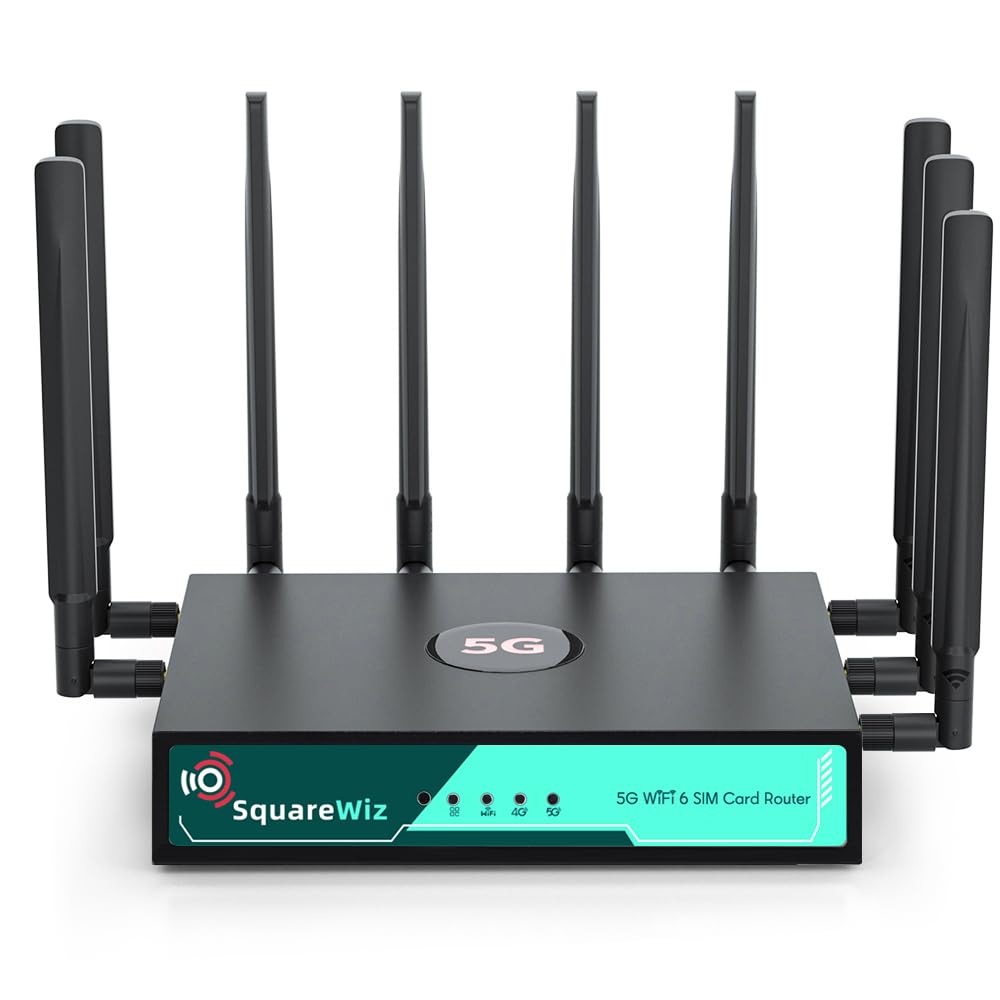
The 9-antenna brute that pushed one owner from 10 Mbps to 150 Mbps.
This router is built for environments where the 5G signal is weak and many people need Wi-Fi at once. It features four 5 dBi cellular antennas and five 5 dBi WiFi antennas — all detachable, so you can replace the stock cellular antennas with higher-gain outdoor ones if needed. The Qualcomm SDX62 modem inside delivers up to 3400 Mbps (nearly matching the Hitron D60 at 3.4 Gbps, an 89% gap over the 1800 Mbps UOTEK model) and supports connections for up to 128 simultaneous Wi-Fi users. One owner reported that their speed jumped from 10/1 Mbps to 150/50 Mbps after swapping in this router, a dramatic improvement that highlights how a good modem can rescue a terrible connection.
Coverage is rated at 300 square meters, and the router supports multi-WAN failover between Ethernet, repeater, cellular, and tethering connections — meaning you can prioritize which connection type the router uses first and fall back to another if it drops. Compared to the GL.iNet GL-X3000 above, the RM520N has more antennas (9 vs. 6) and a slightly higher data rate, but lacks the OpenWrt customization ecosystem. Reviewers do note a reliability concern: the router sometimes disconnects from the cellular network on a daily to weekly basis, and the scheduled restart feature does not seem to fix it. There is also no dedicated tech support or community forum to help troubleshoot.
Standout features
- 9 detachable antennas (4 cellular + 5 WiFi) give excellent flexibility for signal improvement
- Handles up to 128 devices simultaneously, making it suitable for offices or large gatherings
- Supports multiple VPN protocols — PPTP, L2TP, GRE, WireGuard, Zerotier — for secure remote connections
Known issues
- Random cellular disconnections reported by multiple owners, from daily to weekly frequency
- No manufacturer tech support or community forum to resolve issues
Pick this if: You need to cover a large area with many connected devices and want the flexibility to upgrade antennas for weak-signal spots.
skip it if: You cannot tolerate the risk of random disconnections and want a router with official support channels.
4. UOTEK 5G SIM Card Router CPE

The budget entry that outperforms brand-name gateways once you flash custom firmware.
At this price point, the UOTEK 5G CPE delivers a surprising amount of value. It has dual SIM card slots — one on each side of the router — with automatic switching, so if the primary carrier’s signal weakens, the router moves to the secondary SIM without manual intervention. The data transfer rate of 1800 Mbps is lower than the 3400 Mbps of the RM520N or the 3.4 Gbps of the Hitron D60, but one reviewer who came from a GL.iNet X3000 that failed twice noted that the UOTEK immediately connected to T-Mobile and delivered “stronger WiFi and faster speeds” than the carrier-issued Arcadyan gateway. In a weak-signal area, this reviewer consistently got around 200 Mbps.
The Wi-Fi 6 radio supports dual-band 4 spatial streams, which keeps UHD streaming smooth without buffering. The software interface is described as basic but adequate by owners, though the setup instructions leave out the default IP address and admin password — you need to know that the IP is at 192.168.100.1 and the password is “admin.” One reviewer upgraded to Rooter Goldenorb firmware and saw a major improvement: “I get much better speeds than I did on the carrier router. I never seem to lose connection now.” If you are comfortable with a little initial learning curve and the possibility of reflashing firmware, this is a bargain. The hardware itself is built solidly and runs cool according to long-term owners.
What you gain
- Dual SIM slots with automatic carrier switching for uninterrupted service
- Competitive real-world speeds (~200 Mbps) in weak-signal areas after initial setup
- Custom firmware (Rooter Goldenorb) compatibility dramatically improves reliability and speed
What you give up
- Lacks official mesh networking support despite claiming it — no clear way to enable it
- Basic software interface and very poor instruction manual; expect to research setup online
Go for this if: You are on a tight budget and have the patience to flash custom firmware for a big performance upgrade. The hardware spec is solid for the price.
Pass if: You want a router that works perfectly straight from the start with no tinkering and no missing instructions.
5. GL.iNet GL-XE3000 (Puli AX)
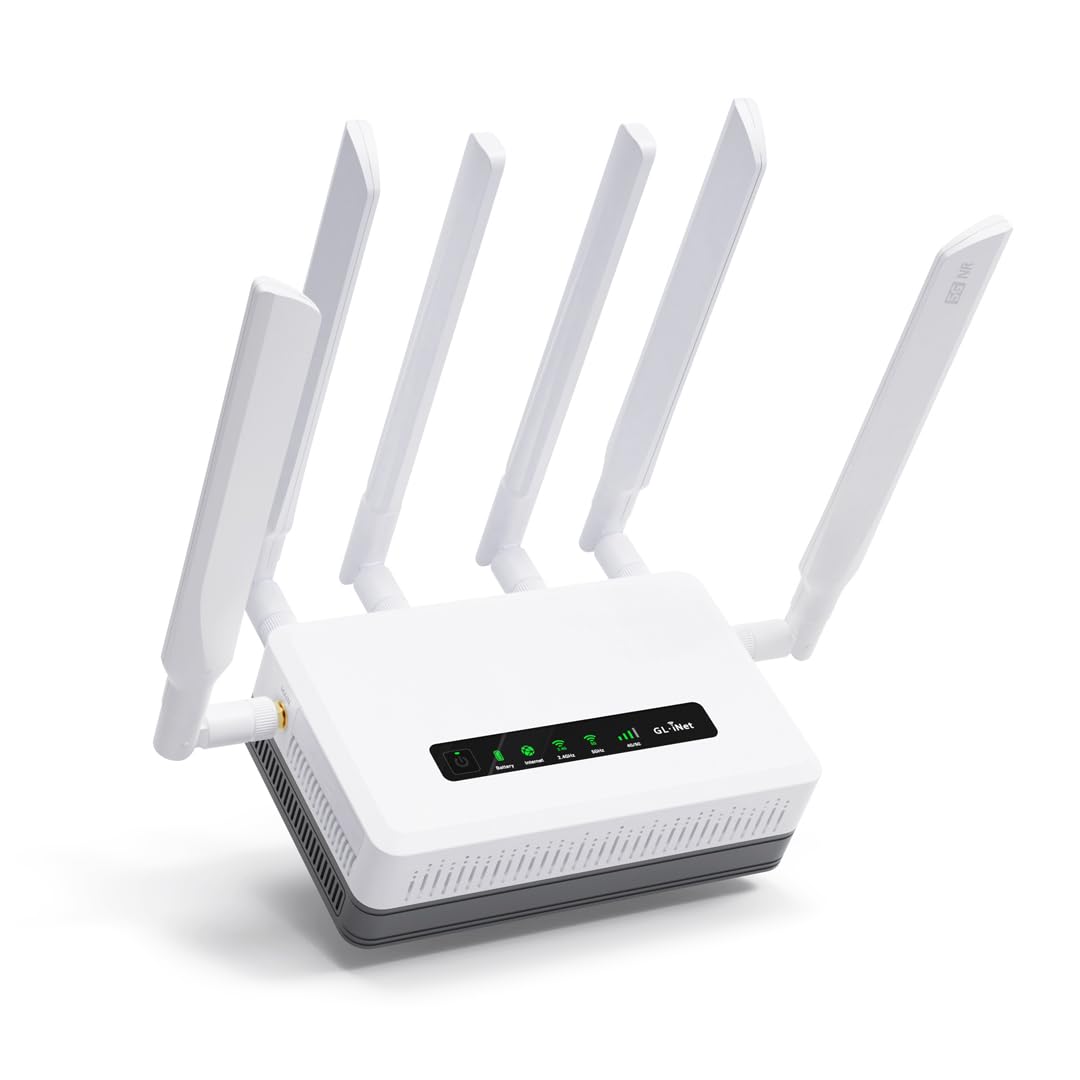
The 5G router that keeps your office running for 8 hours after the power goes out.
This is the same GL.iNet ecosystem as the GL-X3000 above, but with a built-in 6400 mAh battery that delivers up to 8 hours of operation during a power outage. That makes it a go-to for road trips, outdoor events, construction sites, and any situation where the power grid is unreliable. Like its sibling, it uses a 5G modem supporting NSA and SA standards, with a data transfer rate of 3000 Mbps, and dual-SIM slots with a single standby for automatic failover between carriers. The Wi-Fi 6 radio pumps out up to 574 Mbps on 2.4 GHz and 2402 Mbps on 5 GHz, enough for a full office of employees.
Buyers report that the setup is extremely straightforward — one reviewer noted inserting their SIM and having the router immediately detect and connect. The battery backup went through several hours of power outage without a drop. Another owner in an RV praised the router’s ability to find a signal “even in the middle of nowhere” across six states, consistently outperforming their phone’s reception. One critical review flagged concerns about the proprietary firmware based on OpenWrt version 21.02, warning of possible security vulnerabilities, though the overall feedback is strongly positive. Compared to the standard GL-X3000, the XE3000 trades a tiny bit of raw configurability for the battery and retractable antennas that are easier to travel with.
Biggest advantages
- Built-in 6400 mAh battery gives 6-8 hours of continuous use without wall power — real mobility
- Dual-SIM with automatic failover and OpenWrt firmware for advanced network control
- Retractable antennas make it compact enough for a travel bag
Consider this
- The bulk with antennas and battery is chunky — not a pocket device
- Single IMEI for both SIM slots can make carrier activation more complicated than expected
Perfect for: RV travelers, field workers, and small business owners who need reliable internet during power outages and lack of wired infrastructure.
Not for: Someone who just wants a stationary home router and has no use for the battery backup — you pay extra for a feature you would not use.
6. Cudy P5 5G NR SA NSA AX3000 CPE Router

The power-user router that lets you lock onto specific cellular bands to chase down the best signal.
If you have ever wanted to tell your router “only use LTE band 4 and 5G band n41,” the Cudy P5 gives you that control through a clean web interface. The band-lock feature lets you exclude congested or weaker bands and force the modem to stay on the fastest one, which is a big advantage over most consumer 5G routers. The Qualcomm Snapdragon SDX62 inside supports downlink speeds up to 3.4 Gbps (NSA) and 2.4 Gbps (SA), and the Wi-Fi 6 radio delivers AX3000 speeds. The dual SIM slots are paired with WAN failover, keeping you online even if one carrier’s network goes down.
Owners mention that the TTL adjustment feature (a way to make the cellular network treat the router’s traffic like phone traffic, avoiding throttling) works well and that the 5 GHz Wi-Fi easily covers a whole house. One owner who paired it with US Cellular reported that even the LTE connection was solid enough to meet their needs. However, there is a significant carrier limitation: the router is not compatible with T-Mobile SIMs, and one buyer mentioned that the Cudy P5 failed to connect with a Verizon SIM entirely, with unresponsive tech support. If you are on AT&T or US Cellular, it is worth a close look; if you are on T-Mobile or Verizon, this pick will not work for you.
Why it stands out
- Granular band-lock and TTL settings give you control that most routers hide from the user
- Qualcomm SDX62 modem is the same powerful chip used in many top-tier 5G routers
- Dual SIM with WAN failover provides carrier redundancy for uptime
Critical drawback
- Incompatible with T-Mobile SIMs; some customers note it also fails with Verizon, with no tech support help
- Runs warm under load, so make sure it is in a ventilated spot
Choose this if: You are on AT&T or US Cellular, you know your cellular bands, and you want to force the router onto the fastest frequencies in your area.
Do not choose this if: You are on T-Mobile or Verizon — the compatibility issues are well-documented and support is unlikely to help.
7. Yeacomm NR610 Outdoor 5G Router

The waterproof pole-mount that pulled 500+ Mbps from a tower 2000 feet away.
This is the only truly outdoor-rated router on the list. The Yeacomm NR610 has an IP67 enclosure (fully dust-tight and capable of being submerged in 1 meter of water for 30 minutes), a built-in 6-antenna array that handles 4×4 MIMO (multiple-input, multiple-output, meaning it uses multiple antennas to send and receive more data at once), and a data transfer rate of up to 4.67 Gbps — the highest theoretical speed on this list by a wide margin. It supports dual nano SIM slots, 802.3af PoE (Power over Ethernet, so you only run one Ethernet cable to the unit mounted on a pole, avoiding a power outlet at the mounting location), and operates in temperatures from -30°C to +55°C.
The trade-off is that the internal Wi-Fi is only 2.4 GHz and is intended solely for configuration — you are meant to use the LAN port to connect this to a separate Wi-Fi 6 router or switch for actual speed tests and heavy use. One reviewer mounted it on a pole with a clear line of sight to a tower and reported peak speeds over 500 Mbps down and 100 Mbps up, keeping a small business with 20 employees running on site-to-site VPNs, SIP phones, and FTP servers without a hitch. Support is responsive — one owner received a custom firmware update to fix a MAC address issue within days. If you have ever tried to use an indoor router through a metal roof or from a basement, this outdoor unit solves that problem physically by getting the modem outside where the signal is.
Unique strengths
- IP67 waterproof and dustproof rating allows permanent outdoor pole-mount installation in any weather
- Highest theoretical data rate on this list at 4.67 Gbps, with real-world owners seeing 500+ Mbps down
- Built-in 6 internal high-gain antennas with 4×4 MIMO, no external antennas to buy or break
Sacrifices to consider
- The built-in Wi-Fi is 2.4 GHz only and slow (20-30 Mbps) — you must connect a separate Wi-Fi 6 router via LAN for good speeds
- Heavier and more expensive than indoor-only alternatives, though you get the mounting hardware and PoE injector included
Get this if: You live in a metal building, a basement, or a remote area where the only way to get a 5G signal is to mount the modem on a pole outside, exposed to the elements.
pass on it if: You just need a simple indoor router — the NR610 requires an external Wi-Fi router for good wireless speeds and is overbuilt for indoor use.
Understanding the Specs
Data Transfer Rate (Mbps / Gbps)
This is the fastest speed the modem can reach under ideal conditions on the 5G network. Higher numbers — like 4.67 Gbps on the Yeacomm NR610 — mean the modem has more headroom to deliver faster real-world downloads, though your actual speed depends on your carrier and signal strength. Compare this spec between routers to see which one has the newer, faster modem chip.
Dual-SIM and Failover
A dual-SIM router accepts two carrier SIMs. In failover mode, the router uses one SIM as primary and the other as backup — if the primary carrier’s network goes down, the router automatically switches to the backup. Some routers also support load balancing (using both SIMs at once), but most in this category use failover only. This is crucial if you depend on the internet for work and cannot afford an outage.
Detachable vs. Internal Antennas
Detachable antennas screw on and off, allowing you to replace the stock antenna with a higher-gain or directional outdoor antenna to pull in a weaker signal. Internal antennas are permanently built into the case — simpler to use but impossible to upgrade. If you live in a fringe signal area, detachable antennas (as on the SquareWiz RM520N and GL.iNet GL-X3000) are the safer bet.
SA vs. NSA 5G
Non-standalone (NSA) 5G uses the existing 4G LTE network as an anchor for the 5G connection, which means it is more widely available but can have higher latency. Standalone (SA) 5G connects directly to a pure 5G core network, offering lower latency and better performance in the long term. All routers on this list support both, but if your carrier is rolling out SA in your area, a router that handles it well will feel snappier.
FAQ
Will any 5G router with a SIM slot work with my carrier?
Can I use my existing phone SIM card in a 5G router?
How far from a cell tower do I need to be for these routers to work?
Is dual-SIM really worth the extra cost?
How often will I need to reboot these routers?
Can I use these routers with an external outdoor antenna?
What is the difference between a 5G router with SIM slot and a mobile hotspot?
Why is the Yeacomm NR610’s data rate so much higher than the others?
Final Thoughts: The Verdict
For most buyers, the best 5g wifi router with sim card slot is the GL.iNet GL-X3000 because it balances powerful 5G performance, dual-SIM failover, and deep OpenWrt customization in a package that reviewers consistently praise for its flexibility. If you need portable connectivity with battery backup for power outages and travel, grab the GL.iNet GL-XE3000. And for an indoor-only budget-friendly option that can be transformed with custom firmware, the UOTEK 5G CPE delivers surprising value if you are willing to do some initial setup work.
How We Picked
We do not accept paid placement. Every pick is matched to a real buyer and a real use-case; we do not hands-on test units.
Sources & Methodology
Specifications: manufacturer listings and product documentation. Review insights: verified customer reviews, as of July 2026. Pricing: not shown on this page (it changes often); check the current price via the retailer link.
As an Amazon Associate, FitlyFast earns from qualifying purchases. This does not affect which products we feature.