
Our readers keep the lights on and the weekend projects moving. As an Amazon Associate, I earn from qualifying purchases.
Specs are compiled from manufacturer listings and verified buyer reviews and can change over time — please confirm the key details on the product page before buying.
Keeping your fridge cold during a blackout or powering a weekend campsite usually depends on one question: which generator is quiet enough to sleep beside, sipping fuel all night, without a wrestling match to get it started? For most people, the answer is the Champion 2500W Dual Fuel — it runs at a whisper-quiet 53 dBA (decibels measured from 23 feet away, quieter than a normal conversation) and lasts up to 25 hours on a single 20-pound propane tank, so you can sleep through the night without refilling. This guide compares eight inverter generators in the 2,500-watt class, using real specs and patterns across verified buyer reports, to help you pick the one that fits your life.
I’m Rikta — the founder and writer behind FitlyFast. This guide is built by comparing the manufacturers’ published specifications and the patterns across verified customer reviews, so you get each pick’s real strengths and trade-offs instead of marketing spin.
if you need emergency home backup or a travel companion for the RV, these reviews break down the noise levels, runtimes, fuel types, and real-world quirks of each 2,500 watt generator to help you find the one that actually fits your life.
Quick Picks
- Champion Power Equipment 2500-Watt Dual Fuel Portable — Best Overall
- Westinghouse 2550 Peak Watt Super Quiet & Lightweight — Premium Pick
- Champion Power Equipment 2500-Watt Ultralight Portable — Lightest Champion
- RINADURS 2800W Peak Portable Inverter Generator — High Peak Power
- AMERISUN 2500-Watt Gas Powered Portable Inverter Generator — Long Run Champion
- PowerSmart 2500 Watt Portable Inverter Generator — Solid Mid-Range
- Oxseryn 2800-Watts Portable Inverter Generator — Features for Price
- Mutaomay 2500W Portable Inverter Generator — Budget Entry
How To Choose The Best 2,500 Watt Generator
Before you scroll through the reviews, it helps to know what actually matters for a generator in this power class. A 2,500 watt unit isn’t designed to run your whole house — it is built to keep essentials going during an outage or to make camping comfortable. Here is what separates a smart buy from a regret.
Inverter vs Conventional
The biggest decision is whether you buy an inverter generator or a conventional one. Inverter models produce “clean” power, meaning the electrical output has less than 3% total harmonic distortion (THD — a measure of how stable the electricity is). That makes them safe for sensitive electronics like laptops, phones, and CPAP machines. They are also quieter and more fuel-efficient because the engine adjusts speed to match the load. Every generator on this list is an inverter model, so you get that clean power regardless of which you pick.
Noise Level — What “Quiet” Actually Means
Noise is rated in decibels (dBA), and this number is usually measured from 23 feet away. A normal conversation is about 60 dBA. So a generator rated at 53 dBA is quieter than people talking. At 58 dBA, you can still hold a conversation next to it, but it is noticeably present. At 69 dBA, it sounds like a busy restaurant — you will want to place it as far from your tent or bedroom window as the extension cord allows.
Runtime and Fuel Tank Size
Runtime is always quoted at a specific load percentage — usually 25% or 50%. A generator that runs 11 hours at 25% load might only run 3.5 hours at full rated power. Pay attention to both the tank size (in gallons) and the load level in the spec. For emergency backup, you want a model that can get you through the night on a single tank at moderate load. For camping, a smaller tank may be fine if you are only powering lights and chargers.
Quick Comparison
| Model | Best For | Peak / Running Watts | Noise (dBA @ 23ft) | Runtime at 25% Load | Amazon |
|---|---|---|---|---|---|
| Champion 2500W Dual Fuel | Dual-fuel flexibility | 2500 / 1850 | 53 | 11.5h (gas); 25h (propane) | Amazon |
| Champion 2500W Ultralight | Lightest single-fuel option | 2500 / 1850 | 53 | 11.5h | Amazon |
| Westinghouse 2550W | Dual-fuel + RV 30A outlet | 2550 / 1900 | 52 | 12h | Amazon |
| RINADURS 2800W | Highest peak wattage | 2800 / — | — | — | Amazon |
| AMERISUN 2500W | Longest runtime on gas | 2500 / 1900 | 69 | 11h | Amazon |
| PowerSmart 2500W | Budget-friendly inverter | 2500 / 1900 | 59 | 5.5h (at 50% load) | Amazon |
| Oxseryn 2800W | Great value with USB-C | 2800 / 2000 | 58 | 9h | Amazon |
| Mutaomay 2500W | Entry-level price | 2500 / 1800 | 55 | 9.5h (at 450W load) | Amazon |
In‑Depth Reviews
1. Champion Power Equipment 2500-Watt Dual Fuel Portable Inverter Generator

The dual-fuel versatility that frees you from gasoline headaches.
This Champion lets you switch between gasoline and propane without any extra kit — a feature that separates it from every single-fuel model here. It delivers 2500 starting watts and 1850 running watts on gas, and 1665 running watts on propane. The real benefit is the runtime: up to 11.5 hours on gasoline and a massive 25 hours on a standard 20-pound propane tank, all while producing just 53 dBA of noise from 23 feet away — quieter than a normal conversation, so it won’t wake the kids or the neighbors. The CO Shield carbon monoxide auto shutoff system adds a critical layer of safety, especially if you run it near a camper or tent.
Buyers report that the generator started on the third pull with propane right after adding the supplied oil, and that it is so quiet they forgot it was running. One owner who switched from a competing brand noted that the Champion “simply would not run on propane” for the other brand, but fired right up on this one. The 3-year limited warranty with free lifetime technical support also gives more long-term confidence than most competitors offer.
Just keep in mind that at 43.2 pounds, it is slightly heavier than the single-fuel Champion model below. And a few buyers hit a defective coil straight from the factory — though Champion’s customer service eventually replaced the unit, it was a multi-week headache. Check it thoroughly during the break-in period. The parallel capability (with a sold-separately kit) lets you pair it with another Champion inverter to double your output later.
Why it stands out
- Dual fuel (gasoline or propane) with 25-hour runtime on propane
- Ultra-quiet 53 dBA operation — quieter than a conversation
- 3-year warranty with lifetime technical support
Consider this
- A few units arrived with a defective ignition coil, requiring warranty service
- At 43.2 pounds, it is a touch heavier than some single-fuel rivals
- Parallel kit is sold separately
Best for: Anyone who wants the flexibility of propane (longer storage, no fuel gumming) with gasoline as a backup, and who values the quietest operation and the longest possible runtime.
Trade-off: You pay a premium for dual fuel, and a small risk of a defective coil from the start means you should test it immediately.
2. Westinghouse 2550 Peak Watt Super Quiet & Lightweight Portable Inverter Generator

The quietest generator on this list — 52 dBA — with a built-in RV 30A plug.
Westinghouse squeezes 2550 peak watts and 1900 rated watts into a package that weighs 43.2 pounds and runs at just 52 dBA, the lowest noise rating of any model here — so you can hold a phone call right next to it without shouting. But the standout feature for RV owners is the RV-ready TT-30R outlet, a 30-amp receptacle that lets you plug a travel trailer directly in without adapters. It runs on both gasoline and propane (the propane hose is included, so you do not have to buy anything extra), and the 1.16-gallon gas tank gives you up to 12 hours of runtime on economy mode.
Reviewers consistently mention how easy it is to set up — the box includes oil, an oil funnel, a tool kit, and the manual — and one buyer with a small camper said the 30A connection eliminated the need for special connectors. Another owner reported running their RV air conditioner and charging a BLUETTI battery bank on propane with no issues. The less-than-3% THD (total harmonic distortion — how clean the power is) means you can safely plug in laptops and other sensitive electronics.
The catch is that a few owners found the generator ran poorly on old gas; it runs great on fresh fuel. At 52 dBA, you can have a phone call right next to it — a massive advantage for both campsite peace and neighborhood relations during an extended outage, at 52 dBA versus the Champion at 53 dBA.
Quiet power leader
- Quietest at 52 dBA — quieter than a normal conversation
- Built-in RV-ready TT-30R 30A outlet for direct camper hookup
- Dual fuel (gas and propane) with hose included
A few notes
- Requires fresh gasoline for reliable starting; old gas causes rough running
- At 43.2 pounds, not the lightest, but the handle helps
- Propane hose is included but many buyers missed it in the box
Ideal for: RV owners who want a single-connection plug-and-play setup and absolute minimum noise at the campsite. Also great for home backup where quiet operation matters.
Keep in mind: The fuel-efficiency figures are based on economy mode, so you will get shorter runtime at higher loads.
3. Champion Power Equipment 2500-Watt Ultralight Portable Inverter Generator

One of the lightest 2500-watt inverters on the market at just 39.7 pounds.
Champion’s ultralight single-fuel model matches the 53 dBA noise level and 11.5-hour runtime of the dual-fuel version above, but shaves off the extra weight and complexity by sticking to gasoline only. It produces 2500 starting watts and 1850 running watts, and the 79cc 4-stroke engine is known for starting easily — one reviewer noted powering a fridge, chest freezer, and lamps for 26 to 30 hours on a single tank during a storm outage. The CO Shield auto shutoff system is included, and at less than 3% THD, the power is clean enough for your phone, laptop, and CPAP machine.
Reviewers love how portable it is. One owner said their “petite wife” could maneuver it easily, and another who used it for an ice cream cart and slushie machine for 8 hours confirmed it is “relatively quiet” and light enough for one person to load into a truck. The parallel outlets let you pair with another Champion inverter to double capacity later, and the 3-year warranty with free lifetime support is a real safety net. One buyer who stored it for 9 months said it fired up on the first or second pull.
A few users noted the CO sensor can trigger shutdowns too frequently in windy conditions, and some wished the oil dipstick was easier to read. But if you only need gasoline and want the absolute lightest model with Champion’s reliability reputation, this is the one — and at 39.7 pounds, it weighs 39.7 pounds versus the Westinghouse 2550W at 43.2 pounds, making it the easiest to carry of the top picks.
Why you will like it
- Very lightweight at 39.7 pounds — easiest to carry and store
- Ultra-quiet 53 dBA with clean power under 3% THD
- 3-year warranty with free lifetime technical support
Consider before buying
- Gasoline only — no propane option
- CO Shield sensor may trip more often than users expect in breezy conditions
- Oil dipstick is small and hard to read
Perfect for: Campers, tailgaters, and home backup users who prioritize the lightest possible carry weight and want Champion’s warranty support without needing propane capability.
Trade-off: You give up dual-fuel flexibility for a lighter, simpler machine that costs less than the dual-fuel version.
4. RINADURS 2800W Peak Portable Inverter Generator
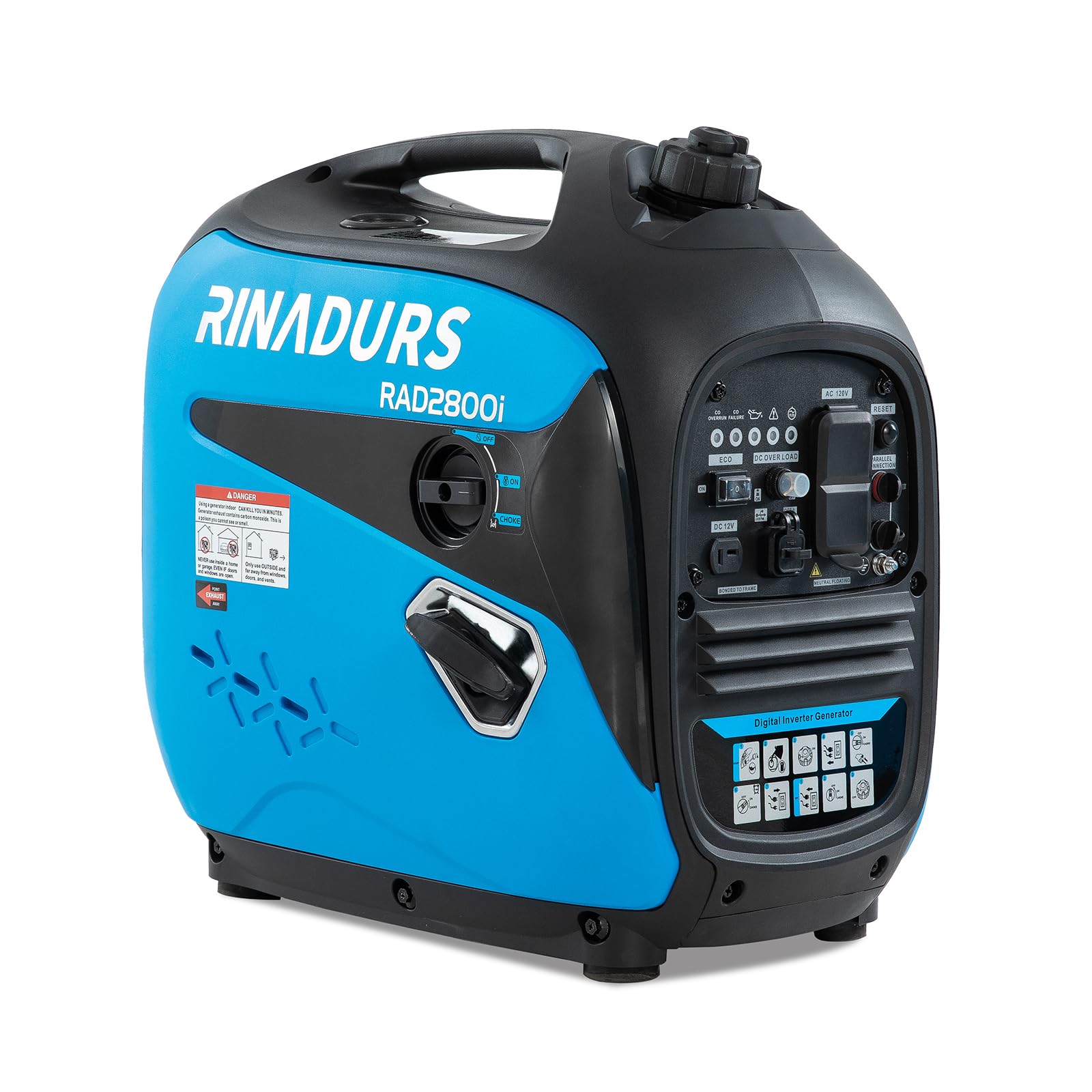
The largest engine displacement (122cc) in this class for extra headroom.
RINADURS steps above the typical 79cc crowd with a 122cc 4-stroke engine that delivers 2800 peak watts — giving you more buffer for starting up a motor or power tool without tripping the breaker. It uses an electric start ignition, a feature most budget generators skip, and includes a CO sensor for carbon monoxide monitoring. The clean inverter power protects sensitive electronics, and the Eco mode adjusts engine speed to save fuel under lighter loads.
Buyers who got a good unit report it is “extremely quiet in eco mode, comparable to a Honda EU2200i” and that it “runs lights, phone chargers, coffee maker easily.” One buyer mentioned the build quality is high and the generator passed load tests well. The parallel-ready capability lets you connect a second compatible inverter for double output. It also carries a 1-year warranty with free technical support.
The reliability picture is mixed, though. One buyer received a unit that looked used (old oil and gas inside) — the seller said it was a factory QC test and offered a free 3-year warranty. More critically, a customer faced a total failure during a Texas ice storm: the generator would not start with correct oil, gas, and choke. That same owner had to get a refund from Amazon and warned others to buy from a more established brand. The starting issues may also be linked to a factory spark plug with the wrong heat range — several reviewers fixed it by swapping to an NGK plug.
Strong points
- Largest engine displacement (122cc) for higher peak power (2800W)
- Electric start and CO sensor included
- Very quiet in Eco mode — comparable to premium Honda models
Risks to know
- QC inconsistency: some units arrive with old gas/oil or defective voltage regulators
- Several owners mention total failure to start during critical power outages
- Factory spark plug may be wrong type; plan to replace with an NGK plug
Best for: Budget-conscious buyers who want the biggest engine in this class and are comfortable doing a spark plug swap and a thorough break-in test right away.
Risk to weigh: The QC issues and customer service complaints make this a gamble for emergency preparedness where life depends on reliable starting.
5. AMERISUN 2500-Watt Gas Powered Portable Inverter Generator
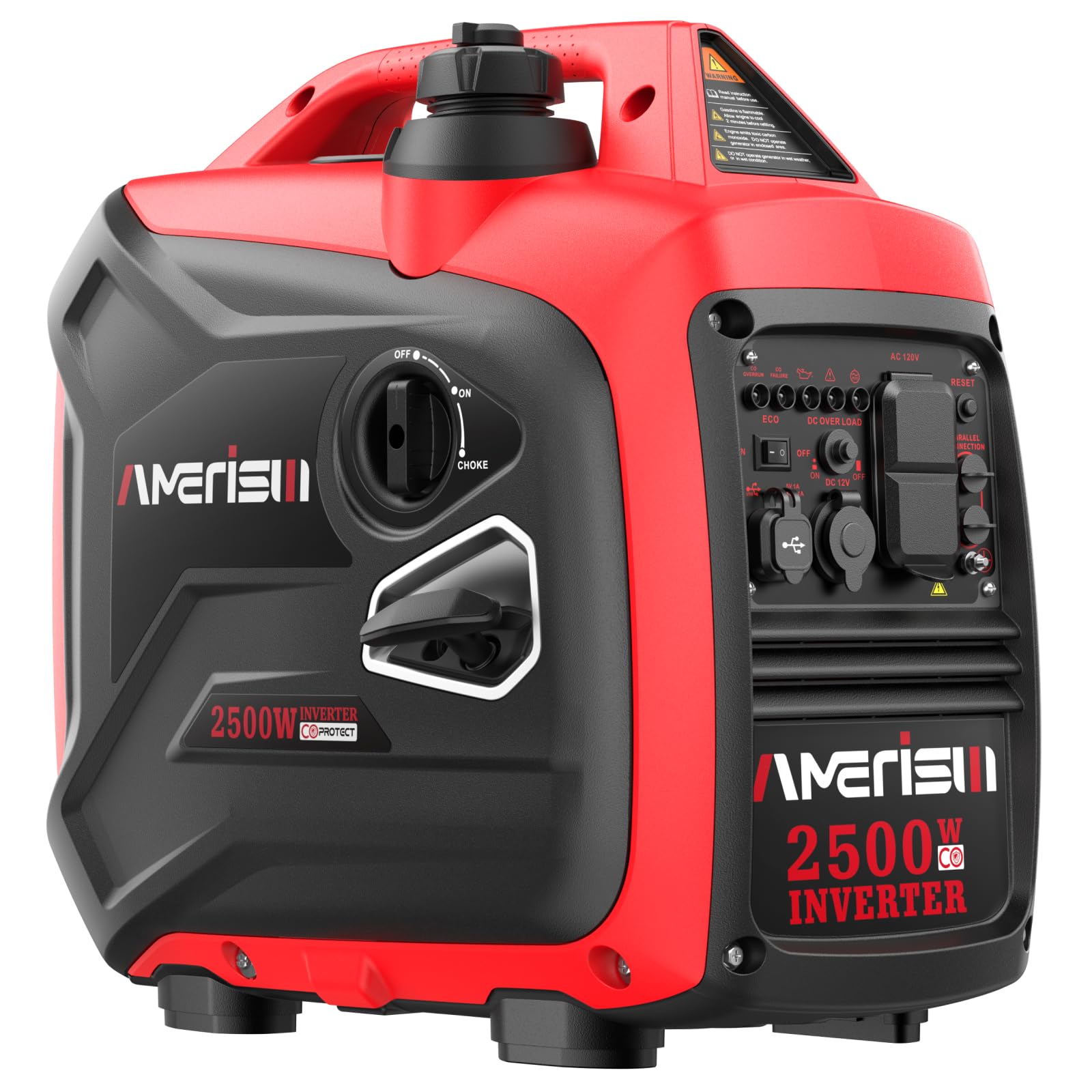
Survived a hurricane in Jamaica — real-world proof of endurance.
This AMERISUN model produces 2500 peak watts and 1900 running watts from its 1.05-gallon tank, and claims up to 11 hours of runtime at 25% load. But one verified buyer put it to the ultimate test: during Hurricane Melissa in Jamaica, it started on one pull and powered 8 bulbs, a fridge, a washer, a 55-inch TV, a PS5, 2 fans, and a CPAP machine simultaneously. The owner said 6 liters of 90-octane gas lasted over 11 hours under heavy load. At just 39 pounds, it is also one of the lightest models here, with a handle that makes one-hand carry genuinely easy.
The panel includes 2x 120V AC outlets, 1x 12V DC outlet, and 2x 5V USB ports, so you have flexibility for different devices. Another buyer ran an RV mini-split air conditioner for 12 hours on a single tank at low demand, and 8 hours at high demand. The performance actually improved after the 5th tank of fuel, suggesting a proper break-in matters. It also ships without oil, which is standard, so you will need to supply your own 10W-30 synthetic.
The main downside is the noise level: 69 dBA at 23 feet is significantly louder than the 52-59 dBA range of other picks — 69 dBA versus the Westinghouse 2550W at 52 dBA. You will want to place it well away from windows and tents. Also, a few buyers found the CO sensor too sensitive — it can shut the generator down in windy conditions. One owner said the sensor failed within 3 weeks and customer service was unreachable. The 2-year warranty exists but may be hard to claim.
Endurance leader
- Proven to run a house full of appliances for 11+ hours under heavy load
- Very lightweight at 39 pounds with convenient carrying handle
- Multiple outlets including USB ports for device charging
Watch out for
- Louder than most at 69 dBA — not ideal for quiet campsites
- CO sensor reported as overly sensitive and prone to early failure
- Customer service difficult to reach for warranty claims
Ideal for: Home emergency backup where raw endurance matters more than noise, especially if you need to run a refrigerator, sump pump, and several lights simultaneously.
Caveat: The loud noise and sensitive CO sensor make it a poor choice for camping with neighbors nearby.
6. PowerSmart 2500 Watt Portable Inverter Generator
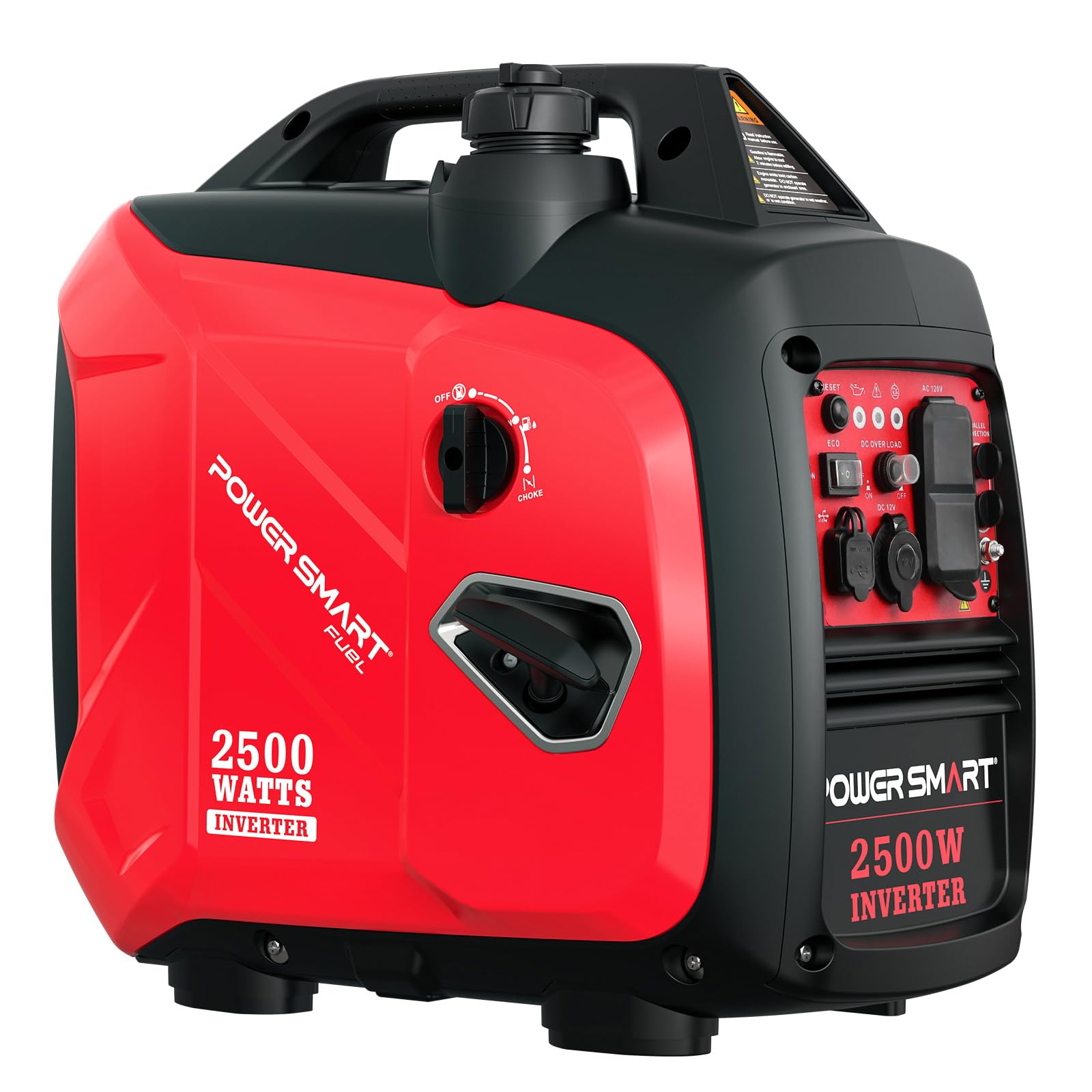
A 59 dBA inverter that handles a dryer and fridge without straining.
The PowerSmart HB5020 packs a 79.8cc 4-stroke OHV engine that delivers 2500 starting watts and 1900 rated watts. The 1.06-gallon fuel tank gives you up to 5.5 hours of runtime at 50% load — at 5.5 hours at 50% load versus the Champion Ultralight’s 11.5 hours at 25% load, so you will need to refuel more often during an all-night outage. Weighing 39.7 pounds, it is right in line with the lightest models, and the built-in ergonomic handle makes it easy to move around a job site or campsite.
Verified buyers are impressed with how easily it starts: “Cranked up in 3-4 pulls with choke,” one owner said, and another who runs a craft fair called it “lightweight, very quiet, and easy first-pull start.” One customer ran a 1500-watt dryer and a fridge simultaneously without any strain, which shows the inverter handles surge loads well. The advanced inverter technology keeps THD low, so laptops and CPAP machines get clean, stable power.
The panel includes 2x 120V AC outlets and 2x 5V USB ports. At 59 dBA, it is a touch louder than the quietest picks but still well below the noise of a normal conversation. The dimensions are a bit larger than some — 20.5 inches long, 12.8 inches wide, and 21.6 inches tall — so check that it fits in your planned storage space. It comes with a 2-year warranty, which is reasonable for the price tier.
Good value points
- Reliable start — usually on first or second pull
- Clean inverter power safe for sensitive electronics
- Compact enough for craft fairs, camping, and home backup
Limitations
- Shorter runtime (5.5 hours at 50% load) means more refueling
- Slightly larger physical footprint than some competitors
- No propane option — gasoline only
Best for: Homeowners who want a dependable inverter generator for occasional outages and weekend projects without overspending.
Trade-off: The shorter runtime at moderate load means you will need to wake up for refueling during a multi-hour outage.
7. Oxseryn 2800-Watts Portable Inverter Generator
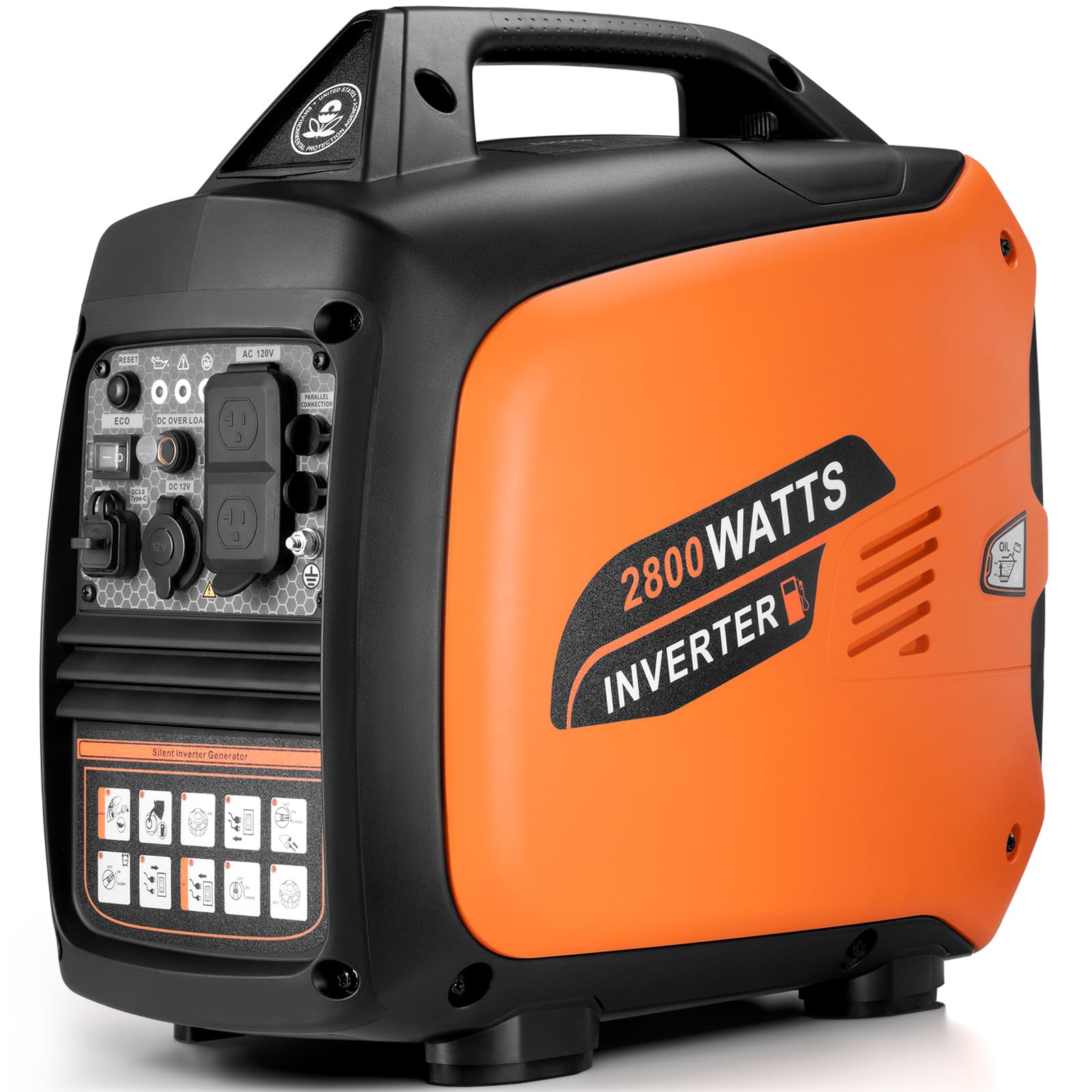
A 58 dBA inverter with a USB-C port, which almost no competitor offers.
The Oxseryn is one of the few generators in this class that includes a Type-C USB port alongside the usual USB-A, 12V DC, and 120V AC outlets — a small but real convenience for charging a modern phone or laptop without an adapter. The 79.8cc 4-stroke OHV engine pushes 2800 peak watts and 2000 running watts from a 1.1-gallon fuel tank, and the manufacturer claims up to 9 hours of runtime at 25% load. The clean power output (less than 3% THD — total harmonic distortion, a measure of electrical noise) makes it safe for sensitive electronics.
One owner reported running the generator for 9.3 hours on one tank at full power during break-in, which actually exceeds the advertised runtime — a strong sign of fuel efficiency. Owners consistently call it “super easy to start” and “nice and quiet.” The 40-pound weight and built-in handle make it manageable for one person to load into a car. At 58 dBA from 23 feet, it is 58 dBA versus the PowerSmart at 59 dBA and the AMERISUN at 69 dBA.
There are a couple of quirks. The side cover must be removed to check the oil level, which several reviewers found messy. One owner noted excessive metal grit in the oil during the first few changes — not uncommon for a break-in, but worth watching. And the ECO mode can cause the generator to stumble under near-max loads, so switch to normal mode for heavy appliances. Weighing 40 lbs, it is virtually the same as the Mutaomay at 39.8 lbs, but with a slightly more compact footprint.
Great features
- Includes a USB-C port for direct Type-C device charging
- Clean power with less than 3% THD for sensitive electronics
- Good runtime — one buyer got 9.3 hours at full power on a tank
Small frustrations
- Side panel removal required to check oil — easy to make a mess
- Metal grit in oil during break-in is normal but requires early oil changes
- ECO mode does not handle near-max loads well
Best for: Tech-savvy campers and emergency preppers who appreciate the USB-C port and want a very quiet generator that does not sacrifice running watts.
Keep in mind: The messy oil access is a daily annoyance if you run it frequently — plan for a careful break-in process.
8. Mutaomay 2500W Portable Inverter Generator
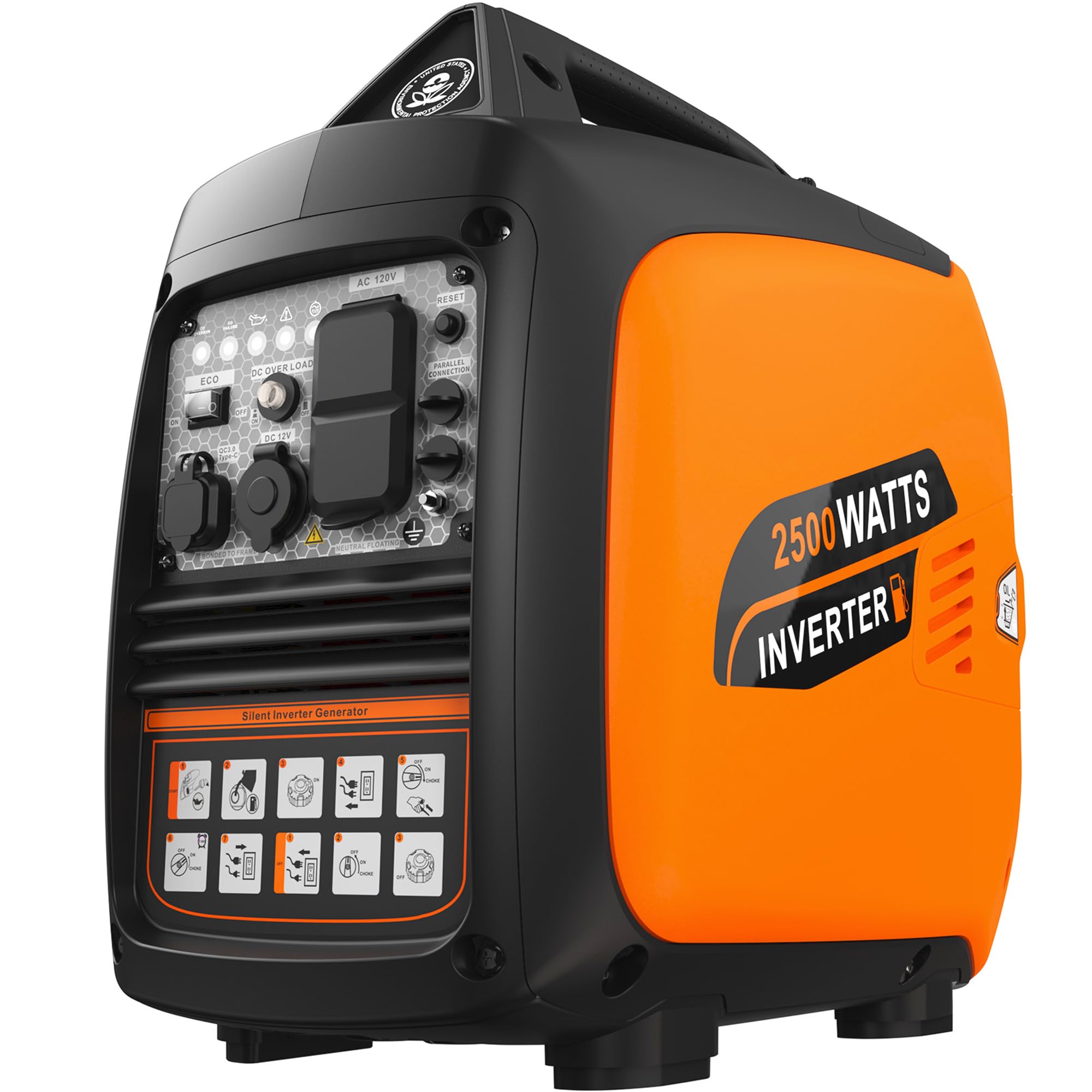
The quietest generator under dBA — with a proven 9.5-hour runtime.
If budget is your primary concern, the Mutaomay delivers 2500 peak watts and 1800 running watts from a 1.1-gallon tank, and claims up to 9.5 hours of runtime at 450W load (roughly a fridge plus a few lights). The big surprise at this price point is the noise level: just 55 dBA, at 55 dBA versus the PowerSmart at 59 dBA. It weighs 39.8 pounds, making it one of the easiest to carry, and includes a CO sensor for carbon monoxide detection and auto shutdown.
Verified buyers are enthusiastic: one said “it was shipped quick!!! Great for camping or keeping the freezer cold when the power is out!!!” Another owner reported it “exceeded my expectations” and called it “easy on fuel.” The inverter technology delivers clean power, so you can safely charge phones and laptops. The panel includes 2x 120V AC outlets and USB ports, matching the standard setup for this class. The ECO mode helps reduce fuel consumption under lighter loads.
That means you need to be more careful about what you run simultaneously. A refrigerator plus a space heater might trip it. Also, a few owners noted the need to get a magnetic oil plug early, as some fine metal particles can show up during break-in. For light-duty camping and powering a single fridge during an outage, it is a genuine bargain.
Why it wins
- Very quiet at 55 dBA — beats many premium models
- Lowest entry price with clean inverter power and CO sensor
- 9.5-hour runtime at low load is enough for overnight camping
Compromises to know
- 1800 running watts is the lowest in this review — limits what you can run
- No propane option; gasoline only
- A magnetic oil plug is recommended to catch break-in debris
Best for: First-time generator buyers on a tight budget who need a quiet, portable unit for light camping or keeping a single refrigerator running.
Not for: Anyone who needs to run power tools, a well pump, or multiple large appliances — the 1800 running watts will max out quickly.
Understanding the Specs
Peak Watts vs Running Watts
Peak watts (also called starting watts) is the surge of power a generator can deliver for a few seconds to start a motor — like a refrigerator compressor or a well pump. Once the motor is running, the demand drops to the running watts (or rated watts). A 2,500 watt generator with 1,800 running watts can start a fridge and keep it going, but it will struggle to start a window AC unit at the same time. Always match the starting surge of your biggest appliance to the peak watts, and the total of everything running at once to the running watts.
THD — Total Harmonic Distortion
THD measures how “clean” the electrical waveform is. A pure sine wave (like what comes out of your wall outlet) has very low THD — under 3%. Inverter generators produce this clean power, making them safe for sensitive electronics like laptops, CPAP machines, and TVs without a risk of damage from voltage spikes or dirty power. Conventional generators often have THD above 5%, which can shorten the life of electronics over time. Every generator in this guide is an inverter model with THD under 3%.
dBA — Decibel Rating
The decibel (dBA) number tells you how loud the generator is, usually measured from 23 feet away. A 53 dBA generator is quieter than a normal conversation (about 60 dBA). At 58 dBA, it is noticeable but still allows normal-volume talking nearby. At 69 dBA, it sounds like a busy restaurant — you will want to place it as far from your tent, camper, or bedroom as possible. For reference, 10 extra decibels sounds about twice as loud to human ears.
Eco Mode and Runtime
Eco mode lets the engine speed automatically adjust to match the electrical load. When you are only running a few lights and a phone charger, the engine throttles down to save fuel and reduce noise. When a refrigerator kicks on, it speeds up to handle the surge. This can extend runtime by 20-40% compared to running the engine at full speed constantly. Most manufacturers quote runtime at 25% or 50% load without Eco mode, so actual runtime with Eco mode on light loads can be longer than the sticker says.
FAQ
Will a 2,500 watt generator run my whole house?
How long will a 2,500 watt generator run on a tank of gas?
Is it safe to run a generator in the rain?
What is the difference between gasoline and propane fuel in these generators?
How quiet is 53 dBA compared to 58 dBA?
Can I charge my phone and laptop directly from a generator?
What does “parallel ready” mean?
How do I break in a new generator?
Is 1800 running watts enough for a refrigerator?
What maintenance does a 2,500 watt generator need?
Final Thoughts: The Verdict
Across the board, the best 2,500 watt generator is the Champion Power Equipment 2500-Watt Dual Fuel because it offers the rare combination of a 53 dBA noise level, dual-fuel flexibility (gasoline or propane), a proven 25-hour propane runtime, and a 3-year warranty — all in a portable package. If you want the absolute quietest option with a built-in RV 30A plug for direct camper hookup, grab the Westinghouse 2550W. And if budget is your main concern but you still want a quiet, reliable inverter with a CO sensor, the Mutaomay 2500W delivers surprising quality at a very entry-level price.
How We Picked
We do not accept paid placement. Every pick is matched to a real buyer and a real use-case; we do not hands-on test units.
Sources & Methodology
Specifications: manufacturer listings and product documentation. Review insights: verified customer reviews, as of July 2026. Pricing: not shown on this page (it changes often); check the current price via the retailer link.
As an Amazon Associate, FitlyFast earns from qualifying purchases. This does not affect which products we feature.